Showing posts with label woolen miniature. Show all posts

Wednesday, June 18, 2025

Having A Ball With This Prewar Steiff Kitten Novelty

Without trying to be catty, Steiffgal suspects you've never seen a Steiff kitten just like this one! Check out this fancy feline who is simply having a ball - literally. This prewar novelty is totally the cat's meow!

This lovely lady is simply cataloged as "Wool Plush Cat." But her details are far more interesting! She measures 9 cm tall and 17 cm long, not including her tail. She is head jointed and in a lying position. She is made from tan wool plush with now faded black airbrushed striping. She has a pinch style squeaker in her torso. Kitty comes to life with felt backed ears, green and black glass pupil eyes set low on her face, and a pink hand embroidered nose and mouth. Her accessories include a satin bow, jingle bell, and a red, yellow, and blue woolen miniature pom pom ball which is held between her two front paws. This delightful rarity was made in 17, 22, and 28 cm (measured horizontally, not including the tail) from 1933-1942.

Kitty's design and presentation closely mirror Steiff's late prewar design aesthetic as well as business drivers and strategy. In the early 1930s, the realities of Germany's challenging geopolitical, social, and economic situation really began impacting every level of operations at Steiff. As such, the company started using less expensive and more readily available non-mohair fabrics as well as launching simplified designs to minimize materials and labor costs. Here to the left you can see this pretty kitty as she appeared in Steiff's 1938/1939 print catalog; you can click on the photo to make it bigger. 

Here's how this kitty's pattern checks many of those boxes. 

1.  She is made from wool plush, which is lovely and durable, but is less elegant than the company's signature mohair. Wool plush is considered a wartime era, substitute fabric and was often used in Steiff's production on items bookending WWII. 

2. Her face is nicely done, and very appealing and expressive, while her body is  very basic in form. Starting around 1931, Steiff began consolidating their design and manufacturing efforts on an item's head, while leaving the rest of the body as simple as possible. A great example of this is the company's line of dressed animal dolls of that era. They consisted of a lovely, detailed mohair head on a plain, generic linen or fabric body. 

3.  Kitty she has only one joint - a head joint. Jointing is very expensive and time consuming, and the fewer joints an item has, the more efficiently it can be made. 

4. And finally, her accessories are also quite telling. Her bow, bell, and simple woolen miniature pom pom are inexpensive to source and quick to attach to her, but really elevate her presentation and draw your eye forward to her finest feature, her head. Steiff debuted its general woolen miniature line, which was invented in part to address the realities of manufacturing in Germany in the 1930s, so it is interesting to see it being used here to compliment and upscale this design. 

Steiffgal hopes this discussion on this wool plush kitty has tickled your whiskers!

Have a question about one of your Steiff treasures? Let's talk! Click here to learn more.

Thursday, June 20, 2024

Remarkable Rarities At Ladenburger Spielzeugauktion's 2024 Steiff Special Auction!

The countdown is on for the most exciting Steiff auction event of the year - Ladenburger Spielzeugauktion's annual Steiff Sonder Auction or Steiff Special Auction! This event is famous for offering WAH-HOO good temptations - as well as producing world record breaking results. This year, it will be held on June 29, 2024 in Giengen, Germany as part of the Steiff Company's annual Steiff Sommer Festival. For more information on the sale, click here!

This year, nearly 230 premier century-spanning button-in-ear treasures will go under the hammer. In addition to rockstar offerings most of us can only dream about - including a google eyed Petsy Bear, a rod bear, and a full set of early skittles - the sale also features a number of hidden jewels. These are items with very special or unique details that really make them extraordinary from the collector's perspective. Here are three that caught Steiffgal's eye... and what makes them so quietly remarkable. 

Let's twist and shout over this first auction hidden jem.
This is lot #28, a Steiff Turbo "Purzelbär" or somersaulting bear. He has an opening bid of 250 € and is cataloged as follows:

"Turbo "Purzelbär" with clock mechanism, arm-wound mechanism and clock mechanism are intact, only produced in 1951, button and cloth tag label number 9315,4, rests of the US zone cloth tag label, 15 cm, original neck label and felt vest, very nice unused condition, rare, only c. 1000 pieces were produced."

In the early 1950s, Steiff made a handful of little known novelties featuring movements that were introduced prewar. These included tail moves head items (which debuted in the early 1930s) in the form of bears and dogs; musical items (which debuted in the late 1920s) in the form of bears, monkeys, cats, and dogs; and a tumbler (which debuted around 1909) in the form of this bear. It is not clear why the company "reintroduced" these old school style novelties postwar, especially given the emphasis on launching new patterns that reflected the contemporary, forward thinking vibe of the times. These early postwar novelties - including this somersaulting bear - only appeared in the catalog for a year or so. This suggests that they were not commercially successful, and/or were expensive and time consuming to produce. Given their very short production time and output, these tumbling bears are extremely few and far between on the secondary market - especially in nice condition like this with IDs. This would be a delightful addition to a collection of midcentury rarities, mechanical novelties, or Teddy bears. 

Steiffgal doesn't want to let the cat out of the bag here, but be sure to check out lot #181 in this signature summer sale.
It is a woolen miniature cat, with an opening bid of 160 €. He appears in the catalog as:

"Cat, produced 1931-1938, with button inscription: Muster, Nomotta-wool, grey/white, lying, swivel head, green glass eyes, height: 6 cm, length: 8 cm, very nice strong colors, extremely rare, exceptional, unused condition."

This pretty kitty is in such lovely condition, with a great presentation and personality. However, what makes her off the charts great is her Steiff ID, which is a MUSTER button. This form of ID was used by Steiff pre-WWII on items considered samples, evolving designs, or prototypes. In general, the button indicated that the item was Steiff property and was not intended for sale or distribution. "Muster" translates loosely from German to English as "pattern" and in a sense, these "muster" items were just that. And, the button is located on her ribbon. This is probably because her ears are not large enough to handle the button. The combination of her condition, unusual ID, and its atypical placement, truly makes her the cat's meow among the woolen miniatures on offer in this fine sale. Purrr-fect in every way. 

And finally, tag - you're it - with this last auction rarity with a happy ending. 
This lot is #147, a Steiff tail turns head Rattler sitting dog. It has a starting bid of 160 € and is cataloged as:

"Rattler, with mechanism for turning head, produced 1931-1942, with button, chest label and cloth tag label, number on cloth tag label: 3310H, red inscription Raddler INT. PAT. APPID. FOR, and with separate paper label: "dreh mich hier herum, ich schau rundherum", 12 cm, colouring is fine shaded, very nice original condition."

This little fellow has two big features that make him a top dog in this exciting sale. The Rattler tail turns head pattern in itself is charming, but not terribly rare. Overall, he appeared in the Steiff line in 8, 10, 14, 17, 22, 25, 28, and 35 cm in the 1930 through 1943 time period. So, it's not challenging to find one these days. However, this particular example, in addition to being in lovely condition, retains his most coveted "tush tag." This is a round cardboard tag on his tail that reads "turn here and I will move my head." These instructions appear in German, English, and Spanish. What's amazing about this is that these moving marvels were designed as fun toys for kids. So it's a miracle that this tag was not removed or lost to time, given its postioning and ephemeral nature! This guy also gets a shout out for his great IDs, including his legible red ear tag. Noted on its is his article number, which is 3310H. This corresponds to 3=sitting, 3=mohair, 10=10 cm tall, and H=tail moves head feature. 

Steiffgal hopes this discussion on these secretly special auction picks has meant a lot to you!

For more information on this June 29, 2024 sale, please check out the company's website at https://www.spielzeugauktion.de/.

Have a question about one of your Steiff treasures? Let's talk! Click here to learn more.

Sunday, September 11, 2022

Fantastic Steiff "Firsts" On Offer Through Ladenburger Spielzeugauktion's September 24th, 2022 Event!

Love at first sight! That's the best way to describe some of the temptations coming up for sale at Ladenburger Spielzeugauktion's Fall event. This can't miss auction features 107 delightful vintage to antique Steiff selections and will be held on Saturday, September 24th, 2022. Here are three wah-hoo good treasures from this auction that Steiffgal has never seen come up for sale before. Enjoy this "one-derful" eye candy!

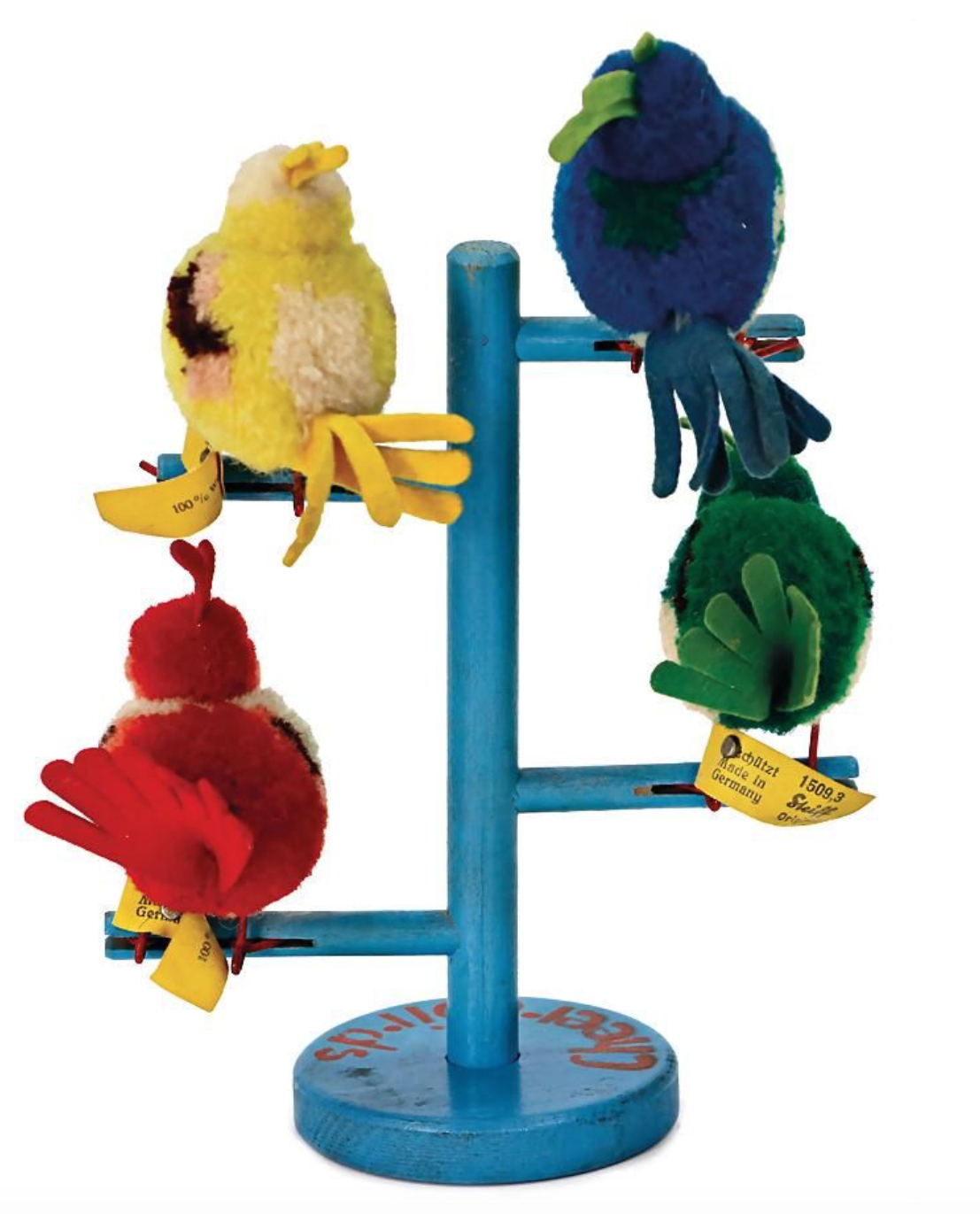
Bird's the word when it comes to this first auction debut item highlight. It is lot #3097, a most unusual woolen miniature bird display, estimated at 220-440 euros. It is cataloged in part as:

"Cheerubirds, rare bird tree, 4 x paradise birds, 100 % wool, with rare original breast sign, Blue Bird No. 1509,2, St. Patrick Bird No. 1509,3, Birthday Bird No. 1509,1, St. Valentine Bird, No. 1509,4, 22 cm, probably special design for the American market, extremely rare, unusual."

Who wouldn't love to feather their nest with this fantastic display? According to the Sortiment, this item appeared in the line from 1953-1956 with its own article number of 5204 Ch. Its overall design gives off a great midcentury vibe. But what makes this rarity so special - in addition to its amazing condition - is that each of the birds not only has a chest tag, but a very custom one. Steiffgal cannot think of any other woolen minis that have chest tags, probably due to their construction and size. The birds featured on this display are otherwise standard line "woolen exotic birds" which appeared in the line from 1953-1966; the earliest ones had red metal feet and legs and those from 1956 onward had plastic feet and legs. 

Now let's take a tumble for this next auction debut highlight. This is lot #3073, a felt, fully jointed circus performer doll, estimated at 280-560 euro. It is cataloged in part as:

"Acrobat, produced between 1911-1918, felt, jointed, from the circus series, with button, block letters, long trailing f, blue glass eyes original clothes, 40 cm, felt is a bit darken, small felt faults at 1 hand, and at stomach and at 1 shoulder, otherwise nice condition, exceptional, rare."

This fine, flexible fellow is a wonderful and seldom seen acrobat doll from Steiff's legacy "Schlopsnies Circus" display. This large scale, dynamic, and extremely popular exhibit was designed and created by Steiff doll freelancer Albert Schlopsnies in the c. 1910-1920 time frame. It consisted of over 30 circus themed dolls and acrobats, based on real life performers at the world famous Circus Sarrasani of Dresden, Germany. The acrobat dolls were often posed in death-defying or upside down poses in the displays. Sometimes they were even animated via camouflaged mechanisms. Steiffgal has seen or handled several of this acrobat's colleagues, including clowns, stagehands, and other performers, but she has never seen or handled this acrobat before. 

And last but hardly least, this final debut auction highlight just begs for attention. Here we have lot #3069, a charming prewar canine themed display, estimated at 280-560 euro. It is cataloged in part as:

"Exceptional show piece, Waldi, on a mohair plate, plate partially with a bit mohair loss, height: 30, width: 30 cm, depth: 22 cm, attending, with huntsman's hat, with button, chest label and a  very beautiful preserved red cloth tag label, with No. 4328,2, probably 1930, nice full mohair, breast sign is a bit faded, with small Treff, sitting, 14 cm, swivel head, exceptional, extremely rare."

This probably one of a kind treasure stands and delivers. It features one of Steiff's most beloved and prolific dog designs, Waldi the Dachshund. Waldi is most often on all fours. However, from 1933-1936, he was produced in a begging position in 17, 22, and 28 cm. His red ear tag numbers perfectly corresponds to that, with 4= begging or standing on back legs, 3= mohair, 28=28 cm tall, and ,2=with a voice. So the dog in itself is a total rarity! The fact that he is mounted on a factory original green mohair mat (probably to resemble grass), wears a  typical German style hat, and is accompanied by a perfectly paired and period Treff friend, make him over the top interesting. 

How this rare pair came to be remains a mystery, though. This charming display could have been produced as part of a larger exhibit, assembled by employees and presented to their friend or colleague as a special tribute gift, or perhaps made as a whimsy, end of day, or prototype that never went into production. Only Waldi and Treff know for sure!


Steiffgal hopes this discussion on these debut Steiff auction treasures has been like an opening night celebration for you. 


For more information about Ladenburger Spielzeugauktion upcoming Steiff event on September 24th, please click here!


Have a question about one of your Steiff treasures? Let's talk! Click here to learn more!

Sunday, July 3, 2022

This 1970s-era Steiff Novelty Is One Merry Mashup!

Steiffgal is certain you'll have no trouble warming up to this week's blog special guest. Here we have a Steiff postwar egg cozy that could only be described as a merry mashup. Check out this happy hopper and her unusual design elements to see what makes her such a rare hare in so many ways.

It's easy to understand why this quirky novelty holds so much appeal. This rabbit egg cozy is 10 cm tall and head jointed. Bunny's head is a large pom-mom that has been airbrushed with tan and pink highlights. She comes to life with brown and black pupil eyes, clear monofilament whiskers, and a tiny pink painted mouth. Her ears are made from a piece of single thick white felt and a piece of single thick tan felt that have been sandwiched together. Her tail is a small white pom-pom, and her body/dress is made from a textured, linen-like material. This pattern was produced in blue, orange, red, or yellow in this size only from 1973-1974. According to Pfeiffer's Sortiment, these warmers were sold in pairs and packaged with a matching placemat.

This egg cozy novelty is interesting from three distinct collecting angles.

1.  Functionally, it is the first egg warmer to appear in the line post-war. Steiff's early egg warmers were primarily made from felt or velvet, with their heyday in the c. 1900-1925 timeframe. Many of the early 20th century egg warmers were also made as rabbits, so her form is entirely consistent with past production. 

2.  Her materials and construction are also unusual. Although pom-pom or woolen miniature animals have been used for pincushions, pen wipes, and displays over time, this is the only egg warmer Steiffgal knows of that incorporates woolen miniature elements. Her ear construction - that of two layers of felt glued together - is also noteworthy. Steiffgal also does not recall ever seeing another button-in-ear item featuring her body/dress fabric. 

3.  And her packaging is also curious. She appeared in pairs, and packaged with a placemat. Although Steiffgal does not have the original packaging, she found an image of it on eBay, and it appears here on the left for your study. The copy on the back reads, "Egg warmer with place mat. Place mat of laminated foam and synthetic material, therefore it doesn't slip and can be washed in lukewarm water." 

Steiffgal hopes this discussion on this 1970s-era egg cozy has added a little novelty to your day.

Have a question about one of your Steiff treasures? Let's talk! Click here to learn more.

Sunday, November 21, 2021

Good Things Come In Threes At Teddy Dorado's December 4th, 2021 Sales Event!

Care to go for the gold? Then check out the upcoming Steiff auction presented by our friends at Teddy Dorado auction house! Their signature winter sale, to be held on December 4th, 2021, features more than 400 new, vintage, and antique button-in-ear temptations - with new goodies being listed regularly. Here are three outstanding lots that caught Steiffgal's eye - and why. 

The first lot is a sweet-tweet-treat indeed.
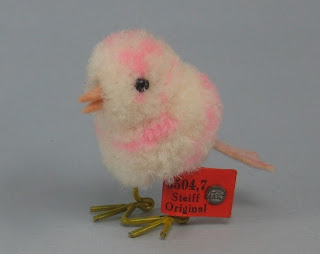
Steiff's earliest prewar woolen miniatures are loved and collected universally - with the rarest ones frequently realizing four figures at auction. Its hard to resist lot #28-4023, which is cataloged as, "Songbird made of white & pink Nomotta wool; black glass eyes; Beak made of skin-colored felt; white felt tail with pink stripes on both sides; Metal legs painted yellow & in perfect condition; Head rotatable & body tillable; approx. 4 mm large FF button slightly rusted, but not visible to the naked eye; red Steiff flag preserved in the best possible way; very clean, absolutely lightfast, odorless & completely unplayed; Premium top condition. approx. 4 cm high." 

This pretty-in-pink treasure has an opening bid of 1,000 Euro.

Bird's the word with this lovely treasure which is fantastic on so many levels. It is amongst the absolute earliest woolen miniatures ever made. This sweet bird design debuted in 1931, the first year Steiff's woolen miniatures were produced on a commercial scale. It was manufactured in six color combinations in 4 or 8 cm. Don't you think his color - pink - is WAH-HOO good? This example is the only Steiff woolen miniature prewar bird that Steiffgal knowns of featuring this great and novel hue. And the condition looks to be as close to like-new as humanly possible. 

You'll be all ears over this next auction highlight.
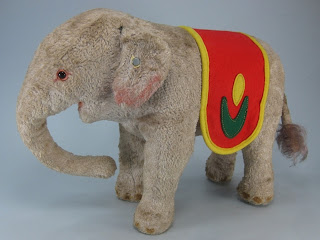
His expression, era, and materials are all so ele-phantastic. He is lot #28-4021, and is cataloged as, "Play elephant, made of light gray rayon plush; black glass eyes underlaid with pink felt; open mouth made of skin-colored felt; Tail tip made of mohair; tightly stuffed with wood wool; large double pressure voice defective; Saddle pad made of red, yellow & dark green felt; approx. 6 mm large, bright silver, shiny & shiny button in the ear; white paper ear tag missing; Artificial silk plush & felt without annoying flaws; very clean, absolutely lightfast, odorless & unplayed; Top condition approx. 21 cm high & without tail approx. 27 cm long." 

This playful pachyderm has an opening bid of 200 Euro. 

It's interesting to note that this distinctive elephant's "birthdate" is not specified. This great design bridged the pre- and postwar periods. It was produced in artificial silk plush in 17, 22, and 28 cm from 1938 through 1943 overall, and postwar in 22 cm only in 1948 though 1949. Given this big baby has a blank button and traces of his yellow ear tag, it is a safe bet that he is a postwar version. He's unforgettable for sure, don't you agree?

And good things come in threes with this final auction highlight.
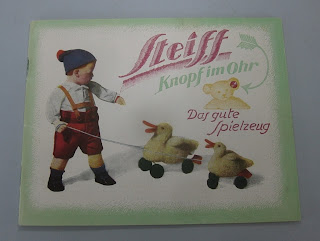
Steiff ephemera - catalogs, photographs, sales sheets, postcards, and other paper items associated with the company - is a fun, educational, and visually exciting complement to a button-in-ear collection of any era. If you are interested in the company's 1920s era production and aesthetic, be sure to check out lot #28-4003, which is cataloged as, "Customer brochure "The good toy" A6 +, 36 pp. 1925–1926 without Steiff printed matter no. German Premium Steiff customer brochure "The good toy" for Germany in the format approx. A6 plus landscape with 36 pages; inside black and white with a light green border; Text in German & without prices; Title shows Schlopsnies doll Theo with two yellow mohair (pulling) ducks, each lying on eccentric wheels; without printer's note or Steiff printed matter no .; original Steiff brochure & no reprint; very clean, absolutely lightfast, odorless & completely unread; Premium top condition." 

This time capsule quality brochure has an opening bid of 100 Euro. 

It's hard to picture a more interesting collection of images than those that appear in this great catalog. It features illustrations of the company's very rare mid-1920s white chimp with a tail, little known wooden toys on wheels, and charming, lifelike, and toddler-esque Schlopsnies dolls, among many other outstanding characters. And what makes these visuals so heartwarming is that they show our favorite button-in-ear favorites in playful and interactive vignettes... as if they were truly alive! Flipping through this period catalog is like taking a trip back in time, in the best possible way.

Steiffgal hopes this discussion on some of Teddy Dorado's upcoming sale highlights has been almost exciting as a live auction event!  Check out the entire catalog for this December 4th sale by clicking here. 

Have a question about one of your Steiff treasures? Let's talk! Click here to learn more.

Sunday, November 15, 2020

Steiff and Teddy Temptations Galore At Special Auction Services' November 2020 Doll and Teddy Bear Event!

In the mood for something fun? Our friends at Special Auction Services near London are hosting their signature late fall Dolls and Teddy Bears Auction on Tuesday, November 24th and Wednesday, November 25th. Mark your calendars for two days of century spanning toy temptations! As always, Steiffgal dove right into the sale catalog, looking for eye-catching treasures that might have a backstory to them. Here are three that called to her... plus some BONUS insights on each from SAS' own toy man, Daniel Agnew. 

This first auction highlight really takes the pole position. It is lot #83, a Steiff woolen miniature rabbit on skis. It is cataloged as, "A rare Steiff pom-pom woolen skiing rabbit (Skihas 17) 1936-40, with brown and black glass eyes, pom-pom yellow and white rabbit, pom-pom green trousers, whiskers, mohair ears, orange wool scarf, wired body, wooden skis and poles and FF underscored button with crisp yellow cloth tag in ear --8in. (20.5cm.) long." It is estimated at £800 - £1,200.

Steiffgal: Daniel, could you please share with us why Steiff's pre-war woolen miniatures are so appealing to collectors. Could you also tell us anything else about this lot - for example, in the broadest sense its history, or how it was discovered in such fine condition nearly a century after its production?

Daniel:
I was delighted to see this ski rabbit. He belongs to a good client who is slowly selling his collection with me. I have known him from antique fair for years since I was around 10 years old. He has a huge collection of toys and hasn't brought in his best items yet. He didn't really know what he had. I let out a little gasp when I saw this toy and its exceptional condition. When you see the flag or tag behind the button in such crisp clean condition, it's such a thrill. These woolens, often called pom-poms in the UK, have their own charm. There are some collectors who specialize in them. Who can remember winding wool around two donut shaped pieces and then tying and cutting them to make a pom-pom ball? We did as children. These are like them, but 100 times more skillful than a childish attempt! Steiff made an amazing range.

This second auction highlight is really elephant-tactic. It is lot #94, an early Steiff fully jointed elephant. It is cataloged as, "A rare and fine Steiff jointed elephant circa 1908, with grey mohair, black boot button eyes, white felt tusks, swivel head, jointed limbs with black stitched toes, tail and squeaker --10 ¼in. (26cm.) height seated (slight tear to one tusk and slight matting)." It is estimated at £800 - £1,200.

Steiffgal: Daniel, can you give the readers a little history on this design, and why elephants are so important in Steiff's legacy?

Daniel: This Steiff elephant is in exceptional condition; this type of fully jointed elephant was one of the first animated or jointed toy animals. Before 1902, all Steiff animals were static models. It was Richard Steiff who experimented with various ways to make Steiff products move. This resulted in a handful of jointed animals, like the now famous rod jointed bear and an elephant. The whole Teddy Bear market is based around this one concept, taking a bear or elephant and making their limbs moveable, so they end up standing on their hind legs, with front legs like arms. As such, a new toy was created, a humanized animal. Anthropomorphism is attributing human characteristics to an animal; this was a hugely popular concept in the late 19th to early 20th centuries and led to the birth of the world's most popular toy. This example, missing the famous button in ear, so making hard to date precisely, probably dates to around 1908 and is a prized example.

And bear with Steiffgal as she chooses a non-Steiff selection as her third pick.
She not-so-secretly has eyes for 20th century-era Cramer bears, given their appeal and precious detailing. As such, lot #109, a sweet Cramer cub takes the bronze here. He is cataloged as, "An Eduard Crämer teddy bear 1930s with light brown mohair, brown and black glass eyes, inset short blonde mohair face mask, brown stitched nose, mouth and remains of claws, swivel head, jointed elongated limbs with felt pads, hump and growler --15in. (38cm.) high (bald spots, holes in lower head around neck from moth attack, general wear, thinning and fading)." It is estimated at £250 - £350.

Steiffgal: Daniel, can you give the readers a brief history on Cramer bears and what makes them so appealing... as well a reason or two why Cramer items should be of interest to Steiff Teddy bear collectors, too?

Daniel:
Cramer is an interesting firm. 20to 30 years ago, we would not have known a great deal about this company. Thanks to research by the Ciesliks, we now know how to identify their bears. Eduard Cramer took over his father-in-law's Schalkau (Germany) toy factory in 1885. It is thought that he made his first Teddy bear in 1905/06, but little is known about his early bears. By the 1920s, Cramer Teds are known as very good quality bears, made from the finest mohair and felt. Their most distinct bear, like lot #109, has a very characteristic inset heart-shaped face mask. I think it's all about the nose stitching; once you get used to the way Cramer made their bears, they become fairly easy to identify. There is a delicate way they are stitched with finer than typical thread. Another non-Steiff bear that would be of interest to Steiff collectors is lot #100, an incredibly rare Strunz jester teddy bear. He's pictured here on the left. He is rod-jointed and dates from c. 1904. Strunz and Steiff had huge rivalry and there were many lawsuits between the two companies. This clown costume is identical to Steiff's jester clown doll from the same era.

For more information on this great sale, and to see the catalog in its entirety, please click here!

Steiffgal hopes this discussion on SAS' upcoming Steiff and toy auction highlights has added a playful touch to your day.

Have a question about one of your Steiff treasures? Let's talk! Click here to learn more.

Sunday, May 3, 2020

This Steifff Woolen Miniature Kitten is Purr-Fect In Every Way

How can something so amazingly tiny be so amazingly cute? Well, size really defies in the case of this very appealing Steiff woolen miniature cat. Steiffgal's been hoping to add one of these fancy felines to her hug for awhile, so she was delighted when this one arrived on little cat's feet. Take a look at this little darling and just try NOT to fall in love with her. 

This happy handful is Steiff's 1970-era woolen miniature cat. She is 6 cm and head jointed. Cat is constructed from grey and white woolen yarn; her body is made from longer threads while her head is made from shorter threads. She has tiny triangular grey felt ears. Her face comes to life with green and black slit pupil eyes, a touch of pink to indicate her mouth, and clear monofilament whiskers. Her pink bow is original to her. This basic design was produced in white; white, grey, black and brown; white and black; white and orange brown; and white and grey in 4 and 6 cm from 1970-1974.

In addition to her Steiff button and eartag, this pretty kitty also has a naturally colored wooden tag indicating she was originally purchased at F.A.O. Schwarz. This tag has the identical gold F.A.O. Schwarz bell logo on both sides; its cord is a piece of silky yellow floss. The bell first appeared in the company's advertising and in the stores in 1880. It is based on a similar bell that was carved into the Schwarz family's dining room table at their home in Greenwich, CT as a symbol of success and prosperity. Most of these F.A.O. Schwarz wooden bell tags are red, but Steiffgal has seen a few of these naturally colored ones on items from the 1970s, including Steiff's legacy "mask" style Teddy bears. 

Here on the left, you can see the original Steiff catalog page from 1972 promoting their range of woolen miniature friends. If you click on it, you can make it bigger. The cats are featured on the top left. According to the description, the 4 cm versions cost 3.10 marks and the 6 cm versions cost 4.50 marks. Another woolen miniature cat - a 5 cm sitting version with a mohair tail that appeared in the line from 1954-1978 - cost 4.25 marks. Using an inflation calculator, in 2020 dollars, that means that the 5 cm sitting cat cost the equivalent of $14.63, the 4 cm lying cat cost the equivalent $10.68, and the 6 cm lying cat, the one under discussion here, cost the equivalent of $15.50.

Steiffgal hopes this discussion on this relatively rare Steiff woolen miniature cat has given you the warm fuzzies.

Have a question about one of your Steiff treasures? Let's talk! Click here to learn more!

Saturday, November 30, 2019

Care To Feather Your Nest With This Steiff Prewar Woolen Miniature Owl?

Whoooo loves ya babe? Well, perhaps this remarkable and very rare miniature marvel is best suited to answer that question! Steiff launched its very successful series of tiny Nomotta yarn animals in the early 1930s. This particular bird is amongst the most eye-catching, and desirable, of the company's prewar collection. Check out his story to see what makes him so fantastic from the design and historical perspectives.

This fine feathered friend is Steiff's owl.He is 8 cm tall, head jointed, and made of dense, high quality woolen yarns. His coloring includes white, yellow and purple/grey threads. His tiny, wise, and inquisitive face comes to life with black and brown glass pupil eyes and a perfectly to scale single-thick tan felt beak. He stands upon two metal legs and feet that have been painted dark brown. His original IDs, which have been lost to time in this case, consisted of a red or white tag held in place with a Steiff button around one of his ankles. Woolen miniature owl was produced in this size and this color set only from 1934-1939.

It is simply astonishing how real this tiny treasure looks compared to his real life inspiration. Woolen threads interpret well into feathers, and in this case, a light touch of airbrushed dots and specks on his back and chest truly help him take flight. His jointed head, when slightly cocked at an angle, suggests he's thinking about ways to solve for world peace or another major global issue! And his playful and prominent feet and legs are a marvelous take on those oversized features seen on owls in the wild.

Steiff's prewar woolen miniature birds debuted in 1931, and were an immediate sensation with children and collectors alike - given their low price point and incredibly appealing presentations. It seemed like everyone wanted to feather their nests with these happy handfuls! Steiff's first woolen miniature songbird-style birds were quite simple and generic. They had felt beaks and tails, metal legs and feet, and were produced in six basic color combinations in 4 and 8 cm. Starting in 1933, specific songbird breeds in the form of robins, woodpeckers, finches, blue tits, sparrows, and gold buntings were introduced. 

More detailed,"exotic" bird woolen miniature rarities - including a canary, parakeet, and this owl - were Steiff catalog highlights from 1934 through 1940. These three beaked beauties featured proportional, elongated bodies and extraordinary, true-to-life shaded coloration. The canary and parakeet sported lifelike, long felt tail feathers and were also available as a novelties perched on wooden and metal stands. Today, these prewar pretties are as rare as crow's teeth!

Steiffgal hopes this discussion on this handsome prewar Steiff woolen miniature owl has been a great learning experience for you.

Have a question about one of your Steiff treasures? Let's talk! Click here to learn more.

Sunday, September 8, 2019

Does This Steiff Story Have A Familiar Ring To It?

Now for something really different, and really fantastic. Steiff animals have always been a part of key family and life cycle events, and here's perfect proof of that. Check out this note from a reader who asks about her Grandmother's special Steiff treasure. She writes, 

"My Aunt, who is in her seventies, recently sent me this lamb that belonged to my Grandmother who was born in 1915. She claims that my Granny’s engagement ring was presented tied to its neck; this would have been in the 1930s. 

My Mom thinks it was a tradition at the time to present a ring attached to a toy or object. She also believes that Grandma's engagement followed her "pinning" at Christmas, which involved a 1930s-era Steiff miniature woolen fawn. My family sent you photos of this little fawn in 2012 and you helped us figure out that mystery a few years ago. It it possible that this this lamb carried the "next step" in Grandma's engagement engagement process? My Granny always loved little stuffed animals and dolls - she collected them later in life. Thank you!"

How fun, and where to start? If you are not familiar with the Steiff woolen miniature fawn "pinning" story mentioned above, please check out that heartwarming post here! The little guy pictured here on the left steals THAT show, and a few hearts along the way! Make sure to scroll to the very end of the story where you can see a remarkable, almost century old photo of the reader's Grandmother at Christmas time with this fantastic Steiff woollie fawn.

So now let's fast forward to the item under discussion today. What we have here is indeed a barnyard buddy, but it is a goat, not a lamb! This goat's name is Zicky. Steiff made these from 1952 through 1972 in 10, 14, 22, 28, and 35 cm. All were unjointed, standing, and made from off white mohair with felt detailing. They came to life with beautiful airbrushed highlighting, including coloration on their backs and legs, and a touch of red on their lips. Zicky goats had black and green slit pupil eyes and black, simple noses and mouths. And given their production era, all had raised script style Steiff buttons, as shown here on the left. Medium and larger sized versions sported wooden or felt horns. All examples left the factory decorated with a silken ribbon and a brass bell. 

This beloved goat pattern was also produced in 14 cm on red wooden eccentric wheels from 1953-1957 and in a somewhat rarer "lying" pattern in 10 and 14 cm from 1954 through 1956.

So, do things align here? Given that the Zicky pattern was introduced in the early 1950s, and the great exchange happened in the 1930s - it is not possible that this goat delivered Granny's ORIGINAL engagement ring, at least in the time and space continuum that Steiffgal knows of. However, it is entirely possible that this goat DID participate in another special ring exchange - perhaps for a 25th wedding anniversary or other milestone event - and the family story just got a little out of order over time.

Steiffgal hopes this great Steiff family story had a familiar ring to it!

Have a question about one of your Steiff treasures? Let's talk! Click here to learn more!

Sunday, June 23, 2019

On the Up and Up With This Tiny Steiff Pup!

Friends for life! Collectors will recognize this slogan as one of Steiff's tag lines in terms of its toy production. But this "promise" also extends to the company's business relationships with other beloved brands and characters over time. Check out his note from a new friend on the west coast who asks about a tiny Poodle that appeared mid-century with dolls from the Nancy Ann Storybook Company.  She writes, in part...

"Several of my doll collecting friends have been helping me research the question of Steiff's Poodle being the dog that Nancy Ann Storybook Company used. 

...I have acquired all the reference books available for Nancy Ann and the company catalog photos that they contain, and even though the salesman's sheet doesn't say that the Poodle in the container is Steiff, my fellow collectors all agree that it is a Steiff Poodle that we see in the containers. You can see the Steiff tag around the belly of the dog.  

...Who knows why Nancy Ann didn't say in their catalog that it was a Steiff Poodle? Vogue Doll company didn't say in their Ginny catalog that Ginny's dog was a Steiff either. The Poodle was available in Muffie catalogs from 1956-1960. it was available in 3 colors from (what I understand): white, gray, and black."

What a best-of-show inquiry! So let's first paws and take a look at the Poodle in question, which is INDEED made by Steiff. This model was made as part of the company's very popular post-war woolen miniature collection, and could be one of the smallest dogs Steiff ever made! These are 6 cm tall, standing, leg and arm jointed, and made from wool and felt. Their faces, arms, and legs are like pom-poms, while their ears and body are felt. They come to life with a little black cord tail and black bead eyes. All models left the factory in Germany wearing a tiny red cord collar. This Poodle was produced from 1955-1978 in grey, black, and white. You can see all three here on the left. They are so tiny that they wear their yellow "eartag" like a bracelet around their middles; this is secured with a tiny Steiff button. These IDs were often lost to time, as noted on the dogs in this picture. Because of their size, they never had a chest tag. 

This precious design remains a collector's favorite today, given how nice they look posed with small to medium scaled mid century dolls.

As far as Steiffgal's understanding and research reveals, Steiff did not specifically make a dog for dolls in this line. However, it is entirely possible that the Nancy Ann Storybook Company "adopted" this dog pattern into its line and made it part of its merchandising and product line - given how delightful the two go together! The Nancy Ann Storybook Company most likely purchased a bunch of these woolen miniature Poodles then boxed them and distributed them through their regular sales channels from their own business headquarters. Steiff usually includes some Steiff branding on their packaging that is factory original. Steiffgal can't tell if there is Steiff branding on the Nancy Ann Storybook Company packing on the photos above, but it is not obvious. It also appears that some of the Nancy Ann packaging for the accessories is quite similar. That also suggests that the packaging was done by Nancy Ann in house and not Steiff. Finally, it is not clear why the Nancy Ann Storybook Company did not promote these as made by Steiff... perhaps for some sort of licensing or business reason? 
  
The Poodle design "adopted" by the Nancy Ann Storybook Company was not a "company exclusive" and was available through worldwide sales channels. You can see the 1961 Steiff catalog page showing these in white, black, and grey, here on the left. (You can click on the photo to make it bigger.) So what would make a product an "exclusive?" It has been Steiffgal's experience that company exclusives often are standard line items with a little something different to them. For example, in the case of these Poodles - if the collars were a different color or style (say blue or green, etc.), or they came in a different color, like brown - that could suggest an exclusive.  But Steiffgal has not personally seen any examples like that, at least not yet! Have you?

Steiffgal hopes this discussion on the company's woolen miniature Poodles has been enormously interesting for you!

Have a question about one of your Steiff treasures? Let's talk! Click here to learn more.

Monday, May 6, 2019

Care To Feather Your Nest With This Steiff Woolen Miniature Parrot?

Bird's the word with this next great Steiff find! Literally! This perky little parrot is really the best of all words, and was produced during the heyday period for Steiff woolen miniature pets. Let's take a bird's eye view of what makes him so interesting from the design and historical perspectives.

Look who arrived on a wing and a prayer! This woolen miniature Steiff parrot measures 8 cm long and 12 cm long including his tail feathers. He is sitting, head jointed, and made from red, blue, green, yellow, and grey Nomotta wool threads. His tail is made from delicately cut, single-thick red, blue, and orange felt fabric. His tiny, irresistible face comes to life with brown and black glass pupil eyes and a double thick grey felt beak. He truly has the most appealing presentation and personality!

Now let's take a seat and check out his great accessories. Parrot is perched on a 23 cm tall wooden and metal stand. The base and his perch are wood and the rest is formed and shaped rods. The base is 8 cm in diameter. Everything is painted the same shade of light green. The little silver chain connecting him to the perch is all original. A few stitches connect the parrot to his perch, which can swing gently from side to side. Parrot's button and tag have been lost to time. They could have been located his felt tail feathers, around a metal rod, or embedded in his circular base - only he knows for sure, and he's not talking! Parrot on a stand was produced in this size only from 1936-1941. The company also made the almost identical parrot standing on metal feet from 1936-1940; his tag and button would have been located like a little bracelet around one of his legs. 

Steiff began creating their line of woolen miniatures in the early 1930s. In response to geo-political, economic, and social pressures of the time, Steiff was looking to produce smaller items at accessible price points that a broad German audience would find desirable. The woolen miniature concept fit that strategy perfectly, as they were ideal as collectibles for adults as well as playthings for children. Birds and rabbits translated especially well to this new product format, given their natural shapes, body positions, and textures. Because they proved so popular, Steiff would go on to introduce animals from practically every category as woolen miniatures through the late 1930s.

This parrot novelty perfectly marries the company's strengths in woolen miniature production, authentic design, decorative use of felt, and it's lesser known core competencies of woodworking and turning. Other Steiff factory original woolen miniatures in "vignettes" with accessories such as this one included a bird tree decorated with flowers and birds, a bird's nest with babies and a proud mama, and a series of congratulators - charming dressed miniature animals mounted on round wooden bases that could be "personalized" with a greeting or inscription for the lucky recipient.

Steiffgal hopes you've enjoyed hanging out with this great antique Steiff parrot today!

Have a question about one of your Steiff treasures? Let's talk! Click here to learn more.

Sunday, February 24, 2019

Having A Ball With This Charming and Early Steiff Woolen Miniature Rooster

Top of the 'morning to you! A rooster's call welcomes the new day. And this little rooster under discussion here is certain to MAKE your day! Check out this happy pre-war handful and see what makes him so delightful from the design and product development perspectives.

Bird's the word with this well-rounded woolen miniature rooster. He is head jointed and measures about 3.75 inches (or 9.5 cm) tall, including his comb, and about 4 inches (or about 10 cm) wide, including his tail. His body is made from green, yellow, tan, brown, blue, and yellow Nomotta wool threads. His two front pom pom "legs" are made from yellow Nomotta wool threads. His tail is made from green felt, while his comb is made from red felt. His happy, smiling beak is made from yellow felt. He has playful, black and white google style glass eyes. Rooster retains his short trailing "f" style button and bits of his yellow tag as his Steiff IDs on his tail feathers. This item was produced in this size (9 cm) from 1938-1942.  

Other similarly ball shaped barnyard bird buddies of rooster's era include an 8 cm duck produced from 1936-1941, an 8 cm chick produced from 1936-1941, and a 9 cm hen produced from 1938-1941. These birds are featured in the photo on the left in the top row. This image is from Steiff's 1938/1939 catalog. You can click on the catalog page to make it bigger. Which is your favorite? 

This woolen miniature rooster has article number "3509." This code translates to 3=sitting, 5=lamb's wool or wool plush, and 09= 9 cm. The 5 is somewhat confusing as it does not specifically call out the "yarn" characteristics of rooster's material. However, almost all of Steiff's prewar woolen miniatures have a 5 as their second article number digit, so it appears that the "5" does incorporate the Nomotta wool category. 

Rooster is also noted on the catalog page as weighing 15 grams. Steiffgal decided to fact check that by weighing her example... and indeed he does!

Woolen miniatures were an important part of the Steiff pre-war line from the early 1930's through the early 1940's. Birds and other pets - like rabbits, cats, dogs, and bugs - were well represented in the product mix. They were appealing, inexpensive to produce and purchase, addictively collectible, and marvelous companions for larger dolls, bears, and other animal friends. Despite their petite proportions, each had a distinct personality and a timeless charm. This probably explains why they are so adored, and collected, by enthusiasts today - nearly 90 years after their introduction! 

Steiffgal hopes that this discussion on this fine feathered friend has been a ball for you!

Have a question about one of your Steiff treasures? Let's talk! Click here to learn more.

Sunday, October 21, 2018

All Treats and No Tricks With These Tiny Orange Steiff Treasures

When you were a kid, what was your favorite Halloween score? For Steiffgal, it was Reese's Peanut Butter Cups. How times have changed! Today, a REAL hair-raising treat would be a palm sized Steiff goodie in a Halloween pail, wouldn't you agree? So, to celebrate this spooky season in a more grownup fashion, here are a few orange hued "snack sized" treats to satisfy your Steiff sweet tooth. (Please click on any photo to enlarge it for viewing and study.) 

It's hard to outfox this teeny tiny Steiff woolen miniature Pitty fox. He is sitting, measures 5 cm, and is made from orange and white woolen threads. His face comes to life with an itty-bitty black bead nose and eyes and felt ears. Steiff's woolen miniatures are often head jointed, but Steiffgal is not sure if this is the case here as he remains in his original cardboard and plastic packaging. Steiff created a series of ten Pitty woolen miniature animals in the 1977 through 1981 time frame; all were distributed in similar bubble style packaging. It is Steiffgal's best guess is that this is the case so they could be merchandised and sold off of a standard counter rack.

Steiffgal's also nuts over this woolen miniature squirrel. She is also from the "Pitty" line. She is begging, measures 5 cm, and is made from orange woolen threads. She has a peach colored base and hands, orange felt ears, and a black button nose and eyes. Like Pitty fox, it is not clear if she is head jointed or not. On the back of her cardboard packaging, she has a white paper price tag from Saks Fifth Avenue. It notes that she costs $5. Adjusted for inflation, $5.00 in 1980 is equal to $16.07 in 2018. Pitty squirrel certainly packs alot of personality into a very small presentation!

This next happy handful is a late 1920s-era Steiff Charly King Charles Spaniel dog. He has distinctive orange mohair highlights on his ears, backside, and tail. Most of Steiff's Charly dogs were produced with brown mohair highlights, so this one is a little more unusual. Charly is sitting and head jointed. He has extremely long fuzzy ears; large, childlike brown and black-pupil eyes; a very detailed facial seam structure; and a prominent tail. Steiff made this Charly pattern both sitting (10, 14, 17, 22, 25, 30, and 35 cm) and standing (7, 10, 12, 14, 17, 22, 25, and 36 cm) through 1939.

Charly likes to troop the colors with this similarly hued Bully the Bulldog. This white and orange mohair pup is 10 cm, sitting, head jointed, and made from orange and white mohair. Orange and white Bully dogs are a little rarer than black and white Bully dogs as they were in the line for fewer years. Bully's face and muzzle area are tan velvet. He has very large brown and black glass pupil eyes and a black, hand-embroidered nose. Most remarkably, Bully retains his original and traditional horsehair collar. This is made from a long, thin strip of material which is doubled over width-wise; the horsehair fibers are sewn in between the faces of the material. The horsehair collar was a typical pre-war accessory and indicated a "regal" nature of the item wearing it. Bully was made in velvet and mohair, as well as sitting and standing, in sizes ranging from 10 to 50 cm in the 1927 through 1937 time frame overall. 

And this discussion would be unbearable without a cub representative in the mix. Here we have a 6 cm Teddy Baby Replica 1930. He is technically cataloged as "maize" in color to reflect his corn colored hue. This tiny Ted is fully jointed and has all the traditional Teddy Baby characteristics - including downturned wrists, flat feet made for standing, and a charming, youthful face - albeit on a super small scale. Maize Teddy Baby appeared in the line from 1998 through 2001.

Steiffgal hopes you found this discussion of tiny orange treasures all treats and no tricks. 


Have a question about one of your Steiff treasures? Let's talk! Click here to learn more!
The teddy bear search engine