Showing posts with label pink. Show all posts

Monday, January 22, 2024

Jumping For Joy Over This Funky 1980s Era Steiff Toy Rabbit

You may be really surprised at Steiffgal's latest addition to her hug. This softie recently arrived as part of a large auction lot purchase from overseas. Although he doesn't exactly fit in with the age, materials, and era of most of her vintage to antique button-in-ear collection, there's just something really sweet and appealing about him. As such, he's earned a place on Team Steiffgal, and in her heart as well. Come learn more about this happy hopper produced at a key time in Steiff's business history. 


Baby Rabbit is standing, unjointed, and measures 28 cm tall, including his ears. He is made primarily from a vibrant baby blue colored soft plush. His paw pads, chest, muzzle, and the lining of his ears are made from soft white plush. His face comes to life with black button eyes, a black hand embroidered nose, and a spot of pink to highlight his mouth. His squeaker works loud and clear. He left the factory wearing a pink neck bow. Baby Rabbit was made in this size in this color combination, as well as a pink and white version, from 1983 through 1986. The pink version is pictured below on left; the image is from Pfeiffer's Steiff Sortiment 1947-2003. 


This super sweet bunny was clearly produced as a toy for children. In terms of "kidproofing," his practically embedded black plastic eyes, lack of a chest tag and button branding (his tag is stitched into the seam of his ear), and washable, synthetic materials set him up for years of cuddles, play, and roughhousing. And his name, and youthful color, (and that of his twin pink sister,) also hint that this pattern may have been intended as a nice baby or baby shower gift.


What's most interesting about Baby Rabbit is the timing and era in which he was produced. The 1980s through the early 1990s were a period of great transition at Steiff. The company was at an important juncture in terms of business, pricing, and design priorities, and the toy industry as a whole was moving quickly in new directions. 


Two key market realities of this era were the continued influx of inexpensive toy imports from Asia and the emerging interest (and rise in value) of vintage to antique Steiff bears, animals, and dolls. As a result of all of this, Steiff started, and/or tested, several new initiatives to adapt to these changes. These included offering replicas and special limited editions; creating an ongoing line of Christmas items and ornaments; increasing partnerships with key organizations (like Disney and F.A.O. Schwarz) and other toymakers (like Suzanne Gibson); and launching the Steiff Club in 1992. These strategies were rolled out in part to capture the higher end market and gain new collectors. Here on the left you can see Steiff's very first replica, "Papa" bear, from 1980. He was made in a worldwide edition size of 11,000 and was designed to celebrate the 100th anniversary of the Steiff Company.


Steiffgal thinks that Baby Rabbit, and other simple, lower end soft plush items of his era, were probably designed, produced, and distributed to compete with the Asian exports part of the business equation. 


Steiffgal hopes this discussion on the company's 1980s production has you feeling nostalgic, in the best possible way. 


Have a question about one of your Steiff treasures? Let's talk! Click here to learn more!

Sunday, March 20, 2022

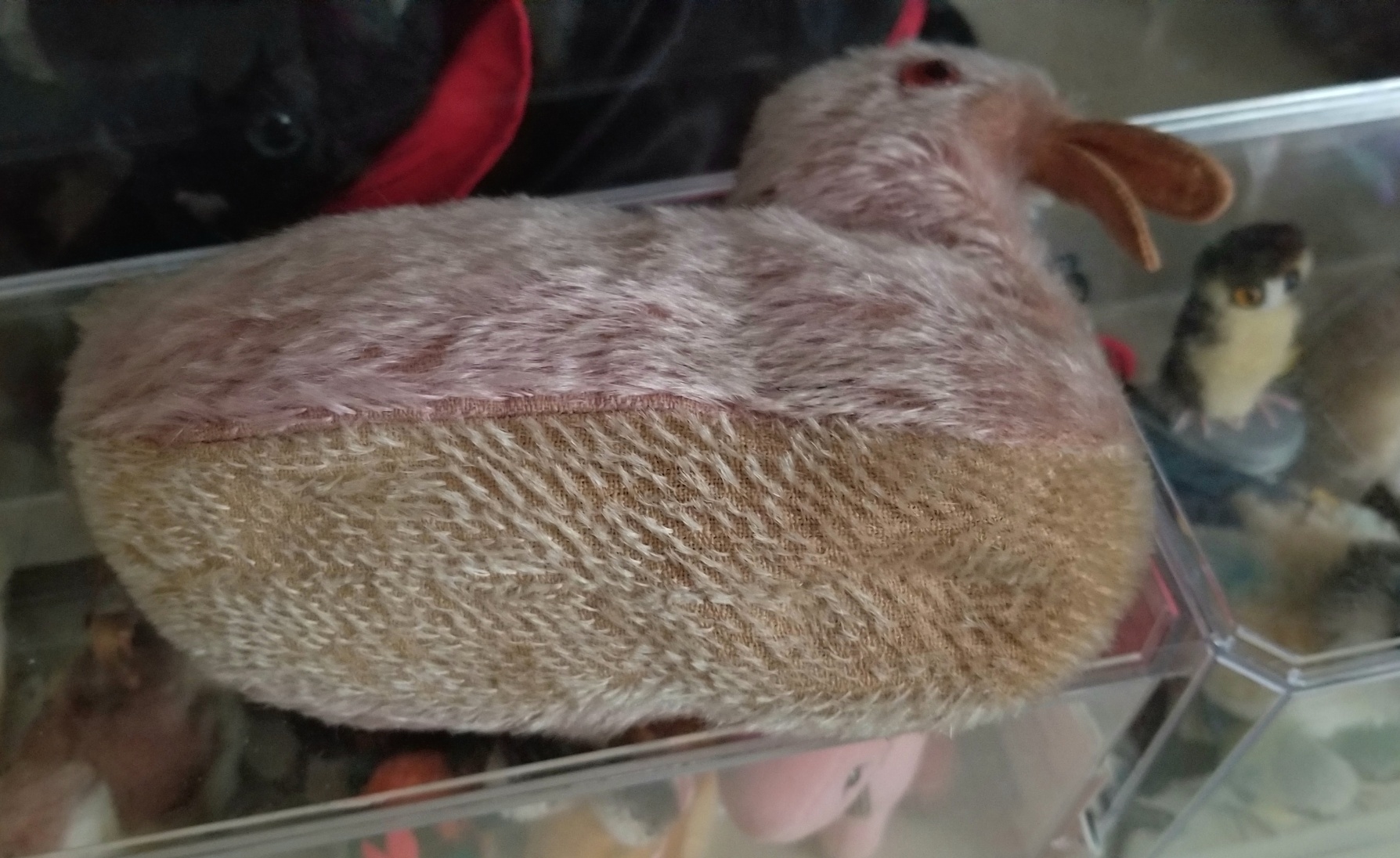
This Delightful 1920s Mohair Bird Gets Top Bill-ing!

This week's special blog guest should have you tickled pink. A new friend writes about a pastel pet her Mother received nearly a century ago. Was this dear heirloom made by Steiff? Let's take a deep duck dive and try and solve the mystery for her. Trish shares,

"I have my Mom's duck that was given to her on shipboard during her family's immigration from Germany in 1929. It no longer has IDs. But the story is documented and she was always adamant that it was made by Steiff. For my own curiosity, I tried to find a reference to Steiff ducks from that era, but have had no luck. It lacks any obvious marks where a tag might have been attached. It measures about 9" long from the tip of its beak to its tail. I appreciate your time!"


Bird's the word with this delightful duck for sure.
However, it is Steiffgal's best thinking that it was not made by Steiff. However, its coloration and presentation are very reflective of the mid to late 1920s, which was when Trish says her Mother was gifted the duck. Starting around 1924 or 1925, Steiff's product line began more accurately reflecting the aesthetic of the "roaring '20s," with items having more of a fun, fluffy, and feminine appearance. Other toy manufacturers quickly followed suit. A big marker of this change across the industry was the widescale production of soft toys in happy pastel colors, including examples in pink, purple, and blue mohair or velvet, as well as vibrantly tipped mohair. Clearly, these colors for the most part did not reflect the animal's hues in nature, but they proved to be "best sellers" with customers because of their novelty and appeal. Trish's pink duck is a perfect example of this.

Not to duck the question, but what about this toy is not Steiff-like?
Here are a few areas of note. First, it lacks the "roundness" of Steiff's swimming style play ducks of the era. It also does not have distinctive wings on the sides of its body. It is missing orange felt legs and feet, and there is no evidence that this toy every had them. Steiff's ducks from this era tended to have black button eyes backed in felt, not oversized glass pupil ones. And finally, as far as Steiffgal can tell, many of Steiff's ducks of the era had open beaks made from double thick felt and not felt that was seen together with seams. So these small details point to another manufacturer for Trish's duck. You can see the Steiff's analogous pastel duck pattern here on the left. These beautiful birds were made in pink, purple, and blue mohair in 11, 13, and 15 cm from 1926-1929 overall. The photo is from Pfeiffer's 1892-1943 Sortiment.

Steiffgal hopes this discussion on this novelty duck has made your day pretty in pink.

Have a question about one of your Steiff treasures? Let's talk! Click here to learn more.

Sunday, November 21, 2021

Good Things Come In Threes At Teddy Dorado's December 4th, 2021 Sales Event!

Care to go for the gold? Then check out the upcoming Steiff auction presented by our friends at Teddy Dorado auction house! Their signature winter sale, to be held on December 4th, 2021, features more than 400 new, vintage, and antique button-in-ear temptations - with new goodies being listed regularly. Here are three outstanding lots that caught Steiffgal's eye - and why. 

The first lot is a sweet-tweet-treat indeed.
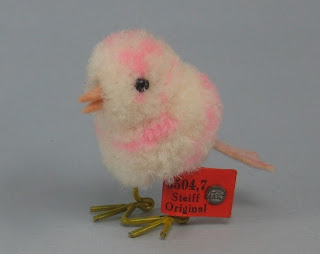
Steiff's earliest prewar woolen miniatures are loved and collected universally - with the rarest ones frequently realizing four figures at auction. Its hard to resist lot #28-4023, which is cataloged as, "Songbird made of white & pink Nomotta wool; black glass eyes; Beak made of skin-colored felt; white felt tail with pink stripes on both sides; Metal legs painted yellow & in perfect condition; Head rotatable & body tillable; approx. 4 mm large FF button slightly rusted, but not visible to the naked eye; red Steiff flag preserved in the best possible way; very clean, absolutely lightfast, odorless & completely unplayed; Premium top condition. approx. 4 cm high." 

This pretty-in-pink treasure has an opening bid of 1,000 Euro.

Bird's the word with this lovely treasure which is fantastic on so many levels. It is amongst the absolute earliest woolen miniatures ever made. This sweet bird design debuted in 1931, the first year Steiff's woolen miniatures were produced on a commercial scale. It was manufactured in six color combinations in 4 or 8 cm. Don't you think his color - pink - is WAH-HOO good? This example is the only Steiff woolen miniature prewar bird that Steiffgal knowns of featuring this great and novel hue. And the condition looks to be as close to like-new as humanly possible. 

You'll be all ears over this next auction highlight.
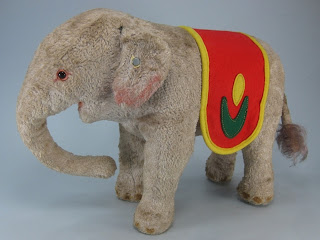
His expression, era, and materials are all so ele-phantastic. He is lot #28-4021, and is cataloged as, "Play elephant, made of light gray rayon plush; black glass eyes underlaid with pink felt; open mouth made of skin-colored felt; Tail tip made of mohair; tightly stuffed with wood wool; large double pressure voice defective; Saddle pad made of red, yellow & dark green felt; approx. 6 mm large, bright silver, shiny & shiny button in the ear; white paper ear tag missing; Artificial silk plush & felt without annoying flaws; very clean, absolutely lightfast, odorless & unplayed; Top condition approx. 21 cm high & without tail approx. 27 cm long." 

This playful pachyderm has an opening bid of 200 Euro. 

It's interesting to note that this distinctive elephant's "birthdate" is not specified. This great design bridged the pre- and postwar periods. It was produced in artificial silk plush in 17, 22, and 28 cm from 1938 through 1943 overall, and postwar in 22 cm only in 1948 though 1949. Given this big baby has a blank button and traces of his yellow ear tag, it is a safe bet that he is a postwar version. He's unforgettable for sure, don't you agree?

And good things come in threes with this final auction highlight.
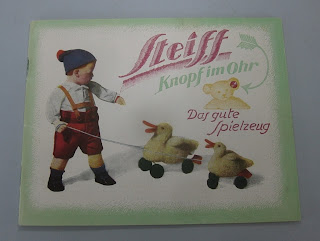
Steiff ephemera - catalogs, photographs, sales sheets, postcards, and other paper items associated with the company - is a fun, educational, and visually exciting complement to a button-in-ear collection of any era. If you are interested in the company's 1920s era production and aesthetic, be sure to check out lot #28-4003, which is cataloged as, "Customer brochure "The good toy" A6 +, 36 pp. 1925–1926 without Steiff printed matter no. German Premium Steiff customer brochure "The good toy" for Germany in the format approx. A6 plus landscape with 36 pages; inside black and white with a light green border; Text in German & without prices; Title shows Schlopsnies doll Theo with two yellow mohair (pulling) ducks, each lying on eccentric wheels; without printer's note or Steiff printed matter no .; original Steiff brochure & no reprint; very clean, absolutely lightfast, odorless & completely unread; Premium top condition." 

This time capsule quality brochure has an opening bid of 100 Euro. 

It's hard to picture a more interesting collection of images than those that appear in this great catalog. It features illustrations of the company's very rare mid-1920s white chimp with a tail, little known wooden toys on wheels, and charming, lifelike, and toddler-esque Schlopsnies dolls, among many other outstanding characters. And what makes these visuals so heartwarming is that they show our favorite button-in-ear favorites in playful and interactive vignettes... as if they were truly alive! Flipping through this period catalog is like taking a trip back in time, in the best possible way.

Steiffgal hopes this discussion on some of Teddy Dorado's upcoming sale highlights has been almost exciting as a live auction event!  Check out the entire catalog for this December 4th sale by clicking here. 

Have a question about one of your Steiff treasures? Let's talk! Click here to learn more.

Sunday, March 28, 2021

Isn't This Amazingly Rare Steiff Bear Pretty In Pink?

This next Steiff inquiry has Steiffgal tickled pink. And chances are, you will be too, after learning about this fantastic Steiff find. Fabienne from Europe shares the following...

"Hello, I have bought an antique Steiff and can't find anything about it in the Pfeiffer catalogue. He is about 38 cm standing, many bald spots but the remaining hair is fair blonde and long mohair. He is excelsior stuffed, some is showing through small holes near the nose etc. He still has his button. His covering is light pink, the mohair looks a very light blonde, but it could be faded. His glass eyes are a bit different than the others I have from that same period, they are a bit oversized. The nose stitching is light brown and still in good condition.

I live in Belgium and bought this bear on a local online marketplace, not only for bears, but everything someone wishes to sell, sort of an online fleamarket ;) I immediately noticed him and saw he was a bit different than my other Steiffs. He lives now happily ever after in my private museum (I have more than 500 bears) not all of them are Steiff. Yours sincerely, Fabienne"

A rose by any other name... just might be this terrific Ted!
Based on the photos provided, it is Steiffgal's best guess that this beautiful bear is a rare example of Steiff's Teddy Rose. As her name suggests, she was made from long, luxurious light pink colored mohair, but also appeared in bright gold mohair. She was manufactured in five sizes, ranging from 23 to 36 cm, measured sitting. These sizes were different than Steiff's standard line bears, possibly as a way to show that her pattern was a new direction for the company. Teddy Rose was stuffed with excelsior and kapok or just excelsior; had a hand embroidered nose, mouth, and claws; and oversized brown and black glass pupil eyes. She had a chunky build and a less prominent back hump. All of these design elements gave her a distinctly youthful appearance. Given her era of production, all Teddy Rose bears would have left the factory with a long trailing "f" Steiff button, just like this one has. According to company records, 5,271 yellow and 4,794 pink versions of Teddy Rose were manufactured in the c. 1925-1930 timeline. 

Today, examples of Teddy Rose are extremely rare on the secondary market. A fine example traded hands at about 19,000 euro (including buyer's premium) at the June 30, 2018 Ladenburger Spielzeugauktion GmbH Steiff Special Auction. The bear had a presale estimate of 2,200-4,400 euros and received an astounding 92 bids. Her cataloging read as follows, "teddy Rose, 44 cm, mohair, pink dyed, caused of old age faded, c. 1928, felt was at 1 paw retouched, mohair is except of minimally places in good condition, rare." She is pictured here on the left; the photo is from www.Liveauctioneers.com.

The Teddy Rose pattern plays a significant role in Steiff's 1920s-era product development and business expansion strategies.
It evolved in part from a directive from Richard Steiff, who was in America from the early 1920s onward growing his family’s business in North America. He noted that by the early 1920’s, the company’s legacy designs - which were almost two decades old by this point - had run their course and did not match the aesthetic or culture of the roaring 1920s. On February 6, 1925, he wrote to his family in Germany, “I am asked almost daily for new products; and I always have to answer that we do not really want to develop new products, since we can hardly cope with the delivery orders we receive for our old toys. However, the stiff competition here means we must be on our toes.”

Also in 1925, he notes, “…Our teddies, in the show room here in New York, appear colorless, sober, and insipid. I feel inclined to decorate all the teddies we have left with huge, colorful silk ribbons; only then can we ask a slightly higher price.”

The folks in Germany took Richard’s directives seriously, and the company's design team started working on entirely new Teddy Bear patterns.
For the most part, these patterns were softer and rounder than the company’s legacy patterns; incorporated longer, often playfully colored mohair into their designs; had larger eyes and childlike personalities and presentations;  and had distinctive facial or paw detailing. Some were distributed with collars, ribbons, or other accessories. And, for the first time ever, these new Teddy Bear designs were given appealing “real” names. They included Happy, Teddy Clown, Petsy, Teddy Baby, Dicky, and the cub under review here today - Teddy Rose. Several of these beloved friends are pictured here on the left; the advertising image is from Carsten Esser's 1920-1929 Steiff Kataloge.

Steiffgal hopes you've found this discussion on the company's Teddy Rose as joyful as a colorful bouquet of spring flowers!

Have a question about one of your Steiff treasures? Let's talk! Click here to learn more.

Tuesday, May 26, 2020

Mark Your Calendars For This Can't Miss June, 2020 Steiff Auction!

How exciting... a major event has just been announced for June! And no, it’s not a royal wedding - but everyone is invited to attend, and fascinators and white gloves are appropriate. It's been SOOOO long since a large Steiff collection has come to auction here in the USA, but that wait is over. Potter & Potter Auctions of Chicago, IL just announced its Eclectible Collectible Auction on June 20, 2020. It includes over 120 lots of neat Steiff treats and treasures, including a ton of prototypes, one-of-a-kinds, hand samples, and unproduced items. In honor of wedding season, here are four lots that caught Steiffgal's eye to the theme of "something old, something new, something borrowed, and something blue."

What's old is new again with lot #29, a pre-production sample of Steiff's "Paper Teddy Bear" replica from 1919. Its auction cataloging reads, "Steiff Club 2010 Teddy Bear, a pre-production example with “Not for Sale” text on verso of tag. Chest tag. 12”. This fully jointed and very appealing example has all IDs, including its black and white "sample" ear tag. This Ted is estimated at $80-150. 

There is so much to love about this "oldie." His IDs, size, and classic presentation are great, and he would fit in perfectly with a new or vintage Steiff, bear, or toy collection. His history is also fascinating. In order to continue soft toy production immediately after WWI, the Steiff company was forced to come up with some alternative fabrics as felt and mohair were not readily available on a commercial scale. Given the abundance of wood in the area, the company started producing things like building sets and furniture for children. Steiff also found a way to produce a tweed-like material from local natural products, including nettles. This engineered fabric was called "paper plush." Paper plush items appeared in the line from 1919 through 1921, and included popular models of the company's standard line bears, dogs, cats, and rabbits. This Ted is a replica of bears from this era. Given there is about a billion to one chance you would find an original c. 1919 paper plush animal, this bear is a sure bet for your collection. 

The "new" kid on the block here is lot #43, a petite pink bear made as an exclusive for the annual "Steiff Sommer" event of 2015. Its cataloging reads, "Steiff Summer 2015 Limited Edition Mini Teddy Bear. Number 19 of 135 bears. Pink and light brown mohair. Black ribbon tie. White tag. 6”. This happy handful is in like new condition and has all of her original IDs. She is estimated at $50-80.

This cutie is a perfect choice for both doll and bear folks. Imagine "Pinky" in the arms of your favorite doll or Ted! How totally adorable would that be?! Her color and presentation are really charming. Her tiny edition size is hugely desirable. And much about her is "debut," at least as far as Steiffgal can tell - most notably, her amazing and almost psychedelic mohair!

It's ok to borrow, especially when the results get everyone feline groovy. A hands down choice for this highlight category is lot #83, a pair of Steiff cats. Their cataloging reads, "Pair of Steiff Cats. Including Kitty limited edition (musical), yellow tag, without EAN or limitation on verso (for 2010 edition), length 12”; and Bagpuss Danbury Mint (yellow tag, EAN 662294), length 13”. The pair is conservatively estimated at $125-225.

Who would not want to add these kittens to their meow mix? It is Steiffgal's best guess that the lovely and almost life-sized musical Kitty is an overproduction of the company's grey and white alpaca cat made in an edition size of 2010 in 2010. When wound up, she plays music and moves the pom pom ball she holds between her two front paws. This may have been originally purchased at the annual tent sale held on the grounds of Steiff in Germany every summer. The Bagpuss is a SUPER COOL rarity that is based on a beloved British TV character cat of the same name. He is made from pink stenciled alpaca which apparently was very difficult to produce, so few actually were distributed. A VERY long time ago, Steiffgal made a video about Steiff's Bagpuss, and all of that information presented is still true today. Take a look here if you can!


And finally, it's time to sing the blues over this last Steiff auction highlight. Here we have lot #13, a pre-production sample of the universally beloved Peter Rabbit. This begging beauty is cataloged as, "Steiff Peter Rabbit Pre-Production Sample. A sample/prototype example of the replica of the 1904 Peter Rabbit, marked “Not for Sale” on ear tag, leather slippers marked on underside: “Regstd. No. 423888/Made in Germany,” height 9 ½”. Peter is estimated at $80-125.

There's not a hare out of place with this wah-hoo good bunny. Most Steiff collectors (including Steiffgal) have an original turn-of-last century Peter Rabbit on their bucket list. Given their absolute rarity and costs... this example just may be a good fix. This toy, of course, is based on English author Beatrix Potter's Peter Rabbit book which debuted in 1902. This tail - oops, tale - became a worldwide sensation due to its simple story and beautiful illustrations. Ms. Potter created a little Peter Rabbit doll and registered it in the London patent office. Despite numerous attempts, she could not find a manufacturer in England to produce her toy. Steiff got wind of this, and soon became the producer of the "official" Peter Rabbit doll for the English market. Steiff's Peter Rabbit was based on an existing begging rabbit pattern and appeared in the line in a number of sizes through about 1919. All version wore a felt topcoat and slippers.

Steiffgal hopes this discussion on some of Potter's June 20, 2020 Steiff sale highlights has been almost exciting as a live auction event! You can learn more about this sale and check out the entire catalog by clicking here.

Have a question about one of your Steiff treasures? Let's talk! Click here to learn more.

Sunday, December 29, 2019

Welcoming 2020 With Hogs and Kisses!

It's time to welcome a new decade with 2020 being just on the horizon. So, how about launching the new year in the best possible - and auspicious - way? Pigs are considered "lucky charms" in Irish, Chinese, and German traditions, among many others. So this moment seems perfect to take a look at this precious pink porker who really knows how to move and groove. She'll undoubtedly put you in a celebratory mood!

This pretty piggy has enormous squeal-appeal. She's just about life-sized compared to a baby piglet, and equally as adorable. Pig is about 9" tall, 16" wide, solidly stuffed with excelsior, and made from soft pink mohair. She is arm and leg jointed. Her lifelike face is detailed with black shoe button eyes, a prominent muzzle, and an inset velvet tipped snout that has been airbrushed with pink nostrils and a mouth. Her pert ears are made entirely from mohair and are dimensional. Her true-to-scale tail is actually in a curly-Q as you would see in a live pig; it is lined in wire and is poseable. This queen of the barnyard retains her small long trailing "f" button as her Steiff ID. This pattern appeared in the line from c.1913-1918.

Jointed pigs are pretty rare in the Steiff line. As far as Steiffgal can tell, this example is just one of two produced prewar - or ever. The first debuted in 1908. This version had a ball jointed neck, as well as jointed arms and limbs. The ball jointed neck enables the head and neck to be twisted and rotated into different lifelike positions. This proprietary movement was invented by Franz Steiff and registered on May 24, 1908 in the German patent office as a "toy animal with movable head." According to company records, this was accomplished by... "attaching a swivel jointed mechanism to the head which was then secured to the body by means of a tube running from the neck to the torso." Steiff used this feature on a few models, including this pig, as well as polar bears, begging poodles, cats, and opossums. This uber-jointed piglet was produced in 14, 17, 22, and 28 cm through 1918 overall. The only one Steiffgal knows of came up for auction in 2018, you can see his listing here.

The pig under discussion here is the second jointed version. Steiffgal suspects that it was produced as a response to economic and marketplace realities of the era.  

*From a supply perspective, it is Steiffgal's best guess that the fully jointed pig with a ball jointed neck was probably pretty expensive to produce - given its complex engineering, unique internal hardware mechanism, and additional manual labor to sew, stuff, and assemble. It was a great product and idea, but somewhat resource intense to bring to life. 

*From the demand perspective, given its time in the line - which considerably overlaps with WWI - Steiffgal also suspects that many consumers did not have alot of extra cash or the inclination to purchase high end toys like this. As such, Steiff most likely simplified elements of their ball jointed pig pattern by removing a big cost/labor element of this design - the neck feature. This reduced the costs for all parties, and made this still-playful pattern a bit more accessible overall.

Pigs really “bring home the bacon” in Germany. There's a German expression, “Ich Habe Schwein Gehabt,” which roughly translates to “I have had pig,” that people say after personally experiencing something lucky or fortunate. This Germanic tradition dates back many centuries of hard times and refers to having enough food to feed a family. If a family had a pig, they were able to eat for a week or more! Today in Germany, pigs made from marzipan are popular holiday time treats and are often given out as little gifts on December 31st to insure luck in the coming year.

Steiffgal thanks you for letting her bend your ear over this fully jointed pig - and happy new year everyone!

Have a question about one of your Steiff treasures? Let's talk! Click here to learn more.

Sunday, June 3, 2018

Thumbs Up Over This Fantastic Paddy Walrus Hand Puppet!

It's all hands in the air for Steiff's great mohair puppets - especially the really rare ones. Steiff started creating these high quality puppets in the early 1900's in the likenesses of some of their most popular characters and designs. This tradition was carried out for the most part through the 1970's; after then, the company's puppets were mostly constructed from plush, plastic, and other materials. Let's take a deep dive and check out one of the most unusual post-war mohair examples and see what makes him so interesting from the product design and historical perspectives.

It's not unusual to see collectors fighting tooth and nail over this walrus hand puppet. This unjointed rarity is 20 cm tall and made from tan mohair that has been airbrushed with brown and tan spots, shading, and highlights. He has a pair of dimensional flippers; the tips are stuffed with excelsior. His oversized, very round head is solidly stuffed with excelsior. His face come to life with two black and white google style eyes, jowls, a long, brown tipped mohair beard, a pink hand embroidered nose, and two white tusks. This walrus puppet was made in this size only in 1962 as an exclusive for high end toy retailer FAO Schwarz.

This perky puppet of course is based on the company's standard line Paddy walrus design. Paddy was produced in 10, 14, and 22 cm in the 1959 through 1965 time frame. It was not unusual in the 1950's and 1960's for Steiff to retool popular items as exclusives for FAO Schwarz. By "retool," Steiffgal means making an item in a bigger or smaller size; sitting instead of standing (or vice versa); dressing a piece in a fancy outfit or giving it a distinctive accessory, or taking a basic design and producing it in another toy category. That's what you see here - the Paddy design being reinterpreted as a puppet. 

To keep things twice as nice, Steiff also produced Paddy as a pajama bag as an exclusive for FAO Schwarz from 1962 through 1972. This delightful and functional collectible was 45 cm nose to tail; made from short brown mohair or dralon plush which was carefully airbrushed on its face, flippers, and tail; and was lined in blue colored silk material. He had a zipper up his belly and was "hollow", meaning that you could indeed store your adult sized pajamas inside of his torso!

Steiffgal's Paddy puppet clearly was someone's best friend at one point in his life, which is a good thing. He has some play wear to him, his beard is quite thin, and he lacked his traditional tusks upon arrival. So the question is, how important is condition when making a Steiff purchase? Of course, everyone has their very own algorithm for this, and it always comes down to personal choices and preferences. But if it is helpful in any way, here are three key things that Steiffgal considers when making a purchase decision for her own collection.

1. Do I have this item in my collection already? If not, then it may be a good choice, all things being equal. If you already do, is this example in better shape than the one you already have? If yes, then consider purchasing it and rehoming your lesser quality example. If no, then maybe pass on the opportunity.

2. How often do examples of this item come up for sale? If the item seldom if ever appears on the secondary market, condition plays somewhat of a lesser role in the decision making process. If the item is almost never seen for sale or at auction, consider adding it to your collection. If you have seen examples of the item come up for sale two or more times in the last year or so, and the item you are considering adopting today is not in great shape, consider waiting for the next purchase opportunity.

3. How "bad" is the condition? In the case of this puppet, he was really dirty, had a small tear in his beard, and had lost his tusks to time. These things can be fixed or restored, and that's exactly what Steiffgal did here. She cleaned him, stitched his beard, and made him tusks out of white Fimo clay. (After all, its not uncommon to need custom tooth implants over the age of 50 these days!) If you (or someone you know) can fix the item's condition to a state that you are comfortable with, and/or stabilizes it so it is around for many more decades to come, then consider the purchase. Just make sure that you fully disclose these repairs if you move the piece along sometime in the future.

If the item is in really rough shape, may attract insects, or has other condition issues that make its time on Earth quite limited, perhaps consider waiting for the next big find - which is always just around the corner!

Steiffgal hopes this discussion on this Paddy walrus puppet has been a happy handful for you. 

Have a question about one of your Steiff treasures? Let's talk! Click here to learn more.

Saturday, November 25, 2017

Steiff Dreams Do Come True!

Look what I got! All collectors know that fabulous feeling when something from their Steiff wish list finally makes it into their hugs for real! Check out this note from a new friend from Europe who recently scored her dream piece - at a dream price! Ann-Charlotte shares,

"I wanted to tell you some exciting news. I just added a very special treasure to my collection - an original Steiff Jackie for only $85! Her mohair is intact and she retains her original pink bow, button in ear, and US Zone tag! I have been looking for an original Jackie for a long time but the few I've found have been too expensive. And she is almost in mint condition!

I got her at a nice local auction house specializing in local antiques and folk art at affordable prices. They sometimes have "odd" objects like toys. They hold country auctions every two weeks. The items for sale are posted on the Internet the preceding Friday and you can bid online up until the live auction begin at noon on Sunday. The auctioneers didn’t know what it was. It was advertised as "Steiff softie" - which doesn't sound very interesting - and no one other than me was interested.

Best wishes from Sweden,
Ann-Charlotte"

Such great news has Steiffgal tickled pink! Yes indeed, this is Steiff's delightful Jackie bear. These were produced in 17, 25, 35, and 75 cm from 1953 through 1955 overall. Regardless of size, all original Jackie bears were made from blonde mohair, had felt paw pads, and were five ways jointed.  Their irresistible faces came to life with brown and black glass pupil eyes, a brown hand embroidered nose and mouth, and a touch of airbrushing.  These special cubs are also known for their their lone horizontal pink noses stitches, airbrushed belly buttons, and distinctly impish expressions and personalities.

Jackie has always been a party animal! Steiff produced this design in honor of the golden anniversary of the Teddy bear - specifically the 50th anniversary of the registration of 55PB at the Heidenheim district court in 1903. As such, she was intentionally designed to look significantly different then the company's other Teddy bears of the time. You can't help but notice Jackie's distinctly stocky proportions, especially in reference to her torso and limbs. (This is meant in the most loving way possible - no judgement intended!) And, her chubby arms don't have the clear break at the wrists as many early 1950's Steiff bears do. All original Steiff Jackie bears left the factory in Giengen with a special 50th anniversary chest tag and a celebratory booklet as part of their branding and IDs. Most Jackies also have a US Zone tag, which appeared on Steiff's postwar items through about 1953 or 1954.

Steiffgal has always considered Jackie to be Steiff's unofficial "First Lady." As such, she has for a long time suspected that Jackie may have been named as a nod to another soon-to-be first lady, Jackie Kennedy.  Jackie married Jack Kennedy in 1953.  This wedding and her escalation on the social scene at the time seemed to usher in a new era of optimism, style, and beauty - much like Steiff's hopes for this bear and its post-war business success.  

To keep the company's anniversary celebration twice as nice, Steiff also produced another special edition.  These were a series of "Nimrod" Teddy bears from 1953 through 1954. The Nimrod bears were all based on the company's early postwar, newly redesigned "Original Teddy" pattern. Overall, four Nimrod bears appeared in Steiff's catalogs. These included a 22 or 50 white version which donned a green cap, an orange felt shirt, and brown boots; a 22 cm gold version which wore a green cap, a brown felt shirt, and brown boots; and a 22 cm caramel version detailed with an orange cap, green scarf, and very tall brown "wader" style boots. All carried wooden rifles suspended from a leather cord. 

Although Jackie and the Nimrod brother bears are early post war anniversary editions, they are not the earliest. In 1947, Steiff produced a blonde, fully jointed 10 cm Teddy bear with a special square shaped tag to commemorate the 100 year anniversary of the birth of Margarete Steiff. The tag read, "To commemorate the 100th birthday of Margarete Steiff on 24.7.1947." As far as Steiffgal can tell, this 1947 Teddy bear edition may be the earliest Steiff commemorative or anniversary item ever produced on a commercial scale by the company. You can see the 1947 bear here on the left, the photo is from Pfeifer's 1947-2003 Sortiment.

Steiffgal hopes this discussion of Ann-Charlotte's Jackie auction find has generated lots of goodwill with you!

Have a question about one of your Steiff treasures? Let's talk! Click here to learn more.
The teddy bear search engine