Showing posts with label Schlopsnies. Show all posts

Sunday, August 28, 2022

Who Is This Tall, Dark, And Handsome Steiff Stranger?

Please say "howdy, partner" to this remarkable Steiff rarity! Steiff's turn of last century dolls have always been Steiffgal's passion. So when she got to handle this rarity, things got pretty wild - but in the best way possible. Check out this mustached marvel and see what makes him WAH-HOO good for so many reasons.

Well, hello handsome! This fellow is named Mexican Cowboy. He is 40 cm tall and fully joined. His head and lower arms are made from felt, and the rest of his body is made from a linen-like material. His weathered face is detailed with black button eyes, a black mohair mustache, a little pink highlighting, black painted eyebrows, and a prominent center facial seam. His fabulous black curly hair is an inset wig and is made from mohair. He retains his long trailing "f" button in ear as his Steiff ID. 

Mexican Cowboy is dressed to the nines in his (almost) all factory original outfit.
It includes a red cotton shirt with tan stitching, wide tan mohair chaps with an open back, and really well made black leather boots. His leather belt with silver detailing is replaced, but perfectly scaled to him. He also wore a blue chambray bandana around his neck, but this has been lost to time. This hard working hunk was produced overall in 40, 45, 55, 70, 100, and 150 cm from 1912 through 1921 overall. The largest ones were most certainly made as display dolls, as they would have been too large and heavy for a child to play with. 

Mexican Cowboy is noted in Pfeiffer's 1892-1943 Sortiment as to be in "national costume" and representing a category called "nation types." 
Steiffgal suspects that he was produced in conjunction with the company's c. 19-teen era Schlopsnies Circus project. This large scale, dynamic, and extremely popular exhibit was designed and executed by Steiff doll freelancer Albert Schlopsnies. It consisted of over 30 circus themed dolls and acrobats, based on real life performers at the world famous Circus Sarrasani of Dresden, Germany. This amazing display garnered a worldwide following and certainly helped in elevating Steiff's dollmaking reputation to global status. 

One of the elements that made the Circus Sarrasani so popular, and unique, was its roster of international talent.
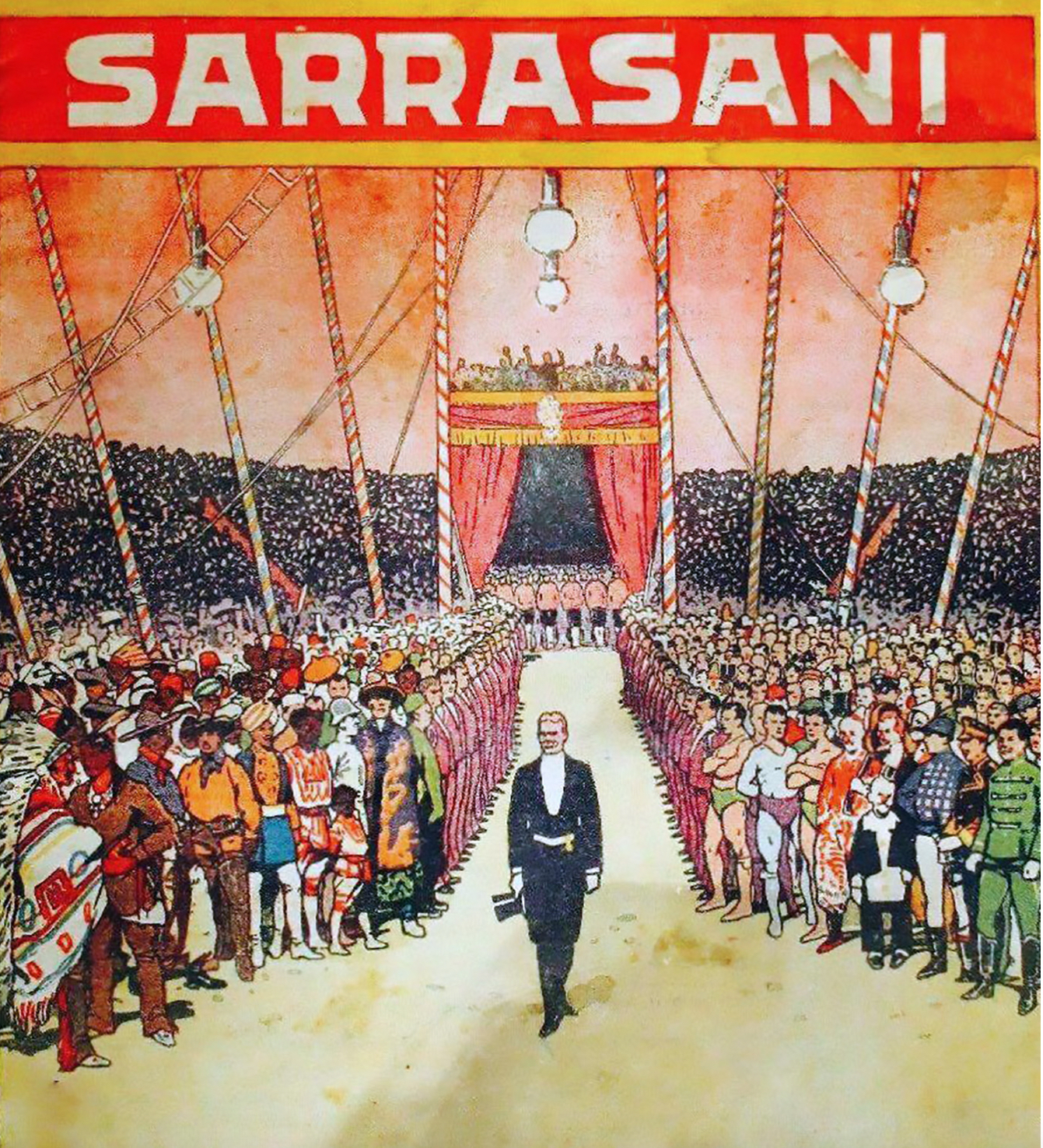
 Original posters, broadsides, photos, and other promotional ephemera from the Circus Sarrasani spotlighted ethnic performers in native costumes, including South American Cowboys, Asian gymnasts, and American Indians, among many others. You can see an example of this on the left. This important detail was noted by Schlopsnies, who included authentic versions of these global ambassadors in his Steiff doll interpretation of the Circus. Steiffgal suspects, given the production timeline of the Mexican Cowboy and the Steiff circus project, that he was in fact produced as part of circus project to bring its important "international" angle to life. And, given all that, it is entirely possible that this doll is based on a real life Mexican Cowboy who appeared in the Circus Sarrasani around 1912 or so.

Steiffgal hopes this discussion on Steiff's Mexican Cowboy doll has been a stampede of fun for you!


Have a question about one of your Steiff treasures? Let's talk! Click here to learn more.

Sunday, November 21, 2021

Good Things Come In Threes At Teddy Dorado's December 4th, 2021 Sales Event!

Care to go for the gold? Then check out the upcoming Steiff auction presented by our friends at Teddy Dorado auction house! Their signature winter sale, to be held on December 4th, 2021, features more than 400 new, vintage, and antique button-in-ear temptations - with new goodies being listed regularly. Here are three outstanding lots that caught Steiffgal's eye - and why. 

The first lot is a sweet-tweet-treat indeed.
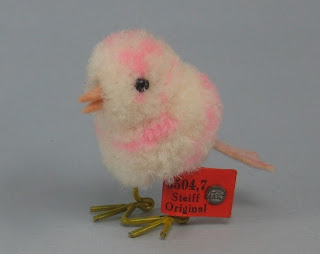
Steiff's earliest prewar woolen miniatures are loved and collected universally - with the rarest ones frequently realizing four figures at auction. Its hard to resist lot #28-4023, which is cataloged as, "Songbird made of white & pink Nomotta wool; black glass eyes; Beak made of skin-colored felt; white felt tail with pink stripes on both sides; Metal legs painted yellow & in perfect condition; Head rotatable & body tillable; approx. 4 mm large FF button slightly rusted, but not visible to the naked eye; red Steiff flag preserved in the best possible way; very clean, absolutely lightfast, odorless & completely unplayed; Premium top condition. approx. 4 cm high." 

This pretty-in-pink treasure has an opening bid of 1,000 Euro.

Bird's the word with this lovely treasure which is fantastic on so many levels. It is amongst the absolute earliest woolen miniatures ever made. This sweet bird design debuted in 1931, the first year Steiff's woolen miniatures were produced on a commercial scale. It was manufactured in six color combinations in 4 or 8 cm. Don't you think his color - pink - is WAH-HOO good? This example is the only Steiff woolen miniature prewar bird that Steiffgal knowns of featuring this great and novel hue. And the condition looks to be as close to like-new as humanly possible. 

You'll be all ears over this next auction highlight.
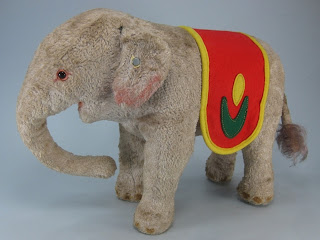
His expression, era, and materials are all so ele-phantastic. He is lot #28-4021, and is cataloged as, "Play elephant, made of light gray rayon plush; black glass eyes underlaid with pink felt; open mouth made of skin-colored felt; Tail tip made of mohair; tightly stuffed with wood wool; large double pressure voice defective; Saddle pad made of red, yellow & dark green felt; approx. 6 mm large, bright silver, shiny & shiny button in the ear; white paper ear tag missing; Artificial silk plush & felt without annoying flaws; very clean, absolutely lightfast, odorless & unplayed; Top condition approx. 21 cm high & without tail approx. 27 cm long." 

This playful pachyderm has an opening bid of 200 Euro. 

It's interesting to note that this distinctive elephant's "birthdate" is not specified. This great design bridged the pre- and postwar periods. It was produced in artificial silk plush in 17, 22, and 28 cm from 1938 through 1943 overall, and postwar in 22 cm only in 1948 though 1949. Given this big baby has a blank button and traces of his yellow ear tag, it is a safe bet that he is a postwar version. He's unforgettable for sure, don't you agree?

And good things come in threes with this final auction highlight.
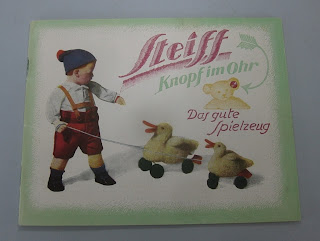
Steiff ephemera - catalogs, photographs, sales sheets, postcards, and other paper items associated with the company - is a fun, educational, and visually exciting complement to a button-in-ear collection of any era. If you are interested in the company's 1920s era production and aesthetic, be sure to check out lot #28-4003, which is cataloged as, "Customer brochure "The good toy" A6 +, 36 pp. 1925–1926 without Steiff printed matter no. German Premium Steiff customer brochure "The good toy" for Germany in the format approx. A6 plus landscape with 36 pages; inside black and white with a light green border; Text in German & without prices; Title shows Schlopsnies doll Theo with two yellow mohair (pulling) ducks, each lying on eccentric wheels; without printer's note or Steiff printed matter no .; original Steiff brochure & no reprint; very clean, absolutely lightfast, odorless & completely unread; Premium top condition." 

This time capsule quality brochure has an opening bid of 100 Euro. 

It's hard to picture a more interesting collection of images than those that appear in this great catalog. It features illustrations of the company's very rare mid-1920s white chimp with a tail, little known wooden toys on wheels, and charming, lifelike, and toddler-esque Schlopsnies dolls, among many other outstanding characters. And what makes these visuals so heartwarming is that they show our favorite button-in-ear favorites in playful and interactive vignettes... as if they were truly alive! Flipping through this period catalog is like taking a trip back in time, in the best possible way.

Steiffgal hopes this discussion on some of Teddy Dorado's upcoming sale highlights has been almost exciting as a live auction event!  Check out the entire catalog for this December 4th sale by clicking here. 

Have a question about one of your Steiff treasures? Let's talk! Click here to learn more.

Saturday, October 10, 2020

The Best of All Worlds: Steiff REAL and Replica!

Are you seeing double? Usually, this is cause for alarm. But not in this case, in terms of these two very fine Steiff fellows. Produced nearly a century apart, these "hairy canaries" prove that good looks, genes, and and remarkable beards are not only timeless and appealing, but great assets, too! Let's take a look at this original turn of last century Steiff doll and his 1990s era replica and see how they compare.


Things are twice as nice when it comes to Steiff's "Hungarian" doll. The original is shown here on the left, and the replica from 1996 is on the right. The early and original Hungarian doll was manufactured by Steiff from 1912 - 1917. According to the Pfeiffer's early Sortiment reference book, he was produced in 50 cm, although this particular example measures 43 cm and the number on his tag reads "Ung 43." It is very possible that he was produced in a number of different sizes during his manufacturing run; not all early records are perfect.

So let's look at the older guy first. Vintage Hungarian - on the left in this photo - is made from felt, stuffed with excelsior, and fully jointed. His uniform is integral to his body. He wears a red felt jacket that is trimmed with curly, jet black mohair and detailed with metal buttons, black and gold embroidery, and cord and orange felt trimmed cuffs. His tan pants are decorated with red embroidered felt stripes. His knee-high leather boots are trimmed with tan string tassels and orange felt. His "proper topper" is a red felt cap embellished with a metal button, orange felt, and a leather brim. Hungarian has a gold rope whip wound around his left shoulder. His face comes to life with Steiff's signature center seam construction, black eyes, a prominent nose, oversized ears, and a full mustache, beard, and head of hair made from the same curly jet black mohair that decorates the bottom circumference of his jacket.

Now let's check out his doppelgänger. This marvelous Steiff replica doll was produced in the late 1990s as part of limited edition doll and horse set. You can see that dynamic duo in the photo here on the left. Although the replica is cataloged at 43 cm, Steiffgal's example actually measures 47 cm tall. In the late 1980s through the late 1990s, Steiff created a series of replicas based on their 19-teen era Schlopsnies Circus program. These replica dolls included clowns, animal trainers, musicians, and performers, among others. The original Schlopsnies Circus was large scale, dynamic, and extremely popular exhibit designed and created by Steiff creative freelancer Albert Schlopsnies. It consisted of over 30 circus themed dolls and acrobats, based on real life performers at the world famous Circus Sarrasani of Dresden, Germany.


So how do the original and the replica align? Keep in mind that it is nearly impossible to recreate something exactly as it was a century onward - given how materials and technology change over time, and how fabrics and fillings oxidize and age. With that as a backdrop, let's compare three factors here: these two doll's detailing and materials, construction, and general aesthetics.

Detailing and materials:
For the most part, the two have a lot in common in these categories. There are a few very minor differences, like the exact embroidery on the back and arms of their jackets and the spacing of the stripes on their cuffs. The original has his button and white paper tag located in his ear, while the replica has his button in ear, and another Steiff button and his white tag located on the edge of his jacket. Clearly, the doll's rope whip and boot tassels cannot be exactly replicated as the materials used for these accessories have evolved over time. The key physical material difference between the early Hungarian and the replica Hungarian is that the replica uses long black plush in the place of long black mohair on the doll's hair, beard, and jacket trim - perhaps as a cost savings measure. 

Construction:
The original Hungarian doll is entirely stuffed with excelsior from head to toe. The replica's head is softly stuffed, while the rest of his body and limbs are stuffed with excelsior. It is really interesting to note that the dolls are nearly identical in weight, with the replica just 4 grams heavier than the antique one. Both dolls have analogous jointing. Here on the left, you can see an original Steiff advertisement from around 1912 featuring the Hungarian astride a camel; the photo is from Ayers and Harrison's Advertising Art of Steiff, Teddy Bears and Playthings.

General aesthetics:
It is obvious that the turn-of-last century doll is slimmer, curvier, and more elegantly scaled than the replica. This is especially noticeable in the face; the original has old fashioned facial contouring and a smaller, to scale nose while the newer version has a fuller, flatter, rounder face with a really bulbous nose. This probably has to do with the fact that excelsior stuffing allows greater contouring than simply polyfill. The replica, although still quite handsome and a wonderful addition to any Steiff collection, is simply a bigger, somewhat streamlined, and boxier interpretation.

Steiffgal hopes this discussion on Steiff's original and replica circus dolls has been one hot ticket for you.

Have a question about one of your Steiff treasures? Let's talk! Click here to learn more.

The teddy bear search engine