Showing posts with label novelties. Show all posts

Sunday, March 28, 2021

Isn't This Amazingly Rare Steiff Bear Pretty In Pink?

This next Steiff inquiry has Steiffgal tickled pink. And chances are, you will be too, after learning about this fantastic Steiff find. Fabienne from Europe shares the following...

"Hello, I have bought an antique Steiff and can't find anything about it in the Pfeiffer catalogue. He is about 38 cm standing, many bald spots but the remaining hair is fair blonde and long mohair. He is excelsior stuffed, some is showing through small holes near the nose etc. He still has his button. His covering is light pink, the mohair looks a very light blonde, but it could be faded. His glass eyes are a bit different than the others I have from that same period, they are a bit oversized. The nose stitching is light brown and still in good condition.

I live in Belgium and bought this bear on a local online marketplace, not only for bears, but everything someone wishes to sell, sort of an online fleamarket ;) I immediately noticed him and saw he was a bit different than my other Steiffs. He lives now happily ever after in my private museum (I have more than 500 bears) not all of them are Steiff. Yours sincerely, Fabienne"

A rose by any other name... just might be this terrific Ted!
Based on the photos provided, it is Steiffgal's best guess that this beautiful bear is a rare example of Steiff's Teddy Rose. As her name suggests, she was made from long, luxurious light pink colored mohair, but also appeared in bright gold mohair. She was manufactured in five sizes, ranging from 23 to 36 cm, measured sitting. These sizes were different than Steiff's standard line bears, possibly as a way to show that her pattern was a new direction for the company. Teddy Rose was stuffed with excelsior and kapok or just excelsior; had a hand embroidered nose, mouth, and claws; and oversized brown and black glass pupil eyes. She had a chunky build and a less prominent back hump. All of these design elements gave her a distinctly youthful appearance. Given her era of production, all Teddy Rose bears would have left the factory with a long trailing "f" Steiff button, just like this one has. According to company records, 5,271 yellow and 4,794 pink versions of Teddy Rose were manufactured in the c. 1925-1930 timeline. 

Today, examples of Teddy Rose are extremely rare on the secondary market. A fine example traded hands at about 19,000 euro (including buyer's premium) at the June 30, 2018 Ladenburger Spielzeugauktion GmbH Steiff Special Auction. The bear had a presale estimate of 2,200-4,400 euros and received an astounding 92 bids. Her cataloging read as follows, "teddy Rose, 44 cm, mohair, pink dyed, caused of old age faded, c. 1928, felt was at 1 paw retouched, mohair is except of minimally places in good condition, rare." She is pictured here on the left; the photo is from www.Liveauctioneers.com.

The Teddy Rose pattern plays a significant role in Steiff's 1920s-era product development and business expansion strategies.
It evolved in part from a directive from Richard Steiff, who was in America from the early 1920s onward growing his family’s business in North America. He noted that by the early 1920’s, the company’s legacy designs - which were almost two decades old by this point - had run their course and did not match the aesthetic or culture of the roaring 1920s. On February 6, 1925, he wrote to his family in Germany, “I am asked almost daily for new products; and I always have to answer that we do not really want to develop new products, since we can hardly cope with the delivery orders we receive for our old toys. However, the stiff competition here means we must be on our toes.”

Also in 1925, he notes, “…Our teddies, in the show room here in New York, appear colorless, sober, and insipid. I feel inclined to decorate all the teddies we have left with huge, colorful silk ribbons; only then can we ask a slightly higher price.”

The folks in Germany took Richard’s directives seriously, and the company's design team started working on entirely new Teddy Bear patterns.
For the most part, these patterns were softer and rounder than the company’s legacy patterns; incorporated longer, often playfully colored mohair into their designs; had larger eyes and childlike personalities and presentations;  and had distinctive facial or paw detailing. Some were distributed with collars, ribbons, or other accessories. And, for the first time ever, these new Teddy Bear designs were given appealing “real” names. They included Happy, Teddy Clown, Petsy, Teddy Baby, Dicky, and the cub under review here today - Teddy Rose. Several of these beloved friends are pictured here on the left; the advertising image is from Carsten Esser's 1920-1929 Steiff Kataloge.

Steiffgal hopes you've found this discussion on the company's Teddy Rose as joyful as a colorful bouquet of spring flowers!

Have a question about one of your Steiff treasures? Let's talk! Click here to learn more.

Sunday, February 21, 2021

Hands In The Air Over This Marvelous Prewar Steiff Charly Puppet!

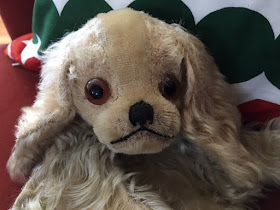
The eyes have it with this marvelous Steiff creation. Steiffgal recently welcomed a rare Steiff prewar novelty into her collection... this marvelous Charly the King Charles Spaniel puppet! This darling dog has truly captured Steiffgal's heart via her irresistible expression as well as her place in the Steiff product development timeline. Admit it, you can't look away either! Come take a look at what makes this puppet such a top dog!

This happy handful is 17 cm tall, unjointed, and made from mohair.
Her body, ears, arms, and face are made from longer mohair, while her muzzle is made from slightly shorter mohair. Her head is stuffed with excelsior and is lined with a cardboard finger tube. Her ears are long, floppy, and stitched lightly to the sides of her head. Her mohair has faded overall and evenly to a mellow vanilla color. When she was new, her ears and parts of her face were light brown, and the rest of her was white. Charly has three hand embroidered black claws on each of her paws; these each have a little bit of excelsior in the ends to give them some dimension. Her pouty face comes to life with oversized brown and black glass pupil eyes and a black hand embroidered nose and mouth. She retains her long trailing "f" button as her Steiff ID. Her article number is 317, which translates to 3=mohair and 17=17 cm. This lovely puppet appeared in the line from 1928 through 1939 in this size only. 

This Charly puppet, of course, is a novelty based on the company's beloved and best selling prewar Charly the King Charles Spaniel.
Steiff introduced Charly in the late 1920s, a time of great creativity at Steiff. The original Steiff Charly was produced both sitting and standing; the two versions were head-jointed only. Charly dogs were made from light brown or orange-tipped mohair and white mohair; had extremely long fuzzy ears; large, childlike brown and black-pupil eyes; a very detailed facial seam structure; and a prominent tail. Their filling included soft kapok, meaning that they were lighter in weight and more cuddly than other animals stuffed exclusively with excelsior. Here on the left, you can see a picture of this Charly puppet, along with a number of other charming Steiff puppets in this vignette from the company's 1929 catalog. The image is from Carsten Esser's Steiff Kataloge 1920-1929.

Knowing a good thing when they saw it, the designers at Steiff recognized that Charly would be a great source for “theme and variation” product introductions, due to her popularity with collectors. As a result, she appeared as various novelties throughout the line through 1940 or so. In addition to the puppet discussed here today, other highlights included pincushions, music boxes; tiny Nomotta woolen miniatures, a purse, and a pajama bag. Perhaps the rarest Charly of all was a Pupp Animal Doll. This version was 28 cm and dressed in a playful purple outfit. She appeared in the line only from 1929 through 1930. In 2010, a Pupp Charly realized over $8,300 at auction at Christie's in London. She is pictured here on the left; the image is from Christies. 

Steiffgal hopes this discussion on Steiff's prewar Charly puppet has been a very paw-sitive experience for you. 

Have a question about one of your Steiff treasures? Let's talk! Click here to learn more.  

Sunday, July 26, 2020

Bird's This Word With This Fantastic Wooden Steiff Cuckoo Novelty

Wooden it be nice to come across a really rare Steiff novelty? Of course it would! And here's your chance, thanks to a new friend from far away who is interested in learning more about her unusual Steiff treasure. Take a look at this singing sweetie... Steiffgal is certain you will go cuckoo over it as well.

What we have here is Steiff's whistling wooden bird on a seesaw toy. He is standing, 12 cm, and gloriously painted as a cuckoo. His legs are made from metal. He stands on a platform, that when pinched back and forth, makes a chirping sound. This fantastic find was produced from 1926-1935. In addition to the cuckoo model, Steiff also produced this same product concept as a wooden duck and swallow; both were made in 12 cm from 1926-1931.

Although most people associate soft toys and collectibles with the Steiff name, the company also has a long tradition of manufacturing wooden playthings, too. In the late 19-teens and early 1920's, Steiff began producing large numbers of wooden items - in part because mohair and other softer materials were in short supply post World War l. These treasures included block sets; wooden characters on rocking bases and wooden wheels; building sets; trains; pull wagons; and animal-themed wagons. Birds on wheels were exceptionally popular; ducks, finches, tits, geese, hens, chicks, and swallows were produced in the c. 1919-1941 time frame. The catalog describes these pre-war models as "Top quality wood, rounded edges and smooth surface, detailed painting." Post war, wooden toys became much less prominent in the line; animal pull toys were manufactured through the 1970's but their designs were far less detailed than their pre-war cousins. Here on the left you can see this cuckoo whistling toy as pictured in Pfeiffer's 1892-1943 Sortiment book.

The timing and design of this cuckoo toy whistle also are noteworthy. Starting in the mid-1920s, Steiff began really emphasizing novelties in their product development priorities. This was most likely in response to pressures in the marketplace, competition amongst other toymakers, and the desire to be seen as a really innovative, responsive company - especially in the United States. As a result, items like novelty bears (Teddy Clown, Teddy Rose, Petsy, etc.) and playful pull toys (roly-dolys, gallops, and wi-wags) took center stage in the Steiff catalog. The company's whistling wooden birds, which were small, interactive, attractive, and unique, were also a perfect fit for Steiff's novelty focus. 

The basic concept behind cuckoo's chirping mechanism was repurposed for another charming novelty that appeared in the line from 1932-1943. This was Steiff's "Chirp Couple." This ephemeral item consisted of two Steiff woolen miniature birds on a green "seesaw" type of movable platform. When the platform was moved up and down, the birds appeared to sing and bow to each other. In July, 2020, an example of a Chirp Couple realized almost $450 at auction. It is pictured here on the left; the photo is from LiveAuctioneers.com. The Chirp Couple was also featured in the 1932 F.A.O. Schwarz catalog under the category of "Unusual Stocking Toys." The listing read: "Pair of Wooly Birds on 4-1/2" voice bellow platform. $0.75." $0.75 in 1932 has the buying power of $14.11 today in 2020.

Steiffgal hopes this discussion on the company's fantastic and rare chirping cuckoo has been music to your ears.

Have a question about one of your Steiff treasures? Let's talk! Click here to learn more.

Saturday, November 30, 2019

Care To Feather Your Nest With This Steiff Prewar Woolen Miniature Owl?

Whoooo loves ya babe? Well, perhaps this remarkable and very rare miniature marvel is best suited to answer that question! Steiff launched its very successful series of tiny Nomotta yarn animals in the early 1930s. This particular bird is amongst the most eye-catching, and desirable, of the company's prewar collection. Check out his story to see what makes him so fantastic from the design and historical perspectives.

This fine feathered friend is Steiff's owl.He is 8 cm tall, head jointed, and made of dense, high quality woolen yarns. His coloring includes white, yellow and purple/grey threads. His tiny, wise, and inquisitive face comes to life with black and brown glass pupil eyes and a perfectly to scale single-thick tan felt beak. He stands upon two metal legs and feet that have been painted dark brown. His original IDs, which have been lost to time in this case, consisted of a red or white tag held in place with a Steiff button around one of his ankles. Woolen miniature owl was produced in this size and this color set only from 1934-1939.

It is simply astonishing how real this tiny treasure looks compared to his real life inspiration. Woolen threads interpret well into feathers, and in this case, a light touch of airbrushed dots and specks on his back and chest truly help him take flight. His jointed head, when slightly cocked at an angle, suggests he's thinking about ways to solve for world peace or another major global issue! And his playful and prominent feet and legs are a marvelous take on those oversized features seen on owls in the wild.

Steiff's prewar woolen miniature birds debuted in 1931, and were an immediate sensation with children and collectors alike - given their low price point and incredibly appealing presentations. It seemed like everyone wanted to feather their nests with these happy handfuls! Steiff's first woolen miniature songbird-style birds were quite simple and generic. They had felt beaks and tails, metal legs and feet, and were produced in six basic color combinations in 4 and 8 cm. Starting in 1933, specific songbird breeds in the form of robins, woodpeckers, finches, blue tits, sparrows, and gold buntings were introduced. 

More detailed,"exotic" bird woolen miniature rarities - including a canary, parakeet, and this owl - were Steiff catalog highlights from 1934 through 1940. These three beaked beauties featured proportional, elongated bodies and extraordinary, true-to-life shaded coloration. The canary and parakeet sported lifelike, long felt tail feathers and were also available as a novelties perched on wooden and metal stands. Today, these prewar pretties are as rare as crow's teeth!

Steiffgal hopes this discussion on this handsome prewar Steiff woolen miniature owl has been a great learning experience for you.

Have a question about one of your Steiff treasures? Let's talk! Click here to learn more.
The teddy bear search engine