Showing posts with label charly. Show all posts

Wednesday, March 5, 2025

It's Hip To Be Square With This Steiff Prewar Charly The King Charles Pajama Bag

You snooze, you lose! But everyone who is interested in this next fantastic find is a clear winner. Check out this short inquiry from Steiff superfan Michael, who writes about an unusual novelty. He simply writes...

"Hi, could you give some detail and history on this pajama case, I think?"

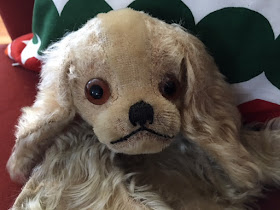
It's hip to be square with this marvelous 1930s era Steiff Charly the King Charles pajama bag. The bag itself is 30 x 30 cm, square shaped, and made from long, soft tan mohair. It closes with a metal zipper with a pull ring and is fully lined in textured light green fabric. All of these details appear to be original to the bag. The bag itself is decorated with the head of Steiff's signature Charley the King Charles Spaniel. Charly's head is made from mohair and measures about 15 cm long. It is head jointed to the bag and was designed to rotate. His face is detailed with oversized brown and black glass pupil eyes (one appears to be missing), a black hand embroidered nose and mouth, and oversized, floppy ears, just like the real dog. And cue the happy dance - this great novelty retains its long trailing "f" button as its Steiff ID. 


This functional favorite was made as part of a series of children's pajama bags in the late prewar period. They were formally called "night dress bags" and were the first style of pajama bags that Steiff launched to the world. For the most part, they are really rare and seldom seen on the secondary market as they were designed to be used and loved as toys as well as functional items. As such, most wore out or were lost to time. Their basic "template" was a simple, square shaped and lined bag with the head of a well-known Steiff pet of the era. They were produced from 1930-1937 overall and came with Teddy baby, Bully, Charly, a Scotty, a Sealyham, Molly, or a Siamese cat as the animal detailing. This is the first one Steiffgal has seen with a Charly as its featured animal.


This rare pajama bag appears to be in really nice condition overall. It is missing an eye, which sometimes happens. Replacing the lost eye would add to its appeal and presentation, and is not that difficult to do with the right needle and thread. However, it is sometimes challenging to find an exact ocular match in terms of size and era. And for some reason, eyes that don't match often look a little strange. As such, if Michael is not able to find an exact match, he may consider replacing BOTH eyes on this item to give the face a pleasing and authentic balance. Of course, it is important to note and disclose any and all known restoration on a vintage item if you are considering selling it at some point in the future.  


Steiffgal hopes this discussion on Steiff's Charly the King Spaniel pajama bag has been the crown jewel in your day today. 


Have a question about one of your Steiff treasures? Let's talk! Click here to learn more.

Saturday, January 25, 2025

This Charly Purse Is A Crown Jewel In Steiff's Prewar Novelty Production

Hold everything and check out this absolutely amazing rarity!
Steiffgal has a thing for Steiff novelties, especially those made in the prewar era. And it is certainly the best of all worlds when it comes to this breathtaking example. This Charly the King Charles Spaniel handbag will undoubtably have your vote for “Best of Show” in terms of her beauty, design, and willingness to lend a paw in service!

What we have here is Steiff’s Charly Handtasche or Charly Purse.
 This novelty is based on Steiff's beloved and legacy Charly The King Charles Spaniel pattern which debuted in the late 1920s. This precious pooch purse is 25 cm long, in a standing (albeit slouchy) position, and head jointed. She is made from long and short mohair plush. Her ears and tail are brown-tipped mohair, while her body and face are off-white mohair which has mellowed to a vanilla color. Her face is detailed with oversized brown and black glass pupil eyes and a simple black hand embroidered nose and mouth. She also has black embroidered claws on her hands and feet. And here’s what makes her a purse: her torso is hollow like a pouch, and is lined in bright orange velvet. You can see that detail in the photo on the left.  Her back opening closes with a study brass zipper. The pouch volume is quite small; it probably is the volume of about a small sized apple. This fantastic and very rare prewar novelty was produced in 22 and 25 cm from 1927 through 1940.

Steiff debuted a series of zippered, mohair purses in 1927 based on some of their most beloved characters of the era.
These measured 17 to 29 cm in size, measured horizontally. Each featured a velvet or silk lined, hollow back pocket which closed with a zipper. The zipper had a mohair ring pull to it, which probably also was designed as a small handle. These rings tend to get lost to time or wear given their function. The first button-in-ear handbag designs to appear included this Charly, as well as Jocko the Chimp, Petsy the Baby Bear, Bully the Bulldog, and Molly the puppy. Other patterns rolled out over time, with the final design being a Pip in 1941. 

Now let's do a bit of time travel. Check out this image on the left from Steiff's 1929 catalog. You can click on the image to make it bigger. The page is dedicated to their line of mohair handbags. Three young ladies are happily modeling the purses, including one with the Charly bag under discussion here today. Steiffgal thinks she looks the happiest of the gals, and for good reason! You can also see the circular mohair zipper pulls on the purses. The words on the advertisement translate roughly to, "Elegant in the arm of the lady, funny with the little ones.” The catalog page also notes that the purses were decorated with a collar or silken ribbon. 

Steiffgal hopes this discussion on Steiff's animal handbags has got you carried away - in the best possible way!

Have a question about one of your Steiff treasures? Let's talk! Click here to learn more.

Tuesday, September 7, 2021

Good Looks Run In The Family With Steiff's Prewar King Charles Spaniel Puppets!

Dog-gonnit, where did the summer go? And just like that, it's September, and all things turn to pumpkin spice. Steiffgal's final summer find turned out to be one happy handful indeed. Check out this charming prewar puppet and see what makes him so interesting from the design and historical perspectives. 


This delightful Steiff puppet is certainly of royal status! Here we have Steiff's Punch Charles, or earliest King Charles Spaniel puppet. He is 17 cm tall and made from black and tan mohair. He has a hollow puppet body and arms. His head is solidly stuffed with excelsior and has a cardboard finger tube in it. The tips of his paws have a little excelsior in them to give them form and dimension. Typical to the dog breed, he has adorable, long, and floppy mohair ears. His face comes to life with proportional brown and black glass eyes, a prominent forehead and muzzle, and a black hand embroidered nose and mouth. His IDs, which were a long trailing "f" button and either a white or red ear tag, have been lost to time.  This cheerful Charles appeared in the line from 1911-1929 overall. 


Like many prewar puppets, Punch Charles is based on a popular, full bodied animal design. He is a novelty item inspired by Steiff's precious King Charles Dog. This canine model was fully jointed and also made from black and tan mohair fabrics. He appeared in the line in 17, 22, 28, and 35 cm from 1908 through 1927. Although these were in production for a relatively long time, Steiffgal has only handled one example in decades. She suspects that is the case as they were so adorable, and lifelike, that kids simply loved them to death! You can see the full bodied King Charles Dogs here on the left, the photo is from Pfeiffer's 1892-1943 Sortiment.


Steiff's black and white, fully jointed King Charles Dog pattern was truly a legacy design for the company, appearing consistently in the line for nearly 20 years.
 In 1924, Steiff introduced a very similar looking brown and white mohair standing King Charles Spaniel in 17, 22, and 25 cm. This head jointed pattern was only produced through 1927. 


In 1928, Steiff debuted its named, and totally fantastic, Charly the King Charles Spaniel pattern. The 1924-1927 model seemed to be a transitional design between the earliest black and white King Charles Dog pattern and Charly. Charly was very typical to late 1920s introductions, and featured fluffy mohair, oversized eyes, puppy like proportions, and a distinctly childlike personality. Charly would go on to be made as a puppet in 17 cm from 1928-1939, overlapping Punch Charles production by two years... 1928 and 1929. These two cousins are pictured here. Punch Charles is on the  left, and Charly is on the right. Good looks certainly run in the family!


Steiffgal hopes you are all hands in the air over Steiff's prewar King Charles Spaniel puppet production!


Have a question about one of your Steiff treasures? Let's talk! Click here to learn more!

Sunday, February 21, 2021

Hands In The Air Over This Marvelous Prewar Steiff Charly Puppet!

The eyes have it with this marvelous Steiff creation. Steiffgal recently welcomed a rare Steiff prewar novelty into her collection... this marvelous Charly the King Charles Spaniel puppet! This darling dog has truly captured Steiffgal's heart via her irresistible expression as well as her place in the Steiff product development timeline. Admit it, you can't look away either! Come take a look at what makes this puppet such a top dog!

This happy handful is 17 cm tall, unjointed, and made from mohair.
Her body, ears, arms, and face are made from longer mohair, while her muzzle is made from slightly shorter mohair. Her head is stuffed with excelsior and is lined with a cardboard finger tube. Her ears are long, floppy, and stitched lightly to the sides of her head. Her mohair has faded overall and evenly to a mellow vanilla color. When she was new, her ears and parts of her face were light brown, and the rest of her was white. Charly has three hand embroidered black claws on each of her paws; these each have a little bit of excelsior in the ends to give them some dimension. Her pouty face comes to life with oversized brown and black glass pupil eyes and a black hand embroidered nose and mouth. She retains her long trailing "f" button as her Steiff ID. Her article number is 317, which translates to 3=mohair and 17=17 cm. This lovely puppet appeared in the line from 1928 through 1939 in this size only. 

This Charly puppet, of course, is a novelty based on the company's beloved and best selling prewar Charly the King Charles Spaniel.
Steiff introduced Charly in the late 1920s, a time of great creativity at Steiff. The original Steiff Charly was produced both sitting and standing; the two versions were head-jointed only. Charly dogs were made from light brown or orange-tipped mohair and white mohair; had extremely long fuzzy ears; large, childlike brown and black-pupil eyes; a very detailed facial seam structure; and a prominent tail. Their filling included soft kapok, meaning that they were lighter in weight and more cuddly than other animals stuffed exclusively with excelsior. Here on the left, you can see a picture of this Charly puppet, along with a number of other charming Steiff puppets in this vignette from the company's 1929 catalog. The image is from Carsten Esser's Steiff Kataloge 1920-1929.

Knowing a good thing when they saw it, the designers at Steiff recognized that Charly would be a great source for “theme and variation” product introductions, due to her popularity with collectors. As a result, she appeared as various novelties throughout the line through 1940 or so. In addition to the puppet discussed here today, other highlights included pincushions, music boxes; tiny Nomotta woolen miniatures, a purse, and a pajama bag. Perhaps the rarest Charly of all was a Pupp Animal Doll. This version was 28 cm and dressed in a playful purple outfit. She appeared in the line only from 1929 through 1930. In 2010, a Pupp Charly realized over $8,300 at auction at Christie's in London. She is pictured here on the left; the image is from Christies. 

Steiffgal hopes this discussion on Steiff's prewar Charly puppet has been a very paw-sitive experience for you. 

Have a question about one of your Steiff treasures? Let's talk! Click here to learn more.  

Sunday, October 21, 2018

All Treats and No Tricks With These Tiny Orange Steiff Treasures

When you were a kid, what was your favorite Halloween score? For Steiffgal, it was Reese's Peanut Butter Cups. How times have changed! Today, a REAL hair-raising treat would be a palm sized Steiff goodie in a Halloween pail, wouldn't you agree? So, to celebrate this spooky season in a more grownup fashion, here are a few orange hued "snack sized" treats to satisfy your Steiff sweet tooth. (Please click on any photo to enlarge it for viewing and study.) 

It's hard to outfox this teeny tiny Steiff woolen miniature Pitty fox. He is sitting, measures 5 cm, and is made from orange and white woolen threads. His face comes to life with an itty-bitty black bead nose and eyes and felt ears. Steiff's woolen miniatures are often head jointed, but Steiffgal is not sure if this is the case here as he remains in his original cardboard and plastic packaging. Steiff created a series of ten Pitty woolen miniature animals in the 1977 through 1981 time frame; all were distributed in similar bubble style packaging. It is Steiffgal's best guess is that this is the case so they could be merchandised and sold off of a standard counter rack.

Steiffgal's also nuts over this woolen miniature squirrel. She is also from the "Pitty" line. She is begging, measures 5 cm, and is made from orange woolen threads. She has a peach colored base and hands, orange felt ears, and a black button nose and eyes. Like Pitty fox, it is not clear if she is head jointed or not. On the back of her cardboard packaging, she has a white paper price tag from Saks Fifth Avenue. It notes that she costs $5. Adjusted for inflation, $5.00 in 1980 is equal to $16.07 in 2018. Pitty squirrel certainly packs alot of personality into a very small presentation!

This next happy handful is a late 1920s-era Steiff Charly King Charles Spaniel dog. He has distinctive orange mohair highlights on his ears, backside, and tail. Most of Steiff's Charly dogs were produced with brown mohair highlights, so this one is a little more unusual. Charly is sitting and head jointed. He has extremely long fuzzy ears; large, childlike brown and black-pupil eyes; a very detailed facial seam structure; and a prominent tail. Steiff made this Charly pattern both sitting (10, 14, 17, 22, 25, 30, and 35 cm) and standing (7, 10, 12, 14, 17, 22, 25, and 36 cm) through 1939.

Charly likes to troop the colors with this similarly hued Bully the Bulldog. This white and orange mohair pup is 10 cm, sitting, head jointed, and made from orange and white mohair. Orange and white Bully dogs are a little rarer than black and white Bully dogs as they were in the line for fewer years. Bully's face and muzzle area are tan velvet. He has very large brown and black glass pupil eyes and a black, hand-embroidered nose. Most remarkably, Bully retains his original and traditional horsehair collar. This is made from a long, thin strip of material which is doubled over width-wise; the horsehair fibers are sewn in between the faces of the material. The horsehair collar was a typical pre-war accessory and indicated a "regal" nature of the item wearing it. Bully was made in velvet and mohair, as well as sitting and standing, in sizes ranging from 10 to 50 cm in the 1927 through 1937 time frame overall. 

And this discussion would be unbearable without a cub representative in the mix. Here we have a 6 cm Teddy Baby Replica 1930. He is technically cataloged as "maize" in color to reflect his corn colored hue. This tiny Ted is fully jointed and has all the traditional Teddy Baby characteristics - including downturned wrists, flat feet made for standing, and a charming, youthful face - albeit on a super small scale. Maize Teddy Baby appeared in the line from 1998 through 2001.

Steiffgal hopes you found this discussion of tiny orange treasures all treats and no tricks. 


Have a question about one of your Steiff treasures? Let's talk! Click here to learn more!

Sunday, December 4, 2016

The Best of The West!

Talk about a California gold rush, Steiff style! Steiffgal recently traveled out west to attend Steiff celebrations on behalf of the company. Attendees were invited to share their personal treasures at these events at fun "show and tell" sessions.  And boy, did they ever! Steiffgal had the pleasure of seeing a number of family heirlooms, some childhood favorites, delightful woolen miniatures, and even one of the company's extremely rare "125 carat" bears, made with real gold mohair. Here are a few of the 14k vintage treasures collectors brought along that really caught Steiffgal's eye!

Sit and stay and take a look at this great King Charles Charly dog. This precious pooch is 14 cm high, sitting, head jointed, and made from white and brownish/orange tipped mohair. His adorable face comes to life with oversized brown and black pupil eyes, a hand embroidered black and white nose and mouth, and an irresistible, "pouty" expression. He was produced in 7 sizes ranging from 10 to 35 cm from 1928 through 1936. Sitting Charly was also produced as a music box in 17 and 22 cm from 1928 through 1931 and on a pincushion in 17 cm from 1929 through 1932.

And what makes this Charly a champion? Steiffgal loves his mile-long ears and huge personality. His size makes him easy to display, and a perfect companion for a larger vintage doll or bear. Plus, a dear friend of hers has a real-life Charly, so this breed and pattern really pulls on her heartstrings.

Rolling right along, this early postwar elephant on wheels also made a huge impression on Steiffgal! This big boy is Steiff's Zieh Elefant or Pull Toy Elephant. He is standing on all fours, unjointed, and made from lovely grey mohair. His face is detailed with black eyes that are backed in pink felt, a smiling mouth, and white felt tusks. The bell on his trunk helps announce his arrival.  Elephant's feet pads are grey felt. He is dressed to the nines in a red and yellow trimmed blanket; this is original to him. His red leather headwear has been lost to time. He glides along on four blue wooden wheels. This elephant on wheels was made in 28 and 35 cm from 1950 through 1961 overall.

Why is this piece so ele-fantasic? This timeless pattern includes design elements from as early as the 19-teens. His condition is the perfect balance between showing some love and play wear, yet still fine enough to have tremendous collector's interest and appeal. And who can resist his open, smiling mouth and delightful felt tusks?  Certainly not Steiffgal!

And finally, size defies with this beautiful baby bunny. This happy hopper is begging, unjoined, and made from white velvet. He is unjointed and decorated with a few brown spots here and there. His face just shines with black shoe button eyes, a simple brown hand embroidered nose and mouth, red airbrushed highlights, and clear monofilament whiskers. His red ribbon is original to him; one way to "test" for this is to see if the ribbon is stitched in place, or if there is evidence if that was once the case. This version of Steiff's velvet begging rabbit was produced in 4 sizes ranging from 10 to 28 cm from 1899 through 1927 overall.

Begging to know what's so cool about this sweet treat? First, his condition is really amazing, showing only minimal darkening over time. He was originally very white, but white velvet tends to become tan or even brown over time, even with careful handling. Kudos to his current owners for keeping him so well protected! Second, his pattern is among the most desirable, early designs produced by Steiff. Collectors can't seem to get enough of the company's small, early, velvet patterns. A similar sized velvet begging rabbit in far less pristine condition recently sold for about $1,000 on eBay. And finally, you can't help but notice his wonderful IDs - his full white ear tag and long trailing "F" style button. The numbers on his ear tag correspond to: 4=begging or standing on back legs; 4=velvet; and 14=14 cm tall. These "small" tag details make all the difference in determining if an item is good or great.  And this begging rabbit is blue ribbon calibre indeed!

Steiffgal hopes this quick peek at event "show and tell" highlights has put you in a festive mood indeed.

Have a question about one of your Steiff treasures? Let's talk! Click here to learn more!

Saturday, May 7, 2016

It's A Family Affair When It Comes To Steiff's Classic Pre-War Canines!


For many lucky collectors, Steiff is truly a family affair when parents, siblings, and other relatives also participate in the "button-in-ear" fun! Steiffgal "inherited" her love of Steiff, as well as some of her beloved Steiff family heirlooms, from her paternal Grandmother. Given that Mother's Day in the USA is right around the corner, Steiffgal thought it would be fun to share some of her favorite "family" photos. But don't worry, there's no embarrassing snapshots of cousins in ill-fitting swimsuits eating ice cream cones together on vacation in 1974. These are pictures of families of pre-war Steiff dogs doing what they do best - looking irresistible!

This first family has always been considered "royalty" among Steiff fans. Here we have a sweet trio of the company's "Charly" dogs. These, of course, are modeled after the King Charles Spaniel breed. Each is standing on all fours and made from mohair. All but the bitty baby are head jointed. This pattern is known for its very long, floppy ears and pert tails. Charly dogs traditionally come to life with expressive and oversized eyes, a prominent forehead, freckles on their muzzles, and hand embroidered noses and mouths. Papa Charly is 14 cm tall and 16 cm long; Mama is 8 cm tall and 10 cm long; and Baby is 6 cm tall and 9 cm long; these measurements do not include their tails. Overall, standing Charly was manufactured in six sizes ranging from 7 to 22 cm from 1928 through 1938.

Sit and stay and have a good look at this second Steiff family. These black and white beauties are, of course, a pack of Steiff's Bully dogs. Their pattern is based on the English Bulldog breed. These Bully dogs are all sitting and head jointed.  Papa and Mama are primarily made from black and white mohair and have poseable ears lined in wires. Baby is made from black and white velvet and has stationary ears. All have face and muzzle areas made from tan velvet, prominent jowls, very large brown and black glass pupil eyes, and black, hand-embroidered noses. Papa Bully is 19 cm tall; Mama is 15 cm tall; and Baby is 9 cm tall. Sitting black and white mohair Bully dogs were produced in 9 sizes ranging from 10 to 50 cm from 1927 through 1938 while sitting black and white velvet Bully dogs were produced in 4 sizes ranging from 7 to 17 cm from 1927 through 1939.  

Hold your horses! Most interestingly, these beautiful Bullies all retain some or all of their original and traditional horsehair collars. These are made from long, thin strips of material which are doubled over width-wise; the horsehair fibers are sewn in between the faces of the material. Each collar is held together with a little knot under Bully's chin. The horsehair collar was a typical accessory of the 1920s and indicated a "regal" nature of the item wearing it.

Great Scot, we've already made it to the third and final Steiff family under discussion today. These grey-black pups are utterly charming Steiff Scotty dogs. All are standing and made from black mohair that almost has a "salt and pepper" cast to it. Mama, on the left, is a rare example of the company's tail- turns-head Scotty. She has tri-color almond shaped glass eyes and felt lined ears. Baby, in the middle, and Papa, on the left, have dark black mohair ears, round black and brown glass pupil eyes, and handsome, original black and white woven leather collars that close with two Steiff buttons each. Papa is head jointed and Baby is unjointed. Papa Scotty is 14 cm tall and 20 cm long; Mama is 10 cm tall and 22 cm long; and Baby is 8 cm tall and 12 cm long; these measurements do not include their tails. Tail-moves-head Scotty was produced in 6 sizes ranging from 9 to 26 cm from 1931 through 1934 while the company's regular line standing Scotty dogs were produced overall in 8 sizes ranging from 8 to 35 cm in either gray or grey-black from 1930 through 1943.

Steiffgal hopes this discussion of these great Steiff dog trios has been a family affair for you!


Have a question about one of your Steiff treasures? Let's talk! Click here to learn more.

Monday, July 13, 2015

Less Is More When It Comes To Steiff's Teeny Tiny Pre-War Mohair Dogs

Steiffgal’s a little short on time this week for blogging. So this is a perfect moment to introduce you to one of the most petite treats in her collection – a tiny and very early Steiff Molly Dog. Take a big look at this particularly small pup and see what makes her so interesting – and irresistible!

This happy handful is the smallest version of Steiff’s Molly the Puppy dog. She is sitting, unjointed, and just a hair over 6 cm tall from head to toe measured vertically. She is made from white and brown tipped mohair. Her wee face comes to life with brown and black glass pupil eyes, a simple black hand embroidered nose and mouth, and the pattern’s typical “folded over” style ears. And she even retains her long trailing “f” style button after all of these years. This little girl indeed is the smallest version of Molly produced (formally documented as 7 cm), and appeared in the line from 1927 through 1943. Pre-war, this sitting brown and white Molly pattern was produced overall from 1925 through 1943 in 12 sizes ranging from 7 through 80 centimeters. She was one of the very first models reintroduced post war, reappearing again in 1949 in five sizes ranging from 10 to 25 cm through 1969.

Molly the Puppy is arguably that most important dog pattern ever produced by Steiff. The 1925 introduction of Molly proved so popular that she is credited for opening the floodgates to a huge influx of Steiff dog designs. Between 1925 and 1938, close to 40 new canine species were noted in the Steiff catalogs after her debut, many reflecting her wide eyed expression, childlike proportions, and happy disposition. These included the now classic Bully the Bulldog, Charly the King Charles Spaniel, and Treff the Bloodhound, as well as some lesser-known designs including Cheerio, the laughing dog, and Putzi, a caricatured standing dog.  And despite her advanced age and location on the family tree, this Molly still enjoys a good time; she is pictured here on the left enjoying a "Strawberries and cream" iced tea drink at the Mad Hatter's Tea at the Sanderson Hotel in London. 

And what about her size – or lack of it, in this case? She is indeed tiny, so much so that Steiffgal didn’t even notice her the first time she was checking out a remarkable window display of vintage dolls and toys in the shop of a new friend. But upon a second review, there she was, and now Steiffgal can’t take her eyes off of her! (And, according to the picture to the left, Molly can't take her hungry eyes off a tiny quiche from the same Mad Hatter's Tea!) 

Ironically, really small Steiff mohair animals can be harder and more complicated to make than their larger siblings. This is because their scale requires especially careful material cutting, intricate stitching, labor intensive turning, and especially precise stuffing and finishing. There just isn’t a lot of “wiggle room” for mistakes or manufacturing variation with these tiny mohair treasures; and because they are not economically efficient to produce, their small stature usually is accompanied by a larger than expected retail price tag. As a result, Steiff created relatively few 7 cm sized pre-war era canine companions; these included Bully the Bulldog, Charly the King Spaniel (pictured here on the left with her fellow 7 cm Molly companion), a few Fox terriers including Spotty, Treff the Bloodhound, and Fellow the black and white puppy. Post war, as far as Steiffgal can tell, the only 7 cm mohair dog Steiff made was Fox the Fox terrier, who only appeared in the line in this smallest size in 1949.

Steiffgal hopes this little post on this tiny Steiff Molly adds a big smile to your day.

Have a question about one of your Steiff treasures? Let's talk! Click here to learn more.

Sunday, August 10, 2014

This Sweet Steiff Spaniel Is Worthy Of A Crown!

Best of show!  Few could argue that Steiff's early canines are truly top dogs!  One of Steiffgal's most favorite 1920's-era pooch pattern is that of Charly, the King Charles Spaniel.  In real life, this breed was one of the "it" dogs of the 1920's.  In addition to being a beloved pet, a "Charly" was often considered a "style accessory," accompanying well dressed society ladies on their important business of the day.

Steiff introduced Charly in the late 1920's, a time of great creativity at Steiff.  Many dog patterns were also debuted around the same time; this was in part due to the overwhelming popularity of the "grandmother of all Steiff dogs," Molly the puppy, who debuted in 1925.   The original Steiff Charly was produced both sitting (10, 14, 17, 22, 25, 30, and 35 cm) and standing (7, 10, 12, 14, 17, 22, 25, and 36 cm); the two versions were head-jointed only. Charly dogs were made from light brown or orange-tipped mohair and white mohair; had extremely long fuzzy ears; large, childlike brown and black-pupil eyes; a very detailed facial seam structure; and a prominent tail. Their filling was soft kapok, meaning that they were lighter in weight and more cuddly than other animals stuffed with crunchy excelsior. Sitting and standing Charly appeared in the line overall through 1939. You can see examples of sitting and standing Charly dogs here on the left.

Knowing a good thing when they saw it, the designers at Steiff recognized that Charly would be a great source for “theme and variation” product introductions, due to his popularity with collectors.  As a result, he appeared in various forms throughout the line through 1940 or so.  Highlights included:

A pin cushion, in two styles - a sitting and standing version.  Both were mounted on a square mohair pincushion—the sitting version was produced from 1929 through 1932, and the standing version was produced from 1930 through 1932.  The standing version is pictured above; the photo is from Christie's.

A puppet.  Charly was produced as a 17 cm mohair puppet from 1928 through 1939.  If you click here, you will go to a page where you can see a number of Charly puppets and others from the same time frame.  This collection website is one of Steiffgal's most favorite; the treasures  are truly phenomenal and very well displayed!  

Musical animals. Steiff produced musical Charly dogs in both sitting and standing styles from 1928 through 1931 overall. The sitting musical Charly was made in 17 and 22 cm. His music box was activated by squeezing his sides. For some smaller versions of the standing musical Charly, his music box was a bit more unusual; in order to play the music you would pull the tail, not wind it. Steiffgal cannot think of another Steiff music box character that was activated this way. Standing musical Charly was produced in 17, 22, and 25 cm; a medium sized standing musical Charly is shown above.  The photo is from Christies.

Tiny 10 cm woolen Nomotta woolen miniatures.  These were made in both sitting and standing patterns from 1935 through 1937 overall.  Their bodies were "pom-pom" style while their ears were made from mohair and were lined in felt. Despite their demunitive size, these petite treats were distinctly "Spaniel" with their dear looks and prominent tails!

A charming child's purse.  Charly Purse was produced in 22 and 25 cm from 1927 through 1940; in this version, Charly was head jointed and his belly was hollow like a pouch and lined in velvet.  You can see the Steiff's original Charly purse is shown above.  It is interesting to note that this purse was reissued as a North American Limited edition replica in 2005.  For more about this fun and functional item, please click here!

A pajama bag.  Charly Nachthemdentasche or "Charly Night Dress Bag" was produced in 30 cm from 1930 through 1935.  In this version, Charly's head was sewn onto a 30 cm x 30 cm mohair zippered bag that was designed to hold children's sleeping clothes during the day.  This unusual item is shown above; the photograph is from Pfeiffer's Steiff 1892-1943 Sortiment. 
 
And perhaps the rarest Charly of all - a Pupp Animal Doll.  This version was 28 cm and dressed in a playful purple outfit.  He appeared in the line only from 1929 through 1930.  In 2010, a Pupp Charly realized over $8,300 at auction at Christie's in London; he is pictured above.

Steiffgal hopes this discussion on Steiff's wonderful Charly dogs has made you feel like King for the day. 

Have a question about one of your Steiff treasures? Let's talk! Click here to learn more.  

Saturday, June 1, 2013

Chin Up Over This Sweet and Unusual Early Steiff Dog

Dog-gonnit, if you are in need of a smile today, chin up!  You have come to the right place for sure. Besides Teddy bears, dogs are second in line as true Steiff superstars.  From the very beginning of the company, dogs have been a huge and important part of the Steiff product offering.  Today Steiffgal would like to share with you one of the more unusual pre-war Steiff dogs - the company's Chin Chins; a typical example is pictured here on the left.  Let's take a look at this early and exotic dog as interpreted by Steiff and see what makes it so interesting from the design and historical perspectives.  

Face it, there's not much not to love about this toy dog treasure!  What we have here is Steiff's Chin Chin.  She is standing and head jointed.  Her tail, chest, sideburns, and ears are made from longer tan mohair, while her body, limbs, and face are made from shorter tan mohair.  She has a squeaker in her belly, and her ears are lined in velvet. Her tail is firmly tacked to her back in a most showy way!  Chin Chin's prominent muzzle is detailed with a black hand embroidered nose and mouth as well as traces of pink and black airbrushed highlights.  Her oversized, black and brown pupil eyes are typical of her period of design, and can also be seen on her distant cousins Molly the Puppy, Bully the Bulldog, Charly the King Charles Spaniel, and others.  

Overall, Chin Chin was produced in 10, 14, 17, 20, 22, 25, 28, and 35 cm from 1931 though 1939.  Some of the smaller models had velvet muzzles and legs in addition to their velvet lined ears.

Despite their enormous appeal, Steiff's Chin Chin dogs - unlike other Steiff "pet" designs of the time - were not produced in a large range of variations.  A 15 cm Ball Chin Chin, which like its name suggests is quite round, was produced as a throw toy with elastic straps from 1932 through 1935.  Steiff also manufactured a 10 cm version on a string as a crib toy from 1931 through 1943, and a 10 cm miniature Nomotta wool "woolie" version from 1935 through 1937. A sitting model was prototyped but never put into production; this is pictured here on the left.  The photo is from the catalog of the Christie's 2010 Steiff Auction in London.  

Steiffgal hopes this introduction to Steiff's rare Chin Chins has been a win win for you.

Have a question about one of your Steiff treasures? Let's talk! Click here to learn more.

Saturday, May 18, 2013

This Singing Steiff Spaniel Has Things All Buttoned Up

Some Steiff items are worthy of royalty - especially the company's beloved King Charles Spaniels!  So it should come as no surprise that Steiffgal all but rolled out the red carpet when a dear friend and fellow collector brought this musical "Charly" to her attention!  This dog truly is best of show for so many obvious - and not so obvious - reasons.  Let's take a look at this crownworthy canine and see what makes him so interesting from the design and historical perspectives.


You can't help but want to break into song over this delightful doggy.  This "Musik-Charly" is standing, head jointed, and made from long mohair.  His body and legs are white mohair, while his tail, long playful ears, and the sides of his face are made from brown tipped mohair.  Charly has a very detailed facial seam structure which really emphasizes his sweet and innocent look. His face is detailed with oversized black and brown pupil eyes, a black hand embroidered nose and mouth, and a few freckles on his muzzle.  Charly's music box is activated by pulling on his tail.  Overall, this particular model of standing Musik-Charly was produced in 17, 22, and 25 cm from 1928 through 1931.  Steiff also produced a sitting version of Musik-Charly in 17 and 22 cm during the same time frame. 


Charly has two very interesting features that make him top dog.  The first is his musical mechanism.  In the late 1920's and early 1930's, Steiff produced a number of "Musik" animals based on the company's most popular designs of the day.  These included Molly the puppy, Bully the bulldog, Fluffy the cat, and a sweet standing lamb, among others.  These were all activated either by gently squeezing and releasing the midsection or loins of the animals, or by turning the animal's tail.  However, for the standing Musik-Charly, his music was produced by tugging gently on his tail - not by turning it.


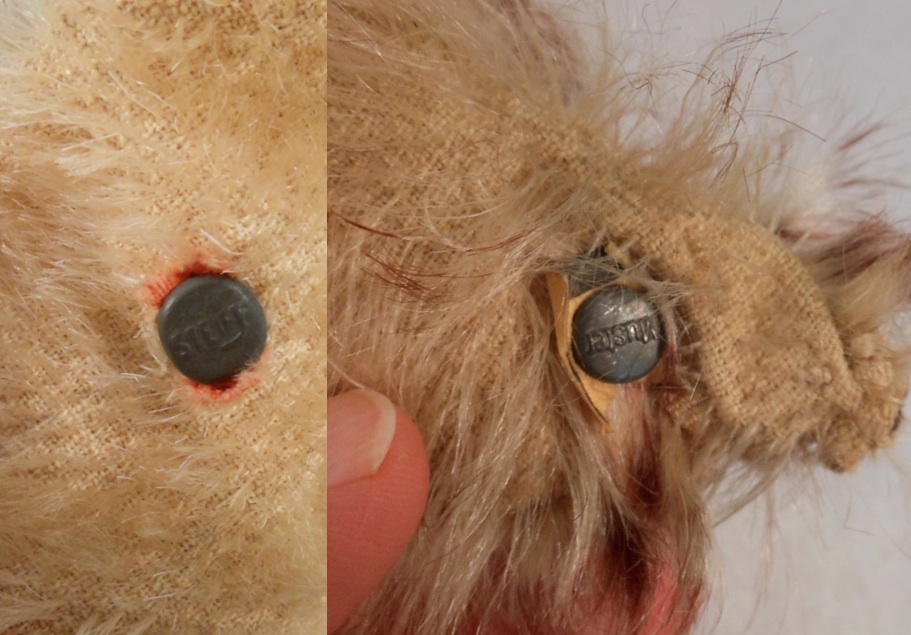
It won't take much to muster your attention towards Charly's second fantastic feature.  In addition to his standard Steiff trailing "f" style button in his ear (on the left size of the photo), Charly also sports a second button in his tail area.  This button, called the "muster" button, was used by Steiff pre-WWII on items considered samples, evolving designs, or prototypes. This is pictured here on the right side of the photo. In general, the button indicated that the item was Steiff property and was not intended for sale or distribution.  "Muster" translates loosely from German to English as "pattern" and in a sense, these "muster" items were just that.  This Charly's "muster" button suggests that he was made in 1928 or before, as the company was gearing up to put this model into production.  

It is interesting to note that Charly didn’t start out as a musical animal, but evolved into one. The original Steiff Charly dog was introduced in the late 1920s. He was produced both sitting (10, 14, 17, 22, 25, 30 and 35 cm) and standing (7, 10, 12, 14, 17 and 22 cm); the two versions were head jointed only. Their filling was soft kapok, meaning that they were lighter in weight and more cuddly than other animals stuffed with crunchy excelsior. An example of the 7 cm standing version is pictured here on the left.  Overall, the Charly pattern appeared in the line through 1936. 

Charly proved to be a great source for highly successful “theme and variation” product introductions, due to his popularity with collectors. He appeared as a 17 cm light brown and white mohair puppet from 1928 through 1939.  Both the sitting and standing versions were produced as pincushions in the 1929 through 1932 time frame.  He was also made as a 10 cm standing or sitting nomotta woolen miniature from 1935 through 1937, a 22 and 25 cm purse from 1927 through 1933, and as a playful, purple dressed 28 cm Pupp-animal doll (pictured on the left, photo from Christie's) from 1929 through 1930.

Steiffgal hopes the discussion on this most amazing vintage Charly dog has been like music to your ears.   

Have a question about one of your Steiff treasures? Let's talk! Click here to learn more.  

Tuesday, July 10, 2012

A Few Of My Favorite (Steiff) Things

Raindrops on roses, and whiskers on kittens... are a few of Julie Andrew's favorite things for sure!  What's on your list?  Hopefully a piece of Steiff, or two or three!  Steiffgal is traveling this week, so in the interim before next week's new question and answer post, she thought she would share a few treasures with you that she has had the pleasure of adding to her collection over the past year or so.   So without further ado, please check out her top three highlights!


The first item is both huge and tiny at the same time!  Here we have Steiff’s 12-centimeter baby Dinos Stegosaurus dinosaur. He is unjointed and standing on all fours, made from tan-colored mohair that has been painstakingly hand airbrushed in a full spectrum of greens, blues, purples and browns. Dinos has a matching felt fin along his back and a sweet, baby-like face. His head is detailed with an open, pink lined felt mouth; green and black google style eyes; and little yellow felt ears. Dinos was produced in 12 and 42 cm as a U.S. exclusive from 1958-59 only. He retains his complete set of ID that includes a named chest tag, raised script button, and crisp, fully legible yellow ear tag.  


The second item is quite a doll - literally.  What we have here Steiff’s Zwerg Puck or Dwarf Puck, who stands 20-centimeters tall and is five-ways jointed. He is quite detailed and very charismatic for his size! His face, a classic “center seam” design, is made from felt and is detailed with shiny black eyes, a comical, round nose, an open, smiling mouth, ruddy cheeks, large ears and a very long, white mohair beard. He has large, clown-like felt hands and very skinny fabric legs. His clothes, which are integral to his body, consist of a light blue felt jacket, a brown felt shirt and blue and white cotton calico pants. He has donned a triangular-shaped yellow mohair hat. He has very large feet (proportionally) and is wearing denim blue-colored fabric boots.


And finally - it's quite clear this fantastic find has quite a purse-sonality.  What we have here is Steiff’s Charly Handtasche or Charly Purse. This precious pooch is 22 centimeters tall in a standing (albeit slouchy) position with a jointed head. She is made from long and short mohair plush and her ears and tail are brown-tipped mohair, while her body and face are off-white mohair. Her face is detailed with oversized brown and black-pupil eyes and a simple black hand-embroidered nose and mouth. She also has black embroidered claws on all four paws. And here’s what makes her a purse: her belly is hollow like a pouch, and is lined in lime-green velvet. It closes with a study brass zipper. The pouch volume is quite small; it probably is the volume of about a small-sized apple.  According to Steiff records, this Charly Purse was produced in 22 and 25 cm from 1927 through 1940. This particular example, with her trailing “F” Steiff button and red ear tag, was made in the 1928-through-1934 time frame.


Steiffgal hopes this 1-2-3 review of delightful Steiff treasures has been a delightful numbers game for you.

Have a question about one of your Steiff treasures? Let's talk! Click here to learn more   
The teddy bear search engine