Showing posts with label doll. Show all posts

Sunday, December 1, 2024

This Prewar Steiff Riding Bulldog Is The Wheel-Deal Indeed!

Look at what just rolled under the Christmas tree of this lucky collector! What a bow-wow beauty for sure! But just who is this captive canine, and what is the story behind him? A new friend shares,

"Hi, my name is Jeanette and have been dabbling with collecting bears, etc. for near on 45 years. My latest find is a Steiff pull along Bully Bulldog. He stands 15" tall not including the wooden wheeled frame. From nose to tail, he is 17" long, his ears have long gone. He has a leather collar with remnants of horse hair still attached to it, it also has Steiff buttons all around it, in total 12 buttons are present. He also has his original bell attached to the collar. He has a pull string still attached, but unfortunately no noise is made when it is pulled. He has large amber and black glass eyes, a black stitched nose, and velvet muzzle. The wooden wheels measure 2.5" in diameter. The pull along frame has a moving front axle, so it can change direction. Any help you can give me, i.e. date, etc. would be greatly appreciated. Thanks in advance!"

This dog on the go would take the pole position in any vintage Steiff enthusiast's collection. What Jeanette has here is Steiff's Bully Bulldog riding animal. This fine fellow was made in 28, 35, 43, and 50 cm in black and white, orange and white, or tan and white from 1927-1936 overall. This model is measured vertically from the top of their heads to their toes, not including their wheels. As such, Jeanette's treasure is the either a large version of the 35 cm or a small version of the 43 cm version; it is Steiffgal's best guess he started out life closer to 43 cm and sort of shrunk over time (like the best of us.)

The condition of Jeanette's Bully is commensurate and typical to that of a beloved ride-on animal.
These realities include things like alot of wear on the back/top areas where a child would sit, a silent squeaker from overuse, and the loss of ears which were probably used as handles for much of its working life! Fortunately, it is not terribly difficult to replace the black velvet ears on this pattern, and Steiffgal would consider doing that restoration if this Bully was in her collection.

One thing that really pops on this example is his great BLING! According to Pfeiffer's 1892-1943 Sortiment, this item is described in part as, "mohair plush, horse hair or leather collar, standing, riding animal, wheels, connecting frame, swivel head, squeaker (barks.)" Jeanette's Bully has a fantastic collar featuring a combination of horse hair detailing as well as a cascade of long trailing f buttons - truly the best of all worlds.

The Bully Bulldog that we all know and love was introduced in 1927.
This design was an instant sensation with both children (as a plaything) and adults (as a collectible and an accessory). He was modeled on the French Bulldog—the “it” companion of those in the know at the time. Bully's pattern featured oversized glass pupil eyes, a black embroidered nose, and a snout and jaw constructed to give him his requisite breed jowls. Full bodied Bully was made in velvet and mohair, as well as sitting and standing, in sizes ranging from 10 to 50 cm through 1939 overall. Here on the left, you can see Bully as he appeared in the company's June, 1927 catalog. This image is from Carsten Esser's Steiff Catalogue 1920-1929.

Given his popularity, beautiful Bully was also produced in numerous novelty forms. These included as a pincushion, pull toy, dangling Charleston doll, jointed dog doll, puppet, purse, and pajama bag, among others. Today, prewar Bullies are one of the most universally desirable and sought-after pre-war Steiff designs among collectors - especially those like this one on wheels! Prewar Bully has been replicated numerous times over the past few decades and even these newer models are coveted by collectors.

Steiffgal hopes you've enjoyed this discussion on this Riding Bully, even if just in a roundabout sort of way.

Have a question about one of your Steiff treasures? Let's talk! Click here to learn more.

Sunday, May 19, 2024

Keeping It Tru With This Mysterious Prewar Steiff Doll

Hat's off to another great Steiff find! Here we have a lovely prewar Steiff doll that recently joined Steiffgal's hug. Her condition and coloring is stunning, and you can't help but admire her perfectly coordinated outfit - and how well she wears it! But behind this little gal are a number of really big mysteries. Take a look at Trude and see what makes here so intriguing from the product design and historical perspectives.

What we have here is a precious pressed felt faced doll named Trude. She is 35 cm, standing, three ways (head and legs) jointed, and excelsior stuffed. Her face is made from flesh colored felt, while her limbs and trunk are made from flesh colored linen. Her arms are floppy and hang loosely by her sides. Her arms are bent slightly at the elbows, and she has very defined fingers. Her face is highly textured, with chubby cheeks, a realistic mouth, pert nose, and lifelike blue glass eyes embedded in eye sockets. Her facial painting is lovely and done with a gentle hand. Even her little ears are sculpted just like a child's. She is finished with a blond mohair wig, which is seamlessly integrated into her head structure. Trude's IDs include her red rubber bracelet, tan colored tag, and teeny tiny prewar button. You can see her IDs close up in the photo below. 

Trude's outfit is adorable and fits her to a "t". She wears a white cotton "one-sie", which is trimmed with lace around the leg openings and bodice. It has thin little straps which fit over her shoulders to help keep it in place. Her short sleeved white cotton blouse is removable and closes in the back. It is cropped and detailed with red pull strings at the neck and arms. She wears a cotton dress that closes with two metal snaps and is detailed with a ruffle around the waist area. The fabric features yellow, blue, black, white, and green wildflowers on a red background. Her footwear also is removable and consists of white cotton socks and red felt Mary-Jane style shoes. And she retains her original red and yellow wide brimmed hat, which is trimmed and ties with a red silk cord.

Trude is super interesting for number of subtle reasons. Steiff's "pressed felt" face doll line was produced from 1937 through 1943, and then again in 1949 and 1950. Steiffgal cannot locate a c. 1930s-1950s era doll of her construction with that name. The fact that her name was written by hand on her tag suggests that only a few of these dolls with this name were made. But more on that in just a moment! Also of note is her construction. Many to most of these wartime era dolls were made entirely from felt, but this example has a felt head and a linen body and limbs. This may suggest that she was manufactured when fine toy making materials were unavailable or expensive due to wartime rationing or shortages - perhaps in the very 1930s to early 1940s. As a result, matching linen in the place of felt was used instead in less "visible" areas of the doll's anatomy. 

Trude is dressed and resembles one of Steiff's standard line production pressed felt faced dolls named Gretel. Gretel was made in 35 and 43 cm from 1938-1942 overall and is also dressed in a similarly styled red dress with snaps, a white blouse, and red felt shoes with white socks. The most obvious difference between Trude and Gretel in terms of outfits is that Gretel wears a red hairband, and Trude has an oversized felt hat. You can see a picture of Gretel here on the left, the image is from Pfeiffer's Sortiment 1892-1943.

So here is where there are more questions than answers about Trude. Was she made to substitute for Gretel in terms of her materials and construction? Was she perhaps a sample of some sort? Why doesn't she appear in any Steiff materials, as far as Steiffgal can locate? And why does she have a large, glorious felt hat... given the rest of her is constructed to minimize the use of this premier toy making fabric? Well, only she knows for sure... and unfortunately, she's not talking!

Steiffgal hopes this discussion on Steiff's terrific Trude doll has been a playful addition to your day. 

Have a question about one of your Steiff treasures? Let's talk! Click here to learn more.

Friday, October 6, 2023

This Rare Steiff Cartoon Doll Is No Laughing Matter!

Steiff certainly has international appeal - and so do many of the company's rarer prewar novelties! Check out this note from a lucky collector who hit it really big with a fantastic doll purchase. Stefan shares:

"I hope this email finds you well and you're doing well. Recently I purchased a figure, which I'm 99% sure it's Steiff. It's a comical character, known as Silent Sam in America, but in Europe known as Adamson. I was just wondering, do you know what year it was manufactured? Thank you so much.  
Kind regards, Stefan"

This delightful cartoon doll is no laughing matter! Here we have Steiff's Adamson doll. This fine fellow is 29 cm tall, fully jointed, and made from felt. His face comes to life with dramatic seaming, blue and black glass pupil eyes backed in large white felt circles, a dimensional nose, and a bald head highlighted with a few remaining black hairs. He smokes a brown and white cigar, which is integral to his mouth. He wears a red and white shirt with cuffs; a white vest detailed with buttons, a collar, and a blue tie; blue pants, and white shoes. These dolls were made from 1925-1929 in this size only. According to the Cieslik's Button in Ear The History of the Teddy Bear and His Friends reference book, 997 examples of this doll were sold. The Ciesliks also note, "In 1925 Steiff adopted Adamson into their program after several trial attempts. For Adamson was not easy to portray; he had a cigar in his mouth which he rarely removed." 

So just who is this cute character?
Adamson, also known as Silent Sam, was the star of a cartoon strip drawn by Oscar Jacobsson (Swedish, 1889–1945). It debuted on October 17, 1920 in the Swedish humor publication Söndags-Nisse. What was so interesting - and universal - about Adamson is that he almost never spoke or used words. Instead, he went about his business and communicated with gestures and movements. As such, Jacobsson's character would go on to be appreciated and enjoyed internationally across all of Europe, the USA, and Asian countries including Japan and China. Silent Sam was a big hit in America starting in 1922. Over time, a series of artists brought the strip to life until it was last published in 1964. 

To honor Jacobsson and his contribution to the art of illustration, the Swedish Academy of Comics founded the Adamson Award in 1965. It is given to one Swedish and one international comic creator every year.  You can see a sample of the Adamson cartoon above on the left. 

Adamson dolls are certainly few and far between, and Stefan is super lucky to have one in his collection.
As far as Steiffgal can tell, only three examples of Steiff's Adamson dolls have come up for public auction from 2017 onward. All were sold by Ladenburger Spielzeugauktion GmbH of Ladenburg, Germany. They ranged in hammer price from 2600 to 4500 euro. The doll pictured here on the left hammered for 4200 euro in 2021; the image is from 
Ladenburger Spielzeugauktion GmbH.

Steiffgal hopes this blog post about this cigar smoking doll has really lit up your day. 

Have a question about one of your Steiff treasures? Let's talk! Click here to learn more.

Sunday, August 27, 2023

Getting Carried Away With A Most Unexpected Antique Steiff Find!

Steiff treasures sometimes appear when you least expect to find them.
Steiffgal recently participated in an online auction. One of the lots listed was a simple and somewhat common midcentury button-in-ear bear. He was super sweet, but nothing really out of the ordinary. Except he was wearing a backpack. This accessory was pictured in one photo of his listing, but not really called out in the description. At the last moment, as he was being sold, Steiffgal took a closer look at his backpack... and realized that it was an absolute Steiff rarity hiding in plain sight. Come take a look at this amazing accessory and see what makes it so appealing from the collector's perspectives.

First, let's get carried away and check out the detailing of this tiny treasure.
The rectangular shaped backpack itself measures 8 cm x 6 cm x 2 cm overall. The front flap is made from brown mohair. The edges are trimmed in red, and it is monogrammed "DL" also in red. The rest of the case is made from brown canvas. The bottom inside is lined with a small piece of cardboard to hold the backpack's shape and angles. The backpack's straps are made from soft brown leather. They close with metal buckles and loops attached to the bottom of the backpack, and to leather straps that are attached to the front flap. The backpack itself has no specific Steiff branding to it. It does has the look, feel, and quality of the company's first quarter of the 20th century accessories - mostly seen on Steiff's military dolls in the form of soldier's kits, canteens, bread bags, etc.

But hold everything - that's not all!
This little time capsule also held a delightful secret. When Steiffgal CAREFULLY opened it up, she discovered two dolly-scaled, double sided chalkboards packed perfectly within the backpack's internal storage space. These lesson boards measured 8 cm x 5 cm and were made from thick brown cardboard with a black painted center. The outer corners of each blackboard were painted silver, and each also had a little hole and a hanging string. Traces of a math lesson could be found on one of them. They also had the look, quality, and detailing of premier Steiff accessories from the first quarter of the 20th century.

So what does all this mean?
This backpack was produced around 1909 or 1910 and was designed - at least in part - to go with the company's line of school children dolls. So the chalkboards make perfect sense here! Steiff designed and produced a number of classroom-style display vignettes featuring their school pupils and their perfectly to scale scholarly accessories through the early 19-teens. According to the Cieslik's Button in Ear book from 1989, "Steiff designed a few versions of this vignette, a smaller one with nine dolls as pupils and their teacher, and a larger one with 13 pupils and a teacher. All school furniture and accessories could be ordered from Steiff. In 1910 Steiff sold 45 complete school displays.” You can see a photo of one of these partial vignettes here on the left; the image is from Theriault's and they sold this set for $50,000 in 2012. Check out those backpacks and chalkboards, too!


Steiffgal hopes this discussion on this tiny, turn of last century Steiff bookbag (also pictured here on the left on a wonderful Steiff student sold on eBay a few years ago) has put you in a back-to-school sort of way. 

Have a question about one of your Steiff treasures? Let's talk! Click here to learn more!

Sunday, August 20, 2023

What a Devilishly Interesting Steiff Mystery!

The devil made me do it! But in this case, it's all in good fun! Check out this note from a new friend who asks about an unusual item she found among her Mother's things. What do we have here? And could this man in red be made by Steiff? Darcie shares:

"I have a red devil doll with a Steiff tag but it is not attached. So I am not sure if it was made by Steiff. I thought Steiff’s have the metal button/tag on them. Can you help?"


Well hell-o handsome! What a great find! Although not specified, it would be Steiffgal's best bet that this devil doll is nearly identical to the blue felt version Steiff made of the Duke University Blue Devil mascot. The Duke Devil was jointed, with a felt body and a rubber head with horns. He was detailed with a blue felt suit, long blue felt tail, and white felt shoes, and carried a three pointed spear. He appeared in the Steiff line from 1954-1958, and then again from 1959-1963 as part of Steiff's early post war series of university and institutional mascots. These charming mascots were featured in F.A.O. Schwarz's catalogs in the early 1950s. 

So what might be the story behind this uncatalogued red version?
Steiffgal suspects it might be a sample or very low edition as she has never seen or heard of a red version previous to this one. The handwritten number "7128" on the early postwar ear tag provided by Darcie refers to 7= in caricature, 1= felt, and 28= 28 cm tall. This makes sense in terms of this guy for sure. 7128 is also the number of the earliest blue Duke Blue Devil mascot edition. Perhaps this red felt version with the US Zone tag and raised script button was made in the c. 1951-1953 time frame (before the launch of the Duke version) when you see items with the US Zone tag, for the most part. It is entirely possible that Steiff saw greater market potential and interest in making this rubber devil doll in blue as the Duke mascot than simply in generic red.

Steiffgal hopes this discussion on this rare devil doll has fired up your interest in the company's unusual mid-century production.

Have a question about one of your Steiff treasures? Let's talk! Click here to learn more!

Sunday, July 30, 2023

Less Is More When It Comes To Steiff's Early Felt Doll Production

Size defies with today's blog special guest.
Steiffgal tries to adopt at least one special Steiff bear, doll, or animal tied to major Steiff events, auctions, and happenings she attends. Here is the little button-in-ear buddy that made his way home to the United States with her via the recent Steiff Special Auction held in Giengen, Germany on July 1st, 2023. Read on to hear his story and to see what makes him so precious from many perspectives.

Like many Steiff collectors, Steiffgal poured over the Ladenburger Spielzeugauktion GmbH Special Steiff Auction catalog from their July 1, 2023 sale.
A million things caught her eye online and on the printed catalog pages... but not this tiny treasure for some reason. However, that all changed when she attended the live auction preview, held in the gallery adjacent to Steiff's museum and gift store, right on the company's campus. Here on the left you can see a photo of Steiffgal attending this auction preview the day before the big sale.  

It was an amazing experience touring this preview room filled with world class treasures - in a world class space! All the auction items were stored in rectangular, glass and wooden cases. You could walk all the way around them and see every angle of the treasures on display. Of course, all eyes were on the 1912 black mohair Titanic Mourning Bear and the google eyed Petsy bear - the stars of the show who were displayed right at the entrance to the room.  

Steiffgal saw this little guy sitting on a shelf and she could not look away.
Yes, he was in the catalog, but he presented so differently in real life than in his pictures. This happens a lot, and a good reason to attend live previews! He was TINY! And his size was further in the spotlight as he was posed with medium and larger Steiff felt dolls. His scale and presentation were so adorable, and so unusual, that Steiffgal immediately decided he was the one! Here on the left you can see this little guy as he was displayed for the auction preview event. 

So this little doll, who has since been named Little Eddy, stands a mere 22 cm.
He is made from felt, fully jointed, and comes to life with a blonde inset wig, blue and black glass pupil eyes, painted eyebrows, prominent dimensional ears, and distinctive horizontal (near his eyes, to give him a youthful, rounded look) and vertical (right down the middle of his face) stitching. His hands are simple and fist style. He wears a red and white sweater and shorts set, with white socks and black felt shoes. This outfit is period appropriate but not original to him. Steiff's 22 cm dolls are few and far between, and this is the first one Steiffgal has ever seen - and now owns! They were produced from 1917-1919 in several boy and girl models over that time frame. You can see Little Eddy standing next to his 28 cm big brother and big sister here on the left - that's the best way to highlight his scale and proportions. 

Little Eddy is also very interesting from the design perspective for two quirky reasons. First, he has typical early Steiff style fist hands with stitched digits. Steiff's dolls from his late 19-teens era production usually have fingered hands or at least hands with prominent fingers. Perhaps his scale made it difficult to give him more detailed hands. And, second, his amazingly tiny silver button - which looks original to him based on its placement and condition - also appears to be more of a short trailing "f" button than a long trailing "f" button. The long trailing "f" button appeared the line through the mid-1930s, and the short trailing "f" button appeared in the line from the mid-1930s through the early 1950s. So his ID is bit of a mystery there as well.

This petite prince is the perfect size to be a special traveling companion.
And, he jumped at the opportunity as soon as his adoption was finalized! He fits snugly in a purse or backpack and makes friends wherever he goes. His big first adventure was an eight hour train ride from Heidelberg, Germany to Prague in the Czech Republic. Here you can see him in his "first class" train seat enjoying the scenery as it whizzed by. He looks forward to many more sightseeing trips in the future. 

Steiffgal hopes this story about Little Eddy has brought you big joy!

Have a question about one of your Steiff treasures? Let's talk! Click here to learn more!

Monday, May 29, 2023

Simply The Best: Highlights From Ladenburger Spielzeugauktion's July 1, 2023 Steiff Auction Event

Last January, Ladenburger Spielzeugauktion GmbH presented the first installment of the Susan Kilgore Wiley collection of breathtaking, antique Steiff bears, animals, and novelties. This awesome event realized over $475,000 and was the talk of the international vintage Steiff collecting community. Now it's time for the second part of the sale, which is most fittingly being held on July 1st, 2023 in Giengen, Germany in association with Steiff's annual Steiff Sommer celebration. Here are three over the top items on offer as part of that auction. Steiffgal did not even know these items existed until now, they are that rare and that AMAZING. Please sit down, fasten your seatbelt, and read on!

It's the best of all worlds with this first Wiley auction highlight.
Here we have lot #45, an early 20th century Steiff Teddy bear girl doll. It is cataloged by the auction house in part as:

"One of the of the highlights of the auction, probably a prototype by the Fa. STEIFF, unusual doll, felt head, blue glass eyes, bright mohair hair, with button, block letters, long trailing f, bear body, with white mohair, probably original silk ribbon and silk collar, height: 35 cm, small felt faults at the right cheek, exceptional, stronger mohair loss on the reverse of the legs and at the back, otherwise single places with slightly thin mohair, exceptional, probably an unique specimen." It has an opening bid of 1500 €.

This beautiful treasure probably dates around 1912, given her presentation, glass pupil eyes, and facial seaming. It was around that time that Steiff's proportional dolls were becoming very popular. The company was producing a number of adorable student and childlike dolls that were dressed in everyday clothes, Sunday best, and regional attire. These charming examples were even sold through FAO Schwarz in the United States! Steiffgal suspects that Steiff was looking at ways to expand their doll offering through different novelty options, and knows of a Steiff topsy-turvy style doll prototype from c. 1912. It makes perfect sense that Steiff would experiment with a doll head and a Teddy bear body, as the company specialized in both deigns and other manufacturers had these "hybrid" items in their lines. This doll bear probably did not go into production because it was very expensive and labor intensive to manufacture on a commercial scale.

This next highlight is truly on fire.
Here we have lot #49, a most colorful Steiff Teddy on the go. The auction house catalogs it in part as:

"STEIFF Record-teddy, produced 1927-1930, with button, block letters, long trailing f, red fiery mohair, glass eyes, felt paws, except of minimally places in good condition, scattered thin mohair, and mohair loss, swivel head, color is wear down at the wooden wheels, height: 24 cm, length: 24 cm, extremely exceptional, very strong colors, rare." It has an opening bid of 1200 €.

Collectors will recognize this delightful pull toy as an example of the company's legacy Record pattern. This pull toy design debuted around 1912 in the form of Record Jocko, a chimp on wheels. Bears and dolls on wheels quickly followed this introduction as they made for perfect passengers on Steiff's simple but charming four wheeled cart design. According to Pfeiffer's Sortiment, this particular Record Teddy was produced in 20 and 25 cm from 1927-1930. What's so interesting about this time frame is that it exactly corresponds with the "heyday" of the appearance of brilliantly colored, tipped mohair items in the Steiff line. Steiffgal has never seen an orange tipped Steiff bear in this size, and it is possible that they were only created for this novelty, and not as a freestanding item. Other tipped mohair highlights from the "roaring 20s" include rabbits, cats, dogs, and other eye-catching pets. 

And last but not least, please check out lot #54, a musical Teddy clown bear.
The auction house catalogs it in part as:

"Teddy clown, rare, with music mechanism, probably a single-item production, yellow gold mohair plush, glass eyes, bright embroidering at snout, softly stuffed, kapok filling, a rarity, with hat, standing height 39 cm, with button, block letters, long trailing f, scattered small faults at the felt paws, nice, full mohair, with music mechanism, long snaped off arms, on the reverse here and there with places with minimally mohair loss, original ruff and hat, produced c. around 1927." It has an opening bid of 1900 €.

These sorts of rarities make collectors want to break out in song! Teddy Clown bears themselves are quite rare on the market, given they were only made from 1926-1930 overall. In 1928, Steiff debuted a series of "Music-Animals" based on their most popular designs and patterns of the time. These items were standard line animals with a music box imbedded in their torsos. According to company documents, they included a Teddy bear, Petsy, Bully dogs, Molly, Cheerio, Fellow, Charly, Treff, Fluffy, a lamb, and a clown. There is no mention of a musical Teddy Clown in any materials Steiffgal can find. However, given the range of characters and novelties produced as music box toys, it is not out of the question that Steiff would have considered producing Teddy Clown as a musical edition. Perhaps this example was created as a prototype for this product development experiment.

For more information on this amazing sale to be held on July 1, 2023 and to see all of the great lots on offer, please see the auction house's website at https://www.spielzeugauktion.de.

Steiffgal hopes this discussion on these absolute auction rarities has further cataloged your interest in vintage Steiff!

Have a question about one of your Steiff treasures? Let's talk! Click here to learn more.

Sunday, May 7, 2023

All Ears Over This Well Dressed Prewar Steiff Rabbit Doll

It's the best of all worlds when it comes to Steiff's dressed animal dolls. What could be finer than a darling Steiff dog, cat, rabbit, or other fine beast donned in Steiff couture from head to toe? Steiff's rabbits are very well represented in the company's history of dressed animals. The company's debut dressed rabbit was none other than Beatrix Potter's own beloved Peter Rabbit in 1904! Check out this prewar-era happy hopper - perhaps a distant cousin of Peter? - who sets Steiffgal's heart aflutter every time she looks at him.


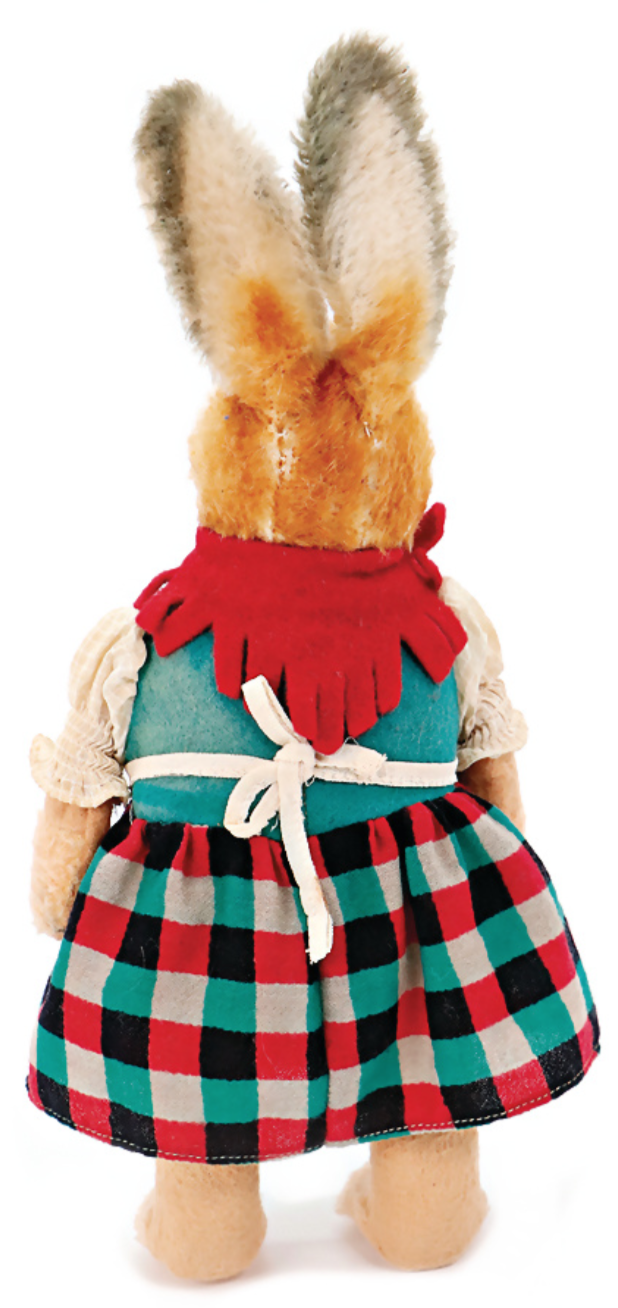
Overall, this smallest version of Steiff's begging rabbit boy is simply adorable. He is 17 cm tall (sans ears) and head jointed. He originally was covered in white and tan mohair, but now he's simply a bare hare. He has mile long, narrow feet with red embroidered claws, downturned arms, a tiny upcurved tail, and oversized, floppy ears not lined in wires. He comes to life with oversized brown and black glass pupil eyes placed low on his face and Steiff's signature 1920s-era rabbit facial embroidery. This includes a "v" shaped nose and an upside down "v" shaped mouth in one color, and horizontal stitches filling in the "v" shaped nose in another color. You can see a close up of this stitching in the photo at the bottom of this post. Dressed rabbit retains his long trailing "f" button and traces of his red ear tag as his Steiff IDs.

You can't help but notice this bun's all original and darling playsuit. His well-constructed pants have tiny faux front pockets, contrasting tan colored stitching, back black snaps, and a perfectly placed opening for his tail.  This model in this outfit appeared in the catalog from 1929-1932 in 17, 22, 28, and 35 cm. 

Given their short time in the line, and probably low production numbers, these dressed, prewar, begging Steiff rabbit dolls are amazingly rare.
 This is only one of a handful in blue overalls Steiffgal has ever seen or handled. Steiffgal purchased this guy at a UFDC national event salesroom a few years ago. More recently, in January, 2023, a medium sized one hammered at auction for 750 euro/841 USD. This model was also produced in five other outfits; these included a red skirt and white apron, a purple jacket, a red skirt and purple jacket, a red and white dress, or a pink dress. In 2010, Christie's sold one of these rarities dressed in the red skirt and white apron for 1,625 GBP.

Steiffgal hopes you enjoyed this clothes encounter with this well dressed prewar rabbit!

Have a question about one of your Steiff treasures? Let's talk! Click here to learn more!

Thursday, January 19, 2023

This Marvelous Prewar Steiff Girl is Made of Sugar and Spice and Everything Nice!

A "rosa" by any other name... would ALMOST be as beautiful as this sweet Steiff doll! Steiffgal recently had the pleasure of handling a very vintage button-in-ear doll that came from a fine and well curated collection down south. Take a look at this lovely lady in red... and be tickled pink, for sure!

Here we have Steiff's charming Rosa girl.
She is 28 cm tall, fully jointed, and made from felt. She has a short blonde inset wig, proportional blue and black glass pupil eyes, and a prominent vertical facial seam. Her perfectly to scale nose is dimensional and she has painted eyebrows. Rosa wears a red felt dirndl style dress with black trim, a white cotton blouse, white apron, a white underskirt and underwear, knit socks, red shoes, and a red felt hat that perfectly matches her dress. Steiffgal believes the tan lace on her dress is probably replaced. Rosa retains her tiny long trailing "f" Steiff button in-ear. This beautifully attired doll appeared in the line in 28, 35, 43, 50, 60, and 75 cm from 1908-1926 overall. So this example is the smallest standard sized produced.

Rosa has a few features that make her particularly interesting from the timeline and product development perspectives.

First is her facial stitching.
In addition to her vertical center seam, she has small horizontal seams near her eyes. Steiff specifically added in this design feature to their line of proportional and endearing "children" line, starting around 1908. These extra seams gave the face a pleasing roundness and further emphasized its youthful symmetry.  

Second are her hands.
Rosa has simple, rounded embroidered style hands, suggesting that she was made at the earliest point in her production timeline. Steiff's first dolls had hands that looked more like fists; "fingers" were indicated by embroidery stitches. You can see this in the photo here on the left. By 1910 or so, most Steiff dolls had "conventional" style hands, with prominent and individual fingers.

And finally is her blouse.
Her white cotton shirt fits perfectly, and is correct to her period and design, but is slightly different than the one pictured in the standard Steiff reference books. Rosa's shirt has lace and lots of tucks and details; the one pictured in Pfeiffer's Sortiment is much plainer. Rosa's shirt may be a replacement, or not. This doll model appeared in the line for nearly two decades. Over the years, clothing styles on dolls tended to be updated a bit, and generally were simplified over time. This was usually for cost savings, labor savings, and/or supply chain management issues. Because Rosa was probably "born" around 1908-1909, it is possible that she is wearing a fancy, original blouse that was streamlined to a more simple version over time. Only she knows for sure!

Steiffgal hopes this discussion on Steiff's Rosa has brought a bouquet of happiness to your day.

Have a question about one of your Steiff treasures? Let's talk! Click here to learn more!

Saturday, December 31, 2022

These Ladenburger Spielzeugauktion Auction Highlights Are Dressed To The Nines!

Three's a charm when it comes to the third post in this blog series of auction highlight from Ladenburger Spielzeugauktion's January 21st, 2023 Collection of Susan Kilgore Wiley sale. It's no secret that Steiffgal goes all hubba-hubba over Steiff's utterly charming dressed dolls and animals. And, this sale offers some of the most appealing ones in memory. Check out this trio of well attired prewar offerings from this auction. Steiffgal is certain you will consider all of them a clothes call indeed.

This first dressed highlight doesn't have a hare out of place.
It is lot #6152, an all original and early Steiff Peter Rabbit. It is estimated at €650-€1,300, and is cataloged in part as:

"One of the highlights of the auction, exceptional hare, Peter, around 1910, with small button, block letters, long trailing f, shoe button eyes, underlaid with red felt, fine brown/beige velvet, attending, with original felt jacket, decorative seams and golden buttons, red slippers, 1 leather sole with original stamp, 1 felt slipper is a bit holey, and small holes on the blue felt jacket, standing height 26 cm, extremely rare, exceptional."

Steiff's turn of last century Peter Rabbit dolls top many collector's bucket lists. This well coutured example is in lovely condition and is a marvelous size. It is interesting to note that the exact details that make up a Steiff "Peter Rabbit" are not specifically identified in Pfeiffer's Sortiment books. It is generally understood amongst collectors that a "Steiff Peter Rabbit" is standing, unjointed, and wears a felt topcoat with buttons and embroidery and felt slippers with leather soles. The Sortiment book pictures two versions of standing rabbits wearing felt topcoats and slippers, but does not identify them as "Peter Rabbit." The first is a spotted velvet version wearing a red or navy topcoat and red slippers; he was produced in 10, 22, and 28 cm from 1904-1919. The second is a white wool plush version wearing a green felt topcoat and red slippers; he was produced in 22 cm from 1904-1918.

This next auction highlight is a pair with flair!
Here we have lot #6181, two early 20th century, fully jointed, center seamed Steiff felt dolls. They are estimated at €330-€660 and are cataloged in part as:

"Felt dolls, Anton & Lisl, Upper Bavarian, produced between 1909 and 1926, 28 cm, with traditional costume, felt-head, mohair-hair, felt body, jointed, arms and legs, original, clothes, very nice condition."

This darling duo are textbook examples of   Steiff's "children" style dolls. 
These guys appeared in the line from 1909 through the late 1920's. Unlike earlier Steiff dolls that were more caricatured, harsh, and designed for adult collectors, these dolls were realistically proportioned, had gentle personalities, and angelic, rosy faces. They truly were designed for child's fun and play. These models were all fully jointed and had felt heads and bodies - except right around WWI when felt was scarce and the bodies were sometimes made from rough cotton or linen type materials. Steiff's children dolls were all dressed head to toe in handmade clothing that included school uniforms, ethnic costumes, sporting attire, and “Sunday best." Steiffgal is certain that the boy is Anton, based on his outfit and presentation. However, she is not 110% certain the identity of the girl is Lisl as her outfit does not match the one pictured in Pfeiffer's Sortiment. Steiffgal also suspects that her clothing, however charming, is not entirely original to her. Nonetheless, the pair is simply wonderful.

And it's tag, you're it! when it comes to our final well dressed auction highlight.
This is lot #6114, a late prewar standing and dressed rabbit doll, estimated at €180-€360. She is cataloged in part as:

"Pupp-hare, Mike, with button, block letters, long trailing f, very nice good preserved, yellow cloth tag label, No. 22, wool plush at hands and feet, original traditional costume, 27 cm, very nice condition."

And just want makes this lovely lady a 10?
She's got a fantastic presentation, and is in delightful, all original condition. And if you look closely at her tag, it is says "22,11." Numbers don't lie here! Her digits mean 22 cm tall (measured without ears), while the number 11 corresponds to her costume as described by the company. Outfit #11 translates to "traditional costume with green checkered skirt, green corsage, and white shirt." Spot on! These utterly charming, dressed rabbit dolls appeared in the line in 14, 22, and 28 cm in maize or white plush from 1932-1943 overall. Eleven total outfits for these rabbits were produced; they ranged from pajamas to playsuits to trousers and dresses through regional outfits like the one featured on this premier example. 

Steiffgal hopes this discussion on these well dressed auction highlights has contributed to the fabric of your collecting life. 


For more information about Ladenburger Spielzeugauktion GmbH's upcoming Special Steiff Auction event on January 21st, please click here!

Have a question about one of your Steiff treasures? Let's talk! Click here to learn more!

Sunday, September 11, 2022

Fantastic Steiff "Firsts" On Offer Through Ladenburger Spielzeugauktion's September 24th, 2022 Event!

Love at first sight! That's the best way to describe some of the temptations coming up for sale at Ladenburger Spielzeugauktion's Fall event. This can't miss auction features 107 delightful vintage to antique Steiff selections and will be held on Saturday, September 24th, 2022. Here are three wah-hoo good treasures from this auction that Steiffgal has never seen come up for sale before. Enjoy this "one-derful" eye candy!

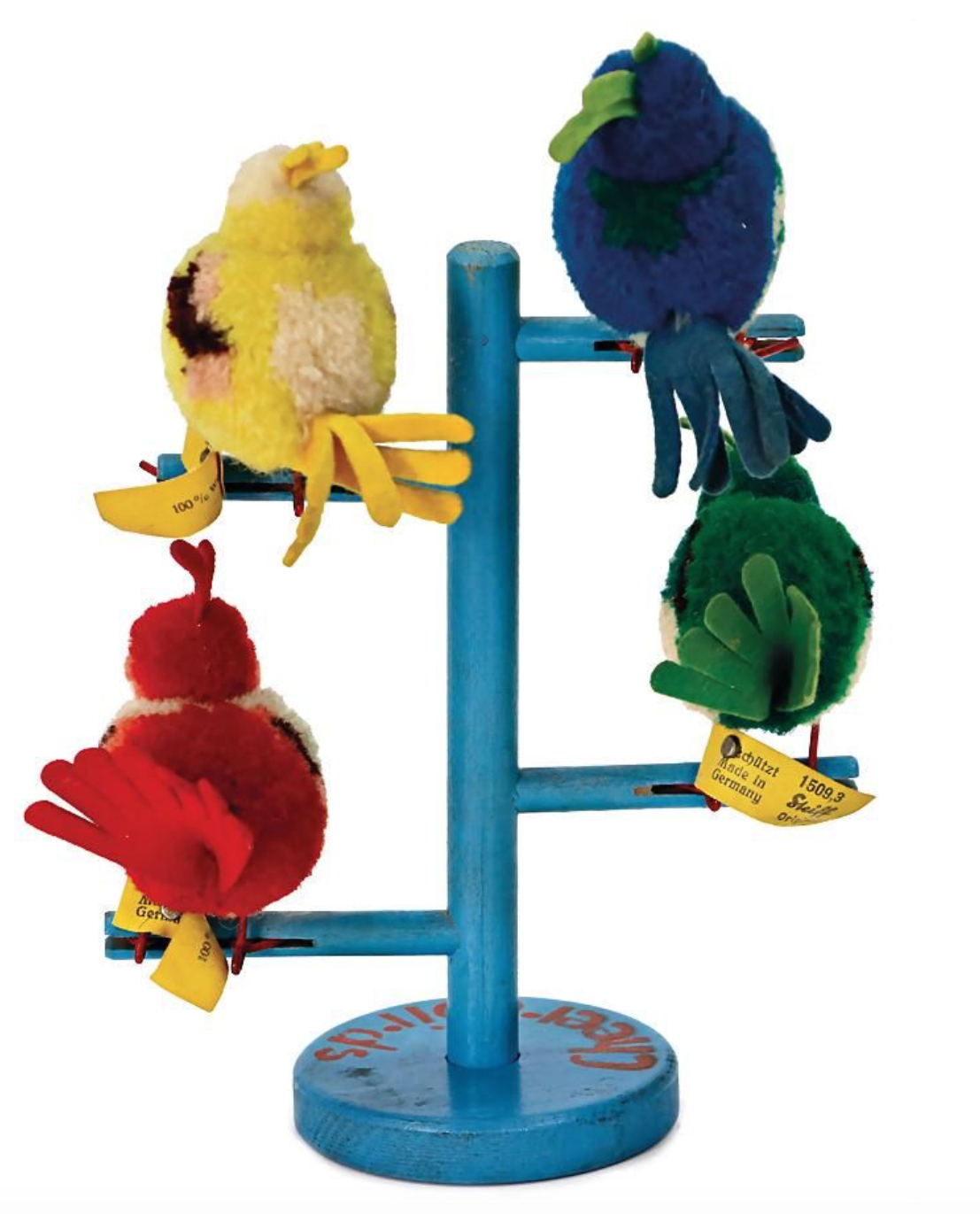
Bird's the word when it comes to this first auction debut item highlight. It is lot #3097, a most unusual woolen miniature bird display, estimated at 220-440 euros. It is cataloged in part as:

"Cheerubirds, rare bird tree, 4 x paradise birds, 100 % wool, with rare original breast sign, Blue Bird No. 1509,2, St. Patrick Bird No. 1509,3, Birthday Bird No. 1509,1, St. Valentine Bird, No. 1509,4, 22 cm, probably special design for the American market, extremely rare, unusual."

Who wouldn't love to feather their nest with this fantastic display? According to the Sortiment, this item appeared in the line from 1953-1956 with its own article number of 5204 Ch. Its overall design gives off a great midcentury vibe. But what makes this rarity so special - in addition to its amazing condition - is that each of the birds not only has a chest tag, but a very custom one. Steiffgal cannot think of any other woolen minis that have chest tags, probably due to their construction and size. The birds featured on this display are otherwise standard line "woolen exotic birds" which appeared in the line from 1953-1966; the earliest ones had red metal feet and legs and those from 1956 onward had plastic feet and legs. 

Now let's take a tumble for this next auction debut highlight. This is lot #3073, a felt, fully jointed circus performer doll, estimated at 280-560 euro. It is cataloged in part as:

"Acrobat, produced between 1911-1918, felt, jointed, from the circus series, with button, block letters, long trailing f, blue glass eyes original clothes, 40 cm, felt is a bit darken, small felt faults at 1 hand, and at stomach and at 1 shoulder, otherwise nice condition, exceptional, rare."

This fine, flexible fellow is a wonderful and seldom seen acrobat doll from Steiff's legacy "Schlopsnies Circus" display. This large scale, dynamic, and extremely popular exhibit was designed and created by Steiff doll freelancer Albert Schlopsnies in the c. 1910-1920 time frame. It consisted of over 30 circus themed dolls and acrobats, based on real life performers at the world famous Circus Sarrasani of Dresden, Germany. The acrobat dolls were often posed in death-defying or upside down poses in the displays. Sometimes they were even animated via camouflaged mechanisms. Steiffgal has seen or handled several of this acrobat's colleagues, including clowns, stagehands, and other performers, but she has never seen or handled this acrobat before. 

And last but hardly least, this final debut auction highlight just begs for attention. Here we have lot #3069, a charming prewar canine themed display, estimated at 280-560 euro. It is cataloged in part as:

"Exceptional show piece, Waldi, on a mohair plate, plate partially with a bit mohair loss, height: 30, width: 30 cm, depth: 22 cm, attending, with huntsman's hat, with button, chest label and a  very beautiful preserved red cloth tag label, with No. 4328,2, probably 1930, nice full mohair, breast sign is a bit faded, with small Treff, sitting, 14 cm, swivel head, exceptional, extremely rare."

This probably one of a kind treasure stands and delivers. It features one of Steiff's most beloved and prolific dog designs, Waldi the Dachshund. Waldi is most often on all fours. However, from 1933-1936, he was produced in a begging position in 17, 22, and 28 cm. His red ear tag numbers perfectly corresponds to that, with 4= begging or standing on back legs, 3= mohair, 28=28 cm tall, and ,2=with a voice. So the dog in itself is a total rarity! The fact that he is mounted on a factory original green mohair mat (probably to resemble grass), wears a  typical German style hat, and is accompanied by a perfectly paired and period Treff friend, make him over the top interesting. 

How this rare pair came to be remains a mystery, though. This charming display could have been produced as part of a larger exhibit, assembled by employees and presented to their friend or colleague as a special tribute gift, or perhaps made as a whimsy, end of day, or prototype that never went into production. Only Waldi and Treff know for sure!


Steiffgal hopes this discussion on these debut Steiff auction treasures has been like an opening night celebration for you. 


For more information about Ladenburger Spielzeugauktion upcoming Steiff event on September 24th, please click here!


Have a question about one of your Steiff treasures? Let's talk! Click here to learn more!

Sunday, August 28, 2022

Who Is This Tall, Dark, And Handsome Steiff Stranger?

Please say "howdy, partner" to this remarkable Steiff rarity! Steiff's turn of last century dolls have always been Steiffgal's passion. So when she got to handle this rarity, things got pretty wild - but in the best way possible. Check out this mustached marvel and see what makes him WAH-HOO good for so many reasons.

Well, hello handsome! This fellow is named Mexican Cowboy. He is 40 cm tall and fully joined. His head and lower arms are made from felt, and the rest of his body is made from a linen-like material. His weathered face is detailed with black button eyes, a black mohair mustache, a little pink highlighting, black painted eyebrows, and a prominent center facial seam. His fabulous black curly hair is an inset wig and is made from mohair. He retains his long trailing "f" button in ear as his Steiff ID. 

Mexican Cowboy is dressed to the nines in his (almost) all factory original outfit.
It includes a red cotton shirt with tan stitching, wide tan mohair chaps with an open back, and really well made black leather boots. His leather belt with silver detailing is replaced, but perfectly scaled to him. He also wore a blue chambray bandana around his neck, but this has been lost to time. This hard working hunk was produced overall in 40, 45, 55, 70, 100, and 150 cm from 1912 through 1921 overall. The largest ones were most certainly made as display dolls, as they would have been too large and heavy for a child to play with. 

Mexican Cowboy is noted in Pfeiffer's 1892-1943 Sortiment as to be in "national costume" and representing a category called "nation types." 
Steiffgal suspects that he was produced in conjunction with the company's c. 19-teen era Schlopsnies Circus project. This large scale, dynamic, and extremely popular exhibit was designed and executed by Steiff doll freelancer Albert Schlopsnies. It consisted of over 30 circus themed dolls and acrobats, based on real life performers at the world famous Circus Sarrasani of Dresden, Germany. This amazing display garnered a worldwide following and certainly helped in elevating Steiff's dollmaking reputation to global status. 

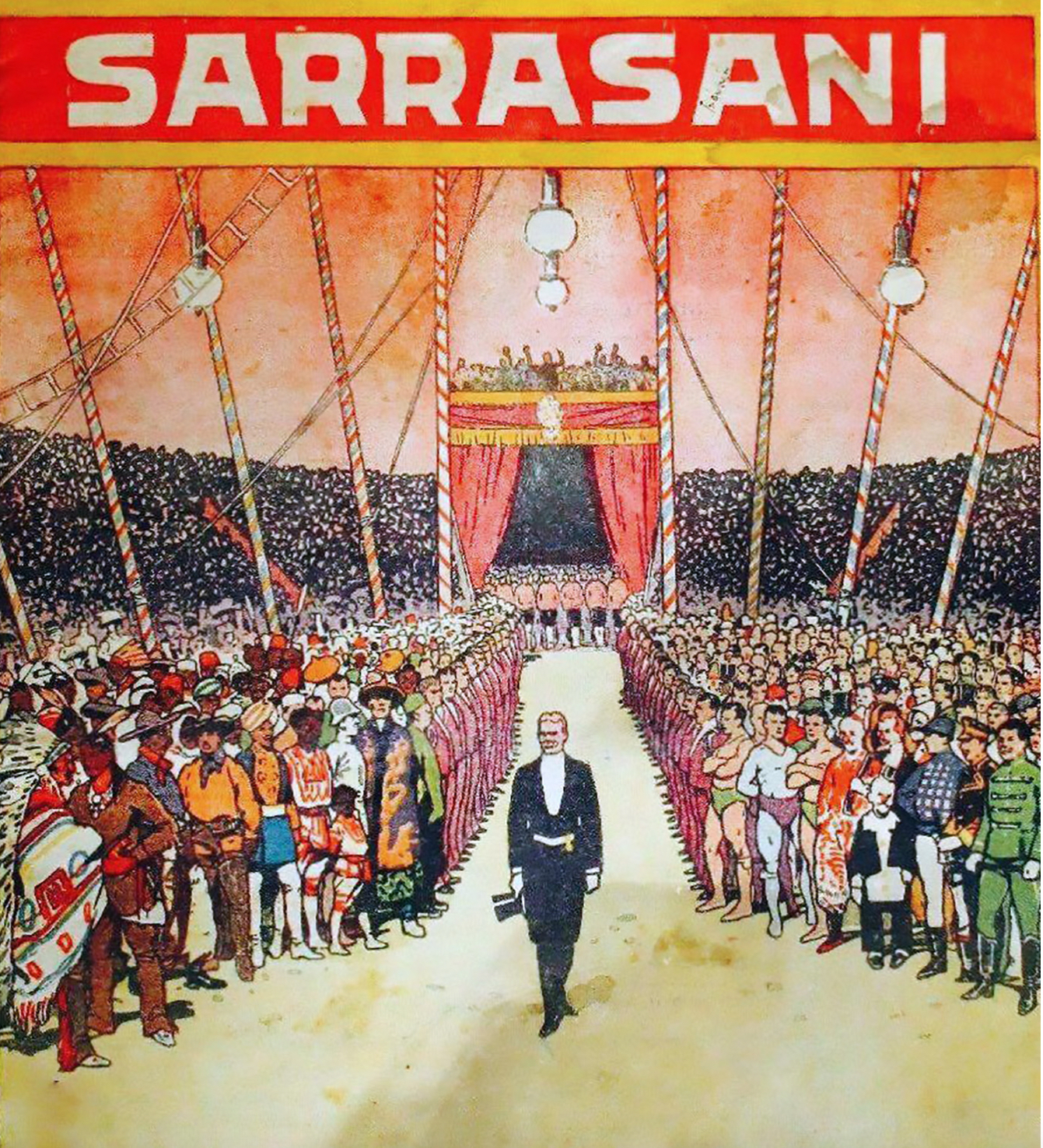
One of the elements that made the Circus Sarrasani so popular, and unique, was its roster of international talent.
 Original posters, broadsides, photos, and other promotional ephemera from the Circus Sarrasani spotlighted ethnic performers in native costumes, including South American Cowboys, Asian gymnasts, and American Indians, among many others. You can see an example of this on the left. This important detail was noted by Schlopsnies, who included authentic versions of these global ambassadors in his Steiff doll interpretation of the Circus. Steiffgal suspects, given the production timeline of the Mexican Cowboy and the Steiff circus project, that he was in fact produced as part of circus project to bring its important "international" angle to life. And, given all that, it is entirely possible that this doll is based on a real life Mexican Cowboy who appeared in the Circus Sarrasani around 1912 or so.

Steiffgal hopes this discussion on Steiff's Mexican Cowboy doll has been a stampede of fun for you!


Have a question about one of your Steiff treasures? Let's talk! Click here to learn more.

The teddy bear search engine