Showing posts with label tail moves head. Show all posts

Thursday, June 20, 2024

Remarkable Rarities At Ladenburger Spielzeugauktion's 2024 Steiff Special Auction!

The countdown is on for the most exciting Steiff auction event of the year - Ladenburger Spielzeugauktion's annual Steiff Sonder Auction or Steiff Special Auction! This event is famous for offering WAH-HOO good temptations - as well as producing world record breaking results. This year, it will be held on June 29, 2024 in Giengen, Germany as part of the Steiff Company's annual Steiff Sommer Festival. For more information on the sale, click here!

This year, nearly 230 premier century-spanning button-in-ear treasures will go under the hammer. In addition to rockstar offerings most of us can only dream about - including a google eyed Petsy Bear, a rod bear, and a full set of early skittles - the sale also features a number of hidden jewels. These are items with very special or unique details that really make them extraordinary from the collector's perspective. Here are three that caught Steiffgal's eye... and what makes them so quietly remarkable. 

Let's twist and shout over this first auction hidden jem.
This is lot #28, a Steiff Turbo "Purzelbär" or somersaulting bear. He has an opening bid of 250 € and is cataloged as follows:

"Turbo "Purzelbär" with clock mechanism, arm-wound mechanism and clock mechanism are intact, only produced in 1951, button and cloth tag label number 9315,4, rests of the US zone cloth tag label, 15 cm, original neck label and felt vest, very nice unused condition, rare, only c. 1000 pieces were produced."

In the early 1950s, Steiff made a handful of little known novelties featuring movements that were introduced prewar. These included tail moves head items (which debuted in the early 1930s) in the form of bears and dogs; musical items (which debuted in the late 1920s) in the form of bears, monkeys, cats, and dogs; and a tumbler (which debuted around 1909) in the form of this bear. It is not clear why the company "reintroduced" these old school style novelties postwar, especially given the emphasis on launching new patterns that reflected the contemporary, forward thinking vibe of the times. These early postwar novelties - including this somersaulting bear - only appeared in the catalog for a year or so. This suggests that they were not commercially successful, and/or were expensive and time consuming to produce. Given their very short production time and output, these tumbling bears are extremely few and far between on the secondary market - especially in nice condition like this with IDs. This would be a delightful addition to a collection of midcentury rarities, mechanical novelties, or Teddy bears. 

Steiffgal doesn't want to let the cat out of the bag here, but be sure to check out lot #181 in this signature summer sale.
It is a woolen miniature cat, with an opening bid of 160 €. He appears in the catalog as:

"Cat, produced 1931-1938, with button inscription: Muster, Nomotta-wool, grey/white, lying, swivel head, green glass eyes, height: 6 cm, length: 8 cm, very nice strong colors, extremely rare, exceptional, unused condition."

This pretty kitty is in such lovely condition, with a great presentation and personality. However, what makes her off the charts great is her Steiff ID, which is a MUSTER button. This form of ID was used by Steiff pre-WWII on items considered samples, evolving designs, or prototypes. In general, the button indicated that the item was Steiff property and was not intended for sale or distribution. "Muster" translates loosely from German to English as "pattern" and in a sense, these "muster" items were just that. And, the button is located on her ribbon. This is probably because her ears are not large enough to handle the button. The combination of her condition, unusual ID, and its atypical placement, truly makes her the cat's meow among the woolen miniatures on offer in this fine sale. Purrr-fect in every way. 

And finally, tag - you're it - with this last auction rarity with a happy ending. 
This lot is #147, a Steiff tail turns head Rattler sitting dog. It has a starting bid of 160 € and is cataloged as:

"Rattler, with mechanism for turning head, produced 1931-1942, with button, chest label and cloth tag label, number on cloth tag label: 3310H, red inscription Raddler INT. PAT. APPID. FOR, and with separate paper label: "dreh mich hier herum, ich schau rundherum", 12 cm, colouring is fine shaded, very nice original condition."

This little fellow has two big features that make him a top dog in this exciting sale. The Rattler tail turns head pattern in itself is charming, but not terribly rare. Overall, he appeared in the Steiff line in 8, 10, 14, 17, 22, 25, 28, and 35 cm in the 1930 through 1943 time period. So, it's not challenging to find one these days. However, this particular example, in addition to being in lovely condition, retains his most coveted "tush tag." This is a round cardboard tag on his tail that reads "turn here and I will move my head." These instructions appear in German, English, and Spanish. What's amazing about this is that these moving marvels were designed as fun toys for kids. So it's a miracle that this tag was not removed or lost to time, given its postioning and ephemeral nature! This guy also gets a shout out for his great IDs, including his legible red ear tag. Noted on its is his article number, which is 3310H. This corresponds to 3=sitting, 3=mohair, 10=10 cm tall, and H=tail moves head feature. 

Steiffgal hopes this discussion on these secretly special auction picks has meant a lot to you!

For more information on this June 29, 2024 sale, please check out the company's website at https://www.spielzeugauktion.de/.

Have a question about one of your Steiff treasures? Let's talk! Click here to learn more.

Thursday, December 1, 2022

Sit and Stay and Check Out This Tiny Steiff Mechanical Marvel!

Now who is a good dog? Those are every puppy's favorite words, and in some ways, Steiffgal's as well! Check out this happy handful of a Steiff 'herd... German Shepherd, that is! This prewar treasure packs a lot of features and design elements into a very small body. He'll have you smiling ear to ear for sure.

This blue ribbon buddy is Steiff's tail-turns-head German Shepherd dog.
He is 15 cm tall, sitting, and made from wool plush (that has practically been entirely loved off.) His cheerful face comes alive with pert triangular ears; brown and black glass pupil eyes; a black hand embroidered nose; and an open, felt lined, smiling mouth. He is solidly stuffed with excelsior, which is a manufacturing feat in itself, given how small he is, and how narrow his limbs are. The excelsior stuffing holds his metal tail-moves-head apparatus in place; it would tend to shift or settle if it was packed in kapok or other lighter filling. This mechanism enables his head to move in a circle when his sweet little tail is twisted. 
This little lovely was made in 15, 18, 23, 29, and 36 cm from 1931-1935 overall. 

One of the most astonishing things about this example is his IDs.
They are great in themselves, but it is sort of a miracle that they even exist at all, given how much love and use this guy clearly has had over the years. He wears his all original brown leather collar. It is held together with two long trailing "F" Steiff buttons. He also retains his original, red imprinted, watermelon shaped named chest tag. It is interesting that on the back of the chest tag, it is stamped "Int. pat. app. for" meaning "International Patent Applied For". Steiff was very proud of its tail-moves-head technology, and other companies were starting to copy it starting in the early 1930s. It really is amazing that he still has his collar and tag, given how ephemeral they really are, relative to his sturdy overall construction.

This pretty puppy has a great place in Steiff's prewar and early midcentury German Shepherd production history.
German Shepherds have been featured almost continuously in the line since 1923. Perhaps the best known Steiff German Shepherd design is Arco, who was introduced in 1935 but got his name in 1937. Pre-war Arco was made from mohair and had prominent, felt lined ears and a smiling, open, felt lined mouth. He was made standing on wheels (in 35, 43, 50, 60, and 70 cm), standing (in 14, 22, 28, 35, 43, 50, and 60 cm), and sitting (in 17, 22, and 28 cm) from 1937 to 1943. During this time, Arco was sometimes also referred to as "The Police Dog." As one of Steiff's most beloved late pre-war dog designs, early Arco again graced the line from 1951-1956 in the form of a 10, 17, and 22 cm standing version. These guys strongly resembled their pre-war pattern. A 43 and 50 cm standing version on wheels was also manufactured from 1949-1956.

Steiffgal hopes this discussion on this tiny Steiff treasure has brought a big slice of joy to your day.

Have a question about one of your Steiff treasures? Let's talk! Click here to learn more.

Thursday, November 17, 2022

This 1930s Steiff Tail-Turns-Head Novelty Is Simply Ele-Fantastic!

Steiff wishes can come true! Check out this note from Carey, a new friend from north of the border. She was gifted a jumbo surprise from her husband - one that just happens to be simply ele-fantastic. Steiffgal is certain you'll agree. She shares in part:

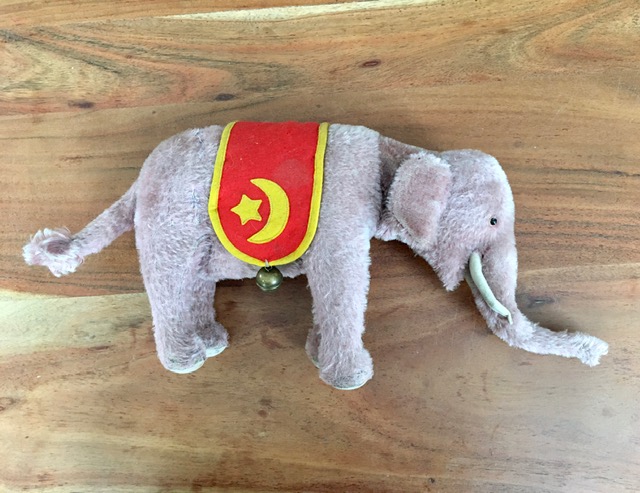
"Hi Steiffgal! I’m emailing from Ontario, Canada. Yesterday my husband gifted me an amazing find from Kijiji from an elderly couple who were downsizing. The elephant belonged to the woman’s father, and they immigrated to Canada from Poland.

Our new blushy pink/mauve Steiff elephant, based on what I could find from the button, is I think from the 30s. The tail makes the head move in a circle and the trunk is posable. It’s stuffed with straw, and due to the wear of the mohair around the foot pads, which are heavy felt, you can see black toes stamped onto the fabric. It’s about 8" tall, and the body excluding the tail and trunk is about 10" long. If it made any sounds when it was new, it doesn’t now."

There's not a drop of junk in the truck when it comes to this playful pachyderm.
This tail-move-head example is standing, head jointed, and made from mohair which has mellowed to a light pink color over time. This sometimes happens with originally grey mohair over time. His pads are made from grey felt, and his prominent tusks are made from white felt. He comes to life with floppy ears, black button eyes (which may be backed in felt - but it’s not clear from his photos) and a smiling, open mouth. His red and yellow felt blanket with bells is original to him. When you twist his mohair tipped tail in a circle, his head moves 360 degrees as well. This amazing tail-moves-head elephant was produced in 18, 23, and 29 cm from 1931-1934 overall; Carey's example is most likely the 18 cm version.


Steiff introduced its patented tail-moves-head line in 1931.
These nifty novelties were made with an internal metal movement mechanism that enabled the heads to move in a circle when the tails were rotated. These items were stuffed with excelsior to hold this mechanism firmly in place. Tail-moves-head animals appeared in the line from the early 1930s - early 1940s; over time, about 25 different examples were made. The line included cats, dogs, rabbits, penguins, goats, and lambs, and even Mickey Mouse! Most were based on popular designs of the ear, but a few - like a bulldog - were brand new patterns. These tail-moves-head items were considered luxury toys of the time. You can see Carey's elephant in action in the video above. 

Carey's elephant appeared on the cover of a 1931 marketing brochure titled "1931 Addendum to the Main Catalogue."
The other "cover girls and boys" included a Scotty, penguin, tabby Bulldog, Rattler Terrier, Molly, chimp, Fox Terrier, lamb, cat, and goat. The copy on the brochure, in part, translates to:

"The year 1931 has presented us with the animals with the new head movement… The simplicity of the mechanism, though which the splendid movement is produced, cannot be beaten, yet it is unbreakable and allows lifelike play, full of variety and mimics… When buying new supply in plush toys please be sure to include the STEIFF animals with the new head movement; all numbers equipped with it are marked ‘H.’" You can see this brochure cover here on the left; you can click on the image to make it bigger. 

Steiffgal hopes this discussion on this really rare elephant has made a huge impression on you.

Have a question about one of your Steiff treasures? Let's talk! Click here to learn more.

Saturday, August 28, 2021

This Pretty, Prewar, And Purple Steiff Princess Rains Supreme!!

WARNING! You are about to get all out joint over today's blog special guest!
This pretty kitty has just about everything going for her, including her looks, color, era, and "secret skill." Check out this fine feline and see what makes her so fabulous from the design and collector's perspective. 

This (now) purple kitten rains supreme. Here we have Steiff's fully jointed "Kitty." She is 15 cm tall and 21cm wide, not including her impressive tail. She is made from blue/black tipped mohair that has faded overall and evenly to a delightful, dark purple hue. Her underbelly, ears, muzzle, feet, and the tip of her tail are made from white mohair. Her face comes to life with a pink hand embroidered nose and mouth and teal green and black slit pupil eyes. Kitty was produced in 15, 18, 21, and 23 cm from 1931-1935. This example retains her long trailing "f" button as her Steiff ID. 

But wait, there's more!
Kitty's long tail is functional as well as aesthetic. This model is actually a tail turns head model, meaning that when her tail is rotated in a circle, her head follows in tandem. This technology was patented by the Steiff company in the early 1930s and basically consists a system that connects the head and the tail through a series of internal metal connectors and joints. 

Head jointed animals were an important part of the Steiff line in the early 1930s. Over time, about 25 different tail turns head models were produced through the very early 1940s. For the most part, these were based on the best selling standard line patterns of the time and included cats, dogs, rabbits, penguins, goats, and lambs, and even Mickey Mouse, among others. However, as far as Steiffgal can tell, this Kitty was one of the few tail moves head items that was only made as a tail moves head animal and not produced in any other form. It is interesting to note that she is neither pictured or mentioned in Steiff's 1931 novelty catalog where many of the other tail moves head animals debuted. 

Now, let's use some colorful language to describe her hue.
Today, Kitty is a marvelous shade of deep purple. But she did not start out life that way. According to Pfeiffer's 1892-1943 Steiff Sortiment, this model was produced in "blue/black tipped" mohair. But it has clearly mellowed to a pretty purple color over time. Another wonderful novelty produced with "blue/black" mohair at about the same time as Kitty was Steiff's King Peng penguin. You can see and example of a King Peng here on the left, the photo is from Christies. Today, when you find a King Peng, often his once blue/black mohair has become a similar purple color as Kitty's. As such, Steiffgal suspects that Steiff's 1930-era blue/black mohair was produced with a dye or dyes that oxidized or somehow had a chemical reaction with air or moisture over time. If this color change was due to something simple like direct sunlight, the change would not be so even or so consistent.

Steiffgal hopes that this discussion on this pretty purple princess has crowned your day.

Have a question about one of your Steiff treasures? Let's talk! Click here to learn more.

Thursday, April 8, 2021

Rolling Out The Red Carpet For This Precious Prewar Doxie On Wheels!

What goes around, comes around... especially if it's on wheels. This darling Doxie on-the-go recently popped by to say hi and Steiffgal couldn't help but roll out the red carpet for her! Come take a look at this great example of Steiff's prewar novelty production and see what makes her so noteworthy from the historical and product development perspectives. 

Doxie on wheels is standing, unjointed, and constructed from mohair.
The dog itself measures 11 cm vertically and 20 cm horizontally. Her top, forehead, ears, and tail are made from black mohair and her muzzle, limbs, and underbelly are made from brownish tipped mohair. Her face comes to life with proportional brown and black glass pupil eyes and a black hand embroidered nose and mouth. She is mounted on two metal axles. She glides along on four wooden eccentric wheels which are painted blue. She is attached to the axles through metal loops that are inserted into her limbs. Doxie on eccentric wheels was produced in 17, 20, and 22 cm from 1930 through 1933 overall. She was also made on traditional round wheels in 28 and 35 cm from 1929 through 1935 overall.

Doxie on wheels is one of many wonderful prewar Dachshunds produced by Steiff.
 Like Fox Terriers and Pointers, Dachshunds are a legacy breed for Steiff, and perhaps one of the company's most famous and prolific dog lines as well. Steiffgal suspects this is because Dachshunds traditionally have been a very popular pet choice across Germany, and even were the animal companions of choice of the Steiff family at the turn of last century! Although this exact pattern under discussion here today was not produced postwar, if you look closely at her face, you can see it is somewhat similar in size and expression to Bazi, who was introduced in 1950. 

Moving along, this particular example three design characteristics that firmly root its production in the late 1920s to early 1930s. These include:

1. Patched mohair construction. Many items that debuted in the 1920s feature different color mohair that is patched and seamed together to create the visual effect of a multi-hued animal. From the mid-1930s onward, the company was much more likely to create an animal from one shade of fabric and then apply color via paint for a similar effect. This was probably done to create labor and material efficiencies.

2. Mohair coloring. This Doxie's brown mohair is actually more like a deep orange or copper color, and is tipped. This creates a wonderful aesthetic effect of depth and richness. Tipped mohair (think of Petsy the Baby Bear, for example) was a very popular fabric choice and treatment during the "Roaring 20s" era. 

3. Novelty detailing.
This Doxie is a novelty, meaning she has a fun feature not seen on standard line playthings. In this case, she's on eccentric wheels. You can see a closeup of this configuration here on the left. A very similar pattern to this Doxie was produced as another novelty - a tail moves head version. This mover and shaker appeared in 14, 17, and 22 cm from 1931 though 1934 overall. Steiff's novelty production exploded in the mid to late 1920s with the introduction of Molly the Puppy and Bully the Bulldog. These popular designs translated well into charming product line extension items like music boxes, purses, animal dolls, various pull toys, Charleston animals, puppets, and tail-move-head characters. Today, late 1920s-early 1930s dogs, cats, and rabbits with a novelty twist universally top collector's wish lists. 

Steiffgal hopes this discussion on this Dachshund novelty has been tremendously entertaining for you. 

Have a question about one of your Steiff treasures? Let's talk! Click here to learn more.

Sunday, June 28, 2020

Stand and Deliver With This Amazing Steiff Tail Turns Head Bear Cub


This next Steiff treasure has one great tail to tell! Check out this amazing, and amazingly charming bear cub. His design looks pretty familiar for sure. But behind his handsome appearance is a little secret with even greater appeal!

This Ted truly stands and delivers. He is 16 cm tall, 30 cm long, and made from brown mohair. His inset muzzle is made from tan mohair. He has tan felt paw pads and four brown hand embroidered claws on each foot. His face comes to life with black and brown glass pupil eyes and a black hand embroidered nose and mouth. Ted is very solidly stuffed with excelsior. What brings him from good to great is the fact that he is a tail moves head example, meaning that he has a little mohair tail that can be moved about in a circle. When this happens, his head rotates in unison. This standing tail moves head bear was produced in 18, 23, and 29 cm from 1930 through 1935. His collar was made by Steiff, but is not original to him.

Prewar, Steiff produced a number of tail moves head items as part of its strategy to create playful, irresistible, and novel toys for the American and worldwide marketplaces. The company received a patent for their tail moves head mechanism in the early 1930s. Over time about 25 different tail turns head models were produced through the very early 1940s. For the most part, these were based on the best selling standard line patterns of the time and included cats, dogs, rabbits, penguins, goats, and lambs, and even Mickey Mouse, among others. 

These innovative new toys - designed to get consumers moving and grooving -  were featured on a Steiff catalog cover from 1931. You can see that image here on the left. They were promoted as, “The year 1931 has presented us with the animals with the new head movement… The simplicity of the mechanism, though which the splendid movement is produced, cannot be beaten, yet it is unbreakable and allows lifelike play, full of variety and mimics… When buying new supply in plush toys please be sure to include the STEIFF animals with the new head movement; all numbers equipped with it are marked ‘H.’” 

This tail moves head model was replaced - and possibly upgraded - by another very similar looking brown mohair bear cub in 1935. This was Steiff's snap jointed Circus bear, and he is pictured here on the left. Unlike his earlier tail moves head cousin who was on all fours, the Circus bear was standing. But these two cubs shared a very similar head and muzzle shape, as well as general look and presentation. The Circus bear was 32 cm tall, with disk jointed arms, leg snap joints, and a tail moves head mechanism. He was in the line from 1935 through 1939 and approximately 897 models were manufactured - making him one rare bear indeed. 

Steiffgal hopes this discussion about this tail moves head cub has made you want to twist and shout. 

Have a question about one of your Steiff treasures? Let's talk! Click here to learn more. 

Sunday, December 15, 2019

This Steiff Tail-Moves-Head Dox Really Rocks!

Care to take a little paws from the holiday madness? That's probably an offer you can't refuse right about now! Then have a look at this darling Dachshund. He's truly a head-turner, in more ways than one! Here's why.

This arm and leg jointed Dox really rocks! He measures about 11 cm tall and about 19 cm wide, not including his tail. His paws, underbelly, face, and muzzle are made from orange tipped mohair. His ears, tail, back, and limbs are made from black mohair. He has three hand painted claws on each foot. His puppy-like face comes to life with a black hand embroidered nose and mouth, proportional black and brown glass pupil eyes, and a touch of black airbrushed highlighting. He retains his long trailing "f" button and traces of his red ear tag as his Steiff IDs. And his secret superpower? He's a rare, tail-moves-head example, meaning that when his long tail is rotated in either direction, his head follows suit! This pretty puppy appeared in the line in 14, 17, and 22 cm from 1931-1934 overall.

Dachshunds are legacy Steiff breeds, and have appeared continuously in the line in one form or the other since the late 1800s. This particular black and orange version was introduced in 1929 in the form of a 22 cm standing version. He also appeared on regular or eccentric wheels in five sizes ranging from 17 to 35 cm from 1929-1935 overall, and as a "detachable" variation in 18, 23, and 29 cm from 1936-1939 overall.  

This Doxie has several interesting design elements that align almost perfectly with his launch and production timeline. 

The first, and most obvious, is his tail-moves-head feature. Starting in the early 1930s, Steiff started to produce several of its most popular designs with a tail-moves-head feature. This Doxie puppy pattern, which reflects the late 1920s happy, childlike aesthetic Steiff is known for (think Molly, Charly, Pip, Bully, etc.) must have been a best seller at the time to merit this novelty upgrade. 

The second is his assembly. Doxie is made from two distinctly different mohair fabrics which are patched together. This type of construction was typical for the 1920s, and was more expensive and labor intense than simply making an item from one type of mohair, or airbrushing color(s) onto one type of mohair. For the most part, Steiff's patched construction was all but phased out by the late 1930s and replaced with more efficient production operations. 

And the third is his orange tipped mohair. Joyful, colorfully tipped mohair debuted in Steiff line in the mid-1920s. Items including rabbits, penguins, deer, and even gnomes featured similar orange tipped mohair through the late 1930s. There's no question that this playful fabric added a touch of whimsy to these very period products. 

Steiffgal hopes this discussion on Steiff's two colored dachshund has been more than twice as nice for you.

Have a question about one of your Steiff treasures? Let's talk! Click here to learn more.

Thursday, October 17, 2019

A Steiff Penguin of Royal Stature!

They say it's not easy being green. But Steiffgal has to disagree, at least in this particular case! A special little someone just waddled his way into her collection, and she couldn't be more excited. Check out this colorful creation and see what makes him so outstanding from the historical and product development perspectives.

Bird's the word with his stunning Steiff King Peng penguin. He stands all of 15 cm and is made from white, green, and orange tipped mohair. His beak is double thick orange felt, and his chubby wings and feet are made from orange velvet. His wings have black hand drawn lines on them. His childlike face is detailed with black and brown glass pupil eyes. Larger versions had cartoon eyes backed in felt. This model is a tail moves head example, meaning that when his tiny green mohair covered metal tail is twisted left and right, his head moves in unison. His long trailing "f" Steiff button is located on the bottom of one of his velvet feet. This polar pal was made in 15, 18, 23, 29, and 36 cm from 1931-1935 overall. He was also produced in the same sizes in a slightly different color combination, with blue/black mohair in the place of the green mohair seen on this example.

Tail moves head editions were amongst Steiff's headliners of the early 1930s. They were produced as a result of the company's emphasis on producing fun, exciting, and endearing novelty items as a way to further capture the pocketbooks - and hearts - of Steiff enthusiasts worldwide. Overall, about 25 different tail turns head models were produced through the late 1930's and very early 1940's. These were advertised as...

"The year 1931 has presented us with the animals with the new head movement… The simplicity of the mechanism, though which the splendid movement is produced, cannot be beaten, yet it is unbreakable and allows lifelike play, full of variety and mimics… When buying new supply in plush toys please be sure to include the STEIFF animals with the new head movement; all numbers equipped with it are marked ‘H.’” 

Most of these newfangled tail moves head items were based on the best selling standard line patterns of the time. Recognizable friends included cats, dogs, rabbits, goats, and lambs, and even Mickey Mouse! Although Steiff did have a penguin in the line in the late 1920s and early 1930s, they did not use that pattern for a tail moves head version. King Peng's introduction most likely corresponds to the worldwide news of Richard Byrd's South Pole exploration, where penguins and other cold-weather animals featured prominently in the story. Since its founding, Steiff has always been extremely conscious of animal themed events and cultural trends and has integrated them when possible into its product line and assortments. You can see the advertisement introducing these merry movers here on the left, the photo is from the Cieslik's Button in Ear: The History of the Teddy Bear and His Friends book from 1989.

Steiffgal hopes this discussion on this Steiff King Peng penguin has been a royal experience for you.

Have a question about one of your Steiff treasures? Let's talk! Click here to learn more!

Saturday, September 2, 2017

This Long Brown Tipped Mohair Steiff Chimp Is One Head Turner Indeed!

When it comes to Steiff, it's always fun to monkey around. Primates have been an important part of the Steiff line since the late 1800's and many collectors really go ape over their expressive faces and playful presentations. Some of them even come with secrets - like this one. Check out this chimp-champ and see what makes him so interesting from the historical and product development perspective.

This sweet jungle-jem is unquestionably a mover and a shaker. His name is Chimpanzee, and he is 22 cm tall, sitting, and fully jointed. His long, narrow body, shapely arms, and bent legs are made from extra long brown tipped mohair. His face and hands and feet are made from tan felt. His charming face comes to life with black and brown glass pupil eyes set close together in eye pockets, a dimensional muzzle, a closed mouth, and a white mohair chin. And he has a delightful surprise - he has a tail moves head mechanism, which allows his head to rotate 360 degrees! Like many tail moves head items from this period, the mohair covering on this Chimp's metal tush-twister has been lost to time. He retains his large trailing f button and a trace of his red ear tag as his IDs. This great pattern was produced in nine sizes ranging from 13 to 66 cm from 1931-1934. Steiff also produced a closed mouth, long brown tipped mohair "Chimpanzee" without the tail moves head feature in five sizes ranging from 25 to 100 cm from 1928-1934 overall. 

Do you suspect any monkeyshines between Chimpanzee's design and that of his better known cousin, Jocko? Steiff's Chimpanzees did in part resemble the company's Jockos, but did have a few distinctively different features and treatments. For a comparison, please check out the photo on the left which features this 22 cm tail moves head Chimpanzee and his new best friend, a 23 cm wool plush Jocko; both were made in the early 1930's.

Steiff was really on the move in the 1920's and early 1930's, at least with its line of top-tier toy categories. Richard Steiff, although living in the United States at the time, was very involved with the company's product design and development pipeline. He constantly encouraged his family in Germany to create new and exciting novelties, to capture the hearts, minds, and pocketbooks of the growing global marketplace. He did this by writing passionate and persuasive handwritten letters, in beautiful penmanship, on his personal letterhead. These letters often stressed the importance of quality, innovation, presentation, and advertising as keys to business growth and success. The Steiff design team came up with the idea of "tail moves head" animals as one of many responses to Richard's directives. The company applied for, and received patents for this technology in the early 1930's.

Overall, about 25 different tail turns head models were produced through the late 1930's and very early 1940's. These were advertised as, "The ingenious head-movement makes Steiff animals appear alive." For the most part, these were based on the best selling standard line patterns of the time and included cats, dogs, rabbits, penguins, goats, and lambs, and even Mickey Mouse, among others. However, there were exceptions to this rule, like a most unusual tabby tail moves head bulldog. Even more interesting to note is the fact that there was not a Teddy bear - perhaps the company's most popular product - on the pre-war production roster of tail moves head items. Steiff would go on to make a fully jointed, tail moves head bear in 18 and 25 cm in 1955 only. Today, this rare bear is one of the most sought after postwar bear examples among collectors.

Steiffgal hopes this discussion on this tail moves head Chimpanzee has been more fun than a barrel full of monkeys!

Have a question about one of your Steiff treasures? Let's talk! Click here to learn more.

Saturday, November 14, 2015

A Delightful Steiff Head-Turning Mystery!

Everyone loves a good Steiff mystery. And this one just might color your world, as well as have you nodding your head in agreement. Check out this note from a new friend who lives overseas. She writes in part:

"Hi,

I wonder if you have seen a Steiff like this before.


He looks to be from around the 1930-40's as his head is quite small and long body unlike the 1950's shape. He is 10 inches high. The front of his body and the inset of his ears are cream mohair and the rest of him is golden. His head is unjointed and he has a canister type thing in his body; you turn his tail and his head goes from side to side. He is not a yes/no as the tail does not move up and down.  

I have not seen one like him before. I would love to hear what you think and also what you think his value is.  Many thanks!"

This Ted is one rare bear indeed! Steiffgal has only seen one or two other examples in many decades of collecting and studying Steiff items. 
 
What we have here is Steiff's "Original Teddy bear with neck mechanism." This little guy with the big clunky name was produced in 1955 only in 18 or 25 cm. He is arm and leg jointed, and his little tail turns his head. This bear pattern is known among other factors for his ears and belly which are a lighter hue than his head, limbs, and body.  He also has a tail, which is an extremely unusual detail feature on Steiff mohair bears from any era. His back side and tail are pictured here on the left.

This bear is neck and neck in rarity with other unusual Steiff items from the early 1950's, including a little known 15 cm clockwork tumbling bear called "Turbo Teddy Somersault Bear" made in 1951 only. One thing that's a bit unusual about today's "head turner" is his production era - the 1950's. After receiving patents for "tail moves head" mechanisms, Steiff introduced a series of these items in the 1930's. For the most part, these were based on the most popular and beloved patterns of the time and included cats, dogs, rabbits, penguins, goats, and lambs, and even Mickey Mouse, among others. These were advertised as, "The ingenious head-movement makes Steiff animals appear alive."  The Bully pictured on the left is one of Steiff's early tail moves head items and appeared in the line in 11, 15, 18, 23, 26, and 31 cm from 1931 through 1935 overall.

Overall, about 25 different tail turns head models were produced through the late 1930's and very early 1940's. Interestingly, there was not a Teddy bear on this pre-war production list. It would be almost two decades later that the Teddy bear with neck mechanism under discussion today would appear in the line - and just for a year at that.  In 1990 and 1991, the company produced the 25 cm version of this bear as a replica in a limited edition size of 4,000 pieces.  This replica tail moves head Steiff bear is pictured here on the left.
 
And now for the question that requires a mohair crystal ball - his value.  As always, something is worth what someone will pay for it.  This item rarely if ever appears on the secondary market and is on the wish lists of many Steiff collectors.  However, there really are no readily available comps to help frame an estimate.  In the broadest sense, Steiffgal guesstimates that he might sell in the $1,500-3,000 range... but only he - and his next future owner - know for sure! 

Steiffgal hopes that this discussion on the company's Teddy bear with neck mechanism has been a dynamic read for you.  
 
Have a question about one of your Steiff treasures? Let's talk! Click here to learn more.  

Saturday, January 10, 2015

Climb Every Mountain For This Great Vintage Steiff St. Bernard Dog!

The excitement of finding wonderful vintage Steiff treasures is certainly universal... and all collectors love to be able to say... "Look what I found!" Check out this note from a reader from Germany who asks for advice on a possible purchase of a very vintage Steiff dog. Leonie writes: 

"Dear Steiffgal, 
Could you give me an advice for a purchase? I saw a Steiff prewar St. Bernard dog on eBay. He lost most of his fur, and his button, too. He is 28 cm high and his price is 95 euro. Should I buy him or is he too expensive? I have also sent a picture. I would appreciate an answer very much. Best regards, Leonie"

Who wouldn't climb every mountain for this wonderful mountain-loving canine?  And yes, Steiffgal says YES, GO FOR IT!  What we have here is a much loved 1930's-era Steiff sitting St. Bernard dog.  This model was made both in white and brownish-copper mohair and white and tan wool plush in 10, 14, 17, 22, 28, and 35 cm.  The mohair version appeared in the line from 1929 through 1937, and the wool plush version from 1929 through 1932.  Given this photo, it is hard to tell if Leonie's pup was originally made from mohair or wool plush.  Both versions were adorable, very puppy-like, and featured realistic fur coloring.  Each model had a dear face that was detailed with expressive brown and black pupil eyes, a black hand-embroidered nose and mouth, and a distinctive muzzle which came to life with black and pink airbrushing. These sitting St. Bernard models had their tails wrapped gently around their backsides, much like how "real" dogs sit... especially when they are on their best behavior!


The mohair version of Steiff's sitting St. Bernard dog - like several very popular models of the 1930's - was also produced as a tail-moves-head model.  The one big difference between the regular and tail-moves-head version of this design is the position of the tail.  The regular versions have wrapped tails, while the tail-moves-head versions have a stretched-out tail.  The sitting tail-moves-head version was made in 11, 15, 18, 23, 29, and 36 cm from 1931 through 1934.  These dynamic doggies in good or better condition are quite rare on the secondary market;  in 2013 Teddy Dorado sold a 29 cm version for over 7,000 euro!  And just how beloved is this moving model?  In 1993,  Steiff made a replica of their special tail-moves-head St. Bernard in in an edition size of 4,000.  This replica is pictured here on the left. 


St. Bernard dogs continue to be collector's favorites today. Many enthusiasts can't get enough of the company's models from the late 1940's through the 60's, and it is easy to see why! It is interesting to note that the first St. Bernard to appear after the factory reopened for business post World War II was a larger standing mohair model on wheels. He was based on the company's pre-war design and was manufactured in 43, 50, 60, and 62 cm from 1949 through 1957. A slightly simplified standing model, also based on the prewar design, was available in 10, 14, and 22 cm from 1953 through 1957.  These early standing post-war St. Bernards are pictured here on the left.

In the early 1960's, Steiff again updated their standard line St. Bernard and even gave him a name for the first time - Bernie. Bernie was made from mohair and available sitting or standing on all fours. New Bernie had a different pattern of facial airbrushing, a chunkier build, and a smaller scale tail; standing Bernie also featured a cask attached to his collar. Standing Bernie is pictured here on the left. Overall, sitting Bernie was produced in 12 and 22 cm from 1963 through 1970 while standing Bernie was made in 22 cm from 1964 through 1966. In about 1970, Steiff also produced a most impressive display sized St. Bernard, perhaps as an exclusive for the high end toy retailer FAO Schwarz. And, since then, St. Bernards have always been a standard feature in the Steiff line, mostly appearing in large size plush models for children's fun and play. 

Steiffgal hopes this discussion on Steiff's wonderful legacy St. Bernards has been a warm and fuzzy experience for you! 

Have a question about one of your Steiff treasures? Let's talk! Click here to learn more.

Saturday, June 7, 2014

Moving And Grooving With This Fabulous Vintage Steiff Scotty

It goes without saying that many vintage Steiff treasures are truly gorgeous!  But Steiffgal would like to share one with you today that is literally a "head turner!"  This week by post she received this marvelous black bearded beauty from Germany.  Take a look at this pup with a secret... and be prepared to shake your head in amazement!

Great Scott!  Here we have Steiff's standing Scotty.  He measures 15 cm head to toe, and 23 cm nose to rear end, not including his tail.  He is made from lovely black backed mohair that has silver threads throughout the material, giving him a very dignified appearance.  Scotty has a long, jet black beard and eyebrows. He has a brown hand embroidered nose, mouth, and claws, and delightful, tri-colored almond shaped glass eyes in white, brown, and black.  The insides of his ears are lined in tan felt.  His bow and bell are not original to him; when he left the factory in Giengen over eight decades ago he most likely wore a little black and white leather collar with a few Steiff buttons on it.  This particular Scotty model was produced in 9, 11, 15, 18, 23,  and 26 cm from 1931 through 1934.


Let's move right on to what makes this Scotty so spectacular.  Like several popular Steiff items of the early 1930's, this pattern has what is known as a "tail moves head" mechanism.  This means by gently twisting the tail back and forth, his head moves in unison - giving the animal a most charming sense of realistic movement.  Take a look at the video to see for yourself!

Steiff's early "action super heroes" of the 1930's include cats, dogs, rabbits, and lambs, among others.  For the most part, each was based on standard line popular designs of the time, and came with a round cardboard tag on its tail that read "turn here and I will move my head." You can see this tag here on the left, the photo is from Teddy Dorado.  Tail turns head items were considered higher end, luxury toys, and most were produced through the late 1930's.  Perhaps the best known tail moves head design was Rattler Terrier, who appeared through the early 1940's. 

Steiffgal hopes this discussion on this Scotty has you bobbing your head in agreement that he is one dynamic dog!

Have a question about one of your Steiff treasures? Let's talk! Click here to learn more.
The teddy bear search engine