Showing posts with label Teddy bear. Show all posts

Saturday, August 17, 2024

Here's A Delightful Steiff Auction "Tip" For You!

In the mood for a little trip across the pond? Steiffgal has just learned of a very exciting Teddy bear sale to be held on December 3, 2024 through Special Auction Services in Newbury in the U.K. The items under the hammer are all from the collection of Ian Pout, the founder of the legendary store Teddy Bears of Witney. This mecca, which unquestionably tops the short list of must visit places for cub collectors worldwide, opened in 1985 and was the first retailer in the U.K. to specialize in antique, vintage, and new Teddy bears. Ian is pictured here on the left, the image is from Special Auction Services.

Steiffgal has visited the Teddy Bears of Whitney at least twice.
The first time, in the very early 2000s, she made the voyage to Witney from London solo, traveling on a series of trains and buses to get to the store. She remembers spending hours in the cozy space, viewing old and new Teds, and how magical it was to see the original red mohair Alphonso in person. Ian Pout was there, and was incredibly gracious and kind, touring her around the museum parts of the store. The next time Steiffgal went, it was with friends, so the fun was multiplied many times over. She and her fellow collectors also spent hours oohing and ahhing over the temptations on display. Of course, all left with at least one shopping bag of souvenirs! You can see a photo of this beloved destination here on the left, the image is from www.cotswolds.com. 

Now back to the sale. There is a preview of highlights from the event already listed at https://www.specialauctionservices.com/Auction-Calendar/2024/A-Special-Teddy-Bear-Collection, and Steiffgal suspects that the auction company will continue to post more as the collection is cataloged, photographed, and prepared for sale. It is a lot of work and very time consuming to prepare precious objects for sale - especially of this caliber - so patience is everything here. But, from what has been made public already, it is clear that Steiff factors heavily in the collection, with rare button-in-ear examples that also have amazing and universally recognized histories taking many of the top lot slots at this event. 

One thrilling highlight from this sale is Happy, a roaring 20s-era bear with so many tales to tell.
According to Special Auction Services, this marvelous example is noted as, "Happy, a rare large eyed brown tipped Steiff teddy bear from circa 1926, which sold at Sotheby’s in 1989 for a world record auction price of £55,000 ($86,000) and bought by Paul Volpp for his wife Rosemary as an anniversary present. An enchanting girl bear with real presence, has since travelled the world raising over $100,000 for charity." She carries a presale estimate of £20,000-30,000. It is Steiffgal's understanding that the underbidder for Happy in 1989 was none other than a member of the British Royal Family! You can see this Happy here on the left, the image is from Special Auction Services. 


Happy dates from a joyful time in the company's product development history - the mid to late 1920s. It was during this era that several of Steiff's beloved named, novelty bears were introduced. These included Teddy Rose, Teddy Clown, Petsy, Teddy Baby, and of course, Happy! Happy was produced for a short time - from 1926-1927 only - in relatively low numbers. As such, examples are very few and far between on the secondary market. That is one of the reasons that this fine Ted - who is truly the package in so many ways - should catch the eyes and pocketbooks of collectors and historians worldwide. For context and comparison, the most recent Happy public auctions sale Steiffgal could find dates from a few years ago. A 51 cm example in fine condition hammered for 20500€ at Ladenburger Spielzeugauktion's Fall, 2022 sale. You can see that Ted pictured here on the left. 


For more information on this upcoming Teddy Bears of Whitney Sale, follow SAS' Facebook page at www.facebook.com/Specialauctionservices or check out their website at www.specialauctionservices.com.


Steiffgal hopes this auction announcement has put you in a very Happy mood indeed. 

Have a question about one of your Steiff treasures? Let's talk! Click here to learn more.

Saturday, June 22, 2024

Timecapsule Treasures On Offer At Ladenburger Spielzeugauktion's 2024 Steiff Special Auction

What's old is new again at this year's Ladenburger Spielzeugauktion's Steiff Special Auction on June 29th, 2024. This sale tempts collectors with almost 230 amazing and well curated lots of century-spanning button-in-ear treasures. One especially noteworthy category in this sale is items from the company's earliest production period - just before and just after the turn of the 20th century. Here are three "golden oldies" definitely worth checking out!


Let's start this trip back in time with lot #10. This is an extremely early dressed Steiff monkey, with an opening bid of 850 €. It is cataloged as:

"Steiff monkey, crouching, around 1900, pre-button era, felt, shoe button eyes, for shirr (missing), height: 17 cm, original felt clothes, smaller faults in the felt, nice original condition."

This sitting sweetie would love to hang out with you!
 It is Steiffgal's best guess that this is an example of the company's turn of last century felt monkey designed as a catch and release toy. If you notice his well formed hands, they look like they were designed to be holding something. Steiffgal thinks this would have been a piece of elastic string. So, someone could bounce him around as a toy on this cord. According to Pfeiffer's 1892-1943 Sortiment, this novelty was produced in 17 cm from 1897-1911 and was described as, "felt, brown, begging, elastic cord, tailcoat and slippers of felt." You can see the photo from this reference book here on the left for study and comparison. 

This next very vintage selection will have you moving and grooving.
 This is lot #6, a Steiff dancing bear, which carries an opening bid of 1800 €. It is cataloged as:

"Steiff dancing bear, around 1900, pre-button era, short plush, in very good condition, attending, dancing on a metal disc, casting wheels with spokes rubber coated, rubber is very worn, therefore the turn function isn't possible, squeaker, length: 68 cm (catalog proof 70 cm), shoe button eyes, one eye is a bit scratched, nose chain and stick, original pull rod, black and white picture in the Pfeiffer catalog page 37, and picture in the Steiff catalog from 1900, book Jürgen & Marianne Cieslik "Knopf im Ohr" page 27, an unusual piece from the beginnings of the Steiff-production, is a museum piece."

This amazing and little known mechanical bear, which was produced in 70 cm from 1898-1907, has a key role in the history of the development of the jointed Teddy bear as we know him today.
 In the late 1890's, Steiff produced a number of circus bear novelties. These were considered "action toys" as they designed to give movement to the toys. These included this dancing bear on a circular wheeled cart; bears on platforms with bristles supporting them; a bear on a cart with metal wheels; and tumblers in different configurations and sizes. The bears on the platforms with bristles would move when someone tapped the table on which they were standing - so they would sort of "shimmy" about. You can see a few of these early examples here on the left, the photo is from Cieslik's Button in Ear: The History of the Teddy Bear and His Friends.

Richard Steiff wanted to create more playful, dynamic, and child-friendly versions of these static/moving bears, and he took this challenge seriously. He studied the way real bears move at the zoo. Mohair became available on a commercial level around 1902. He married those two facts, inserted his creativity, and came up with the patterns for a series of fully jointed bears, starting with string jointing, then rod jointing, then disk jointing. Steiff's disk jointing system has not changed much since its introduction over a century ago. 

At the tail end of this discussion is lot #9, a very large and early monkey.
 He has an opening bid of 1800 € and is cataloged as:

"Steiff monkey, 1904, length: 80 cm, mohair plush, velvet ears, face and hands, PPB, shoe button eyes, elephant head, nice full mohair, velvet is a bit worn, small open place at the head mounting in the back, the wire mounting is visible, very expressive, an early unusual piece from the beginnings of the Steiff production."

This big boy is a fine example of Steiff's early - but not earliest - monkey patterns. This basic design debuted in 1904 and appeared in the line through the 1920s in a variety of slightly modified versions over time. He was produced with and without a tail, in a number of fabrics including brown and white mohair, and with felt or velvet hands and facial features. Given his elephant button, the one under discussion here was produced in the c. 1904-1905 time frame. 

One super interesting thing about this marvelous monkey is the company he keeps. 
This monkey appears in a 1903/04 catalog photo used to debut the company's new editions at the annual Leipzig Spring Fair. But what's so special about that? It's the same picture that debuted PB55... the world's first jointed Teddy bear. Talk about being at the right place at the right time, eh? A snapshot of this catalog page is shown here on the left. You can spot this monkey in the very far back right of the picture - just click on the image to make it bigger. 
The photo is from Cieslik's Button in Ear: The History of the Teddy Bear and His Friends.

Steiffgal hopes this discussion on these time capsule treasures has brought history to life for you. 


For more information on this June 29, 2024 sale, please check out the company's website at https://www.spielzeugauktion.de/.


Have a question about one of your Steiff treasures? Let's talk! Click here to learn more.

Sunday, January 28, 2024

Developing A Plush Crush On This Early Steiff Rod Bear

Steiffgal's just a little out of joint when it comes to today's special guest. And you probably will be too! This turn of last century cub is off the charts rare, totally adorable, and has great provenance. Check out "Plush," an all original Steiff rod jointed bear, and see what makes him so amazing from the historical and product development perspectives. 


This grand old man is Steiff's 28PB. This somewhat technical name refers to 28=measures 28 cm sitting down, P=plush material, and B=jointed. Plush was "born" around 1904, is fully jointed, and is very solidly stuffed with excelsior. His early and signature features include black wooden shoe button eyes, a prominent back hump, an "American" football shaped torso, very curved wrists, felt pads, a simple tan embroidered mouth, a trimmed muzzle, and five black hand embroidered claws on each of his paws. He has very long arms, as he was originally designed to be posed standing on all fours. He also has his original black gutta percha nose. This is pretty special, and also unusual, as this hard rubber facial feature often is lost to time. He would have sported the company's earliest elephant style button when he left the factory c. 120 years ago - but that ID has been lost to time. Without a doubt, Plush is a great example of Steiff's early turn of last century commercial production.  


Steiff's rod bears are typically firm to hard in their texture... not usually "cuddly" as we think of Teddy bears today. They need to be "sturdy," in part, because of their jointing. Their metal rod jointing is heavy and clunky, and would shift around in the bear if it were not tightly packed into his body. The reason rod bears typically have a football shaped torso and slightly unnatural proportions is because these shapes can hold the rods and hardware securely in place when augmented with wood wool stuffing. 


The nose also knows when it comes to rod bears. Each rod bear's nose was applied by hand - with an artisan dropping bits of melted gutta percha directly on the bear's muzzle area until there was enough there to configure this important facial feature. The warm gutta percha was sculpted by hand, so each nose was a little different, and often included the fingerprints of the person making the nose. Legacy has it that Richard Steiff saw this production step and felt it took far too long, and was not consistent enough. So, when he designed the next version of his fully jointed bear - a cardboard disk version that was introduced around 1905/06 - this cub pattern had an embroidered nose (and mouth) to simplify and add efficiencies to the manufacturing process. 


Now let's talk a little bit about Plush's history and background. This bear originally belonged to Katharine Wilson Walker (2/14/1899 - 2/28/1985). Kathe (as she was called) named the bear "Plush" when she was a young child. Kathe passed the bear to her great niece, Barbara Walker Burrows, in the early 1980s. Until most recently, Barbara proudly displayed Plush in her china cabinet, along with other family treasures and period antiques.You can see Plush right at home amongst some lovely blue and white plates in the photo here on the left. 


Steiffgal hopes this discussion on the company's early rod style bears has given you a "Plush Crush" on this remarkable Walker family treasure!


Have a question about one of your Steiff treasures? Let's talk! Click here to learn more!

Saturday, December 9, 2023

Flying High With This Amazing Steiff Marketing Postcard From 1928

Can you hold history in your hand? This blog has recently discussed a number of examples of antique Steiff ephemera, including photos and calling cards. Now let's take a look at an extraordinary postcard that sold recently on eBay. Its image, subject matter, transport logistics, destination, and detailing were simply off the chart interesting. Check out this tiny time capsule from 1928 and see what makes it so fascinating from the design and historical perspectives.


WARNING - A LONG (BUT SUPER INTERESTING) READ AHEAD!


The front of this standard size postcard should be captioned "The Best of 1928!"
Pictured is a charming vignette of Steiff toys enjoying a fun outing together. Steiff has a rich history of creating marketing materials that bring their items to life through clever placement, body positions, and facial expressions. This is a perfect example of that. As for the featured items, the wooden cart and pony on wheels is the company's "Sandkar" or horse drawn wagon which was produced in four sizes from 1921-1936. The puppy is Steiff's sitting Molly, who was produced in 12 sizes ranging from 7 to 80 cm from 1925-1943 overall. The blonde Ted was made in 14 sizes ranging from 10 to 115 cm from 1905-1933 overall. And the bird is Steiff's duck; he was produced in 14, 17, and 22 cm from 1925-1932. One of each, please! You can see the front of the card pictured above, the image is from eBay. You can click on it to make it bigger. 

The back of the card is an astonishing collection of historical facts, highlights, and period information
. Many of the card's details have to do with the card's delivery source, the Graf Zeppelin. This airship, the pride and joy of the German aviation community, debuted in 1928 - the year of this postcard! The Graf Zeppelin, also known as LZ 127, was in service for nine years. During that period, it made 590 flights, including 144 ocean crossings. You can see the Graf Zeppelin here on the left, the image is from www.upi.com.

Here are a few highlight and hidden "gems" tucked within the back copy of this card. The back is pictured below, the image is from eBay. You can click on it to make it bigger. 


First, starting on the upper left corner, you can see two dates in pencil.
They correspond to the date that the card was mailed in Germany and the date that it arrived in the USA. It left Germany on October 10th, 1928 and arrived in the USA on October 16th, 1928 - for a travel time of 6 days. Pretty amazing - even for today, given today international mail often takes weeks to go "across the pond." 

Next, check out the copy on the left hand side of the card. "Place your orders with Fred Wander early to insure Zeppelin deliveries next years. Many novelties will be on display at our old stand. Margarete Steiff & Co. Inc. Borgfeldt Building, 115-119 East 16th Street, New York." Among other things, this tells us the name of Steiff's rep in the USA through the Borgfeldt company nearly a century ago, and the address of that distributor. Even more interesting here is that the card hints that all Steiff deliveries to the USA will be shipped via Zeppelin aircraft!

Now move to the middle of the card. The information that appears there tells us a lot about how the card was transported, and the obvious and international pride the German postal service and aviation authorities had in their Zeppelin program. The orange stamp in the middle of the card translates to: Mit Luftpost (airmail in German) and Par Avion (by plane in French). Right under that, there is a block of copy which translates roughly to: "To the post office in Friedrichshafen (a German town) to be sent via the airship Graf Zeppelin LZ 127 from Friendrichshafen (where there was an airport to handle Zeppelin aircraft.)" And right under that is a blue oval stamp with the translated words "Transported with airship LZ 127". So we can be 99.99% certain that this exact card traveled on the world famous LZ 127 Graf Zeppelin.

The blue and white postage stamp on the upper right hand corner of the card is also revealing. This idealized image pictures the Zeppelin gliding effortlessly and peacefully over the Earth - high enough to see the curve of the planet. The words on the stamp read "America, German Airmail, Europe, and 2 Reichmark". According the Historical Dollar-to-Marks Currency Conversion Page, in 1928, 1 RM was equal to about $4.19, so this stamp cost about $8.38 at the time. This little stamp gives off big vibes that this early airmail program was big, bold, ambitious... and expensive!


And lastly, the recipients! This card was sent to the toy buyers at Gimbel Brother department store in Milwaukee, WI. This legacy store brand and chain would go on to become one of largest and most beloved retailers in the United States, eventually operating over 50 storefronts. Gimbel's started the original Thanksgiving Day parade tradition in 1920. Its chief rival was Macy's - who would debut their version of a turkey day celebration parade in 1924. It is no surprise that Steiff would be doing business with Gimbels (or trying to!). This city block long institution with a river front facade certainly had a toy department and attracted high end customers that would be interested in the Steiff brand. You can see Gimbel's in Milwaukee here on the left in the late 1920's. The photo is from www.thedepartmentstoremuseum.org. 

Steiffgal hopes this discussion on this fascinating Steiff postcard has been the trip of a lifetime!


Have a question about one of your Steiff treasures? Let's talk! Click here to learn more.

Saturday, June 24, 2023

Keeping It In The Family With This Nearly Century-Old Steiff Bear

Old friends make for the best of friends. And so it is with this heirloom who calls the Western part of the USA home. He has lived his nearly century long life with the same family, which is wonderful for both the bear and his people! His owners simply write...

"We are interested in getting more info on a red tag bear who measures approximately 28” standing and 20" sitting. He's been in the family since the 1930s. Thank you."


This delightful and most appealing five ways jointed cub is Steiff's legacy, standard line blonde mohair Teddy bear. This pattern in this color was made in 10, 15, 18, 22, 25, 30, 32, 35, 40, 46, 50, 60, 70, and 115 cm from 1906-1933. Like most prewar blonde Steiff bears, he has black hand embroidered nose, mouth, and claw stitching. He has longish arms with spoon shaped paws and a moderately sized back hump. His paw pads are made from felt and appear to be original to him. His eyes are brown and black glass pupil style, perhaps slightly oversized in proportion.

Bear's red ear tag, long trailing "f" button, and proportions date his production to the c. 1926-1933 time frame.
This aligns really well with the history his family shared. Steiffgal suspects that he was born probably towards the beginning of that time frame as he has more of a 1920s era look to him. Bears from the 1920s tend to be more fuzzy, full figured, and youthful looking. Those from the 1930s often are less fuzzy, more serious looking, and leaner all around. You can check out an image of Steiff's bears from the company's 1929 catalog here on the left for reference. As you can see, they really have a fun and upbeat look to them. 

Given Ted's dimensions - 20 inches/50 cm sitting and 28 inches/70 cm standing - this bear is technically the company's 70 cm version.
This suggests his article number would be 5350,2. This translates to 5=jointed, 3=mohair, 50=size sitting, and ,2=has a growler (noisemaker) in the belly. Sometimes these growlers work but often they break over time. It is not clear if this Ted still talks. However, 5350,2 is the number that would be most likely on his red tag if it were still legible.

As for value, something is worth what someone will pay for it. Steiffgal has not seen or handled this bear firsthand, and does not know if he has any significant losses or condition issues, including those that don't show up in pictures. These include things like dry mohair, smoke damage, or insect damage. However, given he is as nice - and as "healthy" - as he appears in his photos, Steiffgal suspects he may trade hands in the c. $2,500-4,500 range.

Steiffgal hopes this discussion on this heirloom prewar Ted has timeless appeal to you.

Have a question about one of your Steiff treasures? Let's talk! Click here to learn more.

Wednesday, June 7, 2023

Breathtaking Bear Beauties on Offer at Ladenburger Spielzeugauktion's 2023 Special Steiff Auction in Giengen

Can you bear it? Ladenburger Spielzeugauktion's July 1st, 2023 Special Steiff Auction in Giengen is presenting one of the finest lineups of vintage to antique button-in-ear collectibles in memory. Many of those wah-hoo good treasures are from the collection of Susan Kilgore Wiley. Ladenburger sold the first half of her over-the-moon great hug in January, 2023. This second sale presents even more Wiley temptations, including some of the world's most fantastic and aspirational Steiff bears Steiffgal has ever seen! Here are three extraordinary ones that really caught her eye, and why. 

The first can-you-bear it bear is lot #64, a most unusual Teddy Clown bear.
It has a starting bid of 1,300 euro and is cataloged by the auction house as:

"Clown-bear, exceptional, with button, block letters, long trailing f, minimally rests of the red cloth tag label, big blue glass eyes, bright embroidering at snout, and claw embroidering, strong fiery mohair, long snaped off arms, hump, 33 cm, except of small faults felt paws in very nice condition, with ruff, without hat, very expressive."

It's really the best of two legacy Steiff worlds with this terrific temptation. At first glance, he sort of looks like a Petsy the Baby Bear with his tipped mohair, pink hand embroidered nose and mouth, and blue eyes. But, he does not have the signature center facial seam construction or wire lined ears as seen on Steiff's Petsy cubs. But, he has his factory original neck ruff, and these were not put on any models other than Steiff's Teddy Clown bears - at least as far as Steiffgal knows! It is also important to note that this bear's detailing and configuration is not noted in Pfeiffer's Sortiment books. This suggests that very few were produced. Steiffgal suspects that his "birthday" was probably in the mid to late 1920s time frame, when both Petsy and Teddy Clown made their appearances in the catalog. This is only the second of his type Steiffgal knows of.

And speaking of Petsy - this second can-you-bear it bear is lot #15, an insanely rare and equally adorable Petsy bear.
It has a starting bid of 1,600 euro and is cataloged by the auction house as:

"One of the of the highlights of the this year's STEIFF-GIENGEN-auction, Petsy, produced around 1930, with seam at the middle of head, nice, full, pointed mohair, rare cross-eyed, with button, block letters, long trailing f, bright embroidering at snout, long snaped off arms, hump, big ears, original felt paws with flaws here and there, and scattered spotty mohair loss at neck, hump, ears, and shoulder, otherwise very nice condition, nice strong color of the mohair, standing height 50 cm, extremely rare, extremely expressive, an unusual rarity."

Steiffgal is pretty certain that this eye-catching (pun intended) rarity is on every single Steiff collector's dream wish list! It goes without saying that Petsy bears do incredibly well at auction, with one selling for a mind boggling 66,000 euro at a Ladenburger sale in January, 2023. However, this particular one, with black and blue cartoon eyes, is simply off the charts when it comes to his rarity, expression, and presentation. Steiffgal would not be surprised if this example trades hands near or even above this previous record! And what makes this bear so extraordinary?  His "half and half" glass eyes are sewn in his head in such a way that they can be tilted and rotated, giving him countless silly to serious facial expressions. Petsy bears usually have stationary, glass pupil eyes. This is one of the few Petsy bears of this size with cartoon style eye extant. 

And now for the wow OMG wow third can-you-bear it bear of this sale, let's take look at lot #82.
This is a Steiff black Titanic bear. It has a starting bid of 4,500 euro and is cataloged by the auction house as:

"Titanic bear, one of the highlights of the this year's STEIFF GIENGEN auction 2023. A rare item from 1912, was produced in remembrance of the victims of the sinking of the Titanic on April 14th 1912. It were 82 pieces of this grief bear/ black bear produced. This Titanic bear has a seam at the middle of head, red shoe button eyes that are underlaid with felt, black embroidered nose and claws, small STEIFF button, block letters, long trailing f, long snaped off arms, hump, voice, intact, small faults at the feet, produced between 1912 and 1917, 50 cm, nice full black mohair, with provenience, enclosed invoice by the original purchase at Sotheby's 1990, and newspaper article by an American antique magazine, "Antique Review" from February 1991, one of the rarest bears that were ever auctioneered by the Ladenburger Spielzeugauktion."

This bear is so amazing that he leaves Steiffgal pretty much speechless in terms of analysis. So she will share a little story about him instead. When she first heard about this bear, she was certain it was a replica, based on how he was described to her. But his owners insisted he was the real deal from 1912. Fast forward, Steiffgal met this bear in person. His owners handed him to her, and he really was as close to tissue new as possible. So new that Steiffgal again thought he was a replica at first. But after a few moments, it became clear that he was well over 100 years and just in clean, breathtaking condition. His owners did not mention his center seam - which just puts this bear over the top in terms of appeal, desirability, and rarity. It's anyone's guess how the bidding will roll out with this bear... but watching it unfold should be more thrilling than any major Hollywood production!

For more information on this amazing sale to be held on July 1, 2023 and to see all of the great lots on offer, please see the auction house's website at https://www.spielzeugauktion.de.

Steiffgal hopes this discussion on auction bear highlights has left you star-struck!

Have a question about one of your Steiff treasures? Let's talk! Click here to learn more.

Monday, December 26, 2022

These Wheeled Wonders Up For Auction Soon Will Send Your Pulse Into 5th Gear!

We continue our series on auction highlights from Ladenburger Spielzeugauktion's January 21st, 2023 Collection of Susan Kilgore Wiley sale with a focus on AMAZING pull toys. It goes without saying that all the temptations in this sale are simply WAH-HOO good, but some are the "wheel-deal," too! Check out these three breathtaking rarities on the go that send Steiffgal's pulse into fifth gear!

Size defies with this first auction highlight.
Here we have lot #6187, a happy handful of a bear who is clearly off to the races. He is cataloged in part as: 

"Rare Record teddy, in the small manufactured size, height: 10 cm, 1924-1927, on a self-propelling vehicle with motion, with original drawstring, with button, block letters, long trailing f, glass eyes, a little bit flash rust, mohair is a bit thin." He has an opening bid of 280 €.

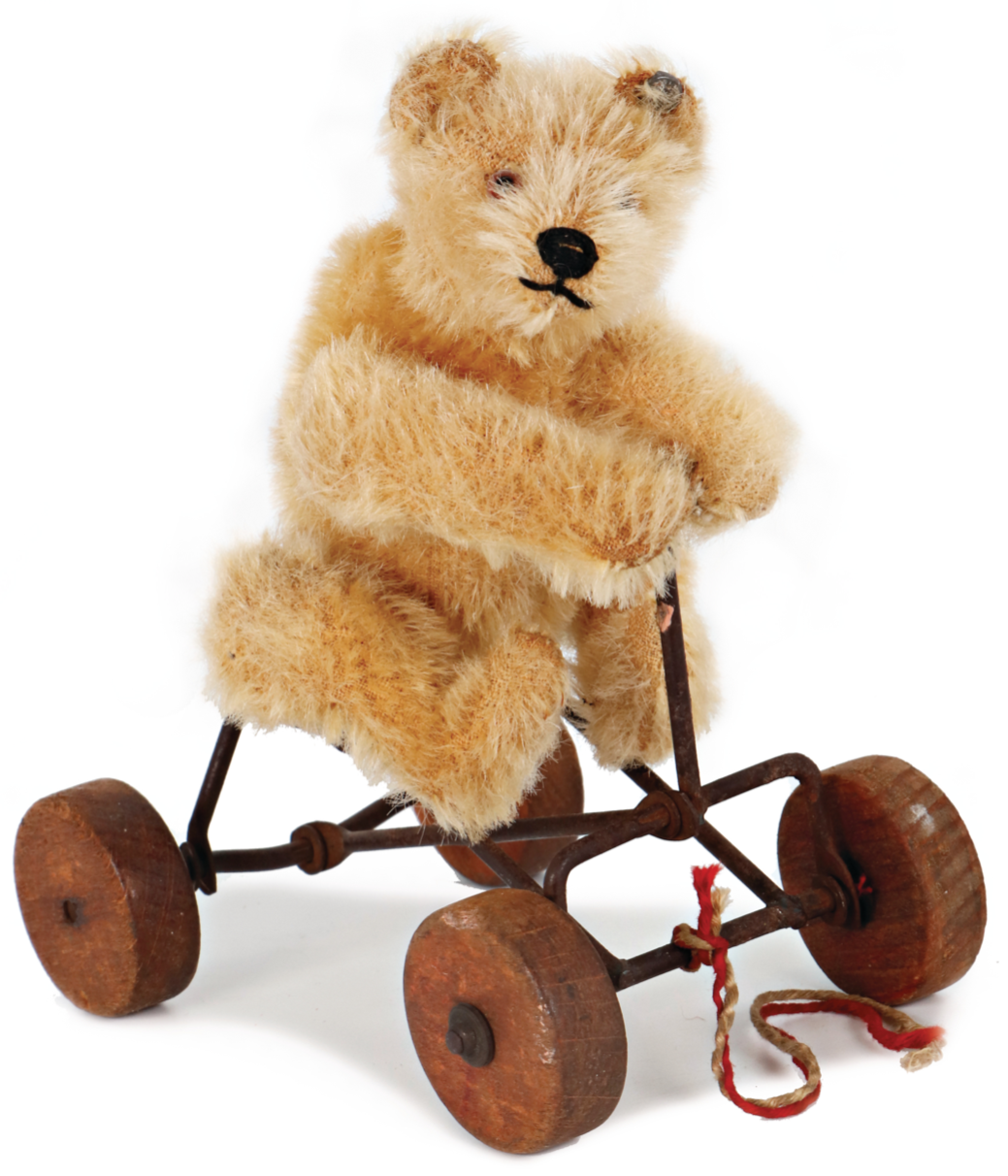
Many of us are familiar with Steiff's charming "Record" animals - those sitting sweeties on a four wheeled cart
. They appear to move back and forth as their vehicles are pulled along. This is due in part to their slightly looser jointing and clever engineering. Record animals and dolls are mostly seen in the c. 20 cm+ size. This one is really, really charming given its teeny, tiny proportions - he's the smallest sized Record bear made by Steiff, ever. His pattern was produced in 10 and 15 cm in blond or gold mohair from 1924-1927. He literally fits in the palm of your hand, and would be insanely adorable as the prized toy in the arms of a very lucky medium to larger scaled bear or doll from any era. And he is RARE! The only other tiny Record Teddy Steiffgal knows of sold at Christies in 2010 for 6,250 GBP.

Our next wheeled highlight proves the saying, "two heads are better than one."
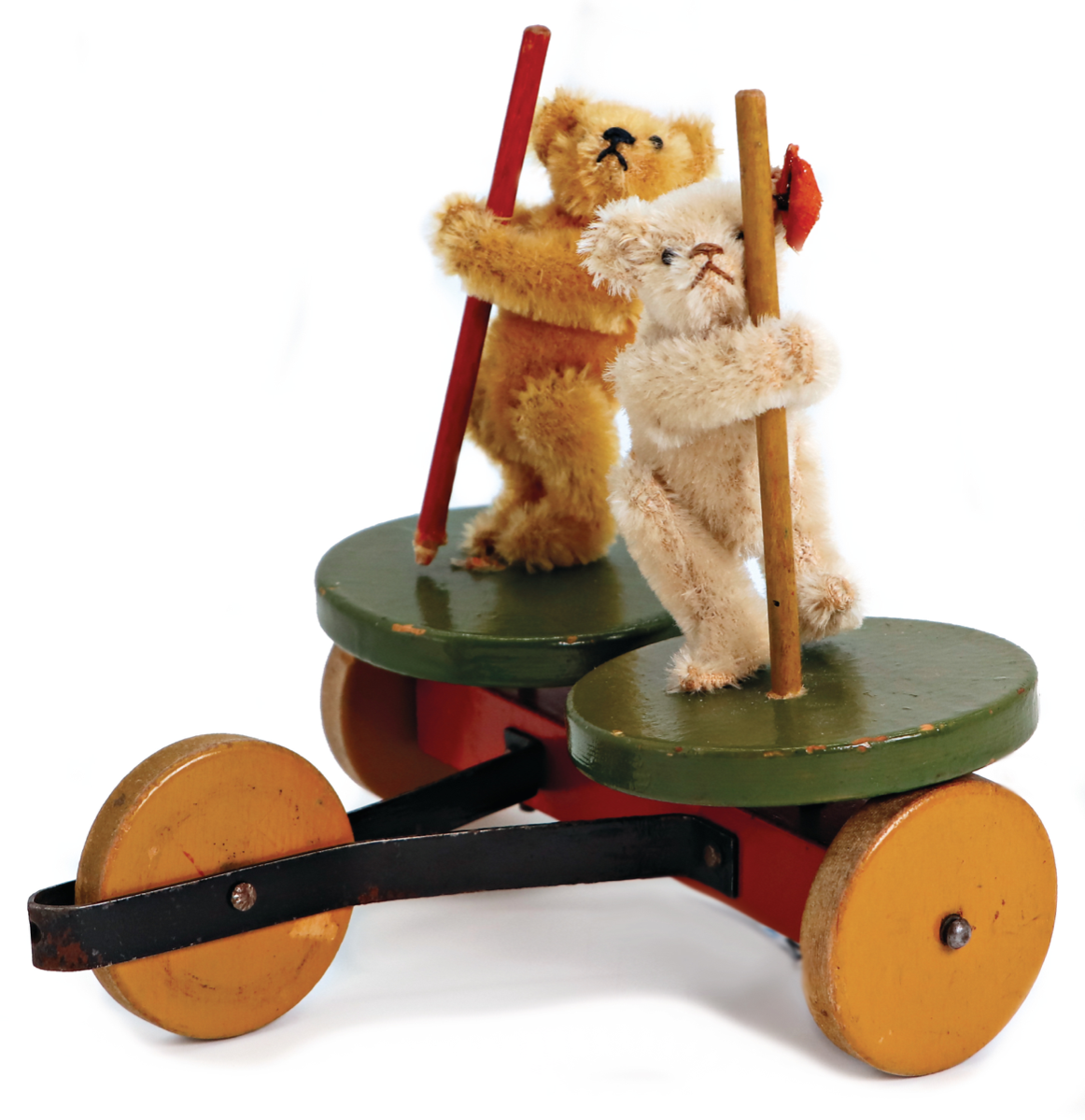
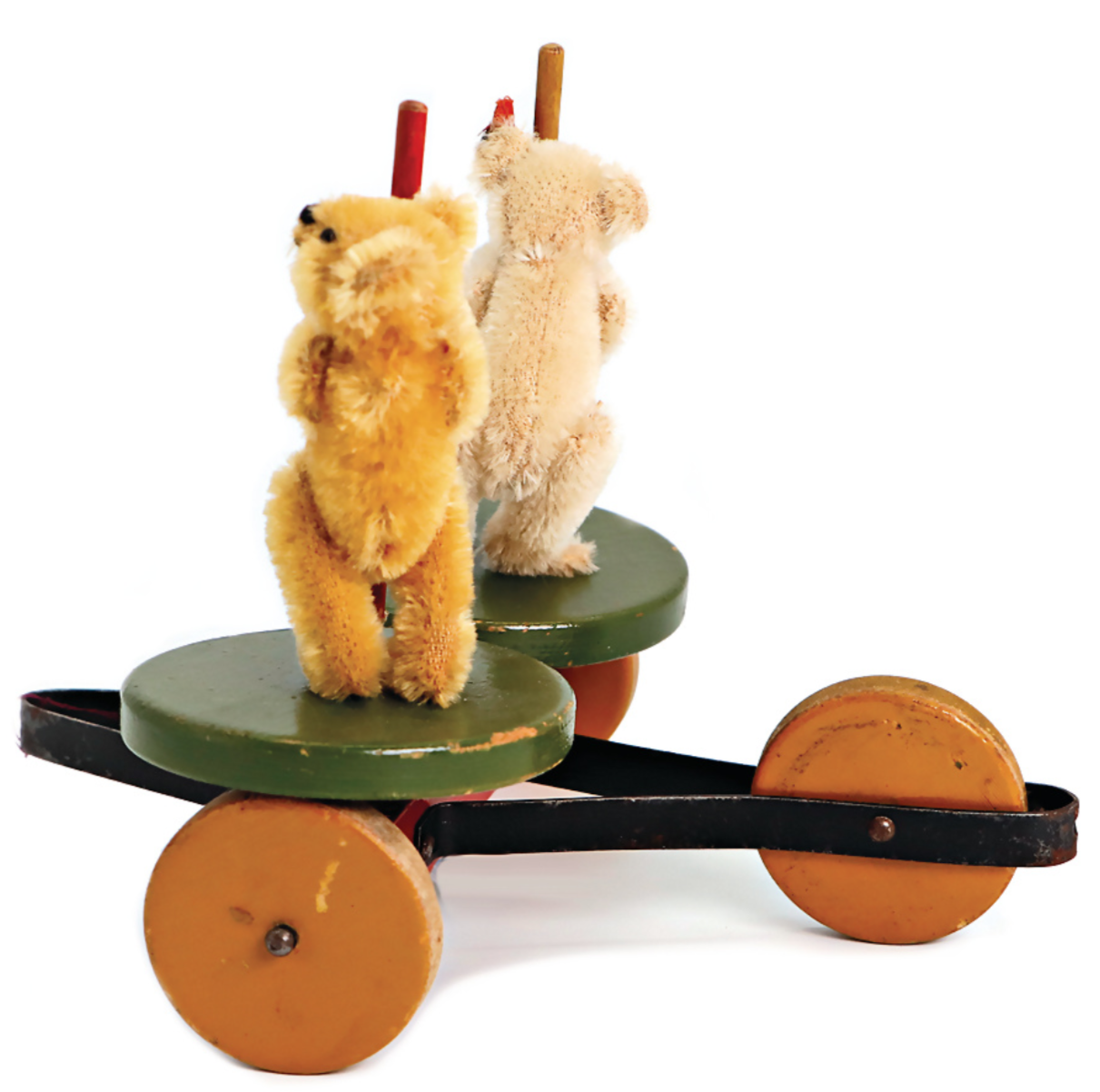
Here we have lot #6050, a stunning Steiff Roly Droly. This bear-pair is cataloged in part as: 

"Tricycle, wood, with 2 turning pre-war bears, 1x golden yellow, 1x white, with button and red cloth tag label, block letters, long trailing f, very nice condition, length: 20 cm, depth: 19 cm, height: 16 cm, extremely rare, sticks were later glued." The Roly Droly has an opening bid of 550 €.

This fantastic novelty is head spinning for a number of reasons, including its rarity, presentation, and condition.
Roly Poly pull toys were made in the mid-1920s through the mid-1930s, and were produced with a number of different "passengers." These included two chicks, two bears, a chick and rabbit, a dog and a cat, and two rabbits, among others. These novelties were specifically produced and designed as hands-on play toys. And toys - especially with moving parts or designed for rough play - wear out, fall apart, or just get lost to time. For example, think about Steiff skittles. Those were designed as a sporting game, so losses and wear on skittle pins and balls are almost expected! This Roly Droly shows just a touch of playwear, and has, or needs, some simple restoration with one of its poles. Nonetheless, this example is so appealing, and so seldom seen, that it just may go into overdrive when the bidding begins.

And finally, let's take a look at just what may be the Maserati of this wheeled category - and maybe the entire sale.
Here we have lot #6071... a breathtakingly rare Record Petsy. It is cataloged in part as:

"Rare Record-Petsy, produced around 1928-1929, length: 25 cm, brown pointed mohair, blue glass eyes, bright embroidering at snout, with seam at the middle of head, with button, block letters, long trailing f, minimally rests of the white cloth tag label, smaller mohair loss at the thighs and at the hand, very nice strong colors of the mohair, red wood wheels, extremely expressive." It has an opening bid of 1,300 €.

Collectors can't seem to get enough of Steiff's Petsy the Baby bear.
 In July, 2022, Ladenburg sold a 72 cm version of this blue-eyed beauty for 42,000
 €! This classic bear design only appeared in the line for a few years in the late 1920s and early 1930s. Like several of the company's mid- to late 1920s popular designs, Petsy was made into several theme and variation novelties, including a music box, a puppet, a purse, and this pull toy. Record Petsy was made in 20 or 25 cm from 1928-1929 only. According to Cieslik's Button In Ear reference book, only 1,462 examples were made. Steiffgal has only seen two of these - ever! One was at the Steiff museum in Giengen (pictured here on the left along with some other fantastic "high rollers") and one at the Spielzeug Welten Museum in Basel. So this Record Petsy is in remarkable, and exclusive, company indeed.

Steiffgal hopes this discussion on these wheeled auction highlights has been thrilling, in a round-about sort of way.

For more information about Ladenburger Spielzeugauktion GmbH's upcoming Special Steiff Auction event on January 21st, please click here!

Have a question about one of your Steiff treasures? Let's talk! Click here to learn more!

Saturday, March 26, 2022

Making A Material Difference At Ladenburger Spielzeugauktion's April 2nd, 2022 Auction

It's nothing short of a bear affair at Ladenburger Spielzeugauktion GmbH's upcoming Special Steiff Auction event on April 2nd, 2022. With over 260 century spanning button-in-ear treasures, there's certainly something on offer for every collector and budget! Of particular interest among all the lots are a group of 20th century bears made from a variety of unconventional or substitute materials. Steiff's Teds are usually rendered in fine mohair fabrics, but there are exceptions - especially around exceptional time periods. Here are three lots that really caught Steiffgal's eye - and why.

The first is lot #5028, a paper plush Teddy bear most likely made just after the conclusion of World War I.
It is cataloged as, "teddy, pre-war era, paper, mohair-plush-substitute, cellulose-plush, brown jointed, shoe button-eyes, strongly used condition, partially fill loss at the disc joints, with button, block letters, long stretched F, 28 cm, in need of restoration, collection Koskinen." This very rare bear has an opening bid of 280 euro.

So just what makes this paper bear worth his weight in gold - despite his apparent condition issues? In order to continue soft toy production in the c. 1918-1920 timeframe, Steiff was forced to come up with some alternative products, as well as materials given the shortage of traditional felt and mohair. Given the abundance of wood in the area, the company started producing things like building sets and furniture for children. Steiff also found a way to produce a tweed-like material from local natural products. This "paper plush" was made from nettles and called "Brennessel." Paper plush items appeared in the line from 1919 through 1921, and included popular models of the company's standard line bears, dogs, cats, and rabbits. 

Size defies with this second sensational Steiff. He is lot #5140, a very big boy made from a seldom seen material. He is cataloged as, "Steiff 1930s-era Teddy bear. Five ways jointed, 100 cm tall, and made from substitute blonde plush fabric. With slightly trimmed muzzle, four claws, glass pupil eyes, and a giant back hump. With long trailing f button and traces of the yellow ear tag as IDs. Extremely impressive and unusual presentation. In excellent condition; with minor playwear and pads with light loss and dust." He has an opening bid of 3,300 euro.

There's so many interesting angles to this rare bear. First, of course, is his size. It is possible that he was intended originally as a display item, or store window display, given his prehistoric proportions. It is somewhat unlikely he was made as a toy, as in some cases he would be larger, and heavier than a child! He was clearly not used as a toy, given his current condition and lack of playwear. Then of course is his materials. As previously noted, Steiff's bears traditionally are made from mohair which gives them a cuddly look and durability to last generations. But this example is made from wartime era substitute blonde plush fabric - and a lot of it. Starting in the early 1930s, items made from wool plush, woolen mohair, silk plush, and other substitute fabrics began appearing in the line. This is the largest - by far - of any item made from alternative fabrics that Steiffgal has ever seen!

And good things come in threes with this third shout out.
Here we have lot #5151, a larger wool plush bear from the 1930s. He is cataloged as, "A most interesting and unusual 60 cm Steiff blonde wool plush bear from the 1930s. Made from war-era materials and featuring long and narrow proportions. With brown and black pupil eyes and black embroidered details. With long trailing F button as ID. In good to very good condition with moderate playwear and generalized thinning." He has an opening bid of 850 euro.

This bear has two key areas of interest - form and fabric. 

First, let’s talk about his presentation. Steiff's bear proportions tend to reflect the period in which they were made. For example, items made in the 1920s were often fluffy, colorful, and upbeat - much like the "roaring twenties" aesthetic, while items introduced in the 1950s tended to reflect the wholesome optimism of the early postwar period. Such is the case for items from the 1930s and 1940s. Steiffgal has noticed that these often have a long, lean, and pensive look to them... reflecting the uncertainty of the time frame in which they were produced. You really can see those distinct elements in this bear.

Now let's focus on his fabric. Wool plush is a distinctive material which holds a key place in the company's product development timeline history, and helps to date this bear pretty accurately. You generally see wool plush items made in the c. 1930 through mid 1950 time frame, but a few models - like the company's Wotan ram - incorporated it through the 1970s. Wool plush is pretty hearty and ages well. Its structure and texture make it less likely to fade, thin, or bald like mohair fabrics. Unlike artificial silk plush, wool plush can also can be cleaned gently like other fine woolen fabrics.

Steiffgal hopes this discussion on rarer fabrics used in Steiff toymaking has made a material difference in your love of the brand!

For more information about Ladenburger Spielzeugauktion GmbH's upcoming Special Steiff Auction event on April 2nd, 2022 please click here!

Have a question about one of your Steiff treasures? Let's talk! Click here to learn more!

Saturday, November 13, 2021

Hans Down, This Prewar Steiff Teddy Bear Has Amazing ID!

This Steiff blog entry is designed to test your "metal" in the most interesting way possible. Check out this delightful and purely period prewar Steiff Ted that Steiffgal has named Hans. He recently joined Steiffgal's hug and previously belonged to a Canadian collector. Can you believe he's close to 90 years old? Indeed, he does check out in every way as a late prewar cub... with a very special and little known detail that helps to narrow down his dating. But more about that in just a bit.

This little love of a cub is a wonderful time capsule of Steiff's mid-1930s to mid-1940s Teddy bear design directives. In terms of his physical properties, Hans stands at 10 inches/25 cm tall and is made from yellow-blonde mohair. He has a back hump, but it is less pronounced than the company's earlier bear editions. He is fully jointed and has both felt hand and foot pads. Each pad is detailed with four black claws. His feet are long and narrow, and his wrists turn slightly upward. Hans' face comes alive with proportional black and brown glass pupil eyes, an unshaven muzzle, and a black hand embroidered nose and mouth. Hans' side-squeeze squeaker works, once in a while.

Hans also has a few "intangible" properties that tie him to the late prewar period. 
He has a very distinctive long, lean, and somewhat "pensive" appearance. He's a "no nonsense" Ted indeed. This "look and feel" is often seen on Steiff's prewar bear production from the early 1930s onward. It is possible that bears created at this time reflected the feelings of the seamstresses making them, as the 1930s and 1940s were very stressful decades in Germany due to challenging and ongoing social, political, and economic realities. In contrast, consider Steiff's early postwar bear production - from the early 1950s onward. Newly introduced midcentury patterns like Zotty and Jackie and the company's re-engineered "Original Teddy Bears" are noted for their jolly faces, rotund bodies, and playful personalities.

Perhaps the most concrete metric in terms of dating Hans is his unexpected branding. He sports an unusual BRASS colored Steiff button. It is the short trailing "f" style and 6 mm in diameter. This button appeared on a few items from 1933/34 through 1943. He also has traces of his yellow linen ear tag, but the information on it is not legible. The yellow tag was introduced around 1934, which suggests Hans' birth year falls roughly between 1934 and 1943. This is one of a handful of times Steiffgal has ever seen this brass button, and Hans is only the second item in her collection of antique Steiff treasures bearing this distinctive trademark. Most of the time, for items produced in the mid 1930's through early 1940's time frame, Steiff used a silver colored short trailing "f" button. It is possible that Steiff substituted brass buttons for silver colored ones during this time for economic or supply chain reasons, but Steiffgal does not know for certain. Whatever the reason, finding items like Hans with this late prewar branding is a rare and wonderful experience for sure!

Steiffgal hopes this discussion on the company's rarer prewar brass buttons has brought the topic full circle for you.

Have a question about one of your Steiff treasures? Let's talk! Click here to learn more.

Monday, October 11, 2021

A Fine Selection Of Century-Spanning Steiff Teddy Baby Bears Headlines Ladenburger Spielzeugauktion's November 6th Sale!


Extra! Extra! Read all about it! Big news on the Steiff front... Ladenburger Spielzeugauktion GmbH is holding a simply awesome premier Steiff sales event on November 6th. The catalog has just been published online and features 368 button-in-ear temptations. In all honesty, there are so many breathtaking options it's a bit overwhelming to pick overall highlights. That being the case, let's take a look at the "cream of the crop" per category or character over the next few weeks. There's not a better place to start this series than with a peek at Ladenburger's offering of century spanning Teddy Baby bears.

All Steiffgal can say is "Ohhhh baby..." when it comes to this first pick.
Here we have lot #3977, a most appealing Teddy Baby made from golden artificial silk plush. His starting bid is a very conservative 750 euro. It is cataloged simply as, "teddy-baby, synthetic silk plush, complete with button, sign and cloth tag label, red writing on sign, very nice original-condition, with original-collar and bell, 30 cm, rare." This sweet cub appears to have all of his IDs, including his button, yellow ear tag, and red bear faced chest tag. Given his IDs, materials, and appearance, Steiffgal suspects this irresistible imp may have been made in the late 1940s.

What is not to love about this fine fellow?
The catalog pictures suggest his condition is quite wonderful, and his happy-go-lucky expression lights up any room. Artificial silk plush is a delicate fabric which loses its shine and soft texture easily, so to find a vintage example which still has its "sheen" is unusual. Although his paw pads are not specifically called out, Steiffgal has a much loved, artificial silk plush Steiff Teddy baby from this similar time period in her collection. She has linen paw pads. That might just be the case for lot #3977 as well.

Steiffgal's second pick is also quite the head turner.
This is lot #4234, an early postwar brown mohair Teddy Baby with all IDs and a million watt smile. His starting bid is 220 euro and he is cataloged as, "teddy-baby, produced 1949-53, with button, chest label and cloth tag label, No. 7322, original condition without damage , additional with US-zone cloth tag label, paws in very good condition, 22 cm, nice full mohair, condition without damage."

The auction catalog photos suggest that this sweet guy is in practically like new condition. Steiffgal is always a little sad when it is clear that a precious toy was not loved by a child as it was intended. On the other side of the coin, this example would make for a crown jewel in any collection, so there is some justice there. Over time, Teddy Baby bears have been produced in sizes ranging from a few inches to over five feet! In Steiffgal's opinion, the smaller sized ones - like this guy - are particularly appealing in their scale, presentation, and proportions. He would be easy to display, doesn't take up too much shelf or cabinet space, and would look charming as a companion for a larger scaled doll or Ted from any era.

And last but not least, check out lot #4314, a super sweet - and super rare - prewar white Teddy Baby.
His starting bid is 520 euro. He is cataloged as, "teddy-baby, white, with button, long stretched F, breast sign, inscription Teddy Baby, inset velvet in face and velvet feet, with painted claws, 13 cm, produced from 1930 to 1933, white mohair, except of minimally place with mohair loss in very nice condition, very expressive, unusual, collection Koskinen."

There's something really magical about white mohair Teddy Baby bears.
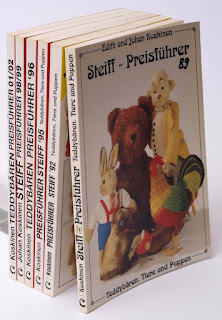
Unlike their blonde and brown mohair peers, the white versions were made for only a handful of years - from 1930 to 1933 overall. Blonde and brown mohair versions appeared from 1930 to 1943. As such, far fewer white mohair versions were produced over time, and most collectors would love to add one to their hugs. Like most coveted collectibles, it’s a supply and demand thing, and Steiffgal suspects this petite treat will be on many auction watchers' wish lists. It is also interesting to note that this example comes from the Koskinen collection. Edith and Johan Koskinen authored several well respected Steiff reference books and price guides over the years. You can see a few of them here on the left, the photo is from Bloss Auktionen. His top shelf provenance certainly adds to his appeal - if that's even possible!


Steiffgal hopes this discussion on Teddy Baby auction highlights has brought out a bit of your inner child today!

Have a question about one of your Steiff treasures? Let's talk! Click here to learn more!

Sunday, May 16, 2021

This Charming Steiff Panda Bear Is Simply Mid-Century Marvelous!

It was pure panda-monium this week at Steiffgal's home when this latest addition joined her hug! Pandas top many Steiff collector's "love lists" and this sweet girl deserves a crown and throne for many reasons. Check out this black and white beauty and see why she really is mid-century marvelous!

This smiling sweetheart - newly named Princess - is 28 cm, five ways jointed, and made from black and white mohair. Her face is detailed with brown and black pupil eyes, a black hand embroidered nose, and an open, triangular shaped peach felt lined open mouth. The black circles around her eyes are created by hand airbrushing; she also has black airbrushing on her back. Princess' pads are made from grey felt. She proudly dons her original pink silken ribbon. Princess retains her yellow eartag, US Zone tag, and raised script button as her Steiff IDs. 

Now let's take a closer look at Princess' place in the product development timeline.
According to the Sortiment, this pattern was produced in 15, 22, 28, 35, 43, and 50 cm from 1951-1961. Her eartag reads 5328,2. This translates to... 5 = jointed, 3 = mohair, 28 = 28 cm tall, and ,2 = with a voice. This pattern, introduced in 1951, was a modification of Steiff's first panda design which debuted in 1938. Steiff's prewar pandas were produced commercially in 15 and 30 cm, and would go on to appear postwar from 1949-1950 in 30 cm only. Given how Princess has elements of both the debut and updated panda patterns in her presentation, as well as her US Zone tag, it is clear that she was produced as the company was transitioning from one pattern to the other - probably in 1951. 

Despite her 1950s birthdate, Princess has many elements of Steiff's earliest panda cubs - especially from the midsection up.
Princess has a broad and triangular mouth; the updated mid-century version has a much smaller, half-oval shaped mouth. Princess has a very round face and muzzle; the updated mid-century one has a more finely contoured head and muzzle. And Princess has her black midsection almost to her mid-torso; the updated mid-century version generally has a much shorter black midsection. Also intriguing is the fact that Princess is technically cataloged at 28 cm, but actually measures 30 cm. And her pre- and very early postwar cousins - who are technically cataloged at 30 cm, actually measure about 26 cm. You can see Princess and her 22 cm updated 1951 postwar panda cousin pictured here on the left for comparison.

Steiff introduced pandas to the world just as they started appearing at zoos across the world in the late 1930s.
These jolly bears immediately rocketed to superstar status. Piggybacking on the success of their real-life cousins, pandas made their debut in the Steiff line in 1938. Because of wartime material shortages, some pandas were produced with linen or other alternative fabrics in the place of felt on their hand and foot paw pads. The success of its first early panda inspired Steiff to produce more pandas in the line as soon as the factory reopened for business in the late 1940s. These early postwar production pandas often had inferior quality felt on their pads as high quality felt materials were still only available in very limited quantities at that time. 

To bring history to life here, check out the two Steiff wartime era pictures above on the left. The one on the left has linen pads and the one on the right has with lesser quality greyish-black felt pads. The one with linen pads has a short trailing "f" button as her ID; the one with greyish-black pads has a raised script button and traces of her US Zone tag as her IDs. 

Steiffgal hopes this discussion on Princess panda has added a touch of royalty to your day.

Have a question about one of your Steiff treasures? Let's talk! Click here to learn more!
The teddy bear search engine