Showing posts with label Ladenburger Spielzeugauktion. Show all posts

Sunday, May 31, 2026

Having A Quack-Attack Over Steiff's Fantastic Duck Chain History


Steiff's Duck Chains are charming novelties that were traditionally produced in the form of a mother duck with two, three, or five babies in tow.
 These birds on the go rode upon eccentric wooden wheels which truly captured their natural strides. This Duck Chain image above with five ducklings is from
 Ladenburger Toy Auctions. 

Toys with "eccentric wheels" have appeared in the Steiff line for over a century. Steiff even owns a patent on this mechanism! The way it works on rolling items is that the wheels are aligned off center or on a bent axle, causing them to move up and down when rotated. Eccentric wheels were invented accidentally, but Steiff realized the opportunity created by their drilling mistakes. The first animal to appear on eccentric wheels was a duck. Steiff launched this item in 1912 as... "This waddling felt duck with brightly colored fathers is fixed onto solidly built, eccentric wooden wheels, which provide the duck with its characteristic waddle. Also fitted with a deceptively realistic "quack-quack" voice. A droll little toy."


Steiff's first and legacy Duck Chain, also on eccentric wheels, debuted in 1917 and was made from felt. 
It consisted of a 10 cm mother duck (pictured here on the left) and two or five 6 cm ducklings (pictured just below.) All were unjointed and stuffed with excelsior. They had grey bodies and green wings and heads. Their wings were decorated with embroidery. Their beaks, legs, and feet were made from orange felt, and their eyes were little black buttons. The mother was cataloged as article number "2110,42 ex," and the ducklings were cataloged as article number "2106 ex." These numbers translate to: 2= lying; 1=felt; 10= 10 cm and 06= 6 cm; 42= simple pattern with a voice; and ex= eccentric wheels. These were branded with Steiff buttons and tags on their felt feet. 
 

In terms of their vehicles, the mother sat on a square metal wire carriage with four wooden eccentric wheels. When she was pulled, she waddled and made a peep sound which was generated by a movement activated voice box embedded in her belly. The ducklings were each mounted on a diamond shaped metal wire carriage with two wooden eccentric wheels. They did not have a voice box. Loops and hooks at the end of the carriages kept the family linked together. This felt Duck Chain was featured in the Steiff catalog through 1932.
 

Duck Chains were also produced in other materials over the years. In the prewar era, the felt version was produced from 1919-1921 in a substitute plush because felt was in short supply for toy making purposes during and shortly after World War I. From 1925-1936, Steiff produced its Duck Chain with two or five ducklings in mohair. Duck Chains appeared in colorfully painted wood from 1924-1927 overall and then in an updated model with integral wheels from 1932-1943. After the debut of the woolen miniature line in the early 1930s, a woolen miniature Duck Chain featuring a drake and three ducklings, all on wooden wheeled metal carriages, appeared in the catalog from 1934-1941. You can see this petite treat here above on the left; the image is from Ladenburger Toy Auctions. 

Postwar, Duck Chains were produced from colorfully painted wood in families of four birds riding on integral eccentric wheels from 1949 through 1966. You can see an example of a 1950s era Steiff wooden duck chain here above on the left; the image is from Ladenburger Toy Auctions. Duck Chains made their final appearance in the catalog from 1969-1973, as a family of four birds in sanded beechwood, decorated with burned-in markings and riding upon large red eccentric wheels that were integral to their bodies. 


Steiffgal hopes this discussion on the history of Steiff's Duck Chain production has fully aligned with your expectations!

Have a question about one of your Steiff treasures? Let's talk! Click here to learn more.

Thursday, September 5, 2024

Japan Celebrates All Things Othello At The Upcoming Teddy Bear With Friends Convention in Tokyo

It's the perfect time for a little get-away... even if it's just virtual! The Japan Teddy Bear Association is holding its 34th Japan Teddy Bear With Friends Convention on October 19th-20th, 2024 in Tokyo. This year, the weekend-long gathering celebrates Othello, the AMAZING and all original 1912 Steiff Titanic Mourning Bear that set a new world's record for the most expensive antique Steiff bear sold at auction in July, 2023. Steiffgal spoke with Shuya Tanaka, the Director of the convention, to learn more about this can't miss event.

Please introduce yourself and tell us about your experience with Steiff and this Teddy bear festival. 

Shuya Tanaka: My name is Shuya Tanaka. I am the youngest director of the Japan Teddy Bear Association and an antique Teddy bear dealer. I was born in Hiroshima in 1991. I studied Western Art at the University of the Arts in Kyoto, and then trained at Ladenburger Toy Auction in Germany. I studied under Mr. Götz Seidel and learned about antique Teddy bears though this internship. After that, I returned to Japan at the age of 26 and started my own business. My company sells antique Teddy bears to regular customers at high-end Japanese department stores. I also work for the Japan Teddy Bear Association to develop the Japanese Teddy bear market. Ladenburger Toy Auction is a business partner and I take my clients to their auctions in Germany several times a year.


Tell us about the 34th Annual Japan Teddy Bear With Friends Convention to be held on October 19th and 20th in Tokyo at the Haneda Airport Garden convention center. How many people will attend?


Shuya Tanaka: The Japan Teddy Bear Convention is the largest Teddy bear show in Asia. We have a partnership with Teddy Total in Germany and Hugglets in the United Kingdom. Our event features over 200 exhibitors. We expect to welcome about 5,000 attendees over the two day celebration. In addition to selling Teddy bears and animals, we also hold charity raffles and auctions, and offer seminars and programs given by Steiff and antique experts from the international Teddy bear community. The event is being held at the new Haneda Airport Garden complex, which is conveniently located to Tokyo International Airport, Terminal 3. You can see a photo of this huge facility here on the left. This all-inclusive space, which could be a travel destination on its own, includes two premier hotels, a rooftop hot-spring bath with views of Mt. Fuji, more than 60 retail stores, and 20 restaurants.


The star of the convention is Othello. Can you tell us about Othello and why he lives in Japan now?

Shuya Tanaka: Othello was sold at auction last summer in Giengen, Germany - also the location of Steiff's world headquarters. The buyer is a client of mine here in Japan, and they entrusted me with Othello's management. When Othello finally arrived in Japan, we decided to have a grand welcoming party for him at our annual Japan Teddy Bear Convention. As such, we will have many delightful black Teddy bear souvenirs available for purchase at this event to celebrate all things Othello. These include a Steiff's 1912 limited edition replica bear, key chains, bags, cookie boxes, and Teddy bears, among many others. 


The festival has a competition for Teddy bear artists. Please tell us about this contest.

Shuya Tanaka: Every year, the Japan Teddy Bear Association holds a contest to determine Japan's number one Teddy bear artist. This year, in addition to the regular contest, there will also be an Othello contest. The theme for this special contest is "Black and Red." We have invited artists to design and sew their best interpretation of Othello for this competition. We expect about 100 entries to the Black and Red contest. Our panel of expert judges comes from all over the world and even includes the President of a Teddy bear company. The judging criteria is confidential, but individual judges will score different elements of each contest bear. The grand prize will be awarded to the bear with the highest overall total score as determined by the judges. 


This event also includes an auction of sorts. Can you please describe this part of the convention. 


Shuya Tanaka: The auctions we hold at the convention are not formal auctions, but simple ones designed to raise money for local and regional charities. The items on offer include Steiff items and other Teddy bears that have been gifted to the Japan Teddy Bear Association. All have very low opening bids. The proceeds from this auction, minus expenses, will be donated to support reconstruction efforts following the major earthquake that occurred in Ishikawa Prefecture in January of this year. And speaking of traditional auctions, you can see a picture of Othello being sold in Giengen in July, 2023 here on the left. He set a new world's record price for the sale of an antique Steiff bear... realizing nearly $250,000!


For our readers outside of Japan and Asia, can you tell us what it is like to collect or be interested in Steiff in Japan?


Shuya Tanaka: There are many individuals in Japan who collect Teddy bears. Of course, there are classic Teddy bear enthusiasts, but Japan has many famous fictional and media characters and a well-developed stuffed animal culture, too. Emotional education that enriches the soul is important here in Japan. So collecting these soft, playful, and appealing items is meaningful to many people for lots of reasons. There are Steiff distributors in Japan, and you can buy new Steiff Teddy bears at many department stores. Although there are few antique shops, our Teddy Bear Convention brings together everything from 100-year-old Teddy bears to the latest Steiff Teddy bears that have yet to be released.


I hear you saying is that this upcoming Teddy bear convention is the ideal destination for anyone - anywhere - that loves Steiff, Teddy bears, artist bears, and other collectible soft toys and playthings! I could not agree more! And thank you for chatting with us!


For more information on the 34th Annual Japan Teddy Bear With Friends Convention to be held on October 19th and 20th in Tokyo, please click here... you will need to use your English (or other preferred language) website translator as the site is in Japanese. 


Have a question about one of your Steiff treasures? Let's talk! Click here to learn more!

Sunday, September 1, 2024

Hands In The Air Over This Antique Steiff Felix The Cat Handpuppet

Here's another great addition to Steiff's meow-mix of fantastic prewar puppets!
Check out this black and white beauty. Do you recognize his distinctive face and impish personality? This guy - who is now over a century old - entertained millions of people through the 20th century.

This Fe-line is none other than Felix the Cat in the form of a hand puppet. He is 20 cm tall and mostly made from black mohair. His face is made from white felt with a stitched mouth, big black button eyes, a dimensional black felt nose, and felt ears. He has a little red and black airbrushing on his mouth. His head is firmly stuffed with excelsior and his finger tube is made from cardboard. This puppet design was made from 1925-1926 in this size only.

So what is the history of this happy handful?
In 1919, Pat Sullivan and Otto Messmer introduced their Felix the Cat movie series. By 1926, sensing that Felix would be a great fit for Steiff, Steiff's distribution partner in the USA - George Borgfeldt - asked Steiff to create a series of licensed Felix the Cat toys. Steiff was hesitant and didn't think the line would be a success. Nonetheless, Steiff did end up producing a full bodied 22 cm Felix from 1926-27, a 20 cm Felix hand puppet from 1925-26, and a 20 cm Record Felix from 1926-27. The doll didn't sell well, but the puppet and wheeled versions struck a chord with buyers at the time.

Today, Steiff's Felix the Cat novelties are few and far on the secondary market.
Given their rarity, they often top the wish lists of Steiff collectors worldwide! The most recent Felix hand puppet sold at auction Steiffgal could find hammered for 1700 euro at Ladenburger Spielzeugauktion's Special Steiff Auction in 2018. In 2019, Morphy Auctions sold a full bodied Felix doll; he hammered for $4,000. And in 2010, Christie's sold a Record Felix in delightful condition for GBP 2,375. The photos of the full bodied and record Felix novelties are pictured here on the left; the images are from Morphy's and Christie's respectively.

Steiffgal hopes this discussion on Steiff's rare Felix the Cat hand puppet merits a thumbs up from you!

Have a question about one of your Steiff treasures? Let's talk! Click here to learn more!

Friday, July 5, 2024

This Amazing Steiff Prewar Treasure Is No Optical Illusion!

Eye, eye, eye... look what we have here! Steiffgal just got an inquiry about an eye-popping rarity and she could not wait to share this exciting find with you. Let's not monkey around and jump right into the details of this precious prewar primate right away!

What we have here is Steiff's Mimocculo Orang Utan.
This example is about 35 cm tall, fully jointed, and made from long, fuzzy red-orange mohair. His hands, feet, ears, and face are made from felt. He features an open, dimentional mouth as well as really unusual and abundant facial seaming. This is because he has a remarkable moving eye feature imbedded in his head. These seams hold his facial fabric, and in turn his eye-movement hardware, securely in place. With Mimocculo, when you pull gently on his ear, his white, brown, and black round glass eyeballs move left and right, as well as up and down. This great example retains his long trailing "f" button and traces of his red ear tag as his Steiff IDs. 

This nifty novelty was produced from 1930 through 1936 in 8, 10, 12, 14, 17, 22, 25, 28, 35, 43, and 50 cm.
 Sizes from 17 cm had the distinctive rolling eye mechanism and deep eye pockets; the smaller ones had standard, stationary glass pupil eyes and closed mouths. Given Mimocculo's charm and collector's appeal, Steiff created a 35 cm tall rolling eye replica of this treasure in 1998. It was produced in an edition size of 3,000 pieces overall and very closely resembled the prewar version.

In the early 1930s, when 
Mimocculo debuted, one of Steiff's business development strategies was to produce high end items with distinctive mechanical features. Other products with amazing jointing or advances from this era included the company's snap jointed tail moves head Circus Elephants (made in 24 and 30 cm from 1931-1940 overall) a snap jointed tail turns head Circus Bear (made in 32 cm from 1935-1939), and a series of press and release music box animals based on Steiff's most popular prewar pet designs. Mimocculo, with his fabulous flirty eyeballs, fit perfectly into this exclusive club of mechanical marvels.

And just how rare are these outrageously outstanding Orang Utans?
Steiffgal has only seen a handful come up for public auction over the past decade or two. Most recently, Ladenburger Spielzeugauktion offered a 10 cm version at their Special Steiff Auction held on June 29th, 2024 in Giengen, Germany. You can see this happy handful here on the left, the image is from Ladenburger Spielzeugauktion. This "mini Mimo" had a starting bid of 180 €, hammered at 3100 €, and was cataloged simply as:

"Monkey, orangutan, MIMOCCULO, made 1930-1933, 10 cm, rust-colored mohair, small glass eyes, felt feet, hands and face as well as ears in very nice condition, unusual."  

Orange you glad you checked out this discussion on Steiff's Mimocculo Orang Utan?

Have a question about one of your Steiff treasures? Let's talk! Click here to learn more.

Saturday, June 22, 2024

Timecapsule Treasures On Offer At Ladenburger Spielzeugauktion's 2024 Steiff Special Auction

What's old is new again at this year's Ladenburger Spielzeugauktion's Steiff Special Auction on June 29th, 2024. This sale tempts collectors with almost 230 amazing and well curated lots of century-spanning button-in-ear treasures. One especially noteworthy category in this sale is items from the company's earliest production period - just before and just after the turn of the 20th century. Here are three "golden oldies" definitely worth checking out!


Let's start this trip back in time with lot #10. This is an extremely early dressed Steiff monkey, with an opening bid of 850 €. It is cataloged as:

"Steiff monkey, crouching, around 1900, pre-button era, felt, shoe button eyes, for shirr (missing), height: 17 cm, original felt clothes, smaller faults in the felt, nice original condition."

This sitting sweetie would love to hang out with you!
 It is Steiffgal's best guess that this is an example of the company's turn of last century felt monkey designed as a catch and release toy. If you notice his well formed hands, they look like they were designed to be holding something. Steiffgal thinks this would have been a piece of elastic string. So, someone could bounce him around as a toy on this cord. According to Pfeiffer's 1892-1943 Sortiment, this novelty was produced in 17 cm from 1897-1911 and was described as, "felt, brown, begging, elastic cord, tailcoat and slippers of felt." You can see the photo from this reference book here on the left for study and comparison. 

This next very vintage selection will have you moving and grooving.
 This is lot #6, a Steiff dancing bear, which carries an opening bid of 1800 €. It is cataloged as:

"Steiff dancing bear, around 1900, pre-button era, short plush, in very good condition, attending, dancing on a metal disc, casting wheels with spokes rubber coated, rubber is very worn, therefore the turn function isn't possible, squeaker, length: 68 cm (catalog proof 70 cm), shoe button eyes, one eye is a bit scratched, nose chain and stick, original pull rod, black and white picture in the Pfeiffer catalog page 37, and picture in the Steiff catalog from 1900, book Jürgen & Marianne Cieslik "Knopf im Ohr" page 27, an unusual piece from the beginnings of the Steiff-production, is a museum piece."

This amazing and little known mechanical bear, which was produced in 70 cm from 1898-1907, has a key role in the history of the development of the jointed Teddy bear as we know him today.
 In the late 1890's, Steiff produced a number of circus bear novelties. These were considered "action toys" as they designed to give movement to the toys. These included this dancing bear on a circular wheeled cart; bears on platforms with bristles supporting them; a bear on a cart with metal wheels; and tumblers in different configurations and sizes. The bears on the platforms with bristles would move when someone tapped the table on which they were standing - so they would sort of "shimmy" about. You can see a few of these early examples here on the left, the photo is from Cieslik's Button in Ear: The History of the Teddy Bear and His Friends.

Richard Steiff wanted to create more playful, dynamic, and child-friendly versions of these static/moving bears, and he took this challenge seriously. He studied the way real bears move at the zoo. Mohair became available on a commercial level around 1902. He married those two facts, inserted his creativity, and came up with the patterns for a series of fully jointed bears, starting with string jointing, then rod jointing, then disk jointing. Steiff's disk jointing system has not changed much since its introduction over a century ago. 

At the tail end of this discussion is lot #9, a very large and early monkey.
 He has an opening bid of 1800 € and is cataloged as:

"Steiff monkey, 1904, length: 80 cm, mohair plush, velvet ears, face and hands, PPB, shoe button eyes, elephant head, nice full mohair, velvet is a bit worn, small open place at the head mounting in the back, the wire mounting is visible, very expressive, an early unusual piece from the beginnings of the Steiff production."

This big boy is a fine example of Steiff's early - but not earliest - monkey patterns. This basic design debuted in 1904 and appeared in the line through the 1920s in a variety of slightly modified versions over time. He was produced with and without a tail, in a number of fabrics including brown and white mohair, and with felt or velvet hands and facial features. Given his elephant button, the one under discussion here was produced in the c. 1904-1905 time frame. 

One super interesting thing about this marvelous monkey is the company he keeps. 
This monkey appears in a 1903/04 catalog photo used to debut the company's new editions at the annual Leipzig Spring Fair. But what's so special about that? It's the same picture that debuted PB55... the world's first jointed Teddy bear. Talk about being at the right place at the right time, eh? A snapshot of this catalog page is shown here on the left. You can spot this monkey in the very far back right of the picture - just click on the image to make it bigger. 
The photo is from Cieslik's Button in Ear: The History of the Teddy Bear and His Friends.

Steiffgal hopes this discussion on these time capsule treasures has brought history to life for you. 


For more information on this June 29, 2024 sale, please check out the company's website at https://www.spielzeugauktion.de/.


Have a question about one of your Steiff treasures? Let's talk! Click here to learn more.

Thursday, June 20, 2024

Remarkable Rarities At Ladenburger Spielzeugauktion's 2024 Steiff Special Auction!

The countdown is on for the most exciting Steiff auction event of the year - Ladenburger Spielzeugauktion's annual Steiff Sonder Auction or Steiff Special Auction! This event is famous for offering WAH-HOO good temptations - as well as producing world record breaking results. This year, it will be held on June 29, 2024 in Giengen, Germany as part of the Steiff Company's annual Steiff Sommer Festival. For more information on the sale, click here!

This year, nearly 230 premier century-spanning button-in-ear treasures will go under the hammer. In addition to rockstar offerings most of us can only dream about - including a google eyed Petsy Bear, a rod bear, and a full set of early skittles - the sale also features a number of hidden jewels. These are items with very special or unique details that really make them extraordinary from the collector's perspective. Here are three that caught Steiffgal's eye... and what makes them so quietly remarkable. 

Let's twist and shout over this first auction hidden jem.
This is lot #28, a Steiff Turbo "Purzelbär" or somersaulting bear. He has an opening bid of 250 € and is cataloged as follows:

"Turbo "Purzelbär" with clock mechanism, arm-wound mechanism and clock mechanism are intact, only produced in 1951, button and cloth tag label number 9315,4, rests of the US zone cloth tag label, 15 cm, original neck label and felt vest, very nice unused condition, rare, only c. 1000 pieces were produced."

In the early 1950s, Steiff made a handful of little known novelties featuring movements that were introduced prewar. These included tail moves head items (which debuted in the early 1930s) in the form of bears and dogs; musical items (which debuted in the late 1920s) in the form of bears, monkeys, cats, and dogs; and a tumbler (which debuted around 1909) in the form of this bear. It is not clear why the company "reintroduced" these old school style novelties postwar, especially given the emphasis on launching new patterns that reflected the contemporary, forward thinking vibe of the times. These early postwar novelties - including this somersaulting bear - only appeared in the catalog for a year or so. This suggests that they were not commercially successful, and/or were expensive and time consuming to produce. Given their very short production time and output, these tumbling bears are extremely few and far between on the secondary market - especially in nice condition like this with IDs. This would be a delightful addition to a collection of midcentury rarities, mechanical novelties, or Teddy bears. 

Steiffgal doesn't want to let the cat out of the bag here, but be sure to check out lot #181 in this signature summer sale.
It is a woolen miniature cat, with an opening bid of 160 €. He appears in the catalog as:

"Cat, produced 1931-1938, with button inscription: Muster, Nomotta-wool, grey/white, lying, swivel head, green glass eyes, height: 6 cm, length: 8 cm, very nice strong colors, extremely rare, exceptional, unused condition."

This pretty kitty is in such lovely condition, with a great presentation and personality. However, what makes her off the charts great is her Steiff ID, which is a MUSTER button. This form of ID was used by Steiff pre-WWII on items considered samples, evolving designs, or prototypes. In general, the button indicated that the item was Steiff property and was not intended for sale or distribution. "Muster" translates loosely from German to English as "pattern" and in a sense, these "muster" items were just that. And, the button is located on her ribbon. This is probably because her ears are not large enough to handle the button. The combination of her condition, unusual ID, and its atypical placement, truly makes her the cat's meow among the woolen miniatures on offer in this fine sale. Purrr-fect in every way. 

And finally, tag - you're it - with this last auction rarity with a happy ending. 
This lot is #147, a Steiff tail turns head Rattler sitting dog. It has a starting bid of 160 € and is cataloged as:

"Rattler, with mechanism for turning head, produced 1931-1942, with button, chest label and cloth tag label, number on cloth tag label: 3310H, red inscription Raddler INT. PAT. APPID. FOR, and with separate paper label: "dreh mich hier herum, ich schau rundherum", 12 cm, colouring is fine shaded, very nice original condition."

This little fellow has two big features that make him a top dog in this exciting sale. The Rattler tail turns head pattern in itself is charming, but not terribly rare. Overall, he appeared in the Steiff line in 8, 10, 14, 17, 22, 25, 28, and 35 cm in the 1930 through 1943 time period. So, it's not challenging to find one these days. However, this particular example, in addition to being in lovely condition, retains his most coveted "tush tag." This is a round cardboard tag on his tail that reads "turn here and I will move my head." These instructions appear in German, English, and Spanish. What's amazing about this is that these moving marvels were designed as fun toys for kids. So it's a miracle that this tag was not removed or lost to time, given its postioning and ephemeral nature! This guy also gets a shout out for his great IDs, including his legible red ear tag. Noted on its is his article number, which is 3310H. This corresponds to 3=sitting, 3=mohair, 10=10 cm tall, and H=tail moves head feature. 

Steiffgal hopes this discussion on these secretly special auction picks has meant a lot to you!

For more information on this June 29, 2024 sale, please check out the company's website at https://www.spielzeugauktion.de/.

Have a question about one of your Steiff treasures? Let's talk! Click here to learn more.

Friday, October 6, 2023

This Rare Steiff Cartoon Doll Is No Laughing Matter!

Steiff certainly has international appeal - and so do many of the company's rarer prewar novelties! Check out this note from a lucky collector who hit it really big with a fantastic doll purchase. Stefan shares:

"I hope this email finds you well and you're doing well. Recently I purchased a figure, which I'm 99% sure it's Steiff. It's a comical character, known as Silent Sam in America, but in Europe known as Adamson. I was just wondering, do you know what year it was manufactured? Thank you so much.  
Kind regards, Stefan"

This delightful cartoon doll is no laughing matter! Here we have Steiff's Adamson doll. This fine fellow is 29 cm tall, fully jointed, and made from felt. His face comes to life with dramatic seaming, blue and black glass pupil eyes backed in large white felt circles, a dimensional nose, and a bald head highlighted with a few remaining black hairs. He smokes a brown and white cigar, which is integral to his mouth. He wears a red and white shirt with cuffs; a white vest detailed with buttons, a collar, and a blue tie; blue pants, and white shoes. These dolls were made from 1925-1929 in this size only. According to the Cieslik's Button in Ear The History of the Teddy Bear and His Friends reference book, 997 examples of this doll were sold. The Ciesliks also note, "In 1925 Steiff adopted Adamson into their program after several trial attempts. For Adamson was not easy to portray; he had a cigar in his mouth which he rarely removed." 

So just who is this cute character?
Adamson, also known as Silent Sam, was the star of a cartoon strip drawn by Oscar Jacobsson (Swedish, 1889–1945). It debuted on October 17, 1920 in the Swedish humor publication Söndags-Nisse. What was so interesting - and universal - about Adamson is that he almost never spoke or used words. Instead, he went about his business and communicated with gestures and movements. As such, Jacobsson's character would go on to be appreciated and enjoyed internationally across all of Europe, the USA, and Asian countries including Japan and China. Silent Sam was a big hit in America starting in 1922. Over time, a series of artists brought the strip to life until it was last published in 1964. 

To honor Jacobsson and his contribution to the art of illustration, the Swedish Academy of Comics founded the Adamson Award in 1965. It is given to one Swedish and one international comic creator every year.  You can see a sample of the Adamson cartoon above on the left. 

Adamson dolls are certainly few and far between, and Stefan is super lucky to have one in his collection.
As far as Steiffgal can tell, only three examples of Steiff's Adamson dolls have come up for public auction from 2017 onward. All were sold by Ladenburger Spielzeugauktion GmbH of Ladenburg, Germany. They ranged in hammer price from 2600 to 4500 euro. The doll pictured here on the left hammered for 4200 euro in 2021; the image is from 
Ladenburger Spielzeugauktion GmbH.

Steiffgal hopes this blog post about this cigar smoking doll has really lit up your day. 

Have a question about one of your Steiff treasures? Let's talk! Click here to learn more.

Wednesday, June 7, 2023

Breathtaking Bear Beauties on Offer at Ladenburger Spielzeugauktion's 2023 Special Steiff Auction in Giengen

Can you bear it? Ladenburger Spielzeugauktion's July 1st, 2023 Special Steiff Auction in Giengen is presenting one of the finest lineups of vintage to antique button-in-ear collectibles in memory. Many of those wah-hoo good treasures are from the collection of Susan Kilgore Wiley. Ladenburger sold the first half of her over-the-moon great hug in January, 2023. This second sale presents even more Wiley temptations, including some of the world's most fantastic and aspirational Steiff bears Steiffgal has ever seen! Here are three extraordinary ones that really caught her eye, and why. 

The first can-you-bear it bear is lot #64, a most unusual Teddy Clown bear.
It has a starting bid of 1,300 euro and is cataloged by the auction house as:

"Clown-bear, exceptional, with button, block letters, long trailing f, minimally rests of the red cloth tag label, big blue glass eyes, bright embroidering at snout, and claw embroidering, strong fiery mohair, long snaped off arms, hump, 33 cm, except of small faults felt paws in very nice condition, with ruff, without hat, very expressive."

It's really the best of two legacy Steiff worlds with this terrific temptation. At first glance, he sort of looks like a Petsy the Baby Bear with his tipped mohair, pink hand embroidered nose and mouth, and blue eyes. But, he does not have the signature center facial seam construction or wire lined ears as seen on Steiff's Petsy cubs. But, he has his factory original neck ruff, and these were not put on any models other than Steiff's Teddy Clown bears - at least as far as Steiffgal knows! It is also important to note that this bear's detailing and configuration is not noted in Pfeiffer's Sortiment books. This suggests that very few were produced. Steiffgal suspects that his "birthday" was probably in the mid to late 1920s time frame, when both Petsy and Teddy Clown made their appearances in the catalog. This is only the second of his type Steiffgal knows of.

And speaking of Petsy - this second can-you-bear it bear is lot #15, an insanely rare and equally adorable Petsy bear.
It has a starting bid of 1,600 euro and is cataloged by the auction house as:

"One of the of the highlights of the this year's STEIFF-GIENGEN-auction, Petsy, produced around 1930, with seam at the middle of head, nice, full, pointed mohair, rare cross-eyed, with button, block letters, long trailing f, bright embroidering at snout, long snaped off arms, hump, big ears, original felt paws with flaws here and there, and scattered spotty mohair loss at neck, hump, ears, and shoulder, otherwise very nice condition, nice strong color of the mohair, standing height 50 cm, extremely rare, extremely expressive, an unusual rarity."

Steiffgal is pretty certain that this eye-catching (pun intended) rarity is on every single Steiff collector's dream wish list! It goes without saying that Petsy bears do incredibly well at auction, with one selling for a mind boggling 66,000 euro at a Ladenburger sale in January, 2023. However, this particular one, with black and blue cartoon eyes, is simply off the charts when it comes to his rarity, expression, and presentation. Steiffgal would not be surprised if this example trades hands near or even above this previous record! And what makes this bear so extraordinary?  His "half and half" glass eyes are sewn in his head in such a way that they can be tilted and rotated, giving him countless silly to serious facial expressions. Petsy bears usually have stationary, glass pupil eyes. This is one of the few Petsy bears of this size with cartoon style eye extant. 

And now for the wow OMG wow third can-you-bear it bear of this sale, let's take look at lot #82.
This is a Steiff black Titanic bear. It has a starting bid of 4,500 euro and is cataloged by the auction house as:

"Titanic bear, one of the highlights of the this year's STEIFF GIENGEN auction 2023. A rare item from 1912, was produced in remembrance of the victims of the sinking of the Titanic on April 14th 1912. It were 82 pieces of this grief bear/ black bear produced. This Titanic bear has a seam at the middle of head, red shoe button eyes that are underlaid with felt, black embroidered nose and claws, small STEIFF button, block letters, long trailing f, long snaped off arms, hump, voice, intact, small faults at the feet, produced between 1912 and 1917, 50 cm, nice full black mohair, with provenience, enclosed invoice by the original purchase at Sotheby's 1990, and newspaper article by an American antique magazine, "Antique Review" from February 1991, one of the rarest bears that were ever auctioneered by the Ladenburger Spielzeugauktion."

This bear is so amazing that he leaves Steiffgal pretty much speechless in terms of analysis. So she will share a little story about him instead. When she first heard about this bear, she was certain it was a replica, based on how he was described to her. But his owners insisted he was the real deal from 1912. Fast forward, Steiffgal met this bear in person. His owners handed him to her, and he really was as close to tissue new as possible. So new that Steiffgal again thought he was a replica at first. But after a few moments, it became clear that he was well over 100 years and just in clean, breathtaking condition. His owners did not mention his center seam - which just puts this bear over the top in terms of appeal, desirability, and rarity. It's anyone's guess how the bidding will roll out with this bear... but watching it unfold should be more thrilling than any major Hollywood production!

For more information on this amazing sale to be held on July 1, 2023 and to see all of the great lots on offer, please see the auction house's website at https://www.spielzeugauktion.de.

Steiffgal hopes this discussion on auction bear highlights has left you star-struck!

Have a question about one of your Steiff treasures? Let's talk! Click here to learn more.

Monday, May 29, 2023

Simply The Best: Highlights From Ladenburger Spielzeugauktion's July 1, 2023 Steiff Auction Event

Last January, Ladenburger Spielzeugauktion GmbH presented the first installment of the Susan Kilgore Wiley collection of breathtaking, antique Steiff bears, animals, and novelties. This awesome event realized over $475,000 and was the talk of the international vintage Steiff collecting community. Now it's time for the second part of the sale, which is most fittingly being held on July 1st, 2023 in Giengen, Germany in association with Steiff's annual Steiff Sommer celebration. Here are three over the top items on offer as part of that auction. Steiffgal did not even know these items existed until now, they are that rare and that AMAZING. Please sit down, fasten your seatbelt, and read on!

It's the best of all worlds with this first Wiley auction highlight.
Here we have lot #45, an early 20th century Steiff Teddy bear girl doll. It is cataloged by the auction house in part as:

"One of the of the highlights of the auction, probably a prototype by the Fa. STEIFF, unusual doll, felt head, blue glass eyes, bright mohair hair, with button, block letters, long trailing f, bear body, with white mohair, probably original silk ribbon and silk collar, height: 35 cm, small felt faults at the right cheek, exceptional, stronger mohair loss on the reverse of the legs and at the back, otherwise single places with slightly thin mohair, exceptional, probably an unique specimen." It has an opening bid of 1500 €.

This beautiful treasure probably dates around 1912, given her presentation, glass pupil eyes, and facial seaming. It was around that time that Steiff's proportional dolls were becoming very popular. The company was producing a number of adorable student and childlike dolls that were dressed in everyday clothes, Sunday best, and regional attire. These charming examples were even sold through FAO Schwarz in the United States! Steiffgal suspects that Steiff was looking at ways to expand their doll offering through different novelty options, and knows of a Steiff topsy-turvy style doll prototype from c. 1912. It makes perfect sense that Steiff would experiment with a doll head and a Teddy bear body, as the company specialized in both deigns and other manufacturers had these "hybrid" items in their lines. This doll bear probably did not go into production because it was very expensive and labor intensive to manufacture on a commercial scale.

This next highlight is truly on fire.
Here we have lot #49, a most colorful Steiff Teddy on the go. The auction house catalogs it in part as:

"STEIFF Record-teddy, produced 1927-1930, with button, block letters, long trailing f, red fiery mohair, glass eyes, felt paws, except of minimally places in good condition, scattered thin mohair, and mohair loss, swivel head, color is wear down at the wooden wheels, height: 24 cm, length: 24 cm, extremely exceptional, very strong colors, rare." It has an opening bid of 1200 €.

Collectors will recognize this delightful pull toy as an example of the company's legacy Record pattern. This pull toy design debuted around 1912 in the form of Record Jocko, a chimp on wheels. Bears and dolls on wheels quickly followed this introduction as they made for perfect passengers on Steiff's simple but charming four wheeled cart design. According to Pfeiffer's Sortiment, this particular Record Teddy was produced in 20 and 25 cm from 1927-1930. What's so interesting about this time frame is that it exactly corresponds with the "heyday" of the appearance of brilliantly colored, tipped mohair items in the Steiff line. Steiffgal has never seen an orange tipped Steiff bear in this size, and it is possible that they were only created for this novelty, and not as a freestanding item. Other tipped mohair highlights from the "roaring 20s" include rabbits, cats, dogs, and other eye-catching pets. 

And last but not least, please check out lot #54, a musical Teddy clown bear.
The auction house catalogs it in part as:

"Teddy clown, rare, with music mechanism, probably a single-item production, yellow gold mohair plush, glass eyes, bright embroidering at snout, softly stuffed, kapok filling, a rarity, with hat, standing height 39 cm, with button, block letters, long trailing f, scattered small faults at the felt paws, nice, full mohair, with music mechanism, long snaped off arms, on the reverse here and there with places with minimally mohair loss, original ruff and hat, produced c. around 1927." It has an opening bid of 1900 €.

These sorts of rarities make collectors want to break out in song! Teddy Clown bears themselves are quite rare on the market, given they were only made from 1926-1930 overall. In 1928, Steiff debuted a series of "Music-Animals" based on their most popular designs and patterns of the time. These items were standard line animals with a music box imbedded in their torsos. According to company documents, they included a Teddy bear, Petsy, Bully dogs, Molly, Cheerio, Fellow, Charly, Treff, Fluffy, a lamb, and a clown. There is no mention of a musical Teddy Clown in any materials Steiffgal can find. However, given the range of characters and novelties produced as music box toys, it is not out of the question that Steiff would have considered producing Teddy Clown as a musical edition. Perhaps this example was created as a prototype for this product development experiment.

For more information on this amazing sale to be held on July 1, 2023 and to see all of the great lots on offer, please see the auction house's website at https://www.spielzeugauktion.de.

Steiffgal hopes this discussion on these absolute auction rarities has further cataloged your interest in vintage Steiff!

Have a question about one of your Steiff treasures? Let's talk! Click here to learn more.

Saturday, December 31, 2022

These Ladenburger Spielzeugauktion Auction Highlights Are Dressed To The Nines!

Three's a charm when it comes to the third post in this blog series of auction highlight from Ladenburger Spielzeugauktion's January 21st, 2023 Collection of Susan Kilgore Wiley sale. It's no secret that Steiffgal goes all hubba-hubba over Steiff's utterly charming dressed dolls and animals. And, this sale offers some of the most appealing ones in memory. Check out this trio of well attired prewar offerings from this auction. Steiffgal is certain you will consider all of them a clothes call indeed.

This first dressed highlight doesn't have a hare out of place.
It is lot #6152, an all original and early Steiff Peter Rabbit. It is estimated at €650-€1,300, and is cataloged in part as:

"One of the highlights of the auction, exceptional hare, Peter, around 1910, with small button, block letters, long trailing f, shoe button eyes, underlaid with red felt, fine brown/beige velvet, attending, with original felt jacket, decorative seams and golden buttons, red slippers, 1 leather sole with original stamp, 1 felt slipper is a bit holey, and small holes on the blue felt jacket, standing height 26 cm, extremely rare, exceptional."

Steiff's turn of last century Peter Rabbit dolls top many collector's bucket lists. This well coutured example is in lovely condition and is a marvelous size. It is interesting to note that the exact details that make up a Steiff "Peter Rabbit" are not specifically identified in Pfeiffer's Sortiment books. It is generally understood amongst collectors that a "Steiff Peter Rabbit" is standing, unjointed, and wears a felt topcoat with buttons and embroidery and felt slippers with leather soles. The Sortiment book pictures two versions of standing rabbits wearing felt topcoats and slippers, but does not identify them as "Peter Rabbit." The first is a spotted velvet version wearing a red or navy topcoat and red slippers; he was produced in 10, 22, and 28 cm from 1904-1919. The second is a white wool plush version wearing a green felt topcoat and red slippers; he was produced in 22 cm from 1904-1918.

This next auction highlight is a pair with flair!
Here we have lot #6181, two early 20th century, fully jointed, center seamed Steiff felt dolls. They are estimated at €330-€660 and are cataloged in part as:

"Felt dolls, Anton & Lisl, Upper Bavarian, produced between 1909 and 1926, 28 cm, with traditional costume, felt-head, mohair-hair, felt body, jointed, arms and legs, original, clothes, very nice condition."

This darling duo are textbook examples of   Steiff's "children" style dolls. 
These guys appeared in the line from 1909 through the late 1920's. Unlike earlier Steiff dolls that were more caricatured, harsh, and designed for adult collectors, these dolls were realistically proportioned, had gentle personalities, and angelic, rosy faces. They truly were designed for child's fun and play. These models were all fully jointed and had felt heads and bodies - except right around WWI when felt was scarce and the bodies were sometimes made from rough cotton or linen type materials. Steiff's children dolls were all dressed head to toe in handmade clothing that included school uniforms, ethnic costumes, sporting attire, and “Sunday best." Steiffgal is certain that the boy is Anton, based on his outfit and presentation. However, she is not 110% certain the identity of the girl is Lisl as her outfit does not match the one pictured in Pfeiffer's Sortiment. Steiffgal also suspects that her clothing, however charming, is not entirely original to her. Nonetheless, the pair is simply wonderful.

And it's tag, you're it! when it comes to our final well dressed auction highlight.
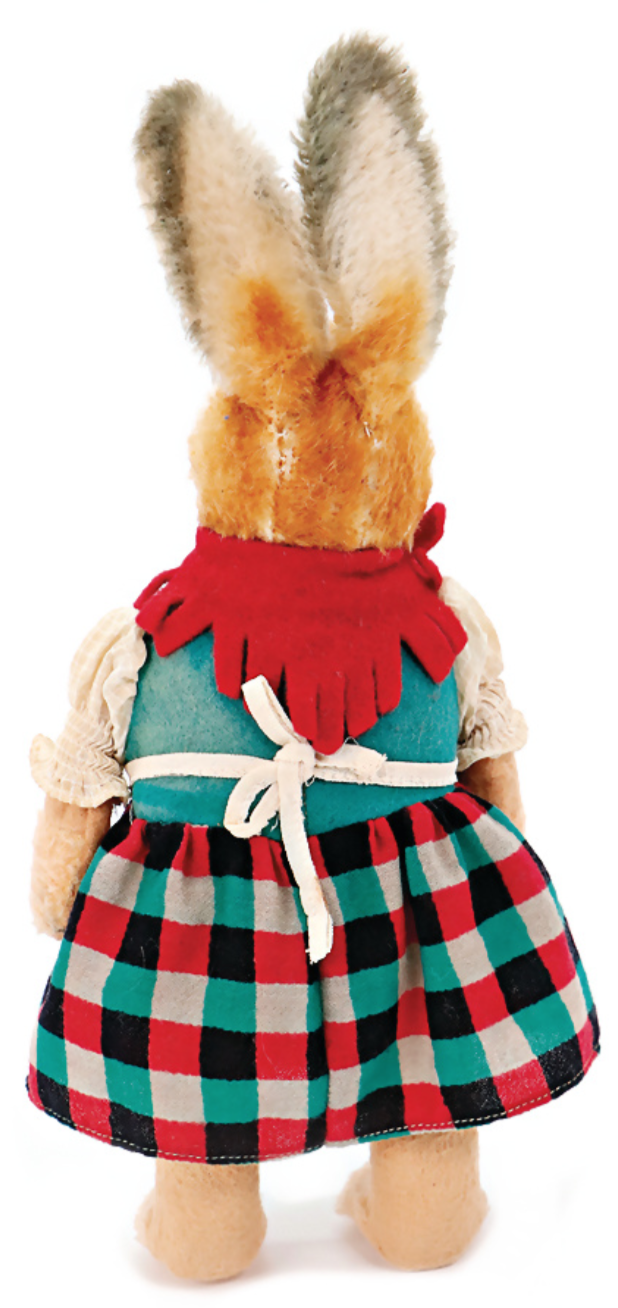
This is lot #6114, a late prewar standing and dressed rabbit doll, estimated at €180-€360. She is cataloged in part as:

"Pupp-hare, Mike, with button, block letters, long trailing f, very nice good preserved, yellow cloth tag label, No. 22, wool plush at hands and feet, original traditional costume, 27 cm, very nice condition."

And just want makes this lovely lady a 10?
She's got a fantastic presentation, and is in delightful, all original condition. And if you look closely at her tag, it is says "22,11." Numbers don't lie here! Her digits mean 22 cm tall (measured without ears), while the number 11 corresponds to her costume as described by the company. Outfit #11 translates to "traditional costume with green checkered skirt, green corsage, and white shirt." Spot on! These utterly charming, dressed rabbit dolls appeared in the line in 14, 22, and 28 cm in maize or white plush from 1932-1943 overall. Eleven total outfits for these rabbits were produced; they ranged from pajamas to playsuits to trousers and dresses through regional outfits like the one featured on this premier example. 

Steiffgal hopes this discussion on these well dressed auction highlights has contributed to the fabric of your collecting life. 


For more information about Ladenburger Spielzeugauktion GmbH's upcoming Special Steiff Auction event on January 21st, please click here!

Have a question about one of your Steiff treasures? Let's talk! Click here to learn more!
The teddy bear search engine