Showing posts with label black. Show all posts

Friday, February 21, 2025

This Fully Jointed Prewar Cat Has Quite The Tail To Tell!

Paws and check out this next Steiff surprise! Steiffgal was recently asked about a wah-hoo good Steiff prewar rarity that probably every collector in the world would love to add to their meow mix. Check out this fabulous feline and see what makes her so interesting from the design and product development perspectives. 

Here we have Steiff's early and delightful mohair cat. She is fully disk jointed - i.e., all limbs, head AND TAIL!! - and made from black mohair. She measures about 21 cm wide (nose to tush, not including her tail) and about 17 cm tall. She has tan claws, round and early green and black glass slit pupil style eyes, and a simple pink hand embroidered nose and mouth. She also retains her tiny long trailing "f" style button. You can see her ID close up in the image below. 

According to Pfeiffer's Sortiment, this rarely seen design was made in 17, 22, and 28 cm (measured vertically, top of head to toes) in grey or black mohair from 1913-1916 overall. You can see this catalog listing here on the left, the image is from Pfeiffer's prewar reference book. Although this one under discussion today does not have a squeaker, Pfeiffer notes that the item was produced with a squeaker, and those may have appeared in the larger sizes where the body cavity was large enough to hold this apparatus in place. 

There are two key things that make this cat purr-fect in every way. 

First, the color is lovely and rare, and its timing is intriguing. The black versions were actually made only in 1913, which is one year after the company produced a series of black mohair bears in tribute to the sinking of the Titanic in 1912. So it is possible that the mohair used on some of these black cats was identical to, or from the same rolls of mohair used to create the company's now legacy Titanic Mourning Bears.

The second is its jointing. Steiff produced a number of uber-jointed items starting around 1910 or so. These included rabbits with long jointed ears, begging squirrels with jointed bushy tails, and standing dogs and cats with jointed tails, among others. Less than a decade prior, Richard Steiff was just beginning to work on ways to create basic jointing on the company's doll and animal production, and Steiff's offerings were very basic animals in simple, stationary forms. 

So it is really amazing how quickly the concept of jointing impacted the company's product design and development trajectory - basically zero to sixty in just a handful of years. However, in the big picture, these extensively jointed items did not last long in the line. This is probably because they were very labor intensive and expensive to produce - and the extra jointing might not have paid out in either ROI or additional sales. 

Steiffgal hopes this discussion on this rare and early black cat has tickled your whiskers!

Have a question about one of your Steiff treasures? Let's talk! Click here to learn more.

Sunday, September 1, 2024

Hands In The Air Over This Antique Steiff Felix The Cat Handpuppet

Here's another great addition to Steiff's meow-mix of fantastic prewar puppets!
Check out this black and white beauty. Do you recognize his distinctive face and impish personality? This guy - who is now over a century old - entertained millions of people through the 20th century.

This Fe-line is none other than Felix the Cat in the form of a hand puppet. He is 20 cm tall and mostly made from black mohair. His face is made from white felt with a stitched mouth, big black button eyes, a dimensional black felt nose, and felt ears. He has a little red and black airbrushing on his mouth. His head is firmly stuffed with excelsior and his finger tube is made from cardboard. This puppet design was made from 1925-1926 in this size only.

So what is the history of this happy handful?
In 1919, Pat Sullivan and Otto Messmer introduced their Felix the Cat movie series. By 1926, sensing that Felix would be a great fit for Steiff, Steiff's distribution partner in the USA - George Borgfeldt - asked Steiff to create a series of licensed Felix the Cat toys. Steiff was hesitant and didn't think the line would be a success. Nonetheless, Steiff did end up producing a full bodied 22 cm Felix from 1926-27, a 20 cm Felix hand puppet from 1925-26, and a 20 cm Record Felix from 1926-27. The doll didn't sell well, but the puppet and wheeled versions struck a chord with buyers at the time.

Today, Steiff's Felix the Cat novelties are few and far on the secondary market.
Given their rarity, they often top the wish lists of Steiff collectors worldwide! The most recent Felix hand puppet sold at auction Steiffgal could find hammered for 1700 euro at Ladenburger Spielzeugauktion's Special Steiff Auction in 2018. In 2019, Morphy Auctions sold a full bodied Felix doll; he hammered for $4,000. And in 2010, Christie's sold a Record Felix in delightful condition for GBP 2,375. The photos of the full bodied and record Felix novelties are pictured here on the left; the images are from Morphy's and Christie's respectively.

Steiffgal hopes this discussion on Steiff's rare Felix the Cat hand puppet merits a thumbs up from you!

Have a question about one of your Steiff treasures? Let's talk! Click here to learn more!

Wednesday, April 17, 2024

Swept Away Over This Latest Midcentury Steiff Discovery!

Isn’t this guy simply "one-derful?" Look who just joined Steiffgal's hug. She had been looking for a fine example for decades, and apparently good things come to those who wait. Make it your lucky day and say hello to this super Steiff Sweep!

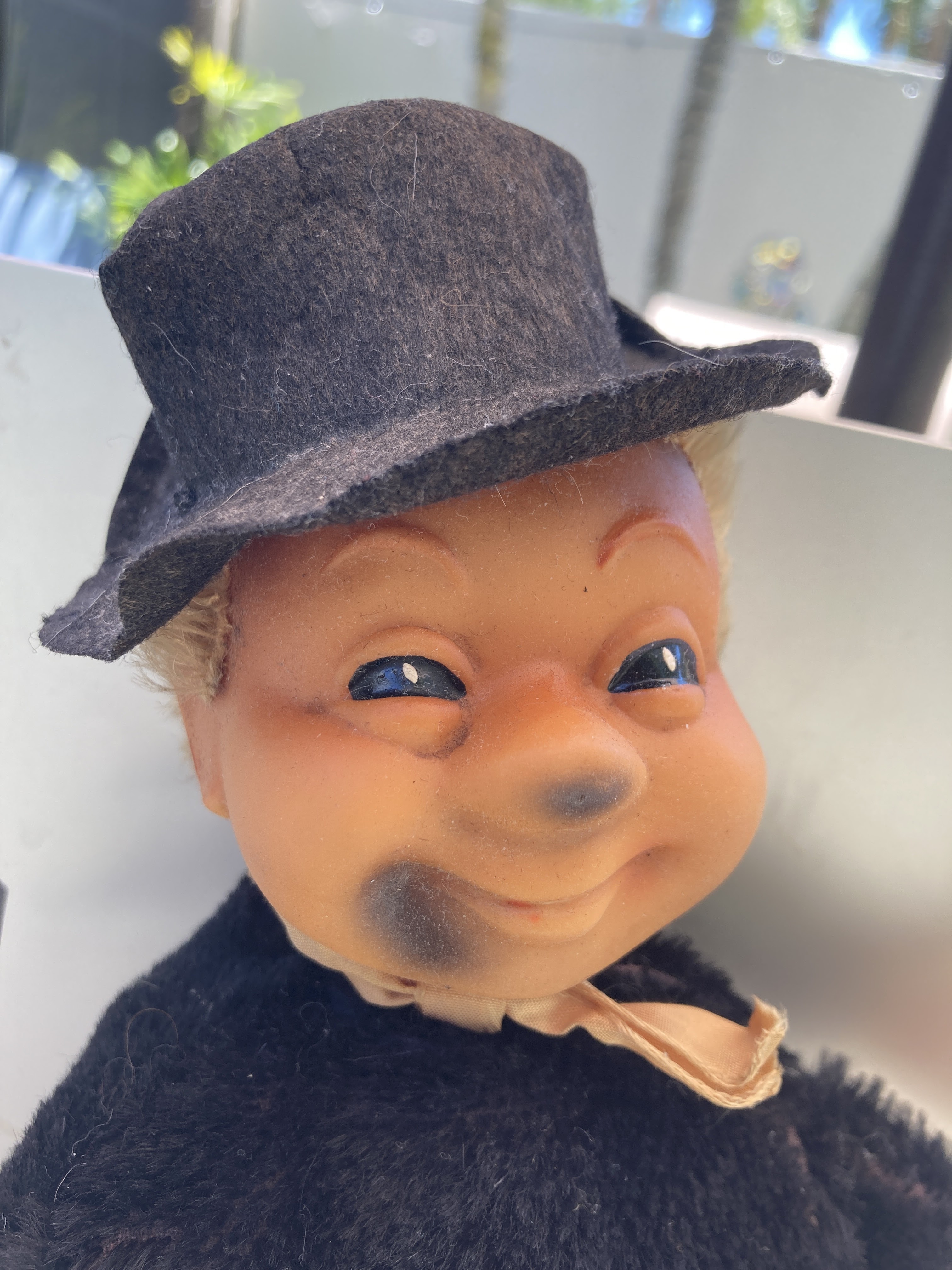
This adorable chimney sweep puppet named Blacky is 17 cm tall. His head is made from a soft rubbery material. He has a plastic finger tube inside his head. His hair is once copper colored mohair, and his body is jet back mohair. His oversized hands are made from felt and are lightly stuffed with excelsior. He wears a traditional black felt top hat and carries a black plastic ladder. His face comes to life with black and white painted eyes and some not-so-random coal smudges. His "outfit" is accessorized with a partial black leather belt and a neck tie. This puppet rarity was made in this size only in 1964.

The chimney sweep profession goes back as far as the 16th century in Europe. According to legend, chimney sweeps have been associated with ushering in health and happiness. As such, many brides in the past would have their chimney swept on their wedding day. Steiff probably added a chimney sweep to its line because of his centuries-long reputation as a good luck charm. 


Blacky debuted in the company's "New Models 1964" catalog.
This four page, full color brochure featured a number of now rare Steiff novelties, including a few that also were made for one year only. Steiffgal refers to these sorts of treasures as Steiff's "One-derfuls." Blacky is pictured on the back page of the catalog, and you can see that part of that page here above. You can also click on the image to make it bigger. 

His neighbor in this catalog is none other than Steiff's equally as rare and interesting Sneba snowman puppet. Sneba is 17 cm, unjointed, and made from white dralon. His face comes to life with button black eyes, an orange felt carrot nose, a red stitched mouth, and a touch of pink blush on his cheeks. He has two black "coal" woolen pompoms on his chest. Like his buddy Blacky, he wears a black felt hat and was made in one size only in 1964. 

You might just recognize Blacky's mug - as the same mold was used for a number of other rubber headed puppets in the 1960s through 1980s.
These include Happy the clown, Hansel and Gretel puppets, a princess, a modernized Shockheaded Peter, and even a grandmother, among others. It is interesting to see how this mold was used to represent male and female characters of all ages. And there is precedence for "recycling" facial molds on Steiff's dolls and puppets. If you look carefully, Steiff's beloved and legacy Dwarfs Lucki, Pucki, and Gucki all have the same face.... and share those good looks with the company's rubber faced Santa Claus dolls of the same era.

Steiffgal hopes this discussion on Blacky the Sweep has been a happy windfall for you.

Have a question about one of your Steiff treasures? Let's talk! Click here to learn more.

Sunday, March 17, 2024

Bleating With Happiness Over This Marvelous Moving Steiff Goat!

Could this next Steiff discovery be the GOAT (greatest of all time)?
Well, it depends who you ask, but he certainly qualifies by genetics! Check out this absolute rarity from the early 1930s and see what makes him so delightful in multiple ways!

What we have here is Steiff's tail-moves-head goat. He is standing, head and tail jointed, firmly stuffed with excelsior, and made from tan mohair. The backs of his ears and the underside of his tail are made from black mohair. He has gorgeous teal and black slit glass pupil eyes and a simple black hand embroidered nose and mouth. When he left the factory nearly a century ago, he had lovely and realistic hand airbrushing over his body to give him texture and dimension. His bow and bell are not original to him, but he also sported these accessories when he was new. 

This adorable barnyard buddy was produced in 18, 23, and 29 cm from 1931-1934.
This guy is the baby of the bunch at 18 cm. His precious presentation plus his 
tail-moves-head feature really put him in a class all by himself. 

So what are the deets behind this mechanical marvel? When you very gently twist his mohair covered tail in a circle, his head follows in tandem. He has an internal metal jointing system which enables this. You can often tell tail-moves-head items because they have an especially long and thick and somewhat undefined neck area. That is necessary to hold the jointing apparatus as well as allow for room for the fabric to move a bit. And more times than not, tail-moves-head items are missing the mohair covering on their tails. You usually see just a naked metal loop or tag, but in this case goat has managed to retain his mohair tail over all of these years. Guess he was good at protecting his assets!

It is interesting to note that this guy, and other Steiff tail-moves-head items from his era had an additional ID tag.
 This was a round, Steiff branded cardboard tag that read "turn here and I will move my head" in three languages. It was attached on or near the animals rear end. Unfortunately, goat's extra tag has been lost to time in this case. 

They heyday for Steiff's tail-moves-head production occurred in the years leading up to WWII. The mechanism, which consisted of a metal apparatus, was patented in the early 1930s. Over 25 different animals were produced with this feature. These included cats, dogs, rabbits, penguins, goats, and lambs, and an elephant, among others. They were considered "luxury toys" at their time and even appeared on the cover of one of the company's 1931 catalogs for their debut. They were promoted as, “The year 1931 has presented us with the animals with the new head movement… The simplicity of the mechanism, though which the splendid movement is produced, cannot be beaten, yet it is unbreakable and allows lifelike play, full of variety and mimics… When buying new supply in plush toys please be sure to include the STEIFF animals with the new head movement; all numbers equipped with it are marked ‘H."

Steiffgal hopes this discussion on this delightful tail-moves-head goat has you jumping for joy.

Have a question about one of your Steiff treasures? Let's talk! Click here to learn more.

Thursday, February 15, 2024

Does This Steiff Prewar Tom Cat Tickle Your Whiskers?

This great Steiff inquiry walked in on little cat's feet!
And talk about launching a collection with a rockstar! A new friend from Germany writes about her debut vintage Steiff purchase. She is curious about its birth year, give or take a bit. Rebecca shares,

"I bought my first vintage Steiff animal and it's the famous Tom cat. As I know that she was produced over many many years I'm now super curious which exact time it was that mine was produced. It's the smallest one. And it has the old button with the long "f" at the end. So I think that means that it can be between 1923 and 1953, right? Do you think you can say it more specific? I just can't find more information. Kind regards from Germany!"

Wow, Rebecca's purchase is truly the cat's meow
. It is Steiff's mid- to later prewar Tom cat. This fantastic feline was made for the standard line in 8, 10, 14, 14, 22, and 28 cm from 1923-1943 overall. The 8 cm and the 10 cm versions had a pitch black velvet body and a fuzzy black mohair tail. From 14 cm onward, all sizes were made entirely from black mohair. These cats were technically measured vertically, from the top of their heads to their toes. Their long vertical tails almost "doubled" their height measurements. They were detailed with green and black round or slit glass pupil eyes, a simple hand embroidered mouth and nose (Steiffgal has seen both pink and red examples), and clear monofilament whiskers. They left the factory wearing a decorative silk ribbon and sometimes a little bell to match. The bow on Rebecca's example is not factory original. 

Now back to the question - his birthday.
The best telling clue here is that he has the short trailing 'f' style button. This button appeared on items in the line from about 1936 through the very early 1950s. So we know that the earliest the cat was produced was 1936. As noted above, this particular cat with a black velvet head and body and mohair tail was made in 8 or 10 cm from 1933-1943 overall. This skinnies down his production timeframe to most likely in the c. 1936-1943 timeframe. So he's clearly from the late prewar period. 

One thing that's nearly purr-fect about this feline pattern is how long it has appeared in the Steiff line.
 The earliest version made its grand public debut in a photograph featured in the 1903-1904 Steiff catalog... in the same picture that introduced PB55... the world's first jointed Teddy bear! This puts Tom in very good company for sure. This photo is here on the left - you can click on it to make it bigger. And Tom CONTINUES to make guest appearances in the line on and off to this day in the form of replicas and special editions. His timeless, universal popularity and appeal have truly earned him legacy status within the Steiff collecting community.

Steiffgal hopes this discussion on Steiff's prewar black Tom cats has tickled your whiskers in a most happy way. 

Have a question about one of your Steiff treasures? Let's talk! Click here to learn more.

Sunday, September 24, 2023

Racing To The Finish Line With This Amazing Steiff Gallop Novelty

There's no horsing around when it comes to this week's blog featured guest. Or guests, in this case! This amazing Steiff rarity came to Steiffgal somewhat out of the blue, and belonged to a collector on the West Coast who really, really loved precious Steiff items. Check out this prancing pair on wheels and see what makes them so delightful from the design and product development timeline perspectives.

It's off to the races with this Steiff Gallop novelty.
It consists of two standing, unjointed 8 cm mohair pets on a metal cart with red wooden wheels. The first animal is little Molly dog. She is made from tan and brown tipped mohair and is solidly stuffed with excelsior. Her face comes to life with brown and black glass pupil eyes and a black hand embroidered nose and mouth. Her ears are seamed on their outside edges, and are folded over in typical Molly style. Her IDs have been lost to time. Her companion is a distinctive cat made from silver tipped mohair. She has a trimmed muzzle, a pink hand embroidered nose and mouth, green and black slit style glass pupil eyes, and a few remaining clear monofilament whiskers. She retains her long trailing "f" button. This Molly and cat Gallop novelty appeared in the line in this size and configuration from 1926-1929.

Now let's check out the lucky passengers on this very special ride!
Standing Molly appeared in the line in 8, 12, 14, 17, 22, 28, and 35 cm from 1925-1936 overall. She was not produced standing postwar. This Gallop Molly is most likely an example of the 8 cm standard line Molly. The cat, on the other hand, did not appear in Steiff's catalog, as far as Steiffgal can tell, except on this exact novelty. This prewar black mohair cat design is just one of a tiny handful of kittens - other than the company's famous arched back Tom Cat - produced in this color and fabric before WWII.

This Gallop toy was one of three novelty pull toy designs Steiff produced from the mid-1920s through the mid-1930s. These included Roly-Drolys, Wiwags, and Gallop toys. Each of these three patterns used pairs of small, standard line items on wooden carts. All were created in response to product development need identified by Richard Steiff. He was living in America at the time and insisted that these sorts of "mobile" items were necessary in the line to keep up with the demands of the marketplace, consumer preferences, and growing worldwide competition.

And just how did these pull toys rock and roll?
Roly-Droys appeared in the line from 1924–1934. The animals rotated in circles as their cart was pulled along. "Roly-Droly" comes from the German words "rollen" (to roll) and "drollig" (funny or droll). Wiwags appeared in the line from 1924–1927; its passengers see-sawed up and down as their cart was propelled forward. And Gallop toys, like the one under review here, were made from 1926–1929. The riders glided back and forth as their cart's wheels turned round and round. Each of these metal and wooden toys came with a pull string that was tipped with a wooden knob decorated with a Steiff button. You can see Steiff's range of Gallop toys as pictured in the company's 1929 catalog. The image is from Carsten Esser's Steiff Katalog 1920-1929. 

According to Steiff's advertising, Gallop toys consisted of
..."Two different animals of fine plush on car of special construction. When pulled along, the galloping moment is produced." Gallop toys were produced in a number of configurations. These included one with a brown and white standing bear; one with a standing lion and elephant; one with a standing fox and hare; one with a Barney Google doll and a standing bear; one with a Barney Google doll and a standing Spark Plug horse; one with a Spark Plug horse and an ostrich; one with two standing goats; and one with a Molly and black cat. The advertisement on the left is from the mid-1920s and features the Molly and black cat version under discussion here today. 
The image is from Carsten Esser's Steiff Katalog 1920-1929. 

Steiffgal hopes this discussion on Steiff's Gallop novelties has put a fun spring in your step today. 

Have a question about one of your Steiff treasures? Let's talk! Click here to learn more.

Saturday, August 12, 2023

Rolling Along With This Early 1930s Steiff Scotty On Wheels

Great Scot! Check out this utterly charming prewar pup on wheels. Despite his small size, he's got a few interesting "time capsule" details that help to date him to a "T". Read on to learn more.

This bearded beauty is the wheel-deal indeed!
Scotty is 17 cm tall, standing, and head jointed. His body and head are made from grey and light black mohair plush fabric. His ears are made from pitch black mohair. Scotty is detailed with proportional black and brown round glass pupil eyes, a black embroidered nose and mouth, and dark pink embroidered claws on each of his four paws. His ears are lined in black mohair. The dog is mounted on a metal carriage and glides along on four blue wooden eccentric wheels. He retains his original collar and brass bell. His collar is white and dark blue or black leather, and closes with a ring and two (now very rusty) Steiff buttons. He retains his long trailing "f" button in ear and traces of his chest tag as his Steiff IDs. 

This model was made in 14, 17, and 22 cm (measured vertically, without wheels) from 1932-1943. He was produced in grey and black mohair plush from 1932 through 1934; after 1934 he appeared in all black mohair. Given those dates, it is safe to say that this guy was "born" in the 1932-1934 time frame. 

Scotty dogs debuted in the Steiff line in 1930 and were an immediate success with customers.
Their size, personality, and proportions translated well into soft toys designs, and Steiff created a number of sitting, standing, wheeled, and novelty versions over the next decade. Some had round glass pupil eyes like this example, while others had brown, white, and black almond shaped glass eyes. Steiffgal has never been able to figure out why that was the case, but both style of eyes are original to Steiff. 

The Scotty under discussion here has two distinctive early 1930s-era details that Steiffgal has not seen on items produced during any other time. The first is his body fabric, which is a mostly black mohair plush with grey fiber details. It is not "spiky" like traditional mohair, but smoother and more elegant, with the longer fibers really resembling a dog's coat. This lovely material was used for awhile on the company's Scotties, but then disappeared in 1934 - about the time that things really started getting difficult at Steiff - and throughout Germany due to geopolitical realities. It is possible that the grey and black fabric was expensive, and the company was trying to save money on materials, and/or that it was no longer being produced, and/or it was entirely allocated by the government for wartime material production. Through the early 1940s, Scotty dogs would go on to be produced in mohair, wool plush, cotton plush, and silk plush - apparently coming to life in the fabrics available at the time. 

Also of note is this Scotty's prominent leather collar.
Steiffgal has only noted this woven style, light and dark belled collar on dogs from the early 1930s. It is possible that this accessory was designed and produced to give the dogs wearing it a more "upscale" look and feel. The collar, which is not removable, needed to be manually attached to the dog and finished with two inserted buttons. This of course required many more assembly steps than the signature, simple red buckled collar which would be used on the model just a few years later. 

Steiffgal hopes this discussion on this early 1930s Scotty on wheels was a joy ride for you!

Have a question about one of your Steiff treasures? Let's talk! Click here to learn more!

Wednesday, July 26, 2023

Watching Steiff Record Making History In Person!

Stop the presses!
Steiff history has been made again! Check out this article that Steiffgal prepared for the online news source Auction Daily detailing the sale of Mrs. Wiley's all but perfect 1912 black mohair Steiff Titanic Bear! He is pictured here on the left, and the photo is from 
Ladenburger Spielzeugauktion GmbH. Here is the story in its entirety - it was originally published on July 23, 2023. Thank you to Auction Daily for allowing Steiffgal to share this fantastic news!

On July 1st, 2023, the auction house Ladenburger Spielzeugauktion GmbH of Ladenburg, Germany presented their Special Steiff Auction in Giengen, Germany - the home of the Margarete Steiff GmbH factory. The Steiff Company is best known for designing and producing the fully jointed Teddy bear as we know him today starting in 1902. This signature, annual sale is traditionally held during the Steiff Company's "Steiff Sommer" event, a three day long family-centric fair that includes carnival rides, a petting zoo, food and souvenir vendors, and button-in-ear activities. This year, the auction included the second half of the Susan Kilgore Wiley collection, an outstanding collection of Steiff prewar bears, animals, novelties, and absolute rarities. The first half of this collection was sold in January, 2023 and realized over $475,000.

The highlight of this midsummer sale was lot #82, an extraordinarily rare, fully jointed 50 cm black mohair Steiff Titanic Mourning Bear.
This bear was the pride and joy of Mrs. Wiley's collection and was accompanied by photos and ephemera related to it. (As a matter of fact, she named her car's license plate after him as well... as you can see on the photo on the left!) She bought the bear at Sotheby’s in London in 1990 for over $40,000; that purchase made international collecting headlines at the time. Since 2000, original antique Steiff Titanic Mourning Bears have rarely come up for auction. When they do, they usually trade hands in about the $20,000-40,000 range. Mrs. Wiley's Titanic Mourning Bear had a starting bid of 4,500 euro, but there was talk the Steiff collecting community that the bear could easily realize six figure, it was so outstanding. They were right - sort of. 

There was great anticipation in the gallery as lot #82 came up for sale. The auction house noted that this bear had five international bidders competing for the bear on telephone lines. However, the winning bidder was live in the audience! This is somewhat unusual in the auction world with sales of this magnitude. Auctioneer Pia Fast Seidel was at the podium and skillfully managed the blizzard of bids and interest in this once-in-a-lifetime lot. Mrs. Wiley's Titanic Mourning Bear would go on to hammer at 180,000 euro or $202,020, and realize $250,505. 


So how does this rank in terms of record sale prices for antique Teddy bears? The most expensive Teddy bear of antique origins to date was a Steiff bear owned by Colonel Bob Henderson named Teddy Girl. She was sold by Christie's in London for £110,000 ($171,600) on December 5th, 1994. However, Mrs. Wiley's Teddy bear traded hands at over a quarter million dollars - breaking this previous high mark by over $78,000! 

There are many factors that made this 1912 Steiff Titanic Mourning Bear so incredibly special. These included a perfect storm of history, rarity, condition, and being at the right place at the right time. It is also possible that the recent spike in interest in all things Titanic, because of the headline making submarine disaster, also further cast the spotlight on Mrs. Wiley's extraordinary bear on offer. (Here on the left you can see Steiffgal in the Steiff museum gallery with Mrs. Wiley's Titanic bear, along with her google-eyed Petsy. These two cubs were the stars of the show for sure!)

There are many factors that made this 1912 Steiff Titanic Mourning Bear so incredibly special. These included a perfect storm of history, rarity, condition, and being at the right place at the right time. It is also possible that the recent spike in interest in all things Titanic, because of the headline making submarine disaster, also further cast the spotlight on Mrs. Wiley's extraordinary bear on offer.

In terms of the bear's place in history, Steiff's Titanic Mourning Bears are tied to one of the most significant worldwide events of the 20th century.
In the early 1900s, Steiff produced a number of all black mohair bears for the general marketplace. However, these did not sell very well and the thought at the time was that they were scary for children. So the company stopped making them. Then, in 1912, the Titanic disaster struck. At that time, nearly everyone in England was personally touched by this event, or had a friend or relative who was. The entire country was in shock and mourning. In response, Steiff produced a handful of all black mohair bears with red felt behind their eyes - to indicate sadness and crying - for the English market. (Here on this picture on the left you can see members of Mrs. Wiley's family and Steiffgal talking to a photographer sent from the Washington Post to cover this sale. As you can see, this very special bear caught the eye of collectors on nearly every continent!)

This black bear also was in breathtaking shape with a very special feature.
It retained its Steiff button and featured the company's most desirable "center seam" face construction. In the early 1900's, every seventh bear that Steiff made had a seam down the center of its face to make the most efficient use of the mohair fabric used to create them. The dimensions of the fabric supplied at the time were such that the Steiff could manufacture six full heads from it, but there was some remaining material from this cutting process. As such, Steiff found a way to "patch" these remainders into another head and as such not waste any fabric. This was the first center seamed black mohair Titanic Mourning Bear to come to public auction, as far as this author could unearth. (Here on this picture on the left you can see Mrs. Wiley's bear enjoying some time in her garden. The sunlight on his face makes his center seam especially prominent!)

Steiffgal hopes you've enjoyed witnessing a breathtaking and probably once in a lifetime bit of Steiff history!

Have a question about one of your Steiff treasures? Let's talk! Click here to learn more!

Saturday, June 24, 2023

Keeping It In The Family With This Nearly Century-Old Steiff Bear

Old friends make for the best of friends. And so it is with this heirloom who calls the Western part of the USA home. He has lived his nearly century long life with the same family, which is wonderful for both the bear and his people! His owners simply write...

"We are interested in getting more info on a red tag bear who measures approximately 28” standing and 20" sitting. He's been in the family since the 1930s. Thank you."


This delightful and most appealing five ways jointed cub is Steiff's legacy, standard line blonde mohair Teddy bear. This pattern in this color was made in 10, 15, 18, 22, 25, 30, 32, 35, 40, 46, 50, 60, 70, and 115 cm from 1906-1933. Like most prewar blonde Steiff bears, he has black hand embroidered nose, mouth, and claw stitching. He has longish arms with spoon shaped paws and a moderately sized back hump. His paw pads are made from felt and appear to be original to him. His eyes are brown and black glass pupil style, perhaps slightly oversized in proportion.

Bear's red ear tag, long trailing "f" button, and proportions date his production to the c. 1926-1933 time frame.
This aligns really well with the history his family shared. Steiffgal suspects that he was born probably towards the beginning of that time frame as he has more of a 1920s era look to him. Bears from the 1920s tend to be more fuzzy, full figured, and youthful looking. Those from the 1930s often are less fuzzy, more serious looking, and leaner all around. You can check out an image of Steiff's bears from the company's 1929 catalog here on the left for reference. As you can see, they really have a fun and upbeat look to them. 

Given Ted's dimensions - 20 inches/50 cm sitting and 28 inches/70 cm standing - this bear is technically the company's 70 cm version.
This suggests his article number would be 5350,2. This translates to 5=jointed, 3=mohair, 50=size sitting, and ,2=has a growler (noisemaker) in the belly. Sometimes these growlers work but often they break over time. It is not clear if this Ted still talks. However, 5350,2 is the number that would be most likely on his red tag if it were still legible.

As for value, something is worth what someone will pay for it. Steiffgal has not seen or handled this bear firsthand, and does not know if he has any significant losses or condition issues, including those that don't show up in pictures. These include things like dry mohair, smoke damage, or insect damage. However, given he is as nice - and as "healthy" - as he appears in his photos, Steiffgal suspects he may trade hands in the c. $2,500-4,500 range.

Steiffgal hopes this discussion on this heirloom prewar Ted has timeless appeal to you.

Have a question about one of your Steiff treasures? Let's talk! Click here to learn more.

Wednesday, June 7, 2023

Breathtaking Bear Beauties on Offer at Ladenburger Spielzeugauktion's 2023 Special Steiff Auction in Giengen

Can you bear it? Ladenburger Spielzeugauktion's July 1st, 2023 Special Steiff Auction in Giengen is presenting one of the finest lineups of vintage to antique button-in-ear collectibles in memory. Many of those wah-hoo good treasures are from the collection of Susan Kilgore Wiley. Ladenburger sold the first half of her over-the-moon great hug in January, 2023. This second sale presents even more Wiley temptations, including some of the world's most fantastic and aspirational Steiff bears Steiffgal has ever seen! Here are three extraordinary ones that really caught her eye, and why. 

The first can-you-bear it bear is lot #64, a most unusual Teddy Clown bear.
It has a starting bid of 1,300 euro and is cataloged by the auction house as:

"Clown-bear, exceptional, with button, block letters, long trailing f, minimally rests of the red cloth tag label, big blue glass eyes, bright embroidering at snout, and claw embroidering, strong fiery mohair, long snaped off arms, hump, 33 cm, except of small faults felt paws in very nice condition, with ruff, without hat, very expressive."

It's really the best of two legacy Steiff worlds with this terrific temptation. At first glance, he sort of looks like a Petsy the Baby Bear with his tipped mohair, pink hand embroidered nose and mouth, and blue eyes. But, he does not have the signature center facial seam construction or wire lined ears as seen on Steiff's Petsy cubs. But, he has his factory original neck ruff, and these were not put on any models other than Steiff's Teddy Clown bears - at least as far as Steiffgal knows! It is also important to note that this bear's detailing and configuration is not noted in Pfeiffer's Sortiment books. This suggests that very few were produced. Steiffgal suspects that his "birthday" was probably in the mid to late 1920s time frame, when both Petsy and Teddy Clown made their appearances in the catalog. This is only the second of his type Steiffgal knows of.

And speaking of Petsy - this second can-you-bear it bear is lot #15, an insanely rare and equally adorable Petsy bear.
It has a starting bid of 1,600 euro and is cataloged by the auction house as:

"One of the of the highlights of the this year's STEIFF-GIENGEN-auction, Petsy, produced around 1930, with seam at the middle of head, nice, full, pointed mohair, rare cross-eyed, with button, block letters, long trailing f, bright embroidering at snout, long snaped off arms, hump, big ears, original felt paws with flaws here and there, and scattered spotty mohair loss at neck, hump, ears, and shoulder, otherwise very nice condition, nice strong color of the mohair, standing height 50 cm, extremely rare, extremely expressive, an unusual rarity."

Steiffgal is pretty certain that this eye-catching (pun intended) rarity is on every single Steiff collector's dream wish list! It goes without saying that Petsy bears do incredibly well at auction, with one selling for a mind boggling 66,000 euro at a Ladenburger sale in January, 2023. However, this particular one, with black and blue cartoon eyes, is simply off the charts when it comes to his rarity, expression, and presentation. Steiffgal would not be surprised if this example trades hands near or even above this previous record! And what makes this bear so extraordinary?  His "half and half" glass eyes are sewn in his head in such a way that they can be tilted and rotated, giving him countless silly to serious facial expressions. Petsy bears usually have stationary, glass pupil eyes. This is one of the few Petsy bears of this size with cartoon style eye extant. 

And now for the wow OMG wow third can-you-bear it bear of this sale, let's take look at lot #82.
This is a Steiff black Titanic bear. It has a starting bid of 4,500 euro and is cataloged by the auction house as:

"Titanic bear, one of the highlights of the this year's STEIFF GIENGEN auction 2023. A rare item from 1912, was produced in remembrance of the victims of the sinking of the Titanic on April 14th 1912. It were 82 pieces of this grief bear/ black bear produced. This Titanic bear has a seam at the middle of head, red shoe button eyes that are underlaid with felt, black embroidered nose and claws, small STEIFF button, block letters, long trailing f, long snaped off arms, hump, voice, intact, small faults at the feet, produced between 1912 and 1917, 50 cm, nice full black mohair, with provenience, enclosed invoice by the original purchase at Sotheby's 1990, and newspaper article by an American antique magazine, "Antique Review" from February 1991, one of the rarest bears that were ever auctioneered by the Ladenburger Spielzeugauktion."

This bear is so amazing that he leaves Steiffgal pretty much speechless in terms of analysis. So she will share a little story about him instead. When she first heard about this bear, she was certain it was a replica, based on how he was described to her. But his owners insisted he was the real deal from 1912. Fast forward, Steiffgal met this bear in person. His owners handed him to her, and he really was as close to tissue new as possible. So new that Steiffgal again thought he was a replica at first. But after a few moments, it became clear that he was well over 100 years and just in clean, breathtaking condition. His owners did not mention his center seam - which just puts this bear over the top in terms of appeal, desirability, and rarity. It's anyone's guess how the bidding will roll out with this bear... but watching it unfold should be more thrilling than any major Hollywood production!

For more information on this amazing sale to be held on July 1, 2023 and to see all of the great lots on offer, please see the auction house's website at https://www.spielzeugauktion.de.

Steiffgal hopes this discussion on auction bear highlights has left you star-struck!

Have a question about one of your Steiff treasures? Let's talk! Click here to learn more.

Monday, May 22, 2023

Getting All Fussy Over This Lovely Steiff Gussy

This pretty kitty can only be described as the cat's meow! Steiff's early postwar production is beloved for its innovation, attention to detail, smaller scale, and the fact that items from this time frame are just so darn cute. Cats and dogs ruled the roost during this period, with this black and white beauty being a true stand out in the feline category. Come see what makes her so special from the design and product development perspectives.

Here we have Steiff's "Young Kitty Gussy." She is pictured here on the left and is 12 cm, standing, and head jointed. Her body and head are made from white mohair, while her tail is made from black mohair. She has black airbrushed highlights on her feet, rear end, sides, and around her black felt ears. Her face comes to life with a white velvet muzzle, piercing green glass slit pupil eyes, a pink hand embroidered nose and mouth, a spot of pink airbrushing on her lips, and clear monofilament whiskers. She left the factory wearing a pink ribbon. This Gussy's IDs include a raised script button, yellow ear tag, and a named, blue imprinted, bear faced chest tag.

Gussy was also produced in 17 cm. She is pictured here on the left. The larger version had two main design differences from the smaller version. Bigger Gussy featured velvet ears instead of felt ears, and had a pink velvet lined mouth instead of a closed mouth. Gussy was produced from 1952-1969 overall. In 1999-2000, Steiff produced a really sweet 17 cm Gussy replica, but did not call her Gussy. She was named 'Classic 1952 Cat', most likely a reference to her year of introduction. This special edition is pictured below and is wearing a blue ribbon.

Open mouth cats are pretty rare for Steiff. The only other mid-century examples that Steiffgal can think of here are the company's Siamy Siamese cats, which were made in 11, 15, and 23 cm from 1953-1954.

Gussy debuted in the line at a really critical time in the company's history. Gussy was introduced in the very early 1950s, so it is possible to find examples with US Zone tags and red imprinted chest tags. A few years after the conclusion of WWII, when the factory was up and running for toy making, Steiff started to produce a large number of smaller, beautifully detailed animals for export. These were brand new patterns, not carry-overs or "updated" prewar designs. Many of these were dogs and cats, as these have always been "best sellers" for the company. These new patterns helped build (and rebuild) Steiff’s business worldwide as soldiers returning home from the war in Europe often brought these “toys” back home as gifts and souvenirs of their time abroad. After all, they didn’t take up too much room in standard issue G.I. duffle bag—most even could fit in a coat pocket. These beloved and newly launched “pocket pets” included Dally the Dalmatian, Tessie the Schnauzer, Snobby the Poodle, and Gussy the Young Kitty, among others.

Steiffgal hopes this discussion on Young Kitty Gussy has tickled your whiskers!

Have a question about one of your Steiff treasures? Let's talk! Click here to learn more!

Monday, May 15, 2023

The Devil Is In The Details When It Comes To Steiff's Rare Postwar Exclusives!

Little differences can mean alot when it comes to the vintage Steiff collecting world. Check out this darling black and white Cocker Spaniel puppy. She has a familiar ring to her, right? But one detail elevates her from beloved everyday companion to best of show at Westminster! Read on to learn more.

Here we have a darling black and white mohair Cockie Cocker Spaniel. She is 12 cm tall, sitting and head jointed. Her body is made from white colored mohair which has lovely hand airbrushed black spots on her legs and body. Her long, floppy ears are made solid black mohair. Her face and muzzle are darling, with a distinctly childlike appearance. She comes to life with pert black and white plastic google eyes, a hand embroidered black nose, and a painted mouth. She appears to be pouting - or begging for a bite of whatever you are snacking on at the moment! She retains her original red collar, which closes with one very small, plain silver snap.

Now for the grand reveal. This happy handful was made in this size only as an exclusive for the upscale toy retailer FAO Schwarz in 1962-1966. Schwarz sold her along with a simple wooden dog house, a red water bowl, bone, and mat as a set. She was attached to the house via a metal chain. The red wooden FAO Schwarz wooden tag was attached to the roof of the house. She is incredibly rare and only the second one Steiffgal has seen or handled in decades of collecting! Through the late 1970s, Steiff often partnered with FAO Schwarz to create store-exclusive products based on the company's most popular standard line items at the time. Other examples of these now-coveted rarities include a series of standing Dalmatians; a walrus puppet and pajama bag; an open mouthed, standing beagle; and a life-sized beagle, among several others.

In this particular case, this FAO Schwarz black and white Cockie Cocker Spaniel is based on Steiff's legacy black and white mohair STANDING Cockie Cocker Spaniel.
This adorable model was produced in 12, 19, and 29 cm from 1960-1976. This Cocker Spaniel exclusive also has the same face and general appearance as the company's charming felt bodied Cockie Nightcap animal. Steiff produced these fun novelties as cats, dogs, bears, foxes, and rabbits in 15 cm from 1969-1974. They were designed to hide a sweet, prize, or coin on the pillow of a child. You can see Nightcap Cockie and a few of her cousins in the image above; this page is from one of Steiff's c. 1969 product catalogs. 

To wrap up this discussion, let's take a look at sitting Cockie's ear tag. Her article number is 3312,96. This translates to 3=sitting, 3=mohair, 12=12 cm tall, 9=display animal or special edition, and 6=black. That pretty much perfectly describes her!

Steiffgal hopes this discussion on this super rare and lovely Cocker Spaniel has added a beautiful highlight to your day.

Have a question about one of your Steiff treasures? Let's talk! Click here to learn more!

Saturday, April 22, 2023

Tag, You're It With This Rare Steiff Badger And Her Equally Fabulous Bonus ID

Steiffgal doesn't want to badger you about this, but have you checked out this fantastic Steiff rarity? This well designed field and forest friend only appeared in the Steiff catalog for two brief years. So blink and you would have missed her! Come Dig a little deeper and learn more about this wonderful member of the weasel family... and her most unusual "bonus" ID. 

This happy handful is Steiff's Diggy badger.
She is 10 cm tall, standing on all fours, unjointed, and made from tipped cream mohair on the top, white mohair on her head area, and black mohair on her bottom section. Her sides and face are beautifully airbrushed with tan and black highlights, giving her a most realistic look. Her tiny ears are made from mohair. She has black felt foot pads, round brown and black pupil eyes, and a simple black nose and mouth. Diggy was produced in 10 and 17 cm from 1963 through 1964 only, making her very rare on the secondary market.

Little Diggy and big Diggy are almost identical, except for one interesting detail. Big Diggy has four white felt triangular shaped claws on each of her limbs, while little Diggy has none. These finger and toe nails remind Steiffgal of those on another Steiff rarity of the same time, Zooby the bear.

In addition to her standard Steiff IDs, this particular example also has an additional tag stapled to her ear.
It is a green linen tag with the word Steiff in cursive letters across the top, and the words Commonwealth of Pennsylvania Department of Labor and Industry in tiny letters encircling a crest with the number "55" on it. What's that all about?

Steiffgal did a little digging (pun intended) and it turns out that the State of Pennsylvania, here in the United States, has something called the Stuffed Toy Law. According to the official PA government website, this law establishes a standard of safety for stuffed toys distributed throughout the Commonwealth. 

This is how this law works, according to this website:
"The Bedding and Upholstery Section receives samples of toys and checks them for flammability, contents and safety of design. Manufacturers of stuffed toys intended for distribution in Pennsylvania by sale or as gifts must be registered with the Department. Stuffed toys must have a tag attached identifying the Pennsylvania registration number of the manufacturer. This tag indicates to the consumer that the toy has been reviewed by the Department and the manufacturer has registered with the Department."

So now let's figure out what we can deduce, and not, concerning this state law. It is interesting to note that  this law was put into place in 1961, just a few years before Diggy debuted in the Steiff catalog. So that timing and her tag align. And it is safe to assume that this particular Diggy started her life in America in PA. But three aspects of her tag remain somewhat of a mystery. 

  • First, it is possible that the number "55" on the tag is Steiff's "official" registration number in the PA system, or it could mean something else. 
  • Second it is not clear who registered Steiff to distribute its products in PA in the early 1960s. It could have been the company itself, or one of its distributors at the time like Reeves International, or it could have been an independent store or business selling Steiff at the time in PA. 
  • And finally, it is difficult to tell whether this tag was put on Steiff's items intended for sale or distribution in PA in Giengen, before they were exported, or in PA, once they arrived in the states.
Steiffgal hopes this discussion on this rare Diggy badger and her great (and mysterious) ear tag has added a pleasant distraction to your day!

Have a question about one of your Steiff treasures? Let's talk! Click here to learn more!
The teddy bear search engine