


Steiffgal hopes you found this discussion on this little sitting Fox Terrier has been dog-gone delightful for you.
Have a question about one of your Steiff treasures? Let's talk! Click here to learn more!

This blog focuses on vintage Steiff finds, Steiff antiquing and travel adventures, international Steiff happenings, and the legacy and history of the Steiff company.


 Posts
All Comments
Posts
All Comments


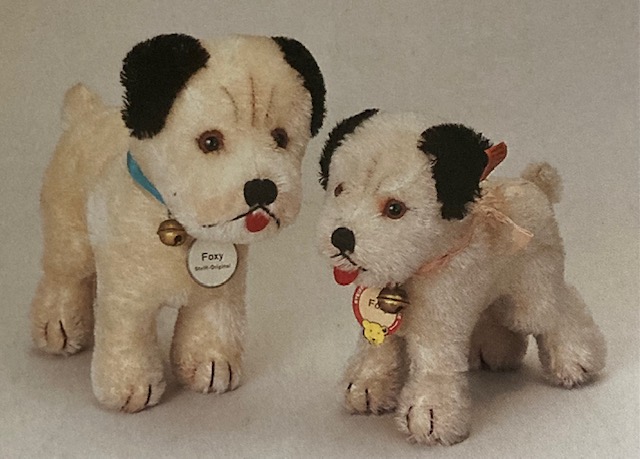


Steiff has traditionally taken inspiration for new product introductions from popular cultural trends. Fox Terriers started to gain prominence in the last quarter of the 19th century. In 1876, the Fox Terrier Club of England was established, and in 1885 the American Fox Terrier Club followed suit. Fox Terriers took top honors at the Westminster Kennel Club Dog Show in 1907, 1908, and 1909. It was clear that this breed captured the hearts and minds of dog fans.


Steiffgal hopes this discussion on the history of Steiff's popular Fox Terrier breed has been a real crowd pleaser for you.
Have a question about one of your Steiff treasures? Let's talk! Click here to learn more!
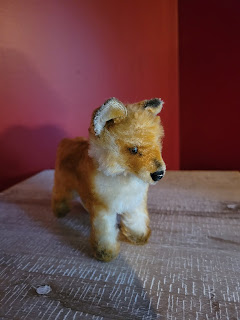
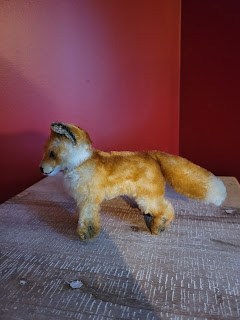
 The "US Zone Tag" has an interesting story behind it. At the end of WWll, the Allied powers divided Germany west of the Oder-Neisse line into four areas: American, British, French, and Soviet occupational zones.The Americans were responsible for the southern part of Germany, which is where Steiff is located. The forces were tasked at "demilitarizing" Germany, which included shutting down many factories that did, or had the potential to produce items that could be used for combat or aggressive purposes.


 This cute canine is the wheel deal indeed. Although it's hard to tell from the photos, it is Steiffgal's best guess that given his form and presentation that this is Steiff's early Fox Terrier on wheels. You can see this item pictured here on the left, the photo is from Pfeiffer's 1892-1943 Sortiment book. He is standing, unjointed, and made from white velvet. His material has been precisely painted brown on his ears and around his eyes. Steiffgal suspects he might have had a few other brown spots here and there that faded over time - most notably right on his back. His face comes to life with a somewhat upturned, pointed snout, black shoe button eyes, and a hand embroidered nose and mouth. He glides along on four metal wheels which are connected by metal axles. As noted, he retains his button in ear as his Steiff ID.

 This foxy friend is 12 cm, sitting, and unjointed. She is made from dralon and mohair; tan dralon on most of her body and tail, white dralon on her chest, and mohair on her muzzle. Her ears are lined in peach colored trivera velvet. She has lost her button, but has a small hole in her ear where it once resided. The backs of her ears, her feet, and her back are highlighted with black airbrushing. Her pensive face comes to life with brown and black pupil eyes, a black hand embroidered nose and mouth, and a bit of black airbrushing to highlight her eyes.
 Let's try and outfox her material-mashup. In the 1960s and 1970s, Steiff produced a great number of toy items in dralon materials. At the time, it was a good solution for toy making as it was relatively easy to work with, very durable, washable, and less expensive than fine woolen fabrics. Starting in the early to mid 1970s, Steiff included a touch of mohair fabrics on items that were predominately made from synthetic fabrics - perhaps to give them a more "upscale" presentation. For example the company's 12 and 18 cm Snuffy rabbit from 1974-1982 has mohair on the back of his ears, top of his tail, and on his two front legs. And their mostly dralon 18 and 25 cm Tapsy Bear Cub from 1972-1978 features a mohair muzzle.
 Pull up a seat and check out this sitting Strupp dog. He is 17 cm tall, made from white mohair, and is head jointed. He has a few black hand airbrushed spots on his body and back. Strupp has black hand embroidered claws on each of his paws. His earnest face comes to life with oversized black and brown glass pupil eyes, a black hand embroidered nose and mouth, and prominent, jet-black mohair ears. Sitting Strupp was produced in 17, 22, 28, 35, and 43 cm from 1928 through 1932 overall. It is interesting to note that this model of Strupp was only produced sitting; Steiff often produced their dogs and cats from his era in a number of body positions.
  Steiff also manufactured a number of Fox Terriers named Strupp in the 1928 through 1934 time frame. However, they looked really different than the sitting Strupp under discussion here. The standing Strupps of the period had black mohair patches on their bodies, a black ear and a white ear, and tawny airbrushing on their faces. The company also made a grey and white sitting tail turns head Fox Terrier named Strupp, but he really presents much more like the company's traditional Fox Terrier design with a prominent, very long mohair muzzle. You can see this grey and white Strupp pictured here on the left; the photo is from Pfeiffer's 1892-1943 Sortiment. So it is Steiffgal's best guess that Strupp might have been a popular name for Fox Terriers at the time, and that is why Steiff called all these different Fox Terrier designs "Strupp."
  Now let's paws and consider this Strupp's place on the product development timeline. The first Fox Terrier appeared in the Steiff line in 1899. It was on wheels and made from felt. Since then, Steiff has produced close to 40 different Fox Terrier models pre-WWll and over 20 designs from the late 1940’s onward. As part of the company's strategy to reflect the culture of the "roaring 20s," Steiff updated or launched many new pets that featured distinctly childlike, playful, and innocent personalities. They also started giving their dogs and cats sweet, endearing names - like Molly, Bully, Fluffy, and Foxy; previous to that, most were simply noted as their biological breed. Fox Terriers were a big part of this strategy, with other models including "Ajax," Spotty," and "Foxy." A lovely, rare pre-war wool plush lying Fox Terrier is pictured above; it is from our dear friend and fellow Steiff enthusiast Daniel Agnew.
  And just what makes a Fox Terrier, well, a Fox Terrier? As his name suggests, this dog was bred to assist in fox hunting. Besides breed size and appearance standards, they have to be able to perform three key hunting tasks. First, they have to have the endurance to keep up with foxhounds, who lead the hunt. Second, they have to be small enough follow foxes down into their holes during the chase. And third, they have to be feisty when they do indeed encounter a cornered fox.
 It's hard to outfox this teeny tiny Steiff woolen miniature Pitty fox. He is sitting, measures 5 cm, and is made from orange and white woolen threads. His face comes to life with an itty-bitty black bead nose and eyes and felt ears. Steiff's woolen miniatures are often head jointed, but Steiffgal is not sure if this is the case here as he remains in his original cardboard and plastic packaging. Steiff created a series of ten Pitty woolen miniature animals in the 1977 through 1981 time frame; all were distributed in similar bubble style packaging. It is Steiffgal's best guess is that this is the case so they could be merchandised and sold off of a standard counter rack.
 Steiffgal's also nuts over this woolen miniature squirrel. She is also from the "Pitty" line. She is begging, measures 5 cm, and is made from orange woolen threads. She has a peach colored base and hands, orange felt ears, and a black button nose and eyes. Like Pitty fox, it is not clear if she is head jointed or not. On the back of her cardboard packaging, she has a white paper price tag from Saks Fifth Avenue. It notes that she costs $5. Adjusted for inflation, $5.00 in 1980 is equal to $16.07 in 2018. Pitty squirrel certainly packs alot of personality into a very small presentation!
 This next happy handful is a late 1920s-era Steiff Charly King Charles Spaniel dog. He has distinctive orange mohair highlights on his ears, backside, and tail. Most of Steiff's Charly dogs were produced with brown mohair highlights, so this one is a little more unusual. Charly is sitting and head jointed. He has extremely long fuzzy ears; large, childlike brown and black-pupil eyes; a very detailed facial seam structure; and a prominent tail. Steiff made this Charly pattern both sitting (10, 14, 17, 22, 25, 30, and 35 cm) and standing (7, 10, 12, 14, 17, 22, 25, and 36 cm) through 1939.
 Charly likes to troop the colors with this similarly hued Bully the Bulldog. This white and orange mohair pup is 10 cm, sitting, head jointed, and made from orange and white mohair. Orange and white Bully dogs are a little rarer than black and white Bully dogs as they were in the line for fewer years. Bully's face and muzzle area are tan velvet. He has very large brown and black glass pupil eyes and a black, hand-embroidered nose. Most remarkably, Bully retains his original and traditional horsehair collar. This is made from a long, thin strip of material which is doubled over width-wise; the horsehair fibers are sewn in between the faces of the material. The horsehair collar was a typical pre-war accessory and indicated a "regal" nature of the item wearing it. Bully was made in velvet and mohair, as well as sitting and standing, in sizes ranging from 10 to 50 cm in the 1927 through 1937 time frame overall.
  And this discussion would be unbearable without a cub representative in the mix. Here we have a 6 cm Teddy Baby Replica 1930. He is technically cataloged as "maize" in color to reflect his corn colored hue. This tiny Ted is fully jointed and has all the traditional Teddy Baby characteristics - including downturned wrists, flat feet made for standing, and a charming, youthful face - albeit on a super small scale. Maize Teddy Baby appeared in the line from 1998 through 2001.
 "Hi there,
 Well, let's pull up a chair and check out this sitting sweetie. From what Steiffgal can make out from the photos, it is her best guess that this is an early Steiff Fox Terrier. It is not clear about his measurements, but based on his remaining materials, it is most likely that he originally was made from white mohair; the woolen covering has entirely been lost to time in this case. If he has a "crunchy" feeling to him when he is squeezed, then he is stuffed with excelsior, which would be consistent with his era of production.
  This basic sitting Foxterrier pattern made a somewhat interesting "solo" appearance in 1928. For that year only, this design was also produced in mohair in 7, 17, 22, 28, and 35 cm but was specifically given the name "Spotty." This name appeared on a white tag with a metal wire rim worn as a chest tag. Two of these 1928 Spotty dogs are pictured here on the left; the photo is from Pfeiffer's 1892-1943 Steiff Sortiment book.
  Unfortunately, due to its condition, it is difficult to put a firm date on Caroline's Steiff dog. However, given the information available about the pattern and assuming that it did have a button-in-ear at one time, it would be safe to say that it was manufactured in the 1904 through 1929 time frame.

 It's hard not to notice lot 1339, a standing Steiff Putzi. He is cataloged as...
 Steiffgal's third pick may just surprise you - but remember, sometimes less is more! Have a ball and check out lot 1456. This simple lot of two cats is cataloged as...
 Let's get around to discussing what makes the Ball Cat such a find. Steiff made a series of small "ball" style animals starting in the early 1930's. These included a lion (1934 to 1935), Teddy (1935 to 1940), Chin-Chin (1932 to 1935), Molly (1934 to 1935), rabbit (1932 to 1943), duck (1932 to 1943), and elephant (1932 to 1940). All were simple versions of popular line items; many, like the cat, had pom-pom front limbs. What's amazing about these items is that any survived at all given they were made to fit in the palm of a child's hand and designed as toys for youngsters! As such, examples in good condition seldom, if ever, appear on the secondary market. A not so good example of the Ball Lion from Steiffgal's collection is pictured here on the left.
  Mr. Seidel: For me there are two. The first is lot 1369, the baby Mimocculo orangutan with movable eyes, and the second is lot 1170, a charming white Teddy bear with his original white ear tag. (Both of these outstanding sections are pictured here on the left.)
  Mr. Seidel: Oh yes! Lot 1398, the "Krinoline" coffee warmer was new to all of us! She is cataloged as...""Krinoline" coffee warmer, felt, multicolored, standing, arms and head
are movable, for warming coffee- or teapots, thick felt lining, item
description "KR 43", exceptional inset eyes, shiny button, wool hair,
color is faded, 43 cm, produced between 1908 - 1912, rare." (This amazing rarity is pictured here on the left.)
Mr. Seidel: Oh yes! Lot 1398, the "Krinoline" coffee warmer was new to all of us! She is cataloged as...""Krinoline" coffee warmer, felt, multicolored, standing, arms and head
are movable, for warming coffee- or teapots, thick felt lining, item
description "KR 43", exceptional inset eyes, shiny button, wool hair,
color is faded, 43 cm, produced between 1908 - 1912, rare." (This amazing rarity is pictured here on the left.)


