Showing posts with label duck. Show all posts

Sunday, May 31, 2026

Having A Quack-Attack Over Steiff's Fantastic Duck Chain History


Steiff's Duck Chains are charming novelties that were traditionally produced in the form of a mother duck with two, three, or five babies in tow.
 These birds on the go rode upon eccentric wooden wheels which truly captured their natural strides. This Duck Chain image above with five ducklings is from
 Ladenburger Toy Auctions. 

Toys with "eccentric wheels" have appeared in the Steiff line for over a century. Steiff even owns a patent on this mechanism! The way it works on rolling items is that the wheels are aligned off center or on a bent axle, causing them to move up and down when rotated. Eccentric wheels were invented accidentally, but Steiff realized the opportunity created by their drilling mistakes. The first animal to appear on eccentric wheels was a duck. Steiff launched this item in 1912 as... "This waddling felt duck with brightly colored fathers is fixed onto solidly built, eccentric wooden wheels, which provide the duck with its characteristic waddle. Also fitted with a deceptively realistic "quack-quack" voice. A droll little toy."


Steiff's first and legacy Duck Chain, also on eccentric wheels, debuted in 1917 and was made from felt. 
It consisted of a 10 cm mother duck (pictured here on the left) and two or five 6 cm ducklings (pictured just below.) All were unjointed and stuffed with excelsior. They had grey bodies and green wings and heads. Their wings were decorated with embroidery. Their beaks, legs, and feet were made from orange felt, and their eyes were little black buttons. The mother was cataloged as article number "2110,42 ex," and the ducklings were cataloged as article number "2106 ex." These numbers translate to: 2= lying; 1=felt; 10= 10 cm and 06= 6 cm; 42= simple pattern with a voice; and ex= eccentric wheels. These were branded with Steiff buttons and tags on their felt feet. 
 

In terms of their vehicles, the mother sat on a square metal wire carriage with four wooden eccentric wheels. When she was pulled, she waddled and made a peep sound which was generated by a movement activated voice box embedded in her belly. The ducklings were each mounted on a diamond shaped metal wire carriage with two wooden eccentric wheels. They did not have a voice box. Loops and hooks at the end of the carriages kept the family linked together. This felt Duck Chain was featured in the Steiff catalog through 1932.
 

Duck Chains were also produced in other materials over the years. In the prewar era, the felt version was produced from 1919-1921 in a substitute plush because felt was in short supply for toy making purposes during and shortly after World War I. From 1925-1936, Steiff produced its Duck Chain with two or five ducklings in mohair. Duck Chains appeared in colorfully painted wood from 1924-1927 overall and then in an updated model with integral wheels from 1932-1943. After the debut of the woolen miniature line in the early 1930s, a woolen miniature Duck Chain featuring a drake and three ducklings, all on wooden wheeled metal carriages, appeared in the catalog from 1934-1941. You can see this petite treat here above on the left; the image is from Ladenburger Toy Auctions. 

Postwar, Duck Chains were produced from colorfully painted wood in families of four birds riding on integral eccentric wheels from 1949 through 1966. You can see an example of a 1950s era Steiff wooden duck chain here above on the left; the image is from Ladenburger Toy Auctions. Duck Chains made their final appearance in the catalog from 1969-1973, as a family of four birds in sanded beechwood, decorated with burned-in markings and riding upon large red eccentric wheels that were integral to their bodies. 


Steiffgal hopes this discussion on the history of Steiff's Duck Chain production has fully aligned with your expectations!

Have a question about one of your Steiff treasures? Let's talk! Click here to learn more.

Saturday, December 9, 2023

Flying High With This Amazing Steiff Marketing Postcard From 1928

Can you hold history in your hand? This blog has recently discussed a number of examples of antique Steiff ephemera, including photos and calling cards. Now let's take a look at an extraordinary postcard that sold recently on eBay. Its image, subject matter, transport logistics, destination, and detailing were simply off the chart interesting. Check out this tiny time capsule from 1928 and see what makes it so fascinating from the design and historical perspectives.


WARNING - A LONG (BUT SUPER INTERESTING) READ AHEAD!


The front of this standard size postcard should be captioned "The Best of 1928!"
Pictured is a charming vignette of Steiff toys enjoying a fun outing together. Steiff has a rich history of creating marketing materials that bring their items to life through clever placement, body positions, and facial expressions. This is a perfect example of that. As for the featured items, the wooden cart and pony on wheels is the company's "Sandkar" or horse drawn wagon which was produced in four sizes from 1921-1936. The puppy is Steiff's sitting Molly, who was produced in 12 sizes ranging from 7 to 80 cm from 1925-1943 overall. The blonde Ted was made in 14 sizes ranging from 10 to 115 cm from 1905-1933 overall. And the bird is Steiff's duck; he was produced in 14, 17, and 22 cm from 1925-1932. One of each, please! You can see the front of the card pictured above, the image is from eBay. You can click on it to make it bigger. 

The back of the card is an astonishing collection of historical facts, highlights, and period information
. Many of the card's details have to do with the card's delivery source, the Graf Zeppelin. This airship, the pride and joy of the German aviation community, debuted in 1928 - the year of this postcard! The Graf Zeppelin, also known as LZ 127, was in service for nine years. During that period, it made 590 flights, including 144 ocean crossings. You can see the Graf Zeppelin here on the left, the image is from www.upi.com.

Here are a few highlight and hidden "gems" tucked within the back copy of this card. The back is pictured below, the image is from eBay. You can click on it to make it bigger. 


First, starting on the upper left corner, you can see two dates in pencil.
They correspond to the date that the card was mailed in Germany and the date that it arrived in the USA. It left Germany on October 10th, 1928 and arrived in the USA on October 16th, 1928 - for a travel time of 6 days. Pretty amazing - even for today, given today international mail often takes weeks to go "across the pond." 

Next, check out the copy on the left hand side of the card. "Place your orders with Fred Wander early to insure Zeppelin deliveries next years. Many novelties will be on display at our old stand. Margarete Steiff & Co. Inc. Borgfeldt Building, 115-119 East 16th Street, New York." Among other things, this tells us the name of Steiff's rep in the USA through the Borgfeldt company nearly a century ago, and the address of that distributor. Even more interesting here is that the card hints that all Steiff deliveries to the USA will be shipped via Zeppelin aircraft!

Now move to the middle of the card. The information that appears there tells us a lot about how the card was transported, and the obvious and international pride the German postal service and aviation authorities had in their Zeppelin program. The orange stamp in the middle of the card translates to: Mit Luftpost (airmail in German) and Par Avion (by plane in French). Right under that, there is a block of copy which translates roughly to: "To the post office in Friedrichshafen (a German town) to be sent via the airship Graf Zeppelin LZ 127 from Friendrichshafen (where there was an airport to handle Zeppelin aircraft.)" And right under that is a blue oval stamp with the translated words "Transported with airship LZ 127". So we can be 99.99% certain that this exact card traveled on the world famous LZ 127 Graf Zeppelin.

The blue and white postage stamp on the upper right hand corner of the card is also revealing. This idealized image pictures the Zeppelin gliding effortlessly and peacefully over the Earth - high enough to see the curve of the planet. The words on the stamp read "America, German Airmail, Europe, and 2 Reichmark". According the Historical Dollar-to-Marks Currency Conversion Page, in 1928, 1 RM was equal to about $4.19, so this stamp cost about $8.38 at the time. This little stamp gives off big vibes that this early airmail program was big, bold, ambitious... and expensive!


And lastly, the recipients! This card was sent to the toy buyers at Gimbel Brother department store in Milwaukee, WI. This legacy store brand and chain would go on to become one of largest and most beloved retailers in the United States, eventually operating over 50 storefronts. Gimbel's started the original Thanksgiving Day parade tradition in 1920. Its chief rival was Macy's - who would debut their version of a turkey day celebration parade in 1924. It is no surprise that Steiff would be doing business with Gimbels (or trying to!). This city block long institution with a river front facade certainly had a toy department and attracted high end customers that would be interested in the Steiff brand. You can see Gimbel's in Milwaukee here on the left in the late 1920's. The photo is from www.thedepartmentstoremuseum.org. 

Steiffgal hopes this discussion on this fascinating Steiff postcard has been the trip of a lifetime!


Have a question about one of your Steiff treasures? Let's talk! Click here to learn more.

Saturday, October 8, 2022

Good Things Come In Threes With This Fabulous Prewar Steiff Duck Chain

It's time to get your ducks in a row and check out this next marvelous Steiff find. It's hard to believe that this family of fine feathered friends was most likely made over a century ago - they appear practically brand new today. Who wouldn't want to feather their Steiff nest with them? They are truly "aligned" in so many interesting ways....and here's why!

Good things come in threes with this duck family trio. It consists of a larger mother duck - measuring about 10 cm tall and 14 cm wide - and two baby ducks - measuring about 6 cm tall and 9 cm wide each. All the ducks are unjointed and are solidly stuffed with excelsior. They have grey felt bodies and green felt wings and heads. Their wings are decorated with yellow embroidery to look like feathers. Their beaks, legs, and feet are made from orange felt, and their eyes are little black buttons. The mother retains her original grey silk neck ribbon. The mother is cataloged as article number "2110,42 ex," and the two ducklings are cataloged as article number "2106 ex." These numbers translate to:  2= lying; 1=felt; 10= 10 cm and 06= 6 cm; 42= simple pattern with a voice; and ex= eccentric wheels. The mother and one of the ducklings retain their tiny raised script button in one foot.

Now let's check out their fabulous rides! Mom is mounted on a square metal wire carriage which glides along on four green wooden eccentric wheels. When she is pulled, she waddles and makes a peep which is generated by a little movement activated voice box embedded in her belly. You can see this feature illustrated in the photo at the end of this post. She also has a green and white twine pull string that looks period, if not original, to her. Each of her babies is mounted on a diamond shaped metal wire carriage which rides upon two green wooden eccentric wheels. They also waddle about when they are rolling along. There are loops and hooks at the end of the carriages to keep the family linked together. 

Steiff's beloved felt "duck chain" parade was a legacy item in the early 20th century. It was produced in two standard line versions: a mom with two ducklings or a mom with five ducklings. Both versions appeared in the line from 1917-1932 overall. From 1919-1921, this duck chain was produced in a substitute plush material because felt was in short supply for toy making purposes during and shortly after World War I. Steiff's signature duck chain novelties were marketed as, "This waddling felt duck with brightly colored fathers is fixed onto solidly built, eccentric wooden wheels, which provide the duck with its characteristic waddle. Also fitted with a deceptively realistic "quack-quack" voice. A droll little toy."

Steiffgal hopes this discussion on this duck chain pull toy has really tugged at your heartstrings!

Have a question about one of your Steiff treasures? Let's talk! Click here to learn more!

Sunday, March 20, 2022

This Delightful 1920s Mohair Bird Gets Top Bill-ing!

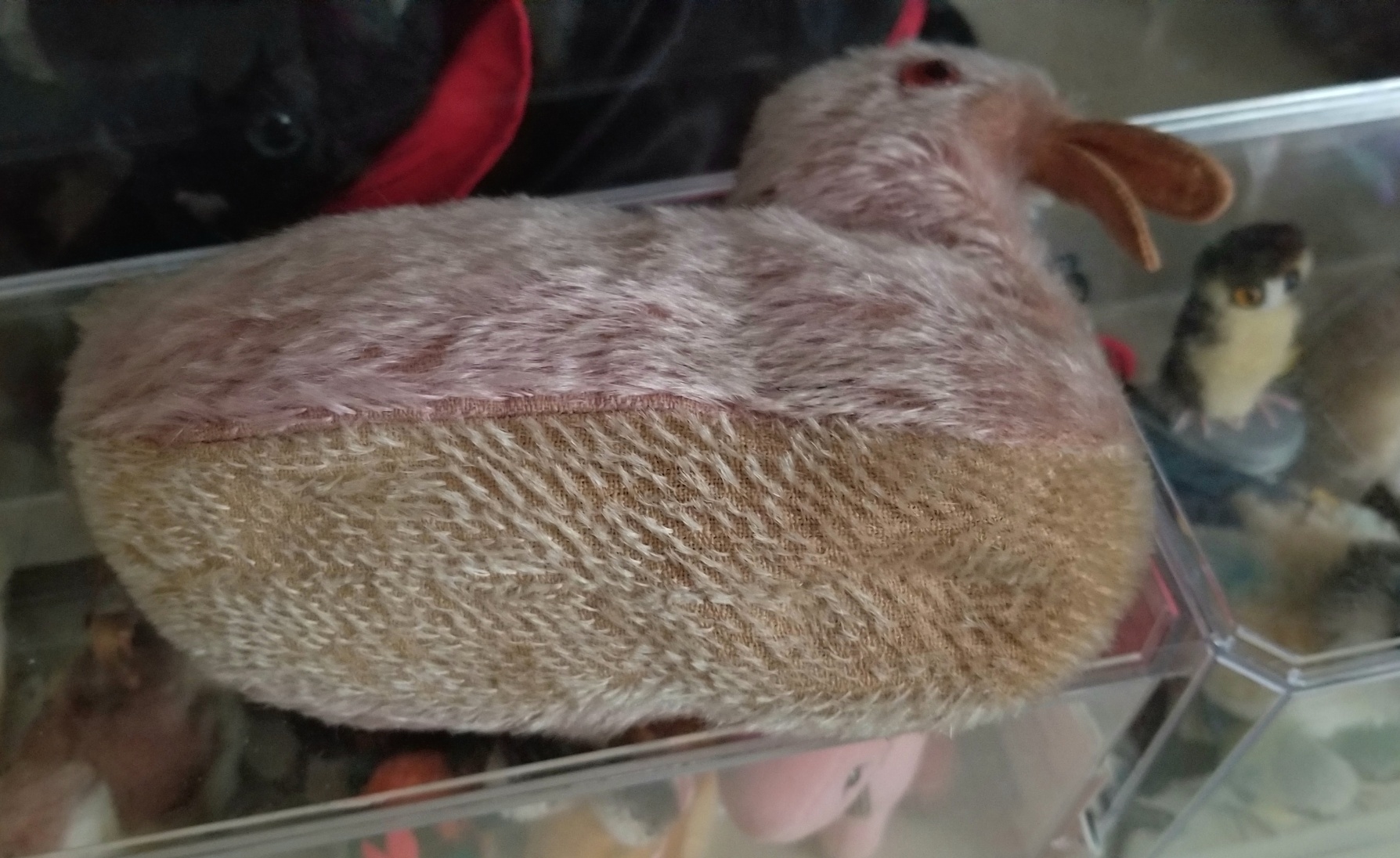
This week's special blog guest should have you tickled pink. A new friend writes about a pastel pet her Mother received nearly a century ago. Was this dear heirloom made by Steiff? Let's take a deep duck dive and try and solve the mystery for her. Trish shares,

"I have my Mom's duck that was given to her on shipboard during her family's immigration from Germany in 1929. It no longer has IDs. But the story is documented and she was always adamant that it was made by Steiff. For my own curiosity, I tried to find a reference to Steiff ducks from that era, but have had no luck. It lacks any obvious marks where a tag might have been attached. It measures about 9" long from the tip of its beak to its tail. I appreciate your time!"


Bird's the word with this delightful duck for sure.
However, it is Steiffgal's best thinking that it was not made by Steiff. However, its coloration and presentation are very reflective of the mid to late 1920s, which was when Trish says her Mother was gifted the duck. Starting around 1924 or 1925, Steiff's product line began more accurately reflecting the aesthetic of the "roaring '20s," with items having more of a fun, fluffy, and feminine appearance. Other toy manufacturers quickly followed suit. A big marker of this change across the industry was the widescale production of soft toys in happy pastel colors, including examples in pink, purple, and blue mohair or velvet, as well as vibrantly tipped mohair. Clearly, these colors for the most part did not reflect the animal's hues in nature, but they proved to be "best sellers" with customers because of their novelty and appeal. Trish's pink duck is a perfect example of this.

Not to duck the question, but what about this toy is not Steiff-like?
Here are a few areas of note. First, it lacks the "roundness" of Steiff's swimming style play ducks of the era. It also does not have distinctive wings on the sides of its body. It is missing orange felt legs and feet, and there is no evidence that this toy every had them. Steiff's ducks from this era tended to have black button eyes backed in felt, not oversized glass pupil ones. And finally, as far as Steiffgal can tell, many of Steiff's ducks of the era had open beaks made from double thick felt and not felt that was seen together with seams. So these small details point to another manufacturer for Trish's duck. You can see the Steiff's analogous pastel duck pattern here on the left. These beautiful birds were made in pink, purple, and blue mohair in 11, 13, and 15 cm from 1926-1929 overall. The photo is from Pfeiffer's 1892-1943 Sortiment.

Steiffgal hopes this discussion on this novelty duck has made your day pretty in pink.

Have a question about one of your Steiff treasures? Let's talk! Click here to learn more.

Sunday, February 24, 2019

Having A Ball With This Charming and Early Steiff Woolen Miniature Rooster

Top of the 'morning to you! A rooster's call welcomes the new day. And this little rooster under discussion here is certain to MAKE your day! Check out this happy pre-war handful and see what makes him so delightful from the design and product development perspectives.

Bird's the word with this well-rounded woolen miniature rooster. He is head jointed and measures about 3.75 inches (or 9.5 cm) tall, including his comb, and about 4 inches (or about 10 cm) wide, including his tail. His body is made from green, yellow, tan, brown, blue, and yellow Nomotta wool threads. His two front pom pom "legs" are made from yellow Nomotta wool threads. His tail is made from green felt, while his comb is made from red felt. His happy, smiling beak is made from yellow felt. He has playful, black and white google style glass eyes. Rooster retains his short trailing "f" style button and bits of his yellow tag as his Steiff IDs on his tail feathers. This item was produced in this size (9 cm) from 1938-1942.  

Other similarly ball shaped barnyard bird buddies of rooster's era include an 8 cm duck produced from 1936-1941, an 8 cm chick produced from 1936-1941, and a 9 cm hen produced from 1938-1941. These birds are featured in the photo on the left in the top row. This image is from Steiff's 1938/1939 catalog. You can click on the catalog page to make it bigger. Which is your favorite? 

This woolen miniature rooster has article number "3509." This code translates to 3=sitting, 5=lamb's wool or wool plush, and 09= 9 cm. The 5 is somewhat confusing as it does not specifically call out the "yarn" characteristics of rooster's material. However, almost all of Steiff's prewar woolen miniatures have a 5 as their second article number digit, so it appears that the "5" does incorporate the Nomotta wool category. 

Rooster is also noted on the catalog page as weighing 15 grams. Steiffgal decided to fact check that by weighing her example... and indeed he does!

Woolen miniatures were an important part of the Steiff pre-war line from the early 1930's through the early 1940's. Birds and other pets - like rabbits, cats, dogs, and bugs - were well represented in the product mix. They were appealing, inexpensive to produce and purchase, addictively collectible, and marvelous companions for larger dolls, bears, and other animal friends. Despite their petite proportions, each had a distinct personality and a timeless charm. This probably explains why they are so adored, and collected, by enthusiasts today - nearly 90 years after their introduction! 

Steiffgal hopes that this discussion on this fine feathered friend has been a ball for you!

Have a question about one of your Steiff treasures? Let's talk! Click here to learn more.

Sunday, November 4, 2018

Rolling Out The Red Carpet For This Amazing Steiff Ball Rabbit

It's easy to have a ball with Steiff! Especially when it comes to the company's tiny and wonderful "baby balltier" or ball animals designed for babies. Steiffgal recently had the pleasure of adding one of these bitty bunnies to her Steiff hug. Check out what makes these unusual novelties so interesting from the historical and product development perspectives.

Rounding things out, this adorable, 9 cm tall bunny is head jointed and made from tan colored mohair. His body is a simple, round form about the size of an apricot. His head is about the size of a ping-pong ball and is detailed with black and brown glass pupil eyes and a simple, red hand embroidered nose and mouth. His ears are made from felt. Rabbit's two front limbs and little tail are all made from tan colored woolen pom-poms. His clear monofilament whiskers have unfortunately been lost to time. This ball rabbit pattern was made from 1934 through 1943. This excellent example has a long trailing "F" button, dating him to the earlier part of this time frame.

Steiff also produced a larger 15 cm version of this bouncing bundle of joy from 1932 through 1942. This bigger bunny featured dimensional mohair ears and limbs as well as a rubberized, pastel colored ribbon band so he could be used as a "toss and catch" toy or perhaps even as a pram toy. This ribbon feature is so ephemeral that Steiffgal has never actually seen one in person. The 15 cm version of this novelty is pictured here on the left; the photo is from Pfeiffer's Steiff 1892-1943 Sortiment.

Steiff rolled out a series of teeny-tiny ball animals starting in the early 1930s. This would prove to be a challenging decade for the company. Germany entered a period of economic depression and widespread unemployment in 1929. At the same time, growing overseas sentiment began negatively impacting Steiff's export markets. As a result, Steiff's product development strategy included focusing on creating a range of lower-tier (i.e. affordable and efficient to produce) products for their domestic market to keep their toymaking business viable. It is interesting to note that the company's inexpensive, palm sized woolen miniature animals (including numerous rabbits in various body positions) also debuted around this same time. 

Coming full circle, Steiff produced about eight types of ball style animals overall. These were all based on simplified patterns of the company's most popular designs of the time. In addition to the rabbits discussed above, the collection also included Teddy bears, elephants, ducks, cats, lions, a Chin-Chin dog, and a Molly the Puppy. What's amazing about these items is that any survived at all given they were made to fit in the palm of a child's hand and designed as toys for youngsters! Here on the left you can see the page from the 1938 Steiff catalog featuring an assortment of these well-rounded items. 

Steiffgal hopes this discussion on these charming Steiff baby toys has put you in a playful mood indeed.

Have a question about one of your Steiff treasures? Let's talk! Click here to learn more!

Saturday, June 10, 2017

Care To Feather Your Nest With This Vintage Steiff Play Duck?

It's easy to go quackers over Steiff's ducks.  These fantastic fowl favorites have made a red carpet appearance in Steiff's commercial catalogs since their debut in 1892, first appearing in felt.  Steiffgal recently adopted a vintage and very darling duckling into her collection.  Waddle on over and check out some of his interesting, prewar design features.

What collector would not want to feather their nest with this dapper duck?   This toy is officially named "Play Duck." He is standing, 22 cm tall, unjointed, and stuffed with excelsior. Play Duck is made from yellow wool plush fabric.  His beak and feet are dimensional and are made from matching yellow felt. His feet are lined in wire and are posable.  His two small wings are spread out playfully along his back. Play Duck's eyes are made from black buttons and are backed in red felt circles - a design feature often seen on Steiff's birds.  He has a nonworking squeaker in his torso. He retains his short trailing "f" style Steiff button in his wing as his ID.  Play Duck was made in this size only from 1933 through 1943.

It's hard not to notice Play Duck's interesting material.  Wool plush is a lovely toy making fabric as it is durable, high quality, and gives items a charming, old fashioned look.  It has a "fuzzy" feeling to it, and even though it is also produced on a cotton backing like mohair, its fibers are more "continuous" than mohair fibers, which tend to be a little more "prickly" and distinctive.  Steiff often used wool plush as a substitute fabric in the place of mohair for a few years before and a few years after World War II, when the company's more traditional mohair and felt fabrics were sanctioned or not available at all. When you see a vintage Steiff item made from wool plush, there's a really good chance that it was made in the 1930's through early 1950's time frame.

Play Duck's felt features are also quite charming, and give him a toddler-esque look.  

First... his tootsies.  His somewhat oversized feet are actually webbed, like a real duck, and allow him to stand and balance easily.  His "toes" are formed by the stitching on his feet.  

Second... his beak. His two part, open beak is positioned in such a way that he appears to be smiling. It is detailed with two small grey marks on the top, indicating his nostrils. Most prewar Steiff ducks either have closed dimensional beaks, or simpler beaks made from orange single or double thick flat felt. As such, this is one lucky ducky! Remarkably, both Play Duck's feet and his beak are stuffed with excelsior.  Just imagine the precision, time, and skill required to do that!

Steiffgal hopes this discussion on her new fine feathered friend had all its ducks in a row.

Have a question about one of your Steiff treasures? Let's talk! Click here to learn more.

Saturday, December 12, 2015

All I Want For Christmas Is...

Perhaps you know the expression, "Good things come in threes." In the Steiff world, that just might refer to a great find complete with its button, ear tag, and chest tag. Or Gucki, Pucki, and Lucki, the trio of beloved gnomes from the 1950's. For Steiffgal, today it is also the number of items from the upcoming December, 2015 Morphy Auctions toy sale she has just added to her holiday wish list. Check out these three lovely lots and see what makes them so interesting from the collector's perspectives.
 

Lot 268
Will you be my Teddy bear? Steiffgal bets that's the question on many collector's minds in regards to this first outstanding item. Here we have lot 268, which is called, "1940's Steiff White Bear." It is cataloged as... 

"A wonderful example of a mid-century Steiff bear with glass eyes in what appears to be in unplayed with all original condition. This original "Teddy," circa 1948, has a block button, working growler within his chest, vibrant white coloring & even his felt pads are bright showing no discoloration/wear/loss. A knockout Steiff and certainly a fine addition to any bear and/or Steiff collection! Size 20-1/2'' L."

Shield shaped nose
And just what makes this Ted so unbearably appealing? The list is as long as the one in Santa's hands right about now! Collectors will recognize this bear as a remarkable example of Steiff's early post war "Original Teddy." This bear was produced overall from about 1950-1966 in blonde, caramel, brown, and white in 14 sizes ranging from 10-100 cm. This early post war bear pattern featured the new square-ish, shield shape nose on cubs 18 cm and over.  (An example of this nose stitching pattern is featured here on the left.)  Although Steiffgal has not seen him firsthand, this particular example appears to be in just about tissue-new condition. His white mohair is brilliantly clean and full, and his pads look pristine. His size is most impressive and probably correlates to the 50 cm version. And it's hip to be square with his block style button. This rare ID, used on Steiff editions from about 1948-1952, is considered amongst the most desirable with collectors worldwide. 
 
Lot 258
Steiffgal is just quackers over this next auction pick. Here we have lot 258, which is called "Unusual Prewar Steiff Duck With ID." It is cataloged as...  

"A charming example of Steiff's early and seldom seen standing and unjointed 22 cm "Play Duck." His excelsior-stuffed body is made from light yellow wool plush that has very light losses consistent with age. He comes to life with yellow felt webbed feet, an open, smiling, dimensional beak, a touch of airbrush highlighting, red felt backed black button eyes, and a pom-pom (similar in look and feel to the company's woolen miniatures) as his crown. His small playful wings angle backwards; one has a very small home repair on the inside fold. Duck retains his trailing "f" button and traces of his red tag as his Steiff IDs. Play Duck was produced in this size only from 1933-1943; this particular example was made in the earliest part of that time frame. Condition: As noted. Duck is in very good condition overall. Provenance: From the Patsy Ziemer Collection; this item comes with copies of the Ziemer family history."
 

Other pre-war ducks
Bird's the word when it comes to Steiff's delightful early ducks. Ducks are a legacy pattern for Steiff, with felt ducks appearing in the company's debut catalog of 1892. It has been Steiffgal's observation that for the most part, Steiff's prewar ducks have always had a more playful than realistic look to them, with their typically oversized and prominent beaks and feet. They were the first animals placed on eccentric style wheels (so they waddled when pulled along), were often made in bright colors, and were sometimes produced wearing charming hats or jackets - adding to their appeal. (A great pair of late 1920's-era Steiff ducks is pictured here on the left for context.) This particular auction example under discussion today, with its irresistible presentation, nice condition, IDs, and "crowning glory" pom-pom, is seldom seen on the secondary market and is quite desirable. It would be a feather in anyone's cap to add this darling duck to their Steiff collection.

Lot 169
This last auction pick just may be on Santa's wish list, too! Here we have lot 169, which is called a Steiff Studio Elk. This big beast is cataloged as...  

"An amazing, almost life sized, mohair Steiff animal from the 1960's time period. These studio animals were quite expensive and often times were used as display pieces in various toy stores such as Strawbridge & Clothier, Lord & Taylor, F.A O. Schwarz etc. that sold Steiff animals, people, toys etc. This fellow is approx. 60" tall, his antlers slip into the head and due to age and original mounting process they droop a bit (resting onto his back) otherwise his overall height would probably be increased by at least another 8" - 10". In remarkable original "bright" condition with virtually no mohair loss, discoloration, wear, holes, etc.! Retains the typical script Steiff button in his ear. Size 60'' L."
 

Steiff display okapi
Oh deer! Who could resist this lifesized friend, especially around Christmas time? This display animal is technically a Rothirsch, or Red Stag. He was made in this size - 190 cm - in 1967 only. The heyday of Steiff's display animal production was in the 1960's, when the company made many more "common" lifesized animals (like giraffes, tigers, and donkeys), but also many "exotic" ones, like chamois bucks, kudus, and this stag. (A Steiff display okapi from the 1960's is pictured here on the left for comparison.) For the most part, display animals from this period were manufactured from mohair, stuffed with excelsior, had sturdy metal skeletons, and had extraordinary detailing - like the antlers on this stag. Some were produced for store displays; these were sometimes mechanized so that their heads would bob, their tails would move, or they would shake a limb or two. Others found their ways into private collections. Regardless of his previous life, this particular Red Stag would make any room feel like the holidays all year 'round today!
 

Steiffgal hopes this review of three top Steiff highlights from the upcoming Morphy Auctions sales event has been a triple-treat for you. Check out the entire auction catalog by clicking here.
 

Have a question about one of your Steiff treasures? Let's talk! Click here to learn more.

Sunday, March 8, 2015

Steiff's Wearing The Green For Saint Patrick's Day 2015!


With the exciting holiday of St. Patrick's Day coming up this week, Steiffgal can't help but think in green! And after such a grey and cold winter around these parts, it seems that everyone is looking forward to spotting their first patch of green grass, crocus sprouts, and leaf buds - especially here in the Northeast! So to celebrate the patron saint of Ireland AND encourage the powers that be to send spring along as soon as possible, let's look at a few vintage - and not so vintage - verdant Steiff treasures. 

This first green goodie is all dressed up with nowhere to go! Here we have Steiff's always jolly and quite portly Mr. Toad of Toad Hall. He is 27 cm tall, made of light and dark green mohair, standing, and head and arm jointed. His foot pads and palms are made from light green felt. His happy, smiling face comes to life with tan, black, and yellow embroidered eyes and a smiling, felt lined open mouth. Toad wears a black felt cutaway style coat which is trimmed with a white cotton collar and cuffs, and a yellow silken bow tie.  Doesn't just looking at this awesome amphibian put a happy spring - as well as a hop, skip, and a jump - in your step? 
 
Mr. Toad was made in an edition size of 2009 pieces in 2009 for the UK Danbury Mint.  He marks the 100th anniversary of the beloved book, "The Wind in the Willows" by Kenneth Grahame. In 2003, this tale was voted the British public's 16th most beloved novel of all time. The drawing on the left is Mr. Toad as he is illustrated for the book; the drawing is by Ernest Howard Shepard.
   

The next emerald hued highlight in today's green parade packs alot of punch in a little package. This tiny fellow is Kroko crocodile. He is 12 cm (measured tip of nose to end of tail), lying, unjointed, and made from light and dark green mohair. He has two dark green felt ridges, extending from his eyes to the end of his tail. His sweet face is detailed with black button eyes and a wide open, felt lined mouth that is lined with teeny, tiny white felt teeth. The detail on this petite treat is astounding! 

Bitty boy Kroko is designed as a key ring or purse decoration and was produced in this size only in 2009. Steiffgal picked him up in the Munich airport on a flight stopover. He was displayed in a store window and his 1,000 karat smile, and vibrant hue, in caught her eye. Like a four leaf clover, he's served as her good luck totem ever since! 

Bird's the word with this third great green treat. This vintage fellow is Steiff's Ente, or Duck. He's 14 cm tall, standing, and unjointed. He is made from white, tan, and bright green mohair which is patched together in a rather charming, precious way. His face is as inviting as a breath of spring air with its red felt backed black button eyes and floppy orange felt beak. Duck stands upon two oversized, comical orange felt feet. His Steiff long trailing f style button button is located on his right footpad.
 

This dandy duck was produced in 14, 17, and 22 cm from 1925 through 1932. Steiffgal adopted him a few years ago at the Brimfield, Massachusetts antique fair, one of the largest in the country. Another lucky find indeed!

Let's end this happy green conversation in a really big way! These green giants are Steiff's mother and daughter Dinos pair. They are 42 and 12 cm, respectively. Both are unjointed, standing on all fours, and made from tan colored mohair that has been painstakingly hand airbrushed in a full spectrum of greens - as well as blues, purples, and browns. Baby Dinos has a felt fin along his back; mom's is made from mohair triangles. Both have an open, pink lined felt mouth, green and black google style eyes, and little yellow felt ears. Their gentle faces and sweet personalities defy their fierce and feisty reputations!

This prehistorically proportioned pair was produced as a US exclusive from 1958 through 1959 only. Steiff also produced mother and daughter Tysus and Brosus duos at the same time.  In 2010 at a Steiff auction at Christie's in London, a complete set of 3 almost pristine quality larger dinosaurs realized over $2,500, while the smaller versions realized over $3,100!  It is safe to say, that for many collectors today, owning the complete range of Steiff's late 1950's mohair dinosaurs would be like stumbling upon a pot of gold at the end of a rainbow!

Steiffgal hopes this celebration of green Steiff treasures was as enjoyable - and refreshing - as a perfectly poured pint of Guinness! Happy spring and St. Patrick's Day, everyone!

Have a question about one of your Steiff treasures? Let's talk! Click here to learn more. 

Sunday, January 4, 2015

Time Travelling Steiff Auction Highlights - Part 2!

Last week, we took a peek back in time and checked out a few auction highlights from a long ago sale. The event was held on Saturday, April 25, 1998 in Germany and managed by auctioneer Horst Poestgens. Steiffgal recently purchased the catalog from this sale and was just floored at some of the amazing treasures it featured. Here are three more absolute standouts from this wonderful Steiff event.


You can't help but think, "oh, baby" with this first auction highlight under review today. This lot, #49, is cataloged in part as... "Prototype of a Steiff snap-joint teddy baby with neck mechanism, 1936. Pre-war button in ear, corn colored mohair, velvet paws and soles, brown-black painted back glass eyes, turnable arms (discs), nose embroidered vertically with light brown tread, open felt mouth, lower jaw notchlessly movable via a built-in hinge, legs movable by snap joint mechanism, excelsior stuffed, head turnable from tail by means of neck mechanism, known from Steiff (like the circus bears or snap joint Dicky bears from the 1930's), standing 30 cm/12", sitting 24 cm/9-1/2", very nice pot bellied bear shape.  Very attractive friendly expression.  This teddy is the only known specimen in the finish worldwide (sample)!! He dates from the time and trial series the snap joint Dicky of 1936." 


Let's snap to it and see what make this little love such a remarkable bear. In the 1930's, Steiff designed and produced a number of items capable of mechanical movements. This started with a tail-moves-head feature. Several of the most popular dogs, rabbits, and cats of the time were made with this detailing. Steiff then took this "movement momentum" one step further by experimenting with just a handful of "snap" style items, which had internal metal joints that allowed these top-tier toys further flexibility in their body positioning. As far as readily available references and sources reveal, Steiff officially produced four such "snap" models: a 30 cm blonde Snap Dicky (pictured here on the left, photo from Christie's), a 30 cm brown Circus bear, a 25 or 28 cm grey or white Circus Elephant, and four variations of a very rare 28 cm "Dream Baby No. 103" doll.  


The Horst Poestgens Snap Teddy Baby in some respects looks a little bit like a Snap Dicky. It is interesting to note that like Snap Dicky, this Snap Teddy Baby also has velvet paw pads. Teddy Baby models from this period in this size were usually made with felt pads.  However, unlike Snap Dicky, this Snap Teddy Baby's pads do not have stenciled footprints, are round and toddler-like, and lack snap fingers and toes.  There is precedence for previously undocumented snap style items to appear on the secondary market; in 2010, Christie's sold a petite 18 cm Snap Dicky bear (pictured here on the left, photo from Christie's).  So, it is entirely possible, given the exploratory and evolutionary nature of its development, the limited number of snap items produced, and the fact that previously unknown snap-style examples occasionally surface in the secondary market, that this Snap Teddy Baby is indeed an utterly charming, insanely rare, one of a kind, uncataloged prototype.


Although Snap Teddy Baby is indeed a hard act to follow, this next auction highlight also gives a terrific performance.  This lot, #57, is cataloged as... "Somersault chimpanzee, Steiff, circa 1910, button in ear and remains of white tag, cinnamon colored mohair, light brown felt face, ears, hands, and feet, the thumbs on both hands expertly repaired (hardly visible), right hand likewise on back of hand, implanted painted back glass eyes, somersault clockwork functions, absolute mint condition, very rare, sitting size 23 cm/9 inches."  

Doesn't this sweetie just make your head spin?  Steiff's tumblers are all time collector's favorites, and seldom appear on the secondary market in delightful, working condition.   This somersaulting chimp example is actually only the second one Steiffgal has ever seen for sale.  These tumbling treasures are activated by an internal clockwork mechanism and literally do somersaults when their arms are wound up. Steiff produced several types of "purzel" animals, including bears, monkeys, and elephants, and a few doll models, including Eskimos and clowns.  Steiff's somersaulting chimp was produced in 23, 26, and 36 cm overall from 1909 through 1919.  

All of Steiff's purzel tumblers are based on popular standard line items of the time with slight tweaks to their design and assembly.  These items tend to have their arms attached slightly lower on their shoulders than their non-tumbling brothers.  And, the arms can sometimes look slightly less "flush" with the body than with the static versions. Tumblers are also significantly heavier than their non-tumbling counterparts, due to their internal metal mechanisms. You can see the physical differences here with the picture on the left of a regular Steiff bear (L) and the tumbling version (R); both bears are 28 cm and were produced in the 1906-09 time frame.


Steiffgal's just quackers over this final auction highlight from this Horst Poestgens auction.  This lot, #82, is cataloged as... "Doll duck pair, Steiff, 1920's, button in ear and white paper tag, article no. 28, linen body with loosely sewn on wings, yellow mohair head, wing tips and back of felt, painted brown claws, pretty head coloring, turning head, orange felt beaks, white wool pom pom on head, black shoe button eyes, original felt/cotton clothes, slightly used condition, interesting early collector's item."


Steiffgal has a very special place in her heart for Steiff's 1930 - 1950's era dressed animal dolls, and these are no exception.  According to Pfeiffer's 1892-1943 Sortiment book, these duck dolls were produced in 14, 22, and 28 cm from 1931 through 1935 overall.  Each size was detailed in one of six styles of clothing, which included a sports shirt and blue trousers (probably the boy duck in this case), pajamas, red patterned trousers, a swimsuit, a salmon red dress (probably the girl duck in this case), or a blue playsuit.  Another more pristine example of the company's duck-doll is pictured here on the left; the photo is from Pfeiffer's 1894-1942 Sortiment. It is interesting to note that the duck in the red shorts does not have a white pom pom on his head, while the pair on offer do.  Another point to consider about the duck couple is their identification.  The cataloging specifically mentioned a white paper tag. However, technically, the white paper tag was only used through 1925/26, and these dolls were made in the early 1930's.  As such, they "should" have red ear tags. In this case, it is entirely possible that Steiff had a bunch of extra "28" imprinted white ear tags in inventory, and simply used the white tags in the place of the red tags for efficiency.   

Steiffgal hopes this discussion of three amazing Steiff lots inspires you to find some wonderful Steiff treasures at auction in 2015!

Have a question about one of your Steiff treasures? Let's talk! Click here to learn more. 

Saturday, December 13, 2014

The Perfect Stocking Stuffers... Early Steiff Woolen Miniatures!

One of Steiffgal's favorite things about this time of year is what her nephews call the "big socks," or Christmas stockings. After all, what's more fun that an oversized piece of faux hosiery filled to the brim with sweets and gifts?  So this got Steiffgal thinking - what would be perfect Steiff stocking stuffers?  Maybe the company's early woolen miniatures or "woolies?"  After all, they don't take up too much room, wrap easily, have a fantastic legacy, and truly capture the precious nature of the season! So let's check out these three very vintage "tiny treasures" to really get into the spirit of the holidays!

Bird's the word with this first pre-war Steiff woolie stocking stuffer.  This mellow yellow fellow is Steiff's Golden Bunting bird.  He is 8 cm, head jointed, and made from yellow, tan, brown, and olive green woolen yarns.  He stands upon metal legs that have been painted brown.  His tail feathers are made from brown felt, and his beak is made from orange felt.  He has tiny black button eyes.  Yellow Bunting wears his Steiff button and tag like a bracelet around his leg.  He never had a chest tag.

This golden oldie was produced in 4 and 8 cm from 1934 through 1943.  Around the same time period, Steiff also made woolie Robins, Green Woodpeckers, Finches, Blue Tits, and Sparrows.  Like the Golden Bunting, all were made in 4 and 8 cm and had very similar construction.  Only their yarn colors differentiated from species to species.  You can see several of the 4 cm versions of these other birds - and also the 8 cm Golden Bunting - in the picture on the left.  It is interesting to note that Steiff reintroduced all their 4 and 8 cm Robin, Green Woodpecker, Finch, Blue Tit, and Sparrow models right after the factory reopened for toy-making business in the late 1940's.  However, the Golden Bunting version, for some mystery reason, never appeared in the line after 1943.

Steiffgal's just quackers over this second woolie Steiff stocking stuffer.  Here we have a little 4 cm Steiff duck.  His body, head, and backside pom-pom are made from yellow woolen yarn.  His decorative head pom-pom is made from white woolen yarn.  His large, friendly beak and oversized feet and legs are made from orange felt.  His face is detailed with black bead eyes and a touch of orange airbrushing.  His button and tag, which have been lost to time, would have been on one of his feet.

This darling woolie duck was made in only this size and color combination from 1931 through 1941.  For the most part, pre-war Steiff woolie birds were designed to stand on metal legs, so this lying duck is somewhat unusual in terms of form and presentation.  

Not a creature was stirring - except for this mouse!  This final Steiff woolie stocking stuffer is not only insanely adorable, but also extremely seasonally appropriate!  This is Steiff's woolie mouse in felt slippers.  He is 9 cm, standing, head jointed, and made from white and orange woolen yarn.  His head and lower body are white, while his midsection is orange.  His hands and ears are made from single thick felt.  His legs are made from grey metal which has been painted light pink.  His little slippers are made from single thick orange felt and literally "slip on" his feet.  His tiny face comes to life with red bead eyes, a touch of pink to indicate his nose and mouth, and a few clear monofilament whiskers.  When he was a younger man - eh, mouse - he had a long matching tail.  He retains his tiny short trailing f Steiff button in his ear.
  
This petite treat was made in from 1936 through 1942 in this size only.  He also came in several other color combinations, including grey and red and brown and yellow.   Steiff also made several other standing woolie models with tiny felt slippers around this same time period; these included birds, rabbits, ladybugs, beetles, and bumblebees. 

Steiffgal hopes this discussion on Steiff's tiny pre-war woolies has gotten you excited for the holidays in a mighty big way.

Have a question about one of your Steiff treasures? Let's talk! Click here to learn more. 
The teddy bear search engine