Showing posts with label orange. Show all posts

Friday, July 5, 2024

This Amazing Steiff Prewar Treasure Is No Optical Illusion!

Eye, eye, eye... look what we have here! Steiffgal just got an inquiry about an eye-popping rarity and she could not wait to share this exciting find with you. Let's not monkey around and jump right into the details of this precious prewar primate right away!

What we have here is Steiff's Mimocculo Orang Utan.
This example is about 35 cm tall, fully jointed, and made from long, fuzzy red-orange mohair. His hands, feet, ears, and face are made from felt. He features an open, dimentional mouth as well as really unusual and abundant facial seaming. This is because he has a remarkable moving eye feature imbedded in his head. These seams hold his facial fabric, and in turn his eye-movement hardware, securely in place. With Mimocculo, when you pull gently on his ear, his white, brown, and black round glass eyeballs move left and right, as well as up and down. This great example retains his long trailing "f" button and traces of his red ear tag as his Steiff IDs. 

This nifty novelty was produced from 1930 through 1936 in 8, 10, 12, 14, 17, 22, 25, 28, 35, 43, and 50 cm.
 Sizes from 17 cm had the distinctive rolling eye mechanism and deep eye pockets; the smaller ones had standard, stationary glass pupil eyes and closed mouths. Given Mimocculo's charm and collector's appeal, Steiff created a 35 cm tall rolling eye replica of this treasure in 1998. It was produced in an edition size of 3,000 pieces overall and very closely resembled the prewar version.

In the early 1930s, when 
Mimocculo debuted, one of Steiff's business development strategies was to produce high end items with distinctive mechanical features. Other products with amazing jointing or advances from this era included the company's snap jointed tail moves head Circus Elephants (made in 24 and 30 cm from 1931-1940 overall) a snap jointed tail turns head Circus Bear (made in 32 cm from 1935-1939), and a series of press and release music box animals based on Steiff's most popular prewar pet designs. Mimocculo, with his fabulous flirty eyeballs, fit perfectly into this exclusive club of mechanical marvels.

And just how rare are these outrageously outstanding Orang Utans?
Steiffgal has only seen a handful come up for public auction over the past decade or two. Most recently, Ladenburger Spielzeugauktion offered a 10 cm version at their Special Steiff Auction held on June 29th, 2024 in Giengen, Germany. You can see this happy handful here on the left, the image is from Ladenburger Spielzeugauktion. This "mini Mimo" had a starting bid of 180 €, hammered at 3100 €, and was cataloged simply as:

"Monkey, orangutan, MIMOCCULO, made 1930-1933, 10 cm, rust-colored mohair, small glass eyes, felt feet, hands and face as well as ears in very nice condition, unusual."  

Orange you glad you checked out this discussion on Steiff's Mimocculo Orang Utan?

Have a question about one of your Steiff treasures? Let's talk! Click here to learn more.

Sunday, March 3, 2024

Hop-ping To Find Answers About This Fantastic Steiff Prewar Rabbit On Wheels

Orange you glad you checked in with this blog today? Well you will be for sure after learning more about this super cool prewar rarity living with a new friend from far away. Alena shares...

"Hello from the Czech Republic,

I have a question about my toy - rabbit on the wooden wheels. I couldn't find any information whether the Rabbit has been produced in Steiff factory in this color. Toy hasn't got any button neither any else marking. 

Thank you very much in advance for the answer and maybe some more information about that."

This happy hopper is the wheel-deal indeed.
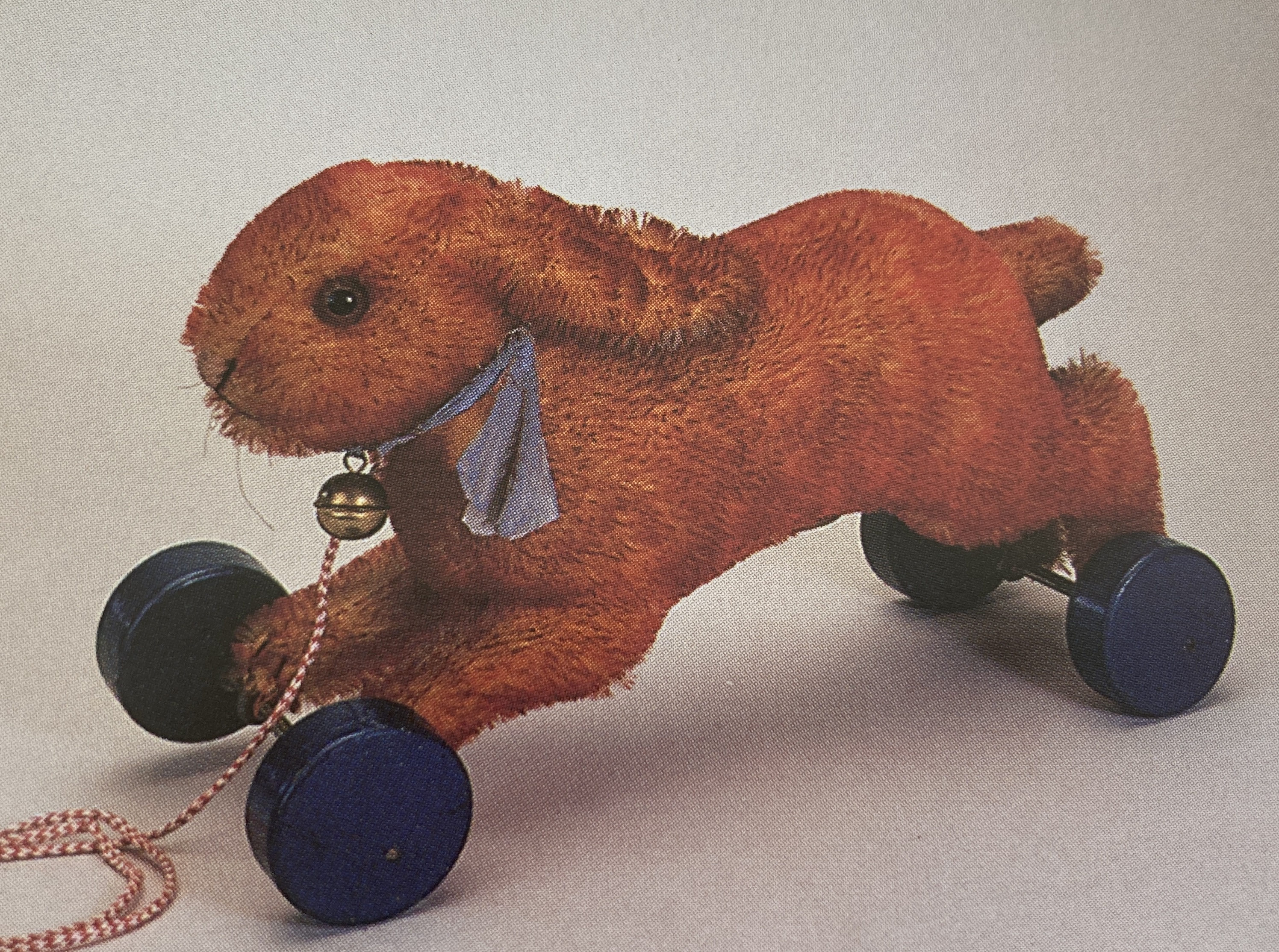
It is Steiffgal's best thinking that he is one of Steiff's standard line rabbits on wheels from the late 1920s. Here on the left, you can see the photo from Pfeiffer's 1892-1943 Sortiment illustrating what Steiffgal believes is this exact item. He is in a "hopping" position, meaning he is on all fours and about ready to take off! The name of this body position was later changed to "running", which also makes alot of sense.

Alena's treasure is one beautiful bunny. Here you can see him relaxing with some WAH-HOO good vintage friends in the photo on the left. Rabbit is unjointed, solidly stuffed with excelsior, and features large brown and black glass pupil eyes, a hand embroidered pink and black nose and mouth, and clear monofilament whiskers. He has once vivid orange mohair. He rides upon four asymmetrical wooden "eccentric" style wheels. As such, he appears to sway back and forth as he is pulled along. This item was produced in 12, 15, 18, and 23 cm (measured vertically, top of the head to toe, not including ears or wheels) from 1927-1930 overall in this stunning color. He was also produced in an almost identical pattern in brown tipped mohair in 14, 17, and 22 cm in 1928.


Brightly colored animals, including rabbits, dogs, cats, and bears - were a delightful feature of Steiff's late 1920s to very early 1930s product line.
These sweet pets appeared in orange, pink, blue, green, gold, or other "jellybean” colored mohair or velvet fabrics, and usually had playful, youthful personalities to match! Tipped mohair - meaning mohair with just the ends or tips dyed a complementary or eye-catching color - also had its heyday in the product line around the same time. You can see a number of these colorful rabbits in the photo on the left, the image is from the company's 1929 product catalog. 

Steiff also produced a few other fun novelties featuring "larger than life" colors like Alena's wheeled rabbit.
One of particular interest is a delightful orange and white begging style rabbit on eccentric wheels. In July, 2023, the auction house Ladenburger Spielzeugauktion GmbH of Ladenburg, Germany sold this 20 cm tall rarity from 1926-1932 for nearly $4,000. He is pictured here on the left, the image is from Ladenburger Spielzeugauktion.

Steiffgal hopes you enjoyed learning about this darling, 24 carrot gold prewar novelty!

Have a question about one of your Steiff treasures? Let's talk! Click here to learn more.

Sunday, April 10, 2022

Monkey See Monkey Do With This Delightful Steiff Prewar Rarity

It's no secret that Steiffgal is simply bananas over Steiff's legacy Jocko the chimp pattern. This happy go lucky primate has been a collector's favorite since its introduction in 1909 - and for good reason! Steiffgal saw today's featured guest listed on an online auction platform in Europe and knew she had to have him. After a few ups and downs, he finally arrived in the USA and was even better than photographed and described. Take a look at this ray of sunshine - literally!

Here's a tip - this Jocko is off the charts great! He measure 30 cm sitting and is fully jointed. He has the design's traditional very long arms and bended at the knee legs. His hands, feet, face, and ears are made from felt. He comes to life with oversized brown and black glass pupil eyes set in eye pocket, a large, open, felt lined mouth, painted features and nostrils, and a white mohair chin. And you can't help but notice his outstanding fabric. He is made from bright orange tipped mohair. This coloration is very prominent on his body and joints and less so on his head and arms. His fading probably happened because of exposure to sunlight, as well as natural fading that occurs with dyes and natural fibers. It is also possible that his torso is less faded because he was wearing clothing that protected these areas from the elements. Only he knows for sure!

Jolly Jocko retains his long trailing "f" button and traces of his yellow ear tag as his Steiff IDs. This is helpful, somewhat, in dating him. The long trailing "f" button appeared from around 1906-1935, and the prewar yellow ear tag appeared around 1934. If you overlay those two data points, they suggest that orange tipped Jocko was most likely "born" in 1934 or 1935.

Colorfully tipped mohair was a prominent design feature starting in the mid-1920s through the early to mid 1930s. Some models of Happy, Teddy Clown, and Petsy featured eye-catching brown tipped mohair. Fluffy the cat is famous for her teal eyes and blue-purple tipped coat, while Bully the bulldog made a name for himself with his orange tipped detailing. Molly the puppy was produced with brown, red, green, or blue tipped mohair, and examples of Charly the King Charles Spaniel with bright orange tipped mohair appear occasionally on the secondary market. Some 1920s rabbits were produced in surreal, tipped hues. and even some field and forest animals sported this distinctive fabric as well.

As far as Steiffgal can see, there is no specific mention of an orange tipped Jocko in any of the standard Steiff reference books. All of his IDs and detailing put him in at the tail end of "the golden age of tipping" at Steiff. However, Jocko monkeys are among the most popular and prolific designs in the Steiff line. Given they've been in production since practically the turn of last century, it would be nearly impossible to capture all of his different versions and variations - especially all the different fabrics he's sported over the years. For example, in her own personal collection, Steiffgal has otherwise undocumented versions of this chimp in artificial silk plush, wool plush, cotton plush, and other woolen combinations - among others! It would be possible to have a collection of just Steiff Jocko monkeys given the enormous range of their appeal, individual personalities, and of course, material presentation.

Orange you glad you checked out this Steiff blog today?

Have a question about one of your Steiff treasures? Let's talk! Click here to learn more.

Thursday, February 3, 2022

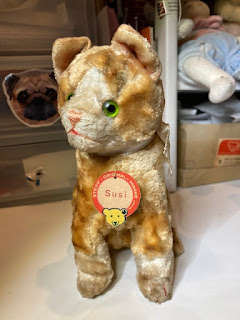
This Marmalade Silk Plush Steiff Susi Kitten Is The Cat's Meow!

Orange you in the mood for something unexpected? Steiff's midcentury kittens are always the cat's meow, but this particular find is purr-fect in every way! Check out this fantastic feline and see what makes her so interesting from the design and historical perspectives.

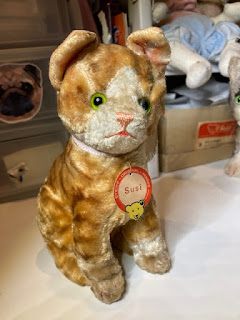
This smooth-as-silk sweetie is an unusual example of Steiff's beloved Susi cat design.
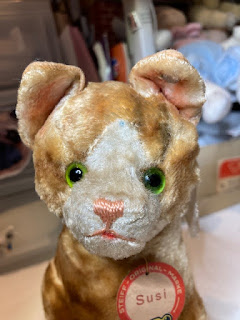
She is 16 cm tall, sitting, and head jointed. Susi is made from artificial silk plush. Her muzzle, front feet, and neck are white while her body, head, and tail are a marmalade color. The marmalade areas are hand airbrushed with dark orange or brown stripes. Her face comes to life with piercing green and black round pupil glass eyes, a pink hand embroidered nose and mouth, traces of a few clear monofilament whiskers, and a touch of pink paint to mark her lips. She has red embroidered claws on her front two paws. She retains her original pink bow. Her IDs include a large, watermelon style red imprinted chest tag, a short trailing f button, and traces of a light yellow or white ear tag.

Steiff's legacy Susi pattern has been a collector's favorite since her debut in 1936.
 It is rumored that this beloved design was named after a member of the Steiff family. Prewar, she was produced in grey and white mohair in 14, 17, 22, and 28 cm through 1943. In Pfeiffer's 1892-1943 Sortiment, she is described as "mohair plush, gray tabby, sitting, very pretty model, round shape." It is very unusual to find subjective or "flattering" descriptions in the Sortiment books as they are almost always entirely factual and literal. So Susi's design must have really caught someone's eye! Shortly after the conclusion of WWII, Steiff began manufacturing just a handful of their most popular prewar patterns - including a version of Susi. Her pattern was first produced in grey and white artificial silk plush in 14, 17, and 22 cm from 1948 to 1949, and then in mohair in 10, 12, 14, 17 and 22 cm from 1948 through 1978.

As far as Steiffgal can tell, this marmalade and white artificial silk plush full bodied Susi cat does not appear in any of the standard Steiff reference books.
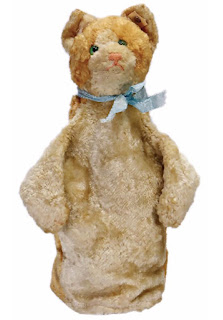
However, it is interesting to note that she resembles a most unusual marmalade and white artificial silk plush Steiff puppet sold at auction in 2019. 
This puppet, which is pictured here on the left, generated 20 bids and realized over $3,000! You can see that they share similar coloring and materials, as well as the same green and black pupil eyes, and other facial detailing. This puppet was described in the catalog as, "hand puppet, faux silk plush, cat, shiny button, rests of the ocher-colored paper sign, was produced during the war, good condition, nice colors." The photo is from Liveauctioneers.com.

So, what's the story with this very pretty, albeit uncatalogued kitty?
Here are a few ideas. It is entirely possible that she is a variation of the grey and white artificial silk plush version from the late 1940s. Her IDs align perfectly to that time frame. Given her stunning but unconventional hue and era of manufacture, she may have been produced as a sample of a design that never went into commercial scale production; was made from the only fabrics available at the time; or perhaps was designed and produced as an item for sale at the PX stores where American soldiers shopped immediately post WWII. However, only she knows for sure!

Steiffgal hopes this discussion on this happily hued Steiff Susi has tickled your whiskers, in the best possible way.

Have a question about one of your Steiff treasures? Let's talk! Click here to learn more.

Sunday, March 7, 2021

Your First Rabbit Sighting Of The Spring Season!

In the mood for a 14 carrot worthy discovery? Then check out this little known Steiff bunny that is certain to satisfy your rabbit-habit! This hoppy handful is certain to put a much welcomed spring in your step.

Here we have Steiff's sitting Sunny the Bunny.
He is also known as Ruebenhase, or Carrot Rabbit. He is 17 cm tall, made from tan mohair, and is head jointed. His arms are lined in wire and are posable. He has chunky thighs and long, narrow feet. His charming, center seamed face comes to life with round, dimensional black, brown, and white glass eyes, a pink hand embroidered nose, a black hand embroidered mouth, clear monofilament whiskers, and long-ish mohair sideburns. His pert ears are lined in felt. Rabbit holds an oversized, dimensional orange felt carrot in his hands, and has another smaller, removable orange felt carrot tucked into a mohair pocket on his back side.

This rare hare was made in 9, 12, 17, and 30 cm from 1954-1956 overall as an exclusive for the US department store R.H. Macy & Co., better known today simply as Macy's.
The 30 cm size also came with a music box. This particular model under discussion today has a raised script button, a yellow ear tag numbered 7317, and a US Zone tag in the seam of his arm as his IDs. These align really well with his early postwar era of production. In this case, 7=in caricature, 3=mohair, and 17=17 cm tall. Pfeiffer's Sortiment shows that sizes from 12 cm onward included the letter "R" in their article number. Steiffgal suspects that the R indicates the presence of a felt carrot (or two) in the design; perhaps the 9 cm version was too small to incorporate this detail.

This sweet design, like many exclusives produced for the US market in the second half of the 20th century, seems to be a modification of one of the company's popular standard line editions of the time.
 This 17 cm Sunny has the general look and feel of Steiff's beloved and popular 17 cm Niki Rabbit, who appeared in the line in 14, 17, 22, 28, and 35 cm from 1951-1964 overall. You can see Niki below, posing with a few springtime friends. Sonny's pert tail, head shape, closed mouth, facial embroidery, whiskers, and long mohair sideburns are quite similar to Niki's. However, the 17 cm Sonny has a few design features that make him more "economical" from a production standpoint than the 17 cm Niki. For example, Sunny is head jointed only, while Niki is fully jointed. Sunny has ears lined in felt, while Niki's are lined in mohair. Niki has felt pads; Sonny does not.

So what does all this mean, maybe?
It is entirely possible that Macy's was looking at ways to produce a fun, playful rabbit exclusive based on Steiff's Niki that didn't break the bank. Sunny's simpler, less expensive, and appealing construction certainly checked all of those boxes. And Sunny's cartoon eyes and fun felt carrot details - neither being expensive or terribly complicated to implement - really brought the design to the next level. 

Steiffgal hopes this discussion on the company's rare Sunny the Bunny has added a little crunch to you day.

Have a question about one of your Steiff treasures? Let's talk! Click here to learn more.

Saturday, June 13, 2020

These Steiff Auction Apes Are More Fun Than A Barrel Full of Monkeys!

It's no secret that Steiffgal is just bananas over Steiff's monkeys from any era. So she was thrilled to see a number of important ones coming up for sale at Potter & Potter's Eclectible Collectible Auction to be held on June 20, 2020. This event features over 120 lots of super sweet Steiff finds, including a ton of prototypes, one-of-a-kinds, hand samples, and unproduced items. So without further ado, let's monkey around a bit and check out some of these premier primates.

It's all fun and games when it comes to this first marvelous monkey. It is lot #90 and cataloged as: "Steiff Jocko Football Player [FAO Schwarz Exclusive]. 1970s. Mohair Jocko in a football uniform, issued exclusively through FAO Schwarz in the early 1970s. 11”. No tags. Uncommon." This athletic ape is estimated at $80-150.  Jocko looks to be in fine shape but is missing his original felt football helmet. This often happens over time when an accessory is not sewn onto an item. The rest of his outfit appears to be in fine condition. And how can you resist his "wild and crazy" blue dralon jersey? Jocko as a football player would be a great fit for a monkey, football, F.A.O. Schwarz, or "wacky 70's" collection.  

Given his time in the line (over a century!) and his global appeal, Jocko has been created in many different materials, forms, and novelties over time. Steiff and F.A.O. Schwarz began their partnership in 1906. Early post World War II, Steiff began creating a series of exclusive products for F.A.O. Schwarz. Some were entirely novel, while others - like this Jocko -  were tweaks and modifications of existing standard line items. Football playing Jocko appeared in the line from 1972-1973 and is considered relatively rare on the secondary market. He is pictured here on the left how he looked when he left the factory in Giengen almost 50 years ago; the image is from Pfeiffer's 1947-2003 Sortiment. 

Steiffgal's willing to go out on a limb for her next primate pick. Here we have Steiff's replica 1903 monkey with extraordinarily long arms and legs. It is lot #85 and cataloged as: "Steiff Monkey 1903 Replica Limited Edition. 2004. From an edition of 1,000. White tag. Brown distressed mohair, felt paws and face. Height 24”. Joints a little tender." This tall drink of water is estimated at $125-250. He has a marvelous, old fashioned look to him, including charming, oversized felt hands and feet. Given his scale and personality, he would be a great focal point for any room needing a little monkeyshines.

This design is a key one in Steiff's product development timeline. In his cataloging, this early ape is described as having "tender joints." Given he is string jointed, it is Steiffgal's suspicion that his joints are a bit wobbly, as they would be in a string jointed item. Steiff's first jointed animals were jointed with string. As you can imagine, these sorts of joints were not durable and broke easily, rendering the toys practically useless. Lot #17, a replica PB55, is another example an early Steiff string jointed animal.  Steiff next experimented with rod jointing. However, this metal infrastructure added a lot of weight - and alot of "uncuddliness" to items. Rod jointed items appeared in the line from c. 1904-1905. Lot #26, a replica 1904 bear, is a nice example of a rod jointed Steiff bear.  Then from c. 1905 onward, Steiff used a cardboard disk and metal pin jointing system, which is still part of production today. You can see the original 1903 string jointed monkey "dancing" with Steiff's original string jointed Teddy bear from company's turn of last century catalog page pictured above; the image is from the Cieslik's Button In Ear The History of the Teddy Bear and His Friends. 

And the eyes have it with Steiffgal's third monkey auction highlight. Here we have Steiff's Mimocculo orangutan replica. It is lot #86 and cataloged as: "Steiff Mimocculo 1930 Replica Limited Edition. 1998. Number 111 of an edition of 3,000. Features a squeaker, moving eyes, rust mohair, jointed arms and legs. Height 13”. He is estimated at $125-250. This irresistible and quirky monkey is quite the looker - from his fantastically colored mohair to his incredibly detailed felt facial mask.

Marvelous Mimocculo has both looks and brains... and is also a feat of precise engineering. What makes both the original and replica Mimocculos so unique are their moving eye features. When you pull on his ear, his glass eyeballs move left and right, as well as up and down! The Mimocculo pattern was originally produced from 1930 through 1936 in 8, 10, 12, 14, 17, 22, 25, 28, 35, 43, and 50 cm; sizes from 17 cm had the distinctive rolling eye mechanism. In 2016, Ladenburger Spielzeugauktion sold a working version of eye rolling Mimocculo for close to $7,400! He is pictured here on the left; the photo is from www.liveauctioneers.com. In the early 1930s, one of Steiff's business development strategies was to produce very high end mechanical novelties, and this is a perfect example of that. So as they say, here's looking at you kid... literally!

Steiffgal hopes this discussion on some of Potter's June 20, 2020 Steiff primate sale highlights has been more fun than a barrel full of monkeys!  You can learn more about this sale and check out the entire catalog by clicking here.

Have a question about one of your Steiff treasures? Let's talk! Click here to learn more.

Sunday, December 15, 2019

This Steiff Tail-Moves-Head Dox Really Rocks!

Care to take a little paws from the holiday madness? That's probably an offer you can't refuse right about now! Then have a look at this darling Dachshund. He's truly a head-turner, in more ways than one! Here's why.

This arm and leg jointed Dox really rocks! He measures about 11 cm tall and about 19 cm wide, not including his tail. His paws, underbelly, face, and muzzle are made from orange tipped mohair. His ears, tail, back, and limbs are made from black mohair. He has three hand painted claws on each foot. His puppy-like face comes to life with a black hand embroidered nose and mouth, proportional black and brown glass pupil eyes, and a touch of black airbrushed highlighting. He retains his long trailing "f" button and traces of his red ear tag as his Steiff IDs. And his secret superpower? He's a rare, tail-moves-head example, meaning that when his long tail is rotated in either direction, his head follows suit! This pretty puppy appeared in the line in 14, 17, and 22 cm from 1931-1934 overall.

Dachshunds are legacy Steiff breeds, and have appeared continuously in the line in one form or the other since the late 1800s. This particular black and orange version was introduced in 1929 in the form of a 22 cm standing version. He also appeared on regular or eccentric wheels in five sizes ranging from 17 to 35 cm from 1929-1935 overall, and as a "detachable" variation in 18, 23, and 29 cm from 1936-1939 overall.  

This Doxie has several interesting design elements that align almost perfectly with his launch and production timeline. 

The first, and most obvious, is his tail-moves-head feature. Starting in the early 1930s, Steiff started to produce several of its most popular designs with a tail-moves-head feature. This Doxie puppy pattern, which reflects the late 1920s happy, childlike aesthetic Steiff is known for (think Molly, Charly, Pip, Bully, etc.) must have been a best seller at the time to merit this novelty upgrade. 

The second is his assembly. Doxie is made from two distinctly different mohair fabrics which are patched together. This type of construction was typical for the 1920s, and was more expensive and labor intense than simply making an item from one type of mohair, or airbrushing color(s) onto one type of mohair. For the most part, Steiff's patched construction was all but phased out by the late 1930s and replaced with more efficient production operations. 

And the third is his orange tipped mohair. Joyful, colorfully tipped mohair debuted in Steiff line in the mid-1920s. Items including rabbits, penguins, deer, and even gnomes featured similar orange tipped mohair through the late 1930s. There's no question that this playful fabric added a touch of whimsy to these very period products. 

Steiffgal hopes this discussion on Steiff's two colored dachshund has been more than twice as nice for you.

Have a question about one of your Steiff treasures? Let's talk! Click here to learn more.

Sunday, October 27, 2019

Is This Turn of Last Century Mohair Goose The Wheel-Deal?

Heads up - there's a goose on the loose! Steiffgal recently came across a most interesting, and very vintage, goose on wheels. His early and endearing presentation, traditional and legacy set of materials, and turn-of-last century manufacturing details certainly appear very Steiff-like. But he does not have any identification, and does not appear in any Steiff reference book or catalog Steiffgal knows of. Take a peek - what do you think?

This fine feathered friend is certainly on a roll. He is standing, unjointed, and measures about 18 cm tall and 28 cm wide. Goose is made from all white mohair and is solidly stuffed with excelsior. His wings are dimensional, stretch backward, and are tacked to his body with a few stitches. His neck is long and graceful. His face comes to life with black button eyes backed in faded red felt, a yellow felt beak, and prominent brown detail embroidery stitching that goes from his eyes to his beak. He glides along on a carriage with four wheels that have traces of gold paint on them. Steiffgal tested the entire rolling mechanism with a magnet and it is made from solid metal.

After much searching around, Steiffgal came across a good picture of a similarly styled goose that Steiff had in the line at the turn of last century. That long-necked bird was standing and had jointed legs. He was made from white mohair, had a yellow felt beak and legs, and almost the identical facial features and detailing - including stitching from the eyes to the beak - as this one on wheels. Steiff's standing, jointed goose was made in 17, 22, 28, 35, and 43 cm from 1911-1918. You can see this goose here on the left, it was sold at Christie's in 2010 along with a smaller farm friend. Together the pair realized GBP 1,375.

So what's going on with this easy rider? Here is a possible explanation, with the tell-tale hint in his wheels. Steiff introduced its wooden up-and-down "eccentric" wheels around 1912 and holds a patent on this mechanism. Eccentric wheels were discovered accidentally, but Steiff quickly realized the product-development opportunities created by their roller drilling mistakes. Birds of all sorts were ideal for eccentric wheels, given their natural "waddling" tendencies, and you see wooden eccentric wheels on many Steiff bird models from 1912 onward.

Now let's shift the discussion into fifth gear. This goose is clearly on metal, not wooden wheels. His pattern, as noted above and given he is Steiff, was introduced in 1911, BEFORE wooden eccentric wheels were in the line. It is possible that in 1911 or early 1912, Steiff wanted to see if their existing standing white mohair goose pattern could be modified as a pull toy on metal wheels - and this example could be the result of that experiment. It is interesting to note that Steiff introduced a new mohair goose on eccentric wooden wheels soon after in 1914. This updated pattern, having an orange felt beak and feet, grey and white coloring, a shorter neck, and a more compact body, appeared in 14 and 17 cm prewar through 1943 overall. You can see that updated goose on wheels here on the left; the picture is from Pfeiffer's 1892-1943 Sortiment. 

Steiffgal hopes this discussion on this unusual and probably Steiff goose knocked you over with a feather.

Have a question about one of your Steiff treasures? Let's talk! Click here to learn more. 

Thursday, October 17, 2019

A Steiff Penguin of Royal Stature!

They say it's not easy being green. But Steiffgal has to disagree, at least in this particular case! A special little someone just waddled his way into her collection, and she couldn't be more excited. Check out this colorful creation and see what makes him so outstanding from the historical and product development perspectives.

Bird's the word with his stunning Steiff King Peng penguin. He stands all of 15 cm and is made from white, green, and orange tipped mohair. His beak is double thick orange felt, and his chubby wings and feet are made from orange velvet. His wings have black hand drawn lines on them. His childlike face is detailed with black and brown glass pupil eyes. Larger versions had cartoon eyes backed in felt. This model is a tail moves head example, meaning that when his tiny green mohair covered metal tail is twisted left and right, his head moves in unison. His long trailing "f" Steiff button is located on the bottom of one of his velvet feet. This polar pal was made in 15, 18, 23, 29, and 36 cm from 1931-1935 overall. He was also produced in the same sizes in a slightly different color combination, with blue/black mohair in the place of the green mohair seen on this example.

Tail moves head editions were amongst Steiff's headliners of the early 1930s. They were produced as a result of the company's emphasis on producing fun, exciting, and endearing novelty items as a way to further capture the pocketbooks - and hearts - of Steiff enthusiasts worldwide. Overall, about 25 different tail turns head models were produced through the late 1930's and very early 1940's. These were advertised as...

"The year 1931 has presented us with the animals with the new head movement… The simplicity of the mechanism, though which the splendid movement is produced, cannot be beaten, yet it is unbreakable and allows lifelike play, full of variety and mimics… When buying new supply in plush toys please be sure to include the STEIFF animals with the new head movement; all numbers equipped with it are marked ‘H.’” 

Most of these newfangled tail moves head items were based on the best selling standard line patterns of the time. Recognizable friends included cats, dogs, rabbits, goats, and lambs, and even Mickey Mouse! Although Steiff did have a penguin in the line in the late 1920s and early 1930s, they did not use that pattern for a tail moves head version. King Peng's introduction most likely corresponds to the worldwide news of Richard Byrd's South Pole exploration, where penguins and other cold-weather animals featured prominently in the story. Since its founding, Steiff has always been extremely conscious of animal themed events and cultural trends and has integrated them when possible into its product line and assortments. You can see the advertisement introducing these merry movers here on the left, the photo is from the Cieslik's Button in Ear: The History of the Teddy Bear and His Friends book from 1989.

Steiffgal hopes this discussion on this Steiff King Peng penguin has been a royal experience for you.

Have a question about one of your Steiff treasures? Let's talk! Click here to learn more!

Saturday, December 22, 2018

Going Ape Over Steiff's Unusual 20th Century Chimps

It's no secret that Steiffgal is completely bananas over Steiff's delightful and ever-happy Jocko the chimp. This marvelous monkey pattern has been in Steiff's catalog since 1909, and was given his “official” Steiff name, Jocko, in 1929. Over the years since his introduction, Jocko has been produced in sizes ranging from 10 cm to a whopping 150 cm, as well as a pull toy on wheels, a somersaulting chimp, a stringed marionette, a hand puppet and even a child’s handbag, among other treasured items.

Because the Jocko design has been around for more than a century, and its pattern is somewhat complex, it is not unusual to see slight variations on it over time. This may mean finding one in a color that is a little different from the standard brown or white versions, one is a fabric that is not traditional mohair, one that may have a distinctive expression or detailing, or even one in an unexpected size. Here are four of Steiffgal's favorite smaller first and second quarter 20th century Jockos; each one is special in his own way. All are 25 cm and fully jointed unless noted otherwise. Which of these fab four is your favorite?

1. Mystery Jocko
This first Jocko stands out aesthetically in several ways. First, Steiffgal has never seen his particular woolen fabric on any other Steiff item. It is very short, extremely dense, somewhat prickly, and an intense, lush brown - like dark chocolate or roasted coffee beans. Also unusual is his assembly; he has a slightly-to-the-left seam up his back shaped like the letter "J." Finally, his scale is chunky and his body is rather "V" shaped; broad shoulders tapering down to smallish hips. Traditional Jockos have more "H" shaped trunks from top to bottom. This peculiar primate retains his long trailing "f" Steiff button, very roughly dating him in the c. 1909 to 1936 time frame.

2. Work of Art Jocko
What makes this Jocko so eye catching is his amazing head detailing and coloration. His face is detailed with green and black glass pupil eyes set in eye pockets and a fuzzy white mohair chin. Jocko's face and ears truly come to life with delightful grey, pink, and black paint and airbrushing. He actually looks alive, and that he is making eye contact with you in real life! Work of Art Jocko has a distinctly innocent, childlike look to him that is rather precious and endearing. Prewar, Steiff made white Jockos in six sizes ranging from 10 to 25 cm from 1925 through 1943. 
Given his short trailing "f" button, Work of Art Jocko was most likely born in the late 1930s.

3. Oh Baby Jocko
This childlike chimp makes this exclusive list for his interesting ID - although his absolutely irresistible childlike expression is also a big plus! When Steiff resumed its toymaking business after the conclusion of WWII, most of its early production focused on pre-war best sellers. Of course, Jocko made this cut easily! Oh Baby Jocko has a very rare blank ear button as his ID, as well as a canvas "made in the US Zone" tag sewn into his leg seam. The company's early postwar blank buttons are quite rare and add tremendous collector and historical interest to any mid-century Steiff treasure. As suspected, Baby Jocko's IDs dates his departure from the Steiff factory around 1950, give or take a year or two. 

4. Ginger Prince Jocko
Unlike the other special Jockos noted above, this future king of the jungle Jocko measures 15 cm tall. He has a short trailing "f" button, most likely dating him to the late 1930s. You can't help but notice his AMAZING orange mohair. His fabric is backed in a light orange color, while the mohair strands are a lovely, deep orange color. He has faded a touch, but it is clear that he was "born" a glorious and unique (at least to Jockos) color. It is possible that Ginger Prince Jocko is distantly "related" to another preferred primate, Steiff's Mimocculo Orangutan, as they are both made from brilliant orange mohair. However, given that Steiff produced their smaller, non-eye moving Mimocculos only through 1933, that Mimocculo had a more elaborate facial construction, and that Ginger Prince Jocko most likely dates from the late 1930s... the two are more likely second or third cousins than brothers in this case!

Steiffgal hopes this discussion on interesting 20th century Steiff Jockos has been more fun than a barrel of monkeys!

Have a question about one of your Steiff treasures? Let's talk! Click here to learn more.

Sunday, October 21, 2018

All Treats and No Tricks With These Tiny Orange Steiff Treasures

When you were a kid, what was your favorite Halloween score? For Steiffgal, it was Reese's Peanut Butter Cups. How times have changed! Today, a REAL hair-raising treat would be a palm sized Steiff goodie in a Halloween pail, wouldn't you agree? So, to celebrate this spooky season in a more grownup fashion, here are a few orange hued "snack sized" treats to satisfy your Steiff sweet tooth. (Please click on any photo to enlarge it for viewing and study.) 

It's hard to outfox this teeny tiny Steiff woolen miniature Pitty fox. He is sitting, measures 5 cm, and is made from orange and white woolen threads. His face comes to life with an itty-bitty black bead nose and eyes and felt ears. Steiff's woolen miniatures are often head jointed, but Steiffgal is not sure if this is the case here as he remains in his original cardboard and plastic packaging. Steiff created a series of ten Pitty woolen miniature animals in the 1977 through 1981 time frame; all were distributed in similar bubble style packaging. It is Steiffgal's best guess is that this is the case so they could be merchandised and sold off of a standard counter rack.

Steiffgal's also nuts over this woolen miniature squirrel. She is also from the "Pitty" line. She is begging, measures 5 cm, and is made from orange woolen threads. She has a peach colored base and hands, orange felt ears, and a black button nose and eyes. Like Pitty fox, it is not clear if she is head jointed or not. On the back of her cardboard packaging, she has a white paper price tag from Saks Fifth Avenue. It notes that she costs $5. Adjusted for inflation, $5.00 in 1980 is equal to $16.07 in 2018. Pitty squirrel certainly packs alot of personality into a very small presentation!

This next happy handful is a late 1920s-era Steiff Charly King Charles Spaniel dog. He has distinctive orange mohair highlights on his ears, backside, and tail. Most of Steiff's Charly dogs were produced with brown mohair highlights, so this one is a little more unusual. Charly is sitting and head jointed. He has extremely long fuzzy ears; large, childlike brown and black-pupil eyes; a very detailed facial seam structure; and a prominent tail. Steiff made this Charly pattern both sitting (10, 14, 17, 22, 25, 30, and 35 cm) and standing (7, 10, 12, 14, 17, 22, 25, and 36 cm) through 1939.

Charly likes to troop the colors with this similarly hued Bully the Bulldog. This white and orange mohair pup is 10 cm, sitting, head jointed, and made from orange and white mohair. Orange and white Bully dogs are a little rarer than black and white Bully dogs as they were in the line for fewer years. Bully's face and muzzle area are tan velvet. He has very large brown and black glass pupil eyes and a black, hand-embroidered nose. Most remarkably, Bully retains his original and traditional horsehair collar. This is made from a long, thin strip of material which is doubled over width-wise; the horsehair fibers are sewn in between the faces of the material. The horsehair collar was a typical pre-war accessory and indicated a "regal" nature of the item wearing it. Bully was made in velvet and mohair, as well as sitting and standing, in sizes ranging from 10 to 50 cm in the 1927 through 1937 time frame overall. 

And this discussion would be unbearable without a cub representative in the mix. Here we have a 6 cm Teddy Baby Replica 1930. He is technically cataloged as "maize" in color to reflect his corn colored hue. This tiny Ted is fully jointed and has all the traditional Teddy Baby characteristics - including downturned wrists, flat feet made for standing, and a charming, youthful face - albeit on a super small scale. Maize Teddy Baby appeared in the line from 1998 through 2001.

Steiffgal hopes you found this discussion of tiny orange treasures all treats and no tricks. 


Have a question about one of your Steiff treasures? Let's talk! Click here to learn more!

Saturday, May 26, 2018

Have You Ever Seen 14 Carrot Mohair On A Steiff Rabbit?

Anyone out there have a rabbit-habit? Steiffgal does for sure, especially when it comes to Steiff's unusual vintage bunnies. And this fantastic example under discussion here is not only breathtaking to look at, but also is a bit mysterious in terms of his construction and dating. Take a look and this bouncing bundle of joy and see what you think.  Jill shares...

"Here are a few pictures of the orange rabbit I was telling you about. He is 11" in height without his ears, which are floppy. His head and front paws are jointed. He has a non-working squeaker. 

I thought maybe he was from the 1920-30s, BUT he has a raised script button, not an FF button. Could he be prewar stock that was buttoned and sold until after the war? I was not able to find him in any Steiff reference book.

Thank you for any help or insights you can provide."

Orange you glad you checked out the blog this week to see this wonderful treat?  There are three key things to note about this happy hopper.  

The first, of course, is his 14 carrot mohair.  It is bright orange with a little white tipping to it. Tipping and/or bright colors were very popular fabric choices for charming things designed and produced in the mid- to late 1920's through the 1930's at Steiff. For example, think of the company's wonderful "jellybean" colored begging and sitting rabbits and the bright orange Bully the Bulldog patterns produced during this time - and of course Petsy the Baby Bear, famous for his brown tipped fur.   

Now let's move and grove with his second feature, his jointing. According to Jill, this example is head and arm jointed.  He has a very similar presentation to the company's tail moves head rabbits, which appeared in the line from c. 1931 through 1938 overall.  This is especially true when you look at his neck area, which is somewhat elongated.  You can see an example of one of Steiff's tail moves head rabbits here on the left for comparison. This photo is from Morphy Auctions. However, Jill's rabbit is absolutely not tail moves head jointed.  

And finally, let's button up this analysis with a look at his ID. Apparently Jill's rabbit came with a raised script button.  This ID would indicate that he was produced in the c. 1952-1969 time frame. However, his color, pattern, and presentation strongly suggest that he was made prewar.

So do you feel you've just been lead down a rabbit hole? Well, Jill's orange rabbit is confusing in part, but here's Steiffgal's best take on him.  He may be an undocumented, one-off sample or prototype made in the mid-1930's and based on a little known rabbit that appeared in the Steiff line in 21 and 30 cm in 1935 through 1936 only. (Jill's rabbit is 28 cm, so it is entirely possible that he started out life at 30 cm, or shrunk a little over time, like all good things seem to do.)  This cataloged rabbit, which is pictured here on the left, was begging, at least head jointed, and produced in long, soft grey/brown mohair tipped in white.  This model is specially called out for its distinctive fabric, as noted in his cataloging. This photo is from Pfeiffer's Sortiment 1892-1943; you can click on it to make it larger. 

It's unclear exactly why Jill's rabbit was not produced on a commercial scale, but it most likely had something to do with the general business realities of the 1930's in Germany.  It is possible that his orange mohair was either too expensive or simply not available in commercial quantities necessary for manufacturing, and/or that Steiff decided that he would not sell in enough volume to justify his costs.  And what about his ID? As Jill suspects - and Steiffgal concurs - he may have been made pre-war, put into storage, and buttoned and sold in the very early 1950's, explaining his raised script style button. 

Steiffgal hopes this discussion on Jill's fabulous rabbit has been a cheerful-earful for you. 
The teddy bear search engine