Showing posts with label goat. Show all posts

Sunday, March 17, 2024

Bleating With Happiness Over This Marvelous Moving Steiff Goat!

Could this next Steiff discovery be the GOAT (greatest of all time)?
Well, it depends who you ask, but he certainly qualifies by genetics! Check out this absolute rarity from the early 1930s and see what makes him so delightful in multiple ways!

What we have here is Steiff's tail-moves-head goat. He is standing, head and tail jointed, firmly stuffed with excelsior, and made from tan mohair. The backs of his ears and the underside of his tail are made from black mohair. He has gorgeous teal and black slit glass pupil eyes and a simple black hand embroidered nose and mouth. When he left the factory nearly a century ago, he had lovely and realistic hand airbrushing over his body to give him texture and dimension. His bow and bell are not original to him, but he also sported these accessories when he was new. 

This adorable barnyard buddy was produced in 18, 23, and 29 cm from 1931-1934.
This guy is the baby of the bunch at 18 cm. His precious presentation plus his 
tail-moves-head feature really put him in a class all by himself. 

So what are the deets behind this mechanical marvel? When you very gently twist his mohair covered tail in a circle, his head follows in tandem. He has an internal metal jointing system which enables this. You can often tell tail-moves-head items because they have an especially long and thick and somewhat undefined neck area. That is necessary to hold the jointing apparatus as well as allow for room for the fabric to move a bit. And more times than not, tail-moves-head items are missing the mohair covering on their tails. You usually see just a naked metal loop or tag, but in this case goat has managed to retain his mohair tail over all of these years. Guess he was good at protecting his assets!

It is interesting to note that this guy, and other Steiff tail-moves-head items from his era had an additional ID tag.
 This was a round, Steiff branded cardboard tag that read "turn here and I will move my head" in three languages. It was attached on or near the animals rear end. Unfortunately, goat's extra tag has been lost to time in this case. 

They heyday for Steiff's tail-moves-head production occurred in the years leading up to WWII. The mechanism, which consisted of a metal apparatus, was patented in the early 1930s. Over 25 different animals were produced with this feature. These included cats, dogs, rabbits, penguins, goats, and lambs, and an elephant, among others. They were considered "luxury toys" at their time and even appeared on the cover of one of the company's 1931 catalogs for their debut. They were promoted as, “The year 1931 has presented us with the animals with the new head movement… The simplicity of the mechanism, though which the splendid movement is produced, cannot be beaten, yet it is unbreakable and allows lifelike play, full of variety and mimics… When buying new supply in plush toys please be sure to include the STEIFF animals with the new head movement; all numbers equipped with it are marked ‘H."

Steiffgal hopes this discussion on this delightful tail-moves-head goat has you jumping for joy.

Have a question about one of your Steiff treasures? Let's talk! Click here to learn more.

Sunday, June 12, 2022

Things Are Heating Up For Ladenburger Spielzeugauktion's Steiff Summer Auction On June 25th!

After a two year pause due to COVID-19 public health concerns, Ladenburger Spielzeugauktion's Special Steiff Auction will again take place in Giegnen as part of Margarete Steiff GmbH's annual three day Sommer event. This signature festival happens on June 24th-26th 2022, and Ladenburger's auction takes place the evening of June 25th in the town's historic Schranne hall. This sale always features the best of the best - and this year is no different. Here are three rare and interesting temptations from the auction that really caught Steiffgal's eye. 

This first pick is fit for a king - of the jungle, that is. It is lot #6018, a turn of last century lion pincushion. It has an opening bid of €550 and is cataloged as....

"Pin-cushion, lion, around 1905, velvet lion with mohair mane, very nice clearly visible colors, great condition, small STEIFF button with block letters, long trailing F, on a green mohair pin-cushion, minimally faults at the mohair of the pin-cushion, otherwise very nice condition, length of the cushion: 16 x 11 cm, height with lion: 14 cm, exceptional, very nice condition."

Steiff has a long tradition of creating novelties like pincushions from some of their most popular designs of the time. This particular lion pattern appeared in the catalog in 10 and 14 cm from 1904-1919 overall. The lion itself - sans cushion - was produced in 10 and 14 cm from 1903-1912 overall. Other prewar pincushion designs included animals wearing backpack style pincushions made from baskets and velvet, pets perched on fluffy mohair pillows, and woolen miniatures posed on thick felt leaves. This particular example is in wonderful condition with ID. The lion's royal personality just radiates from within, don't you think? 

The next pick is truly a looker.
It is lot #6071, a mid-century manufacturing display. It has an opening bid of €130 and is cataloged simply as...

"Show piece, board made of cardboard, development of a Steiff-lion 5312, 43 cm and 30 cm, around 1954."

This dashing display shows the steps needed to create the company's "Mama Lioness." This early prewar design was produced in 12 and 21 cm from 1949 through 1957 and is considered relatively rare and desirable on the secondary market. So the date on the display of 1954 makes perfect sense. 


The words on the sign basically summarize how the lioness comes together. They roughly translate to: "History of a Steiff Lion 5312. Work steps: cut, sew, turn around, sew limbs on, ears, garnish the nose, shape, paint, check, protect." The poster also includes examples of the raw materials used at each step of the process, and a finished Lioness. It is interesting to imagine what this display was created for.... training, public relations, part of a museum or traveling exhibit? Today, it is just a fabulous time capsule and a great piece of visual as well as teaching art. 


The final auction pick today is certain to get your goat, in the best possible way. It is lot #6124, a midcentury era goat advertising specialty. It has an opening bid of €220 and is cataloged as:

"Billy-Goat (billy goat), advertising item by the company Scabal, 1959, wool plush, with monocle and caricature eyes, standing height with hat 40 cm, complete, No. 6535,90, very good condition, hat is a bit creased."

What a fun item! Goat's playful, blue and black glass eyes are meant to be silly and cartoon-like, and are almost identical to those seen on the Steiff's beloved Lulac rabbits of the same period. His "proper topper" and black vest add a touch of formality to him. And his numbering describes him accurately, with 6 = young, 5 = wool plush, 35 = his height, almost; 9 = display animal or special edition, and 0 = natural coloring. 

But what's the tie between goats and the company Scabal? According to Wikipedia, Scabal is... "a Belgian textile company founded in 1938 by Otto Hertz as a cloth merchant and supplier of fabrics. "Scabal" is an acronym for Société Commerciale Anglo Belgo Allemande Luxembourgeoise." Goats are famous for producing mohair and cashmere, and Scabal may use these fine fibers in their cloth production. It is also possible that this goat design somehow was part of the company's branding or identity in the late 1950s. So the dandy goat design really does tie back to the business of Scabal. 

Steiffgal hopes this discussion on these fabulous Steiff auction treasures has further buttoned up your love of the brand. 

For more information about Ladenburger Spielzeugauktion GmbH's upcoming Special Steiff Auction event on June 25th, please click here!

Have a question about one of your Steiff treasures? Let's talk! Click here to learn more!

Sunday, September 8, 2019

Does This Steiff Story Have A Familiar Ring To It?

Now for something really different, and really fantastic. Steiff animals have always been a part of key family and life cycle events, and here's perfect proof of that. Check out this note from a reader who asks about her Grandmother's special Steiff treasure. She writes, 

"My Aunt, who is in her seventies, recently sent me this lamb that belonged to my Grandmother who was born in 1915. She claims that my Granny’s engagement ring was presented tied to its neck; this would have been in the 1930s. 

My Mom thinks it was a tradition at the time to present a ring attached to a toy or object. She also believes that Grandma's engagement followed her "pinning" at Christmas, which involved a 1930s-era Steiff miniature woolen fawn. My family sent you photos of this little fawn in 2012 and you helped us figure out that mystery a few years ago. It it possible that this this lamb carried the "next step" in Grandma's engagement engagement process? My Granny always loved little stuffed animals and dolls - she collected them later in life. Thank you!"

How fun, and where to start? If you are not familiar with the Steiff woolen miniature fawn "pinning" story mentioned above, please check out that heartwarming post here! The little guy pictured here on the left steals THAT show, and a few hearts along the way! Make sure to scroll to the very end of the story where you can see a remarkable, almost century old photo of the reader's Grandmother at Christmas time with this fantastic Steiff woollie fawn.

So now let's fast forward to the item under discussion today. What we have here is indeed a barnyard buddy, but it is a goat, not a lamb! This goat's name is Zicky. Steiff made these from 1952 through 1972 in 10, 14, 22, 28, and 35 cm. All were unjointed, standing, and made from off white mohair with felt detailing. They came to life with beautiful airbrushed highlighting, including coloration on their backs and legs, and a touch of red on their lips. Zicky goats had black and green slit pupil eyes and black, simple noses and mouths. And given their production era, all had raised script style Steiff buttons, as shown here on the left. Medium and larger sized versions sported wooden or felt horns. All examples left the factory decorated with a silken ribbon and a brass bell. 

This beloved goat pattern was also produced in 14 cm on red wooden eccentric wheels from 1953-1957 and in a somewhat rarer "lying" pattern in 10 and 14 cm from 1954 through 1956.

So, do things align here? Given that the Zicky pattern was introduced in the early 1950s, and the great exchange happened in the 1930s - it is not possible that this goat delivered Granny's ORIGINAL engagement ring, at least in the time and space continuum that Steiffgal knows of. However, it is entirely possible that this goat DID participate in another special ring exchange - perhaps for a 25th wedding anniversary or other milestone event - and the family story just got a little out of order over time.

Steiffgal hopes this great Steiff family story had a familiar ring to it!

Have a question about one of your Steiff treasures? Let's talk! Click here to learn more!

Sunday, December 2, 2018

It's Hard Not To Gloat Over This Marvelous Steiff Goat!

This next Steiff find is one barn burner indeed! Check out this sweet farmyard friend that Steiffgal recently added to her Steiff herd. His adorable presentation and personality can't help but get your goat!

Here we have Steiff's late 1920s-era Ziege or goat. He is standing, unjointed, and made from tan mohair. He has brown airbrushed spots all over his body and back. His back legs are particularly shapely, with well defined bends in his "knees." He has a pert tail and large, almost triangular shaped ears. His face comes to life with green-teal and black glass slit pupil eyes (the same ones used on Steiff's felines of the same production era), black hand embroidered nostrils and mouth, and a touch of red highlighting on his snout. He has a non-working side squeaker in his belly.  This great goat was made in 17, 22, and 28 cm from 1928-1932; this is the smallest, or 17 cm version. 

Now let's bleat about Steiff's wonderful legacy of producing goats. They have appeared in the Steiff catalog in one form or another almost continuously since the very late 1800's. Like most of Steiff's output, the earliest were made from felt or early plush materials. The first mohair goat debuted in 1906, just three years after mohair became available on a commercial scale in 1903. These were fully jointed and produced in either white or white and black in four sizes ranging from 22 to 43 cm (measured vertically from head to toe.) Other models - including those on regular or eccentric wheels, pram and pull toys, tail moves head versions, and riding goats - appeared through the early 1940s. The company's most famous postwar model, Zicky, was introduced in 1952. He was made freestanding in 5 sizes ranging from 10 to 35 cm through 1972, as well as on eccentric wheels in 14 cm from 1953-1957 and lying down in 10 and 14 cm from 1954-1956.

Two prewar models that are certain to have collectors act the giddy goat are a handsome wool plush 28 cm model with prominent felt horns from 1938-1942 and a palm-sized woolen miniature goat which was made in 10 or 17 cm from 1935-1939. The woolen miniature version is pictured here on the left and the photo is from Gunther Pfeiffer's 1892-1943 Sortiment book. There's no mistaking his goat-like qualities, given his great eyes and perfectly proportioned ears. Isn't it amazing how many "goaty" details Steiff was able to squeeze into such a petite treat?

Taking a page from history, here on the left you can see how goats were presented in the 1929 Steiff catalog - including the one under discussion here today. It is interesting to note that they share real estate with the company's handsome tigers. This is because the catalog presents the range by series number, with tigers being 70 and goats being 74. Series numbers appear to have been assigned to the "type" or grouping an animal falls into, as well as where it may fall in alphabetical order. This playful picture is from Carsten Esser's Steiff Katalog 1920-1929. You can click on the photo to enlarge it for better viewing.

Steiffgal hopes this discussion on this beautiful pre-war Billy has helped you separate the sheep from the goats.


Have a question about one of your Steiff treasures? Let's talk! Click here to learn more.

Monday, May 14, 2018

Here's Looking At You, Kid!

Steiffgal's not trying to get your goat here, but she's betting you haven't seen this Steiff rarity before! All kid-ding aside, this young mountain-dwelling friend is not only darling, but has some wonderful period detailing on him. Check out this baby Chamois and see what makes him so delightful from the design and product development perspectives.

Here's looking at you, kid! This Chamois kid is 22 cm tall, unjointed, and made from light and dark tan woolen mohair. He is airbrushed with darker brown highlighting on his back. His claws are designated by black airbrushing. He has a sweet, stubby tail, curvy legs, and a non-working squeaker in his belly. His youthful and appealing face comes to life with brown and black glass pupil eyes, two embroidered black nostrils, a simple black embroidered mouth, and black airbrushing around his eyes. The insides of his pert ears are highlighted with a touch of pink airbrushing. He retains his short trailing "f" button and yellow ear tag as his Steiff IDs. This Chamois kid was produced in this size only from 1933 through 1943.

Steiff also made an adult Chamois, who looks quite similar to the "kid' - except for black fabric horns and a more "adult" expression - in 17, 22, and 28 cm from 1938 through 1943.


So what exactly is a Chamois? These somewhat hybrid goat-antelopes are native to the mountains of Europe, although they can also be found in New Zealand - which also known for its altitudes! Several species of Chamois are protected by law in order to preserve their populations and well being. Fully grown males are usually around 30 inches tall and can weigh in the 66–132 pound range. As usually found in nature, the males are a little larger than females. Interestingly, both adult males and females have horns. According to Wiki, "Distinct characteristics are white contrasting marks on the sides of the head with pronounced black stripes below the eyes, a white rump and a black stripe along the back." The Steiff Chamois under discussion today indeed sports these breed-specific features.

This young Chamois certainly hides his age well! He has two key features that really reflect the time in which he was produced - just at the start of World War II.

The first is his material. He is made from woolen mohair, not Steiff's traditional mohair plush. You often see items in the Steiff line made from woolen mohair, wool plush, short pile plush, or artificial silk plush from the early to mid-1930's onward. Steiff used these substitute materials from the early 1930's through the very early 1950's when regular mohair plush was in short supply as it was being allocated for military purposes. Chamois' woolen mohair texture is a bit more coarse and flat due to its short nap and fabric properties. 

The second is his construction. He has delightful "color patching" seam work. That means that the different colors that are used to bring him to life are actually made from distinctive fabrics - not one fabric that has been painted or airbrushed to show contrast. This is especially noticeable on the deep "V" shapes on his neck and forehead. This multi-fabric detailing is expensive in terms of time and labor to do. One way to approximately date Steiff animals is to look for this old fashioned "patched color" construction. Earlier items have it, while most items dating from the mid-1950's rely on airbrushing for color differentiation.

Steiffgal hopes this discussion on this high-altitude early Chamois kid has left you breathless!

Have a question about one of your Steiff treasures? Let's talk! Click here to learn more.

Saturday, December 31, 2016

Is This Steiff Jungle Gem A Diamond In The Rough?

Let's end 2016 in a wild way! Check out this note from a reader on the east coast who found an Ivy-League tier Steiff treasure and wants to learn more about it. Jacob, in part, writes...

"I was hoping you could tell me a bit more about a Steiff tiger that I found recently. It is similar to one you've written a blog post about already but with some noticeable differences. It is an approximately 40 cm long, 23 cm tall mohair tiger wearing a black felt vest with an orange "Princeton" P. It has a Steiff button in the ear and a tag that says "US Zone Germany." It is standing, rather than sitting and does not have a jointed head as the one you've written about did. However, it does have the "cartoon" eyes."

Wow, Steiffgal is seeing stripes over this cool cat. This indeed is the standing, larger version of Steiff's early 1950's Princeton Tiger. He is unjointed and made from mohair that has been hand airbrushed with black stripes. His face comes to life with a prominent, felt lined open mouth, white wooden teeth, and green and black "squint" style glass eyes. And, of course, what makes him head of the class is his orange and black felt "P" blanket. He was made as an exclusive for the upscale US toy retailer F.A.O. Schwarz in the c. 1951-1952 timeframe.

Now let's take a little trip backwards in time and check out some interesting things about this grrrr-eat example. Here you can see this tiger's original advertising from the 1951 F.A.O. Schwarz catalog. Other Steiff mascots listed with him include the sitting Princeton Tiger, a sitting and standing Yale Bulldog, a sitting and standing Navy Goat, an Army Mule, and a Columbia Lion. They ranged in price at the time from $7.50-10.00. This is the equivalent of $69.62 to $92.83 in 2016 dollars. Steiff is, and always has been, a premium product. Ironically, the mascots pictured just below the Steiff versions that were made in France are more expensive than the Steiff ones upon their introduction. It is Steiffgal's strongest suspicion that they would have mostly sentimental value today.

Steiff also created other smaller scaled school and institutional mascots in the late 1950's and early 1960's. These were all standing and included a 14 cm Yale Bulldog in 1957, a 10 cm Princeton Tiger in 1957-1958, 12 and 14 cm Army Donkeys in 1957, a 15 cm Navy Goat in 1957, and a 25 cm Navy Goat in 1957-60.

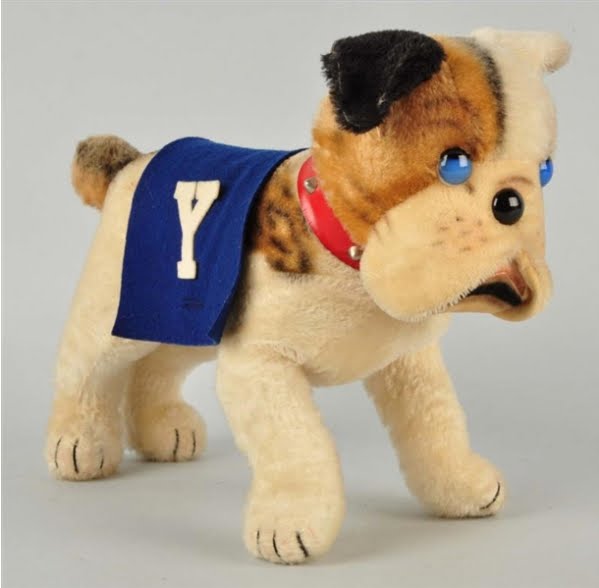
Is this jungle gem a diamond in the rough? Well, as always, something is worth what someone will pay for it. These marvelous mascots come on the secondary market quite infrequently, so "comps" are hard to come by. However, in June 2016, a standing Yale Bulldog illustrated along with the standing Princeton Tiger in the 1951 F.A.O. Schwarz catalog sold at auction here in the US. Estimated at $600-1,200, it realized $900.  This "Handsome Dan" is pictured here on the left. 

Steiffgal hopes this discussion of Jacob's great tiger puts you on the prowl for some great Steiff finds in 2017! Happy New Year, dear readers!

Have a question about one of your Steiff treasures? Let's talk! Click here to learn more.

Wednesday, September 10, 2014

This Steiff Goat Is The Wheel-Deal Indeed!

Do Steiff goats float your boat? Well, they certainly do for Steiffgal! It is easy to fall for these charming farm friends who just seem to have a great sense of fun, energy, and humor. Check out this great goat on wheels and see what truly makes him the life of the barnyard!
 

There's no 'kid'ding around when it comes to this beautiful billy! Here we have Steiff's Nachzieh Ziege or pull toy goat. Goat is 12 cm high (head to toe) and 16 cm long, unjointed, and made from off white mohair. His back, tail, legs, and face are lightly airbrushed with brown detailing, making him truly an authentic farm friend. The lining of his ears and the underside of his pert tail are made from peach colored felt. He has black and green slit pupil eyes and a black hand embroidered nose and mouth. His tiny horns are made from wooden beads, and his snout is highlighted with a tiny bit of red accent. He rides upon a black metal framed carriage which is mounted on four red wooden eccentric wheels. He was produced in this size only (officially documented at 14 cm) from 1953 through 1957.
 

Collector's may recognize this baaaa-d boy as Steiff's "Zicky" the goat pattern. And, he does indeed have a small, colorful, named bear faced chest tag with the name "Zicky" imprinted in blue. Overall, standing Zicky was made from 1952 through 1972 in 10, 14, 22, 28, and 35 cm. A family of standing Zicky goats is pictured here on the left. Zicky was also produced in a somewhat rarer "lying" pattern in 10 and 14 cm from 1954 through 1956. The smaller lying version of Zicky is pictured below on the left.

It probably won't get your goat to learn that goats are a legacy design for Steiff. The first ones appeared as early as the late 1800's in felt. In addition to just regular standing models, early and prewar goats were produced as hanging toys, as woolen miniatures, as wooden pull toys, on wheels, as nodding animals, with tail moves head mechanisms, and with special voice boxes that were designed to sound like a real goat. 

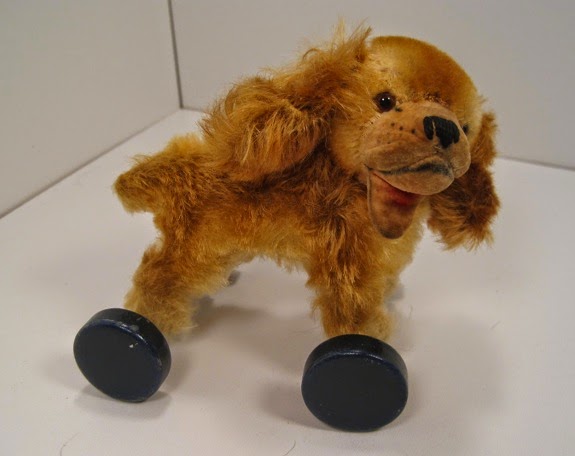
And yes, he is the wheel deal! Steiff has traditionally produced pull toy versions of many of its most popular items.  In the 1950's and 1960's, these were usually made from the smallest or next to smallest versions of the standard line items and on red, blue, or green wooden eccentric or regular style wheels. These petite treats included cats, farm animals like donkeys and ponies, rabbits, and ducks, and dogs. Steiff's tiny 10 cm Cockie Cocker Spaniel on eccentric wheels is pictured here on the left. Larger wooden wheeled treasures from this period included Fox Terriers and elephants.
 

Steiffgal hopes this discussion on Steiff's rolling Zicky helps to move along your day in a most positive way!

Have a question about one of your Steiff treasures? Let's talk! Click here to learn more.

Tuesday, June 17, 2014

Something Old, Something New, Something Borrowed, Something Blue At The Upcoming Withington Steiff Auction Event!

June - at least around these parts - has got to be one of the finest months of the year. It's not too hot, the flowers are in full bloom, and its the prime season for wonderful happenings, including lots of weddings and happy family times together. And, apparently, auctions as well! Steiffgal has just learned of a wonderful collection of Steiff treasures coming up for sale at Withington Auctions. This event will be held in Nashua, NH on Friday, June 20, 2014. In keeping with the theme of happy seasonal events - especially those involving brides and grooms - let's take a look at some of the highlights from this upcoming sale!

It would only be proper to start out this review with "SOMETHING OLD." Steiffgal's eye went immediately to lot S96, which can be found by clicking here. Of course, collectors will recognize these delightful doggies as a group of three Steiff Treff the Bloodhounds, who are also pictured here on the left. According to Withington's, they are cataloged as... "3 Steiff Treff Bloodhounds, Beige, brown glass eyes, dark brown yarn nose and paws. Large one is 12 ½” sitting; Medium one is 10” sitting and Medium one is standing on all fours. All swivel necks." 

Care to sniff out some additional details about this great design? Treff appeared in the Steiff line from 1928 through 1938. Models were produced in mohair, velvet, and an inexpensive alternative material called "coat plush" in sizes ranging from 7 to 50 cm overall. This design is famous for its long, floppy ears which are lightly stitched down; brown and black pupil eyes which are set in eye pockets; hand embroidered black noses; dainty muzzle “freckles"; and red facial highlights on their lips and under their eyes. Every Treff left the Giengen factory adorned with a large pastel-colored silk ribbon. These ribbons were meant to add a little lightness and color to Steiff's items; this mandate came directly from Richard Steiff around 1925. Treff was so popular that she was produced sitting, standing, on wheels, as a music box, and on a pin cushion during her time in the line. 

Now onto "SOMETHING NEW." Well, that's a bit challenging with this wonderful vintage collection, but something in LIKE NEW condition really caught Steiffgal's eye. Check out lot S126, which can be found by clicking here. The lot is simply cataloged as, "3 – Steiff mohair plush animals, “Sonny” rabbit 5”, “Hush Puppy” 11”, small standing Bear 5 ½." And yes, all three treasures in the lot are dear. But one is exceptional! That is the 11" Steiff Hush Puppy! 

Steiffgal certainly cannot keep quiet about this bashful Basset! Steiff's Hush Puppy examples are quite rare and desirable, and are based on the company's standard line Basset hounds that appeared in the line from 1961 through 1963 in 12, 14, and 22 cm. Steiff's standard line Bassets are sitting, head jointed, and made from mohair that has been carefully airbrushed in multiple shades of tan, brown, and black. Each has long, droopy ears; hand embroidered black noses; and realistic, dimensional soft jowls. The larger ones have extremely round, realistic-looking eyeballs that are embedded into their facial mask structure. The 12 cm model one has flatter, but no less realistic looking, eyes that seem to have a reflective quality to them. Standard line Steiff Bassets wear green collars and usually have "Basset" on their named chest tags.

But here's where it gets interesting. According to company records and literature, Steiff produced Hush Puppy branded 12 and 14 cm Basset hounds as premiums from 1970 through 1972; these were differentiated from the standard line of Basset hound items by a red collar and a special chest tag that had the “Hush Puppies” logo on it. However, this model on offer is 22 cm, and as far as Steiffgal can tell, does not appear in the standard Steiff reference books. A rare beast indeed!
 

Ok, now in keeping with our celebratory theme, it's time for "SOMETHING BORROWED." These two items were selected by Steiff for replication as they have always been of such great interest to collectors. Check out this ORIGINAL pair of Steiff's spiders, lot S68, by clicking here! According to the catalog, these are... "Lot of 2 - Steiff Spider, “Spidy”. 4 ½” length. Three beady eyes, eight wired legs, two antennas, two mouths, red/brown/green coloring on back and neck. Wool and cotton. Raised button, C.T. 2312,00, Steiff Spider, “Spidy”. 9” length. Five beady eyes, eight legs, four antennas. Beige mohair, red, green and brown coloring design on back and neck. Raised button on left leg."
 
It's certainly time to get a leg up on these great vintage spiders! This small and large sized Spidy pair are 12 and 22 cm respectively. Both have bead-like black glass eyes and are manufactured from light beige mohair, which is gloriously hand airbrushed in brown, red, and green. Small Spidy has legs and feelers made from gray pipe cleaners, while the larger size has thin mohair legs and feelers. Both large and small Spidy spiders were produced in 1960 and 1961 only, making them quite collectible. Spidy was produced at a time when the company was experimenting with different unconventional materials such as pipe cleaners, rubber, and plastic sheeting to create a series of "creepy crawlers." These included bats, salamanders, snails, and of course, these spiders. And, indeed Steiff did "borrow" a good idea from themselves, creating a replica set of a large and small Spidy in 1991 and 1992 in an edition size of 4,000 pieces.

And finally, it would not be a celebration without "SOMETHING BLUE." And there's not much that's more "true blue" than the US Navy and their mascot the goat! Check out lot S05, a pair of Steiff Navy Goats, by clicking here! According to the catalog, these are... "Steiff Navy Goat, 8” height (to his ear), 12” length. Beige, plush, leather horns and hoofs, green glass eyes. Navy felt blanket. Raised ear button. Cotton tag #1228.0. 1940s, Steiff Navy Goat, 5 ½” height (w/out horns). Grey mohair (long) on body. Mohair (short) on face and feet, short tail, green googly eyes, felt striped horns, black yarn nose, navy blanket with “N”. #7315.90, MINT"
 

Let's give a salute to these great goats and their interesting history. During the 1950's and very early 1960's, Steiff produced a number of mascots especially for the US market. Mascots were produced for several of top-tier schools, as well as the country's military training institutes - including the United States Naval Academy. The official launch of Steiff's mascot program began in 1951 with the production of two caricatured versions of the US Navy goat. Both were 28 cm; one was sitting and one was standing on all fours. This lot features this early standing version. Each was made from white mohair and had leather hooves and horns; green and black "squint" style eyes, a long beard, and wore a blue and gold felt blanket with a large "N" on the side. These goats were entirely original designs and were manufactured through 1959. Steiff also produced a smaller Navy goat in 15 and 25 cm from 1957 through 1960. This is the smaller goat in the lot. The smaller navy goat's pattern is quite similar to the one that would later be seen on the standard line item Rocky the Capricorn goat, who appeared in the line from 1963 through 1976. 

Steiffgal hopes this celebratory post has put you in the mood for love - Steiff auction love, that is!

Have a question about one of your Steiff treasures? Let's talk! Click here to learn more. 

Monday, April 22, 2013

Fantastic Steiff Finds at the Sturbridge Doll, Toy, Bear, and Holiday Show

It's been a pretty tough week in the Boston neighborhoods that are in close proximity to Steiffgal's home.  Thankfully things do seem to be returning to normal after a really high anxiety few days.  There is no better way, at least in Steiffgal's mind, to help improve one's mood than to surround themselves with good friends and Steiff.  And that's exactly what she did, by attending the annual Sturbridge Doll, Toy, Bear, and Holiday Show last Sunday in Sturbridge, Massachusetts.  The show, produced by Steiffgal's colleague Kim Kittredge, was a wonderful way to temporarily escape from Boston Marathon bombing madness... and enjoy some really remarkable Steiff treasures.  Here are a few great items that really caught Steiffgal's eye.

Does this goat float your boat?  Well, he certainly got Steiffgal's attention.  Here we have Steiff's Ziege or Goat.  He is five ways jointed and made from very long, white shaggy mohair.  His face is made from shorter white mohair, and is detailed with hand embroidered black nostrils and a simple line mouth.  His round pupil eyes are made from green and black glass, and his ears are lined in velvet.  Goat was produced in 22, 28, 35, and 43 cm from 1906 through 1927.

So what makes this goat "best of the barnyard?" Besides being really just marvelous, he also has two Steiff buttons in his left ear:  a large one (8mm) and a small one (4mm).  Both have the long trailing "f" style Steiff writing on them.  Some early Steiff items do have two buttons; this was sometimes done to indicate an item was an early prototype or model - but usually this was indicated by a button with the word "muster" on it, plus a regular Steiff button.  Steiffgal has never seen anything quite like this button configuration before.


So how much is that doggie in the window? Readers may recognize this tiny treasure as the smallest sized mohair version of Treff the bloodhound.  This feminine, droopy-eyed dog design was introduced to the world in 1928. The first Treff examples - like this 7 cm version -  were sitting, head jointed and made in light brown mohair or velvet. They all have long, floppy ears, brown and black pupil eyes set in eye pockets, hand embroidered black noses and dainty muzzle “freckles.” Every Treff left the Giengen factory adorned with a large pastel-colored silk ribbon. Early sitting Treffs were produced in 7, 10, 14, 17, 22, 28, 35, 43 and 50 centimeters.

Treff’s popularity certainly lived up to her blue-ribbon looks and personality. As a result, Steiff quickly expanded her role in the product line. She was soon manufactured in a standing position, as a large ride-on toy, a side-squeeze musical animal, a pin cushion, a dressed dog-doll toy, a child-sized purse, and a tail-turns-head model. It is interesting to note that she was also manufactured in a less-expensive coat-plush material from 1932 through 1937. Politics and the world economic situation during this time frame greatly limited both Steiff’s ability to obtain high-quality materials and its customer’s ability to afford such “luxuries.” Overall, Treff appeared in the Steiff catalog through 1938.

You've been a doll to read this far, so let's thank you with just that.  Here we have an approximately 16 inches tall or 43 cm Steiff doll.  She is made from felt and is fully jointed.  Her "typical" Steiff style face is center-seamed and is detailed with brilliant cobalt blue and black glass pupil eyes.  This sweet lady is wearing a peasant style removable dress and full skirted apron, as well as a bandana on her head.  It is Steiffgal's best guess, based on her size, styling, and removable clothing,  that she is the Brenz Farmer's Wife doll, which was made in 43 cm in 1912 and 50 cm from 1912 through 1921.

Well hello Dolly!  Given this model was only produced in this size for one year, this is indeed one fantastic find indeed!

Let's get a leg up on this final great show find.  This "tall drink of water" is Rabbiette, a design that Steiff produced from 1927 through 1932. She has a standard line mohair rabbit head, long, soft unjointed dangling limbs; and mohair hands and paws. Her body, arms, and legs are made from lilac colored velvet.  She has glass, very large black and brown pupil eyes and an embroidered nose and mouth.  When she was new, she had a bright, sherbet colored silk ribbon. 

Rabbiette is one of a series of long limbed lovelies in the Steiff catalog from 1927-1932. These "play and car dolls" included Bulliette, the bulldog, Fluffiette, the cat, Molliette, the puppy, and Cherrioette, the open mouthed puppy. These were based on the most popular named Steiff characters of the time; it is interesting that there was not a bear in this series.  Each play and car doll had the head of the character, mohair paws and feet, and dangling velvet limbs. Most were available in several bright, happy "jelly bean" colors and in 20, 30, and 43 cm, with the larger sizes having a squeaker. 

Steiffgal hopes these special finds have added some highlights - and happiness - to your day today.  (And be sure to mark your calendars for next year's Sturbridge Doll, Toy, Bear, and Holiday Show, which will be held on Sunday, April 27th 2014 at the Sturbridge Host Hotel, Sturbridge, Massachusetts.) 

Have a question about one of your Steiff treasures? Let's talk! Click here to learn more.

Friday, March 15, 2013

No Lying, Here Are Some Perfect Steiff Pint-Sized Easter Treats

What's the most important treat the Easter bunny can deliver... candy or a Steiff treasure?  Well, Steiffgal would be fibbing if she said she didn't really love sweets, almost as much as Steiff!  And both are essential in the perfect Easter basket.  Here are three tiny vintage "lying style" treats that are perfect for a Steiff lover's Easter basket... that also leave plenty of space for chocolate bunnies, jelly beans, and other seasonal goodies. 

Wouldn't ewe just love to curl up with this first featured friend?  Here we have a very sweet example of Steiff's relatively hard to find lying Lamm or lamb. This little handful is all of 10 cm, curled up, unjointed, and made from white wool plush. She has green and black glass slit pupil eyes and a simple hand embroidered nose and mouth. When she left the factory in Germany, she was detailed with a baby blue silk ribbon and a brass bell.  This pattern was made in 10 and 14 cm from 1954 through 1955 and then again in 1966 through 1972 in 25 cm.  It is interesting to note that on this particular example, her chest tag has the name "Lamby" on it, although she appears in the reference books simply as Lamb.

Our next barnyard basket buddy just may get your goat - with his cuteness, that is!  Here we have Steiff's Ziege or goat.  He is 10 cm, lying, and made from tan mohair that has been nicely highlighted with darker tan airbrushing on his body, legs, and face.  Goat's ears and the underside of his tail are made from peach colored felt.  His face is detailed with green and black slit pupil eyes, a black hand embroidered nose and mouth, and just a touch of red around his lips.  Goat retains his original colorful bear faced chest tag, salmon colored silk ribbon, and bitty brass bell.  This design was made in 10 and 14 cm from 1954 through 1956 only, and is considered relatively rare.  Like his sister Lamb discussed above, it is interesting to note that on this particular example, goat's chest tag has the name "Zicky" on it, although he appears in the reference books simply as Ziege.

Of course, rabbits are the perfect Easter accessory, so this last selection should put everyone "at ease."  Here we have Steiff’s 6 cm Lieg Hase, or Lying Rabbit. And by “lying,” Steiffgal means “outstretched,” not “dishonest.” This rabbit is reclining and made from mohair. She is head jointed and has quite a prominent “tail end.” Her ears are lined in pink velvet and she has a pink, hand-embroidered nose; black lips, and clear monofilament whiskers. Probably her most eye-catching feature is her outstanding black and white google-style peepers! This basking bunny was made in 6, 9, and 12 cm from 1953 through 1970.

Steiffgal hopes this discussion on little lying Steiff Easter-themed treasures has been a breath of spring air for you.

Have a question about one of your Steiff treasures? Let's talk! Click here to learn more. 

Friday, May 25, 2012

Collecting Steiff's Very Vintage Treasures

Although Steiff treasures can't talk themselves, they certainly inspire delightful conversations between enthusiasts from all over the world!  Steiffgal recently had the pleasure of meeting a collector who has a special passion for really old Steiff:  items from the turn of last century or before!  Come meet Jean and check out some of her absolutely museum quality antique Steiff finds!

Steiffgal:  Please tell us your name, where you are from, and your profession.

Jean:  My name is Jean Smith, and I live in the San Francisco Bay Area, in Berkeley, California. I’ve been at UC Berkeley for 25 years, and am currently the business manager for the communications office… never a dull moment, I can assure you!

Steiffgal:  Please tell us how you got interested in Steiff.

Jean:  When I was a child, my mother gave me a Steiff animal when I received good grades on my report card. I was never interested in dolls, but loved animals, so her ploy worked… I wound up with 20 or so Steiffs in my toy basket. Fortunately, even then, I knew they were special, so I always kept them, although I do remember pulling the chest tags, buttons and stock tags out… ouch!

Steiffgal:  Please tell us about the first piece of Steiff you remember getting.  Do you still have it?

Jean:  I recall that my first Steiff was “Slo” turtle, followed closely by a little fox, a woolie ladybug (sadly misplaced), an “Wittie” owl, a “Pieps” mouse, a “Nosy” rhino, a “Gaty” alligator, and an elephant. I still have them all!

Steiffgal:  Please tell us about your very, very old Steiff items.

Jean:  I think I started veering into the really old Steiff pieces back in the 1980s and 90s. My mom and I for several years attended the “Festival of Steiff” Show in Toledo, OH, where I saw wonderful pieces on display and for sale. We also haunted the old Marin City flea market every Sunday. Over the years, I found an 1898 Steiff skittles set, all elephants, with the original pink and green felt ball, a Steiff velvet cat pincushion which also had sewing guide lines (literally template lines) drawn on at the factory for a young girl to practice her needlework, and many other treasures.


Steiffgal:  What draws you to items from the turn of last century?

Jean:  I find the workmanship, imagination, and historical significance of these pieces to be fascinating. Being a bit of a history wonk, I love the idea of handling something that has survived two World Wars and over 100 years of handling. I also have a weakness for those little shoe-button eyes… can’t help myself when I see a shoe-button eye! 


Steiffgal:  What are your favorite three items in your collection from this time period? Why is each one a favorite?

Jean:  I’d have to say my favorite of the entire collection is the 1898 skittles set. They are pre-ear button era. The set’s just so clean, so complete and so wonderfully whimsical that I just adore it. When it came to me, I could see that each piece had been wrapped in old newspaper, and judging from a small scrap of paper, came from Britain. Just what these little guys had been doing for all this time was a mystery. They certainly were not played with. I often wonder… did some parent buy them for a child who died young? Did some adult fall in love with them and then put them away in a box? So far, the elephants are not talking. 
 

I also love a little felt giraffe on metal wheels. This came from a couple of wonderful California Steiff dealers, the Jensens. He’s also incredibly clean and was not ever played with. Imagine what this little guy has seen…the advent of the automobile, human flight, computers, etc. 


Little kitty pin cushion and Mr. Goat run a third-place tie for favorites. I adore pet goats, so it was just crazy the day I saw this guy on EBay. I agonized over his “Buy It Now” price and finally hit the button and he was mine. My mom’s Steiff goat is even earlier, on metal wheels, but she won’t part with him to keep mine company. 
 

Steiffgal: How do you display these precious items?

Jean:  All of my pre-1940s pieces are housing in a large glass-fronted case in my bedroom, arranged by species or character. I have a few very rare 1950s pieces in there as well, like the grasshopper, his frog buddy, and the Bayer Germ. 

I keep, in my bedroom, an old comforter cover, king sized… if there’s ever a fire, my dogs go out the window first and then I start frantically stuffing those old Steiffs in the comforter cover and make my escape!

Steiffgal: What is your dream/fantasy piece that you hope to add to your collection someday?

Jean:  There is a picture, in one of my Steiff books, of a Steiff character frog standing on his hind legs, holding an oar. I would LOVE to find one of those froggies. And of course I would find him at a garage sale and pay $5 for him. Well, I can dream. I would also love to find a Billy possum, but the last one I saw went on EBay for over $9,000. Maybe at that same garage sale…?

Steiffgal:  Many, many thanks for sharing these remarkable Steiff treasures with me and our wonderful readers! And good luck finding your frog... I am sure you will find him if he's out there!

Have a question about one of your Steiff treasures? Let's talk! Click here to learn more.

The teddy bear search engine