Showing posts with label kitten. Show all posts

Sunday, October 5, 2025

This Oversized Steiff Cat Is Kind Of A Big Deal!

Talk about a wow-wow-wow meow find! Steiffgal was handling a small collection for a new friend and came across this most unexpected item amongst a number of other button-in-ear treasures. According to the consigner, all of these precious childhood Steiff companions were purchased at F.A.O. Schwarz in the late 1950s and early 1960s. That information was good to know... but proved really invaluable in this particular case. Come learn more about this purr-fect Steiff rarity. 

What we have here is a supersized Steiff Fiffy cat. She is lying, head jointed, and made from white mohair that has been carefully hand-airbrushed with black stripes. Her tail wraps around her rear in a most realistic way. She has green and black slit pupil eyes, and a pink embroidered nose, mouth, and claws. Her pink ribbon appears to be original to her. Steiff's standard line Fiffy cat was produced from 1955-1962 in 12, 17, and 25 cm. This Fiffy retains her button, ear tag, chest tag, and red wooden bell shaped F.A.O. Schwarz tag as her Steiff IDs. 

Soooo... what's the big deal here? Well, this gal is UNUSUALLY large, and in fact is 30 cm. The largest one noted in the standard Steiff reference books is 25 cm. This example has a yellow ear tag which is numbered #2330.90. These digits translate to: 2=lying, 3=mohair, 30=size in cm, 9=special edition, and 0=normal or natural coloring. Given her dimensions, numbering, and presentation, it is Steiffgal's best thinking that this monumental Fiffy was produced as a special edition item for F.A.O. Schwarz in the mid 1950s to the early 1960s. 

It was not uncommon for Steiff to make tweaks to popular standard line patterns and present them as exclusives to F.A.O. Schwarz in the 1950s and 1960s. So there is precedence for this unusual find. These modifications included things like size, coloration, body position, materials, or other design details. For example, Steiff produced standing or lying Dally Dalmatians (the standard line versions were sitting), a sitting black and white Cockie (the standard line version was standing), and an open mouthed Biggie Beagle (the standard line version had a closed mouth) as dog specials for F.A.O. Schwarz. And for the felines, the list is shorter, but equally intriguing. It is suspected that a pair of 8 cm, legless, curled up baby cats that appeared in F.A.O. Schwarz's "Kittens in a Basket" offering were based on Steiff's beloved standing Tapsy kitten design. These happy handfuls are pictured here on the left. Like the fabulous Fiffy under discussion here, the one with the open eyes also has a faintly legible ".90" at the end of her article number.

Steiffgal hopes this discussion on this supersized Fiffy has really tickled your whiskers!

Have a question about one of your Steiff treasures? Let's talk! Click here to learn more.

Saturday, July 5, 2025

You Are Certain To Have A Plush Crush On This Amazing Steiff Prewar Rarity!

No need to sugar coat this amazing rarity! Here we have a wonderful example of Steiff's little known sitting "coat plush" cat. Have you ever seen a Steiff animal in this little known fabric? She is just about purr-fect in every way. 

This pretty kitty is 17 cm tall, sitting, unjointed, and made from grey and white coat plush.
Her back is covered in now faded black stripes. Her tail wraps around her rear, as often noted in Steiff's sitting cat patterns over the years. She has green and black pupil eyes and a pink painted nose and mouth. Her face is detailed with black stripes. Any whiskers have been loved off or lost to time. Her bow is not original to her, but her bell might be. She retains her button as her Steiff ID. This fantastic feline was made in 14, 17, 22, and 28 cm from 1931-1939 overall. 

Let's now take a look at how she is cataloged in Pfeiffer's 1892-1943 Sortiment. It says, "Rauhstoff, Grau/weiss, sitzend, billige Series." This translates to English as "Rough cloth, grey/white, sitting, cheap series." These descriptors are very telling about her construction and era of production in two key ways.

First, let's consider her material.
It is called rough cloth or coat plush. This is the first time that Steiffgal had handled an item made from this wartime era fabric, it is that unusual. More commonly noted substitute fabrics found on items produced just before and just after WWII include wool plush, artificial silk plush, cotton plush, and linen. From an aesthetic perspective, this material looks and feels a bit like flannel cloth - the fabric usually seen on nightclothes and plaid shirts! It has a very slightly fuzzy surface. Steiffgal suspects that the absence of this fabric appearing over a wide range Steiff prewar designs suggests that it was unpopular, hard to work with, and/or unavailable on a commercial level.

However, it is interesting to note that coat plush was used on two other cat models around the same time as this one. One, a standing version, was made in 14, 17, and 22 cm from 1931-1933. This same model was also produced on blue eccentric wooden wheels as a pull toy in 14, 17, and 22 cm from 1931-1932.

And second, let's noodle what Pfeiffer might mean by the words "cheap series."
It is unclear if this specifically means "cheap to manufacture" or "cheap (or cheaper) to purchase", or both. The early 1930s at Steiff were a time when the company was implementing numerous strategies to slash costs and create efficiencies throughout the entire organization. So the chronology of these words does make sense. This sitting cat was made at the same time as a number of the company's now legacy sitting cats, including Susi, the sweet tabby; Siamy, the Siamese cat; and Fluffy, the adorable blue tipped kitten. Clearly, these head jointed mohair cats were far more elegant in their materials, construction, and detailing than this basic, unjointed one. This "cheap series" cat also has simple painted facial features - not embroidered ones - which are far more economical to apply than hand embroidered ones.

All of these small tweaks in the aggregate certainly brought her costs down... but not her appeal or importance in the company's product development timeline in any way.

Steiffgal hopes this discussion on this prewar era coat plush rarity has warmed your heart and soul!

Have a question about one of your Steiff treasures? Let's talk! Click here to learn more.

Wednesday, June 18, 2025

Having A Ball With This Prewar Steiff Kitten Novelty

Without trying to be catty, Steiffgal suspects you've never seen a Steiff kitten just like this one! Check out this fancy feline who is simply having a ball - literally. This prewar novelty is totally the cat's meow!

This lovely lady is simply cataloged as "Wool Plush Cat." But her details are far more interesting! She measures 9 cm tall and 17 cm long, not including her tail. She is head jointed and in a lying position. She is made from tan wool plush with now faded black airbrushed striping. She has a pinch style squeaker in her torso. Kitty comes to life with felt backed ears, green and black glass pupil eyes set low on her face, and a pink hand embroidered nose and mouth. Her accessories include a satin bow, jingle bell, and a red, yellow, and blue woolen miniature pom pom ball which is held between her two front paws. This delightful rarity was made in 17, 22, and 28 cm (measured horizontally, not including the tail) from 1933-1942.

Kitty's design and presentation closely mirror Steiff's late prewar design aesthetic as well as business drivers and strategy. In the early 1930s, the realities of Germany's challenging geopolitical, social, and economic situation really began impacting every level of operations at Steiff. As such, the company started using less expensive and more readily available non-mohair fabrics as well as launching simplified designs to minimize materials and labor costs. Here to the left you can see this pretty kitty as she appeared in Steiff's 1938/1939 print catalog; you can click on the photo to make it bigger. 

Here's how this kitty's pattern checks many of those boxes. 

1.  She is made from wool plush, which is lovely and durable, but is less elegant than the company's signature mohair. Wool plush is considered a wartime era, substitute fabric and was often used in Steiff's production on items bookending WWII. 

2. Her face is nicely done, and very appealing and expressive, while her body is  very basic in form. Starting around 1931, Steiff began consolidating their design and manufacturing efforts on an item's head, while leaving the rest of the body as simple as possible. A great example of this is the company's line of dressed animal dolls of that era. They consisted of a lovely, detailed mohair head on a plain, generic linen or fabric body. 

3.  Kitty she has only one joint - a head joint. Jointing is very expensive and time consuming, and the fewer joints an item has, the more efficiently it can be made. 

4. And finally, her accessories are also quite telling. Her bow, bell, and simple woolen miniature pom pom are inexpensive to source and quick to attach to her, but really elevate her presentation and draw your eye forward to her finest feature, her head. Steiff debuted its general woolen miniature line, which was invented in part to address the realities of manufacturing in Germany in the 1930s, so it is interesting to see it being used here to compliment and upscale this design. 

Steiffgal hopes this discussion on this wool plush kitty has tickled your whiskers!

Have a question about one of your Steiff treasures? Let's talk! Click here to learn more.

Sunday, March 24, 2024

Would You Take A Tumble For This Early And Fantastic Feline Steiff Novelty?

This next Steiff inquiry comes in on little cat's feet. A new friend has reached out about a special family heirloom with provenance. Just what is this very early turn of last century treasure? And what makes it so fantastic from the collector's perspectives? Tom shares in part,

"I've attached photos of my Rolly Polly cat. I've had this since I was a child (50+ years ago)... It originally came from a relative who inherited it from their partner who came from a wealthy family from New England."


This guy is simply the cat's meow. But, given his form, he is "technically" a tumbler and not a roly-poly. Steiff's early 20th century roly-polys are all fabric and shaped sort of like an inverted balloon. Most are head and arm jointed, without legs. Examples include mohair cats (made in 16 and 23 cm from 1909 through 1919 overall); mohair Teddy bears (made in 16, 19, 23, and 29 cm from 1909 through 1916 overall)mohair rabbits (made in 23 cm from 1909 through 1918); and a series of mohair and felt dolls from the same basic time frame.

On the other hand, tumblers are full bodied and mounted to a very heavy, weighted wooden half circle base. As such, they wobble about like a weeble but always return to an upright position. Their bases are simply stained and are a natural wood color. Most tumblers measure 12 to 17 cm tall and are standing, sitting, or begging. Steiff did make a few oversized circus bear style tumblers in 35 and 43 cm through 1918 overall.

Tumblers debuted as early as 1894 and appeared in the general line with frequency through the late 19-teens. In the late 1930s, Steiff produced a series of three begging style tumblers on green or red painted wooden bases from 1936 through 1943 overall. Models included a velvet and mohair squirrel, a mohair Waldi Dachshund, and a mohair kitten holding a pom pom ball.

So back to Tom's cat.
 The photos suggest that he is made entirely from felt. Steiffgal suspects he is the company's Tumbling Cat, which appeared in the line in 17 cm (not including his base) from 1894 through 1919. The cat is solidly stuffed with excelsior and features black shoe button eyes and simple facial embroidery. It is hard to tell if he ever had a button, based on the photo of his face. It is entirely possible that he was manufactured pre-1904. Other early Steiff cat tumblers include a spotted velvet version made in 12 cm from 1904 through 1917 and a velvet striped version made in 17 cm from 1901 through 1919.

What makes this tumbler even more remarkable is its condition. He is made from felt, which tends to get grubby over time and attract insects. He was also designed as a toy, but it is clear he received little hands on play. Also of note is his tail. These are actually super thin, not terribly sturdy, and are attached to the animal's rear with just a few stitches. Often, these go missing or break off given their construction and natural aging. However, in this case, Tom's tumbler appears clean and damage free against all odds! Super score all around!

Steiffgal hopes this discussion on Steiff's early tumblers has got you rocking and rolling!

Have a question about one of your Steiff treasures? Let's talk! Click here to learn more.

Saturday, September 2, 2023

Going Out On A Limb Over This Unusual Steiff Prewar Novelty

Look what I found! That's exactly what a new friend from Florida said when she came across an interesting button-in-ear treasure at an estate sale local to her. But what exactly is this creature? Is it a merry mashup, or a loved to (almost) death standard line novelty? Valerie shares in part,

"This odd little fellow has a bear head; a caramel colored velvet body; a maybe muslin head, ears, hands, and feet; but also a 2" long tail! His skinny arms and legs are sewn/unjointed. His hands and feet have red embroidery threads roughly delineating his fingers and toes. All of his "fur" has been lost over time, except for very scant tufts of grey mohair inside his right ear. There's a dark metal button in his left ear, with Steiff in all capital letters with the tail of the second F extending to the "e." His nose and mouth are embroidered with faded pink thread. His eyes are sew-on green glass with black centers, and stick away from his face. I think the head is stuffed with excelsior, but the body, hands and feel softer.

Ancient bears had long tails, but I'm wondering if somebody sewed a Steiff bear head onto another beloved animal's body? The only thing that throws me off is that the material of the head, hands, feet and tail are the same. What do you think?"


Fingers crossed that Valerie can bear the news that her fabulous find is not a bear, but actually a cat!
This cute cat is named Fluffiette, and she was one of a series of long limbed lovelies featured in the Steiff catalog from 1927-1932. These "play and car dolls" included Bulliette the bulldog, Molliette the puppy, Rabbiette the rabbit, Cherrioette the open mouthed puppy, and this cat - named Fluffiette (after the company's popular and beloved 1920s era cat named Fluffy.) Each animal doll had the mohair or velvet head of the character, mohair or velvet paws and feet, and dangling velvet limbs. Most were available in several colors and in 20, 30, and 43 cm, with the larger sizes having a squeaker. Each left the factory suspended from an elastic cord and was detailed with an ivory ring for hanging and a decorative pom-pom. Fluffiette was produced in pink or orange velvet, which is completely consistent with Valerie's example. Here on the left you can see what Fluffiette looked like when new, the image is from Pfeiffer's 1892-1943 Sortiment.

It has been suggested that the design of this series was based on a similar line from the Chad Valley Toy Company of England called "Tango Toys." Steiff modified the design to fit their characters and manufacturing processes, and named the line "Charleston Animals," based on the Charleston dance crazy of the 1920’s, with its fast moving arm and leg movements. You can see Steiff's full line of Charleston Animals here on the left; this image appeared in the company's 1929 product catalog. Fluffiette is third in from the right, sandwiched between a standing Molliette and a standing Rabbiette. 

Steiffgal hopes this discussion on this Fluffiette Charleston Animal has put a little spring in your step today.

Have a question about one of your Steiff treasures? Let's talk! Click here to learn more.

Monday, May 22, 2023

Getting All Fussy Over This Lovely Steiff Gussy

This pretty kitty can only be described as the cat's meow! Steiff's early postwar production is beloved for its innovation, attention to detail, smaller scale, and the fact that items from this time frame are just so darn cute. Cats and dogs ruled the roost during this period, with this black and white beauty being a true stand out in the feline category. Come see what makes her so special from the design and product development perspectives.

Here we have Steiff's "Young Kitty Gussy." She is pictured here on the left and is 12 cm, standing, and head jointed. Her body and head are made from white mohair, while her tail is made from black mohair. She has black airbrushed highlights on her feet, rear end, sides, and around her black felt ears. Her face comes to life with a white velvet muzzle, piercing green glass slit pupil eyes, a pink hand embroidered nose and mouth, a spot of pink airbrushing on her lips, and clear monofilament whiskers. She left the factory wearing a pink ribbon. This Gussy's IDs include a raised script button, yellow ear tag, and a named, blue imprinted, bear faced chest tag.

Gussy was also produced in 17 cm. She is pictured here on the left. The larger version had two main design differences from the smaller version. Bigger Gussy featured velvet ears instead of felt ears, and had a pink velvet lined mouth instead of a closed mouth. Gussy was produced from 1952-1969 overall. In 1999-2000, Steiff produced a really sweet 17 cm Gussy replica, but did not call her Gussy. She was named 'Classic 1952 Cat', most likely a reference to her year of introduction. This special edition is pictured below and is wearing a blue ribbon.

Open mouth cats are pretty rare for Steiff. The only other mid-century examples that Steiffgal can think of here are the company's Siamy Siamese cats, which were made in 11, 15, and 23 cm from 1953-1954.

Gussy debuted in the line at a really critical time in the company's history. Gussy was introduced in the very early 1950s, so it is possible to find examples with US Zone tags and red imprinted chest tags. A few years after the conclusion of WWII, when the factory was up and running for toy making, Steiff started to produce a large number of smaller, beautifully detailed animals for export. These were brand new patterns, not carry-overs or "updated" prewar designs. Many of these were dogs and cats, as these have always been "best sellers" for the company. These new patterns helped build (and rebuild) Steiff’s business worldwide as soldiers returning home from the war in Europe often brought these “toys” back home as gifts and souvenirs of their time abroad. After all, they didn’t take up too much room in standard issue G.I. duffle bag—most even could fit in a coat pocket. These beloved and newly launched “pocket pets” included Dally the Dalmatian, Tessie the Schnauzer, Snobby the Poodle, and Gussy the Young Kitty, among others.

Steiffgal hopes this discussion on Young Kitty Gussy has tickled your whiskers!

Have a question about one of your Steiff treasures? Let's talk! Click here to learn more!

Thursday, February 3, 2022

This Marmalade Silk Plush Steiff Susi Kitten Is The Cat's Meow!

Orange you in the mood for something unexpected? Steiff's midcentury kittens are always the cat's meow, but this particular find is purr-fect in every way! Check out this fantastic feline and see what makes her so interesting from the design and historical perspectives.

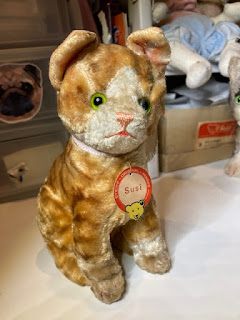
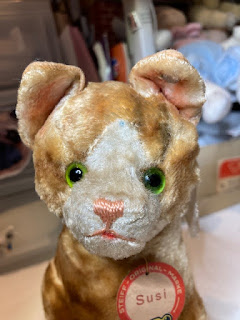
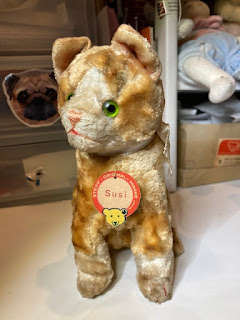
This smooth-as-silk sweetie is an unusual example of Steiff's beloved Susi cat design.
She is 16 cm tall, sitting, and head jointed. Susi is made from artificial silk plush. Her muzzle, front feet, and neck are white while her body, head, and tail are a marmalade color. The marmalade areas are hand airbrushed with dark orange or brown stripes. Her face comes to life with piercing green and black round pupil glass eyes, a pink hand embroidered nose and mouth, traces of a few clear monofilament whiskers, and a touch of pink paint to mark her lips. She has red embroidered claws on her front two paws. She retains her original pink bow. Her IDs include a large, watermelon style red imprinted chest tag, a short trailing f button, and traces of a light yellow or white ear tag.

Steiff's legacy Susi pattern has been a collector's favorite since her debut in 1936.
 It is rumored that this beloved design was named after a member of the Steiff family. Prewar, she was produced in grey and white mohair in 14, 17, 22, and 28 cm through 1943. In Pfeiffer's 1892-1943 Sortiment, she is described as "mohair plush, gray tabby, sitting, very pretty model, round shape." It is very unusual to find subjective or "flattering" descriptions in the Sortiment books as they are almost always entirely factual and literal. So Susi's design must have really caught someone's eye! Shortly after the conclusion of WWII, Steiff began manufacturing just a handful of their most popular prewar patterns - including a version of Susi. Her pattern was first produced in grey and white artificial silk plush in 14, 17, and 22 cm from 1948 to 1949, and then in mohair in 10, 12, 14, 17 and 22 cm from 1948 through 1978.

As far as Steiffgal can tell, this marmalade and white artificial silk plush full bodied Susi cat does not appear in any of the standard Steiff reference books.
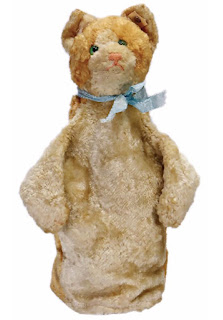
However, it is interesting to note that she resembles a most unusual marmalade and white artificial silk plush Steiff puppet sold at auction in 2019. 
This puppet, which is pictured here on the left, generated 20 bids and realized over $3,000! You can see that they share similar coloring and materials, as well as the same green and black pupil eyes, and other facial detailing. This puppet was described in the catalog as, "hand puppet, faux silk plush, cat, shiny button, rests of the ocher-colored paper sign, was produced during the war, good condition, nice colors." The photo is from Liveauctioneers.com.

So, what's the story with this very pretty, albeit uncatalogued kitty?
Here are a few ideas. It is entirely possible that she is a variation of the grey and white artificial silk plush version from the late 1940s. Her IDs align perfectly to that time frame. Given her stunning but unconventional hue and era of manufacture, she may have been produced as a sample of a design that never went into commercial scale production; was made from the only fabrics available at the time; or perhaps was designed and produced as an item for sale at the PX stores where American soldiers shopped immediately post WWII. However, only she knows for sure!

Steiffgal hopes this discussion on this happily hued Steiff Susi has tickled your whiskers, in the best possible way.

Have a question about one of your Steiff treasures? Let's talk! Click here to learn more.

Friday, October 8, 2021

The Eyes Have It With This Adorable Prewar Steiff Kitten

Looking for a little something to tickle your whiskers this fine fall day? Then check out this short but sweet note from a new friend. Jenny needs help identifying a precious pet. Could it be made by Steiff? She shares,

"I was wondering if you could help me identify an old possibly Steiff cat... It feels like wool and stuffed with wood. Thanks!"


What a pretty kitty! From the looks of him, Jenny's kitten looks to be sitting, probably head jointed, and made from wool plush, not mohair. Wool plush has a more fluid, continuous look and feel to it, while mohair tends to have more of a prickly "hooked rug" appearance where the fabric backing meets up with the surface fibers. The fact that he is "stuffed with wood" is consistent with his stuffing being made from excelsior. Other distinctive features of this example include traces of airbrushed highlighting on its body, tiny pink claws, clear monofilament whiskers on his nose and forehead, a tail that wraps gently around his backside, a pink hand embroidered nose and mouth, and piercing teal and black slit style pupil eyes. His size is noted at 6.5 inches tall, or nearly 17 cm tall. 

All of those factors help to cat-alyze his likely identification.
It is possible that Jenny's kitty is a rare and well loved example of the company's seldom seen prewar sitting wool plush cat. This appealing pattern was made in 10, 14, 17, 22, and 28 cm from 1929 through 1933 overall. All of these fancy felines left the factory wearing a large silken ribbon. You can see this wool plush rarity pictured here on the left, the photo is from Pfeiffer's 1892-1943 Sortiment. You can't help but notice the basic resemblance of this wool plush cat pattern to the company's most beloved sitting Susi cat design. She was produced prewar in 14, 17, 22 and 28 cm from 1936 through 1943, and then again postwar from 1948 through 1978 in 10, 12, 14, 17 and 22 cm
 
The timing of all of this is quite interesting.
The cat under review today was made at a critical time point in the company's history. Germany entered a period of economic depression and widespread unemployment in 1929 while growing anti-German sentiment crippled Steiff's export markets. These realities triggered a number of fundamental product design, production, and distribution changes at Steiff. One very noteworthy revision was the increased use of substitute fabrics in manufacturing. As traditional toy making materials became more expensive and more challenging to source, the company started to look at alternative fabrics to use in place of mohair. This may explain why this cat debuted in wool plush - a less expensive and readily available fabric - exactly at this time. 

Steiffgal hopes this discussion of this prewar cat has added a purr-fectly pleasant paws to your day.

Have a question about one of your Steiff treasures? Let's talk! Click here to learn more!

Saturday, August 28, 2021

This Pretty, Prewar, And Purple Steiff Princess Rains Supreme!!

WARNING! You are about to get all out joint over today's blog special guest!
This pretty kitty has just about everything going for her, including her looks, color, era, and "secret skill." Check out this fine feline and see what makes her so fabulous from the design and collector's perspective. 

This (now) purple kitten rains supreme. Here we have Steiff's fully jointed "Kitty." She is 15 cm tall and 21cm wide, not including her impressive tail. She is made from blue/black tipped mohair that has faded overall and evenly to a delightful, dark purple hue. Her underbelly, ears, muzzle, feet, and the tip of her tail are made from white mohair. Her face comes to life with a pink hand embroidered nose and mouth and teal green and black slit pupil eyes. Kitty was produced in 15, 18, 21, and 23 cm from 1931-1935. This example retains her long trailing "f" button as her Steiff ID. 

But wait, there's more!
Kitty's long tail is functional as well as aesthetic. This model is actually a tail turns head model, meaning that when her tail is rotated in a circle, her head follows in tandem. This technology was patented by the Steiff company in the early 1930s and basically consists a system that connects the head and the tail through a series of internal metal connectors and joints. 

Head jointed animals were an important part of the Steiff line in the early 1930s. Over time, about 25 different tail turns head models were produced through the very early 1940s. For the most part, these were based on the best selling standard line patterns of the time and included cats, dogs, rabbits, penguins, goats, and lambs, and even Mickey Mouse, among others. However, as far as Steiffgal can tell, this Kitty was one of the few tail moves head items that was only made as a tail moves head animal and not produced in any other form. It is interesting to note that she is neither pictured or mentioned in Steiff's 1931 novelty catalog where many of the other tail moves head animals debuted. 

Now, let's use some colorful language to describe her hue.
Today, Kitty is a marvelous shade of deep purple. But she did not start out life that way. According to Pfeiffer's 1892-1943 Steiff Sortiment, this model was produced in "blue/black tipped" mohair. But it has clearly mellowed to a pretty purple color over time. Another wonderful novelty produced with "blue/black" mohair at about the same time as Kitty was Steiff's King Peng penguin. You can see and example of a King Peng here on the left, the photo is from Christies. Today, when you find a King Peng, often his once blue/black mohair has become a similar purple color as Kitty's. As such, Steiffgal suspects that Steiff's 1930-era blue/black mohair was produced with a dye or dyes that oxidized or somehow had a chemical reaction with air or moisture over time. If this color change was due to something simple like direct sunlight, the change would not be so even or so consistent.

Steiffgal hopes that this discussion on this pretty purple princess has crowned your day.

Have a question about one of your Steiff treasures? Let's talk! Click here to learn more.

Saturday, August 7, 2021

This Rare Midcentury Steiff Cat Is Certain To Tickle Your Whiskers!

Here's a sweet Steiff rarity that walked in - and quickly walked out - on little cat's feet! This early postwar kitten just appeared in the line for a handful of years in the early 1950s, and has seldom made an appearance on the secondary market or in images since then. Check out this fabulous feline and see what makes her so interesting from the design and product development perspectives. 

This leisurely lovely is simply cataloged as "Cat." She is lying, head jointed, and measures c. 27 cm wide and c. 14 cm tall. She is made from very long, soft mohair which has some grey airbrushed highlights to it in all the right cat places. She has red hand embroidered claws on each foot. Her face comes to life with pert felt lined ears, a shorter mohair muzzle area, green and black slit pupil eyes, a pink hand embroidered nose and mouth, and clear monofilament whiskers. She retains her now faded blue silken ribbon. Her squeaker works, sometimes. As for IDs, she has her script style Steiff button, traces of her yellow ear tag, and her US Zone tag. This rarity was made in this size only from 1952-1953, technically in 22 cm. She has a lovely, old fashioned look to her. 

According to the Sortiment books, her article number is 2322,1. This translates to: 2=lying, 3=mohair, 22=22 cm, and ,1=squeaker... so everything aligns here!

A picture is worth a thousand words, and here is one of the very few photos Steiffgal could find in regards to this cat. Here on the left, you can see page 5 from Steiff's "Neuheiten 52" or "New Hits for 1952" catalog. Please click on the photo to make it bigger. Cat is pictured among Steiff's now legacy early wool plush Snobby poodles, a 17 cm wool plush camel, and a pair of Gussy cats. As the title of the catalog suggests, all of these specific items "debuted" in 1952. It is interesting to note that several of these newbies are made in wool plush, a substitute material mostly used just before and just after World War II. It is possible that in 1952, both the mohair supply and the ability to manufacture this premier toy making fabric were still not back to full capacity. Perhaps Steiff did what they have always done best in adverse situations - make lemonade out of lemons. In this case, they produced a number of wool plush items that really "popped" in this distinctive, readily available fabric. 

Now back to this pretty kitty. Why did she disappear in just a two year timeframe? It is interesting to note that in 1955, Steiff introduced their beloved lying "Fiffy" cat. This little love would go on to be produced in 12, 17, and 25 cm though 1962. Fiffy was head jointed and made from white mohair that was hand-airbrushed with black stripes. Like the cat under discussion here today, her little tail wrapped around her rear, and she came to life with green and black slit pupil eyes, a pink embroidered nose, mouth, claws, and clear monofilament whiskers. It is Steiffgal's best guess that Fiffy became Steiff's midcentury lying cat of choice based on a few factors. It is possible that Fiffy was faster and easier to manufacture, required less expensive materials, and had a more "updated," modern aesthetic than did the company's 1952-1953 lying cat. 

Steiffgal hopes this story about this rare mid-century cat really tickled your whiskers. 

Have a question about one of your Steiff treasures? Let's talk! Click here to learn more!

Saturday, June 5, 2021

Check Out This Purr-fectly Lovely, Time Traveling Steiff Cat!

There's no need for a fluff factor to describe how lovely this sweet kitten really is!
Cats have been a key part of Steiff's offering since the very beginning, and have evolved in their presentation and construction over time. Just a handful of cat designs bridge the company's pre- and postwar production. This excellent example just squeezes into that elite category.

Here's a tip: this darling cat is going to steal your heart! What we have here is a 14 cm version of Steiff's Fluffy cat. Fluffy is sitting, head jointed, and made in part from 
blueish/lilac tipped mohair - which is just spectacular. Her little tail wraps sweetly around her body. Fluffy's face is detailed with large deep turquoise green and black pupil eyes, a simple hand embroidered pink nose and mouth, and clear monofilament whiskers. Her claws are indicted by pink paint, and she retains her original pink silken ribbon.

And just what makes her such a time traveler? For the most part, Fluffy is usually considered to be a legacy prewar production item. Her childlike proportions and colorful presentation (and personality!) all reflect the aesthetics of the time she was born, the "roaring '20s". Fluffy appeared in 7, 10, 14, 17, 22, 25, 30, 35, and 43 from 1926-1943 overall. However, this particular model IDs include traces of a white ear tag, a raised script button, a named, red imprinted chest tag, and a US Zone tag, suggesting that she left the factory in Giengen in the very early 1950s.

Well, it turns out this pattern also tiptoed its way into Steiff's postwar production on little cat's feet. Sitting, head jointed Fluffy in the prewar tipped bluish lilac mohair pattern was produced in 14, 17, and 22 cm from 1949 through 1950! The branding on this sweet girl really does align perfectly to this manufacturing timeframe.

Given her popularity, it is curious to think about why her production ended midcentury. This might have to do with her distinctive, signature material - a blueish/lilac tipped mohair. This distinctively old fashioned looking fabric may not have been produced in sufficient quantities or just "timed out" in popularity in the early 1950s. For the most part, Steiff rolled out a huge number of brand new, or updated dog, cat, bear, and animal patterns starting in the 1950s, perhaps to re-launch and re-invigorate its brand post war. Perhaps Steiff felt Fluffy's presentation was "too dated" for the midcentury marketplace which was focused on the space race, technology, television, and rock and roll music. In terms of sitting cats, Fluffy's design was slowly replaced by Susi, another favorite design that spanned the pre- and postwar periods. Susi was a line standard through 1978. 

Steiffgal hopes this discussion on this midcentury cat has been as close to purr-fect as possible.

Have a question about one of your Steiff treasures? Let's talk! Click here to learn more!

Tuesday, June 23, 2020

This Steiff First Feline Is Of Presidential Caliber

Like many felines, the stories associated with Steiff's fabulous and legacy arched-backed black Tom Cats seem to have nine lives. And here's another one that Steiffgal has just discovered!

Look what just snuck in on little cat's feet. While doing some research for an unrelated Steiff project, Steiffgal came across this very interesting blurb in the Cieslik's Button In Ear The History of the Teddy Bear and His Friends reference book. She was looking up information on tea cozies, and the book pictures a black Tom Cat on one of these kitchen-helpers. In addition, the copy describing the photo notes... "This Tom Cat was especially popular at Halloween time in the USA and was also in demand as a souvenir item, as "Blackie the White House Mascot, c. 1924." The picture from Cieslik's book is pictured here on the left. 

This was the first Steiffgal had ever heard of Blackie, so she did a little research. Most people are familiar with US Presidents having a "First Dog" pet as part of their administration family. For example, LBJ invited his famous beagle pair "Him and Her" to many official White House affairs and happenings. But it turns out that in 1924, there was a "First Cat," or actually a pair of First Cats, belonging to President Calvin Coolidge and his wife. According to the Oct. 22, 1923 edition of the New York Tribune, these two pretty kitties made their debut as follows:

“THE NEWEST ARRIVALS AT THE WHITE HOUSE: Introducing Blackie & Tige, two friendly kittens recently received by the President and Mrs. Coolidge. Peter Pan and Laddie Buck, the President’s wire-haired terrier and Airedale, respectively, have refused to be quoted concerning the latest additions to the White House zoo.” This 1923 picture from the story is from the Library of Congress.

So how does all of this fit into Steiff's product development and design history? Purrr-fectly, actually. The original Tom Cat was produced in both black and white velvet. Both versions were very skinny, standing on all fours, unjointed, and had arched backs and open mouths. They all left the factory in Giengen, Germany wearing a silk ribbon and bell. Black Tom cats were produced in 10, 14, and 17 cm from 1904 through 1918. White Tom cats were produced in 14 and 17 cm for three years only - from 1906 through 1908 - and are exceptionally rare. You can see one of these very early velvet Tom Cats here on the left, he dates from around 1905 or 1906.

It is interesting to note that there was a five year gap in black Tom Cat production, with the final ones leaving the Giengen factory in the late 19-teens. Then, all of a sudden, this beloved pattern re-emerged in 1923 - just as Blackie here in the US was making headlines.  Like his older brother, Steiff's 1920s-era black Tom Cat also was standing and unjointed. He was produced in 8, 10, 14, 17, 22, and 28 cm through 1943; the 8 and 10 cm sizes were made from black velvet while the 14 cm and larger versions were made from mohair. All sizes had prominent green and black glass eyes. Unlike the original super skinny Tom Cat, design, these were all a little more robust in appearance, had closed mouths, and bushy mohair tails regardless of sizes. These design updates reflect the general mid-1920s Steiff aesthetic of "fluffy, fat, and feminine." You can see one of these 1920-era black Tom Cats here on the left, he dates from about 1923 through 1935. 

Given Steiff has always looked to headline making news for product development inspiration, Steiffgal suspects the grand second debut of its black Tom cat pattern in 1923 was no coincidence at all.

Steiffgal hopes this amazing and little known Steiff cat tale has tickled your whiskers today. 

Have a question about one of your Steiff treasures? Let's talk! Click here to learn more. 

Tuesday, May 26, 2020

Mark Your Calendars For This Can't Miss June, 2020 Steiff Auction!

How exciting... a major event has just been announced for June! And no, it’s not a royal wedding - but everyone is invited to attend, and fascinators and white gloves are appropriate. It's been SOOOO long since a large Steiff collection has come to auction here in the USA, but that wait is over. Potter & Potter Auctions of Chicago, IL just announced its Eclectible Collectible Auction on June 20, 2020. It includes over 120 lots of neat Steiff treats and treasures, including a ton of prototypes, one-of-a-kinds, hand samples, and unproduced items. In honor of wedding season, here are four lots that caught Steiffgal's eye to the theme of "something old, something new, something borrowed, and something blue."

What's old is new again with lot #29, a pre-production sample of Steiff's "Paper Teddy Bear" replica from 1919. Its auction cataloging reads, "Steiff Club 2010 Teddy Bear, a pre-production example with “Not for Sale” text on verso of tag. Chest tag. 12”. This fully jointed and very appealing example has all IDs, including its black and white "sample" ear tag. This Ted is estimated at $80-150. 

There is so much to love about this "oldie." His IDs, size, and classic presentation are great, and he would fit in perfectly with a new or vintage Steiff, bear, or toy collection. His history is also fascinating. In order to continue soft toy production immediately after WWI, the Steiff company was forced to come up with some alternative fabrics as felt and mohair were not readily available on a commercial scale. Given the abundance of wood in the area, the company started producing things like building sets and furniture for children. Steiff also found a way to produce a tweed-like material from local natural products, including nettles. This engineered fabric was called "paper plush." Paper plush items appeared in the line from 1919 through 1921, and included popular models of the company's standard line bears, dogs, cats, and rabbits. This Ted is a replica of bears from this era. Given there is about a billion to one chance you would find an original c. 1919 paper plush animal, this bear is a sure bet for your collection. 

The "new" kid on the block here is lot #43, a petite pink bear made as an exclusive for the annual "Steiff Sommer" event of 2015. Its cataloging reads, "Steiff Summer 2015 Limited Edition Mini Teddy Bear. Number 19 of 135 bears. Pink and light brown mohair. Black ribbon tie. White tag. 6”. This happy handful is in like new condition and has all of her original IDs. She is estimated at $50-80.

This cutie is a perfect choice for both doll and bear folks. Imagine "Pinky" in the arms of your favorite doll or Ted! How totally adorable would that be?! Her color and presentation are really charming. Her tiny edition size is hugely desirable. And much about her is "debut," at least as far as Steiffgal can tell - most notably, her amazing and almost psychedelic mohair!

It's ok to borrow, especially when the results get everyone feline groovy. A hands down choice for this highlight category is lot #83, a pair of Steiff cats. Their cataloging reads, "Pair of Steiff Cats. Including Kitty limited edition (musical), yellow tag, without EAN or limitation on verso (for 2010 edition), length 12”; and Bagpuss Danbury Mint (yellow tag, EAN 662294), length 13”. The pair is conservatively estimated at $125-225.

Who would not want to add these kittens to their meow mix? It is Steiffgal's best guess that the lovely and almost life-sized musical Kitty is an overproduction of the company's grey and white alpaca cat made in an edition size of 2010 in 2010. When wound up, she plays music and moves the pom pom ball she holds between her two front paws. This may have been originally purchased at the annual tent sale held on the grounds of Steiff in Germany every summer. The Bagpuss is a SUPER COOL rarity that is based on a beloved British TV character cat of the same name. He is made from pink stenciled alpaca which apparently was very difficult to produce, so few actually were distributed. A VERY long time ago, Steiffgal made a video about Steiff's Bagpuss, and all of that information presented is still true today. Take a look here if you can!


And finally, it's time to sing the blues over this last Steiff auction highlight. Here we have lot #13, a pre-production sample of the universally beloved Peter Rabbit. This begging beauty is cataloged as, "Steiff Peter Rabbit Pre-Production Sample. A sample/prototype example of the replica of the 1904 Peter Rabbit, marked “Not for Sale” on ear tag, leather slippers marked on underside: “Regstd. No. 423888/Made in Germany,” height 9 ½”. Peter is estimated at $80-125.

There's not a hare out of place with this wah-hoo good bunny. Most Steiff collectors (including Steiffgal) have an original turn-of-last century Peter Rabbit on their bucket list. Given their absolute rarity and costs... this example just may be a good fix. This toy, of course, is based on English author Beatrix Potter's Peter Rabbit book which debuted in 1902. This tail - oops, tale - became a worldwide sensation due to its simple story and beautiful illustrations. Ms. Potter created a little Peter Rabbit doll and registered it in the London patent office. Despite numerous attempts, she could not find a manufacturer in England to produce her toy. Steiff got wind of this, and soon became the producer of the "official" Peter Rabbit doll for the English market. Steiff's Peter Rabbit was based on an existing begging rabbit pattern and appeared in the line in a number of sizes through about 1919. All version wore a felt topcoat and slippers.

Steiffgal hopes this discussion on some of Potter's June 20, 2020 Steiff sale highlights has been almost exciting as a live auction event! You can learn more about this sale and check out the entire catalog by clicking here.

Have a question about one of your Steiff treasures? Let's talk! Click here to learn more.

Sunday, May 3, 2020

This Steifff Woolen Miniature Kitten is Purr-Fect In Every Way

How can something so amazingly tiny be so amazingly cute? Well, size really defies in the case of this very appealing Steiff woolen miniature cat. Steiffgal's been hoping to add one of these fancy felines to her hug for awhile, so she was delighted when this one arrived on little cat's feet. Take a look at this little darling and just try NOT to fall in love with her. 

This happy handful is Steiff's 1970-era woolen miniature cat. She is 6 cm and head jointed. Cat is constructed from grey and white woolen yarn; her body is made from longer threads while her head is made from shorter threads. She has tiny triangular grey felt ears. Her face comes to life with green and black slit pupil eyes, a touch of pink to indicate her mouth, and clear monofilament whiskers. Her pink bow is original to her. This basic design was produced in white; white, grey, black and brown; white and black; white and orange brown; and white and grey in 4 and 6 cm from 1970-1974.

In addition to her Steiff button and eartag, this pretty kitty also has a naturally colored wooden tag indicating she was originally purchased at F.A.O. Schwarz. This tag has the identical gold F.A.O. Schwarz bell logo on both sides; its cord is a piece of silky yellow floss. The bell first appeared in the company's advertising and in the stores in 1880. It is based on a similar bell that was carved into the Schwarz family's dining room table at their home in Greenwich, CT as a symbol of success and prosperity. Most of these F.A.O. Schwarz wooden bell tags are red, but Steiffgal has seen a few of these naturally colored ones on items from the 1970s, including Steiff's legacy "mask" style Teddy bears. 

Here on the left, you can see the original Steiff catalog page from 1972 promoting their range of woolen miniature friends. If you click on it, you can make it bigger. The cats are featured on the top left. According to the description, the 4 cm versions cost 3.10 marks and the 6 cm versions cost 4.50 marks. Another woolen miniature cat - a 5 cm sitting version with a mohair tail that appeared in the line from 1954-1978 - cost 4.25 marks. Using an inflation calculator, in 2020 dollars, that means that the 5 cm sitting cat cost the equivalent of $14.63, the 4 cm lying cat cost the equivalent $10.68, and the 6 cm lying cat, the one under discussion here, cost the equivalent of $15.50.

Steiffgal hopes this discussion on this relatively rare Steiff woolen miniature cat has given you the warm fuzzies.

Have a question about one of your Steiff treasures? Let's talk! Click here to learn more!
The teddy bear search engine