Monday, July 6, 2026
Bibbed Beauties: Steiff's Rare And Wonderful White Zotty Bears
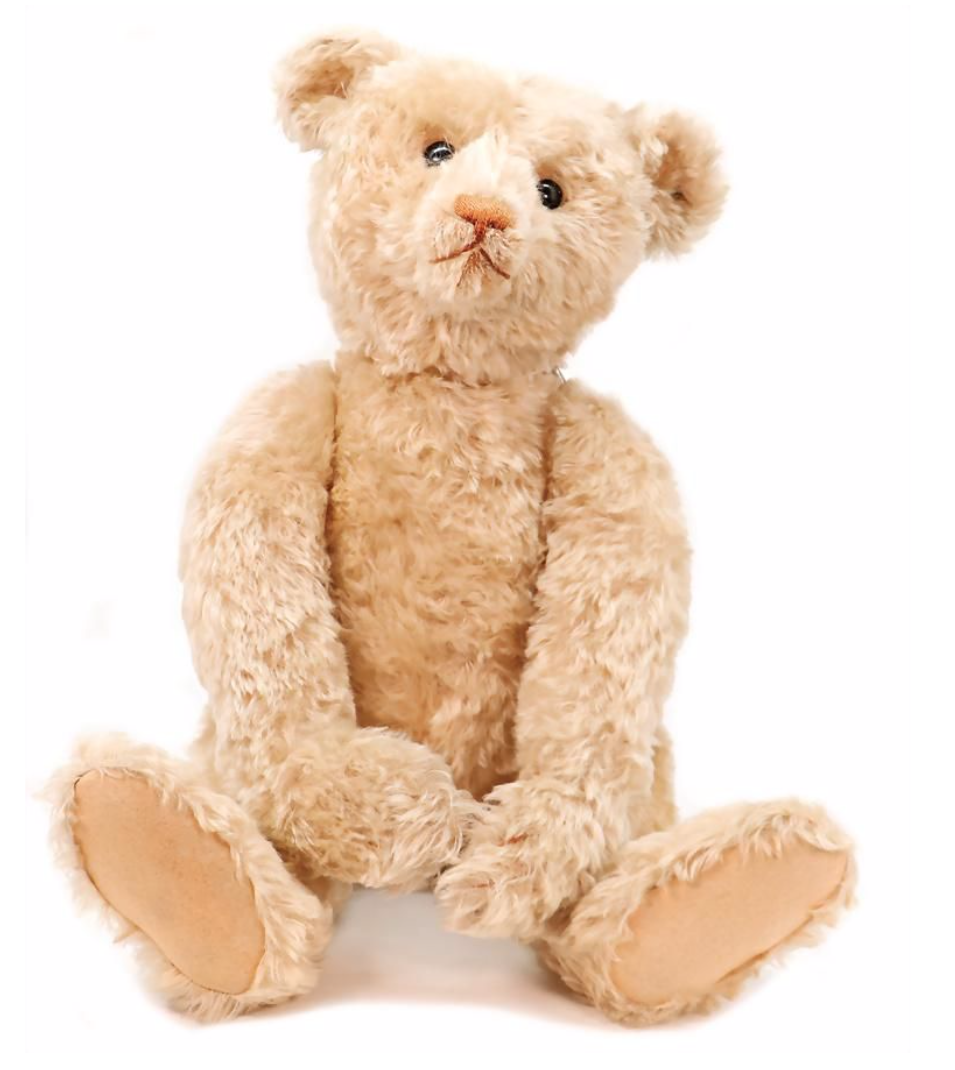
“Zotty” is from the German word “zottel,” which means “shaggy," and as such, is the perfect name for this signature Steiff bear. He was designed as a breath of fresh air after the factory reopened for toymaking business post WWII as his elements truly reflected the optimism and aesthetics of the 1950s. He was instantly popular, and many other toy companies introduced copycat Zotty bears as a result of his success. These companies would vary the pattern just enough not to infringe on the Steiff version.
Zotty’s legacy (and perhaps namesake) goes back over a century. In 1914, Steiff debuted their first “Zottlebaer” or “Shaggy Bear. ” He was in the line through 1927 and was known for his shaggy coat, sweet face, and soft texture.
Steiff's debut, midcentury Zotty bear was produced in 9 sizes ranging from 17 - 100 cm from 1951 through 1978. He was fully jointed and made from long shaggy caramel tipped mohair with an orange bib and a shorter mohair muzzle. His paw pads were made from felt. Earlier versions had glass pupil eyes, while later versions had plastic pupil eyes, for safety reason. Depending on size and era, Steiff sometimes backed the eyes in felt. Zotty featured an open, felt lined mouth, an embroidered nose, and distinctly toddler-like proportions. Zotty was created by Steiff designer Mr. Siegfried Zeller (1915-2000) around 1949-1950. His son, Rolland Zeller (1944-2008) also worked for Steiff and designed over 2,000 items over the course of his career there. You can see this great Steiff duo, along with an original caramel Zotty bear, in this photo on the left.
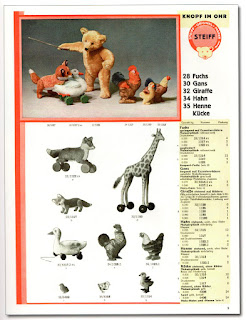
Given his supersonic rise in popularity, Steiff debuted a white version of Zotty in 1960. He was made in 28 or 35 cm. He had almost identical design details as his caramel tipped cousin, but was made from very shaggy white mohair. In Steiff's 1960 new releases catalog, he is pictured along with a Disney Perri squirrel and a mohair Nagy beaver who were also relatively new products in the line at that time. Both Perri and Nagy which would go on to appear in the catalog for decades. You can see this catalog page here in the photo on the left.
It is not clear why White Zotty was produced in so few sizes, relative to the standard line Zotty, or why he was discontinued just a year later in 1961. Traditionally, white mohair Steiff bears are quite popular and sell really well. It is possible that he just did not take off with customers, and/or the finances did not make sense. It is also possible that his white mohair was not available, or really expensive, or simply was challenging to work with. Whatever the reason - only he knows for sure!
Steiffgal hopes this discussion on the history of Steiff's white mohair Zotty bear has been a hair raising experience for you!
Sunday, September 1, 2024
Hands In The Air Over This Antique Steiff Felix The Cat Handpuppet
This Fe-line is none other than Felix the Cat in the form of a hand puppet. He is 20 cm tall and mostly made from black mohair. His face is made from white felt with a stitched mouth, big black button eyes, a dimensional black felt nose, and felt ears. He has a little red and black airbrushing on his mouth. His head is firmly stuffed with excelsior and his finger tube is made from cardboard. This puppet design was made from 1925-1926 in this size only.
So what is the history of this happy handful? In 1919, Pat Sullivan and Otto Messmer introduced their Felix the Cat movie series. By 1926, sensing that Felix would be a great fit for Steiff, Steiff's distribution partner in the USA - George Borgfeldt - asked Steiff to create a series of licensed Felix the Cat toys. Steiff was hesitant and didn't think the line would be a success. Nonetheless, Steiff did end up producing a full bodied 22 cm Felix from 1926-27, a 20 cm Felix hand puppet from 1925-26, and a 20 cm Record Felix from 1926-27. The doll didn't sell well, but the puppet and wheeled versions struck a chord with buyers at the time.
Today, Steiff's Felix the Cat novelties are few and far on the secondary market. Given their rarity, they often top the wish lists of Steiff collectors worldwide! The most recent Felix hand puppet sold at auction Steiffgal could find hammered for 1700 euro at Ladenburger Spielzeugauktion's Special Steiff Auction in 2018. In 2019, Morphy Auctions sold a full bodied Felix doll; he hammered for $4,000. And in 2010, Christie's sold a Record Felix in delightful condition for GBP 2,375. The photos of the full bodied and record Felix novelties are pictured here on the left; the images are from Morphy's and Christie's respectively.
Monday, June 10, 2024
The Tail Of Two Marvelous Steiff Midcentury Weasels
Two of the more unusual editions from this unofficial series have to be a pair of weasels. The first, Wiggy, was made from all white dralon. She had a white pipe cleaner style tail that was detailed with a black tip. She is shown here on the left, you can click on the image to enlarge it. The second was Waggy, who was made from white dralon that was airbrushed brown, and had a brown pipe cleaner tail. She is shown just below; please click on her picture for a more detailed view.
These marvelous mammals both were cataloged at 12 cm; they physically measured about 3 inches tall and 6 inches long. Both were standing on all fours and unjointed, with felt ears and feet. They came to life with black button eyes, a pink hand embroidered mouth and nose, and clear monofilament whiskers. Both were produced in this size only and for one year in 1962. Today, it is extremely rare to see a Wiggy or Waggy in very good or better condition on the secondary market; their dralon material tends to get dirty and ratty looking, and often times their pipe cleaner tails simply snap off with age and wear.
It is possible that both Wiggy and Waggy are Ermines, which is a woodland animal that lives across North America and Eurasia. Ermines have different coloration over the course of the year. In the warm weather, their coat is brown, with a whitish throat, chest, and belly. In climates with a very cold winter, the fur turns white, except for the black tail tip. In locations with moderately cold weather, their the fur becomes only partly white. So this pair may represent Steiff's take on a winter Ermine (Wiggy) and a summer Ermine (Waggy.)
It's interesting to note that Wiggy and Waggy may have "royal connections" as well. White Ermine fur was traditionally used to decorate the robes of kings and queens in Europe and was seen as a status symbol for the wealthy. Fast forward to today... these 60 years old oddities often play the aristocratic role as the crown jewels in the collections of vintage Steiff enthusiasts around the world.
Friday, May 24, 2024
This Steiff Teddy Bear From 1964 Is One Merry Mash-Up!
Talk about hiding in plain sight! Steiffgal was checking out the latest listings on eBay to see if she could find a hidden treasure. And lo and behold, the shopping gods aligned and this rarity appeared out of nowhere! He doesn't look like much - and could be easy to miss. Check out this merry mash-up of a bear and see what makes him so distinctive from the design and marketing perspectives.
Cosy Teddy is 28 cm, unjointed, and softly stuffed. His body shape and proportions are a bit like the company's childlike Lully baby bear. Cozy Teddy is made from white dralon. His paw pads are made from pinky-peach colored dralon. He has four brown dimensional felt claws on each of his paws. His face comes to life with smaller scaled black and white cartoon eyes and a hand embroidered brown nose and mouth. This pattern of facial stitching is similar to that seen on the company's postwar Original Teddy bears. He also has a little airbrushing around his peepers to give them some depth. When he left the factory, Cosy Teddy was decorated with a blue ribbon. This guy was produced in this size only in 1964. He retains his raised script button and bits of his yellow tag as his IDs. Given his washable construction, size, and simplicity, it is quite possible he was designed a hands on plaything for kids.
This bear has two key design elements that make him quite distinctive. First, he has wool felt claws, which is most unusual in the Steiff line. A few other bears from his mid-1960s era, including Zooby the zoo bear, Cosy Nauty the polar bear, and Zipper Nauty the PJ bag, also have this detailing... but the vast majority of Steiff's cubs from all eras have embroidered or painted claws. And second, he sports round black and white plastic cartoon eyes, which are somewhat too small for his face. This configuration is also an outlier in Steiff's bear production. The only other example with this style and scale of eyes Steiffgal can think of is the company's Cosy Bruni Collar bear; he was made from 1965-1966.
Steiff clearly had big plans for Cosy Teddy, as he was the "cover bear" for its 1964 "New Models" catalog. You can see that cover shot here on the left. Like Cosy Teddy, this four page catalog introduced a significant collection of new editions made from dralon materials. This publication is also very interesting because it debuted a number of items that were only produced for a year or so. Steiffgal refers to these now hard to find treasures as "One-derfuls" to note their single year appearance in the line. Cosy Teddy is one of these 1964 "One-derfuls"; others pictured in this brochure include Reinhold the Rhino, Loopy the Wolf, Zipper Cockie, and Sneba the Snowman puppet. Today, many of these rarities top enthusiasts' wish lists given how few were produced over a very short period of time.
Steiffgal hopes this discussion on Cosy Teddy and his discovery has added a soft spot to your day.
Monday, May 22, 2023
Getting All Fussy Over This Lovely Steiff Gussy
This pretty kitty can only be described as the cat's meow! Steiff's early postwar production is beloved for its innovation, attention to detail, smaller scale, and the fact that items from this time frame are just so darn cute. Cats and dogs ruled the roost during this period, with this black and white beauty being a true stand out in the feline category. Come see what makes her so special from the design and product development perspectives.
Here we have Steiff's "Young Kitty Gussy." She is pictured here on the left and is 12 cm, standing, and head jointed. Her body and head are made from white mohair, while her tail is made from black mohair. She has black airbrushed highlights on her feet, rear end, sides, and around her black felt ears. Her face comes to life with a white velvet muzzle, piercing green glass slit pupil eyes, a pink hand embroidered nose and mouth, a spot of pink airbrushing on her lips, and clear monofilament whiskers. She left the factory wearing a pink ribbon. This Gussy's IDs include a raised script button, yellow ear tag, and a named, blue imprinted, bear faced chest tag.
Gussy was also produced in 17 cm. She is pictured here on the left. The larger version had two main design differences from the smaller version. Bigger Gussy featured velvet ears instead of felt ears, and had a pink velvet lined mouth instead of a closed mouth. Gussy was produced from 1952-1969 overall. In 1999-2000, Steiff produced a really sweet 17 cm Gussy replica, but did not call her Gussy. She was named 'Classic 1952 Cat', most likely a reference to her year of introduction. This special edition is pictured below and is wearing a blue ribbon. Open mouth cats are pretty rare for Steiff. The only other mid-century examples that Steiffgal can think of here are the company's Siamy Siamese cats, which were made in 11, 15, and 23 cm from 1953-1954.
Gussy debuted in the line at a really critical time in the company's history. Gussy was introduced in the very early 1950s, so it is possible to find examples with US Zone tags and red imprinted chest tags. A few years after the conclusion of WWII, when the factory was up and running for toy making, Steiff started to produce a large number of smaller, beautifully detailed animals for export. These were brand new patterns, not carry-overs or "updated" prewar designs. Many of these were dogs and cats, as these have always been "best sellers" for the company. These new patterns helped build (and rebuild) Steiff’s business worldwide as soldiers returning home from the war in Europe often brought these “toys” back home as gifts and souvenirs of their time abroad. After all, they didn’t take up too much room in standard issue G.I. duffle bag—most even could fit in a coat pocket. These beloved and newly launched “pocket pets” included Dally the Dalmatian, Tessie the Schnauzer, Snobby the Poodle, and Gussy the Young Kitty, among others.
Steiffgal hopes this discussion on Young Kitty Gussy has tickled your whiskers!
Have a question about one of your Steiff treasures? Let's talk! Click here to learn more!
Monday, May 15, 2023
The Devil Is In The Details When It Comes To Steiff's Rare Postwar Exclusives!
Little differences can mean alot when it comes to the vintage Steiff collecting world. Check out this darling black and white Cocker Spaniel puppy. She has a familiar ring to her, right? But one detail elevates her from beloved everyday companion to best of show at Westminster! Read on to learn more.
Here we have a darling black and white mohair Cockie Cocker Spaniel. She is 12 cm tall, sitting and head jointed. Her body is made from white colored mohair which has lovely hand airbrushed black spots on her legs and body. Her long, floppy ears are made solid black mohair. Her face and muzzle are darling, with a distinctly childlike appearance. She comes to life with pert black and white plastic google eyes, a hand embroidered black nose, and a painted mouth. She appears to be pouting - or begging for a bite of whatever you are snacking on at the moment! She retains her original red collar, which closes with one very small, plain silver snap.
In this particular case, this FAO Schwarz black and white Cockie Cocker Spaniel is based on Steiff's legacy black and white mohair STANDING Cockie Cocker Spaniel. This adorable model was produced in 12, 19, and 29 cm from 1960-1976. This Cocker Spaniel exclusive also has the same face and general appearance as the company's charming felt bodied Cockie Nightcap animal. Steiff produced these fun novelties as cats, dogs, bears, foxes, and rabbits in 15 cm from 1969-1974. They were designed to hide a sweet, prize, or coin on the pillow of a child. You can see Nightcap Cockie and a few of her cousins in the image above; this page is from one of Steiff's c. 1969 product catalogs.
To wrap up this discussion, let's take a look at sitting Cockie's ear tag. Her article number is 3312,96. This translates to 3=sitting, 3=mohair, 12=12 cm tall, 9=display animal or special edition, and 6=black. That pretty much perfectly describes her!
Steiffgal hopes this discussion on this super rare and lovely Cocker Spaniel has added a beautiful highlight to your day.
Have a question about one of your Steiff treasures? Let's talk! Click here to learn more!
Saturday, April 22, 2023
Tag, You're It With This Rare Steiff Badger And Her Equally Fabulous Bonus ID
This happy handful is Steiff's Diggy badger. She is 10 cm tall, standing on all fours, unjointed, and made from tipped cream mohair on the top, white mohair on her head area, and black mohair on her bottom section. Her sides and face are beautifully airbrushed with tan and black highlights, giving her a most realistic look. Her tiny ears are made from mohair. She has black felt foot pads, round brown and black pupil eyes, and a simple black nose and mouth. Diggy was produced in 10 and 17 cm from 1963 through 1964 only, making her very rare on the secondary market.
Little Diggy and big Diggy are almost identical, except for one interesting detail. Big Diggy has four white felt triangular shaped claws on each of her limbs, while little Diggy has none. These finger and toe nails remind Steiffgal of those on another Steiff rarity of the same time, Zooby the bear.
In addition to her standard Steiff IDs, this particular example also has an additional tag stapled to her ear. It is a green linen tag with the word Steiff in cursive letters across the top, and the words Commonwealth of Pennsylvania Department of Labor and Industry in tiny letters encircling a crest with the number "55" on it. What's that all about?
- First, it is possible that the number "55" on the tag is Steiff's "official" registration number in the PA system, or it could mean something else.
- Second it is not clear who registered Steiff to distribute its products in PA in the early 1960s. It could have been the company itself, or one of its distributors at the time like Reeves International, or it could have been an independent store or business selling Steiff at the time in PA.
- And finally, it is difficult to tell whether this tag was put on Steiff's items intended for sale or distribution in PA in Giengen, before they were exported, or in PA, once they arrived in the states.
Thursday, September 29, 2022
Breakthrough Bear Surprises At Ladenburger Spielzeugauktion's Fall 2022 Event!
Auctions always deliver surprises, and that's one of the reasons many collectors love them! Ladenburger Spielzeugauktion's recent Steiff sale, held in the wee hours (at least on the East coast!) of Saturday, September 24th, 2022, produced some really outstanding results - especially on some "under the radar" items. Here are three that bubbled to the top, in the most delightful ways possible.
This bear was estimated a €2,500-€5,000, generated 70 bid, and hammered for a whopping €38,000!
This big beauty was certainly the package when it comes to all the things vintage Steiff enthusiasts adore. His white mohair, black eyes, and center seam facial construction checked all the boxes. He also retained his original Steiff button-in-ear, which only added to his appeal. And then of course was his adorable personality and presentation - classic, timeless, and just plain irresistible. It is interesting to note that this cub hammered almost twice that of a Happy Teddy bear (€20,000) or a fine rod bear (€20,000) also sold through this sale.
This next auction highlight is certain to bring a smile to your face. Here we have lot #3049, an impish, blonde mohair Steiff Dicky bear. He was cataloged in part as, "...with button, red cloth tag label, No. 5322,2, glass eyes, velvet paws, airbrush is partially a bit subtle visible, 34 cm, long snapped off arms, very expressive, mohair is a bit thin at minimally places, otherwise beautiful."
Dicky was estimated at €950-€1,900, generated 81 bits, and hammered for €14,500.
Dicky bears are among Steiff's most desirable prewar novelty cubs. Steiffgal suspects, but has no proof, that the pattern may have been named in honor of Richard Steiff. Dicky bears were produced at a challenging socio-economic period in Germany and designed with features which made them faster and more efficient to manufacture than Steiff's standard line Teddy bears. Steiff's marketing materials described them as, "A new, improved, and less expensive Steiff Teddy Bear. Attractive design, newly formed head, strong squeeze growler, soft filling, blond or white mohair with painted pads, movable head and joints, famous workmanship." This fine example had a great attitude, retained its premier and fully legible red ear tag and Steiff button... and clearly radiated an "X" factor which spoke to many bidders!
And three's a charm with lot #3037, a terrific Ted from the mid 1920s to early 1930s timeframe. He was cataloged as, "...exceptional, pre-war era, with button, block letters, faded, red cloth tag label, glass eyes, bright embroidering at snout, white mohair, exceptional size, 75 cm, clearly damages at the felt paws, long snaped off arms, hump, nice, bright mohair, scattered mohair loss, very expressive."
Big Ted was estimated at €1,200-€2,400, generated 55 bids, and hammered for €6,700.
This cute cub is good for a few supersized Teddy hugs! He was the second biggest standard sized prewar Teddy bear produced, with the largest being 115 cm. This example - with his oversized glass pupil eyes, fuzzy muzzle, and toddler-esque proportions - perfectly embodied the playful and upbeat aesthetic of "the red ear tag" era. In retrospect, it should have come as no surprise that he caught the hearts, eyes, and wallets of collectors worldwide.
Steiffgal hopes this discussion on these three top auction lots has you going for the gold today.
Have a question about one of your Steiff treasures? Let's talk! Click here to learn more!
Thursday, August 11, 2022
This Steiff Primate Makes For One Fantastic Tale Of A Tail!
This handsome and unusual prewar Steiff sweetie pull toy is "officially" named Record Peter. He is 18 cm and fully jointed. He is made from white mohair. His hands, feet, face, and ears are made from tan colored felt. His pensive face comes to life with green and black glass pupil eyes, a seamed mouth, and light purple-ish and pink colored airbrushed highlights on his nose area and forehead. He rides upon a black metal, four-wheeled cart. The centered wheels are solid wood and painted red. When Record Peter is pulled along, his arms and legs move back and forth vigorously, giving the appearance that he’s working hard to keep his cart moving. When he left the factory in Giengen, Germany about a century ago, he had a pull cord attached to the front of his vehicle. Record Peter retains his long trailing "f" button and traces of his white ear tag as his Steiff IDs.
Prewar, Record Peter appeared in the standard Steiff catalog in 10, 15, 20, 25, and 30 cm in deep chocolate brown from 1913-1943 and in white in 18 cm from 1925-1934. He was also produced in a few other "surreal" colors, including blue, yellow, green, red, and black! These hues are so incredibly rare that Steiffgal has only seen photos of them. Given this Peter's ID configuration, it is Steiffgal's best thinking that he was "born" in the very beginning of his manufacturing time frame.
Now let's take a step back and look at one of the features that makes this Record Peter so unusual - in addition to his white mohair. If you study his rear end (and its ok to stare in this case) you will notice he has a tail. Unlike many other standard line tail-less primates produced by Steiff, this model indeed has a long, thin mohair tail. This appendage probably was challenging to manufacture, given its size and shape.
Here on the left, you can see the 1929 catalog page advertising some of the company's primate line for the year. You can click on the image to make it bigger. This page has a subtle bit of information that adds some insight to the tail issue. Here, items noted as product category "9" are chimpanzees, while items noted as product category "10" are monkeys or Record Peter items. From the scientific perspective, chimps, gorillas, and orangutans do not have tails – classifying them as "apes." Those primates with a tail are classified as "monkeys." That is why the tail-less brown mohair "Jocko" pattern we know and love is considered a "9". However, it is curious that a white, freestanding mohair primate with a tail on this page is classified as a "9," suggesting it should NOT have a tail. Perhaps something here got lost in translation?
On the way bottom on the right of the catalog page, you can spot the white primate on wheels under discussion today. A close-up of him is here on the left. You can click on the image to make it bigger. The copy reads, "Record-Peter, Speedaway movement of amusing effect. No clockwork or mechanism to get out of order, simply pull cord. Strong colored wire frame, varnished wood wheels, voice, each in a box." He is also noted as product number 10/318 (10 = a Record Peter, 3 = sitting, and 18 = size in cm); that he weighs .31 kilograms (which was important for shipping and logistics) and that he was packed one to a box.
Steiffgal hopes you've enjoyed this tale of a tail detective story!
Have a question about one of your Steiff treasures? Let's talk! Click here to learn more!
Saturday, December 25, 2021
Care To Feather Your Steiff Nest With This Grand Goose On Wheels?
This fine feathered Steiff friend is certain to give you goosebumps! Bird's the word when it comes to this adorable goose on wheels. She's flown a little under the radar relative to other birds in the Steiff line, but has a most impressive history worth a honk - or two! Check out her story below.
This gorgeous goose is 17 cm tall and 23 cm wide. She is lying on her belly and is made from white mohair. Her neck and head are airbrushed with a touch of grey. Her wings are splayed outward, in a most realistic and playful way. Her feet and legs are made from single thick orange felt. Her face comes to life with black button eyes backed in red felt and a proportionally large and dimensional orange felt beak. She rests on a metal carriage and glides along on four green wooden eccentric wheels. When she moves, her back axle activates a squeaker in her belly. Goose on the go was made postwar in 17 cm from 1949-1964.
Tuesday, September 14, 2021
This 1960s-Era Steiff Polar Bear Is Footloose And Fancy Free!
This polar pal's name is Cosy Nauty. He is standing, unjointed, and measures about 15 cm tall and 27 cm wide. He is made from longer white dralon plush, while his inset muzzle is made from shorter white dralon. His paw pads are made from peach colored felt. His face comes to life with black button eyes, a black hand embroidered nose and mouth, and a touch of airbrushed highlights. His feet are detailed with tiny white felt claws in the shapes of triangles. Nifty Nauty appeared in the line in this size only from 1963-1966.
This polar bear pattern has two really interesting details associated with it. The first is its unusual claw detailing. Steiff most often indicates claws by stitching or paint. In this case, Nauty's claws are three dimensional and made from white felt. You can see a close up of that detailing here on the left. Steiff may have been experimenting with this treatment in the mid-1960s. It is curious that their beloved Zooby Circus bear - produced in 1964 and 1966 - also had white felt triangular claws, while its 28 cm white Cosy Bear from 1964 only featured brown felt triangular claws. These three bears with this similar design element were all the line for only a handful of years. This suggests that this feature was not terribly attractive to buyers, and/or was too costly from the manufacturing perspective.
The second noteworthy thing about Nauty is that he was also produced as an even lesser known novelty item. In 1964, Steiff produced a series of smaller scaled pajama bags. These included a Zipper Cockie (a cocker spaniel) Zipper Zotty (a Zotty bear) and Zipper Nauty (a polar bear). All were 30 cm. Cockie and Zotty were made from mohair while Nauty was produced in white dralon - similar to the full bodied version. And like his namesake, this polar bear PJ bag also featured felt claws. You can see Zipper Nauty and Zipper Zotty pictured here on the left. These Zipper animals appeared in the line through 1966 overall.
Steiffgal hopes this discussion on Steiff's little known Nauty polar bear has helped you to chill out just a bit today!
Have a question about one of your Steiff treasures? Let's talk! Click here to learn more!
Saturday, July 31, 2021
Moving And Grooving With This Tiny Steiff Treasure
Ever shake your head back and forth (in the best possible way) because you cannot believe your luck? Well, that just happened to Steiffgal when it came to this recent find. Sit and stay and check out why she is such a blue ribbon beauty.
So just what makes this girl best of show? Believe it or not, she is a very unusual postwar tail moves head model. So, when you twist her tail, her head moves in tandem. Her yellow eartag, which is numbered 3310H and perfectly describes her, "translates" to 3=sitting, 3=mohair, 10=10 cm tall, and H=head turning. This is the very first time Steiffgal had ever seen or handled one of these little known Cockie novelties!
Steiff introduced a number of Cocker Spaniels in the early 1950s. They were produced in brown and white, black and white, and golden mohair. Some had open mouths and others had closed mouths. They were all named Cockie, which can get a little confusing sometimes! Unlike most of the other Cockies, the black and white mohair, open mouthed pattern - the one under discussion here - was also produced in a number of different "novelties." These included this tail moves head pattern, a music box, as a life-sized, or studio edition, as well as an upscale pajama bag - most likely as a special edition for FAO Schwarz.
Steiffgal hopes this discussion on this rare and kinetic dog has headlined your day!
Have a question about one of your Steiff treasures? Let's talk! Click here to learn more!
Sunday, June 27, 2021
Back In The Steiff Saddle, Sort Of!
It wouldn't be a show without a little souvenir, and Steiffgal couldn't help fawning over a little midcentury Steiff treasure she spotted right in one of the first booths she visited. Check out this 17 cm wool plush Jungreh or fawn. Isn't she lovely! Fawn is standing, unjointed, and made from lumpy-bumpy tan wool plush. Her pert ears are lined in white wool plush. She has delightful, authentic brown airbrushed contrasting on her neck and back, and little black airbrushed feet. Her face is detailed with very large black button eyes and a black hand embroidered nose and mouth, pink highlighting, and a white stitch across her nose. She has a wonderful, quality, old fashioned look to her. Her IDs include a short trailing "f" button and midcentury style yellow ear tag. You can see her button and ear tag in the photo near the end of this post.
This fawn was one of the earlier items produced after the factory reopened after WW2 for toymaking business. She was first produced postwar in artificial silk plush in 17 and 22 cm in 1948 through 1949. She was then made in wool plush in 17 and 22 cm from 1949 through 1953. Then, in 1954, her pattern was modernized just a bit and she was made in mohair in 14, 17, and 22 cm through 1978 overall.
Wool plush is a distinctive fabric which holds a key place in the company's product development timeline history. Steiff used wool plush, a relatively inexpensive and more readily available toymaking fabric, in times of conflict or other hardships when mohair was not being produced, or allocated for military purposes. You generally see wool plush items made in the c. 1930 through mid 1950 time frame, but a few models - like the company's Wotan ram - incorporated it through the 1970s. Wool plush is pretty hearty and ages well. Its structure and texture make it far less likely to fade, thin, or bald like mohair fabrics. Unlike artificial silk plush, wool plush can also can be cleaned gently like other fine woolen fabrics.
Steiffgal deerly hopes you too will be enjoying the fun of live, in person events soon... and finding vintage button-in-ear treasures that make you smile.
Have a question about one of your Steiff treasures? Let's talk! Click here to learn more.
Tuesday, May 25, 2021
Playing The Dating Game With Steiff's Precious Pre- And Post War Chimp Puppets
Steiff's chimp puppets have been produced almost continuously in mohair from 1911 through 1978 (with a pause in the 1940s for World War II) and are beloved universally. Steiff's monkey puppet design was produced prewar from 1911-1943. He was called Punch Chimpanzee through 1928 and Jocko from 1929 onward. Greater variants of this puppet were produced prewar than postwar. Prewar, they were made in 17 cm in brown, blonde, and white mohair. Brown was the most popular and prolific color and appeared from 1911-1943. A larger, 28 cm brown mohair version was produced from 1912-1916. The blonde version is super rare and was produced only from 1913-1916. And the white version appeared in the line from 1925-1928 - probably coinciding with the popularity of John Galsworthy’s 1925 best-selling book, “The White Monkey." A sweet 17 cm prewar brown mohair chimp puppet is pictured here on the left.
Steiffgal has also seen prewar Jocko puppets with the traditional mohair head and felt hands, but with a red felt or purple felt body. These were probably made to match the "colorful" aesthetic of their production time - 1921 through 1942. These are relatively rare and seldom seen on the secondary market. You check out these fun novelties here on the left, the photo is LiveAuctioneers. Steiffgal also knows of a few other examples of these felt and mohair puppets, including one that has a blue felt body.
The Jocko puppet was also a mainstay in the postwar Steiff product line through 1978. He was produced in brown artificial silk plush in early 1949, and then again in brown mohair starting later in 1949 onward. Like the popular, standard line prewar version, he measured 17 cm and basically shared the same general detailing as his earlier ancestors. A sweet 17 cm postwar brown mohair chimp puppet is pictured here on the left.
So how do you date a Steiff chimp puppet sans IDs? There is no one simple answer here, and every expert probably has their own set of criteria and ways of thinking about this. Steiffgal personally can think of four subtle differences that are distinctive between older versions and more recent ones. They are:
1. Finger tube. As far as Steiffgal can tell, prewar chimp puppets have a cardboard finger tube, while postwar ones have a plastic one.
2. Eyes. For the most part, Steiff used glass pupil eyes on these puppets through the early 1960s; by the end of the 1960s these were almost entirely replaced by plastic ones for health and safety reasons.
3. Fabrics. Steiff produced these monkey puppets in a number of mohair and felt colors prewar, but only in brown postwar. Steiffgal has noticed that occasionally the brown mohair on the prewar versions feels or looks a little different than "traditional" mohair. By that she means it is a bit lighter or darker in color, or has a slightly different touch or feel to it. This may be because of wartime-related production limitations or supply chain issues.
4. Appearance. Steiffgal has noticed that the prewar versions in her collection have a more "delicate" presence to them than do the post war versions. The prewar ones tend to have longer, leaner heads with more angular felt masks; the postwar ones are a bit more rounded and childlike, with curvy felt masks. The prewar ones have gentle, nuanced painting and shading on the face and ears, while the postwar ones have darker, more prominent shading. The prewar ones have larger, almond shaped eye pockets while the postwar ones have smaller, more circular ones. And for the most part, the prewar versions have their button on the outside of their ears, and the postwar ones have their button on the inside of their ears. Here on the left you can see a closeup on the faces of a prewar Jocko puppet (on the left) and a postwar Jocko puppet (on the right) for comparison.
Steiffgal hopes this discussion on pre- vs. postwar Jocko hand puppets has been more fun than a barrel full of monkeys.
Have a question about one of your Steiff treasures? Let's talk! Click here to learn more!