Showing posts with label wheels. Show all posts

Sunday, December 1, 2024

This Prewar Steiff Riding Bulldog Is The Wheel-Deal Indeed!

Look at what just rolled under the Christmas tree of this lucky collector! What a bow-wow beauty for sure! But just who is this captive canine, and what is the story behind him? A new friend shares,

"Hi, my name is Jeanette and have been dabbling with collecting bears, etc. for near on 45 years. My latest find is a Steiff pull along Bully Bulldog. He stands 15" tall not including the wooden wheeled frame. From nose to tail, he is 17" long, his ears have long gone. He has a leather collar with remnants of horse hair still attached to it, it also has Steiff buttons all around it, in total 12 buttons are present. He also has his original bell attached to the collar. He has a pull string still attached, but unfortunately no noise is made when it is pulled. He has large amber and black glass eyes, a black stitched nose, and velvet muzzle. The wooden wheels measure 2.5" in diameter. The pull along frame has a moving front axle, so it can change direction. Any help you can give me, i.e. date, etc. would be greatly appreciated. Thanks in advance!"

This dog on the go would take the pole position in any vintage Steiff enthusiast's collection. What Jeanette has here is Steiff's Bully Bulldog riding animal. This fine fellow was made in 28, 35, 43, and 50 cm in black and white, orange and white, or tan and white from 1927-1936 overall. This model is measured vertically from the top of their heads to their toes, not including their wheels. As such, Jeanette's treasure is the either a large version of the 35 cm or a small version of the 43 cm version; it is Steiffgal's best guess he started out life closer to 43 cm and sort of shrunk over time (like the best of us.)

The condition of Jeanette's Bully is commensurate and typical to that of a beloved ride-on animal.
These realities include things like alot of wear on the back/top areas where a child would sit, a silent squeaker from overuse, and the loss of ears which were probably used as handles for much of its working life! Fortunately, it is not terribly difficult to replace the black velvet ears on this pattern, and Steiffgal would consider doing that restoration if this Bully was in her collection.

One thing that really pops on this example is his great BLING! According to Pfeiffer's 1892-1943 Sortiment, this item is described in part as, "mohair plush, horse hair or leather collar, standing, riding animal, wheels, connecting frame, swivel head, squeaker (barks.)" Jeanette's Bully has a fantastic collar featuring a combination of horse hair detailing as well as a cascade of long trailing f buttons - truly the best of all worlds.

The Bully Bulldog that we all know and love was introduced in 1927.
This design was an instant sensation with both children (as a plaything) and adults (as a collectible and an accessory). He was modeled on the French Bulldog—the “it” companion of those in the know at the time. Bully's pattern featured oversized glass pupil eyes, a black embroidered nose, and a snout and jaw constructed to give him his requisite breed jowls. Full bodied Bully was made in velvet and mohair, as well as sitting and standing, in sizes ranging from 10 to 50 cm through 1939 overall. Here on the left, you can see Bully as he appeared in the company's June, 1927 catalog. This image is from Carsten Esser's Steiff Catalogue 1920-1929.

Given his popularity, beautiful Bully was also produced in numerous novelty forms. These included as a pincushion, pull toy, dangling Charleston doll, jointed dog doll, puppet, purse, and pajama bag, among others. Today, prewar Bullies are one of the most universally desirable and sought-after pre-war Steiff designs among collectors - especially those like this one on wheels! Prewar Bully has been replicated numerous times over the past few decades and even these newer models are coveted by collectors.

Steiffgal hopes you've enjoyed this discussion on this Riding Bully, even if just in a roundabout sort of way.

Have a question about one of your Steiff treasures? Let's talk! Click here to learn more.

Sunday, March 3, 2024

Hop-ping To Find Answers About This Fantastic Steiff Prewar Rabbit On Wheels

Orange you glad you checked in with this blog today? Well you will be for sure after learning more about this super cool prewar rarity living with a new friend from far away. Alena shares...

"Hello from the Czech Republic,

I have a question about my toy - rabbit on the wooden wheels. I couldn't find any information whether the Rabbit has been produced in Steiff factory in this color. Toy hasn't got any button neither any else marking. 

Thank you very much in advance for the answer and maybe some more information about that."

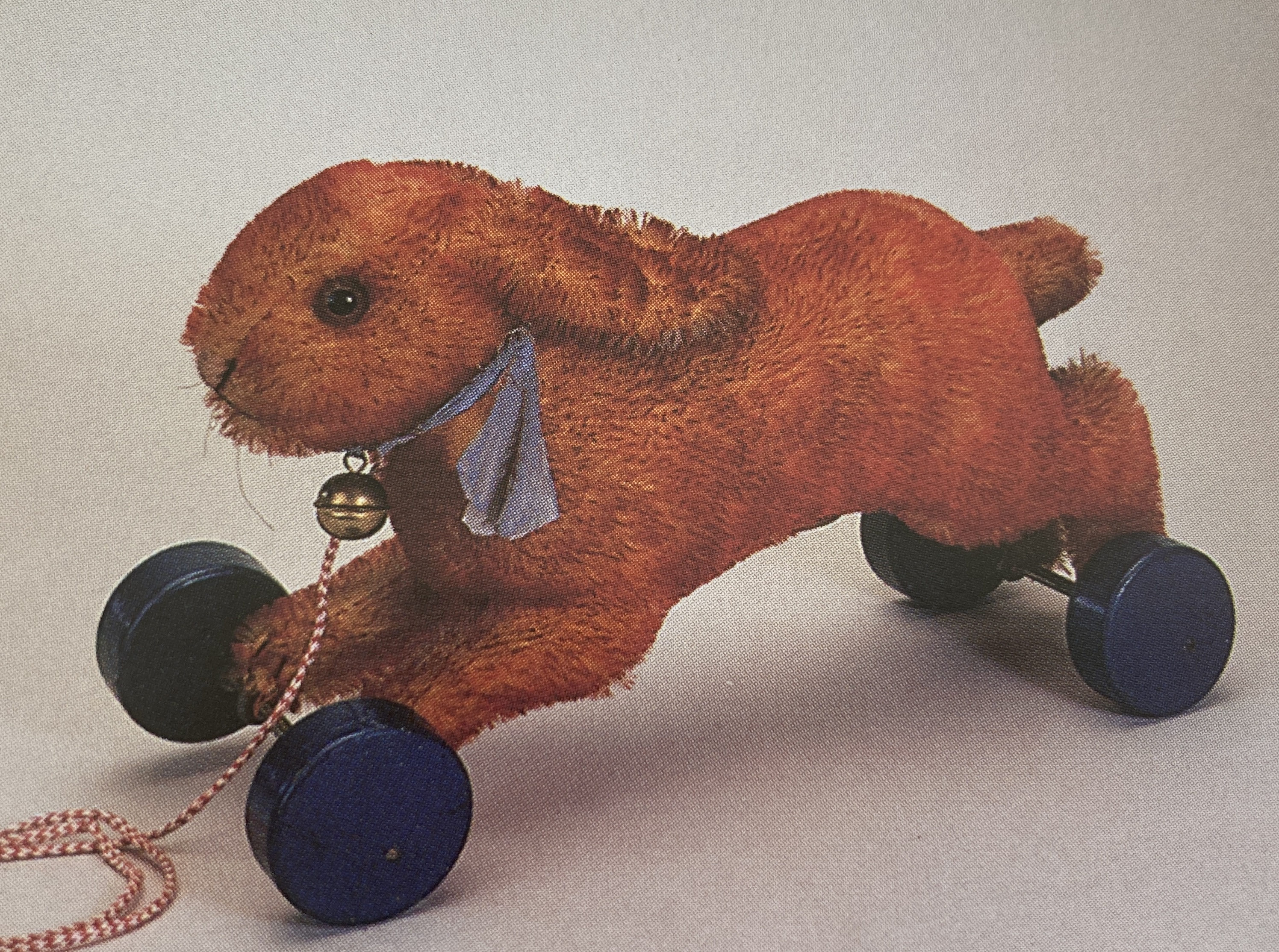
This happy hopper is the wheel-deal indeed.
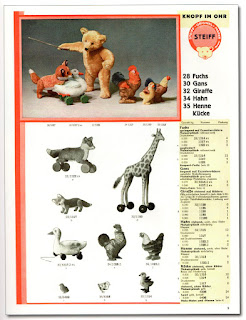
It is Steiffgal's best thinking that he is one of Steiff's standard line rabbits on wheels from the late 1920s. Here on the left, you can see the photo from Pfeiffer's 1892-1943 Sortiment illustrating what Steiffgal believes is this exact item. He is in a "hopping" position, meaning he is on all fours and about ready to take off! The name of this body position was later changed to "running", which also makes alot of sense.

Alena's treasure is one beautiful bunny. Here you can see him relaxing with some WAH-HOO good vintage friends in the photo on the left. Rabbit is unjointed, solidly stuffed with excelsior, and features large brown and black glass pupil eyes, a hand embroidered pink and black nose and mouth, and clear monofilament whiskers. He has once vivid orange mohair. He rides upon four asymmetrical wooden "eccentric" style wheels. As such, he appears to sway back and forth as he is pulled along. This item was produced in 12, 15, 18, and 23 cm (measured vertically, top of the head to toe, not including ears or wheels) from 1927-1930 overall in this stunning color. He was also produced in an almost identical pattern in brown tipped mohair in 14, 17, and 22 cm in 1928.


Brightly colored animals, including rabbits, dogs, cats, and bears - were a delightful feature of Steiff's late 1920s to very early 1930s product line.
These sweet pets appeared in orange, pink, blue, green, gold, or other "jellybean” colored mohair or velvet fabrics, and usually had playful, youthful personalities to match! Tipped mohair - meaning mohair with just the ends or tips dyed a complementary or eye-catching color - also had its heyday in the product line around the same time. You can see a number of these colorful rabbits in the photo on the left, the image is from the company's 1929 product catalog. 

Steiff also produced a few other fun novelties featuring "larger than life" colors like Alena's wheeled rabbit.
One of particular interest is a delightful orange and white begging style rabbit on eccentric wheels. In July, 2023, the auction house Ladenburger Spielzeugauktion GmbH of Ladenburg, Germany sold this 20 cm tall rarity from 1926-1932 for nearly $4,000. He is pictured here on the left, the image is from Ladenburger Spielzeugauktion.

Steiffgal hopes you enjoyed learning about this darling, 24 carrot gold prewar novelty!

Have a question about one of your Steiff treasures? Let's talk! Click here to learn more.

Saturday, December 2, 2023

Playing Doggy Detective Over This Unusual Steiff Wartime Era Canine

Paws and take a look at this interesting dog made during a really challenging time in world history. He has a familiar ring to him, don't you think... but his fabric is quite different than his standard line relatives. Just who is he, and when was his birthday - in dog years or otherwise? 

His lucky owner - Patricia from Europe - shares:

"I would be very grateful for your expertise concerning this Spitz dog. He is not catalogued in any of the Steiff Sortiment books. 

I have absolutely no idea if he is prewar? 

My concerns are his alternative coat. This is definitely not mohair plush. This is very lightly woven and the pile is flat, not fluffy.The airbrushing is bright and vibrant and his coat has full coverage. 

He is completely perfect with no damages at all. Unfortunately, he doesn't have his Steiff ID. He has beautiful glass eyes and is quite lovely. He is 22 x 22 cm in size. Any information on this little treasure will be greatly appreciated."

What an interesting find!
Some of Steiff's items made just before, and just after, WWII are not captured in the Sortiment books. This could be because very few were actually made and sold, they are extremely rare today, they might have been produced only as samples or test items, or they simply fell through the documentation cracks during a complicated geopolitical period and its aftermath. The Sortiment books are great references, but they are not a complete and comprehensive accounting of Steiff's production. And, they were not validated or published by Steiff - but by a third party. 

That being said, it is Steiffgal's best guess that this dog is a version of the company's standard line Wolfspitz dog series that was officially in production from 1934-1943 overall.
These canines were made standing on all fours in 22 and 35 cm; on eccentric wheels in 22 cm; and sitting in 17, 21, 22, and 25 cm. They were all unjointed and stuffed with excelsior. Their face, ears, and legs were made from shorter mohair while their backs, tails, and torsos were made from very long matching mohair. Each was detailed with lifelike brown and black shading on their backs and tails and had three embroidered black claws on each paw. Their faces came to life with felt lined ears, brown and black glass pupil eyes, a black embroidered nose and mouth, and brown airbrushed highlights on their foreheads. For reference, you can see the 22 cm mohair sitting Wolfspitz here on the left; the photo is from Steiffgal's collection. 

Patricia's dog appears to check many of the boxes to the company's basic prewar Wolfspitz pattern.
These details include things like the use of long and short materials to replicate the dog's coat; three painted folds on the dog's forehead; airbrushed shading on his back and tail; and a very similar facial expression and rendering, among others.

From c. 1934 - the early 1940s, and then again from c. 1946 - 1949, things were really tough from the materials, supply chain, and operations perspectives at Steiff. Premier, traditional toy making materials including mohair and felt were in short supply and were often allocated to military purposes. As such, Steiff did everything it could to keep its toy making production lines supplied and active during these times. One way to do this was to use fabrics and materials that were available in the place of felt and mohair. These often were in the forms of artificial silk plush, wool plush, cotton plush, and other hybrid fabrics that blended wool, mohair, and other fibers. 

Given its presentation, materials, size, and detailing, it is Steiffgal's best thinking that this Spitz dog dates from the late prewar period and is made in part from some type of substitute plush that has wool as an element of its weave.
 He might have been a sample or prototype to test how his design would turn out in the plush available at the time. There is no indication (as far as Steiffgal knows of) that this pattern was produced in any form in the early postwar era.  The fabric on Patricia's pooch appears somewhat similar in texture and density to the unusual "lumpy-bumpy" plush on an otherwise standard line standing play duck from Steiffgal's collection. This fine feathered friend - like the Wolfspitz - was in the line from the early 1930s through the early 1940s. You can see this duck here on image on the left. 

Steiffgal hopes this discussion on this interesting Spitz dog has you barking up the right tree!

Have a question about one of your Steiff treasures? Let's talk! Click here to learn more!

Sunday, November 19, 2023

This Antique Image Featuring Steiff's Record Peter Is Pretty As A Picture

This reader's question is the real-wheel-deal indeed! And just goes to show you how far back, and how deeply, some of Steiff's legacy patterns resonate with people all around the world. Zuzana from Slovakia writes,

"Good evening,

I have a very special question for you and would be really grateful if you can help me. I am a restoration and conservation student from Academy of Fine Art and Design in Bratislava, Slovakia. I am working on this gelatine photograph of two girls with a goat in the middle. One of the girls has a pull toy monkey and I am guessing it's a Steiff toy. I was just curious, if you maybe will have any kind of information about this specific toy. This photo is the only I have and no more information was attached. Maybe you as a professional will see something I cannot.

I'm looking forward to hearing from you and thank you so so much.

Have a nice day and Greetings from Slovakia, Zuzana."


This delightful inquiry falls beautifully at the intersection of antique ephemera and Steiff history.
It is always fascinating to see Steiff items appearing in photographs of yesterday - or even last century. What you see here in the photo from Zuzana is definitely one of Steiff's most beloved and signature items - a chimpanzee on a four wheeled cart, or what is traditionally called a "Record Peter." Here on the left you can see a very early Steiff print advertisement for this very product, the image is from D. Ayers and D. Harrison's, Advertising Art of Steiff, Teddy Bears and Playthings.

Let's focus on the history and details of this marvelous monkey.
Steiff's Record Peter is unquestionably the most well-known novelty based on the company's legacy Jocko the Chimp pattern. This plaything consists of a Jocko riding upon a metal chassis hand cart which glides along on four wooden wheels - usually painted red. When Record Peter is pulled, his arms and legs swing back and forth in synchrony, giving the appearance that he’s working hard to keep his vehicle in motion. Record Peter made his debut in 1912 in 25 cm. As such, this photo was taken in 1912 at the earliest. Here on the left you can see a lovely legacy and most likely mid-century Steiff Record Peter with his original box, the image is from Invaluable.com.

The Record Peter design was an immediate sensation upon its introduction. Steiff's 1912 catalog described him as: “Record Peter, in silky brown mohair plush, seated on a self-drive chassis with sturdy wooden wheels and automatic sound box. Virtually unbreakable mechanism. Simply has to be pulled along by attached cord.” This novelty also came in a number of cataloged and colorful forms and size variations through the early 1940s. These included examples ranging from 10 to 30 cm, as well as rarities made in red, blue, yellow, white, green, red, and black mohair. Each of these colorful characters was decorated with a festive neck ruff. Given his longevity in the line, he also appeared once in a blue moon in some unconventional and/or not cataloged fabrics, including artificial silk plush and cotton plush. These "non-mohair" fabrics usually suggest that the item was made just before, during, or after one of the world wars. You can see two prewar variations on Steiff's Record Peter design below; the one on the left is made from all felt and wears a matching fez and the one of the right is made from cinnamon colored mohair. The image is from the author's collection. 

Due to his popularity, it is no surprise that Record Peter was one of the first items Steiff manufactured when the factory reopened for toy making business post WWII.
A 25 cm version was produced in brown silk plush in 1949, then in brown mohair through 1970. Even though he has not "officially" appeared full time in the line for nearly half a century, he remains one of the most cherished and timeless Steiff designs amongst collectors today.

Steiffgal hopes this discussion on this fabulous photo (and its contents) has been a picture perfect experience for you.

Have a question about one of your Steiff treasures? Let's talk! Click here to learn more.

Saturday, August 12, 2023

Rolling Along With This Early 1930s Steiff Scotty On Wheels

Great Scot! Check out this utterly charming prewar pup on wheels. Despite his small size, he's got a few interesting "time capsule" details that help to date him to a "T". Read on to learn more.

This bearded beauty is the wheel-deal indeed!
Scotty is 17 cm tall, standing, and head jointed. His body and head are made from grey and light black mohair plush fabric. His ears are made from pitch black mohair. Scotty is detailed with proportional black and brown round glass pupil eyes, a black embroidered nose and mouth, and dark pink embroidered claws on each of his four paws. His ears are lined in black mohair. The dog is mounted on a metal carriage and glides along on four blue wooden eccentric wheels. He retains his original collar and brass bell. His collar is white and dark blue or black leather, and closes with a ring and two (now very rusty) Steiff buttons. He retains his long trailing "f" button in ear and traces of his chest tag as his Steiff IDs. 

This model was made in 14, 17, and 22 cm (measured vertically, without wheels) from 1932-1943. He was produced in grey and black mohair plush from 1932 through 1934; after 1934 he appeared in all black mohair. Given those dates, it is safe to say that this guy was "born" in the 1932-1934 time frame. 

Scotty dogs debuted in the Steiff line in 1930 and were an immediate success with customers.
Their size, personality, and proportions translated well into soft toys designs, and Steiff created a number of sitting, standing, wheeled, and novelty versions over the next decade. Some had round glass pupil eyes like this example, while others had brown, white, and black almond shaped glass eyes. Steiffgal has never been able to figure out why that was the case, but both style of eyes are original to Steiff. 

The Scotty under discussion here has two distinctive early 1930s-era details that Steiffgal has not seen on items produced during any other time. The first is his body fabric, which is a mostly black mohair plush with grey fiber details. It is not "spiky" like traditional mohair, but smoother and more elegant, with the longer fibers really resembling a dog's coat. This lovely material was used for awhile on the company's Scotties, but then disappeared in 1934 - about the time that things really started getting difficult at Steiff - and throughout Germany due to geopolitical realities. It is possible that the grey and black fabric was expensive, and the company was trying to save money on materials, and/or that it was no longer being produced, and/or it was entirely allocated by the government for wartime material production. Through the early 1940s, Scotty dogs would go on to be produced in mohair, wool plush, cotton plush, and silk plush - apparently coming to life in the fabrics available at the time. 

Also of note is this Scotty's prominent leather collar.
Steiffgal has only noted this woven style, light and dark belled collar on dogs from the early 1930s. It is possible that this accessory was designed and produced to give the dogs wearing it a more "upscale" look and feel. The collar, which is not removable, needed to be manually attached to the dog and finished with two inserted buttons. This of course required many more assembly steps than the signature, simple red buckled collar which would be used on the model just a few years later. 

Steiffgal hopes this discussion on this early 1930s Scotty on wheels was a joy ride for you!

Have a question about one of your Steiff treasures? Let's talk! Click here to learn more!

Tuesday, May 2, 2023

This Early Steiff Giraffe On The Go Is The Wheel-Deal!

It's no stretch to say that Steiff's giraffes are quite the jungle gems. Prewar ones are few and far between on the secondary market, and always catch the eye of collectors. Check out this note from Lynda who would like to know more about a fine and early example from her collection. She writes:

"Hello, I would appreciate any information on age, rarity and value of this old Steiff giraffe on wheels. He measures just under 21” on wheels; the height of giraffe sans wheels 20 1/2” as he sits on a crossbar; actual wheels measure 1 3/4” in height. Thanks!"

This handsome and dramatic giraffe on the go is a legacy pre-war item. The pattern appeared overall in 9 sizes overall, ranging from 28 to 260 cm, from 1909 through 1942. Given his dimensions, Lynda's pal is the 50 cm size, as wheels are not included in his official measurements. He is made from hand stenciled felt, has mohair ears, is standing, and unjointed. His face comes to life with pert black button eyes, prominent ossicones, airbrushed features, and dramatic seams. He retains his long trailing "f" button as his Steiff ID. Giraffe debuted on metal wheels; in 1923 he started to be produced on wooden wheels. Given these details, it is safe to say that this guy was "born" in the 1909-1923 time frame.

Given his appeal and longevity in the line, it is not surprising that this giraffe on wheels pattern was produced in a few forms and variations over the years.
 
For example, the 110 cm size was also made in mohair in the early 1930s. Some larger models were made as riding toys with steering features, while the largest ones came with a saddle and footrests - much like the company's riding horses or donkeys. According to Pfeiffer's Sortiment, the saddle and foot rests were intended "for shoe stores, for fitting children's shoes."

It is interesting to note that despite his age, this model is not Steiff's debut or earliest giraffe model. The company produced felt giraffes with or without metal wheels in 17, 28, 35, and 65 cm from 1892-1909 overall. These first generation, earliest models had simpler lines and more dramatic coloring than the model under discussion here. 

Now for the tricky question - his value.
 As always, something is worth what someone will pay for it, and Steiffgal does not have a crystal ball or insights into what any given bidder or buyer would offer for it. A solid way to think about value is to see what other similar items have sold for at public auction. In 2018, a 50 cm felt giraffe in excellent to unused condition with IDs from the late 1920s-early 1930s realized about $3,751. He is pictured here on the left, and may be the same one shown in Pfeiffer's 1892-1943 Sortiment book, page 310. Given Lynda's example has significant losses and playwear, but retains its ID, has metal wheels, and probably could be restored a bit, it is Steiffgal's best GUESS that he may change hands in the c. $1,500-2,500 range. 

Steiffgal hopes this discussion on Lynda's giraffe keeps your interest in Steiff on a roll. 

Have a question about one of your Steiff treasures? Let's talk! Click here to learn more!

Saturday, October 29, 2022

This Precious Prewar Pug On Wheels Stands And Delivers!

As she continues to celebrate the arrival of her newly adopted sister-pugs, Steiffgal thought it was the perfect moment to share a special button-in ear version of the beloved breed.
Dogs have always been an important design category for Steiff, so it should be no surprise that the first flat-faced cutie was introduced in the Steiff catalog in 1916. Take a look at this very early pug on the go and see what makes him so delightful from the design and product development perspectives.

This happy traveler is 22 cm tall (not including his wheels) and made from grey mohair.
He is standing, unjointed, and solidly stuffed with excelsior. He has black hand embroidered claws on each of his feet. His distinctive face comes to life with proportional brown and black glass pupil eyes (which may be replaced), a black hand embroidered nose and mouth, and black lines on his forehead - to give him his breed-specific wrinkled forehead. His pert ears are lined in velvet, and he has a very curly tail. He retains his small trailing "f" button and traces of his white paper ear tag as his Steiff IDs.

Now let's dig deeper into his detailing.
Pug wears a leather collar, which may or may not be original to him, but is appropriate in materials, design, age, and fit. His pull cord has been lost to time. Pug is mounted to two metal rods and rides upon four wooden eccentric wheels. It is interesting to note that this pattern, unlike many other dog patterns, only came on wheels, and was not produced sitting or in any other configuration. Pug on wheels was produced in 17 cm and 22 cm from 1916-1927.

Like many of the Steiff pets debuting in the 19-teens, this perky pug has a proportional and literal design.
The key pug breed elements - a flat muzzle, wrinkled forehead, and a curly tail - are very well represented in his pattern. For the most part, Steiff's dogs, cats, rabbits, and other popular pets introduced in the c. 1910-1920 time frame were not as basic as the company's earliest patterns, but did not have the youthful, often goofy or playful appearances of those items designed in the 1920s through early 1930s. Items from around 1925 onward often featured oversized eyes, brightly colored materials, and rounded faces, bodies, and limbs. As such, Steiff's second pug - introduced in 1925 as its first pug pattern was being phased out - was a truly silly looking sitting pup with exaggerated facial features and a larger than life red felt tongue. He appeared in the line from 1925 - 1927 in 14 cm. He is pictured on the left; the photo is from Pfeiffer's 1892-1943 Sortiment.

Steiffgal hopes this discussion on the company's early Pug on wheels has captured your interested in a round-about sort of way.

Have a question about one of your Steiff treasures? Let's talk! Click here to learn more!

Saturday, October 8, 2022

Good Things Come In Threes With This Fabulous Prewar Steiff Duck Chain

It's time to get your ducks in a row and check out this next marvelous Steiff find. It's hard to believe that this family of fine feathered friends was most likely made over a century ago - they appear practically brand new today. Who wouldn't want to feather their Steiff nest with them? They are truly "aligned" in so many interesting ways....and here's why!

Good things come in threes with this duck family trio. It consists of a larger mother duck - measuring about 10 cm tall and 14 cm wide - and two baby ducks - measuring about 6 cm tall and 9 cm wide each. All the ducks are unjointed and are solidly stuffed with excelsior. They have grey felt bodies and green felt wings and heads. Their wings are decorated with yellow embroidery to look like feathers. Their beaks, legs, and feet are made from orange felt, and their eyes are little black buttons. The mother retains her original grey silk neck ribbon. The mother is cataloged as article number "2110,42 ex," and the two ducklings are cataloged as article number "2106 ex." These numbers translate to:  2= lying; 1=felt; 10= 10 cm and 06= 6 cm; 42= simple pattern with a voice; and ex= eccentric wheels. The mother and one of the ducklings retain their tiny raised script button in one foot.

Now let's check out their fabulous rides! Mom is mounted on a square metal wire carriage which glides along on four green wooden eccentric wheels. When she is pulled, she waddles and makes a peep which is generated by a little movement activated voice box embedded in her belly. You can see this feature illustrated in the photo at the end of this post. She also has a green and white twine pull string that looks period, if not original, to her. Each of her babies is mounted on a diamond shaped metal wire carriage which rides upon two green wooden eccentric wheels. They also waddle about when they are rolling along. There are loops and hooks at the end of the carriages to keep the family linked together. 

Steiff's beloved felt "duck chain" parade was a legacy item in the early 20th century. It was produced in two standard line versions: a mom with two ducklings or a mom with five ducklings. Both versions appeared in the line from 1917-1932 overall. From 1919-1921, this duck chain was produced in a substitute plush material because felt was in short supply for toy making purposes during and shortly after World War I. Steiff's signature duck chain novelties were marketed as, "This waddling felt duck with brightly colored fathers is fixed onto solidly built, eccentric wooden wheels, which provide the duck with its characteristic waddle. Also fitted with a deceptively realistic "quack-quack" voice. A droll little toy."

Steiffgal hopes this discussion on this duck chain pull toy has really tugged at your heartstrings!

Have a question about one of your Steiff treasures? Let's talk! Click here to learn more!

Thursday, August 11, 2022

This Steiff Primate Makes For One Fantastic Tale Of A Tail!

Now we are truly on a roll!
Steiffgal recently returned from a trip to St. Louis, MO to celebrate all things dolls, bears, and toys at the 2022 United Federation of Doll Clubs annual event. The salesroom associated with this gathering always has some of the finest Steiff temptations on offer - and this year did not disappoint! Check out this charming and unusual Steiff primate on wheels Steiffgal found on opening night of the festivities. You'd have to agree - he makes for one heck of a souvenir!

This handsome and unusual prewar Steiff sweetie pull toy is "officially" named Record Peter. He is 18 cm and fully jointed. He is made from white mohair. His hands, feet, face, and ears are made from tan colored felt. His pensive face comes to life with green and black glass pupil eyes, a seamed mouth, and light purple-ish and pink colored airbrushed highlights on his nose area and forehead. He rides upon a black metal, four-wheeled cart. The centered wheels are solid wood and painted red. When Record Peter is pulled along, his arms and legs move back and forth vigorously, giving the appearance that he’s working hard to keep his cart moving. When he left the factory in Giengen, Germany about a century ago, he had a pull cord attached to the front of his vehicle. Record Peter retains his long trailing "f" button and traces of his white ear tag as his Steiff IDs.

Prewar, Record Peter appeared in the standard Steiff catalog in 10, 15, 20, 25, and 30 cm in deep chocolate brown from 1913-1943 and in white in 18 cm from 1925-1934. He was also produced in a few other "surreal" colors, including blue, yellow, green, red, and black! These hues are so incredibly rare that Steiffgal has only seen photos of them. Given this Peter's ID configuration, it is Steiffgal's best thinking that he was "born" in the very beginning of his manufacturing time frame.

Now let's take a step back and look at one of the features that makes this Record Peter so unusual - in addition to his white mohair. If you study his rear end (and its ok to stare in this case) you will notice he has a tail. Unlike many other standard line tail-less primates produced by Steiff, this model indeed has a long, thin mohair tail. This appendage probably was challenging to manufacture, given its size and shape.

Here on the left, you can see the 1929 catalog page advertising some of the company's primate line for the year.
 You can click on the image to make it bigger. This page has a subtle bit of information that adds some insight to the tail issue. Here, items noted as product category "9" are chimpanzees, while items noted as product category "10" are monkeys or Record Peter items. From the scientific perspective, chimps, gorillas, and orangutans do not have tails – classifying them as "apes." Those primates with a tail are classified as "monkeys." That is why the tail-less brown mohair "Jocko" pattern we know and love is considered a "9". However, it is curious that a white, freestanding mohair primate with a tail on this page is classified as a "9," suggesting it should NOT have a tail. Perhaps something here got lost in translation?

On the way bottom on the right of the catalog page, you can spot the white primate on wheels under discussion today.
 A close-up of him is here on the left. 
You can click on the image to make it bigger. The copy reads, "Record-Peter, Speedaway movement of amusing effect. No clockwork or mechanism to get out of order, simply pull cord. Strong colored wire frame, varnished wood wheels, voice, each in a box." He is also noted as product number 10/318 (10 = a Record Peter, 3 = sitting, and 18 = size in cm); that he weighs .31 kilograms (which was important for shipping and logistics) and that he was packed one to a box.

Steiffgal hopes you've enjoyed this tale of a tail detective story!

Have a question about one of your Steiff treasures? Let's talk! Click here to learn more!

Saturday, June 4, 2022

This Earliest Steiff Cub On Wheels Is A Little Rough Around The Edges

Which comes first.... age or beauty? In this case, it's a tie for sure. Check out this very vintage, legacy Steiff bear on wheels. This old man has circled the sun in three separate centuries, and is hardly any worse for the wear. Come see what makes him so interesting from the materials and product development timeline perspectives.

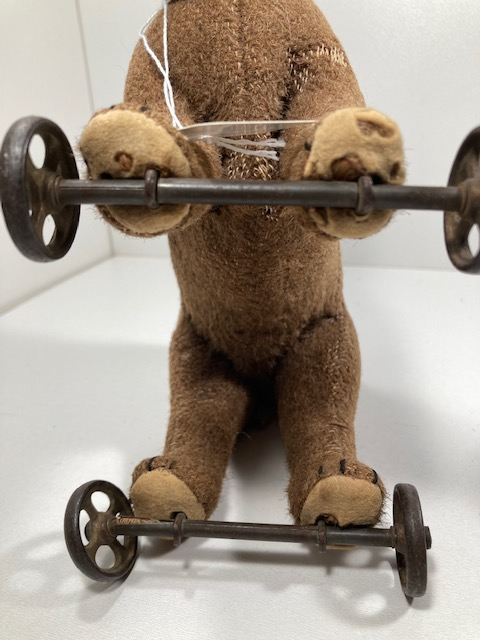
This cheerful cub is standing, head jointed, and is 17 cm tall (measured vertically). He is made from brown short pile plush. His paw pads are made from tan felt. His face comes to life with black button eyes and a black hand embroidered nose and mouth. He also has black hand embroidered claws. He is mounted on two metal axles and rides upon four metal wheels - each is about 1 inch in diameter. You can see a close up of his "ride" at the end of this post. When he left the factory in Giengen, he would have been wearing a leather collar. This accessory has been lost to time. He was made in this brown short pile plush fabric in 10 sizes ranging from 10 to 100 cm from 1894-1926 overall. There is no indication on his ear that he ever had a button; as such, it is entirely possible that he was made in the prebutton era - c. 1894 through 1903/04. 

This bear's fabric represents a materially important time period in Steiff's history.
He is made from a somewhat rough to the touch cloth consisting of thicker brown woolen threads woven with thinner tan cotton threads. The way they come together gives the bear a bit of texture and visual interest. Steiff used this material on some of their earliest bears as it was available, affordable, and was probably the best alternative at the time. Because parts of this fabric are woolen and other parts are not, it ages and manifests losses in an interesting way. When the brown woolen threads are lost to time or insect damage, only the tan thinner cotton threads remain. Unlike mohair, there is no backing to this short pile plush - so you can see the excelsior stuffing between the threaded areas of loss. 

Mohair was really a game changer for Steiff when it became available on a commercial scale in 1903.
This "newfangled" fabric caught the eye of Richard Steiff, who brilliantly realized how well it would translate to the toy making world. And, just a few months later, he would unveil his 55PB bear at the 1904 Leipzig Spring Fair! This cub, which measured 55 cm tall, was made from long, reddish brown mohair, five ways string jointed, and detailed with black boot button eyes and a gutta percha nose. He was very heavy and solidly stuffed with excelsior and made to look like a real bear, not a playful toy. Although 55PB was not a commercial success - his mohair "grandson"... a cardboard disk jointed cub debuting around 1905... would go on to make Steiff one of the most recognized and beloved toy companies on the planet. 

It is interesting to note that the short pile plush bear under discussion today remained in production for more than two decades after the introduction of softer, more playful mohair items in the Steiff line.  This suggests that he sold well and was profitable enough to hold his place in the company's catalog. There's certainly no denying his charm and appeal - almost 130 years onward. 

Steiffgal hopes this discussion on this legacy bear on wheels has come full circle for you.

Have a question about one of your Steiff treasures? Let's talk! Click here to learn more.

Friday, March 11, 2022

No Need To Spin Your Wheels Over This Remarkable Prewar Steiff Doll On The Go!

It's time to hit the road - literally - with this week's special blog guest.
A new friend from the state of Wisconsin in the United States asks about a special family heirloom that holds a very important place in her heart. This racy red rider has escaped identification, until now. So the question is... is he the wheel deal? 

Diane shares,
"I have never been able to locate a Steiff like my Grandmothers. It is a postman on an Irish Mail or pull cart. He is 8 inches tall when he is in the forward position. The button is in the ear. It is difficult to see the button in the photo. He was purchased in the 1930s. I have seen a few animals on pull carts but never a doll. Thank you in advance for any information you could provide."

What we have here is Steiff's super cute, and super rare, Radler doll on wooden wheels.
The doll itself is 20 cm tall, fully jointed, and made entirely from felt. He wears a red felt suit that is integral to his body. His jacket is detailed with cuffs and a collar, as well as buttons. His shoes are black, and his matching red felt hat fits nicely on his head. His boyish face comes to life with a prominent center seam, glass eyes, a dimensional mouth and nose highlighted with hand painting, rosy cheeks, and pert ears. His hair is painted. He sits upon a metal carriage which glides along on four naturally colored wooden wheels. When the cart is pulled along, it appears as if the doll is shuffling back and forth in tandem with the movement of his vehicle. This particular doll design is named "Radler" and he was produced in this size only from 1916-1929.

It's interesting to note that "Radler" is the German word for cyclist. The word is also a name for a distinctly German adult beverage. A "radler" is a mixture of beer and citrus flavored soda. It is fitting to see how a radler might enjoy a cold, frosty radler after a long bicycle ride! For a detailed history of radler the beverage, please click here!

Radler (the doll!) is part of Steiff's beloved and traditional "record" production.
"Record" refers to a jointed item riding a four wheeled cart with a handle. The first record item was "Record Peter" - a chimp on wheels - who came on the scene in 1912. He was an immediate best seller then, and remains a collector's favorite today. A Record Teddy debuted in 1913 and a Record Rabbit appeared in the catalog starting in 1926. In terms of dolls, in 1916 a series of record dolls topped Steiff's novelty production. These included a Record Puck gnome, Shockheaded Peter, Max, Moritz, a Record August (a boy in a purple felt suit) and this Radler. Over time, popular characters like Mickey Mouse, Petsy the baby bear, and Felix the Cat were also produced as record-style novelties. Postwar, record style rabbits and chimps appeared in the line through 1964 and 1970, respectively. You can see a photo of Radler as he would have appeared leaving the factory brand new a century ago - this image is from Pfeiffer's 1892-1943 Sortiment.

Steiffgal hopes this discussion of Diane's radler has been a refreshing pause in your day. 

Have a question about one of your Steiff treasures? Let's talk! Click here to learn more.

Saturday, December 25, 2021

Care To Feather Your Steiff Nest With This Grand Goose On Wheels?

This fine feathered Steiff friend is certain to give you goosebumps! Bird's the word when it comes to this adorable goose on wheels. She's flown a little under the radar relative to other birds in the Steiff line, but has a most impressive history worth a honk - or two! Check out her story below. 

This gorgeous goose is 17 cm tall and 23 cm wide. She is lying on her belly and is made from white mohair. Her neck and head are airbrushed with a touch of grey. Her wings are splayed outward, in a most realistic and playful way. Her feet and legs are made from single thick orange felt. Her face comes to life with black button eyes backed in red felt and a proportionally large and dimensional orange felt beak. She rests on a metal carriage and glides along on four green wooden eccentric wheels. When she moves, her back axle activates a squeaker in her belly.  Goose on the go was made postwar in 17 cm from 1949-1964.

This timeless pattern must also have been an unassuming best seller for Steiff.
That is because it appeared both in the prewar and postwar period. Interestingly, it does not seem that this goose model was ever made without wheels. Prewar, it was made in 14 and 17 cm from 1914-1943. It is really likely that the pattern was updated just a bit in the 1914-1943 time frame - given how aesthetics, economics, and manufacturing realities evolved so quickly during that nearly three decade long period of production. Nonetheless, technically this goose on wheels was noted in every Steiff catalog published for a stretch of 50 years! This longevity is right up there with the company's legacy Molly the puppy (1925 - 1969, about 44 years overall), Waldi the Doxi (1933 - 1980, about 47 years overall) and Susi the cat (1936 - 1978, about 42 years overall.) You can see goose on wheels as she was presented in Steiff's 1929 catalog; the image is from C. Esser's Steiff Kataloge 1920-1929. You can click on the photo to make it larger.


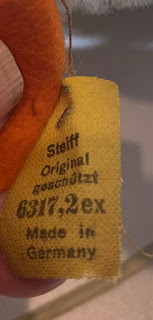
Goose's yellow tag is unusually descriptive in this case and helps to nail down her birthyear.
The words on it include "Steiff Original geschuzt (protected)"; this copy was only used in the late 1940s and very early 1950s. And the numbering is quite telling as well. It reads, 6317,2 ex. This means, 6 = young, 3 = mohair, 17 = 17 cm, ,2 = double press voice, growler, or pull cord voice, and ex = on eccentric wheels. She also has her raised script button but no evidence of a US Zone tag. All of this information suggests that this particular goose on wheels was produced probably around 1952 or 1953.

Steiffgal hopes this discussion on this timeless toy has made you feel young at heart today.

Have a question about one of your Steiff treasures? Let's talk! Click here to learn more.

Thursday, April 8, 2021

Rolling Out The Red Carpet For This Precious Prewar Doxie On Wheels!

What goes around, comes around... especially if it's on wheels. This darling Doxie on-the-go recently popped by to say hi and Steiffgal couldn't help but roll out the red carpet for her! Come take a look at this great example of Steiff's prewar novelty production and see what makes her so noteworthy from the historical and product development perspectives. 

Doxie on wheels is standing, unjointed, and constructed from mohair.
The dog itself measures 11 cm vertically and 20 cm horizontally. Her top, forehead, ears, and tail are made from black mohair and her muzzle, limbs, and underbelly are made from brownish tipped mohair. Her face comes to life with proportional brown and black glass pupil eyes and a black hand embroidered nose and mouth. She is mounted on two metal axles. She glides along on four wooden eccentric wheels which are painted blue. She is attached to the axles through metal loops that are inserted into her limbs. Doxie on eccentric wheels was produced in 17, 20, and 22 cm from 1930 through 1933 overall. She was also made on traditional round wheels in 28 and 35 cm from 1929 through 1935 overall.

Doxie on wheels is one of many wonderful prewar Dachshunds produced by Steiff.
 Like Fox Terriers and Pointers, Dachshunds are a legacy breed for Steiff, and perhaps one of the company's most famous and prolific dog lines as well. Steiffgal suspects this is because Dachshunds traditionally have been a very popular pet choice across Germany, and even were the animal companions of choice of the Steiff family at the turn of last century! Although this exact pattern under discussion here today was not produced postwar, if you look closely at her face, you can see it is somewhat similar in size and expression to Bazi, who was introduced in 1950. 

Moving along, this particular example three design characteristics that firmly root its production in the late 1920s to early 1930s. These include:

1. Patched mohair construction. Many items that debuted in the 1920s feature different color mohair that is patched and seamed together to create the visual effect of a multi-hued animal. From the mid-1930s onward, the company was much more likely to create an animal from one shade of fabric and then apply color via paint for a similar effect. This was probably done to create labor and material efficiencies.

2. Mohair coloring. This Doxie's brown mohair is actually more like a deep orange or copper color, and is tipped. This creates a wonderful aesthetic effect of depth and richness. Tipped mohair (think of Petsy the Baby Bear, for example) was a very popular fabric choice and treatment during the "Roaring 20s" era. 

3. Novelty detailing.
This Doxie is a novelty, meaning she has a fun feature not seen on standard line playthings. In this case, she's on eccentric wheels. You can see a closeup of this configuration here on the left. A very similar pattern to this Doxie was produced as another novelty - a tail moves head version. This mover and shaker appeared in 14, 17, and 22 cm from 1931 though 1934 overall. Steiff's novelty production exploded in the mid to late 1920s with the introduction of Molly the Puppy and Bully the Bulldog. These popular designs translated well into charming product line extension items like music boxes, purses, animal dolls, various pull toys, Charleston animals, puppets, and tail-move-head characters. Today, late 1920s-early 1930s dogs, cats, and rabbits with a novelty twist universally top collector's wish lists. 

Steiffgal hopes this discussion on this Dachshund novelty has been tremendously entertaining for you. 

Have a question about one of your Steiff treasures? Let's talk! Click here to learn more.
The teddy bear search engine