Showing posts with label pull toy. Show all posts

Saturday, August 24, 2024

Color Me Beautiful With This Fabulous Antique Felt Steiff Rooster

Bird's the word with this next Steiff inquiry. A collector friend with a great eye just added this fine feathered friend to her Steiff hug. His coloration and form are simply outstanding! Julie shares, 


"I just got this adorable little felt Steiff rooster! I am excited to know more about him and to learn when he was made. The closest I can find to him in the Sortiment is on page 546, which is a little rooster on a wheeled platform. The colors are exactly the same. Mine is about 10 cm high, and that's accounting for him being bent over a bit. If he had a button would it have been in his tail? He has a rusty old pin stuck in his side which is interesting. His tail is in really great shape, I don’t see any potential holes for a button in it. Was there maybe something with the style of feet and legs or tail to distinguish him from the very early 1892-1905 production? I see some may have had felt covered feet. The seller said that his great grandmother was born in Austria and brought this rooster with her to the US around 1900 or a little later."


This fantastic find wins Steiffgal's admiration with flying colors! What we have here is one of Steiff's earliest commercially successful legacy animal patterns. This classic, full bodied standing felt rooster was produced for the standard line in 12, 22, 29, and 35 cm from 1892-1929 overall. Very similar patterns were made on eccentric wooden wheels in 12 and 22 cm from 1917-1929 overall; as a tumbling 17 cm version on a weighted wooden hemisphere from 1894-1918; as an 8 cm pull toy on a wheeled wooden cart from 1916-1919; and as the kingpin in a set of hen skittles from 1894-1914 overall. 


What makes this pattern so exceptional, and so timely, is its materials and form. In terms of fabric, Margarete Steiff launched her company in the late 1800s; she initially specialized in producing felt items including garments, functional pockets, and household items. Felt material was readily available and relatively easy to cut and sew. When she started to produce animals a few years later, Margarete discovered that felt also translated perfectly into feathers when precisely cut, layered, and placed in cascading natural hues. In terms of form, Steiff's turn of last century product development was based on "everyday" animals - those farm, field, and forest animals that folks in Giengen would come across on a regular basis. As such, this particular rooster pattern is practically a time capsule example of Steiff's earliest commercial production. 


Given its popularity, Steiff's felt rooster pattern appeared in the line in one form or another for nearly 40 years. As such, it can be challenging to exactly date any given example. The felt supplied for this item certainly had some natural variations in color and quality over time; this can account for minor differences in product appearances. Many artisans cut and sewed this rooster over its four decade long appearance in the catalog; because of this, variations in size, presentation, and button placement are also expected. For the most part, older versions of legacy items have a more distinctive, handmade, and organic look to them than their cousins produced a few years or decades onward. Julie's example has metal feet and legs which are wrapped in string to finish them. This detailing is seen on many of Steiff's earlier birds from the turn of last century, as well as on some smaller and/or baby birds through the 1920s. 


Given these factors, and that his original family can date him to the very beginning of the 20th century, it is Steiffgal's best thinking that this example might date from the pre-button period (i.e., produced before 1904). Also supporting this age guesstimate is the fact that there is no indication anywhere on the rooster of a small hole where a button may have been placed originally. Steiffgal has seen a Steiff button inserted in the tail feathers, waddle, or comb of the company's early felt rooster and hen production. She also thinks that Julie's bird is most likely a 12 cm version that was either made a little on the small side or which bent or shrunk a little over its nearly century and a quarter existence. 


Here's one final point about this barnyard buddy. Interestingly, is possible that this pint-sized rooster was used at one time as a pincushion. This would make sense given his size and materials, and may explain the rusty pin found in his side! And/or, it is possible that this pin could have been used during his production in Giengen and never removed by accident... but only he knows for sure!


Steiffgal hopes this discussion on this antique felt rooster has you crowing about Steiff's earliest production. 

Have a question about one of your Steiff treasures? Let's talk! Click here to learn more.

Sunday, April 21, 2024

Jumping For Joy Over This Tiny Steiff Prewar Mystery Rabbit

It's off to the races with this next Steiff mystery. Size defies when it comes to this bitty hare on the go. Her proportions, IDs, and detailing date her to the Roaring Twenties - but who exactly is she? Let's go down the research rabbit hole and see what we can infer about her origins. 

Steiffgal is jumping for joy over this teeny tiny running rascal.
Baby bunny is on all fours and about to spring into action. She measures about 8 cm tall and 10 cm wide. She is unjointed and made from mohair that has faded over time to appear brown with silver tipping. Rabbit has a simple pink hand-embroidered mouth and nose, brown and black glass pupil eyes, and a few remaining clear monofilament whiskers. She also has "rough" stitching on the edge of her ears. You occasionally see that on some mid-1920s era items, including early Molly dogs. Running rabbit retains her long trailing "f" button and traces of her red ear tag as her Steiff IDs. 

As far as Steiffgal can tell, this item does not appear in the Sortiment as a regular line item.
After a little digging, she suspects that it was made especially to be one of the passengers on the company's mid to late 1920s-era pull toy novelties. Specifically, given the rabbit's size, color, era, and presentation, it is possible that she was produced to ride on the company's Galop-Fux novelty. This is pictured here on the left; this wheeled wonder was in production from 1926-1929. This image is from Pfeiffer's 1892-1943 Sortiment.

Galop-Fux consisted of a little grey running rabbit and a red brown fox that were mounted upon an elaborate metal wire chassis. Their cart had four red wooden wheels. When pulled along, passengers on a Galop toy shuffled back and forth in opposite tandem; the rotation of the front wheels was responsible for one animal's movement, while the rotation of the back wheels was responsible for the other one's movement. The running rabbit form would be perfect for this sort of effect. 

Galop style toys appeared in the Steiff product line from 1926-1929 overall.
In addition to this fox and rabbit model, Steiff also made Galop toys with a Molly and black cat; two bears; an elephant and a lion; Barney Google and a bear cub; Barney Google and Sparkplug; and two goats.

It is interesting to note that there is precedence for Steiff making unique items for their 1920s-era pull toy novelties. Like this rabbit, these rarities did not appear in any other sizes or as stand-alones in the line at all. For example, the Galop featuring a Molly and black cat version included a c. 10 cm tall standing and unjointed black Tom cat. He is fabulous for sure - but does not make an appearance anywhere else in the catalog ever, as far as Steiffgal can tell.

Steiffgal hopes this discussion on this mystery rabbit has improved your day by leaps and bounds. 

Have a question about one of your Steiff treasures? Let's talk! Click here to learn more.

Friday, April 5, 2024

Hands In The Air Over This Fabulous Prewar Steiff Find!

The show must go on... and this week it is in the form of a puppet show! Yet another super Steiff surprise hit Steiffgal's inbox this week. Here is something so rare that Steiffgal can count on one hand (yes, pun intended!) the number of examples she knows of in real life. Check out this note from Mariette who shares...

"I read something about your Charly puppet and saw my Petsy puppet in the same advertisement picture. Since you are always interested in more Steiff items I present to you my Steiff puppet from I guess 1928? It is about 24 cm long and made from tipped reddish and white mohair. It has blue glass eyes and a prewar long ff button with red remnants of a tag. On the inside it has a cardboard cylinder where you can put your finger in to move the head. I bought it at an antique market for 85 euros in the Netherlands. Hope you can tell me something about if it is rare because I never saw one before."


Here's a tip - this guy is off the charts great!
What we have here is Steiff's "Punch Petsy," or Petsy as a hand puppet. According to published company records, this cute cub was made in 17 cm from 1928 to 1932. His head and the tips of his paws are stuffed with excelsior, and as Mariette notes, he has a cardboard finger tube embedded in his head. Of course, he is based on the company's beloved brown tipped mohair Petsy the Baby Bear design - one of the true sweethearts of the company's "roaring 20s" era Teddy bear production.

Petsy's design was introduced in the late 1920s and was originally named "Buschy." Thankfully, Steiff's marketing team changed this to "Petsy" to reflect his precious and toddler-esque presentation and personality. Brown tipped Petsy appeared in the catalog from 1928 to 1930 in 10 sizes ranging from 22 to 75 cm, measured standing. This model was fully jointed with tan felt pads. His distinctive facial properties included a prominent center facial seam, blue and black glass pupil eyes, a rose-pink hand embroidered nose and mouth, and proportionally large, rounded, wire rimmed, and posable ears.

In addition to a puppet, Steiff also made a handful of other novelty items based on their brown tipped Petsy pattern.
These included a full bodied musical version, which was produced in 25 and 30 from 1928 to 1930. He also appeared as a pull toy on wheels, called a "Record Petsy." This delightful design appeared in the line in 20 and 25 cm from 1928 to 1929. And finally, Petsy was manufactured as a standing, head jointed handbag in 17 cm from 1927 to 1928. All of these blue eyed novelties are indeed blue ribbon, and as rare as hen's teeth!

Ok, how about a penny for your thoughts here?
Mariette notes that she paid 85 euro for her Petsy puppet. So how did she do? After much research, the only other example Steiffgal could find of a Petsy puppet sold at public auction was in February, 2016. There, one traded hands at over 6,300 euro! Of course, something is worth what someone will pay for it, and Mariette's example has some condition and losses which might impact its ultimate value or price tag. But it is safe to say that she did VERY WELL, and would have no trouble at all selling it at a significant profit if she ever decided to rehome it. 

Steiffgal hopes this discussion on Steiff's amazing Petsy Puppet is worthy of a standing ovation. 

Have a question about one of your Steiff treasures? Let's talk! Click here to learn more.

Sunday, March 3, 2024

Hop-ping To Find Answers About This Fantastic Steiff Prewar Rabbit On Wheels

Orange you glad you checked in with this blog today? Well you will be for sure after learning more about this super cool prewar rarity living with a new friend from far away. Alena shares...

"Hello from the Czech Republic,

I have a question about my toy - rabbit on the wooden wheels. I couldn't find any information whether the Rabbit has been produced in Steiff factory in this color. Toy hasn't got any button neither any else marking. 

Thank you very much in advance for the answer and maybe some more information about that."

This happy hopper is the wheel-deal indeed.
It is Steiffgal's best thinking that he is one of Steiff's standard line rabbits on wheels from the late 1920s. Here on the left, you can see the photo from Pfeiffer's 1892-1943 Sortiment illustrating what Steiffgal believes is this exact item. He is in a "hopping" position, meaning he is on all fours and about ready to take off! The name of this body position was later changed to "running", which also makes alot of sense.

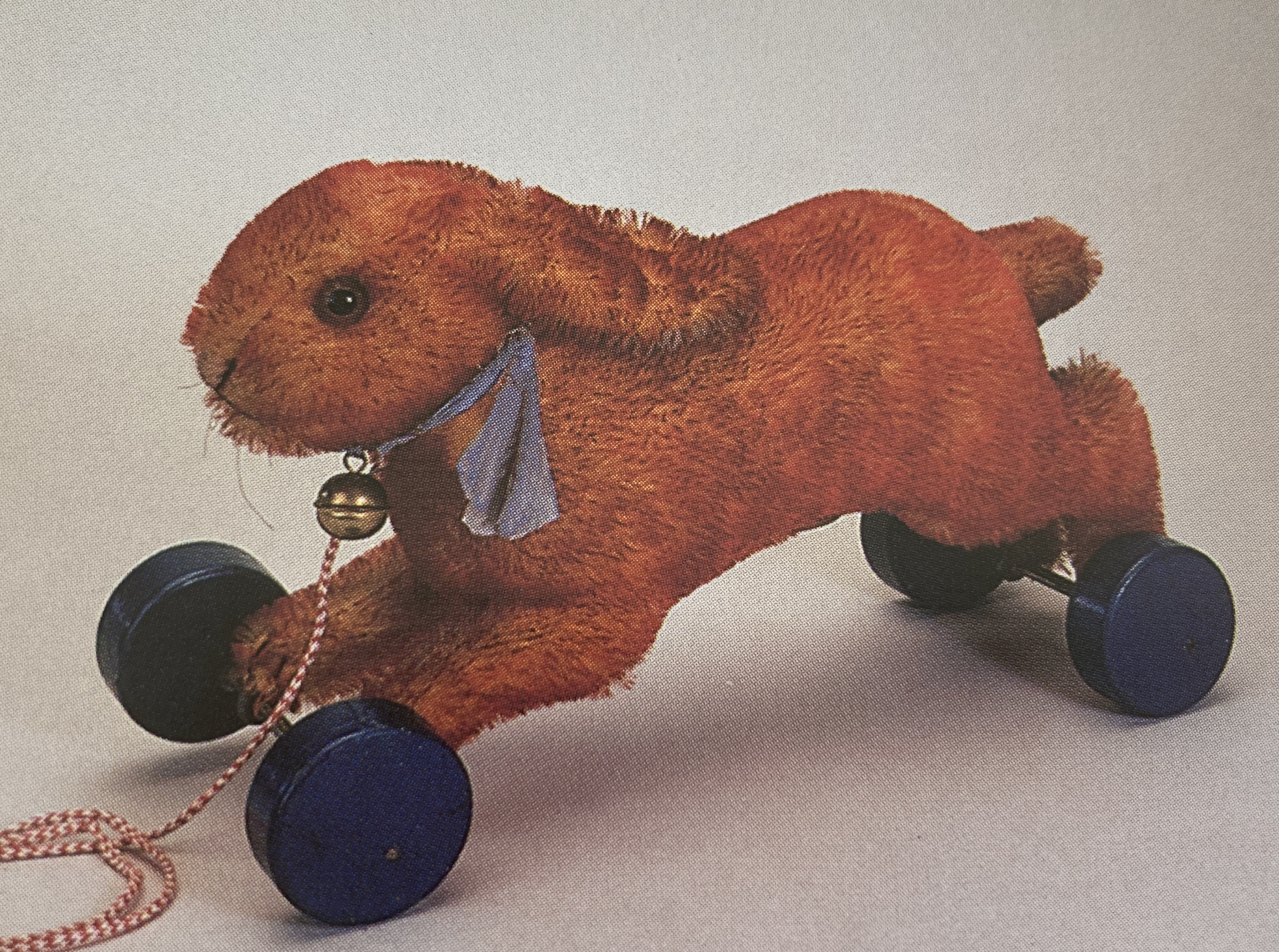
Alena's treasure is one beautiful bunny. Here you can see him relaxing with some WAH-HOO good vintage friends in the photo on the left. Rabbit is unjointed, solidly stuffed with excelsior, and features large brown and black glass pupil eyes, a hand embroidered pink and black nose and mouth, and clear monofilament whiskers. He has once vivid orange mohair. He rides upon four asymmetrical wooden "eccentric" style wheels. As such, he appears to sway back and forth as he is pulled along. This item was produced in 12, 15, 18, and 23 cm (measured vertically, top of the head to toe, not including ears or wheels) from 1927-1930 overall in this stunning color. He was also produced in an almost identical pattern in brown tipped mohair in 14, 17, and 22 cm in 1928.


Brightly colored animals, including rabbits, dogs, cats, and bears - were a delightful feature of Steiff's late 1920s to very early 1930s product line.
These sweet pets appeared in orange, pink, blue, green, gold, or other "jellybean” colored mohair or velvet fabrics, and usually had playful, youthful personalities to match! Tipped mohair - meaning mohair with just the ends or tips dyed a complementary or eye-catching color - also had its heyday in the product line around the same time. You can see a number of these colorful rabbits in the photo on the left, the image is from the company's 1929 product catalog. 

Steiff also produced a few other fun novelties featuring "larger than life" colors like Alena's wheeled rabbit.
One of particular interest is a delightful orange and white begging style rabbit on eccentric wheels. In July, 2023, the auction house Ladenburger Spielzeugauktion GmbH of Ladenburg, Germany sold this 20 cm tall rarity from 1926-1932 for nearly $4,000. He is pictured here on the left, the image is from Ladenburger Spielzeugauktion.

Steiffgal hopes you enjoyed learning about this darling, 24 carrot gold prewar novelty!

Have a question about one of your Steiff treasures? Let's talk! Click here to learn more.

Sunday, November 19, 2023

This Antique Image Featuring Steiff's Record Peter Is Pretty As A Picture

This reader's question is the real-wheel-deal indeed! And just goes to show you how far back, and how deeply, some of Steiff's legacy patterns resonate with people all around the world. Zuzana from Slovakia writes,

"Good evening,

I have a very special question for you and would be really grateful if you can help me. I am a restoration and conservation student from Academy of Fine Art and Design in Bratislava, Slovakia. I am working on this gelatine photograph of two girls with a goat in the middle. One of the girls has a pull toy monkey and I am guessing it's a Steiff toy. I was just curious, if you maybe will have any kind of information about this specific toy. This photo is the only I have and no more information was attached. Maybe you as a professional will see something I cannot.

I'm looking forward to hearing from you and thank you so so much.

Have a nice day and Greetings from Slovakia, Zuzana."


This delightful inquiry falls beautifully at the intersection of antique ephemera and Steiff history.
It is always fascinating to see Steiff items appearing in photographs of yesterday - or even last century. What you see here in the photo from Zuzana is definitely one of Steiff's most beloved and signature items - a chimpanzee on a four wheeled cart, or what is traditionally called a "Record Peter." Here on the left you can see a very early Steiff print advertisement for this very product, the image is from D. Ayers and D. Harrison's, Advertising Art of Steiff, Teddy Bears and Playthings.

Let's focus on the history and details of this marvelous monkey.
Steiff's Record Peter is unquestionably the most well-known novelty based on the company's legacy Jocko the Chimp pattern. This plaything consists of a Jocko riding upon a metal chassis hand cart which glides along on four wooden wheels - usually painted red. When Record Peter is pulled, his arms and legs swing back and forth in synchrony, giving the appearance that he’s working hard to keep his vehicle in motion. Record Peter made his debut in 1912 in 25 cm. As such, this photo was taken in 1912 at the earliest. Here on the left you can see a lovely legacy and most likely mid-century Steiff Record Peter with his original box, the image is from Invaluable.com.

The Record Peter design was an immediate sensation upon its introduction. Steiff's 1912 catalog described him as: “Record Peter, in silky brown mohair plush, seated on a self-drive chassis with sturdy wooden wheels and automatic sound box. Virtually unbreakable mechanism. Simply has to be pulled along by attached cord.” This novelty also came in a number of cataloged and colorful forms and size variations through the early 1940s. These included examples ranging from 10 to 30 cm, as well as rarities made in red, blue, yellow, white, green, red, and black mohair. Each of these colorful characters was decorated with a festive neck ruff. Given his longevity in the line, he also appeared once in a blue moon in some unconventional and/or not cataloged fabrics, including artificial silk plush and cotton plush. These "non-mohair" fabrics usually suggest that the item was made just before, during, or after one of the world wars. You can see two prewar variations on Steiff's Record Peter design below; the one on the left is made from all felt and wears a matching fez and the one of the right is made from cinnamon colored mohair. The image is from the author's collection. 

Due to his popularity, it is no surprise that Record Peter was one of the first items Steiff manufactured when the factory reopened for toy making business post WWII.
A 25 cm version was produced in brown silk plush in 1949, then in brown mohair through 1970. Even though he has not "officially" appeared full time in the line for nearly half a century, he remains one of the most cherished and timeless Steiff designs amongst collectors today.

Steiffgal hopes this discussion on this fabulous photo (and its contents) has been a picture perfect experience for you.

Have a question about one of your Steiff treasures? Let's talk! Click here to learn more.

Sunday, September 24, 2023

Racing To The Finish Line With This Amazing Steiff Gallop Novelty

There's no horsing around when it comes to this week's blog featured guest. Or guests, in this case! This amazing Steiff rarity came to Steiffgal somewhat out of the blue, and belonged to a collector on the West Coast who really, really loved precious Steiff items. Check out this prancing pair on wheels and see what makes them so delightful from the design and product development timeline perspectives.

It's off to the races with this Steiff Gallop novelty.
It consists of two standing, unjointed 8 cm mohair pets on a metal cart with red wooden wheels. The first animal is little Molly dog. She is made from tan and brown tipped mohair and is solidly stuffed with excelsior. Her face comes to life with brown and black glass pupil eyes and a black hand embroidered nose and mouth. Her ears are seamed on their outside edges, and are folded over in typical Molly style. Her IDs have been lost to time. Her companion is a distinctive cat made from silver tipped mohair. She has a trimmed muzzle, a pink hand embroidered nose and mouth, green and black slit style glass pupil eyes, and a few remaining clear monofilament whiskers. She retains her long trailing "f" button. This Molly and cat Gallop novelty appeared in the line in this size and configuration from 1926-1929.

Now let's check out the lucky passengers on this very special ride!
Standing Molly appeared in the line in 8, 12, 14, 17, 22, 28, and 35 cm from 1925-1936 overall. She was not produced standing postwar. This Gallop Molly is most likely an example of the 8 cm standard line Molly. The cat, on the other hand, did not appear in Steiff's catalog, as far as Steiffgal can tell, except on this exact novelty. This prewar black mohair cat design is just one of a tiny handful of kittens - other than the company's famous arched back Tom Cat - produced in this color and fabric before WWII.

This Gallop toy was one of three novelty pull toy designs Steiff produced from the mid-1920s through the mid-1930s. These included Roly-Drolys, Wiwags, and Gallop toys. Each of these three patterns used pairs of small, standard line items on wooden carts. All were created in response to product development need identified by Richard Steiff. He was living in America at the time and insisted that these sorts of "mobile" items were necessary in the line to keep up with the demands of the marketplace, consumer preferences, and growing worldwide competition.

And just how did these pull toys rock and roll?
Roly-Droys appeared in the line from 1924–1934. The animals rotated in circles as their cart was pulled along. "Roly-Droly" comes from the German words "rollen" (to roll) and "drollig" (funny or droll). Wiwags appeared in the line from 1924–1927; its passengers see-sawed up and down as their cart was propelled forward. And Gallop toys, like the one under review here, were made from 1926–1929. The riders glided back and forth as their cart's wheels turned round and round. Each of these metal and wooden toys came with a pull string that was tipped with a wooden knob decorated with a Steiff button. You can see Steiff's range of Gallop toys as pictured in the company's 1929 catalog. The image is from Carsten Esser's Steiff Katalog 1920-1929. 

According to Steiff's advertising, Gallop toys consisted of
..."Two different animals of fine plush on car of special construction. When pulled along, the galloping moment is produced." Gallop toys were produced in a number of configurations. These included one with a brown and white standing bear; one with a standing lion and elephant; one with a standing fox and hare; one with a Barney Google doll and a standing bear; one with a Barney Google doll and a standing Spark Plug horse; one with a Spark Plug horse and an ostrich; one with two standing goats; and one with a Molly and black cat. The advertisement on the left is from the mid-1920s and features the Molly and black cat version under discussion here today. 
The image is from Carsten Esser's Steiff Katalog 1920-1929. 

Steiffgal hopes this discussion on Steiff's Gallop novelties has put a fun spring in your step today. 

Have a question about one of your Steiff treasures? Let's talk! Click here to learn more.

Tuesday, May 2, 2023

This Early Steiff Giraffe On The Go Is The Wheel-Deal!

It's no stretch to say that Steiff's giraffes are quite the jungle gems. Prewar ones are few and far between on the secondary market, and always catch the eye of collectors. Check out this note from Lynda who would like to know more about a fine and early example from her collection. She writes:

"Hello, I would appreciate any information on age, rarity and value of this old Steiff giraffe on wheels. He measures just under 21” on wheels; the height of giraffe sans wheels 20 1/2” as he sits on a crossbar; actual wheels measure 1 3/4” in height. Thanks!"

This handsome and dramatic giraffe on the go is a legacy pre-war item. The pattern appeared overall in 9 sizes overall, ranging from 28 to 260 cm, from 1909 through 1942. Given his dimensions, Lynda's pal is the 50 cm size, as wheels are not included in his official measurements. He is made from hand stenciled felt, has mohair ears, is standing, and unjointed. His face comes to life with pert black button eyes, prominent ossicones, airbrushed features, and dramatic seams. He retains his long trailing "f" button as his Steiff ID. Giraffe debuted on metal wheels; in 1923 he started to be produced on wooden wheels. Given these details, it is safe to say that this guy was "born" in the 1909-1923 time frame.

Given his appeal and longevity in the line, it is not surprising that this giraffe on wheels pattern was produced in a few forms and variations over the years.
 
For example, the 110 cm size was also made in mohair in the early 1930s. Some larger models were made as riding toys with steering features, while the largest ones came with a saddle and footrests - much like the company's riding horses or donkeys. According to Pfeiffer's Sortiment, the saddle and foot rests were intended "for shoe stores, for fitting children's shoes."

It is interesting to note that despite his age, this model is not Steiff's debut or earliest giraffe model. The company produced felt giraffes with or without metal wheels in 17, 28, 35, and 65 cm from 1892-1909 overall. These first generation, earliest models had simpler lines and more dramatic coloring than the model under discussion here. 

Now for the tricky question - his value.
 As always, something is worth what someone will pay for it, and Steiffgal does not have a crystal ball or insights into what any given bidder or buyer would offer for it. A solid way to think about value is to see what other similar items have sold for at public auction. In 2018, a 50 cm felt giraffe in excellent to unused condition with IDs from the late 1920s-early 1930s realized about $3,751. He is pictured here on the left, and may be the same one shown in Pfeiffer's 1892-1943 Sortiment book, page 310. Given Lynda's example has significant losses and playwear, but retains its ID, has metal wheels, and probably could be restored a bit, it is Steiffgal's best GUESS that he may change hands in the c. $1,500-2,500 range. 

Steiffgal hopes this discussion on Lynda's giraffe keeps your interest in Steiff on a roll. 

Have a question about one of your Steiff treasures? Let's talk! Click here to learn more!

Saturday, October 29, 2022

This Precious Prewar Pug On Wheels Stands And Delivers!

As she continues to celebrate the arrival of her newly adopted sister-pugs, Steiffgal thought it was the perfect moment to share a special button-in ear version of the beloved breed.
Dogs have always been an important design category for Steiff, so it should be no surprise that the first flat-faced cutie was introduced in the Steiff catalog in 1916. Take a look at this very early pug on the go and see what makes him so delightful from the design and product development perspectives.

This happy traveler is 22 cm tall (not including his wheels) and made from grey mohair.
He is standing, unjointed, and solidly stuffed with excelsior. He has black hand embroidered claws on each of his feet. His distinctive face comes to life with proportional brown and black glass pupil eyes (which may be replaced), a black hand embroidered nose and mouth, and black lines on his forehead - to give him his breed-specific wrinkled forehead. His pert ears are lined in velvet, and he has a very curly tail. He retains his small trailing "f" button and traces of his white paper ear tag as his Steiff IDs.

Now let's dig deeper into his detailing.
Pug wears a leather collar, which may or may not be original to him, but is appropriate in materials, design, age, and fit. His pull cord has been lost to time. Pug is mounted to two metal rods and rides upon four wooden eccentric wheels. It is interesting to note that this pattern, unlike many other dog patterns, only came on wheels, and was not produced sitting or in any other configuration. Pug on wheels was produced in 17 cm and 22 cm from 1916-1927.

Like many of the Steiff pets debuting in the 19-teens, this perky pug has a proportional and literal design.
The key pug breed elements - a flat muzzle, wrinkled forehead, and a curly tail - are very well represented in his pattern. For the most part, Steiff's dogs, cats, rabbits, and other popular pets introduced in the c. 1910-1920 time frame were not as basic as the company's earliest patterns, but did not have the youthful, often goofy or playful appearances of those items designed in the 1920s through early 1930s. Items from around 1925 onward often featured oversized eyes, brightly colored materials, and rounded faces, bodies, and limbs. As such, Steiff's second pug - introduced in 1925 as its first pug pattern was being phased out - was a truly silly looking sitting pup with exaggerated facial features and a larger than life red felt tongue. He appeared in the line from 1925 - 1927 in 14 cm. He is pictured on the left; the photo is from Pfeiffer's 1892-1943 Sortiment.

Steiffgal hopes this discussion on the company's early Pug on wheels has captured your interested in a round-about sort of way.

Have a question about one of your Steiff treasures? Let's talk! Click here to learn more!

Saturday, October 8, 2022

Good Things Come In Threes With This Fabulous Prewar Steiff Duck Chain

It's time to get your ducks in a row and check out this next marvelous Steiff find. It's hard to believe that this family of fine feathered friends was most likely made over a century ago - they appear practically brand new today. Who wouldn't want to feather their Steiff nest with them? They are truly "aligned" in so many interesting ways....and here's why!

Good things come in threes with this duck family trio. It consists of a larger mother duck - measuring about 10 cm tall and 14 cm wide - and two baby ducks - measuring about 6 cm tall and 9 cm wide each. All the ducks are unjointed and are solidly stuffed with excelsior. They have grey felt bodies and green felt wings and heads. Their wings are decorated with yellow embroidery to look like feathers. Their beaks, legs, and feet are made from orange felt, and their eyes are little black buttons. The mother retains her original grey silk neck ribbon. The mother is cataloged as article number "2110,42 ex," and the two ducklings are cataloged as article number "2106 ex." These numbers translate to:  2= lying; 1=felt; 10= 10 cm and 06= 6 cm; 42= simple pattern with a voice; and ex= eccentric wheels. The mother and one of the ducklings retain their tiny raised script button in one foot.

Now let's check out their fabulous rides! Mom is mounted on a square metal wire carriage which glides along on four green wooden eccentric wheels. When she is pulled, she waddles and makes a peep which is generated by a little movement activated voice box embedded in her belly. You can see this feature illustrated in the photo at the end of this post. She also has a green and white twine pull string that looks period, if not original, to her. Each of her babies is mounted on a diamond shaped metal wire carriage which rides upon two green wooden eccentric wheels. They also waddle about when they are rolling along. There are loops and hooks at the end of the carriages to keep the family linked together. 

Steiff's beloved felt "duck chain" parade was a legacy item in the early 20th century. It was produced in two standard line versions: a mom with two ducklings or a mom with five ducklings. Both versions appeared in the line from 1917-1932 overall. From 1919-1921, this duck chain was produced in a substitute plush material because felt was in short supply for toy making purposes during and shortly after World War I. Steiff's signature duck chain novelties were marketed as, "This waddling felt duck with brightly colored fathers is fixed onto solidly built, eccentric wooden wheels, which provide the duck with its characteristic waddle. Also fitted with a deceptively realistic "quack-quack" voice. A droll little toy."

Steiffgal hopes this discussion on this duck chain pull toy has really tugged at your heartstrings!

Have a question about one of your Steiff treasures? Let's talk! Click here to learn more!

Thursday, August 11, 2022

This Steiff Primate Makes For One Fantastic Tale Of A Tail!

Now we are truly on a roll!
Steiffgal recently returned from a trip to St. Louis, MO to celebrate all things dolls, bears, and toys at the 2022 United Federation of Doll Clubs annual event. The salesroom associated with this gathering always has some of the finest Steiff temptations on offer - and this year did not disappoint! Check out this charming and unusual Steiff primate on wheels Steiffgal found on opening night of the festivities. You'd have to agree - he makes for one heck of a souvenir!

This handsome and unusual prewar Steiff sweetie pull toy is "officially" named Record Peter. He is 18 cm and fully jointed. He is made from white mohair. His hands, feet, face, and ears are made from tan colored felt. His pensive face comes to life with green and black glass pupil eyes, a seamed mouth, and light purple-ish and pink colored airbrushed highlights on his nose area and forehead. He rides upon a black metal, four-wheeled cart. The centered wheels are solid wood and painted red. When Record Peter is pulled along, his arms and legs move back and forth vigorously, giving the appearance that he’s working hard to keep his cart moving. When he left the factory in Giengen, Germany about a century ago, he had a pull cord attached to the front of his vehicle. Record Peter retains his long trailing "f" button and traces of his white ear tag as his Steiff IDs.

Prewar, Record Peter appeared in the standard Steiff catalog in 10, 15, 20, 25, and 30 cm in deep chocolate brown from 1913-1943 and in white in 18 cm from 1925-1934. He was also produced in a few other "surreal" colors, including blue, yellow, green, red, and black! These hues are so incredibly rare that Steiffgal has only seen photos of them. Given this Peter's ID configuration, it is Steiffgal's best thinking that he was "born" in the very beginning of his manufacturing time frame.

Now let's take a step back and look at one of the features that makes this Record Peter so unusual - in addition to his white mohair. If you study his rear end (and its ok to stare in this case) you will notice he has a tail. Unlike many other standard line tail-less primates produced by Steiff, this model indeed has a long, thin mohair tail. This appendage probably was challenging to manufacture, given its size and shape.

Here on the left, you can see the 1929 catalog page advertising some of the company's primate line for the year.
 You can click on the image to make it bigger. This page has a subtle bit of information that adds some insight to the tail issue. Here, items noted as product category "9" are chimpanzees, while items noted as product category "10" are monkeys or Record Peter items. From the scientific perspective, chimps, gorillas, and orangutans do not have tails – classifying them as "apes." Those primates with a tail are classified as "monkeys." That is why the tail-less brown mohair "Jocko" pattern we know and love is considered a "9". However, it is curious that a white, freestanding mohair primate with a tail on this page is classified as a "9," suggesting it should NOT have a tail. Perhaps something here got lost in translation?

On the way bottom on the right of the catalog page, you can spot the white primate on wheels under discussion today.
 A close-up of him is here on the left. 
You can click on the image to make it bigger. The copy reads, "Record-Peter, Speedaway movement of amusing effect. No clockwork or mechanism to get out of order, simply pull cord. Strong colored wire frame, varnished wood wheels, voice, each in a box." He is also noted as product number 10/318 (10 = a Record Peter, 3 = sitting, and 18 = size in cm); that he weighs .31 kilograms (which was important for shipping and logistics) and that he was packed one to a box.

Steiffgal hopes you've enjoyed this tale of a tail detective story!

Have a question about one of your Steiff treasures? Let's talk! Click here to learn more!

Friday, March 11, 2022

No Need To Spin Your Wheels Over This Remarkable Prewar Steiff Doll On The Go!

It's time to hit the road - literally - with this week's special blog guest.
A new friend from the state of Wisconsin in the United States asks about a special family heirloom that holds a very important place in her heart. This racy red rider has escaped identification, until now. So the question is... is he the wheel deal? 

Diane shares,
"I have never been able to locate a Steiff like my Grandmothers. It is a postman on an Irish Mail or pull cart. He is 8 inches tall when he is in the forward position. The button is in the ear. It is difficult to see the button in the photo. He was purchased in the 1930s. I have seen a few animals on pull carts but never a doll. Thank you in advance for any information you could provide."

What we have here is Steiff's super cute, and super rare, Radler doll on wooden wheels.
The doll itself is 20 cm tall, fully jointed, and made entirely from felt. He wears a red felt suit that is integral to his body. His jacket is detailed with cuffs and a collar, as well as buttons. His shoes are black, and his matching red felt hat fits nicely on his head. His boyish face comes to life with a prominent center seam, glass eyes, a dimensional mouth and nose highlighted with hand painting, rosy cheeks, and pert ears. His hair is painted. He sits upon a metal carriage which glides along on four naturally colored wooden wheels. When the cart is pulled along, it appears as if the doll is shuffling back and forth in tandem with the movement of his vehicle. This particular doll design is named "Radler" and he was produced in this size only from 1916-1929.

It's interesting to note that "Radler" is the German word for cyclist. The word is also a name for a distinctly German adult beverage. A "radler" is a mixture of beer and citrus flavored soda. It is fitting to see how a radler might enjoy a cold, frosty radler after a long bicycle ride! For a detailed history of radler the beverage, please click here!

Radler (the doll!) is part of Steiff's beloved and traditional "record" production.
"Record" refers to a jointed item riding a four wheeled cart with a handle. The first record item was "Record Peter" - a chimp on wheels - who came on the scene in 1912. He was an immediate best seller then, and remains a collector's favorite today. A Record Teddy debuted in 1913 and a Record Rabbit appeared in the catalog starting in 1926. In terms of dolls, in 1916 a series of record dolls topped Steiff's novelty production. These included a Record Puck gnome, Shockheaded Peter, Max, Moritz, a Record August (a boy in a purple felt suit) and this Radler. Over time, popular characters like Mickey Mouse, Petsy the baby bear, and Felix the Cat were also produced as record-style novelties. Postwar, record style rabbits and chimps appeared in the line through 1964 and 1970, respectively. You can see a photo of Radler as he would have appeared leaving the factory brand new a century ago - this image is from Pfeiffer's 1892-1943 Sortiment.

Steiffgal hopes this discussion of Diane's radler has been a refreshing pause in your day. 

Have a question about one of your Steiff treasures? Let's talk! Click here to learn more.

Saturday, December 19, 2020

A Hint of August In December!

Baby, it's cold outside! But this wonderful mystery from Chile - of all places - will warm your heart for sure. Check out this note from a new friend who asks about a very vintage find on wheels. He shares over time:

"Hello, my name is Adrián and I am from Chile. 

I am writing to inquire about an antique object that appears to be made by Steiff. It is a doll stuffed with straw, covered with cloth on a quadricycle, apparently it had a mechanism that when walking made the doll move. His eyes are made of glass, his body is complete but unfortunately the moths have damaged the coating.... Under the jacket it presents a purple felt. It has wooden wheels and the caddy is made of metal wire. It measures 9 inches tall. In advance I appreciate your help!"

This purple-clad Steiff doll reigns supreme!
This guy is Steiff's "Record August." The doll is made from felt and jointed. When he left the factory in Giengen more than a century ago, we was wearing a purple shirt, a matching purple brimmed cap, white trousers, a black belt, black socks, and brown shoes. You can see elements of this outfit on him today. These details were key in helping to identify him. August has traces of Steiff's first quarter of the 20th century doll facial construction, including a center seam, brown and black glass pupil eyes, a dimensional nose, and facial painting. His ride is Steiff's traditional "record" style vehicle. With this design, a jointed rider is sitting on the seat of a simple cart made from a metal chassis and four wooden wheels. The cart has a handlebar, and the rider appears to pump it back and forth as he is pulled along. Record August was produced in 20 cm from 1916-1929. A picture of him "as new" is here on the left; it is from Pfeiffer's 1892-1943 Sortiment.

So what is the story behind this wonderful find? According to Adrián:

"The truth is that my late boss was dedicated to antiques, his name was Heriberto Gudenschwager Klaassen. I continued working in his store after he passed away. I found some boxes in the shop, they were stored away for many years, and they contained several old toys on wheels - including the little boy on his quadricycle. A prewar mohair Steiff duck on wheels was also part of this collection. These toys were found in a box in the attic of an old house. My boss bought them from a grandson of the original owner. It was only this year that they were rediscovered in the shop."

In a roundabout way, Record August is part of Steiff's legacy "record" production.
The first record item was "Record Peter" - a chimp on wheels - who came on the scene in 1912 and was an immediate success. The 1912 catalog described him as: “Record Peter, in silky brown mohair plush, seated on a self-drive chassis with sturdy wooden wheels and automatic sound box. Virtually unbreakable mechanism. Simply has to be pulled along by attached cord.” A Record Teddy debuted in 1913, and by 1916, a series of record dolls topped Steiff's novelty production. These included a Record Puck gnome, Shockheaded Peter, Max, Moritz, Radler (a boy in a red felt suit) and this Record August. Over time, popular characters like Mickey Mouse, Petsy the baby bear, and Felix the Cat were also produced as record-style novelties. The record rabbit, pictured here on the left, was featured in Steiff's catalog from 1926 through 1943. Postwar, record style rabbits and chimps appeared in the line through 1964 and 1970, respectively.

Steiffgal hopes this discussion on Record August has been a joy ride for you!

Have a question about one of your Steiff treasures? Let's talk! Click here to learn more.

Sunday, March 1, 2020

It's Time For A Little Horseplay With This Sweet Steiff Filly On Wheels

Let's saddle up and take a look at this week's delightful vintage Steiff find. Here we have a barnyard friend who's really on the move, and excited to share her story with you. Check out this happy handful and see what makes her so much more than just a dog and pony show!

This pretty pony is the mane event indeed. She's 12 cm, standing, unjointed, and made from tan mohair which has been airbrushed with brown spots. Her tail and mane are made from longer, stiff mohair, and her ears are made from felt. Her face is detailed with brown and black pupil eyes and black airbrushing to indicate her nose, mouth, and other facial contours. She is ready to hit the trail with her red faux leather saddle, red plastic reins, and red string headwear detailed with yellow felt circle decorations. She is mounted on two metal axels which are connected to four blue wooden eccentric wheels. She bobs to and fro, much like a real filly, when she is pulled along. Pony on wheels was made in this size only from 1954-1957 and then again in 1960. 

Hold your horses! It's no coincidence that the information printed on filly's yellow cloth ear tag pretty much describe her to a "T." The code reads, "1312 ex." This stands for 1=standing, 3=mohair, 12= 12 cm, and ex= riding upon four wooden eccentric wheels. And her thin lettered, raised script button, which debuted in 1952, is perfectly period to her as well.

This delightful pull toy is a natural product line extension of a beloved, standard line item introduced in the early 1950s. This of course was the company's pony, which was made in 12 and 17 cm from 1951-1976 overall. The larger and smaller sizes were quite similar in design, with two details setting them apart. The first is that the smaller version had a dark tan mane, and the larger version had a white mane. The second is that the smaller version had a saddle and headwear made from thin red string and decorated with felt, while the larger one did not have a saddle and had headwear made from faux red leather and metal studs. 

Creating petite pull toys on wooden wheels from the smallest, or smaller versions of popular Steiff designs was an efficient way for the company to grow its product range in the c. 1950-1960 time frame. Versions on wheels were usually produced a few years after the animal design was initially introduced - much like in the case of the pony. For example, Cockie the cocker spaniel was introduced in 1952 in 10, 17, and 25 cm. The 10 cm Cockie was made as a pull toy from 1954-1957 and 1960. Bully the bulldog was introduced in 1951 in 10, 17, and 22 cm. The 10 cm version was made as a pull toy from 1954-1957 and 1960. And the company's postwar mohair donkey - made in 14, 22, and 28 cm from 1950 onward, was made as a 14 cm pull toy from 1954-57 and 1961. You can see Bully and Cockie on wheels here on the left.

These pint-sized, mid-century pull toys remain extremely popular with toy collectors worldwide, and for good reason! They are adorable, don't take up too much room, and look precious posed in groups or accompanying vintage dolls from any era. 

Steiffgal hopes this discussion on this pony on wheels made horse-sense to you.

Have a question about one of your Steiff treasures? Let's talk! Click here to learn more!
The teddy bear search engine