Showing posts with label US Zone. Show all posts

Sunday, May 5, 2024

All Smiles Over This Steiff Midcentury Musical Teddy Baby!

You will quickly understand why Steiffgal is whistling a happy tune over this next fantastic - and most unexpected - find. This sweet gal was found at an estate sale in the New England area in somewhat run down condition. But Steiffgal knew with a little TLC, spit, and polish (and a new spring outfit), she would be nearly her old self again. Take a look at this midcentury singing sweetie and see what makes her so interesting from the design and historical perspectives.

Can you bear it? Yes, what we have here is Steiff's Music-Baer or Music Bear. She is 25 cm tall, head jointed, and standing. Her body is a simple cylinder made from tan wool plush and her brown mohair arms are floppy. She has pink hand embroidered claws on each paw. Her head is based on the beloved and legacy Teddy baby design, originally introduced in the 1920s. Teddy has an internal Swiss music box which plays when her torso is pressed and released up and down like an accordion. When she was new, she left the factory dressed in a white cotton shirt and a red, black, and white rayon skirt with a green felt waistband and matching suspenders. 

This musical marvel was made from 1950 through 1951 only. She retains her original Steiff trailing f button, yellow ear tag with the numbers 9325 on it, and traces of a white linen "Made in the US Zone" tag in her left arm seam. All of these IDs perfectly align with her dates of manufacture - just a few years after the company opened for toy making business again following WWII. It is interesting to note that this musical Teddy baby's ID number translates to... 9=mechanical, 3=mohair, 25=25 cm tall. Steiff also made "girly" versions of this dressed music box product based on their popular Bazi the Doxie and Kitty the cat designs of the period.

This Teddy baby find really benefited from a little spa treatment. Sadly, her rayon skirt and white shirt had all but disintegrated over time; what was left of both items were in tatters. To honor her "plaid" origins, Steiffgal created a little neck scarf out of the skirt's salvageable material. You can see her factory original outfit here on the left, the photo is from Pfeiffer's 1947-2003 Sortiment. 

Music Teddy also was covered in at least a half century of dust and grime. With a little elbow grease and a gentle scrub, her original beauty and personality came shining through again! Her wool plush body and tan muzzle darkened a touch overall and evenly over time, and there's not much anyone can do about that. But her brown mohair really revealed quite a glow upon cleaning. 

As for her clothing, Teddy baby is again donning an all original Steiff outfit. Although these contemporary pieces were produced by Steiff more than a half century onward from Teddy baby's birth year, they still look great, are appropriate, and well scaled to her somewhat unusual body. She wears a green calico dress; the fabric features tiny versions of Steiff's most popular playthings and Steiff bear faced logos. And she's keeping warm with a light blue felt jacket detailed with a collar and round gold buttons; this coat was produced for a Steiff Peter Rabbit a few years ago.

Steiffgal hopes this discussion on this wonderful Teddy find has been music to your ears. 

Have a question about one of your Steiff treasures? Let's talk! Click here to learn more.

Sunday, August 20, 2023

What a Devilishly Interesting Steiff Mystery!

The devil made me do it! But in this case, it's all in good fun! Check out this note from a new friend who asks about an unusual item she found among her Mother's things. What do we have here? And could this man in red be made by Steiff? Darcie shares:

"I have a red devil doll with a Steiff tag but it is not attached. So I am not sure if it was made by Steiff. I thought Steiff’s have the metal button/tag on them. Can you help?"


Well hell-o handsome! What a great find! Although not specified, it would be Steiffgal's best bet that this devil doll is nearly identical to the blue felt version Steiff made of the Duke University Blue Devil mascot. The Duke Devil was jointed, with a felt body and a rubber head with horns. He was detailed with a blue felt suit, long blue felt tail, and white felt shoes, and carried a three pointed spear. He appeared in the Steiff line from 1954-1958, and then again from 1959-1963 as part of Steiff's early post war series of university and institutional mascots. These charming mascots were featured in F.A.O. Schwarz's catalogs in the early 1950s. 

So what might be the story behind this uncatalogued red version?
Steiffgal suspects it might be a sample or very low edition as she has never seen or heard of a red version previous to this one. The handwritten number "7128" on the early postwar ear tag provided by Darcie refers to 7= in caricature, 1= felt, and 28= 28 cm tall. This makes sense in terms of this guy for sure. 7128 is also the number of the earliest blue Duke Blue Devil mascot edition. Perhaps this red felt version with the US Zone tag and raised script button was made in the c. 1951-1953 time frame (before the launch of the Duke version) when you see items with the US Zone tag, for the most part. It is entirely possible that Steiff saw greater market potential and interest in making this rubber devil doll in blue as the Duke mascot than simply in generic red.

Steiffgal hopes this discussion on this rare devil doll has fired up your interest in the company's unusual mid-century production.

Have a question about one of your Steiff treasures? Let's talk! Click here to learn more!

Monday, May 22, 2023

Getting All Fussy Over This Lovely Steiff Gussy

This pretty kitty can only be described as the cat's meow! Steiff's early postwar production is beloved for its innovation, attention to detail, smaller scale, and the fact that items from this time frame are just so darn cute. Cats and dogs ruled the roost during this period, with this black and white beauty being a true stand out in the feline category. Come see what makes her so special from the design and product development perspectives.

Here we have Steiff's "Young Kitty Gussy." She is pictured here on the left and is 12 cm, standing, and head jointed. Her body and head are made from white mohair, while her tail is made from black mohair. She has black airbrushed highlights on her feet, rear end, sides, and around her black felt ears. Her face comes to life with a white velvet muzzle, piercing green glass slit pupil eyes, a pink hand embroidered nose and mouth, a spot of pink airbrushing on her lips, and clear monofilament whiskers. She left the factory wearing a pink ribbon. This Gussy's IDs include a raised script button, yellow ear tag, and a named, blue imprinted, bear faced chest tag.

Gussy was also produced in 17 cm. She is pictured here on the left. The larger version had two main design differences from the smaller version. Bigger Gussy featured velvet ears instead of felt ears, and had a pink velvet lined mouth instead of a closed mouth. Gussy was produced from 1952-1969 overall. In 1999-2000, Steiff produced a really sweet 17 cm Gussy replica, but did not call her Gussy. She was named 'Classic 1952 Cat', most likely a reference to her year of introduction. This special edition is pictured below and is wearing a blue ribbon.

Open mouth cats are pretty rare for Steiff. The only other mid-century examples that Steiffgal can think of here are the company's Siamy Siamese cats, which were made in 11, 15, and 23 cm from 1953-1954.

Gussy debuted in the line at a really critical time in the company's history. Gussy was introduced in the very early 1950s, so it is possible to find examples with US Zone tags and red imprinted chest tags. A few years after the conclusion of WWII, when the factory was up and running for toy making, Steiff started to produce a large number of smaller, beautifully detailed animals for export. These were brand new patterns, not carry-overs or "updated" prewar designs. Many of these were dogs and cats, as these have always been "best sellers" for the company. These new patterns helped build (and rebuild) Steiff’s business worldwide as soldiers returning home from the war in Europe often brought these “toys” back home as gifts and souvenirs of their time abroad. After all, they didn’t take up too much room in standard issue G.I. duffle bag—most even could fit in a coat pocket. These beloved and newly launched “pocket pets” included Dally the Dalmatian, Tessie the Schnauzer, Snobby the Poodle, and Gussy the Young Kitty, among others.

Steiffgal hopes this discussion on Young Kitty Gussy has tickled your whiskers!

Have a question about one of your Steiff treasures? Let's talk! Click here to learn more!

Sunday, October 17, 2021

It's Easy To Outfox This Early Postwar Steiff Mystery!

Tag - you're it - when it comes to this week's Steiff inquiry. Check out this note from a new friend who has found a mystery fox. He seems Steiff-y... but was he indeed made by the Steiff factory in Germany? And when? She shares:

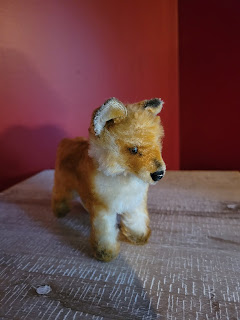
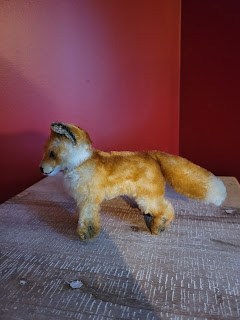
Hi - came across this little guy and thought he was cute - intrigued by the made in US Zone Germany tag located on the back of his right leg seam so I started researching and now I am wondering if he is vintage Steiff? He does not have a button or flag or anything identifying him as Steiff. He is approximately 6 inches from tail to end with another 3 inches for his tail. His head is articulated. He appears to be made of mohair and I am not sure what the filling is but it is very firm and stiff. Here are some pictures. Thank you!"

This sweet field and forest friend was indeed made by Steiff, and is one of the most beloved early post war designs amongst collectors today. This fox pattern is known for its great coloring, big fuzzy tail, and really appealing presentation. These foxes come to life with realistic airbrushed highlights on their feet, ears, and faces. Each is detailed with brown and black glass pupil eyes, a black hand embroidered nose and mouth, and a bit of pink airbrushing to on their lips. This legacy pattern was produced in 10, 14, and 17 cm from 1950-1957.  The smallest size is unjointed while the medium and larger sized ones are head jointed. The example under discussion today is most likely the medium or 14 cm version. 

Now let's get into the zone and talk about this fox's tag.
The US Zone tag on this fox is sort of a Steiff ID, but more a general indication of the time frame in which it was made. This is so because many German companies were required to note this production detail following the end of World War II. For example, 
Steiffgal has also noted similar text on items produced by Schuco - including white cloth tags on their soft plush toys as well as imprints on the chassis of their metal vehicles. White linen or ribbon tags were attached to all Steiff soft toy items from 1947 through 1953 (although Steiffgal has only personally seen them on items from 1951 onward.) These all read: Made in US - Zone Germany. Given this fox was in production from 1950-1957 and Steiff used these tags consistently from 1951-1953, it is safe to say that he was manufactured in the very early 1950s. 

The "US Zone Tag" has an interesting story behind it.  At the end of WWll, the Allied powers divided Germany west of the Oder-Neisse line into four areas: American, British, French, and Soviet occupational zones.The Americans were responsible for the southern part of Germany, which is where Steiff is located. The forces were tasked at "demilitarizing" Germany, which included shutting down many factories that did, or had the potential to produce items that could be used for combat or aggressive purposes. 

When Steiff's very limited postwar production slowly started up again in 1945 - 1946, items could only be sold to the American troops. These restrictions were gradually eased and by 1947 Steiff could sell domestically; by 1949 the company's products were once again available internationally. The "US Zone Tag" insured to the outside world that items produced in Germany were done so in a "civilian" factory and met business and distribution standards set up by the American military government overseeing the occupational zone. 

Steiffgal hopes this discussion on this mystery fox has been an engaging tail for you!

Have a question about one of your Steiff treasures? Let's talk! Click here to learn more.

Saturday, August 7, 2021

This Rare Midcentury Steiff Cat Is Certain To Tickle Your Whiskers!

Here's a sweet Steiff rarity that walked in - and quickly walked out - on little cat's feet! This early postwar kitten just appeared in the line for a handful of years in the early 1950s, and has seldom made an appearance on the secondary market or in images since then. Check out this fabulous feline and see what makes her so interesting from the design and product development perspectives. 

This leisurely lovely is simply cataloged as "Cat." She is lying, head jointed, and measures c. 27 cm wide and c. 14 cm tall. She is made from very long, soft mohair which has some grey airbrushed highlights to it in all the right cat places. She has red hand embroidered claws on each foot. Her face comes to life with pert felt lined ears, a shorter mohair muzzle area, green and black slit pupil eyes, a pink hand embroidered nose and mouth, and clear monofilament whiskers. She retains her now faded blue silken ribbon. Her squeaker works, sometimes. As for IDs, she has her script style Steiff button, traces of her yellow ear tag, and her US Zone tag. This rarity was made in this size only from 1952-1953, technically in 22 cm. She has a lovely, old fashioned look to her. 

According to the Sortiment books, her article number is 2322,1. This translates to: 2=lying, 3=mohair, 22=22 cm, and ,1=squeaker... so everything aligns here!

A picture is worth a thousand words, and here is one of the very few photos Steiffgal could find in regards to this cat. Here on the left, you can see page 5 from Steiff's "Neuheiten 52" or "New Hits for 1952" catalog. Please click on the photo to make it bigger. Cat is pictured among Steiff's now legacy early wool plush Snobby poodles, a 17 cm wool plush camel, and a pair of Gussy cats. As the title of the catalog suggests, all of these specific items "debuted" in 1952. It is interesting to note that several of these newbies are made in wool plush, a substitute material mostly used just before and just after World War II. It is possible that in 1952, both the mohair supply and the ability to manufacture this premier toy making fabric were still not back to full capacity. Perhaps Steiff did what they have always done best in adverse situations - make lemonade out of lemons. In this case, they produced a number of wool plush items that really "popped" in this distinctive, readily available fabric. 

Now back to this pretty kitty. Why did she disappear in just a two year timeframe? It is interesting to note that in 1955, Steiff introduced their beloved lying "Fiffy" cat. This little love would go on to be produced in 12, 17, and 25 cm though 1962. Fiffy was head jointed and made from white mohair that was hand-airbrushed with black stripes. Like the cat under discussion here today, her little tail wrapped around her rear, and she came to life with green and black slit pupil eyes, a pink embroidered nose, mouth, claws, and clear monofilament whiskers. It is Steiffgal's best guess that Fiffy became Steiff's midcentury lying cat of choice based on a few factors. It is possible that Fiffy was faster and easier to manufacture, required less expensive materials, and had a more "updated," modern aesthetic than did the company's 1952-1953 lying cat. 

Steiffgal hopes this story about this rare mid-century cat really tickled your whiskers. 

Have a question about one of your Steiff treasures? Let's talk! Click here to learn more!

Saturday, June 5, 2021

Check Out This Purr-fectly Lovely, Time Traveling Steiff Cat!

There's no need for a fluff factor to describe how lovely this sweet kitten really is!
Cats have been a key part of Steiff's offering since the very beginning, and have evolved in their presentation and construction over time. Just a handful of cat designs bridge the company's pre- and postwar production. This excellent example just squeezes into that elite category.

Here's a tip: this darling cat is going to steal your heart! What we have here is a 14 cm version of Steiff's Fluffy cat. Fluffy is sitting, head jointed, and made in part from 
blueish/lilac tipped mohair - which is just spectacular. Her little tail wraps sweetly around her body. Fluffy's face is detailed with large deep turquoise green and black pupil eyes, a simple hand embroidered pink nose and mouth, and clear monofilament whiskers. Her claws are indicted by pink paint, and she retains her original pink silken ribbon.

And just what makes her such a time traveler? For the most part, Fluffy is usually considered to be a legacy prewar production item. Her childlike proportions and colorful presentation (and personality!) all reflect the aesthetics of the time she was born, the "roaring '20s". Fluffy appeared in 7, 10, 14, 17, 22, 25, 30, 35, and 43 from 1926-1943 overall. However, this particular model IDs include traces of a white ear tag, a raised script button, a named, red imprinted chest tag, and a US Zone tag, suggesting that she left the factory in Giengen in the very early 1950s.

Well, it turns out this pattern also tiptoed its way into Steiff's postwar production on little cat's feet. Sitting, head jointed Fluffy in the prewar tipped bluish lilac mohair pattern was produced in 14, 17, and 22 cm from 1949 through 1950! The branding on this sweet girl really does align perfectly to this manufacturing timeframe.

Given her popularity, it is curious to think about why her production ended midcentury. This might have to do with her distinctive, signature material - a blueish/lilac tipped mohair. This distinctively old fashioned looking fabric may not have been produced in sufficient quantities or just "timed out" in popularity in the early 1950s. For the most part, Steiff rolled out a huge number of brand new, or updated dog, cat, bear, and animal patterns starting in the 1950s, perhaps to re-launch and re-invigorate its brand post war. Perhaps Steiff felt Fluffy's presentation was "too dated" for the midcentury marketplace which was focused on the space race, technology, television, and rock and roll music. In terms of sitting cats, Fluffy's design was slowly replaced by Susi, another favorite design that spanned the pre- and postwar periods. Susi was a line standard through 1978. 

Steiffgal hopes this discussion on this midcentury cat has been as close to purr-fect as possible.

Have a question about one of your Steiff treasures? Let's talk! Click here to learn more!

Tuesday, August 25, 2020

Care To Get Cosy With Steiff's Marvelous Tosi?

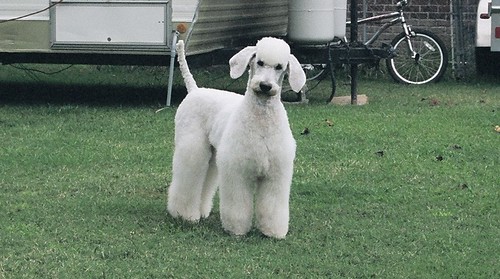
Care to noodle a delightful and unusual Poodle? Then look no further than Steiff's midcentury "curly girl" production! During a handful of years in the 1950s, Steiff introduced a number of interesting and specialty Poodles, including Maidy, a few named Snobby, and even a long legged lovely named SnobbyLac. However, one particular model has always caught Steiffgal's eye for her simplicity, authenticity, and relative rarity. Check out this mid-century marvel and see what makes her so noteworthy from the design and product development perspectives.

So let's get cosy with Steiff's lovely Tosi!
Tosi is standing, head jointed, and made from thick, lush, white wool plush. She measures 17 cm tall and 21 cm wide. Her simple, earnest face is detailed with a black glass button nose, brown and black glass pupil eyes, and a black hand embroidered nose. Other Tosi dogs Steiffgal knows of have soulful, almond shaped white, brown, and black eyes. It is her guess that Steiff probably used what eyes they had on hand at the time when producing her. Tosi's coat is in what is referred to as a "Karakul" trim, meaning that it is fluffy but uniformly the same length all over her body. She has a small, pert tail. Sadly, her red leather collar has been lost to time. 

Overall, Tosi was produced in 14, 17, 22, and 28 cm in white or black from 1950 through 1953. Because of her time of manufacturer, her factory original IDs would have included a red-imprinted chest tag and a US Zone tag in her leg seam. Her ear button options could have included a short trailing "f" button, a blank button, a STEIFF all caps button, or even a raised script button. All of these different buttons have been noted on items from the very early 1950s. 

Tosi was Steiff's debut postwar Poodle and her materials and form really reflect her time in the line.
In terms of her fabric - she is made from wool plush. This material, which also appeared in the line on many standard line Steiff animals prewar, is often considered a wartime, transitional, or mohair substitute fabric. It is quite durable, with an old fashioned look and feel to it, and is good for toy making. In this case, given its fluffy, curly, thick consistency, it is a perfect fit for Tosi's Poodle particulars. 

Although she debuted in 1950, Tosi's general presentation is more reflective of the late 1930s and early 1940s Steiff aesthetic.
Products designed and produced during those tough years were often simplified, basic patterns with minimal jointing and as little decoration as possible. Some even had a seemingly "glum" or pensive presentation. All of this was a result of trying to be as efficient with materials, labor, and logistics as possible. Most likely, some of these same constraints were still in place early post war. Nonetheless, Steiff touted Tosi's introduction in its catalogs, even making her a cover girl in 1950. You can see this "glamour" shot here on the left.

Steiffgal hopes you enjoyed dipping your "Toe-si" into the story behind this pretty period Poodle!

Have a question about one of your Steiff treasures? Let's talk! Click here to learn more. 

Saturday, March 7, 2020

Are You Smitten With This Midcentury Steiff Kitten?

It's time to let the cat out of the bag concerning this week's fantastic Steiff find. The company's delightful vintage button-in-ear kittens have long headlined Steiff and doll collectors' lists of favorites given their incredible appeal, playful personalities, and ease of display. And there's simply nothing cuter than a kindle** of Steiff kittens! Take a look at this delightful, interestingly ID'ed midcentury example and try not to fall in love with her!

This fantastic feline is an early postwar version of Steiff's beloved Susi cat. She is 17 cm tall, sitting, and head jointed. Susi is made from grey and white 
patched style mohair. Her muzzle, front feet, and chest area are white; her body, head, and tail are grey. Her grey mohair is hand airbrushed with bold, eye catching black stripes. Her front claws are red and hand embroidered. Sweet Susi's face comes to life with green and black slit pupil glass eyes, a pink embroidered nose and mouth, and clear monofilament whiskers. Her belly squeaker works, sometimes! Her dark pink silk ribbon is original to her. This mohair Susi was made in 10, 12, 14, 17, and 22 cm from 1949-1978 overall. This example was produced in the earliest part of that time frame.


Susi is paws-atively a key design in Steiff's century-plus history of cat production. Steiff debuted its original Susi cat in 1936. Prewar, she was produced in mohair in 14, 17, 22, and 28 cm through 1943. In Pfeiffer's 1892-1943 Sortiment, she is described as "mohair plush, gray tabby, sitting, very pretty model, round shape." It is very unusual to find subjective or "flattering" descriptions in the Sortiment books as they are almost always entirely factual and literal. So Susi's design really must be the cat's meow! Early postwar, Susi - like many of Steiff's legacy prewar patterns - was produced in artificial silk plush as that was the fabric that was available for toy product in the late 1940s. Art silk Susi appeared in 14, 17, and 22 cm from 1948-1949 overall.

There is so much to love about this pretty kitty. Her facial expression and presentation are lifelike and irresistible. Her construction has so much integrity, and has a distinctively "old fashioned" quality to it. And her condition is lovely, too; it's amazing she looks almost fresh as a daisy after nearly seven decades. From the historical perspective, Susi's IDs bridge pre- and post-war designs. She has her linen tag style "US Zone" tag sewn into her arm seam; technically, these appeared in items produced in the c. 1947-1953 time frame. She also has her red imprinted, "watermelon" bear faced chest tag. These appeared on items prewar from c. 1928 through the mid 1940s, then again through 1952. This tag features a very angular Teddy bear face with a distinctive "U" shaped muzzle. 


Steiffgal hopes this discussion on this early postwar Susi kitten has made you grin like a Cheshire cat.

Have a question about one of your Steiff treasures? Let's talk! Click here to learn more!

**YES! This is a real word to describe a collection or group of kittens!

Saturday, February 8, 2020

Finding This Steiff Rarity Was A Hair-Raising Experience!

Steiffgal does not mean to (hedge)hog your time, but this gorgeous gent is worth a look - or two! Steiff's royal couple, Micki and Mecki the hedgehog dolls, are legacy items in the Steiff line and are proudly represented in most Steiff collections. But did you know this pattern had a little twist to it bridging its first and second years of production? Read on to learn more!

Here we have a simply marvelous, 28 cm Mecki hedgehog doll. He is standing and head and arm jointed. His body is solidly stuffed; his legs, arms and torso are made from felt and his head is made from rubber. Mecki has a patch of long tipped mohair on his chest (how macho!) and very long, spikey mohair as his hair. His shoes are black felt with tan soles, and his pants are grey canvas with faux red and blue felt patches. He wears a red plaid shirt and a brown felt vest with leather buttons. He is supposed to look a bit dusty and "dirty," like he's spent the day hard at work, but that's just in his design and he's actually clean as a whistle. His charming and all original accessories include a rope belt, a wooden pipe, and a faux leather "wallet" containing his identification papers.

Mecki and Micki have been produced almost continuously in the Steiff line since 1951. They traditionally have appeared in 17, 28, and 50 cm; Mecki was also produced as a 100 cm Studio model in 1967. The pair were the mascots for a very popular German magazine called HorZu, which covered radio and television news. The magazine is still in business today and mostly covers TV news; it is somewhat like People Magazine here in the U.S. HorZu began publishing in 1946; the hedgehogs made their debut in 1949. Knowing a good thing when it saw it, Steiff negotiated an exclusive licensing rights to produce the dolls in 1951, and they have been a mainstay in the line to this day.

Let's get right to the point here... so what's the big deal with this common item which appeared in the line since, well, forever? So hair's why this example is WAH-HOO good. Mecki and Micki are famous for their legacy style "v" hairlines, meaning that their prickly mohair hair comes to a "v" on their forehead. However, the very FIRST examples, made in 1951, had rounded hairlines. It is incredibly rare to find a rounded hairline HorZu hedgehog doll in any condition, given their heads were made from a rubber material which tends to dry out and fall apart over time. This Mecki is in practically new condition. He retains his US Zone tag in his arm seam as well as his red rubber bangle-style bracelet which anchors his button and yellow ear flag IDs like charms. He'd only be more perfect if he also had his chest tag, but you can't have everything, eh?

Steiffgal hopes you found this discussion on this earliest Mecki doll simply hair-raising (in the best possible way.)

Have a question about one of your Steiff treasures? Let's talk! Click here to learn more!

Saturday, December 22, 2018

Going Ape Over Steiff's Unusual 20th Century Chimps

It's no secret that Steiffgal is completely bananas over Steiff's delightful and ever-happy Jocko the chimp. This marvelous monkey pattern has been in Steiff's catalog since 1909, and was given his “official” Steiff name, Jocko, in 1929. Over the years since his introduction, Jocko has been produced in sizes ranging from 10 cm to a whopping 150 cm, as well as a pull toy on wheels, a somersaulting chimp, a stringed marionette, a hand puppet and even a child’s handbag, among other treasured items.

Because the Jocko design has been around for more than a century, and its pattern is somewhat complex, it is not unusual to see slight variations on it over time. This may mean finding one in a color that is a little different from the standard brown or white versions, one is a fabric that is not traditional mohair, one that may have a distinctive expression or detailing, or even one in an unexpected size. Here are four of Steiffgal's favorite smaller first and second quarter 20th century Jockos; each one is special in his own way. All are 25 cm and fully jointed unless noted otherwise. Which of these fab four is your favorite?

1. Mystery Jocko
This first Jocko stands out aesthetically in several ways. First, Steiffgal has never seen his particular woolen fabric on any other Steiff item. It is very short, extremely dense, somewhat prickly, and an intense, lush brown - like dark chocolate or roasted coffee beans. Also unusual is his assembly; he has a slightly-to-the-left seam up his back shaped like the letter "J." Finally, his scale is chunky and his body is rather "V" shaped; broad shoulders tapering down to smallish hips. Traditional Jockos have more "H" shaped trunks from top to bottom. This peculiar primate retains his long trailing "f" Steiff button, very roughly dating him in the c. 1909 to 1936 time frame.

2. Work of Art Jocko
What makes this Jocko so eye catching is his amazing head detailing and coloration. His face is detailed with green and black glass pupil eyes set in eye pockets and a fuzzy white mohair chin. Jocko's face and ears truly come to life with delightful grey, pink, and black paint and airbrushing. He actually looks alive, and that he is making eye contact with you in real life! Work of Art Jocko has a distinctly innocent, childlike look to him that is rather precious and endearing. Prewar, Steiff made white Jockos in six sizes ranging from 10 to 25 cm from 1925 through 1943. 
Given his short trailing "f" button, Work of Art Jocko was most likely born in the late 1930s.

3. Oh Baby Jocko
This childlike chimp makes this exclusive list for his interesting ID - although his absolutely irresistible childlike expression is also a big plus! When Steiff resumed its toymaking business after the conclusion of WWII, most of its early production focused on pre-war best sellers. Of course, Jocko made this cut easily! Oh Baby Jocko has a very rare blank ear button as his ID, as well as a canvas "made in the US Zone" tag sewn into his leg seam. The company's early postwar blank buttons are quite rare and add tremendous collector and historical interest to any mid-century Steiff treasure. As suspected, Baby Jocko's IDs dates his departure from the Steiff factory around 1950, give or take a year or two. 

4. Ginger Prince Jocko
Unlike the other special Jockos noted above, this future king of the jungle Jocko measures 15 cm tall. He has a short trailing "f" button, most likely dating him to the late 1930s. You can't help but notice his AMAZING orange mohair. His fabric is backed in a light orange color, while the mohair strands are a lovely, deep orange color. He has faded a touch, but it is clear that he was "born" a glorious and unique (at least to Jockos) color. It is possible that Ginger Prince Jocko is distantly "related" to another preferred primate, Steiff's Mimocculo Orangutan, as they are both made from brilliant orange mohair. However, given that Steiff produced their smaller, non-eye moving Mimocculos only through 1933, that Mimocculo had a more elaborate facial construction, and that Ginger Prince Jocko most likely dates from the late 1930s... the two are more likely second or third cousins than brothers in this case!

Steiffgal hopes this discussion on interesting 20th century Steiff Jockos has been more fun than a barrel of monkeys!

Have a question about one of your Steiff treasures? Let's talk! Click here to learn more.

Monday, December 12, 2016

This Unusual Steiff Penguin Is All Dressed Up With No Place To Go!


Now that the holiday hooligans are in full swing, Steiffgal thought it would be a good time to invite readers to chill out and meet one of her favorite seasonal friends - a wonderful and unusually sized early postwar Steiff penguin. There's just something about these delightful black and white buddies that make them universal favorites. Perhaps it is their charming appearance, playful personalities, or their adorable wiggle walk (or all of the above!) What do you think?

Consider this your formal introduction to Steiffgal's beloved "Tux." Tux is a super-sized version of Steiff's early and original Peggy penguin design. He is pictured here on the left, towering over his 10 cm cousin of the same pattern. Tux measures a little over 50 cm tall. He is standing, unjointed, solidly stuffed with excelsior, and made from black and white mohair. His beak and oversized, fat feet are made from red felt and have black painted detailing on them. His wings are floppy and hang gently at his sides. His face comes to life with green and black slit pupil style eyes. His squeaker works loudly and clearly! Tux's Peggy pattern appeared in the line from 1952 through 1956 and was produced on a commercial scale in 10, 14, and 22 cm.

In the mid-1950s, Steiff gave its standard line Peggy penguin design a little makeover. The “new” Peggy was now more angular and lifelike; she had additional airbrushed details, a pointy beak, and slimmer grey feet. Larger versions were head jointed. The updated Peggy penguin appeared in the line from 1956 through 1975 in 10, 14, 22, 35, and 50 cm. She was also produced as a studio edition in 80 cm for a few years in the 1960s.

It is interesting to note that Tux at 50 cm is more than twice as big as the largest standard sized Steiff early Peggy of the era. However, he is about the same size as the smaller and beloved real-life "Gentoo" breed of penguins, for which he has a somewhat similar appearance. You can see a happy trio of Gentoo penguins here on the left. As such, perhaps Tux could be considered an early postwar "Studio" example by default!

Tux's IDs are consistent with his era of production. He has a linen "US Zone" tag sewn into his front hip seam, a raised script button, and a yellow tag with the numbers 4350,2 printed on it. This corresponds to 4=sitting up or begging, 3=mohair, 50=50 cm tall, and ,2=double press voice, growler, or pull cord voice - all which truly describe him in the broadest sense.  

Steiffgal hopes that Tux has added a touch of elegance and sophistication to you day.

Have a question about one of your Steiff treasures? Let's talk! Click here to learn more!

Monday, August 27, 2012

This Vintage Steiff Elephant Has Wheel Appeal!

It's certainly easy to be on a roll when it comes to delightful vintage Steiff collectibles!  It just seems that things on moving carriages have "wheel appeal" to most Steiff collectors all over the world.  And such is the case here with this half-century plus old family heirloom.  Take a note from this reader who asks about her newly acquired plush pachyderm.  Anita writes in part...

"Hi Steiff Gal! 

I am interested in learning more about  a Steiff elephant on wheels I inherited. Based on my own detective work and help from others, I believe he is a 1950 pull toy, Steiff Sortiment serial number 1335.  I was hoping you might be able to confirm this or advise if you think he could be something different.  

I am attaching several pictures including the button, the tag, and the wheel markings.  The button has block lettering and no trailing line on the F.  He has a chest tag that is half gone but what is visible appears to be "Made in US Zone Germany."  No other tags or markings I can find other than on the wheel which reads "STEIFF 66 (or 55) X 12".  I measured him at 15 inches long and 11 inches high. We believe he is mohair and his eyes are either glass or plastic. Oh, he has a working squeaker, too! His stuffing feels harder but I am not sure what it's made of.

Apparently he also used to have a little blanket and leather head piece which is missing.   I looked carefully and actually do see a few red threads on his body that I was wondering about before as they seemed attached to him.  Now that makes sense.  Also when I look at the wear on the top of his head I can see the outline of where the head piece may have been.   

I am so fortunate to have inherited him.  I have enjoyed seeing him in our family my whole life. However, I do not know where he originally came from except that we think my mother or father must have gotten him since no other relatives remember him.  

Thanks for any information you can provide!

Anita"

Steiffgal doesn't want to push the issue, but what Anita has here is called Steiff's Zieh Elephant or Pull Toy Elephant He is standing, unjointed, and made from grey mohair.  He has white felt tusks and a happy, smiling open mouth.  He was made in 28 and 35 cm from 1949 through 1961.  If he is 11 inches high (assuming height without wheels) then his is most likely the 28 cm size and has shrunk just a bit over time; this tends to happen with older excelsior stuffed items.  He came originally with a red felt blanket detailed with a yellow moon and star design, and red leather head dress. 

This excellent elephant has several features which allow him to be dated quite precisely.  This item had blue painted wooden wheels in 1949 and metal wheels with rubber tires from 1950 through 1961. He also has a US Zone tag, which dates him him from about 1947 through 1953, and the relatively rare Steiff block button, dating him from around 1950 or so.  If you dovetail all of this information, he probably was made in 1950 and as such is item #1328,2.  If he were made in 1951, which is also a possibility, his item number would be #1328,1.  These numbers translate into 1=standing; 3=mohair; 28 =28 cm; ,1= squeaker; and ,2=double press voice, growler, or pull chord voice. 

To restore or not to restore, that is a question here.  Steiffgal thinks that Anita's elephant is a very nice example of a classic item and would probably would benefit from restoration. Suggested basic improvements would include a good cleaning and a little re-stuffing around the trunk and head area.  It may also be good to recreate his original blanket and headdress as closely as possible.  The picture here to the left shows what this model looked like when new; it is the 1949 version with blue wooden wheels.  Anita's piece from 1950 or 1951 would be identical except for the wheels.  

Now for the question that turns Steiffgal into a wild beast - his value.  As always, Steiffgal is not an appraiser and truly believes something is worth what someone will pay.  The piece is in somewhat rough shape as it stands now.  Unfortunately, for many collectors, the condition and appearance of the face greatly drives its overall appeal and desirability - and that is one of the main problem areas with this example.  It is Steiffgal's best guess  is that although he probably has some collector's value, most of it is sentimental, given his current condition.  Getting him back in shape will at least preserve the value he has, and make him last for many more generations to come.  If he were Steiffgal's, she would make the investment.  

Steiffgal hopes this discussion on Anita's Pull Toy Elephant has been a fun joy ride for you.

Have a question about one of your Steiff treasures? Let's talk! Click here to learn more
 
The teddy bear search engine