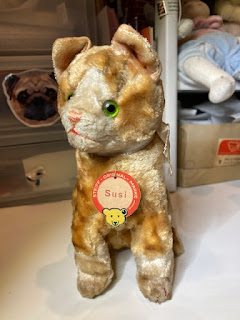
Orange you in the mood for something unexpected? Steiff's midcentury kittens are always the cat's meow, but this particular find is purr-fect in every way! Check out this fantastic feline and see what makes her so interesting from the design and historical perspectives.
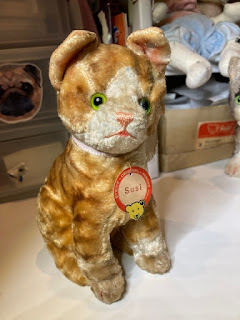
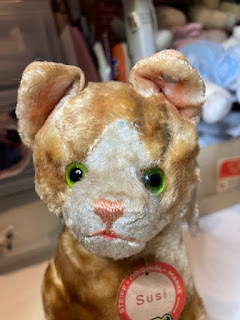
This smooth-as-silk sweetie is an unusual example of Steiff's beloved Susi cat design. She is 16 cm tall, sitting, and head jointed. Susi is made from artificial silk plush. Her muzzle, front feet, and neck are white while her body, head, and tail are a marmalade color. The marmalade areas are hand airbrushed with dark orange or brown stripes. Her face comes to life with piercing green and black round pupil glass eyes, a pink hand embroidered nose and mouth, traces of a few clear monofilament whiskers, and a touch of pink paint to mark her lips. She has red embroidered claws on her front two paws. She retains her original pink bow. Her IDs include a large, watermelon style red imprinted chest tag, a short trailing f button, and traces of a light yellow or white ear tag.
Steiff's legacy Susi pattern has been a collector's favorite since her debut in 1936. It is rumored that this beloved design was named after a member of the Steiff family. Prewar, she was produced in grey and white mohair in 14, 17, 22, and 28 cm through 1943. In Pfeiffer's 1892-1943 Sortiment, she is described as "mohair plush, gray tabby, sitting, very pretty model, round shape." It is very unusual to find subjective or "flattering" descriptions in the Sortiment books as they are almost always entirely factual and literal. So Susi's design must have really caught someone's eye! Shortly after the conclusion of WWII, Steiff began manufacturing just a handful of their most popular prewar patterns - including a version of Susi. Her pattern was first produced in grey and white artificial silk plush in 14, 17, and 22 cm from 1948 to 1949, and then in mohair in 10, 12, 14, 17 and 22 cm from 1948 through 1978.
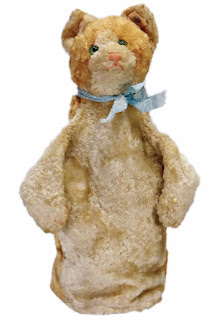
As far as Steiffgal can tell, this marmalade and white artificial silk plush full bodied Susi cat does not appear in any of the standard Steiff reference books. However, it is interesting to note that she resembles a most unusual marmalade and white artificial silk plush Steiff puppet sold at auction in 2019. This puppet, which is pictured here on the left, generated 20 bids and realized over $3,000! You can see that they share similar coloring and materials, as well as the same green and black pupil eyes, and other facial detailing. This puppet was described in the catalog as, "hand puppet, faux silk plush, cat, shiny button, rests of the ocher-colored paper sign, was produced during the war, good condition, nice colors." The photo is from Liveauctioneers.com.
So, what's the story with this very pretty, albeit uncatalogued kitty? Here are a few ideas. It is entirely possible that she is a variation of the grey and white artificial silk plush version from the late 1940s. Her IDs align perfectly to that time frame. Given her stunning but unconventional hue and era of manufacture, she may have been produced as a sample of a design that never went into commercial scale production; was made from the only fabrics available at the time; or perhaps was designed and produced as an item for sale at the PX stores where American soldiers shopped immediately post WWII. However, only she knows for sure!
Steiffgal hopes this discussion on this happily hued Steiff Susi has tickled your whiskers, in the best possible way.
Have a question about one of your Steiff treasures? Let's talk! Click here to learn more.
Showing posts with label Susi. Show all posts
Thursday, February 3, 2022
Friday, October 8, 2021
The Eyes Have It With This Adorable Prewar Steiff Kitten
Looking for a little something to tickle your whiskers this fine fall day? Then check out this short but sweet note from a new friend. Jenny needs help identifying a precious pet. Could it be made by Steiff? She shares,
"I was wondering if you could help me identify an old possibly Steiff cat... It feels like wool and stuffed with wood. Thanks!"
What a pretty kitty! From the looks of him, Jenny's kitten looks to be sitting, probably head jointed, and made from wool plush, not mohair. Wool plush has a more fluid, continuous look and feel to it, while mohair tends to have more of a prickly "hooked rug" appearance where the fabric backing meets up with the surface fibers. The fact that he is "stuffed with wood" is consistent with his stuffing being made from excelsior. Other distinctive features of this example include traces of airbrushed highlighting on its body, tiny pink claws, clear monofilament whiskers on his nose and forehead, a tail that wraps gently around his backside, a pink hand embroidered nose and mouth, and piercing teal and black slit style pupil eyes. His size is noted at 6.5 inches tall, or nearly 17 cm tall.
All of those factors help to cat-alyze his likely identification. It is possible that Jenny's kitty is a rare and well loved example of the company's seldom seen prewar sitting wool plush cat. This appealing pattern was made in 10, 14, 17, 22, and 28 cm from 1929 through 1933 overall. All of these fancy felines left the factory wearing a large silken ribbon. You can see this wool plush rarity pictured here on the left, the photo is from Pfeiffer's 1892-1943 Sortiment. You can't help but notice the basic resemblance of this wool plush cat pattern to the company's most beloved sitting Susi cat design. She was produced prewar in 14, 17, 22 and 28 cm from 1936 through 1943, and then again postwar from 1948 through 1978 in 10, 12, 14, 17 and 22 cm.
The timing of all of this is quite interesting. The cat under review today was made at a critical time point in the company's history. Germany entered a period of economic depression and widespread unemployment in 1929 while growing anti-German sentiment crippled Steiff's export markets. These realities triggered a number of fundamental product design, production, and distribution changes at Steiff. One very noteworthy revision was the increased use of substitute fabrics in manufacturing. As traditional toy making materials became more expensive and more challenging to source, the company started to look at alternative fabrics to use in place of mohair. This may explain why this cat debuted in wool plush - a less expensive and readily available fabric - exactly at this time.
Steiffgal hopes this discussion of this prewar cat has added a purr-fectly pleasant paws to your day.
Have a question about one of your Steiff treasures? Let's talk! Click here to learn more!
Labels:
antique,
button in ear,
cat,
feline,
kitten,
kitty,
mohair,
mysteifflife,
plaything,
prewar,
ribbon,
sitting,
Steiff,
Steiffgal,
Steifflife,
Susi,
toy,
whiskers,
wool plush
Saturday, June 5, 2021
Check Out This Purr-fectly Lovely, Time Traveling Steiff Cat!
There's no need for a fluff factor to describe how lovely this sweet kitten really is! Cats have been a key part of Steiff's offering since the very beginning, and have evolved in their presentation and construction over time. Just a handful of cat designs bridge the company's pre- and postwar production. This excellent example just squeezes into that elite category.
Here's a tip: this darling cat is going to steal your heart! What we have here is a 14 cm version of Steiff's Fluffy cat. Fluffy is sitting, head jointed, and made in part from blueish/lilac tipped mohair - which is just spectacular. Her little tail wraps sweetly around her body. Fluffy's face is detailed with large deep turquoise green and black pupil eyes, a simple hand embroidered pink nose and mouth, and clear monofilament whiskers. Her claws are indicted by pink paint, and she retains her original pink silken ribbon.
And just what makes her such a time traveler? For the most part, Fluffy is usually considered to be a legacy prewar production item. Her childlike proportions and colorful presentation (and personality!) all reflect the aesthetics of the time she was born, the "roaring '20s". Fluffy appeared in 7, 10, 14, 17, 22, 25, 30, 35, and 43 from 1926-1943 overall. However, this particular model IDs include traces of a white ear tag, a raised script button, a named, red imprinted chest tag, and a US Zone tag, suggesting that she left the factory in Giengen in the very early 1950s.
Here's a tip: this darling cat is going to steal your heart! What we have here is a 14 cm version of Steiff's Fluffy cat. Fluffy is sitting, head jointed, and made in part from blueish/lilac tipped mohair - which is just spectacular. Her little tail wraps sweetly around her body. Fluffy's face is detailed with large deep turquoise green and black pupil eyes, a simple hand embroidered pink nose and mouth, and clear monofilament whiskers. Her claws are indicted by pink paint, and she retains her original pink silken ribbon.
And just what makes her such a time traveler? For the most part, Fluffy is usually considered to be a legacy prewar production item. Her childlike proportions and colorful presentation (and personality!) all reflect the aesthetics of the time she was born, the "roaring '20s". Fluffy appeared in 7, 10, 14, 17, 22, 25, 30, 35, and 43 from 1926-1943 overall. However, this particular model IDs include traces of a white ear tag, a raised script button, a named, red imprinted chest tag, and a US Zone tag, suggesting that she left the factory in Giengen in the very early 1950s.Well, it turns out this pattern also tiptoed its way into Steiff's postwar production on little cat's feet. Sitting, head jointed Fluffy in the prewar tipped bluish lilac mohair pattern was produced in 14, 17, and 22 cm from 1949 through 1950! The branding on this sweet girl really does align perfectly to this manufacturing timeframe.
Given her popularity, it is curious to think about why her production ended midcentury. This might have to do with her distinctive, signature material - a blueish/lilac tipped mohair. This distinctively old fashioned looking fabric may not have been produced in sufficient quantities or just "timed out" in popularity in the early 1950s. For the most part, Steiff rolled out a huge number of brand new, or updated dog, cat, bear, and animal patterns starting in the 1950s, perhaps to re-launch and re-invigorate its brand post war. Perhaps Steiff felt Fluffy's presentation was "too dated" for the midcentury marketplace which was focused on the space race, technology, television, and rock and roll music. In terms of sitting cats, Fluffy's design was slowly replaced by Susi, another favorite design that spanned the pre- and postwar periods. Susi was a line standard through 1978.
Steiffgal hopes this discussion on this midcentury cat has been as close to purr-fect as possible.
Have a question about one of your Steiff treasures? Let's talk! Click here to learn more!
Steiffgal hopes this discussion on this midcentury cat has been as close to purr-fect as possible.
Have a question about one of your Steiff treasures? Let's talk! Click here to learn more!
Saturday, March 7, 2020
Are You Smitten With This Midcentury Steiff Kitten?
This fantastic feline is an early postwar version of Steiff's beloved Susi cat. She is 17 cm tall, sitting, and head jointed. Susi is made from grey and white patched style mohair. Her muzzle, front feet, and chest area are white; her body, head, and tail are grey. Her grey mohair is hand airbrushed with bold, eye catching black stripes. Her front claws are red and hand embroidered. Sweet Susi's face comes to life with green and black slit pupil glass eyes, a pink embroidered nose and mouth, and clear monofilament whiskers. Her belly squeaker works, sometimes! Her dark pink silk ribbon is original to her. This mohair Susi was made in 10, 12, 14, 17, and 22 cm from 1949-1978 overall. This example was produced in the earliest part of that time frame.
Susi is paws-atively a key design in Steiff's century-plus history of cat production. Steiff debuted its original Susi cat in 1936. Prewar, she was produced in mohair in 14, 17, 22, and 28 cm through 1943. In Pfeiffer's 1892-1943 Sortiment, she is described as "mohair plush, gray tabby, sitting, very pretty model, round shape." It is very unusual to find subjective or "flattering" descriptions in the Sortiment books as they are almost always entirely factual and literal. So Susi's design really must be the cat's meow! Early postwar, Susi - like many of Steiff's legacy prewar patterns - was produced in artificial silk plush as that was the fabric that was available for toy product in the late 1940s. Art silk Susi appeared in 14, 17, and 22 cm from 1948-1949 overall.
Steiffgal hopes this discussion on this early postwar Susi kitten has made you grin like a Cheshire cat.
Have a question about one of your Steiff treasures? Let's talk! Click here to learn more!
**YES! This is a real word to describe a collection or group of kittens!
Labels:
antique,
artificial silk plush,
button,
cat,
chest tag,
collectible,
kitten,
mohair,
plaything,
ribbon,
Steiffgal,
Steifflife,
Susi,
toy,
US Zone,
vintage,
watermelon
Saturday, September 30, 2017
Purr-haps You Recognize This Unusual Steiff Cat ?
This purr-fectly lovely girl is an early version of Steiff's Susi cat. She is 17 cm tall, sitting, and head jointed. Susi is made from artificial silk plush. Her muzzle, front feet, and chest area are (were) white while her body, head, and tail are (were) grey. The grey areas are hand airbrushed with black stripes. Her face comes to life with back painted green and black slit pupil glass eyes and a pink embroidered nose and mouth. Her clear monofilament whiskers and her red claws have been lost to time. You can feel the squeaker in her belly, but it is not working now. This version of Susi was produced in 14, 17, and 22 cm from 1948 to 1949 only.
Given cats do have nine lives, and taking into account her date of introduction, it is possible Susi's updated pattern was designed to replace the company's legacy sitting, head jointed "Fluffy" cat pattern. Fluffy was introduced in the mid-1920's and reflected the "roaring 20's" aesthetic ideal of that era. Items designed for that period were often "fat, fluffy, and feminine," and sometimes featured "unnatural" color - like the blue on Fluffy's backside. But the times had clearly changed in the interim. You can see a photo of Fluffy here on the left; this example is from the collection of Shelley Smith. Post war, Susi remained the cat's meow. She was produced in mohair from 1949 through 1978 overall in 10, 12, 14, 17 and 22 cm. Almost 40 years onward, she is still a classic favorite, with the smallest versions especially in demand among Steiff and doll collectors alike.
Steiffgal hopes this discussion on Steiff's rare early post war silk plush Susi cat has you feline groovy.
Have a question about one of your Steiff treasures? Let's talk! Click here to learn more.
Labels:
antique,
artificial silk plush,
button in ear,
capital letters,
cat,
feline,
Fluffy,
head jointed,
kitten,
plaything,
Steiff,
Steiffgal,
Susi,
toy,
vintage
Sunday, September 25, 2016
It's Twice As Nice With These Two Steiff Tabby Cats From The Late 1920's
Although by nature more of a "dog" person, Steiffgal has started to put a few more Steiff kittens into her meow mix lately. Her most recent additions have something in common - they are both sweet "Tabby" style cats from the late 1920's. Check out these two fantastic felines and see if they have you "feline groovy" too.
This first Tabby has a purr-fectly angelic look to her. She is 10 cm tall, standing on all fours, is head jointed, and made from tan mohair that has been striped with orange highlights. Her limbs and tail are elegant and shapely Her face comes to life with oversized teal and black slit pupil style glass eyes, a light pink embroidered nose and mouth, and a spot of red right on her lips. She has a particularly inquiring look on her face. This Tabby even retains a few of her original monofilament whiskers remaining on her muzzle and forehead. This cool cat was made in mohair in 7, 10, 12, 14, 17, and 22 cm from 1928 through 1937.
The second Tabby appears to be lying down on the job, but that's ok in this case. She is unjointed and measures 5 cm tall and 10 cm long (not including her tail.) She is lying in a very relaxed way, as if she's observing something very interesting in the room - perhaps a dust bunny, or a window shade moving in the breeze? Tabby is made from tan mohair that is striped in more tan or light brown colored highlights. Her sweet face comes to life with oversized light teal and black slit pupil style glass eyes, a light pink hand embroidered nose and mouth, and a spot of red right on her lips. She retains most of her original monofilament whiskers. Lying Tabby, in all honesty, was made in 8 sizes ranging fro 5 to 20 cm from 1928 through 1935.
Both of these Tabby patterns reflected Steiff's approach to cat design and production in the 1920's. It was at this time that the company started diversifying their cat offerings, as well as matching their cats’ appearances to the cultural preferences of the time. Steiff’s cats from the mid-1920’s onward were distinctly feminine, fluffy, and playful in appearance - much like all things popular from the “roaring ‘20s.” Felines from this period often had oversized, childlike eyes; were made from brightly colored materials; and had youthful detailing or textures. They were in great demand both as playthings for children as well as companions for adults. It is also interesting to note that it was at this time that the company began giving “real” names to its cat designs, with the first one being “Fluffy,” a blue-tipped mohair sweetie who was introduced in 1926. Prior to that, any cat in the line was simply named “Cat." Fluffy was a smashing success, and remains a collector's favorite today.
It is safe to say that Fluffy let the cat out of the bag in terms of creating a huge demand for Steiff's cat offerings. As such, Steiff quickly followed up on Fluffy’s popularity with a number of additional cat introductions. Like Fluffy, these were all designed and named to evoke softness, gentleness, and cuddling. These included the adult “Kitty,” who was standing on all fours, fully jointed, and featured a “tail moves head” mechanism; baby “Tabby,” who was standing on all fours or lying; the exotic, blue eyed, sitting “Siamy” Siamese Temple cat; and “Susi,” a very pretty sitting, head jointed tabby cat. Kitty, Tabby, Siamy, and Susi were all manufactured through the early 1940’s. And due to their popularity, they all reappeared in the line in the late 1940’s after the factory reopened for toy making business at the conclusion of WWII.
Steiffgal hopes this discussion on the company's early Tabby cats has made for a pleasant paws in your day.
Have a question about one of your Steiff treasures? Let's talk! Click here to learn more.
![]() |
| Standing Tabby in all of her glory. |
![]() |
| Lying Tabby closely observing something. |
![]() |
| Close up of standing Tabby's face. |
![]() |
| Close up of lying Tabby's face. |
Steiffgal hopes this discussion on the company's early Tabby cats has made for a pleasant paws in your day.
Have a question about one of your Steiff treasures? Let's talk! Click here to learn more.
Friday, February 5, 2016
"Lots" Of Outstanding Steiff Treasures Up For Sale At The Upcoming Steiff Sonder-Auktion On February 19th!
February unquestionably is a short, dark, and cold month. But a number of fantastic auctions starting mid-month should really heat things up for collectors. Over the next few weeks, Steiffgal will present highlights from three upcoming world-class Steiff-centric sales events that should be on the calendar of every enthusiast. Let's start with the "Steiff Sonder-Auktion" at Ladenburger Spielzeugauktion. This exclusively Steiff sale will be held on February 19th, 2016 in Germany.
The items for sale at this upcoming auction are simply amazing, and read like a "who's who" of the most sought after Steiff rarities. So it is all but impossible to pick out three highlights as each item is outstanding in its own way. So Steiffgal will share three selections that simply catch her eye - as well as call to her heart.
It's hard not to notice lot 1339, a standing Steiff Putzi. He is cataloged as...
"Putzi, dog caricature, produced between 1932 - 1935, wool plush, white, attending, with button in ear, long stretched F, used condition, swivel head, very rare, unusual."
This adorable character was produced in 17, 22, and 28 cm and was modeled on the well known "Putzi" comic strip of the time. His chest tag reads, "I am Putzi, of the TAZ." TAZ is the name of a German newspaper publisher. According to Steiff records, a total of 2,542 Putzi dogs were manufactured overall. This is only the second one Steiffgal has ever seen come up for sale on the secondary market.
In addition to his playful presentation, Putzi has two interesting design features. The first is his glass nose. Of course, it is not unusual for Steiff items to have glass eyes. But this is only one of a handful of items Steiffgal has come across that features a glass nose. A few of the company's early 1950-era poodles also have this distinctive facial detail. The second feature has been lost to time on this Putzi, but is important to note nonetheless. Every Putzi dog that left the Giengen factory had distinctive eyebrows placed high on his forehead. This was done to mirror Putzi's appearance in print.
It's time to roll forward to Steiffgal's second auction pick. It would be hard to outfox lot 1381, a charming fox on wheels. He is cataloged as...
"fox on excenter-wheels, c. 1925, with button, long stretched F, height 14 cm, length 20 cm, copper-colored mohair, at single places with slight mohair loss, otherwise good condition."
This field and forest favorite was produced in 14, 17, and 22 cm on eccentric wooden wheel from 1915 through 1933.
Admit it, you also have a plush-crush on this fantastic fox. His outstanding, vibrant copper coloring makes perfect cents in bringing him to life. And it's impossible to resist his "Teddy bear" style face, black mohair detailed ears, and charming presentation.
Steiffgal's third pick may just surprise you - but remember, sometimes less is more! Have a ball and check out lot 1456. This simple lot of two cats is cataloged as...
"2 cats, sitting, 1x pre-war era, with button, 1x without button, ear damaged, 10 cm, otherwise good condition."
This "hidden gem" duo consists of what appears to be a sweet, well loved mid-century Susi cat plus a most unusual Steiff "Ball Cat." The Ball Cat, which has a distinctive, simple, rounded body shape, was produced in 9 and 15 cm from 1934 though 1943 overall.
Let's get around to discussing what makes the Ball Cat such a find. Steiff made a series of small "ball" style animals starting in the early 1930's. These included a lion (1934 to 1935), Teddy (1935 to 1940), Chin-Chin (1932 to 1935), Molly (1934 to 1935), rabbit (1932 to 1943), duck (1932 to 1943), and elephant (1932 to 1940). All were simple versions of popular line items; many, like the cat, had pom-pom front limbs. What's amazing about these items is that any survived at all given they were made to fit in the palm of a child's hand and designed as toys for youngsters! As such, examples in good condition seldom, if ever, appear on the secondary market. A not so good example of the Ball Lion from Steiffgal's collection is pictured here on the left.
This is the first time Steiffgal has featured auction selections from Ladenburger Spielzeugauktion in this blog. As such, here's a little interview with the company's owner and auctioneer.
Steiffgal: Tell a little bit about yourself and responsibilities at Ladenburger Spielzeugauktion.
Mr. Seidel: My name is Götz C. Seidel. I am the owner of Ladenburger Spielzeugauktion. My responsibilities include describing the items, customer contact and service, and running our auctions and business along with my daughter and son-in-law.
Steiffgal: Tell us about your auction house and its history. How long has the company been in business? What type of things does the company sell? How many does the company have per year?
Mr. Seidel: We are a family company and have been in business since 1989. We sell historical toys and important items ranging from the Biedermeyer-time (an era in Central Europe between 1815 and 1848 when the arts and decorative items had wide appeal) to the greater 19th century through the beginning of the 20th century. These would include things like tin toys, trains, traditional German folk art items, Christmas decorations, Steiff animals and bears, doll houses and furniture, and dolls. We have four main auctions, plus several specialty auctions, per year.
Steiffgal: Ladenburger Spielzeugauktion's upcoming Steiff auction has many remarkable treasures. Are they from one collection, or from several consignors?
Mr. Seidel: Many of the fine consignments are from one person, who wishes to remain anonymous. This person inherited the collection from a relative who authored several books on Steiff.
Steiffgal: In your opinion, what is the most special item in the auction? What is your favorite lot in the auction?
Mr. Seidel: For me there are two. The first is lot 1369, the baby Mimocculo orangutan with movable eyes, and the second is lot 1170, a charming white Teddy bear with his original white ear tag. (Both of these outstanding sections are pictured here on the left.)
Steiffgal: Are there any items in Ladenburger Spielzeugauktion's upcoming auction that were new to you or your team - things that you had never seen before?
Mr. Seidel: Oh yes! Lot 1398, the "Krinoline" coffee warmer was new to all of us! She is cataloged as...""Krinoline" coffee warmer, felt, multicolored, standing, arms and head
are movable, for warming coffee- or teapots, thick felt lining, item
description "KR 43", exceptional inset eyes, shiny button, wool hair,
color is faded, 43 cm, produced between 1908 - 1912, rare." (This amazing rarity is pictured here on the left.)
Steiffgal: Wow, I had never seen her before, either! One last question for you. If your auction house could sell any Steiff piece ever created, which one would that be and why?
Mr. Seidel: Margarete Steiff's elephant pincushion, of course. That's because it's the most historical Steiff object of all.
Steiffgal: Thank you so much for your time, and best of luck at this sales event! Readers, you can participate online in this auction through LiveAuctioneers. For more information, click here!
Steiffgal hopes this Steiff related discussion and interview has been the highlight of your day.
Have a question about one of your Steiff treasures? Let's talk! Click here to learn more.
The items for sale at this upcoming auction are simply amazing, and read like a "who's who" of the most sought after Steiff rarities. So it is all but impossible to pick out three highlights as each item is outstanding in its own way. So Steiffgal will share three selections that simply catch her eye - as well as call to her heart.
It's hard not to notice lot 1339, a standing Steiff Putzi. He is cataloged as... "Putzi, dog caricature, produced between 1932 - 1935, wool plush, white, attending, with button in ear, long stretched F, used condition, swivel head, very rare, unusual."
This adorable character was produced in 17, 22, and 28 cm and was modeled on the well known "Putzi" comic strip of the time. His chest tag reads, "I am Putzi, of the TAZ." TAZ is the name of a German newspaper publisher. According to Steiff records, a total of 2,542 Putzi dogs were manufactured overall. This is only the second one Steiffgal has ever seen come up for sale on the secondary market.
In addition to his playful presentation, Putzi has two interesting design features. The first is his glass nose. Of course, it is not unusual for Steiff items to have glass eyes. But this is only one of a handful of items Steiffgal has come across that features a glass nose. A few of the company's early 1950-era poodles also have this distinctive facial detail. The second feature has been lost to time on this Putzi, but is important to note nonetheless. Every Putzi dog that left the Giengen factory had distinctive eyebrows placed high on his forehead. This was done to mirror Putzi's appearance in print.
It's time to roll forward to Steiffgal's second auction pick. It would be hard to outfox lot 1381, a charming fox on wheels. He is cataloged as...
"fox on excenter-wheels, c. 1925, with button, long stretched F, height 14 cm, length 20 cm, copper-colored mohair, at single places with slight mohair loss, otherwise good condition."
This field and forest favorite was produced in 14, 17, and 22 cm on eccentric wooden wheel from 1915 through 1933.
Admit it, you also have a plush-crush on this fantastic fox. His outstanding, vibrant copper coloring makes perfect cents in bringing him to life. And it's impossible to resist his "Teddy bear" style face, black mohair detailed ears, and charming presentation.
Steiffgal's third pick may just surprise you - but remember, sometimes less is more! Have a ball and check out lot 1456. This simple lot of two cats is cataloged as..."2 cats, sitting, 1x pre-war era, with button, 1x without button, ear damaged, 10 cm, otherwise good condition."
This "hidden gem" duo consists of what appears to be a sweet, well loved mid-century Susi cat plus a most unusual Steiff "Ball Cat." The Ball Cat, which has a distinctive, simple, rounded body shape, was produced in 9 and 15 cm from 1934 though 1943 overall.
Let's get around to discussing what makes the Ball Cat such a find. Steiff made a series of small "ball" style animals starting in the early 1930's. These included a lion (1934 to 1935), Teddy (1935 to 1940), Chin-Chin (1932 to 1935), Molly (1934 to 1935), rabbit (1932 to 1943), duck (1932 to 1943), and elephant (1932 to 1940). All were simple versions of popular line items; many, like the cat, had pom-pom front limbs. What's amazing about these items is that any survived at all given they were made to fit in the palm of a child's hand and designed as toys for youngsters! As such, examples in good condition seldom, if ever, appear on the secondary market. A not so good example of the Ball Lion from Steiffgal's collection is pictured here on the left. This is the first time Steiffgal has featured auction selections from Ladenburger Spielzeugauktion in this blog. As such, here's a little interview with the company's owner and auctioneer.
Steiffgal: Tell a little bit about yourself and responsibilities at Ladenburger Spielzeugauktion.
Mr. Seidel: My name is Götz C. Seidel. I am the owner of Ladenburger Spielzeugauktion. My responsibilities include describing the items, customer contact and service, and running our auctions and business along with my daughter and son-in-law.
Steiffgal: Tell us about your auction house and its history. How long has the company been in business? What type of things does the company sell? How many does the company have per year?
Mr. Seidel: We are a family company and have been in business since 1989. We sell historical toys and important items ranging from the Biedermeyer-time (an era in Central Europe between 1815 and 1848 when the arts and decorative items had wide appeal) to the greater 19th century through the beginning of the 20th century. These would include things like tin toys, trains, traditional German folk art items, Christmas decorations, Steiff animals and bears, doll houses and furniture, and dolls. We have four main auctions, plus several specialty auctions, per year.
Steiffgal: Ladenburger Spielzeugauktion's upcoming Steiff auction has many remarkable treasures. Are they from one collection, or from several consignors?
Mr. Seidel: Many of the fine consignments are from one person, who wishes to remain anonymous. This person inherited the collection from a relative who authored several books on Steiff.
Mr. Seidel: For me there are two. The first is lot 1369, the baby Mimocculo orangutan with movable eyes, and the second is lot 1170, a charming white Teddy bear with his original white ear tag. (Both of these outstanding sections are pictured here on the left.)
Mr. Seidel: Oh yes! Lot 1398, the "Krinoline" coffee warmer was new to all of us! She is cataloged as...""Krinoline" coffee warmer, felt, multicolored, standing, arms and head
are movable, for warming coffee- or teapots, thick felt lining, item
description "KR 43", exceptional inset eyes, shiny button, wool hair,
color is faded, 43 cm, produced between 1908 - 1912, rare." (This amazing rarity is pictured here on the left.)Steiffgal: Wow, I had never seen her before, either! One last question for you. If your auction house could sell any Steiff piece ever created, which one would that be and why?
Mr. Seidel: Margarete Steiff's elephant pincushion, of course. That's because it's the most historical Steiff object of all.
Steiffgal: Thank you so much for your time, and best of luck at this sales event! Readers, you can participate online in this auction through LiveAuctioneers. For more information, click here!
Steiffgal hopes this Steiff related discussion and interview has been the highlight of your day.
Have a question about one of your Steiff treasures? Let's talk! Click here to learn more.
Saturday, April 12, 2014
A Tisket, A Tasket, Here's Steiff's Kitties In A Basket!
Well, if this fantastic Steiff rarity isn't the cat's meow, Steiffgal is not sure what would be! Here we have an all but purr-fect basket of Steiff Susi cats all snuggled up together in their special bed. Let's take a closer look at these pretty kitties and see what makes this grouping so interesting from the collector's perspective.
A tisket - a tasket - here we have sweet kitties in a basket! This marvelous set consists of three total baby 10 cm Susi cats, and one Mama 17 cm Susi cat. The cats are head jointed and made from white mohair that has been carefully hand-airbrushed with black stripes. Their tails wrap around their rears. Each has green and black slit pupil eyes, a pink embroidered nose, and clear monofilament whiskers. All the Susi cats have been gussied up with a spray of faux silk flowers which are worn like a corsage on their ribbon, or as a pretty crown-wreath on their head. (You can see one of the kittens with her floral flourish here on the left.) Post war, this Susi cat pattern was produced from 1948 through 1978 in 10, 12, 14, 17 and 22 cm and remains a classic favorite, even today.
It is interesting to note that "Susi" was named after a member of the Steiff family.
Let's weave the conversation now to the family's great wicker basket. It measures about 36 cm long by 25 cm wide by 11 cm high and is oval in shape. It is made from nicely woven brown wicker and is stamped "West Germany" on the base. The cushion is made from red and white gingham check cotton material, is quite soft and fluffy, and is removable from the basket. The cats are all tied down to the cushion by white thread, which you can see on the underside of the cushion; this is illustrated here on the left.
This charming design was an "exclusive" item produced for the upscale toy retailer FAO Schwarz. Steiff and FAO actually collaborated on a number of different "families in a basket" offerings, including groupings of large and small Dally Dalmatians, Molly Puppies, Snobby Poodles, and other popular pet patterns. In addition to Susi cats, Steiff's Kitty and Tabby cats were also used for this item. You can see the Molly version of this product here on the left; the photo is from the book "A Century of Steiff & FAO Schwarz." Pet families in wicker baskets appeared in FAO Schwarz stores overall from 1961 through 1972; three or four total animals appeared in the baskets depending on the model used and year of production. Steiff made the mohair animals and FAO Schwarz then decorated and attached them to their cushions in house once they arrived here in the United States. According to the FAO Schwarz catalog,
"Next best thing to a real life family of pets (which can have its trying moments) is one of these happy groups of Steiff pets arranged on a pillow in a sturdy 14-inch beribboned wicker basket."
Steiffgal hopes this discussion on Steiff and FAO Schwarz's Susi cat family in a basket has been an exclusive experience for you.
Have a question about one of your Steiff treasures? Let's talk! Click here to learn more.
Saturday, January 18, 2014
I Get By With A Little Help From My Steiff Friends!
The first stop on the Steiff tour was to view the collection of Sandy Booth, where we were treated to a magnificent and well curated exhibit of Steiff rarities, most in excellent condition with all IDs! Here is one of her display units - and it's ok to stare! Which are your favorites?
There were so many great things to see at Sandy's, that Steiffgal felt like a kid in a candy store. It's hard to pick out highlights when everything is so lovely, but here's a few things that really caught every one's eye. The first was this precious duo of a very large vintage Treff the Bloodhound and her little duckling friend. Treff is 35 cm, made from mohair, and sitting. Sitting Treffs were produced in 7, 10, 14, 17, 22, 28, 35, 43 and 50 centimeters. Treff proved to be a very successful design and was produced in a number of sizes, materials, and models through 1938. The darling duck is Steiff's Spiel Ente or Play duck. He is standing, made from yellow wool plush, and 22 cm. His big feet and open beak are made from yellow felt. He has red felt disks behind his black button eyes. Pre-war, Play duck was produced in this size only from 1933 through 1943.
Another cool item with wheel - ahem, real - appeal was Sandy's marvelous donkey on wheels. Donkey is 14 cm, standing, unjointed, and made from mohair. He has a very short black mane. His tail is made from felt with a black mohair tip. He has black airbrush highlights down his back, on the tips of his ears, and indicating his hooves. Donkey's face is sweet and baby-like; it is detailed with shiny black button eyes and delicate airbrushing to define his nose and mouth area. He sports his original red leather reins. Donkey is mounted on a simple metal chassis and glides along on four red wooden eccentric wheels. This donkey on wheels was produced in this size only from 1954 through 1961.
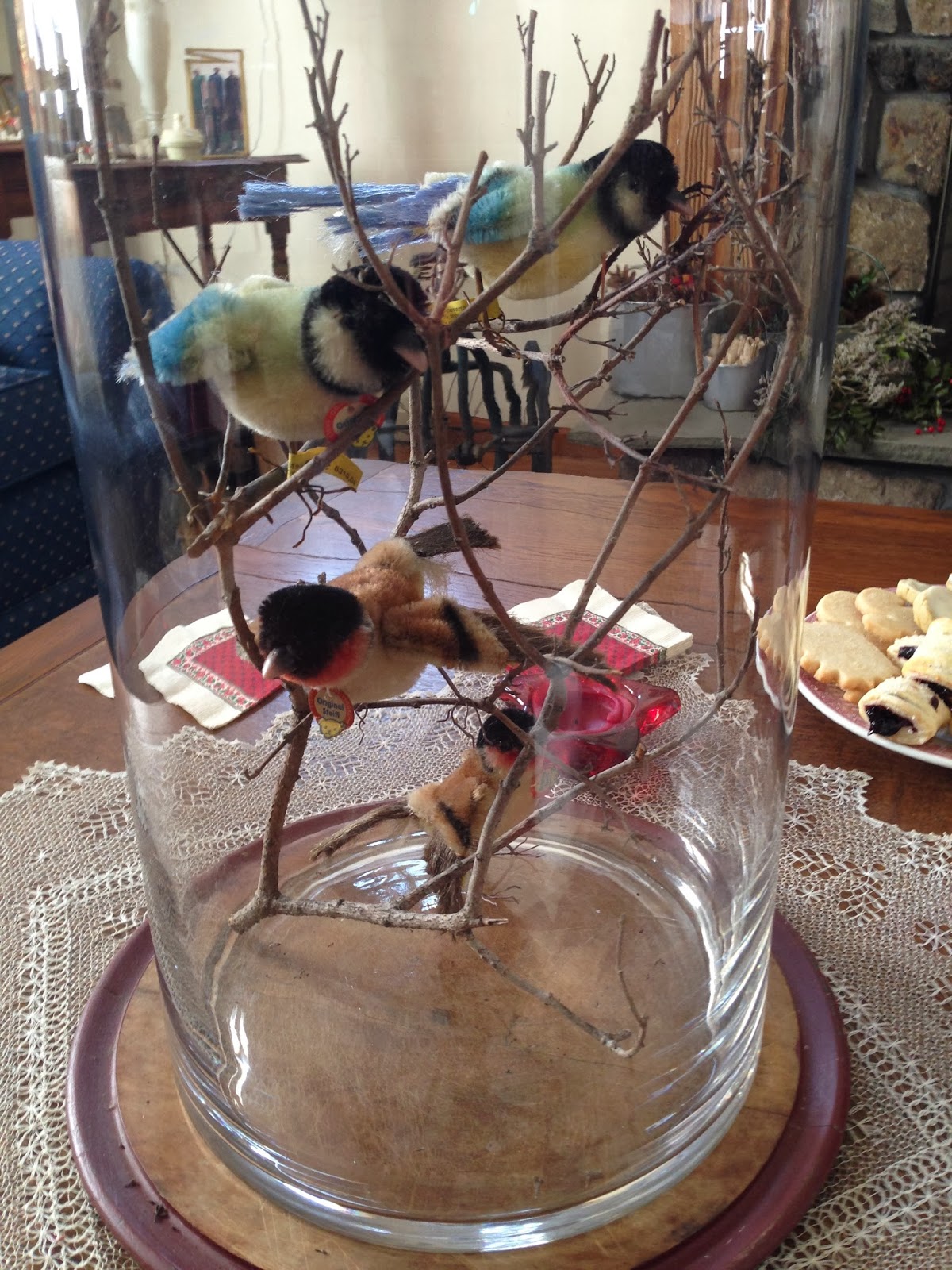
In addition to Sandy's great taste in Steiff, she also has a wonderful sense of how to display her collection. Take for example, this glass domed vignette of four early Steiff birds perched on just the perfect branch. Two of the birds are Finches, while the other two are Blue Tits. The birds are all 10 cm, made from mohair, with stiffened braided hair wing tips, plastic beaks, and early metal feet. Both the Finches and the Blue Tits were produced in this size from 1959 through 1961.
After a delicious lunch, the Steiff Superteam was off to their second and final destination of the tour. After a brief car ride, we arrived at the lovely home museum of Shelley Smith. In addition to Steiff, Shelley also collects and sells antiques, dolls, miniatures, and Christmas related collectibles. So viewing this remarkable setting was truly like being in Santa's magical workshop! Choosing highlights from Shelley's collection was as challenging as it was to do with Sandy's. Here is just the tip of the iceberg of the things that really called to Steiffgal.
It's hard not to oodle these two marvelous poodles! Here we have spectacular examples of two rare, 1950's era Steiff poodles. The white one on the left is the early version of Snobby. This top dog is standing and made from wool plush. She came in black or white. Her face is detailed with a black glass button nose and round brown and black glass pupil eyes. Her mouth and claws are defined by embroidery. Her coat is in what Steiff refers to as the "French" trim, meaning that it is fluffy basically from the waist area up; her lower torso and backside are more closely cropped. She also has longer tufts of fur around her knees, elbows, and the tip of her tail. This original Snobby was produced in 17 or 22 cm in 1952 only. The black poodle on the right is Maidy. She is standing and unjointed, and made from delightful and really unusual "Persian Lamb" style mohair. She has a slightly longer mohair "beard" around her chin. Her mouth and claw stitching is done in mauve colored embroidery floss. She was produced in 25 and 30 cm in 1959 only.
Eye bet you cannot resist this next highlight from Shelley's outstanding collection. This sitting sweetheart is the early Susi cat. She is 17 cm, made from grey mohair and is head jointed. Her little tail wraps gently around her backside. She his lovingly hand airbrushed with black stripes. Her face is detailed with bluish-green and black slit pupil eyes, a pink hand embroidered mouth and nose, and large, pert ears. Susi, who is named for a member of the Steiff family, was produced pre-war in 14, 14, 22, and 28 cm from 1936 through 1943.
You don't have to be from the Boston area to fall in love with this fourth highlight from Shelley's hug. Here we have Steiff's extremely rare Boston Terrier on metal wheels. The dog itself is 28 cm, unjointed, standing, and made from brown and tan felt. His face is detailed with black button eyes and a simple black hand embroidered nose and mouth. When he was new, he had a few black dots around his muzzle to indicate his whiskers. Boston Terrier is mounted to metal axles with regular, not eccentric, round wheels. Although his neckwear is not original, he did leave the factory in Giengen a century ago with a handsome leather collar. Boston Terrier on wheels was produced in 22, 28, and 35 cm from 1913 through 1919.
Many thanks to Sandy and Shelley for opening up their homes to the Steiff community, as well as providing such gracious hospitality.
Steiffgal hopes this virtual tour has inspired you to share your collection with new friends, too!
Have a question about one of your Steiff treasures? Let's talk! Click here to learn more.
Subscribe to:
Posts (Atom)