Showing posts with label blue. Show all posts

Friday, April 5, 2024

Hands In The Air Over This Fabulous Prewar Steiff Find!

The show must go on... and this week it is in the form of a puppet show! Yet another super Steiff surprise hit Steiffgal's inbox this week. Here is something so rare that Steiffgal can count on one hand (yes, pun intended!) the number of examples she knows of in real life. Check out this note from Mariette who shares...

"I read something about your Charly puppet and saw my Petsy puppet in the same advertisement picture. Since you are always interested in more Steiff items I present to you my Steiff puppet from I guess 1928? It is about 24 cm long and made from tipped reddish and white mohair. It has blue glass eyes and a prewar long ff button with red remnants of a tag. On the inside it has a cardboard cylinder where you can put your finger in to move the head. I bought it at an antique market for 85 euros in the Netherlands. Hope you can tell me something about if it is rare because I never saw one before."


Here's a tip - this guy is off the charts great!
What we have here is Steiff's "Punch Petsy," or Petsy as a hand puppet. According to published company records, this cute cub was made in 17 cm from 1928 to 1932. His head and the tips of his paws are stuffed with excelsior, and as Mariette notes, he has a cardboard finger tube embedded in his head. Of course, he is based on the company's beloved brown tipped mohair Petsy the Baby Bear design - one of the true sweethearts of the company's "roaring 20s" era Teddy bear production.

Petsy's design was introduced in the late 1920s and was originally named "Buschy." Thankfully, Steiff's marketing team changed this to "Petsy" to reflect his precious and toddler-esque presentation and personality. Brown tipped Petsy appeared in the catalog from 1928 to 1930 in 10 sizes ranging from 22 to 75 cm, measured standing. This model was fully jointed with tan felt pads. His distinctive facial properties included a prominent center facial seam, blue and black glass pupil eyes, a rose-pink hand embroidered nose and mouth, and proportionally large, rounded, wire rimmed, and posable ears.

In addition to a puppet, Steiff also made a handful of other novelty items based on their brown tipped Petsy pattern.
These included a full bodied musical version, which was produced in 25 and 30 from 1928 to 1930. He also appeared as a pull toy on wheels, called a "Record Petsy." This delightful design appeared in the line in 20 and 25 cm from 1928 to 1929. And finally, Petsy was manufactured as a standing, head jointed handbag in 17 cm from 1927 to 1928. All of these blue eyed novelties are indeed blue ribbon, and as rare as hen's teeth!

Ok, how about a penny for your thoughts here?
Mariette notes that she paid 85 euro for her Petsy puppet. So how did she do? After much research, the only other example Steiffgal could find of a Petsy puppet sold at public auction was in February, 2016. There, one traded hands at over 6,300 euro! Of course, something is worth what someone will pay for it, and Mariette's example has some condition and losses which might impact its ultimate value or price tag. But it is safe to say that she did VERY WELL, and would have no trouble at all selling it at a significant profit if she ever decided to rehome it. 

Steiffgal hopes this discussion on Steiff's amazing Petsy Puppet is worthy of a standing ovation. 

Have a question about one of your Steiff treasures? Let's talk! Click here to learn more.

Monday, January 22, 2024

Jumping For Joy Over This Funky 1980s Era Steiff Toy Rabbit

You may be really surprised at Steiffgal's latest addition to her hug. This softie recently arrived as part of a large auction lot purchase from overseas. Although he doesn't exactly fit in with the age, materials, and era of most of her vintage to antique button-in-ear collection, there's just something really sweet and appealing about him. As such, he's earned a place on Team Steiffgal, and in her heart as well. Come learn more about this happy hopper produced at a key time in Steiff's business history. 


Baby Rabbit is standing, unjointed, and measures 28 cm tall, including his ears. He is made primarily from a vibrant baby blue colored soft plush. His paw pads, chest, muzzle, and the lining of his ears are made from soft white plush. His face comes to life with black button eyes, a black hand embroidered nose, and a spot of pink to highlight his mouth. His squeaker works loud and clear. He left the factory wearing a pink neck bow. Baby Rabbit was made in this size in this color combination, as well as a pink and white version, from 1983 through 1986. The pink version is pictured below on left; the image is from Pfeiffer's Steiff Sortiment 1947-2003. 


This super sweet bunny was clearly produced as a toy for children. In terms of "kidproofing," his practically embedded black plastic eyes, lack of a chest tag and button branding (his tag is stitched into the seam of his ear), and washable, synthetic materials set him up for years of cuddles, play, and roughhousing. And his name, and youthful color, (and that of his twin pink sister,) also hint that this pattern may have been intended as a nice baby or baby shower gift.


What's most interesting about Baby Rabbit is the timing and era in which he was produced. The 1980s through the early 1990s were a period of great transition at Steiff. The company was at an important juncture in terms of business, pricing, and design priorities, and the toy industry as a whole was moving quickly in new directions. 


Two key market realities of this era were the continued influx of inexpensive toy imports from Asia and the emerging interest (and rise in value) of vintage to antique Steiff bears, animals, and dolls. As a result of all of this, Steiff started, and/or tested, several new initiatives to adapt to these changes. These included offering replicas and special limited editions; creating an ongoing line of Christmas items and ornaments; increasing partnerships with key organizations (like Disney and F.A.O. Schwarz) and other toymakers (like Suzanne Gibson); and launching the Steiff Club in 1992. These strategies were rolled out in part to capture the higher end market and gain new collectors. Here on the left you can see Steiff's very first replica, "Papa" bear, from 1980. He was made in a worldwide edition size of 11,000 and was designed to celebrate the 100th anniversary of the Steiff Company.


Steiffgal thinks that Baby Rabbit, and other simple, lower end soft plush items of his era, were probably designed, produced, and distributed to compete with the Asian exports part of the business equation. 


Steiffgal hopes this discussion on the company's 1980s production has you feeling nostalgic, in the best possible way. 


Have a question about one of your Steiff treasures? Let's talk! Click here to learn more!

Sunday, August 20, 2023

What a Devilishly Interesting Steiff Mystery!

The devil made me do it! But in this case, it's all in good fun! Check out this note from a new friend who asks about an unusual item she found among her Mother's things. What do we have here? And could this man in red be made by Steiff? Darcie shares:

"I have a red devil doll with a Steiff tag but it is not attached. So I am not sure if it was made by Steiff. I thought Steiff’s have the metal button/tag on them. Can you help?"


Well hell-o handsome! What a great find! Although not specified, it would be Steiffgal's best bet that this devil doll is nearly identical to the blue felt version Steiff made of the Duke University Blue Devil mascot. The Duke Devil was jointed, with a felt body and a rubber head with horns. He was detailed with a blue felt suit, long blue felt tail, and white felt shoes, and carried a three pointed spear. He appeared in the Steiff line from 1954-1958, and then again from 1959-1963 as part of Steiff's early post war series of university and institutional mascots. These charming mascots were featured in F.A.O. Schwarz's catalogs in the early 1950s. 

So what might be the story behind this uncatalogued red version?
Steiffgal suspects it might be a sample or very low edition as she has never seen or heard of a red version previous to this one. The handwritten number "7128" on the early postwar ear tag provided by Darcie refers to 7= in caricature, 1= felt, and 28= 28 cm tall. This makes sense in terms of this guy for sure. 7128 is also the number of the earliest blue Duke Blue Devil mascot edition. Perhaps this red felt version with the US Zone tag and raised script button was made in the c. 1951-1953 time frame (before the launch of the Duke version) when you see items with the US Zone tag, for the most part. It is entirely possible that Steiff saw greater market potential and interest in making this rubber devil doll in blue as the Duke mascot than simply in generic red.

Steiffgal hopes this discussion on this rare devil doll has fired up your interest in the company's unusual mid-century production.

Have a question about one of your Steiff treasures? Let's talk! Click here to learn more!

Saturday, August 12, 2023

Rolling Along With This Early 1930s Steiff Scotty On Wheels

Great Scot! Check out this utterly charming prewar pup on wheels. Despite his small size, he's got a few interesting "time capsule" details that help to date him to a "T". Read on to learn more.

This bearded beauty is the wheel-deal indeed!
Scotty is 17 cm tall, standing, and head jointed. His body and head are made from grey and light black mohair plush fabric. His ears are made from pitch black mohair. Scotty is detailed with proportional black and brown round glass pupil eyes, a black embroidered nose and mouth, and dark pink embroidered claws on each of his four paws. His ears are lined in black mohair. The dog is mounted on a metal carriage and glides along on four blue wooden eccentric wheels. He retains his original collar and brass bell. His collar is white and dark blue or black leather, and closes with a ring and two (now very rusty) Steiff buttons. He retains his long trailing "f" button in ear and traces of his chest tag as his Steiff IDs. 

This model was made in 14, 17, and 22 cm (measured vertically, without wheels) from 1932-1943. He was produced in grey and black mohair plush from 1932 through 1934; after 1934 he appeared in all black mohair. Given those dates, it is safe to say that this guy was "born" in the 1932-1934 time frame. 

Scotty dogs debuted in the Steiff line in 1930 and were an immediate success with customers.
Their size, personality, and proportions translated well into soft toys designs, and Steiff created a number of sitting, standing, wheeled, and novelty versions over the next decade. Some had round glass pupil eyes like this example, while others had brown, white, and black almond shaped glass eyes. Steiffgal has never been able to figure out why that was the case, but both style of eyes are original to Steiff. 

The Scotty under discussion here has two distinctive early 1930s-era details that Steiffgal has not seen on items produced during any other time. The first is his body fabric, which is a mostly black mohair plush with grey fiber details. It is not "spiky" like traditional mohair, but smoother and more elegant, with the longer fibers really resembling a dog's coat. This lovely material was used for awhile on the company's Scotties, but then disappeared in 1934 - about the time that things really started getting difficult at Steiff - and throughout Germany due to geopolitical realities. It is possible that the grey and black fabric was expensive, and the company was trying to save money on materials, and/or that it was no longer being produced, and/or it was entirely allocated by the government for wartime material production. Through the early 1940s, Scotty dogs would go on to be produced in mohair, wool plush, cotton plush, and silk plush - apparently coming to life in the fabrics available at the time. 

Also of note is this Scotty's prominent leather collar.
Steiffgal has only noted this woven style, light and dark belled collar on dogs from the early 1930s. It is possible that this accessory was designed and produced to give the dogs wearing it a more "upscale" look and feel. The collar, which is not removable, needed to be manually attached to the dog and finished with two inserted buttons. This of course required many more assembly steps than the signature, simple red buckled collar which would be used on the model just a few years later. 

Steiffgal hopes this discussion on this early 1930s Scotty on wheels was a joy ride for you!

Have a question about one of your Steiff treasures? Let's talk! Click here to learn more!

Sunday, September 18, 2022

Check Out All The Doggy Details On This Rare Prewar Steiff Wolfspitz!

What a prize winning beauty!
Steiffgal recently had the pleasure of handling a beautiful prewar pup with the most appealing facial expression and presentation. And she really did come with a blue ribbon - but more about that in a moment! Take a look at this simply lovely sitting sweetie and see what makes her such a top dog in so many ways.

Here we have Steiff's simply wonderful Wolfspitz. She is 22 cm tall, sitting, unjointed, and made from tawny colored mohair. She is solidly stuffed with excelsior. Her face, ears, and legs are made from shorter mohair while her back, tail, back legs, and torso are made from very long matching mohair. She has lifelike brown and black shading on her back and tail. Wolfspitz has three hand embroidered black claws on each paw. Her face comes to life with felt lined ears, brown and black glass pupil eyes, a black embroidered nose and mouth, and brown airbrushed highlights. You can feel her nonworking squeaker in her belly.

This lovely lady was made in 17, 21, 22, and 25 cm from 1934
 
- 1943 overall. She was also made standing on all fours in 22 and 35 cm from 1934 - 1943 overall, and standing on eccentric wheels in 22 cm from 1934 - 1943. You can see a picture of the Wolfspitz on wheels as pictured in a 1938 company brochure here on the left; she is in the middle row and on the very right hand side of the page. Just click on the image to make it larger. The caption under her reads Wolfspitz, Mohair, 1322 ex, 6.-. The ex refers to her eccentric wheels and the 6.- refers to the price in German marks. Today, 6 marks in 1938 is ROUGHLY the equivalent of $50 in 2022, according to the US Inflation Calculator.   

Besides her striking good looks, this Wolfspitz also is in wonderful condition and retains her long trailing "f" button as well as her all original red ear tag as her IDs.
Her article number is 3322,2. This stands for 3=sitting, 3=mohair, 22=22 cm tall, and ,2=squeaker. According to Pfeiffer's Steiff Sortiment 1892-1943 book, this particular Wolfspitz with this exact numbering only appeared in the line from 1934 - 1936.

Now - what's with her blue ribbon?
Wolfspitz retains her all original red leather collar. She also has a light blue ribbon tied to a metal ring which is part of her collar. When Steiffgal first saw this, she thought maybe a previous owner had put that onto her as a decoration. It turns out that all the Wolfspitz dogs pictured in Pfeiffer's Sortiment also are decorated with a blue ribbon. You can spot the blue ribbon on the photo from that book her on the left. As all collectors can attest, it’s very exciting to find an "almost" antique item which retains this sort of factory original accessory!

Steiffgal hopes this discussion on this stunning Steiff Wolfspitz has added a beautiful spot to your day.

Have a question about one of your Steiff treasures? Let's talk! Click here to learn more!

Sunday, August 22, 2021

This Dressed Steiff Rabbit Doll Is The Best Of Both Worlds!

Overall, this next fantastic find is certain to put a joyful spring in your step! Steiffgal found this bitty bun in the recent United Federation of Doll Club's salesroom - lying upside down and backwards in a case piled full of mohair and treasures. All she could see was one very large foot with red claw stitching... and the rest is history. Come take a look at this dolly-delightful bun and see what makes him so interesting from the design and collector's perspectives.

This happy hopper measures 17 cm (without his ears), is begging, and head jointed. He originally was covered in white and tan mohair - but not a hare/hair remains on him! He is detailed with extra long, skinny feet, a tiny pert tail, and oversized ears. His face comes to life with big brown and black glass pupil eyes, a typical 1920s era style hand embroidered nose and mouth, and traces of once brown airbrushed highlights. He dons his original and totally adorable blue cloth overalls. He retains his long trailing "f" button and traces of his red ear tag as his Steiff IDs.

This seldom seen pattern appeared in the line from 1929-1932 overall in 17, 22, 28, and 35 cm. Steiff's rabbits are measured without their ears, so they actually are a little larger in real life than these measurements suggest. This model was produced in one of six documented outfits. According to Pfeiffer's 1892-1943 Sortiment, these included a blue playsuit, a red skirt and white apron, a purple jacket, a red skit and purple jacket, a red and white dress, or a pink dress. This example under discussion here is the one in a blue playsuit - which is detailed with tiny faux front pockets, contrasting tan colored stitching, back black snaps, and a perfect opening for his pert tail. It is interesting to note that this pattern is considered a "doll" in terms of his category - most likely because of his toddler-esque shape, standing form, and the fact that he is dressed. 

This guy is really shy - and seldom if ever appears in public! Despite being launched in 1929, as far as Steiffgal can tell, an example does not appear in the company's primary catalog of that year. The only other one Steiffgal is aware of is one that was sold at Christies in 2010. That particular example was cataloged as, "A STEIFF DRESSED BOY RABBIT, (4317,61), light brown and white mohair, brown and black glass eyes, pink and red stitching, whiskers, swivel head, inoperative squeaker, blue dungarees and FF button with red cloth tag, circa 1930 --6¼in. (16cm.) (some slight fading)." It was estimated at GBP 1,000 - GBP 1,500 and realized GBP 1,375. You can see that listing here on the left, the image is from Christies. You can click on it to make it bigger.

Steiffgal hopes this discussion of this rare and usual animal doll has been the best of both worlds for you.

Have a question about one of your Steiff treasures? Let's talk! Click here to learn more.

Sunday, July 12, 2020

Steiff Bucket List Beauty.... Or Not?

What's on your Steiff bucket list? An item or two that has gained nearly mythical status in your mind due to its elusiveness? In Steiffgal's case, that would be a mid-1920s Schlopsnies doll. A new friend writes about what she's looking for... but does it really exist? Joyce shares,

"I'm wondering and would be interested in the Steiff Clown Replica in blue or red. I've never seen it in those colors. Did they make them in the blue and red? They are not even listed in the Steiff Sortiment book, but are pictured on the original tag of the light yellow Circus Dolly bear, article number 0164/30. I have the green, yellow and purple. I don't want to keep looking if they don't exist. thanks much!"

So let's take a deep dive here and see if we can solve this Steiff mystery. What Joyce is describing is a series of colorful, 32 cm Teddy bears Steiff produced in the 1987-1989 timeframe as exclusive products for the US market. They are pictured here on the left; the photo is from Pfeiffer's 1947-2003 Sortiment book. They were based on Steiff's "Dolly" Teddy bear pattern that was introduced in 1913 in honor of the inauguration of Thomas Woodrow Wilson, the 28th President of the USA. Unlike Roosevelt and Taft, Wilson did not have an animal mascot associated with him. Roosevelt of course had the Teddy bear, and Taft had an opossum. To welcome the new President into office, Steiff designed its Dolly bear, and launched this novelty at the 1913 Leipzig Spring Trade Fair.

Legacy Dolly bears were known for their distinct coloration and novel neckwear. All had a white head but their bodies and limbs were made in jewel tones including red, blue, yellow, and green. Apparently there was a violet version that was produced as a prototype, but it never went into full production. Dolly bears were detailed with a festive neck ruff, black shoebutton eyes, and brown facial stitching. Brown facial stitching was traditionally used on early white bears, so that color choice here makes sense. Each had a "hug me" voice in its belly. The original Dolly bears appeared in the line from 1913 through 1918 in 25, 30, and 32 cm. Here you can see a blue and white version from the early 19-teens; the photo is from Christies. 

Today, original Dolly bears are extremely rare and seldom seen on the secondary market. Steiffgal is aware of maybe one or two that have come up for sale at auction in memory. Steiff has produced them a few times in replica form, most notably in the late 1980s as part of the company's circus theme of that era. These are the bears Joyce is referring to in her note. In 1987, the company mistakenly produced a Dolly bear as part of this series in very pale yellow and white mohair. Very few were made and this particular color combination is considered really collectible. This pale yellow was replaced with a brighter yellow, and the company would go on to make these Teds in white and bright yellow, green, and violet mohair from 1987-1989. You can see this pale yellow Dolly bear here on the left.

As Joyce notes, the hang tag on the pale yellow version of the 1987 Dolly bear features this design in red, blue, yellow, green, and violet. But the in the company catalog for this series, shown here, only the bright yellow, green, and purple versions are featured. So were red and blue examples ultimately made as part of this 32 cm series? Steiffgal thinks not. But here are three loose speculations why these bears were pictured on the tag.

First, it is entirely possible that Steiff had the intention to produce the replica Dolly bears in five hues as part of this late 1980s series. The company's photo of these five bears on the tag suggest that all five colors were produced, at least in prototype form. However, in terms of commercial production, perhaps reality got in the way after this marketing photo was taken. Maybe the blue and the red mohair were not available or too expensive or somehow diluted the line a bit. Archival paperwork from Reeve's International, Steiff's distributor partner here in the USA at the time, note only the yellow, green, and violet versions were actually ordered for the North American market in 1988. 

Second, it is also possible that the tag is trying to show the original 1913 range of production, when these colors were (mostly) in the line. So the tag was intended to be a reflection of historical, not current, production. 

And third, the pale yellow version in itself was a mistake. It appears there were several issues and problems over time with this product introduction and marketing, including its IDs and collateral, and this inconsistent tag was just part of that mix. 

Steiffgal hopes this round-about sleuthing has added a bright spot to your day.

Have a question about one of your Steiff treasures? Let's talk! Click here to learn more. 

Sunday, March 22, 2020

Boy Oh Boy This Is One Interesting Steiff Doll!

Snips and snails and puppy dog tails - that's what little boys are made of. At least according to an early 19th century nursery rhyme. But what about Steiff little boy dolls? What are they made of? Well, that depends on the timeframe in which they were produced. Take a look at this delightful, and unusual, Steiff boy and see how his composition suggests a pretty specific production era.

Well hello handsome! Here we have Steiff's Erich. He is 35 cm tall and fully jointed. He comes to life with brown hair which has faded to silver over time, lovely blue and black glass pupil eyes, delicate painting to define his eyebrows, nostrils, cheeks, and mouth, and Steiff's distinctive and early vertical center seam facial construction. He also has two small horizontal seams by each of his eyes; these are original to his pattern and help add roundness and softness to his head and face shapes.

Erich is dressed for fun and play in his early 20th century style outfit. He dons a white cotton shirt, a cotton "one-sie" consisting of blue shorts and a black vest, a blue cotton jacket, a linen apron with a pocket, and blue and white striped socks and black felt shoes; most, if not all of these accessories are original to him. He retains his tiny long trailing "f" button and traces of his white ear tag as his IDs. This charming pattern was made in 28, 35, 43, and 50 cm from 1912-1927 overall.

So what about his actual composition? With his full permission and consent, Erich is happy to share his noteworthy make-up and is proud of his role in historical research! His head and arms are made from Steiff's traditional high quality felt. His legs are made from smooth, flesh colored linen; their color matches his felt pretty well. And his torso is made from a very coarse, blue and tan colored muslin material. More typically, a pre WWII doll from Steiff has a felt head, torso, and limbs. 

Erich's assembly makes sense if you think about it from the visibility, financial, and historical perspectives... and helps to inform his dating as well. 

  • Visibility: The areas that are most seen - his face and arms - are made from the nicest materials. His legs, which are almost all covered by his shoes, socks, and shorts, are made from a less expensive fabric that somewhat "blends into" the rest of his body. And his torso - which usually never sees the light of day - is made from the cheapest and least elegant material. Overall, when dressed, has the appearance of being a quality, finely designed and produced Steiff doll.
  • Financial: Given his materials, it is likely that Steiff was trying to manufacture him as inexpensively as possible. This suggests that money was tight throughout the German economy - both on the business and consumer sides.
  • Historical: Just before, during, and after WWI, traditional, high quality toy making fabrics like mohair and felt were in short supply, rationed, or simply not available in Germany. Companies used what supplies they had on hand, or what they could source, to keep the business up and running.

Given his presentation, detailing, and body composition, it is Steiffgal's guess that Erich is a "wartime baby" and was born in the c. 1914-1919 time frame. Steiff has always done their best to deliver "only the best for our children" regardless of hardships and supply chain issues. Erich is a great case in point illustrating that business priority. 

Isn't it amazing he still has his boyish good looks, given he's over a century old?

Steiffgal hopes you found this discussion on Erich of material interest.

Have a question about one of your Steiff treasures? Let's talk! Click here to learn more!

Sunday, April 7, 2019

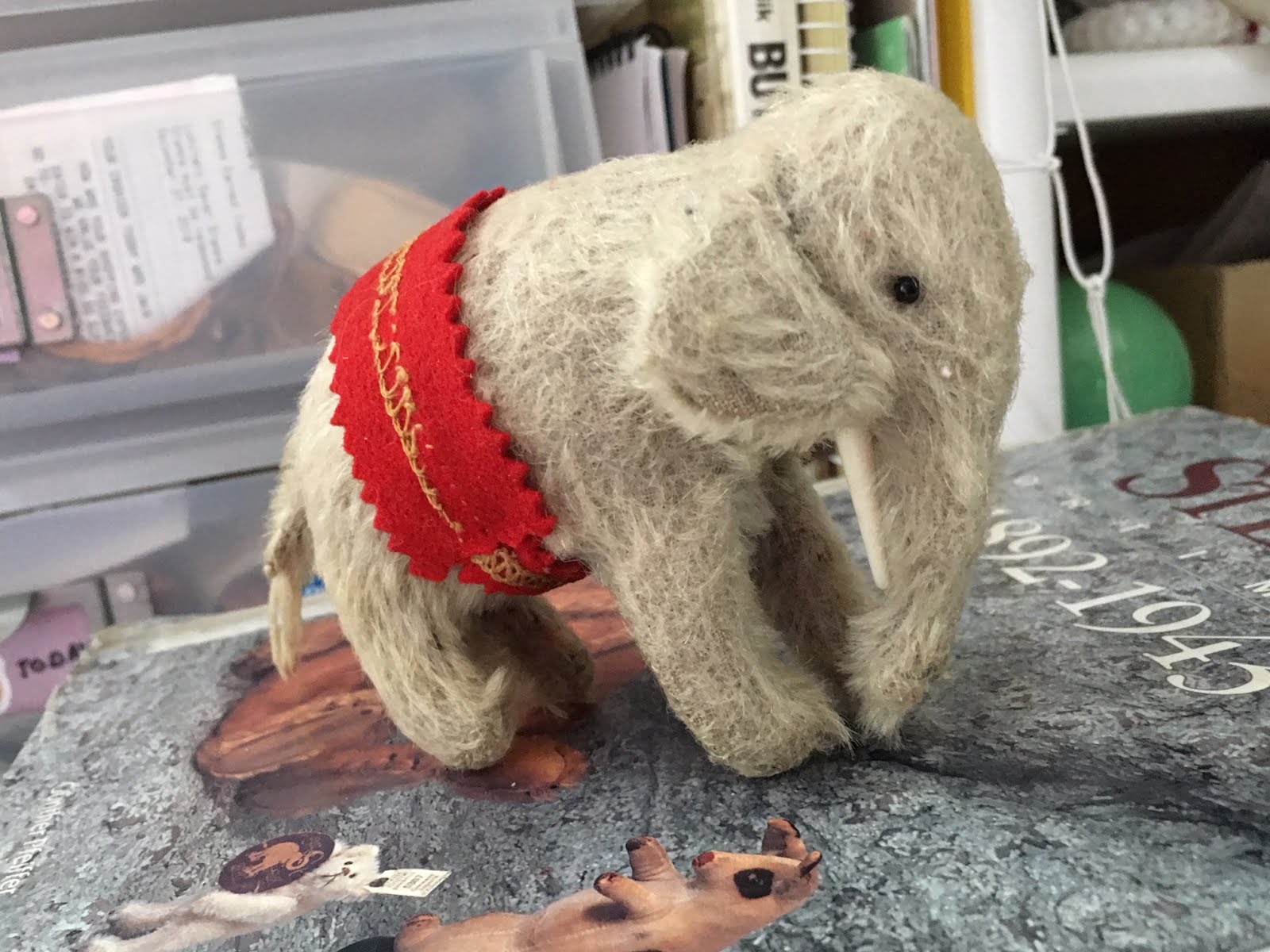
This Petite Steiff Pachyderm Is Simply Unforgettable!

How can something so small be absolutely jumbo at the same time? Well, that's a riddle most Steiff collectors have no trouble answering. The very first "plaything" Margarete Steiff produced - albeit by "accident" - was a felt elephant in 1880. Since then, the company's elephants, regardless of size, have always garnered lots of love and interest from collectors worldwide. Steiffgal challenges you NOT to fall in love with this petite prince under discussion today!

There's not room for much junk in the trunk when it comes to this happy handful. Here we have a 10 cm standing baby elephant. He is unjointed and made from blue mohair. His little face come alive with simple black button eyes, proportional ears, a slightly tucked under trunk, and ivory tusks. His mohair tail is tipped in what feels to be like woolen yarn. His red saddle cloth is vintage, but probably not original to him given its "homemade" presentation. It is decorated with gold colored embroidery. Elephant retains his long trailing "f" button and traces of his red ear tag as his Steiff IDs. 

This little guy is absolutely ele-fantastic, but exactly who is he? It's a little confusing. He doesn't EXACTLY appear in Pfeiffer's 1892-1943 Sortiment. Steiff did produced a blue standing 8 cm elephant as a "pram toy" in 1926 through 1933. He came with a bell on the tip of his trunk, a cord, a pom-pom decoration, and an ivory hanging ring. However, this pram toy did not have tusks and had black and brown glass pupil eyes. So as they say, close but no cigar with a match here. 

A bit more research finds a 10 cm blue mohair elephant with black button eyes and ivory tusks pictured in the Sortiment. However, this model is described as having eccentric wooden wheels. That wheeled model was made in 1924 only. The elephant under discussion today looks very much like the one pictured in the Sortiment, but shows no evidence of ever being on wheels - there are no stitches, holes, or indicators on the bottom of his feet that would suggest he was once "on a roll." It is Steiffgal's best guess that the elephant noted in the Sortiment was produced with or without wheels, and that was just an oversight in his cataloging. This can happen on items that were produced in limited quantities, and/or for a short period of time. 

Now for a little color commentary. Although this elephant looks grey today, if you look in his "nooks and crannies," his baby-blue coloring is obvious. Steiff introduced many items in the mid to late 1920s in happy, jelly bean colors like this, so his hue perfectly aligns with his production period. These colors - especially pink and blue - tend to really fade over time. This probably has to do with the chemistry and properties of the pigments used to make fabric color dyes last century.  

Steiffgal hopes you found this discussion on this little blue elephant absolutely unforgettable. 

Have a question about one of your Steiff treasures? Let's talk! Click here to learn more.

Wednesday, January 30, 2019

And The Blue Ribbon For The Most Unusual Steiff Bully the Bulldog Goes To...

Are you looking for blues clues about a most unusual Steiff treasure? Then check out this fabulous - and fabulously rare - example of Steiff's beloved prewar Bully the Bulldog. There's no doubt he'd be top dog in anyone's Steiff canine kennel!

The sky's the limit with this outstanding blue and white Bully. He's sitting, head jointed, and made from velvet. His blue has oxidized to more of a green color since his "birthday" nine decades ago. You see this often with vintage materials and dye colors. (Check out where the sun doesn't shine - like armpits and crotches - to find areas untouched by time.) Like the Bully dogs of his era, he has large, metal lined, and poseable ears and patched construction. His face comes to life with oversized black and brown glass pupil eyes, a hand embroidered nose, a few freckles, and an elaborately constructed and very detailed muzzle. Blue Bully retains his original horsehair collar and bell, as well as his long trailing "f" button as his ID. This bouncing bundle of joy was produced in 7, 10, 14, and 17 cm from 1927 through 1934 - and is only the second blue Bully Steiffgal has ever seen!

It is interesting to note that in the late 1920s through early 1930s, Steiff produced a number of animal and novelty patterns in fun, "jellybean" hues - both in mohair and velvet. These included rabbits, bears, dogs, pincushions, and other favorites. It is Steiffgal's best guess that these colorful critters were designed to match the mood and aesthetic of the "roaring 20s" and were produced not only as toys for children but as gifts and collectibles for adults. 

Small, unusually hued, prewar Steiff rarities with IDs and accessories like this only surface once in a blue moon - and always generate lots of dollars, and interest, at auction. For example, in 2016, an 8 cm version generated 12 bids and hammered at €2,400 (roughly $2,800) on its €330 - €660 (roughly $376 - $750) estimate. And why is that? Like most marketplace or economic situations, it has to do with supply and demand. For example, consider....

  • Petitely proportioned items are/were often a child's "best friend" and as such, were loved to death as playthings, or lost to time. So there are not alot of them in general still around. 
  • These small treasures span several collecting categories, including general antiques, Christmas items, dollhouse items, dolls, and Steiff. So many people are interested in them. 
  • They don't take up too much space in a collection.  So they are very desirable from the collection management and logistics perspectives, especially amongst more "seasoned" collectors. 
  • And they are simply just plain wonderful. Collectors seldom if ever tire of them, and very rarely sell them unless they absolutely have to.
Steiffgal hopes you've enjoyed learning about this blue ribbon beauty.

Have a question about one of your Steiff treasures? Let's talk! Click here to learn more.

Saturday, June 23, 2018

This Steiff Rabbit Is Such A Blue Belle!

In the mood to learn about a bouncing bundle of joy?  Of course you are!  And it's a boy - really!  Steiffgal was delighted to add this big blue baby bunny to her Steiff hug recently.  He's got such a great personality, and exemplifies many of Steiff typical 1920's era characteristics.  Take a look... you'll certainly fall for this cheerful-earful as well!

If this isn't hoppi-ness, then what is?  Here we have Steiff's sitting rabbit. He is head jointed and measures 20 cm tall (not including his ears, which are typically not included in rabbit measurements.) He is made from blue mohair, while his chest and the fronts of his ears are white mohair. He has a proportionally petite tail and short, thin, curvy arms and legs. His face comes to life with oversized brown and black pupil eyes, a pink hand embroidered nose, and a black hand embroidered mouth. He even retains a few mono filament whiskers. His big ears are lined in wire and are posable. He is stuffed with a combination of crunchy excelsior and soft kapok. Rabbit retains his long trailing f button and bits of his red ear tag as his Steiff IDs. 

This design was produced in mohair in 11, 15, 18, and 23 cm from 1926 through 1932. It was also made in velvet in 11, 15, and 18 cm from 1927 through 1933.

So just what makes this rabbit such a blue belle? Colors can be tricky with Steiff. When you have a vintage piece in hand, always look in "places where the sun don't shine" to discover its true and original color. Although this rabbit today looks cream or tan, if you peek in the crotch, deep in the neck joint, under the tail, under the glass eyes, and in its "armpits," you can absolutely see traces of a baby blue color both on its fabric backing and its mohair covering. Dyes used in the first quarter of the 20th century can fade, wash out, or change color dramatically over time, due to the nature of their chemical composition. So don't always assume that your 1920-1930's era Steiff items, although perhaps tan or grey today, didn't start out life in a much more colorful manner. Here on the left you can see traces of his blue coloring on the underside of his tiny tail.

This rabbit is a delightful example of a delightful product development era at Steiff - the mid 1920's through the early 1930's. Here's what makes this beautiful boy so period to the "roaring 20's:"

His color: Steiff did alot with colored and tipped mohair starting in the mid-1920's. It was not unusual to see rabbits, bears, dogs and other popular animals produced in "jelly bean" colored mohair, or tipped mohair though the early 1930's. Think of Teddy Rose, Molly the puppy, Charly the King Charles, and other favorites from that period. These color choices were the result of a directive from Richard Steiff, who insisted in the mid-1920's that the company's products include lighter, happier colors that reflected popular cultural trends of the time. Here on the left, you can see another colorful example from c. 1929, he is the 11 cm version of the blue bunny under discussion today, but in pink (which has also faded a bit over time.)

His proportions: During this period, many of the items produced moved away from lifelike proportions to appealing proportions. Items designed during this period were more round, chubbier, and toddler-esque than in the past. Teddy baby, who debuted in 1929, is a perfect example of this. As you can see with this rabbit, its head and body are quite oversized, while its legs are quite thin and narrow - not lifelike, but very endearing. Here on the left you can see a picture of a number of colorful rabbits that also fit this description; the photo is a 1929 Steiff advertisement and is taken is from Carsten Esser's Steiff Kataloge 1920-1929.

His detailing: Steiff items produced in the mid-1920's through the early 1930's have playful and happy personalities which come alive thorough subtle design elements. In this case, the rabbit's ears are lined in metal wires, making them posable and more interactive.  Think of Petsy the baby bear, who also had this detailing. And his oversized eyes, placed low and wide on his very symmetrical face, give him a distinctly innocent, appealing, and inviting look.  

Steiffgal hopes this discussion on this blue bunny has left you jumping for joy.

Have a question about one of your Steiff treasures? Let's talk! Click here to learn more.

Saturday, December 30, 2017

Welcoming 2018 With These Once In A Blue Moon Steiff Rarities


You've probably heard the expression, "once in a blue moon." This phrase is meant to indicate that something happens extremely infrequently, and specifically refers to periods when two full moons occur in the same month. Well, 2018 greets us with two full moons in January, hopefully signaling auspicious things on the horizon for everyone on the cusp of the new year.

To celebrate this special occurrence, and to welcome 2018 in the warmest way possible, please say hello to five "once in a blue moon" Steiff finds. These characters are quite unusual (at least to Steiff enthusiasts here in the United States) and demonstrate Steiff's enormous talents in bringing fictional characters to life. Perhaps they will send you over the moon as well! 

You can't help but dig this first "blue moon" find. Here we have Max Mole. He is 15 cm, standing, unjointed, and made from brown woven fur. His feet are flat, cardboard lined, and enable him to stand. They are made from brown faux leather, much like the soles on the feet on Steiff's standing Zooby the circus bear. He has four felt claws on each hand. His prominent snout has been slightly sheared, then painted a salmon pink. His nose is made from felt, and he has simple black button eyes. He dons a yellow plastic "hard hat" emblazoned with a DB logo; it is visually secured to his head via a black painted strap. This hard working mole was produced in 1999 only as an advertising specialty for Deutsche Bahn, the German railway company headquartered in Berlin.

All that glistens is not gold - but in this situation - it is "Goldi." This petite treat is 15 cm, standing, unjointed, and made from soft plush. Her fabulous and largely scaled head is made from SEVEN different materials, including five colors of short plush, one color of long plush, and felt - for her prominent teeth! Her eyes are simple black buttons and she has black whiskers. Goldi is dressed to the nines in removable clothing including a teal velour shirt and yellow cotton overalls featuring the Commerzbank logo. This precious gem was made in 2007 for Commerzbank, a global financial services company that was founded in 1870 and has its headquarters in Frankfurt. 

It is interesting to note that Steiff also produced a 32 cm Goldi the Hamster in 1978-1980 for Commerzbank. This happy hamster is best known as the mascot of Germany’s “Kinder-Verkehrs-Club” or “Children’s Traffic Club” which was sponsored by Commerzbank over time. This countrywide program was launched in 1976 and ran until 1997. The goal of the program was to help parents of three to six year old children teach their youngsters about road and traffic safety.

Things are twice as nice with this next pair of rarities. Here we have two very playful Steiff dragons. They are both sitting, unjointed, and made from soft yellow plush. Their bellies are white while their wings, back scales, inner ears, and open mouths are orange plush. Their blue tongues are made from felt and their cartoonish eyes are machine embroidered. Each has two sets of arms. The larger one stands 26 cm tall, while the smaller one, which has a keyring attached to it, is 14 cm tall. They bear the GVS logo and are the company's natural gas mascots. Given their form and IDs, this dragon duo was most likely made within the last few years. GVS is short for GasVersorgung Süddeutschland GmbH; they are one of Germany's largest gas companies. According to their website, they "supply natural gas to public utilities companies, regional gas suppliers, industrial customers and power stations both within Germany and abroad."

Next in this monster-mashup is this fine green hand puppet, also in the form of a dragon. This lean green machine is 35 cm tall and made from trivera velvet. His body is green, his wings are pink, his ears are blue, and his mouth is peach colored. He is detailed with green felt back scales, grey faux suede "hair", and oversized black and white google style plastic eyes. You can open and close his huge mouth from inside his hollow body. This playful puppet was made in 1991 as a promotional item for the printer Oldenburg, which is now part of the De Gruyter group. This large publishing house is headquartered in Berlin and has a company history that goes back over 260 years!

Now for a refreshing change, please consider this last "blue moon" Steiff selection. Here we have a very chubby, cartoon looking 30 cm unicorn called "Fritz Horn." This name appears on his yellow Steiff ear tag. His unjointed body is made from white velour and his feet are made from black fabric. His tail and back mane are made from black spotted white velour. His eyes, nose, and mouth are machine embroidered in black. And what's that thing on his head? Why it’s a black velour "fritz-kola" bottle horn, of course! This black and white beauty was made in 2016 for the Hamburg based Fritz Kola company, which was started in 2002 by two childhood friends. This quirky, playful European specialty brand is "mainly known for its high caffeine content (about 25 mg per 100 mL) and its strong lemon flavour as well as its distinctive glass bottles," according to its website.

Steiffgal hopes this review of "once in a blue moon" rarities helps your stars align for a very happy and healthy 2018.  

Have a question about one of your Steiff treasures? Let's talk! Click here to learn more.
The teddy bear search engine