This bearded beauty is the wheel-deal indeed! Scotty is 17 cm tall, standing, and head jointed. His body and head are made from grey and light black mohair plush fabric. His ears are made from pitch black mohair. Scotty is detailed with proportional black and brown round glass pupil eyes, a black embroidered nose and mouth, and dark pink embroidered claws on each of his four paws. His ears are lined in black mohair. The dog is mounted on a metal carriage and glides along on four blue wooden eccentric wheels. He retains his original collar and brass bell. His collar is white and dark blue or black leather, and closes with a ring and two (now very rusty) Steiff buttons. He retains his long trailing "f" button in ear and traces of his chest tag as his Steiff IDs.
Showing posts with label Scotty. Show all posts
Saturday, August 12, 2023
Rolling Along With This Early 1930s Steiff Scotty On Wheels
Great Scot! Check out this utterly charming prewar pup on wheels. Despite his small size, he's got a few interesting "time capsule" details that help to date him to a "T". Read on to learn more.
This bearded beauty is the wheel-deal indeed! Scotty is 17 cm tall, standing, and head jointed. His body and head are made from grey and light black mohair plush fabric. His ears are made from pitch black mohair. Scotty is detailed with proportional black and brown round glass pupil eyes, a black embroidered nose and mouth, and dark pink embroidered claws on each of his four paws. His ears are lined in black mohair. The dog is mounted on a metal carriage and glides along on four blue wooden eccentric wheels. He retains his original collar and brass bell. His collar is white and dark blue or black leather, and closes with a ring and two (now very rusty) Steiff buttons. He retains his long trailing "f" button in ear and traces of his chest tag as his Steiff IDs.
This model was made in 14, 17, and 22 cm (measured vertically, without wheels) from 1932-1943. He was produced in grey and black mohair plush from 1932 through 1934; after 1934 he appeared in all black mohair. Given those dates, it is safe to say that this guy was "born" in the 1932-1934 time frame.
Scotty dogs debuted in the Steiff line in 1930 and were an immediate success with customers. Their size, personality, and proportions translated well into soft toys designs, and Steiff created a number of sitting, standing, wheeled, and novelty versions over the next decade. Some had round glass pupil eyes like this example, while others had brown, white, and black almond shaped glass eyes. Steiffgal has never been able to figure out why that was the case, but both style of eyes are original to Steiff.
The Scotty under discussion here has two distinctive early 1930s-era details that Steiffgal has not seen on items produced during any other time. The first is his body fabric, which is a mostly black mohair plush with grey fiber details. It is not "spiky" like traditional mohair, but smoother and more elegant, with the longer fibers really resembling a dog's coat. This lovely material was used for awhile on the company's Scotties, but then disappeared in 1934 - about the time that things really started getting difficult at Steiff - and throughout Germany due to geopolitical realities. It is possible that the grey and black fabric was expensive, and the company was trying to save money on materials, and/or that it was no longer being produced, and/or it was entirely allocated by the government for wartime material production. Through the early 1940s, Scotty dogs would go on to be produced in mohair, wool plush, cotton plush, and silk plush - apparently coming to life in the fabrics available at the time.
Also of note is this Scotty's prominent leather collar. Steiffgal has only noted this woven style, light and dark belled collar on dogs from the early 1930s. It is possible that this accessory was designed and produced to give the dogs wearing it a more "upscale" look and feel. The collar, which is not removable, needed to be manually attached to the dog and finished with two inserted buttons. This of course required many more assembly steps than the signature, simple red buckled collar which would be used on the model just a few years later.
Steiffgal hopes this discussion on this early 1930s Scotty on wheels was a joy ride for you!
Have a question about one of your Steiff treasures? Let's talk! Click here to learn more!
Monday, October 17, 2022
Care To Go On A Date With This Prewar Steiff Scotty?
It's never appropriate to ask someone how old they are - right? But in this case, this vintage Steiff friend proudly advertises his "birthday" in a very special, and very prominent, way. Intrigued? Then check out this little black Scotty and his amazing and informative chest tag to learn more.
Here we have Steiff's 1930s-era Scotty dog. He is standing on all fours, head jointed, and solidly stuffed with excelsior. He has a non-working side squeaker in his torso. He measures 12 cm tall and 18 cm long, not including his tail. He is made from black mohair, with a longer mohair beard. His pert triangular ears are lined in felt. He comes to life with a black hand embroidered nose and lovely white, black, and brown glass pupil eyes in the shape of almonds. He retains his long trailing "f" button, trace of his red ear tag, and his named chest tag as his IDs. This pattern was made in 8, 10, 14, 17, 22, 25, 28, and 35 cm in grey or black or dark grey from 1930-1943 overall.
Now let's take a closer look at his chest tag. It is amazing how much information is squeezed onto this tiny piece of cardboard measuring just a pinch more than 1/2" in diameter. The design features Steiff's prewar and angular yellow and blue Teddy bear face. Its center copy reads in red: SCOTTY, D.R. Patent, U.S. Patented Jan. 9, 1932. This means that the Scotty pattern was registered in D.R. - which is short for "Deutsches Reich," the constitutional name for the German nation state that existed from 1871 to 1945. The tag also gives the EXACT date that the design was also patented in the United States - January 9, 1932!
The vast number of Steiff prewar chest tags simply had the bears, animal, or doll's name noted in the center of the label. However, it is interesting to note that in some cases, like this one, that the tag also specifically mentioned that the item's patent protection status in the United States. For example, check out the tags on a 14 cm Molly and a 10 cm Tabby from the 1920s as pictured here on the left. Both have the on this words, "Reg. U.S. Pat. Off." on their chest tags as well.
Scotty, Tabby, and Molly were extremely popular 1920s-era patterns. So it would be reasonable to assume that the Steiff management team in Germany was concerned about other companies - especially those in America - "stealing" these beloved designs. Steiff's business in the USA was really booming in the mid-1920s through early 1930s, partially due to the efforts of Richard Steiff. He moved to the States in the early 1920s with his family to grow the family business, alongside the company's US distributor, George Borgfeldt & Company. For Steiff to take the time and expense to register their designs with the US Patent Office says suggested that they really meant business when it came to design intellectual property, that they were in the United States market for the long run, and that they wanted to perhaps "American-ize" their line, making it less foreign or exotic, to add to its marketing appeal and potential.
Steiffgal hopes this discussion on chest tag details has had patent appeal with you.
Have a question about one of your Steiff treasures? Let's talk! Click here to learn more!
Saturday, December 12, 2020
Putting On A Show Of Support For Steiff's Fantastic And Early Handpuppets!
Hands in the air if you love Steiff puppets! These great novelties are universally treasured by Steiff, toy, and puppet collectors, and are a great cross-collectible. Although the first Steiff catalog was produced in 1892, hand puppets did not appear in these publications until 1911. However, the designs for a puppet bear, cat, and dog had all been registered in a German patent office since 1909. Through pure serendipity - in the best possible way- Steiffgal recently met an amazing collector with a passion for Steiff's puppets, especially the company's pre-war rarities. Come learn more about puppets and what makes Steiff's puppets so spectacular from the perspective of a lifelong puppet enthusiast.
Steiffgal: Please tell us your name, where you live, and what you collect.
Marcus: Puppets have always fascinated me since I was a little kid. All the great memories of attending marionette shows and playing with hand puppets — fostered by my parents during my childhood — led me to a side career as a puppet performer and theatre producer of A RODA puppet Company.
My collection is very broad. I have Shadow Puppets made of animal hide, Wooden Marionettes (also called string puppets), Rod Puppets and, of course, the beloved and most known Hand Puppets! Some were once used professionally but many are well loved old toys.
Steiff stole my heart at the very first moment I saw a Jocko puppet. Today I have quite a large collection of these adorable Steiff critters and a soft spot for monkeys. Within the plush world, I also have puppets by interesting manufacturers like Schuco, Kersa, Eduard Cramer, Hermann Teddy, Grisly, Clemens, Anker, Invicta, SAF, Alpha Farnell, Hamiro and the list goes on…
I live in a condo and I don’t have much display space available. So most of my puppets are stored away, sadly! I use a barrister bookcase to display my favourite plush puppets. Some other special ones keep popping out of the trunks and hanging around the house.
Steiffgal: Do you actually use the puppets as puppets in performances? Or are they more like fine collectibles that are appreciated for their beauty, aesthetics, and rarity?
Marcus: I used to perform with the wooden puppets created by my artistic partner Olga Gomez, within the context of our puppet company A RODA in Brazil. The wooden puppet on the left is from A RODA's show "Love and Madness." Currently I collect puppets for their beauty, craftsmanship and also to preserve such an important part of the culture they come from. People would be amazed to know that pretty much every corner of the world has a form of puppetry.
Steiffgal: What about Steiff brand puppets particularly catches your eye?
Marcus: Steiff is truly an amazing brand! The attention to detail, craftsmanship and understanding of how toys are used, impress me. They are not only incredibly beautiful but they also function very well technically, as puppets. Their designs are so well thought out. Just as an example, if you take a close look at the back of a mid-century Steiff hand puppet, you will notice that it is slightly wider than its front. This pattern fits the puppeteer’s hand very nicely and even gives the puppet a nicer shape.
Marcus: Wow, that’s a tough one! My collection is so wide and the puppets that I have are so different in styles, origin and materials that it is hard to compare and pick one. But I can say that some pre-war Steiff Jockos are among my favourite plush puppets, probably due to my early memories of a play with a monkey puppet climbing a coconut tree. One named Blondie is pictured here on the left. My other two favourites are a late 19th Century Czech marionette of a noble man with a moustache and a full body Japanese Bunraku puppet.
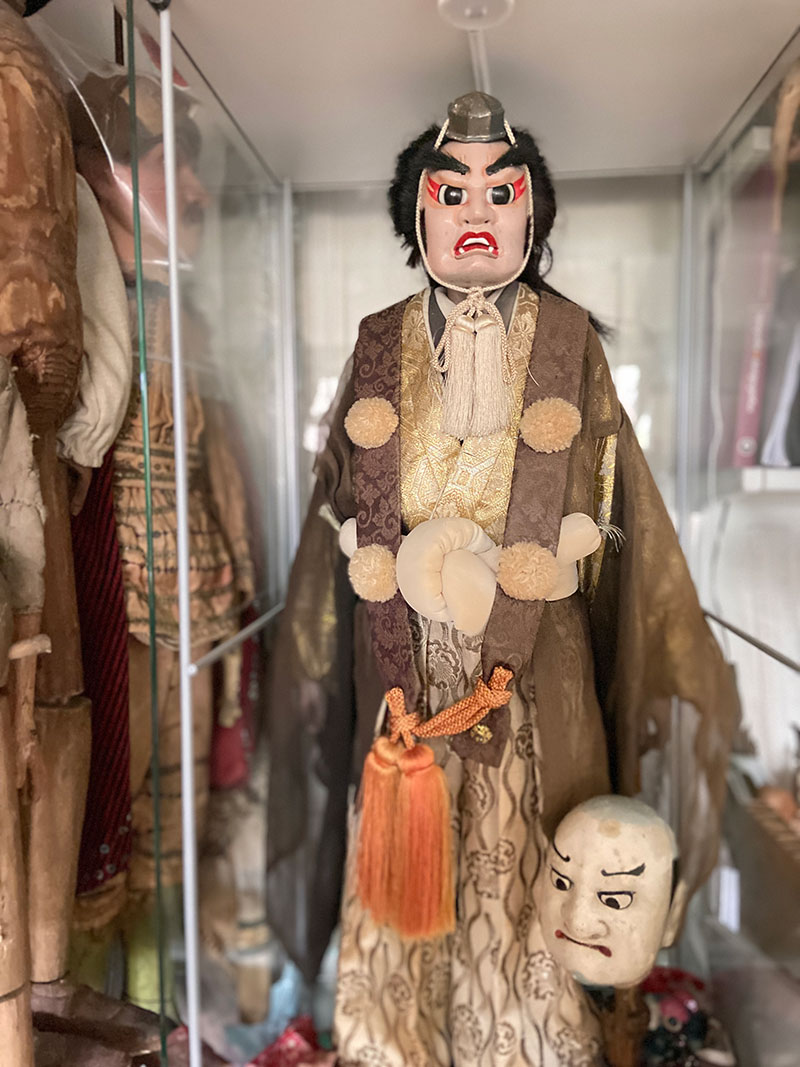
Marcus: Just in the beginning of 2020, I had the amazing opportunity to purchase a full body Japanese Bunraku puppet. I never thought I would be able to have such a treasure in my hands one day, but it happened! He is pictured here on the left. Most puppeteers cherish this highly respected form of puppetry that dates as far back as the 16th century in Japan. And when it comes to Steiff, I would love to add some of the rare and beautiful pre-war puppets that I’m still missing. An old Steiff Teddy Bear Puppet would be a dream come true!
Marcus Sampaio: My name is Marcus Sampaio. I was born in Salvador, the birth city of Brazil. In 2009 I immigrated to Canada and since then I’ve been living in Toronto, an amazing multicultural city. I’m a passionate collector of all sorts of puppets from different parts of the world.
Steiffgal: How did you get interested in puppets? Please describe your puppet collection, and how you store or display it.
Marcus: Puppets have always fascinated me since I was a little kid. All the great memories of attending marionette shows and playing with hand puppets — fostered by my parents during my childhood — led me to a side career as a puppet performer and theatre producer of A RODA puppet Company.
My collection is very broad. I have Shadow Puppets made of animal hide, Wooden Marionettes (also called string puppets), Rod Puppets and, of course, the beloved and most known Hand Puppets! Some were once used professionally but many are well loved old toys.
Steiff stole my heart at the very first moment I saw a Jocko puppet. Today I have quite a large collection of these adorable Steiff critters and a soft spot for monkeys. Within the plush world, I also have puppets by interesting manufacturers like Schuco, Kersa, Eduard Cramer, Hermann Teddy, Grisly, Clemens, Anker, Invicta, SAF, Alpha Farnell, Hamiro and the list goes on…
I live in a condo and I don’t have much display space available. So most of my puppets are stored away, sadly! I use a barrister bookcase to display my favourite plush puppets. Some other special ones keep popping out of the trunks and hanging around the house.
Steiffgal: Do you actually use the puppets as puppets in performances? Or are they more like fine collectibles that are appreciated for their beauty, aesthetics, and rarity?
Marcus: I used to perform with the wooden puppets created by my artistic partner Olga Gomez, within the context of our puppet company A RODA in Brazil. The wooden puppet on the left is from A RODA's show "Love and Madness." Currently I collect puppets for their beauty, craftsmanship and also to preserve such an important part of the culture they come from. People would be amazed to know that pretty much every corner of the world has a form of puppetry.
Steiffgal: What about Steiff brand puppets particularly catches your eye?
Marcus: Steiff is truly an amazing brand! The attention to detail, craftsmanship and understanding of how toys are used, impress me. They are not only incredibly beautiful but they also function very well technically, as puppets. Their designs are so well thought out. Just as an example, if you take a close look at the back of a mid-century Steiff hand puppet, you will notice that it is slightly wider than its front. This pattern fits the puppeteer’s hand very nicely and even gives the puppet a nicer shape.
Steiff is also very consistent in their production. Once I had 2 Dally Dalmatian hand puppets and decided to compare their black dots. I was amazed to see that they were identical but at the same time, their expressions were slightly different, as if they had different souls. I don’t see this design consistency and attention to detail very often when it comes to toy puppets.
Steiffgal: What are the top three favorite puppets in your collection, and why?
Marcus: Wow, that’s a tough one! My collection is so wide and the puppets that I have are so different in styles, origin and materials that it is hard to compare and pick one. But I can say that some pre-war Steiff Jockos are among my favourite plush puppets, probably due to my early memories of a play with a monkey puppet climbing a coconut tree. One named Blondie is pictured here on the left. My other two favourites are a late 19th Century Czech marionette of a noble man with a moustache and a full body Japanese Bunraku puppet.
Steiffgal: And finally, what is the holy grail you would like to find to add to your puppet collection?
Marcus: Just in the beginning of 2020, I had the amazing opportunity to purchase a full body Japanese Bunraku puppet. I never thought I would be able to have such a treasure in my hands one day, but it happened! He is pictured here on the left. Most puppeteers cherish this highly respected form of puppetry that dates as far back as the 16th century in Japan. And when it comes to Steiff, I would love to add some of the rare and beautiful pre-war puppets that I’m still missing. An old Steiff Teddy Bear Puppet would be a dream come true!
Steiffgal: Thank you so much for sharing your knowledge and insights with the Steiff collecting community today!
For more information on Marcus and his puppet passion, check out his website at https://onceuponapuppet.com.
Have a question about one of your Steiff treasures? Let's talk! Click here to learn more.
Labels:
A RODA,
antique,
Brazil,
Bully,
Bunraku,
button in ear,
Canada,
Japanese,
Jocko,
Marcus Sampaio,
monkey,
mysteifflife,
playthings,
puppets,
Scotty,
Steiff,
Steiffgal,
vintage
Monday, December 9, 2019
Sit and Stay With This Marvelous Prewar White Steiff Sealyham
Do you like things sealed with a kiss? Usually, there's never any downside to that, especially when it comes to all things button-in-ear. So grab a chair and take a look at this tiny sitting sweetie. You're certain to appreciate the leg up on what makes him (and his kissing cousin) so interesting from the pre-war product design perspectives.
Your seat-mate for today's discussion is this charming sitting Sealyham. He is head jointed and made from white mohair that has mellowed to a vanilla color over time. He measures 10 cm high and 11 cm long, not including his sweet tail. His face comes to life with brown and black glass pupil eyes. a black hand embroidered nose and mouth, and traces of pink airbrushing around his eyes and lips, He wears his original red collar and brass bell and retains his short trailing "f" button as his ID. Sitting Sealyham was produced in 8, 10, 14, 17, 22 and 25 cm from 1930 through 1939. The sitting version of this breed is somewhat rarer than the standing version as it was produced for fewer years. Given this petite pooch has short trailing "f" button, its a safe bet to conclude that he was made post 1935 or so.
Steiff's prewar Scotty and Sealyham dogs have much in common between their two patterns, including their looks, proportions, materials, and sizes produced. Clearly, Sealyhams were made in white, while Scottys were made in grey or black. Besides color, one small design difference between the two that Steiffgal has noticed are their eyes. From the ones she has seen, some prewar Scotty dogs have almond shaped glass eyes, while others have round glass pupil eyes... while all prewar Sealyhams seem to have round glass pupil eyes.
So picture this! Check out the page from Steiff's 1938/39 catalog featuring Scotty and Sealyham dogs pictured here on the left. You can click on it to make it bigger. It is interesting to see that Scottys are noted on wheels (eccentric at 17 and 22 cm, and riding at 28 and 25 cm) on the breed page, while a Sealyham model on detachable riding wheels appears later on in the catalog, on a page promoting novelties. If you look at the bottom of the page, you see the words, "dasselbe Modell auch in weiss als Sealyham" under an image of a black Scotty. This translates to the "same model in white as Sealyham," further suggesting that the black Scotty and the white Sealyham are basically "cut from the same cloth."
Steiffgal hopes this discussion on this tiny white pup has been on the up and up.
Have a question about one of your Steiff treasures? Let's talk! Click here to learn more.
Saturday, October 8, 2016
Sitting Pretty With This Rare And Unusual Prewar Steiff Sealyham Dog
Pull up a chair and make yourself comfortable! Today's Steiff find really takes sitting down on the job to a new level - in the best way possible. Check out this remarkable sitting Sealyham and see what makes him so interesting from the design and historical perspectives.
Let's paws and check out sitting Sealy's details. This white wonder is 22 cm tall, head jointed, and made from very long white mohair, which has mellowed to a vanilla color. He has three black claws on each of his padless paws, and a pert little tail. His adorable face comes to life with a fuzzy muzzle, oversized black and brown glass pupil eyes, and a black hand embroidered nose and mouth. There is just a trace of pink airbrushing on his mouth, as often seen on Steiff's dogs. His prominent, triangular shaped ears are lined in tan felt. He retains his long trailing "f" button as his Steiff ID. When he left the factory in Giengen he wore a leather collar with a bell; unfortunately these accessories have been lost to time. Sitting Sealy was produced in 8, 10, 14, 17, 22, and 25 cm from 1930 through 1939.
The Sealyham breed was considered one of the more stylish and desired breeds of the late 1920's and early 1930's. As such, Steiff created several versions of this "it" dog. In addition to this sitting style, Steiff also produced a similar standing model. The standing version came in eight sizes ranging from 8 to 35 cm and appeared from 1930 through 1943. Pre-1943, Steiff made numerous Sealyhams on wheels, a tail turns head version, a few nomotta wool woolen miniature or "woolie" Sealyhams, and a 30 cm Sealyham night dress bag. Sealyhams were produced again immediately after the factory reopened for business in the late 1940's. However, only standing examples were produced. These models, which appeared through 1957, had very minor if any changes in fundamental design from the model launched in 1930.
This Sealyham pattern was introduced during what could only be called Steiff's "dog days." This period began in the mid-1920's with the introduction of the company's "Molly the Puppy" pattern. Molly's 1925 debut proved so popular that she is credited for opening the floodgates to a huge influx of Steiff dog designs, including Sealyhams and their black mohair Scotty "cousins." (If you look at the photo on the left, you can see several similarities between sitting Sealy and Molly, including their identical oversized eyes, gentle expressions, and body positions and general presentations.) Between 1925 and 1938, close to 40 new canine species were noted in the Steiff catalogs. These included the now classic Bully Bulldog, Arco the German Shepherd, and Peky the Pekinese, as well as some lesser-known designs including Cheerio, the laughing dog, Putzi, a caricatured standing dog, and Lord the Great Dane.
Steiffgal hopes this discussion on this rare and unusual sitting Sealyham has been a welcome respite in your busy day.
Have a question about one of your Steiff treasures? Let's talk! Click here to learn more.
This Sealyham pattern was introduced during what could only be called Steiff's "dog days." This period began in the mid-1920's with the introduction of the company's "Molly the Puppy" pattern. Molly's 1925 debut proved so popular that she is credited for opening the floodgates to a huge influx of Steiff dog designs, including Sealyhams and their black mohair Scotty "cousins." (If you look at the photo on the left, you can see several similarities between sitting Sealy and Molly, including their identical oversized eyes, gentle expressions, and body positions and general presentations.) Between 1925 and 1938, close to 40 new canine species were noted in the Steiff catalogs. These included the now classic Bully Bulldog, Arco the German Shepherd, and Peky the Pekinese, as well as some lesser-known designs including Cheerio, the laughing dog, Putzi, a caricatured standing dog, and Lord the Great Dane.
Steiffgal hopes this discussion on this rare and unusual sitting Sealyham has been a welcome respite in your busy day.
Have a question about one of your Steiff treasures? Let's talk! Click here to learn more.
Monday, July 11, 2016
The More The Merrier With Steiff's Scottie Terriers!
Great Scott! Just what is it about little black dogs that makes Steiffgal go a little crazy? Well, maybe its because she has two real life black pugs as her adored fur babies. But since Steiff has not yet made a black pug (hint, hint...) Steiffgal has fallen almost as hard for the company's sweet black Scottish Terriers. Here are a few recent Scottie additions to her collection you might find quite interesting as well.
Go big or go home! Or in this case, both! Here we have an almost life-sized Scottie. He measures 28 cm tall and 36 cm long, not counting his pert tail. That adds another 9 cm to his presentation. He is standing on all fours, head jointed, and made from long black mohair. He has tan embroidered claws. His ears are lined in black felt. His face comes to life with large white, brown, and black almond shaped glass eyes, a long shaggy mohair beard, and a black hand embroidered nose and mouth. His IDs include a raised script style button and a US Zone tag. This model was produced in 10, 14, 17, 22, 25, 28, and 35 cm from 1949 through 1957. So this version is the second to largest size (as they are "measured" vertically from head to toe) and most likely made in around 1952, give or take a year or two. Here in the picture on the left you can see Scottie modeling with the beautiful and perfect real-life black pug Booboo.
The biggest Steiff Scottie produced ever, as far as Steiffgal can tell, is a 43 cm version produced as a ride-on animal from 1950 through 1961. His design appears to be the same as Steiffgal's big boy, (pictured here on the left) just blown up in scale to almost twice the size. It is interesting to note that Steiff never produced a Studio Scottie, at least on a commercial scale.
This second Scottie
highlight is the wheel-deal indeed. Here we have Steiff's early postwar Scottie on eccentric wheels. He measures 13 cm tall and 21 cm long; 24 cm including his tail. He is standing on all fours, head jointed, and made from short mohair. His beard is made from longer black mohair. His ears are lined in black felt. His face comes to life with proportional white, brown, and black almond shaped glass eyes and a black embroidered nose and mouth. Scottie is mounted to a metal chassis and glides along on four red wooden eccentric wheels. He retains his raised script style button as his ID. This model was produced in 14 and 17 cm from 1949 through 1957 overall. This pup on the go is the smaller version of this model, and probably made towards the tail end of the production period.
Scottie on wheels is a legacy design for Steiff - one produced both pre- and post World War II. The photo here on the left is a close up beauty shot of him; his collar is not original to him but was indeed made by Steiff. Three versions of Scottie dogs on wheels were produced prewar. The first was a Scottie on eccentric wheels which was made in 14, 17, and 22 cm from 1932 to 1943 overall. The second was a Scottie on regular wheels which was made in 28 and 35 cm from 1932 to 1943 overall; those from 1932 through 1936 came with a squeaker. And the third was a version that squeaked automatically when he was pulled along; he was produced in 17 cm from 1939 through 1942. This was called the "barking dog" version.
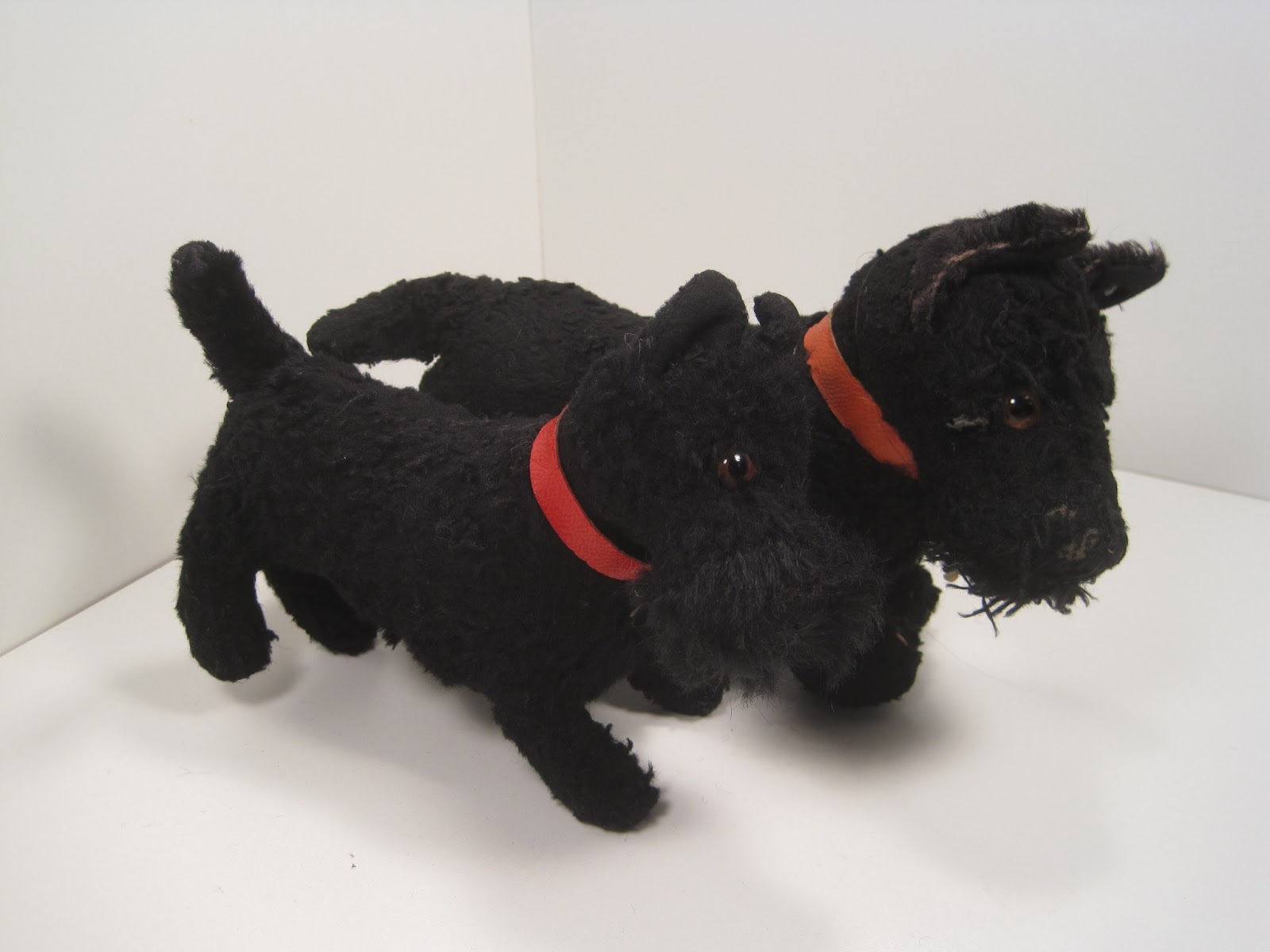
And the third's the charm with this last interesting Scottie. Well, actually pair of Scotties, they've been inseparable since meeting up in the collection. Here we have two silk plush Scotties. The smaller one measures 14 cm tall and 19 cm long; 22 cm including his tail. The larger one measures 16 cm tall and 22 cm long; 26 cm including his tail. Both are standing on all fours, head jointed, and have round brown and black glass pupil eyes. As mentioned above, both are made from artificial silk plush. This material started out soft and shiny, but over time tends to lose its sheen and get a little dull and matted down, especially the longer versions. This is the case here. Unlike wool plush, longer artificial silk plush does not have a slightly "coarse" touch to it.
The detailing and IDs on the larger and smaller silk plush versions are a bit different, which is interesting given that both were only produced in 1949 - according to Steiff records. The smaller one has a shaggy black mohair beard and a raised script button as his ID. The larger one has a sort of shaggy black artificial silk plush beard, and a blank button as his ID. Based on these differences, it is Steiffgal's best guess that the larger one was indeed manufactured and distributed in the very late 1940's. However, because the smaller one has mohair detailing, as well as a raised script button (which technically launched in the early 1950's) it is likely that the smaller one was produced and distributed at a later date than the larger one when mohair was more readily available for toy making purposes.
Steiffgal hopes this discussion of interesting post war Scottie dogs has added a pleasant paws to your day.
Have a question about one of your Steiff treasures? Let's talk! Click here to learn more.
Go big or go home! Or in this case, both! Here we have an almost life-sized Scottie. He measures 28 cm tall and 36 cm long, not counting his pert tail. That adds another 9 cm to his presentation. He is standing on all fours, head jointed, and made from long black mohair. He has tan embroidered claws. His ears are lined in black felt. His face comes to life with large white, brown, and black almond shaped glass eyes, a long shaggy mohair beard, and a black hand embroidered nose and mouth. His IDs include a raised script style button and a US Zone tag. This model was produced in 10, 14, 17, 22, 25, 28, and 35 cm from 1949 through 1957. So this version is the second to largest size (as they are "measured" vertically from head to toe) and most likely made in around 1952, give or take a year or two. Here in the picture on the left you can see Scottie modeling with the beautiful and perfect real-life black pug Booboo.
The biggest Steiff Scottie produced ever, as far as Steiffgal can tell, is a 43 cm version produced as a ride-on animal from 1950 through 1961. His design appears to be the same as Steiffgal's big boy, (pictured here on the left) just blown up in scale to almost twice the size. It is interesting to note that Steiff never produced a Studio Scottie, at least on a commercial scale.
This second Scottie
highlight is the wheel-deal indeed. Here we have Steiff's early postwar Scottie on eccentric wheels. He measures 13 cm tall and 21 cm long; 24 cm including his tail. He is standing on all fours, head jointed, and made from short mohair. His beard is made from longer black mohair. His ears are lined in black felt. His face comes to life with proportional white, brown, and black almond shaped glass eyes and a black embroidered nose and mouth. Scottie is mounted to a metal chassis and glides along on four red wooden eccentric wheels. He retains his raised script style button as his ID. This model was produced in 14 and 17 cm from 1949 through 1957 overall. This pup on the go is the smaller version of this model, and probably made towards the tail end of the production period.
Scottie on wheels is a legacy design for Steiff - one produced both pre- and post World War II. The photo here on the left is a close up beauty shot of him; his collar is not original to him but was indeed made by Steiff. Three versions of Scottie dogs on wheels were produced prewar. The first was a Scottie on eccentric wheels which was made in 14, 17, and 22 cm from 1932 to 1943 overall. The second was a Scottie on regular wheels which was made in 28 and 35 cm from 1932 to 1943 overall; those from 1932 through 1936 came with a squeaker. And the third was a version that squeaked automatically when he was pulled along; he was produced in 17 cm from 1939 through 1942. This was called the "barking dog" version.
And the third's the charm with this last interesting Scottie. Well, actually pair of Scotties, they've been inseparable since meeting up in the collection. Here we have two silk plush Scotties. The smaller one measures 14 cm tall and 19 cm long; 22 cm including his tail. The larger one measures 16 cm tall and 22 cm long; 26 cm including his tail. Both are standing on all fours, head jointed, and have round brown and black glass pupil eyes. As mentioned above, both are made from artificial silk plush. This material started out soft and shiny, but over time tends to lose its sheen and get a little dull and matted down, especially the longer versions. This is the case here. Unlike wool plush, longer artificial silk plush does not have a slightly "coarse" touch to it.
The detailing and IDs on the larger and smaller silk plush versions are a bit different, which is interesting given that both were only produced in 1949 - according to Steiff records. The smaller one has a shaggy black mohair beard and a raised script button as his ID. The larger one has a sort of shaggy black artificial silk plush beard, and a blank button as his ID. Based on these differences, it is Steiffgal's best guess that the larger one was indeed manufactured and distributed in the very late 1940's. However, because the smaller one has mohair detailing, as well as a raised script button (which technically launched in the early 1950's) it is likely that the smaller one was produced and distributed at a later date than the larger one when mohair was more readily available for toy making purposes.
Steiffgal hopes this discussion of interesting post war Scottie dogs has added a pleasant paws to your day.
Have a question about one of your Steiff treasures? Let's talk! Click here to learn more.
Saturday, May 7, 2016
It's A Family Affair When It Comes To Steiff's Classic Pre-War Canines!
For many lucky collectors, Steiff is truly a family affair when parents, siblings, and other relatives also participate in the "button-in-ear" fun! Steiffgal "inherited" her love of Steiff, as well as some of her beloved Steiff family heirlooms, from her paternal Grandmother. Given that Mother's Day in the USA is right around the corner, Steiffgal thought it would be fun to share some of her favorite "family" photos. But don't worry, there's no embarrassing snapshots of cousins in ill-fitting swimsuits eating ice cream cones together on vacation in 1974. These are pictures of families of pre-war Steiff dogs doing what they do best - looking irresistible!
This first family has always been considered "royalty" among Steiff fans. Here we have a sweet trio of the company's "Charly" dogs. These, of course, are modeled after the King Charles Spaniel breed. Each is standing on all fours and made from mohair. All but the bitty baby are head jointed. This pattern is known for its very long, floppy ears and pert tails. Charly dogs traditionally come to life with expressive and oversized eyes, a prominent forehead, freckles on their muzzles, and hand embroidered noses and mouths. Papa Charly is 14 cm tall and 16 cm long; Mama is 8 cm tall and 10 cm long; and Baby is 6 cm tall and 9 cm long; these measurements do not include their tails. Overall, standing Charly was manufactured in six sizes ranging from 7 to 22 cm from 1928 through 1938.
Sit and stay and have a good look at this second Steiff family. These black and white beauties are, of course, a pack of Steiff's Bully dogs. Their pattern is based on the English Bulldog breed. These Bully dogs are all sitting and head jointed. Papa and Mama are primarily made from black and white mohair and have poseable ears lined in wires. Baby is made from black and white velvet and has stationary ears. All have face and muzzle areas made from tan velvet, prominent jowls, very large brown and black glass pupil eyes, and black, hand-embroidered noses. Papa Bully is 19 cm tall; Mama is 15 cm tall; and Baby is 9 cm tall. Sitting black and white mohair Bully dogs were produced in 9 sizes ranging from 10 to 50 cm from 1927 through 1938 while sitting black and white velvet Bully dogs were produced in 4 sizes ranging from 7 to 17 cm from 1927 through 1939. Hold your horses! Most interestingly, these beautiful Bullies all retain some or all of their original and traditional horsehair collars. These are made from long, thin strips of material which are doubled over width-wise; the horsehair fibers are sewn in between the faces of the material. Each collar is held together with a little knot under Bully's chin. The horsehair collar was a typical accessory of the 1920s and indicated a "regal" nature of the item wearing it.
Great Scot, we've already made it to the third and final Steiff family under discussion today. These grey-black pups are utterly charming Steiff Scotty dogs. All are standing and made from black mohair that almost has a "salt and pepper" cast to it. Mama, on the left, is a rare example of the company's tail- turns-head Scotty. She has tri-color almond shaped glass eyes and felt lined ears. Baby, in the middle, and Papa, on the left, have dark black mohair ears, round black and brown glass pupil eyes, and handsome, original black and white woven leather collars that close with two Steiff buttons each. Papa is head jointed and Baby is unjointed. Papa Scotty is 14 cm tall and 20 cm long; Mama is 10 cm tall and 22 cm long; and Baby is 8 cm tall and 12 cm long; these measurements do not include their tails. Tail-moves-head Scotty was produced in 6 sizes ranging from 9 to 26 cm from 1931 through 1934 while the company's regular line standing Scotty dogs were produced overall in 8 sizes ranging from 8 to 35 cm in either gray or grey-black from 1930 through 1943.
Steiffgal hopes this discussion of these great Steiff dog trios has been a family affair for you!
Labels:
bulldog,
Bully,
button in ear,
charly,
collectible,
dog,
felt,
horsehair collar,
King Charles Spaniel,
mohair,
Scotty,
Steiff,
Steiffgal,
toy,
velvet,
vintage
Saturday, June 7, 2014
Moving And Grooving With This Fabulous Vintage Steiff Scotty
It goes without saying that many vintage Steiff treasures are truly gorgeous! But Steiffgal would like to share one with you today that is literally a "head turner!" This week by post she received this marvelous black bearded beauty from Germany. Take a look at this pup with a secret... and be prepared to shake your head in amazement!
Great Scott! Here we have Steiff's standing Scotty. He measures 15 cm head to toe, and 23 cm nose to rear end, not including his tail. He is made from lovely black backed mohair that has silver threads throughout the material, giving him a very dignified appearance. Scotty has a long, jet black beard and eyebrows. He has a brown hand embroidered nose, mouth, and claws, and delightful, tri-colored almond shaped glass eyes in white, brown, and black. The insides of his ears are lined in tan felt. His bow and bell are not original to him; when he left the factory in Giengen over eight decades ago he most likely wore a little black and white leather collar with a few Steiff buttons on it. This particular Scotty model was produced in 9, 11, 15, 18, 23, and 26 cm from 1931 through 1934.
Let's move right on to what makes this Scotty so spectacular. Like several popular Steiff items of the early 1930's, this pattern has what is known as a "tail moves head" mechanism. This means by gently twisting the tail back and forth, his head moves in unison - giving the animal a most charming sense of realistic movement. Take a look at the video to see for yourself!
Steiff's early "action super heroes" of the 1930's include cats, dogs, rabbits, and lambs, among others. For the most part, each was based on standard line popular designs of the time, and came with a round cardboard tag on its tail that read "turn here and I will move my head." You can see this tag here on the left, the photo is from Teddy Dorado. Tail turns head items were considered higher end, luxury toys, and most were produced through the late 1930's. Perhaps the best known tail moves head design was Rattler Terrier, who appeared through the early 1940's.
Steiffgal hopes this discussion on this Scotty has you bobbing your head in agreement that he is one dynamic dog!
Have a question about one of your Steiff treasures? Let's talk! Click here to learn more.
Great Scott! Here we have Steiff's standing Scotty. He measures 15 cm head to toe, and 23 cm nose to rear end, not including his tail. He is made from lovely black backed mohair that has silver threads throughout the material, giving him a very dignified appearance. Scotty has a long, jet black beard and eyebrows. He has a brown hand embroidered nose, mouth, and claws, and delightful, tri-colored almond shaped glass eyes in white, brown, and black. The insides of his ears are lined in tan felt. His bow and bell are not original to him; when he left the factory in Giengen over eight decades ago he most likely wore a little black and white leather collar with a few Steiff buttons on it. This particular Scotty model was produced in 9, 11, 15, 18, 23, and 26 cm from 1931 through 1934.
Let's move right on to what makes this Scotty so spectacular. Like several popular Steiff items of the early 1930's, this pattern has what is known as a "tail moves head" mechanism. This means by gently twisting the tail back and forth, his head moves in unison - giving the animal a most charming sense of realistic movement. Take a look at the video to see for yourself!
Steiff's early "action super heroes" of the 1930's include cats, dogs, rabbits, and lambs, among others. For the most part, each was based on standard line popular designs of the time, and came with a round cardboard tag on its tail that read "turn here and I will move my head." You can see this tag here on the left, the photo is from Teddy Dorado. Tail turns head items were considered higher end, luxury toys, and most were produced through the late 1930's. Perhaps the best known tail moves head design was Rattler Terrier, who appeared through the early 1940's.
Steiffgal hopes this discussion on this Scotty has you bobbing your head in agreement that he is one dynamic dog!
Have a question about one of your Steiff treasures? Let's talk! Click here to learn more.
Wednesday, September 11, 2013
Life's Just A Party When It Comes To Vintage Steiff
Every day can be a party when it comes to vintage Steiff! And nothing could be closer to the truth than last weekend, when Steiffgal invited a few collector friends from the New England area to gather at her home for an afternoon of all things Steiff! The happening included a tour of Steiffgal's personal collection, a sales table chock full of exciting new vintage items just acquired from two collections, an identification and valuation clinic, and of course seasonal treats and refreshments - including Steiffguy's homemade pretzels! Here's a little summary of the highlights of this memorable occasion.
Nothing says "welcome" like a family of life sized Steiff donkeys, right? These two "great Grissys" (as well as a few live pug dogs) greeted our beloved visitors as they arrived at the event.
Everyone had the opportunity to add a few choice items to their collection from the huge range of items available on the sales table. Steiffgal spent the week prior to the event cataloging, cleaning, and preparing each of these 175 goodies for their grand debut. Of course, the large monkey in the background is not Steiff, but hired nonetheless to stand guard over the precious treasures.
Almost all of our Steiff friends brought delightful goodies for evaluation as well as group discussion. Here are some wonderful highlights from this "show and tell" session.
This little guy is simply a handful of puppy love! This woolie wonder measures about 4 cm tall and 8 cm long and is made from white Nomotta wool. He has felt ears, tiny pupil eyes, and a little black nose. He is detailed with the tiniest red collar! He is either a white Scotty or a Sealyham; both these patterns were almost identical and made in 8, 10, 14, and 16 cm the 1935 through 1941 time frame.
There's no need to be sheepish about this next visitor. Here we have Steiff's woolen miniature Lamm or Lamb. Like her sweet puppy friend mentioned above, she is also made from white Nomotta wool. Her insides are lined in wire, so she is somewhat poseable. Lamb has charming pink highlights on her nose and paws. Her face is detailed with little eyes and felt ears, and she wears a tiny pink bow. Lamb was produced in 7 and 10 cm in black and white in the 1935 through 1941 time frame.
Now this is a find worthy of royalty, really! Here we have what Steiff calls a Spitz or Pomeranian dog. This pensive looking puppy was produced from 1902 though 1927 in 14, 17, 22, 28, 35, and 43 cm. Spitz is sitting and made from long white curly mohair with a white felt face, ears, and legs below his hips. He has black shoe button eyes and embroidered facial features. He is wearing a bell collar and painted pink ribbon which are period and authentic, but not original to him. Most likely, when he was new, this Spitz featured a red cord with two pom-poms or tassels around his neck, giving him a “regal” appearance. The breed does have some connections to German royalty, which may explain why Steiff decorated them like “little kings.” This classic design was also produced in several other variations, including a jointed standing version, as a pup on wheels, and as a pincushion on a red velvet pillow.
Let's paws and take a look at this next beloved Steiff guest, who is just about purrr-fect in every way. This is of course a fantastic example of Steiff's "Fluffy" cat. She is sitting, unjointed, and made in part from bluish tipped mohair, which is just spectacular. Her little tail wraps sweetly around her body. Fluffy's face is detailed with deep green and black pupil eyes and a simple pink hand embroidered red nose and mouth. And check out her fantastic early named metal ring chest tag! Sitting Fluffy was made overall from 1926 through 1950 in 7, 10, 14, 17, 22, 25, 30, 35, and 43 cm. She was such a favorite that she was produced on a pincushion, as a music box, and as a tail turns head model.
You can't help but feel lovey-dovey when it comes to this final Steiff masterpiece. Here we have a most unusual example of the company's turn of last century's pigeon or dove. She is 10 cm and made from soft velvet like felt. Her feet are made from metal that has been wrapped tightly with yellow string, giving them a most authentic appearance. Her body has been elegantly and gracefully stenciled and airbrushed with black and grey highlights. Her eyes are black button and backed in felt; her tiny beak is also made from felt. She wears a red ribbon with a tag on it which are period but not original to her. She most likely left the factory in Giengen on a little metal pull cart, but that has been lost to time. This remarkable item was produced in this size only from 1916 through 1919.
Steiffgal hopes this review of her recent Steiff celebration has been nothing but a party for you... and thanks to all the wonderful guests (collectors and their and treasures) who helped to make it that way!
Have a question about one of your Steiff treasures? Let's talk! Click here to learn more.
Nothing says "welcome" like a family of life sized Steiff donkeys, right? These two "great Grissys" (as well as a few live pug dogs) greeted our beloved visitors as they arrived at the event.
Everyone had the opportunity to add a few choice items to their collection from the huge range of items available on the sales table. Steiffgal spent the week prior to the event cataloging, cleaning, and preparing each of these 175 goodies for their grand debut. Of course, the large monkey in the background is not Steiff, but hired nonetheless to stand guard over the precious treasures.
Almost all of our Steiff friends brought delightful goodies for evaluation as well as group discussion. Here are some wonderful highlights from this "show and tell" session.
This little guy is simply a handful of puppy love! This woolie wonder measures about 4 cm tall and 8 cm long and is made from white Nomotta wool. He has felt ears, tiny pupil eyes, and a little black nose. He is detailed with the tiniest red collar! He is either a white Scotty or a Sealyham; both these patterns were almost identical and made in 8, 10, 14, and 16 cm the 1935 through 1941 time frame.
There's no need to be sheepish about this next visitor. Here we have Steiff's woolen miniature Lamm or Lamb. Like her sweet puppy friend mentioned above, she is also made from white Nomotta wool. Her insides are lined in wire, so she is somewhat poseable. Lamb has charming pink highlights on her nose and paws. Her face is detailed with little eyes and felt ears, and she wears a tiny pink bow. Lamb was produced in 7 and 10 cm in black and white in the 1935 through 1941 time frame.
Now this is a find worthy of royalty, really! Here we have what Steiff calls a Spitz or Pomeranian dog. This pensive looking puppy was produced from 1902 though 1927 in 14, 17, 22, 28, 35, and 43 cm. Spitz is sitting and made from long white curly mohair with a white felt face, ears, and legs below his hips. He has black shoe button eyes and embroidered facial features. He is wearing a bell collar and painted pink ribbon which are period and authentic, but not original to him. Most likely, when he was new, this Spitz featured a red cord with two pom-poms or tassels around his neck, giving him a “regal” appearance. The breed does have some connections to German royalty, which may explain why Steiff decorated them like “little kings.” This classic design was also produced in several other variations, including a jointed standing version, as a pup on wheels, and as a pincushion on a red velvet pillow.
Let's paws and take a look at this next beloved Steiff guest, who is just about purrr-fect in every way. This is of course a fantastic example of Steiff's "Fluffy" cat. She is sitting, unjointed, and made in part from bluish tipped mohair, which is just spectacular. Her little tail wraps sweetly around her body. Fluffy's face is detailed with deep green and black pupil eyes and a simple pink hand embroidered red nose and mouth. And check out her fantastic early named metal ring chest tag! Sitting Fluffy was made overall from 1926 through 1950 in 7, 10, 14, 17, 22, 25, 30, 35, and 43 cm. She was such a favorite that she was produced on a pincushion, as a music box, and as a tail turns head model.
You can't help but feel lovey-dovey when it comes to this final Steiff masterpiece. Here we have a most unusual example of the company's turn of last century's pigeon or dove. She is 10 cm and made from soft velvet like felt. Her feet are made from metal that has been wrapped tightly with yellow string, giving them a most authentic appearance. Her body has been elegantly and gracefully stenciled and airbrushed with black and grey highlights. Her eyes are black button and backed in felt; her tiny beak is also made from felt. She wears a red ribbon with a tag on it which are period but not original to her. She most likely left the factory in Giengen on a little metal pull cart, but that has been lost to time. This remarkable item was produced in this size only from 1916 through 1919.
Steiffgal hopes this review of her recent Steiff celebration has been nothing but a party for you... and thanks to all the wonderful guests (collectors and their and treasures) who helped to make it that way!
Have a question about one of your Steiff treasures? Let's talk! Click here to learn more.
Monday, May 6, 2013
The Skye's The Limit With This Delightful and Unusual Steiff Dog
Things are really looking up - way up - with this very special Steiff item under discussion today. Here we have Steiff's seldom seen Skye Terrier! This little fellow, who in some ways resembles the perfect dust mop (Steiffgal means this in the MOST LOVING WAY), only appeared for a few pre-WWII years in the Steiff catalog. He has some delightful and unusual features. Let's take a look at what makes him so interesting from the design and historical perspectives.
The musician Jimi Hendrix is famous for saying, "Excuse me while I kiss the sky," and that would make perfect sense in reference to this sweet dog as well. Skye is about 7 inches tall and 17 inches long. His ear tag indicates that he is the 22 cm version, making him the largest size of this design produced. He is standing, unjointed, and and made from extremely long light grey mohair. His ears and muzzle are made from very long black mohair. His face is detailed with oversized, almond shaped tri-colored glass eyes and a very simple brown hand embroidered nose and mouth. He wears a red leather color and retains his large, early named bear faced chest tag, short trailing "f" Steiff button, and yellow ear tag. Overall, this Skye Terrier model was produced in 12, 14, 17, and 22 cm from 1933 through 1943.
Steiff introduced Skye Terriers to collectors just a handful of years after launching two other famous bearded beauties, their black Scotties and white Sealyhams. Both Steiff Scotties and Sealyhams made their debut in 1930. These friends are pictured here on the left. As you can see, Steiff Skye Terriers, Scotties, and Sealys all have a similar look and feel, with several design overlaps and commonalities. They even share an "impish" quality between them. It is interesting to note that over time, both the Scotties and the Sealyhams were produced both sitting and standing, while the Skye was only produced standing. Although the Sealyhams always had round brown and black pupil eyes, the Scotties and the Skyes were produced with both round as well as tri-colored almond shaped eyes. Steiffgal is extrapolating that alot had to do with timing and supply chains at the time.
Despite his relatively short tenure in the Steiff line, the Skye Terrier pattern appeared in several very interesting theme and variation products in the late 1930's and early 1940's. He was produced as an "unbuttoned" animal on wheels from 1936 through 1940. This meant that that he could be mounted and dismounted from a rolling carriage as desired. He was also made as a "barking" animal on wheels from 1939 through 1941; this model automatically made doggie sounds when pulled about. And finally, he appeared as a purse with a hollow body and a zipper up his back from 1935 through 1940.
Steiffgal hopes this discussion on this most unusual Steiff dog has been nothing but blue skies for you.
Have a question about one of your Steiff treasures? Let's talk! Click here to learn more.
The musician Jimi Hendrix is famous for saying, "Excuse me while I kiss the sky," and that would make perfect sense in reference to this sweet dog as well. Skye is about 7 inches tall and 17 inches long. His ear tag indicates that he is the 22 cm version, making him the largest size of this design produced. He is standing, unjointed, and and made from extremely long light grey mohair. His ears and muzzle are made from very long black mohair. His face is detailed with oversized, almond shaped tri-colored glass eyes and a very simple brown hand embroidered nose and mouth. He wears a red leather color and retains his large, early named bear faced chest tag, short trailing "f" Steiff button, and yellow ear tag. Overall, this Skye Terrier model was produced in 12, 14, 17, and 22 cm from 1933 through 1943.
Steiff introduced Skye Terriers to collectors just a handful of years after launching two other famous bearded beauties, their black Scotties and white Sealyhams. Both Steiff Scotties and Sealyhams made their debut in 1930. These friends are pictured here on the left. As you can see, Steiff Skye Terriers, Scotties, and Sealys all have a similar look and feel, with several design overlaps and commonalities. They even share an "impish" quality between them. It is interesting to note that over time, both the Scotties and the Sealyhams were produced both sitting and standing, while the Skye was only produced standing. Although the Sealyhams always had round brown and black pupil eyes, the Scotties and the Skyes were produced with both round as well as tri-colored almond shaped eyes. Steiffgal is extrapolating that alot had to do with timing and supply chains at the time.
Despite his relatively short tenure in the Steiff line, the Skye Terrier pattern appeared in several very interesting theme and variation products in the late 1930's and early 1940's. He was produced as an "unbuttoned" animal on wheels from 1936 through 1940. This meant that that he could be mounted and dismounted from a rolling carriage as desired. He was also made as a "barking" animal on wheels from 1939 through 1941; this model automatically made doggie sounds when pulled about. And finally, he appeared as a purse with a hollow body and a zipper up his back from 1935 through 1940.
Steiffgal hopes this discussion on this most unusual Steiff dog has been nothing but blue skies for you.
Have a question about one of your Steiff treasures? Let's talk! Click here to learn more.
Subscribe to:
Posts (Atom)


c