Showing posts with label giraffe. Show all posts

Tuesday, May 2, 2023

This Early Steiff Giraffe On The Go Is The Wheel-Deal!

It's no stretch to say that Steiff's giraffes are quite the jungle gems. Prewar ones are few and far between on the secondary market, and always catch the eye of collectors. Check out this note from Lynda who would like to know more about a fine and early example from her collection. She writes:

"Hello, I would appreciate any information on age, rarity and value of this old Steiff giraffe on wheels. He measures just under 21” on wheels; the height of giraffe sans wheels 20 1/2” as he sits on a crossbar; actual wheels measure 1 3/4” in height. Thanks!"

This handsome and dramatic giraffe on the go is a legacy pre-war item. The pattern appeared overall in 9 sizes overall, ranging from 28 to 260 cm, from 1909 through 1942. Given his dimensions, Lynda's pal is the 50 cm size, as wheels are not included in his official measurements. He is made from hand stenciled felt, has mohair ears, is standing, and unjointed. His face comes to life with pert black button eyes, prominent ossicones, airbrushed features, and dramatic seams. He retains his long trailing "f" button as his Steiff ID. Giraffe debuted on metal wheels; in 1923 he started to be produced on wooden wheels. Given these details, it is safe to say that this guy was "born" in the 1909-1923 time frame.

Given his appeal and longevity in the line, it is not surprising that this giraffe on wheels pattern was produced in a few forms and variations over the years.
 
For example, the 110 cm size was also made in mohair in the early 1930s. Some larger models were made as riding toys with steering features, while the largest ones came with a saddle and footrests - much like the company's riding horses or donkeys. According to Pfeiffer's Sortiment, the saddle and foot rests were intended "for shoe stores, for fitting children's shoes."

It is interesting to note that despite his age, this model is not Steiff's debut or earliest giraffe model. The company produced felt giraffes with or without metal wheels in 17, 28, 35, and 65 cm from 1892-1909 overall. These first generation, earliest models had simpler lines and more dramatic coloring than the model under discussion here. 

Now for the tricky question - his value.
 As always, something is worth what someone will pay for it, and Steiffgal does not have a crystal ball or insights into what any given bidder or buyer would offer for it. A solid way to think about value is to see what other similar items have sold for at public auction. In 2018, a 50 cm felt giraffe in excellent to unused condition with IDs from the late 1920s-early 1930s realized about $3,751. He is pictured here on the left, and may be the same one shown in Pfeiffer's 1892-1943 Sortiment book, page 310. Given Lynda's example has significant losses and playwear, but retains its ID, has metal wheels, and probably could be restored a bit, it is Steiffgal's best GUESS that he may change hands in the c. $1,500-2,500 range. 

Steiffgal hopes this discussion on Lynda's giraffe keeps your interest in Steiff on a roll. 

Have a question about one of your Steiff treasures? Let's talk! Click here to learn more!

Saturday, October 14, 2017

Things Are Spot on With This Delightful Pre-War Steiff Giraffe!


Steiffgal's gonna stick her neck out here and say that you will undoubtedly develop a plush-crush on this week's blog friend. She bought him based on a photo from a sale in Europe, as something about him really called to her. As a fellow collector, she is certain you know that feeling all too well! So how about following a tall order and checking him out?

Things are spot on with this delightful pre-war Steiff giraffe. He is 35 cm tall, unjointed, and made from light orange wool plush. He is hand spotted with darker orange spots. His mane is made from short light orange mohair, while the tip of his tail is made from longer orange mohair. His face comes to life with two pert horns, black button eyes, a painted orange mouth, and ears lined in peach colored felt. This pattern was made in 28 and 35 cm from 1936 through 1943.  

Despite his simple and charming appearance, this delightful example is actually outstanding in two ways. 


First, material matters. Giraffes are a legacy pattern for Steiff. Giraffes were featured in the company's debut 1892 catalog. Wheeled and simple standing ones were available in sizes ranging from 17 cm to 65 cm overall through 1909. This pattern was updated in 1909 and produced in an even greater spectrum of sizes - from 28 to 260 cm through 1942 overall. The larger sizes were designed for riding and were constructed with a stabilizing internal metal frame and detailed with steering and leather saddles. Except for a lone 110 cm example made in 1933, all of these gorgeous giraffes were made of felt.  Given the elegant lines of these animals, as well as their need for precise spot detailing, this makes perfect sense from the manufacturing, economic, and design perspectives. 

So then, what's the big deal with this little guy? This giraffe under discussion today is really the first non-felt version produced as a standard line item for any length of time. And its fabric - wool plush - aligns perfectly with its period of manufacture. Its detailing materials - felt on the ears, and mohair on the mane and tail tip - are used as minimally as possible, yet really add to the giraffe's appeal and sense of quality. Felt and mohair were beginning to become less and less available for toymaking in the mid-1930's due to geo-political reasons. As such, Steiff was very careful with the limited quantities of these upscale fabrics they had available to them. Here on the left is the catalog entry for this giraffe in Steiff's Hauptkatalog (main catalog) dated D 1938/39.

Giraffe's second fantastic feature is a heavy-metal favorite. His "knopf" is the most unusual BRASS colored Steiff button. It is the short trailing "f" style and 6 mm in diameter. This button appeared on some Steiff items from 1933/34 through 1943. This are pretty uncommon; this is only the second item in Steiffgal's collection of vintage Steiff treasures bearing this distinctive trademark. Most of the time, for items produced in the mid 1930's through early 1940's time frame, Steiff used a silver colored short trailing "f" button.  You can see this brass button, with traces of the yellow ear tag, here on the left. 

Steiffgal hopes this discussion on this delightful tall drink of water has whetted your appetite for Steiff's late pre-war wool plush rarities. 

Have a question about one of your Steiff treasures? Let's talk! Click here to learn more.

Friday, December 6, 2013

An Exclusive Online Auction Preview, Just For Steifflife Readers!


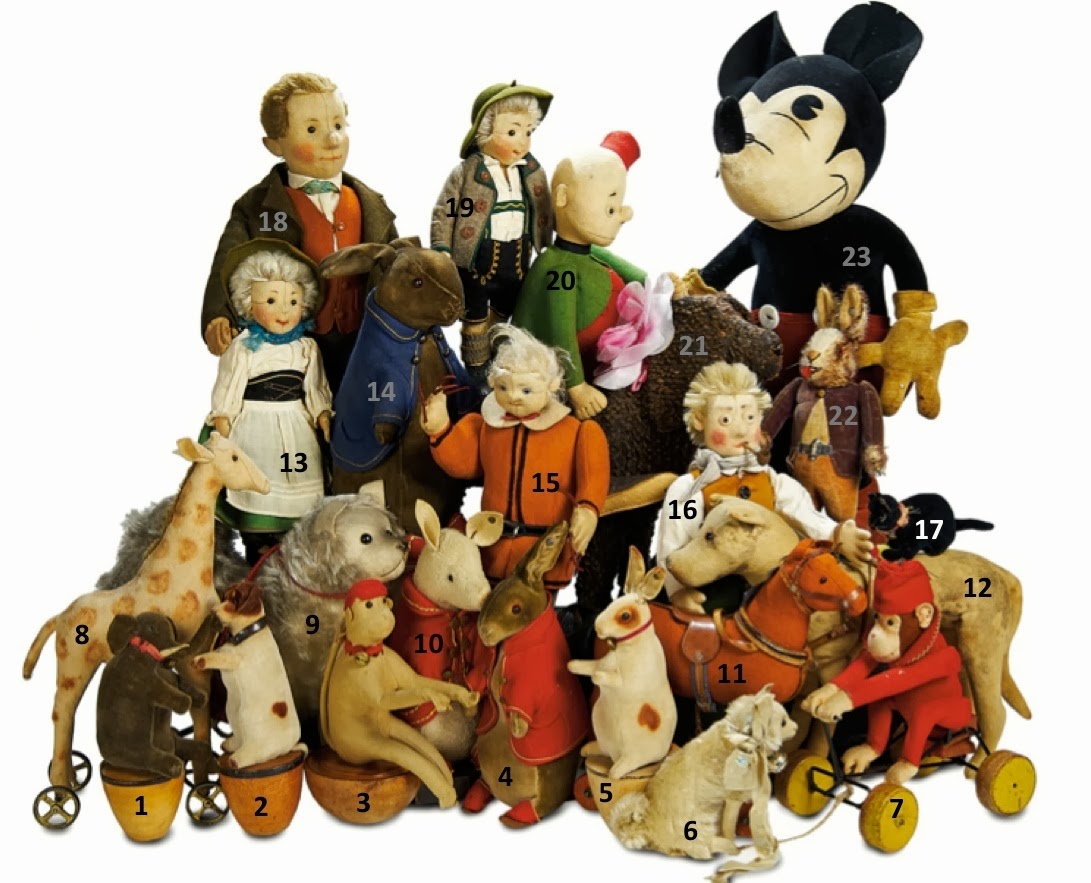
Pssss.... wanna know a (Steiff) secret?  Steiffgal has learned of an AMAZING collection of vintage Steiff items going up for sale early next year... and she wants to share the details with you!  Check out this breathtaking photo of vintage Steiff treasures that will hit the auction block on January 10-12th, 2014.  They are all part of Theriault's Marquis event which will be held at the Westin South Coast Plaza in Newport Beach, CA.  The image reflects just a small sample of the 100+ treasures from the collection of American Steiff enthusiast Helen Welsh Gastaldo.  Let's take a look at these items and see what makes them so interesting, and exciting, from the collector's perspective.

Items 1, 2, and 5:
In this case, it's very good to get off to a shaky start.  What we have here are marvelous examples of Steiff's early skittles.  Skittles as a game was a turn of last century pastime analogous to bowling.  Steiff produced skittle sets from 1892 through 1919. Over that period of time, Steiff made the sets with hens, monkeys, elephants, pigs, rabbits, poodles, pointers, cats, chicks, dachshunds, elephants, pointers, cats, and bears, among others. In all cases - except the hen and the chick versions - the kingpin wore a felt jacket and crown.  The sets produced for the European market had nine total skittles, while those for America had ten total.  All sets came with two felt "bowling" balls. 

These three skittles - an elephant, pointer, and rabbit - are made from velvet and are on a wooden base.  The elephant skittle was made from 1901 through 1916; the pointer was made from 1901 through 1909; and the rabbit was made from 1901 thorough 1916.

Item 3:
Steiffgal is certain most collectors would take a tumble for item #3.  Here we have Steiff's turn of last century tumbling monkey.  Unlike skittles, which were designed to be knocked over, Steiff's tumblers were made to wobble about, but not flip over.   It is interesting to note that the monkey on the top of this tumbler is one of the very earliest Steiff designs ever; it is quite possible that he might even be "pre-button" as this product was made even before Steiff began putting their trademark "Knopf Im Ohr" in all products starting in 1904. 

Tumbling monkey was produced in felt in 17 cm from 1894 through 1917; pre-1912 models resembled the more primitive looking one in the group photo above.  Models produced after 1912 looked much more like Steiff's traditional "Jocko" style chimp, who was debuted in 1909 and received his moniker in 1929.

Items 4 and 14:
These two items will most definitely generate more than just a hare of interest.  These honey bunnies are none other than original Steiff Peter Rabbit dolls!  In 1902, a "little book" written and illustrated by English author Beatrix Potter, hit the market in a big way. This book, Peter Rabbit, became a worldwide sensation due to its simple, universal story and beautiful illustrations. Ms. Potter created a little Peter Rabbit doll and registered it in the London patent office. Despite numerous attempts, she could not find a manufacturer in England to produce her toy. Steiff got wind of this, and soon became the producer of the "official" Peter Rabbit doll for the English market.   

It is generally understood by collectors that a "Steiff Peter Rabbit" is standing and wears a felt topcoat and slippers. According to the Steiff Sortiment, the gold standard Steiff reference book, there are two version of Peter Rabbit. The first is a spotted white velvet version wearing a red or navy topcoat and red slippers; he was produced in 10, 22, and 28 cm from 1904 through 1919.The second is a white wool plush version wearing a green felt topcoat and red slippers; he was produced in 22 cm from 1904 through 1918. 

Item 10:
Interestingly, at the exact time that Steiff was manufacturing its Peter Rabbit dolls, they also produced a similarly designed white wool plush cat, poodle, bulldog, pig, and elephant.  All were 22 cm, sitting, flat bottomed, begging, and dapperly attired in felt topcoats and slippers identical in design to the one worn by the Peter Rabbit.   

Item #10 in the photo is indeed a nice example of the pig; specifically, this design was manufactured from 1904 through 1918.

Items 6 and 9:
These next two items should be treated like royalty!  Here we have two versions of Steiff's early unjointed Spitz or Pomeranian dogs.  See how #9, the one on wheels, has a red cord around his neck?  Most likely #6 did too, when he left the factory in Giengen over a century ago.  Early Steiff Spitz dogs usually wore a red cord with two pom-poms or tassels around their necks, giving them a “regal” appearance. The breed does have some connections to German nobility, which may explain why they are decorated like “little kings.”   

Spritz on wheels was manufactured in 17, 22, 28, 35, 43, and 50 cm from over the 1902 through 1929 time period.  Sitting Spritz was produced in 14, 17, 22, 28, 35, and 43 cm from 1902 through 1927.  This pattern was also produced jointed, as well as on a pincushion.

Items 12 and 21:
Besides bears, dogs are, and have always been, the second most important category in the Steiff line.  There was even a time in the mid to late 1920's where dog production outnumbered bear production at Steiff.  Here we have two exceptional dogs that could be the "blue ribbon" in any Steiff enthusiast's collection. And they even have something quite unusual in common - Steiffgal was not aware of these two items before doing some research on them!   

Item #12 is great for many reasons, including his legacy!  He is Steiff's Lord the Great Dane, who was made from course fabric in 17, 22, and 28 cm from only 1932 through 1936.  Even rarer is item #21, which is Steiff's earliest curled wool plush poodle, which was only made in this brown color from 1892 through 1894.  Overall, this early poodle design was produced in black, grey, brown and white fur in 12, 14, 17, 22, 28, 35, 43, 50, and 60 cm with and without wheels from 1892 through 1905.

Item 17:
Collector's just may get into a cat fight over this most unusual Steiff kitten.  Like dogs, cats are very high up on the company's list of important product cat-agories, no pun intended!  And Steiff's black cats have always held a special place in collector's hearts, due to their rarity and distinctive appearance.  The first black Steiff cat did appear in the company's debut catalog of 1892 in the form of a black standing  plush tabby, with or without wheels.  But this early lying version is a bit of a mystery... 

Despite much searching, Steiffgal was not able to find this small "lying" style black velvet cat in her Steiff archival materials.  However, based on the item's appearance, scale, and placement of bow, it is her best guess that she is an unreferenced black version of the company's early lying cat that debuted in velvet in 1899.  This general style of cat - unjointed, in a relaxed position, with a basic body shape - first appeared in felt in 1898.  Steiff's general line early lying velvet cat was produced in 6, 8, and 10 cm through 1927 in white, grey, spotted, or striped patterns.  It is interesting to note that these lying cats all held tiny woolen balls between their front paws; it is not possible to tell from the photo if this black example has one as well. 

Items 7, 8, and 11:
These three items are the wheel deal indeed.  Here we have three great examples of Steiff's rolling rarities.  Steiff has a very long tradition of producing items on wheels; many felt examples like these were featured in the company's debut catalog of 1892... including #8, the giraffe, and #11, the horse!  Wheels gave an item movement and life, so it is not surprising that Steiff designed some playthings with this feature. The earliest items were produced on metal wheels; wooden wheels made their debut in the 19-teens.  

Rolling right along, the monkey on wheels is Steiff's Record Peter, which was produced in 20 and 25 cm from 1913 through 1938.  His "vehicle" is sometimes referred to as an "Irish Mail Cart." The giraffe was produced with and without wheels in 17, 28, 35, and 65 cm from 1892 through 1909 overall.  And the handsome horse - which was one of the most popular, and prolific prewar items -  was produced overall in 12, 14, 17, 22, 28, 35, 43, 50, 60, and 80 cm from 1892 through 1943.

Items 13, 18, and 19:
Soft dolls debuted in the Steiff line around 1903, and were known as "karikaturpuppen" or character dolls because of their exaggerated features and cartoon-like proportions.  It was not until the early 19-teens that the company started to make dolls on a truly human scale, usually with childlike or charming looks.  Often times these dolls would be boy-girl pairs wearing "everyday" or "Sunday best" attire; the company also made a series of dolls sporting country specific clothing.  These sweet friends were made in sizes ranging from 22 to a whopping 115 cm - and always dressed to the 9's regardless of height! 

Steiffgal's not kid-ing around when it comes to these adorable Steiff youngsters.  Lucky item #13 is Steiff's Lisl, who was produced in 28, 35, 43, 50, 60, and 75 cm from 1909 through 1926.  It is interesting to note that in the Steiff reference books she is pictured with a miniature zither - which was Margarete Steiff's instrument of choice.  Although Steiffgal cannot find an exact reference to item #18 in her Steiff history books, she is confident that he was made in the 1911 through 1920 time frame and is most likely a student or sportsman.  Steiff made a series of very tall, elegant, and sophisticatedly dressed dolls in this timeframe, and his "look and feel" really overlap with these better-known examples.  And finally, item #19 is Anton.  This beautiful Bavarian boy was made in 28, 35, 43, 50, and 60 cm from 1909 through 1927.

Item 16:
Steiff dolls also could have a sense of humor, and this particular example certainly takes the bully pulpit on that point! Here we have Steiff's 35 cm fully jointed Tramp Strolch doll.  It is interesting to note that "strolch" translates from German to English as "Bully."  Clearly, Strolch looks like he's had better days.  His bare feet, patched pants, and "hangover" style eyes accurately reflect, and accentuate, his character. 

Tramp Strolch doll was produced in this size only from 1922 through 1928.

Items 15, 20, 22, and 23:
Finally, Steiff has a very long tradition of partnering with companies, authors, and the media to bring beloved cultural or fictional characters to life - Steiff style! Perhaps the earliest example of this took place in 1913, when Steiff was asked to create “Bibendum” out of felt in two sizes for a company in France. “Bibendum”, or “Bib”, is the Michelin Tire Man! Like the Peter Rabbits discussed previously, newspapers, books, and magazines have also provided Steiff with great ideas for very successful product development ideas.  These four items truly illustrate that point in the best way possible. 

Item #15 is Steiff's Shockheaded Peter doll.  Steiff produced Shockheaded Peter in the 1909 through 1927 time frame in 3 sizes - 30, 35, and 43 cm. He was also available in 20 cm as a ride-on pull toy from 1916 through 1927.  Shockheaded Peter was the central character in a book written by Heinrich Hoffmann in 1845 as a gift to his son. The book was composed of ten richly illustrated tales focusing on children. Each story had a life or societal lesson and graphically illustrated the results of bad behavior in each situation, in an Edward Gorey - like fashion.  

Item #20 is the cartoon strip character "Happy Hooligan."  He was produced in 35 cm only from 1904 through 1927. Happy, who was actually usually unhappy, was character from a comic strip called Happy Hooligan penned by writer Frederick Bur Opper; the series debuted in print in 1900. 

Item #22 is Jack Rabbit, who was produced in 22 and 28 cm from 1927 through 1931.  He was, of course, the central character in a popular series of children's books (of the time) by beloved author Dave Cory. 

Item #23 needs no introduction.  Here we have Steiff's classic velvet Mickey Mouse doll.  Steiff made Mickey Mouse from 1931 through 1936 in 11, 16, 23, 30, 36, and 48 cm. A tail moves head and a 24 cm puppet version were also produced in the same time frame. 

Steiffgal hopes this special preview has put you in the most delightful holiday mood ever!  More information about these items, which are all offered without reserve, will be posted around Christmastime at either www.issuu.com/theriaults or www.proxibid.com/theriaults.  Or, you can call Theriault's at 1-800-638-0422 to order the print catalog, which is scheduled to ship the last week in December. 

Have a question about one of your Steiff treasures, family or otherwise? Let's talk! Click here to learn more.

Friday, May 25, 2012

Collecting Steiff's Very Vintage Treasures

Although Steiff treasures can't talk themselves, they certainly inspire delightful conversations between enthusiasts from all over the world!  Steiffgal recently had the pleasure of meeting a collector who has a special passion for really old Steiff:  items from the turn of last century or before!  Come meet Jean and check out some of her absolutely museum quality antique Steiff finds!

Steiffgal:  Please tell us your name, where you are from, and your profession.

Jean:  My name is Jean Smith, and I live in the San Francisco Bay Area, in Berkeley, California. I’ve been at UC Berkeley for 25 years, and am currently the business manager for the communications office… never a dull moment, I can assure you!

Steiffgal:  Please tell us how you got interested in Steiff.

Jean:  When I was a child, my mother gave me a Steiff animal when I received good grades on my report card. I was never interested in dolls, but loved animals, so her ploy worked… I wound up with 20 or so Steiffs in my toy basket. Fortunately, even then, I knew they were special, so I always kept them, although I do remember pulling the chest tags, buttons and stock tags out… ouch!

Steiffgal:  Please tell us about the first piece of Steiff you remember getting.  Do you still have it?

Jean:  I recall that my first Steiff was “Slo” turtle, followed closely by a little fox, a woolie ladybug (sadly misplaced), an “Wittie” owl, a “Pieps” mouse, a “Nosy” rhino, a “Gaty” alligator, and an elephant. I still have them all!

Steiffgal:  Please tell us about your very, very old Steiff items.

Jean:  I think I started veering into the really old Steiff pieces back in the 1980s and 90s. My mom and I for several years attended the “Festival of Steiff” Show in Toledo, OH, where I saw wonderful pieces on display and for sale. We also haunted the old Marin City flea market every Sunday. Over the years, I found an 1898 Steiff skittles set, all elephants, with the original pink and green felt ball, a Steiff velvet cat pincushion which also had sewing guide lines (literally template lines) drawn on at the factory for a young girl to practice her needlework, and many other treasures.


Steiffgal:  What draws you to items from the turn of last century?

Jean:  I find the workmanship, imagination, and historical significance of these pieces to be fascinating. Being a bit of a history wonk, I love the idea of handling something that has survived two World Wars and over 100 years of handling. I also have a weakness for those little shoe-button eyes… can’t help myself when I see a shoe-button eye! 


Steiffgal:  What are your favorite three items in your collection from this time period? Why is each one a favorite?

Jean:  I’d have to say my favorite of the entire collection is the 1898 skittles set. They are pre-ear button era. The set’s just so clean, so complete and so wonderfully whimsical that I just adore it. When it came to me, I could see that each piece had been wrapped in old newspaper, and judging from a small scrap of paper, came from Britain. Just what these little guys had been doing for all this time was a mystery. They certainly were not played with. I often wonder… did some parent buy them for a child who died young? Did some adult fall in love with them and then put them away in a box? So far, the elephants are not talking. 
 

I also love a little felt giraffe on metal wheels. This came from a couple of wonderful California Steiff dealers, the Jensens. He’s also incredibly clean and was not ever played with. Imagine what this little guy has seen…the advent of the automobile, human flight, computers, etc. 


Little kitty pin cushion and Mr. Goat run a third-place tie for favorites. I adore pet goats, so it was just crazy the day I saw this guy on EBay. I agonized over his “Buy It Now” price and finally hit the button and he was mine. My mom’s Steiff goat is even earlier, on metal wheels, but she won’t part with him to keep mine company. 
 

Steiffgal: How do you display these precious items?

Jean:  All of my pre-1940s pieces are housing in a large glass-fronted case in my bedroom, arranged by species or character. I have a few very rare 1950s pieces in there as well, like the grasshopper, his frog buddy, and the Bayer Germ. 

I keep, in my bedroom, an old comforter cover, king sized… if there’s ever a fire, my dogs go out the window first and then I start frantically stuffing those old Steiffs in the comforter cover and make my escape!

Steiffgal: What is your dream/fantasy piece that you hope to add to your collection someday?

Jean:  There is a picture, in one of my Steiff books, of a Steiff character frog standing on his hind legs, holding an oar. I would LOVE to find one of those froggies. And of course I would find him at a garage sale and pay $5 for him. Well, I can dream. I would also love to find a Billy possum, but the last one I saw went on EBay for over $9,000. Maybe at that same garage sale…?

Steiffgal:  Many, many thanks for sharing these remarkable Steiff treasures with me and our wonderful readers! And good luck finding your frog... I am sure you will find him if he's out there!

Have a question about one of your Steiff treasures? Let's talk! Click here to learn more.

The teddy bear search engine