


 Posts
Posts


His lucky owner - Patricia from Europe - shares:
"I would be very grateful for your expertise concerning this Spitz dog. He is not catalogued in any of the Steiff Sortiment books.
"I would be very grateful for your expertise concerning this Spitz dog. He is not catalogued in any of the Steiff Sortiment books.
I have absolutely no idea if he is prewar?
My concerns are his alternative coat. This is definitely not mohair plush. This is very lightly woven and the pile is flat, not fluffy.The airbrushing is bright and vibrant and his coat has full coverage.
He is completely perfect with no damages at all. Unfortunately, he doesn't have his Steiff ID. He has beautiful glass eyes and is quite lovely. He is 22 x 22 cm in size. Any information on this little treasure will be greatly appreciated."
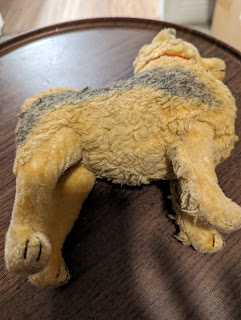 What an interesting find! Some of Steiff's items made just before, and just after, WWII are not captured in the Sortiment books. This could be because very few were actually made and sold, they are extremely rare today, they might have been produced only as samples or test items, or they simply fell through the documentation cracks during a complicated geopolitical period and its aftermath. The Sortiment books are great references, but they are not a complete and comprehensive accounting of Steiff's production. And, they were not validated or published by Steiff - but by a third party.
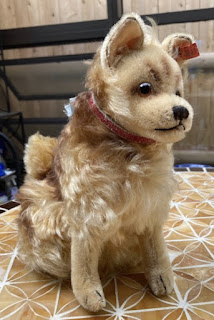 That being said, it is Steiffgal's best guess that this dog is a version of the company's standard line Wolfspitz dog series that was officially in production from 1934-1943 overall. These canines were made standing on all fours in 22 and 35 cm; on eccentric wheels in 22 cm; and sitting in 17, 21, 22, and 25 cm. They were all unjointed and stuffed with excelsior. Their face, ears, and legs were made from shorter mohair while their backs, tails, and torsos were made from very long matching mohair. Each was detailed with lifelike brown and black shading on their backs and tails and had three embroidered black claws on each paw. Their faces came to life with felt lined ears, brown and black glass pupil eyes, a black embroidered nose and mouth, and brown airbrushed highlights on their foreheads. For reference, you can see the 22 cm mohair sitting Wolfspitz here on the left; the photo is from Steiffgal's collection.
 Patricia's dog appears to check many of the boxes to the company's basic prewar Wolfspitz pattern. These details include things like the use of long and short materials to replicate the dog's coat; three painted folds on the dog's forehead; airbrushed shading on his back and tail; and a very similar facial expression and rendering, among others.
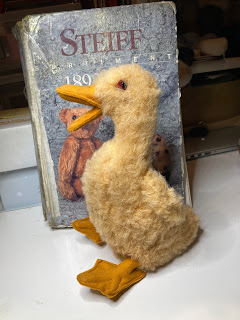 Given its presentation, materials, size, and detailing, it is Steiffgal's best thinking that this Spitz dog dates from the late prewar period and is made in part from some type of substitute plush that has wool as an element of its weave. He might have been a sample or prototype to test how his design would turn out in the plush available at the time. There is no indication (as far as Steiffgal knows of) that this pattern was produced in any form in the early postwar era. The fabric on Patricia's pooch appears somewhat similar in texture and density to the unusual "lumpy-bumpy" plush on an otherwise standard line standing play duck from Steiffgal's collection. This fine feathered friend - like the Wolfspitz - was in the line from the early 1930s through the early 1940s. You can see this duck here on image on the left.


From c. 1934 - the early 1940s, and then again from c. 1946 - 1949, things were really tough from the materials, supply chain, and operations perspectives at Steiff. Premier, traditional toy making materials including mohair and felt were in short supply and were often allocated to military purposes. As such, Steiff did everything it could to keep its toy making production lines supplied and active during these times. One way to do this was to use fabrics and materials that were available in the place of felt and mohair. These often were in the forms of artificial silk plush, wool plush, cotton plush, and other hybrid fabrics that blended wool, mohair, and other fibers.

Steiffgal hopes this discussion on this interesting Spitz dog has you barking up the right tree!
Have a question about one of your Steiff treasures? Let's talk! Click here to learn more!


