Showing posts with label Spitz. Show all posts

Saturday, December 2, 2023

Playing Doggy Detective Over This Unusual Steiff Wartime Era Canine

Paws and take a look at this interesting dog made during a really challenging time in world history. He has a familiar ring to him, don't you think... but his fabric is quite different than his standard line relatives. Just who is he, and when was his birthday - in dog years or otherwise? 

His lucky owner - Patricia from Europe - shares:

"I would be very grateful for your expertise concerning this Spitz dog. He is not catalogued in any of the Steiff Sortiment books. 

I have absolutely no idea if he is prewar? 

My concerns are his alternative coat. This is definitely not mohair plush. This is very lightly woven and the pile is flat, not fluffy.The airbrushing is bright and vibrant and his coat has full coverage. 

He is completely perfect with no damages at all. Unfortunately, he doesn't have his Steiff ID. He has beautiful glass eyes and is quite lovely. He is 22 x 22 cm in size. Any information on this little treasure will be greatly appreciated."
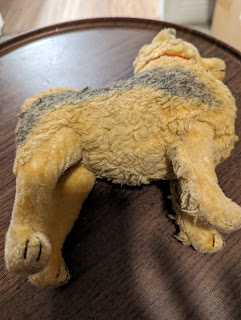
What an interesting find!
Some of Steiff's items made just before, and just after, WWII are not captured in the Sortiment books. This could be because very few were actually made and sold, they are extremely rare today, they might have been produced only as samples or test items, or they simply fell through the documentation cracks during a complicated geopolitical period and its aftermath. The Sortiment books are great references, but they are not a complete and comprehensive accounting of Steiff's production. And, they were not validated or published by Steiff - but by a third party. 
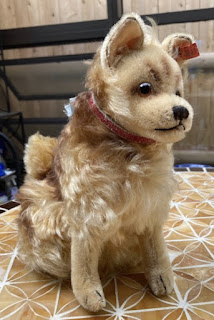
That being said, it is Steiffgal's best guess that this dog is a version of the company's standard line Wolfspitz dog series that was officially in production from 1934-1943 overall.
These canines were made standing on all fours in 22 and 35 cm; on eccentric wheels in 22 cm; and sitting in 17, 21, 22, and 25 cm. They were all unjointed and stuffed with excelsior. Their face, ears, and legs were made from shorter mohair while their backs, tails, and torsos were made from very long matching mohair. Each was detailed with lifelike brown and black shading on their backs and tails and had three embroidered black claws on each paw. Their faces came to life with felt lined ears, brown and black glass pupil eyes, a black embroidered nose and mouth, and brown airbrushed highlights on their foreheads. For reference, you can see the 22 cm mohair sitting Wolfspitz here on the left; the photo is from Steiffgal's collection. 

Patricia's dog appears to check many of the boxes to the company's basic prewar Wolfspitz pattern.
These details include things like the use of long and short materials to replicate the dog's coat; three painted folds on the dog's forehead; airbrushed shading on his back and tail; and a very similar facial expression and rendering, among others.
From c. 1934 - the early 1940s, and then again from c. 1946 - 1949, things were really tough from the materials, supply chain, and operations perspectives at Steiff. Premier, traditional toy making materials including mohair and felt were in short supply and were often allocated to military purposes. As such, Steiff did everything it could to keep its toy making production lines supplied and active during these times. One way to do this was to use fabrics and materials that were available in the place of felt and mohair. These often were in the forms of artificial silk plush, wool plush, cotton plush, and other hybrid fabrics that blended wool, mohair, and other fibers. 

Given its presentation, materials, size, and detailing, it is Steiffgal's best thinking that this Spitz dog dates from the late prewar period and is made in part from some type of substitute plush that has wool as an element of its weave.
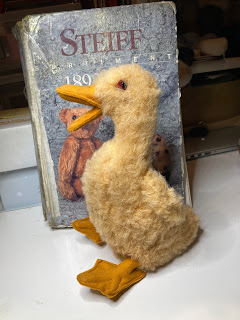
 He might have been a sample or prototype to test how his design would turn out in the plush available at the time. There is no indication (as far as Steiffgal knows of) that this pattern was produced in any form in the early postwar era.  The fabric on Patricia's pooch appears somewhat similar in texture and density to the unusual "lumpy-bumpy" plush on an otherwise standard line standing play duck from Steiffgal's collection. This fine feathered friend - like the Wolfspitz - was in the line from the early 1930s through the early 1940s. You can see this duck here on image on the left. 

Steiffgal hopes this discussion on this interesting Spitz dog has you barking up the right tree!

Have a question about one of your Steiff treasures? Let's talk! Click here to learn more!

Saturday, September 28, 2019

Double Doggie Delights at Auction This Week!

Some things simply stand on their own merits... like Steiff's fantastic prewar animal dolls. These sweet treats - with simple, humanized bodies and animal heads representing the most popular Steiff pets of the 1930s and 1940s - are breathtaking in their beauty and rarity. Within the past few days, two remarkable canine examples came up for auction in Germany. Both really caught Steiffgal's eye. Here's a bit more about this duo of delightful doggies.

There's no question the first one will really whet your appetite. He is lot #15 from Auktionshaus Eppli's Art, Antiques, Asiatica, Jewelry & more... sale held on September 27, 2019. He is cataloged as: 

"STEIFF "Chow doll", 1939-1940. Standing dog doll, button with shortened 2nd "f", remains of yellow tag, plush head and paws, clothing of brown wool plush, belt missing, right foot damaged, signs of use. H: 30 cm."

This doll had a starting bid of €150 and realized €3,600 or $3938.77. 

This extraordinary example was made in this size only from 1939-1940 as noted. He has a simple, head jointed fabric body, feet and hands made from mohair, and a realistically constructed mohair head. He wears a brown collared, long sleeved woolen top and matching pants. They are both removable. The top had a thin brown string belt when he left the factory in Giengen eight decades ago; it is not uncommon to lose accessories like this to playwear and time. Steiffgal has never handled one of these in person and has only read about them in reference books. 

Although he is named Pupp Chow or Chow Doll, Steiffgal thinks his coloring and detailing is more like the company's Wolfspitz dogs than the company's Chow Chow dogs. The Wolfspitz dogs, made from long tawny colored mohair, appeared in the line standing, sitting, and on wheels from 1934-1943 overall. The Chow Chow dogs, made in light brown, dark brown, and white mohair, appeared in the line sitting, standing, and on wheels from 1928-1932 overall. So the Chow Chows were not even in the line at the time of his introduction in the late 1930s. It is possible that "Chow Doll" sounded a lot better than "Wolfspitz Doll", and in reality Chow dogs and Spitz dogs are very closely related genetically.   

Now let's shepherd in an introduction to today's second dog doll auction highlight. He is lot #3037 from the Ladenburger Spielzeugauktion GmbH Antique Toy Auction - Spielzeugauktion held on September 28, 2019. He is cataloged as:

"Pupp Arco, head mohair-plush, standing, with button and cloth tag label, number 22 (22 cm), 1937-1939, felt underwear good, cotton shirt, 2 spots, all in all good condition."

This doll was estimated estimated at €650 - €1,300 and realized €2,562 or $2803.09.

This irresistible rarity is clearly based on the company's beloved "Police Dog" Arco the German Shepherd dog. He is dressed in a simplified, traditional farmer's outfit. This consists of an oversized, puffy blue cotton shirt and black felt shorts. He has the identical, generic body construction as noted on the Chow doll, with the same mohair detailing on his feet and hands. His head is based on the one used on Steiff's mohair Arco German Shepherds from the mid-1930s onward. This happy, open mouthed, smiling dog was made sitting, standing, and on wheels from 1935-1943. Pupp Arco was made in 22 and 28 cm from 1937-1940 overall.

The appearance of a farmer's outfit on a police dog model is unexpected, but all original in this case. These animal dolls, for the most part, were dressed in "everyday" work or play or regional/ethnic costumes. Arco is the only animal doll that Steiffgal knows of dressed as a farmer. Although Steiffgal does not have any more factual information on this puzzle, she suspects it might have more to do with economics than anything else. The Arco head is majestic and highly detailed, with an open mouth and large, prominent, felt lined ears. It appears to be among the most labor intensive relative to the other animals represented in this doll line. Perhaps this simple, plain outfit was used to save on the overall time and effort invented in bringing this doll to life? Whatever the reason, Pupp Arco is simply dashing!

Steiffgal hopes this discussion on the company's rare dressed dog dolls has been a clothes call for you.

Have a question about one of your Steiff treasures? Let's talk! Click here to learn more!

Saturday, March 3, 2018

This Tiny, Turn of Last Century Steiff Pomeranian Is The Wheel-Deal Indeed!

What's the "best of all worlds" Steiff find for you? Everyone certainly has their own take on what that might be. For Steiffgal, that would include a small, prewar dog on wheels with ID with an interesting history. So it was a real treat when she was recently asked to help rehome just that from a fine estate in Ohio. Apparently his previous owner had a real life Pom, so its clear why this treasure was a crown jewel in her collection. So without further "pom" and circumstance, check out this petite treat and see what makes her so interesting from the design and historical perspectives.  

This little gal is the wheel-deal indeed. She's an early standing and unjointed 17 cm Steiff Pomeranian on wheels. Her legs, face, and ears are made from felt and her body and tail are made from lovely long mohair. Both started out more white but have mellowed to a vanilla color over time. Pom's adorable face is detailed with prominent seams, early black shoebutton eyes, a thin hand embroidered brown nose and mouth, and a touch of tan paint on her nose. Her legs are quite firm and appear to lined in metal rods to support her. These rods end at the tips of her paws in loops. These loops in turn secure her to the axles that connect to her metal wheels. Each wheel measures about three-quarters of an inch in diameter, and has four spokes.

In terms of age and marks, this pretty Pom retains her tiny long trailing "F" Steiff button in ear as her ID. She was produced in 17, 22, 28, 35, 43, and 50 cm (measured top of head to toe, sans wheels) from 1902 through 1929 overall. This design appeared exclusively on metal wheels through 1916/17; as such, she was certainly made at the beginning of her manufacturing time frame.   

Pomeranian dogs are a legacy design for Steiff. The company's earliest felt and mohair Poms were manufactured in many configurations, including sitting, jointed, on a pincushion, and on wheels - like the example under discussion today. An interesting, unusual, and rare five ways jointed version was produced with its legs jointed and attached to the back end interior of the body torso - not along the outside of the hip area as typically seen. A great example of Steiff's Pom pincushion is shown here on the left; this item realized $700 in January, 2018 at a Theriaults doll auction. The photo is from Theriaults.

It goes without saying these antique Poms are charming - and charmed! Every turn of last century Pom that left the Steiff factory in Germany was decorated with a red cord with two pom-poms or tassels. This gave the dogs an undeniably “regal” appearance. The breed does have some connections to German royalty, which may explain why Steiff decorated them like “little kings.” Steiff's earliest Poms also have enormous appeal to vintage doll collectors, who love to pose them alongside antique dolls from the same era.

Steiffgal hopes this discussion on Steiff's early Pomeranian dogs has unleashed your desire to add one to your collection someday!

Have a question about one of your Steiff treasures? Let's talk! Click here to learn more. 

Saturday, December 27, 2014

Time Travelling Steiff Auction Highlights - Part 1!

Nothing is better than studying precious Steiff items in person, but that is not always possible for many reasons. A great - and budget friendly - way to learn about exceptional button-in-ear rarities is through auction catalogs. In addition to collecting vintage Steiff, you probably won't be surprising to learn that Steiffgal also collects auction catalogs, both for entertainment and research purposes. Most recently, she spent just a few dollars on a relatively vintage catalog from 1998. A picture of the catalog's cover is featured here on the left. The auction was held on Saturday, April 25, 1998 in Germany; the auctioneer was Horst Poestgens. Little did she know how many treasures the catalog featured! Here are three highlights from this long-ago sale; in next week's blog she will describe three more. Steiffgal is certain that they will make you want to turn the clock back to 1998 as well!
 
This first auction highlight is truly an original! This lot, #33, is cataloged as... "Original Teddy, Steiff, circa 1905/06, button in ear, grey mohair (type Richard Steiff-Teddy), black shoe button eyes, black embroidered nose and claws (missing on left paw), expertly restored hole in felt on left paw, growler defect, long bent arms, expressive humped back, pointed muzzle, Teddy has no mohair loss, good condition, an interesting collector' item, standing size: 35 cm/14"."
 

 And - given that he is as described -  just what makes this such an incredibly rare bear? His color, construction, and proportions suggest he is one of the absolute earliest disk jointed bears created by the company. And it is quite possible that Richard Steiff himself directly had a hand in bringing him to life! Steiffgal once read that Richard Steiff made his early prototype bears in grey mohair as that was the color of material at hand - and that the grey mohair was originally purchased for the manufacture of elephants. She has not been able to confirm that through other sources, but the theory would make sense from the logistics and R&D perspectives. According to the Cieslik's Button in Ear book, in reference to these early grey bears, "Only two examples of the bear are known to have been made in gray plush. It is possible that this color was used for a few hand made samples and not for an actual series."
 

Steiffgal thinks this second auction highlight deserves a "best of show" nod as well! This lot, #38, is cataloged as... "Wolf Pomeranian, Steiff, 1930's, button in ear and remains of red woven tag, long mohair white, white short mohair lower legs, inner ears and mouth, standing, turnable head, painted back glass eyes, black embroidered nose and claws, punch growler, dog in mint condition, standing size: 30 cm/12"."

Steiff has a very long history of manufacturing Spitz or Pomeranian dogs, but this example is truly in a class by itself! And that is because Steiffgal can't find any reference to it at all in the standard Steiff reference materials. His larger size, oversized eyes, and his facial/muzzle construction are quite distinct from the company's other Spitz models from 1902 through the mid-1940's time frame. His long mohair forehead and sweet expression give him a youthful, innocent look; one that was quite prevalent in Steiff designs of the late 1920's. Because he does indeed have traces of his red ear tag, it is entirely possible that he was designed and produced at the same time as the beloved - and childlike - Teddy Clown, Teddy Baby, Bully, and Molly models.
 

Today's last auction highlight is pretty as a postcard. Literally! This lot, #66, is simply cataloged as... "Original Steiff postcard with Steiff felt dolls, motive, Dutch village, 1912, very good condition, very rare."

Steiff's wonderful dolls, bears, and animals have always been as attractive in print as they are in real life. Steiff has used this to their advantage in terms of advertising, marketing, and promotions from about the early 19-teens onward. The company's charming center-seamed felt "children" and "student" dolls were used in many classic photo shoots including circuses, skiing vignettes, cultural and "small town" local settings, toy rooms, Christmas celebrations, and other playful and imaginative displays. These shots were intended as illustrations for catalogs and postcards, among other printed items. (If this is of interest to you, check out the book Advertising Art of Steiff Teddy Bears & Playthings by Dottie Ayers and Donna Harrison. It features many of these beloved images and is one of Steiffgal's favorites.)


The postcard itself is delightful in so many ways - the theme, layout, composition, and attention to lifelike detail are simply charming and universally appealing. However, on a more personal note, Steiffgal noticed that the card also features two Dutch children dolls that she has in her own personal collection - Alida and Harry, who are pictured here on the left. Alida, who is featured in the front and relative center with a boy and a rabbit on the postcard, was made from 1909 through 1919 in 28, 35, 43, and 50 cm. She is described as "felt, jointed, Dutchwoman, original costume, Sunday best." Harry, pictured in the left of the postcard talking to another boy, was made from 1908 through 1925 in 28, 35, 43, 50, and 60 cm. He is described as "felt, jointed, Dutch fisherman, original costume." By "original costume" Steiff means that the dolls are dressed in apparel that is traditional to a country - in this case, the Netherlands. And by "Sunday best", that would imply "fancier" clothing for going to Church on Sunday, which makes sense in the case of Alida given her elaborately embroidered dress bodice and red cuffs.

Steiffgal hopes this review of some long-ago auction highlights has been as fun as a time travel adventure!  And be on the lookout for more additional highlights from this great catalog in next week's blog edition!

Have a question about one of your Steiff treasures? Let's talk! Click here to learn more.

Sunday, November 30, 2014

Rolling Towards The Holidays With This Great Steiff Spitz Dog On Wheels

Ever feel like howling in excitement upon a wonderful Steiff find? Even if just in your mind? Well, that just happened to Steiffgal when this delightful Wolfspitz on wheels arrived on her doorstep last week! Take a look at this dynamic dog and see what makes him so interesting from the design and product development perspectives.
 

This vintage pup is the wheel-deal indeed. Wolfspitz measures 20 cm from head to toe and 22 cm including his wheels, measured vertically. He is standing, unjointed, and made from tan mohair. His body and tail are made from long wavy mohair, while his face, ears, and legs are made from matching short mohair. He has very distinctive black hand embroidered claws on his paws, and a full and very prominent tail. He has distinctive mohair "feathering" construction on his front legs; this is pictured here on the left. His somewhat serious face is detailed with black and brown glass pupil eyes, a black hand embroidered nose and mouth, and traces of black airbrush highlighting. He rides upon four red wooden eccentric wheels.  

So how old is this pup, in dog years or otherwise? He retains his short trailing "f" button and traces of his yellow year tag. Given this utterly charming pattern was made in this size only from 1934 through 1943; his combination of IDs suggest he was produced in the 1936 to 1943 time frame.

Spitz, or Pomeranian dogs, are legacy patterns for Steiff. They appeared as early as 1902 in the Steiff line. The earliest Steiff Spitz dogs were produced in felt and mohair. This is most interesting from the historical perspective. And why is this? Felt was Steiff's first toy making fabric, and mohair became available on a commercially viable scale in 1903. Thus, early Spitz dogs truly embody the "old" and "new" material ways of manufacturing at Steiff!

These earliest Spitz dogs were produced in many configurations, including on wheels, sitting, fully jointed, and on a pincushion. They were made from long white curly mohair, with white felt faces, ears, and legs. All had black shoe button eyes and embroidered facial features. Most also left the factory in Giengen with a red cord with two pom-poms or tassels around his neck, giving them a “regal” appearance. The breed does have some connections to German royalty, which may explain why Steiff decorated them like “little kings.” The felt and mohair Spitz dogs appeared in the line in general through the 1920s.  A typical early Steiff Spitz is pictured here on the left; the photo is from Christie's.

Except for one all mohair, 17 cm model produced from 1924 through 1927, it was not until the mid 1930's that the company focused again on Spitz dogs. In 1934, Steiff launched a series of very expressive, all mohair tan colored Spitz dogs. These included a standing version (produced in 22 and 35 cm); a sitting version (produced in 17, 21, 22, and 25 cm) and the 22 cm version on wheels, the topic of this post. At the same time, the company also introduced two new all white Zwergspitz, or Miniature Pomeranians. These included a standing model (produced in 15, 18, and 23 cm) and a 20 cm sitting version. (An example of a lovely white Zwergspitz dog is pictured here on the left, the photo is from Teddy Dorado.) All appeared in the line through 1943, when Steiff ceased toy production due to war constraints and political realities. 

It is interesting to note that despite their popularity and longevity in the line, Steiff did not produce a standard line mohair Spitz after the factory reopened for business after the war in the late 1940's.  More recent Spitz dogs include a 22 cm white dralon "Cosy Spitz Blanko" from 1960 through 1973; a 30 cm woven fur model produced in black, white, or red-brown from 1980 through 1983; and a 60 cm mohair standing display "Polar Pomeranian" dog, produced in 1960 and then again in 1967.

So what's in a name?  According to Wikipedia, the Wolfspitz breed name was formally changed to "Keeshond," in 1926 in England. The breed is described as having "a lion like ruff, spectacles, small and dark triangular ears, definite contrast, and a thick double coat." All of these characteristics truly describe Steiff's Spitz dogs from the very beginning! 

Steiffgal hopes this discussion on Steiff's lovely Spitz dogs has been a warm and fuzzy experience for you.

Have a question about one of your Steiff treasures? Let's talk! Click here to learn more.

Wednesday, September 11, 2013

Life's Just A Party When It Comes To Vintage Steiff

Every day can be a party when it comes to vintage Steiff!  And nothing could be closer to the truth than last weekend, when Steiffgal invited a few collector friends from the New England area to gather at her home for an afternoon of all things Steiff!  The happening included a tour of Steiffgal's personal collection, a sales table chock full of exciting new vintage items just acquired from two collections, an identification and valuation clinic, and of course seasonal treats and refreshments - including Steiffguy's homemade pretzels!  Here's a little summary of the highlights of this memorable occasion.

c
Nothing says "welcome" like a family of life sized Steiff donkeys, right?  These two "great Grissys" (as well as a few live pug dogs) greeted our beloved visitors as they arrived at the event.


Everyone had the opportunity to add a few choice items to their collection from the huge range of items available on the sales table.  Steiffgal spent the week prior to the event cataloging, cleaning, and preparing each of these 175 goodies for their grand debut.  Of course, the large monkey in the background is not Steiff, but hired nonetheless to stand guard over the precious treasures.

Almost all of our Steiff friends brought delightful goodies for evaluation as well as group discussion.  Here are some wonderful highlights from this "show and tell" session. 


This little guy is simply a handful of puppy love!  This woolie wonder measures about 4 cm tall and 8 cm long and is made from white Nomotta wool.  He has felt ears, tiny pupil eyes, and a little black nose.  He is detailed with the tiniest red collar!  He is either a white Scotty or a Sealyham; both these patterns were almost identical and made in 8, 10, 14, and 16 cm the 1935 through 1941 time frame.


There's no need to be sheepish about this next visitor.  Here we have Steiff's woolen miniature Lamm or Lamb.  Like her sweet puppy friend mentioned above, she is also made from white Nomotta wool.  Her insides are lined in wire, so she is somewhat poseable.  Lamb has charming pink highlights on her nose and paws.  Her face is detailed with little eyes and felt ears, and she wears a tiny pink bow.  Lamb was produced in 7 and 10 cm in black and white in the 1935 through 1941 time frame.  


Now this is a find worthy of royalty, really!  Here we have what Steiff calls a Spitz or Pomeranian dog. This pensive looking puppy was produced from 1902 though 1927 in 14, 17, 22, 28, 35, and 43 cm. Spitz is sitting and made from long white curly mohair with a white felt face, ears, and legs below his hips. He has black shoe button eyes and embroidered facial features.  He is wearing a bell collar and painted pink ribbon which are period and authentic, but not original to him.  Most likely, when he was new, this Spitz featured a red cord with two pom-poms or tassels around his neck, giving him a “regal” appearance. The breed does have some connections to German royalty, which may explain why Steiff decorated them like “little kings.” This classic design was also produced in several other variations, including a jointed standing version, as a pup on wheels, and as a pincushion on a red velvet pillow. 

Let's paws and take a look at this next beloved Steiff guest, who is just about purrr-fect in every way. This is of course a fantastic example of Steiff's "Fluffy" cat. She is sitting, unjointed, and made in part from bluish tipped mohair, which is just spectacular. Her little tail wraps sweetly around her body. Fluffy's face is detailed with deep green and black pupil eyes and a simple pink hand embroidered red nose and mouth. And check out her fantastic early named metal ring chest tag!  Sitting Fluffy was made overall from 1926 through 1950 in 7, 10, 14, 17, 22, 25, 30, 35, and 43 cm. She was such a favorite that she was produced on a pincushion, as a music box, and as a tail turns head model.  


You can't help but feel lovey-dovey when it comes to this final Steiff masterpiece.  Here we have a most unusual example of the company's turn of last century's pigeon or dove.  She is 10 cm and made from soft velvet like felt.  Her feet are made from metal that has been wrapped tightly with yellow string, giving them a most authentic appearance.  Her body has been elegantly and gracefully stenciled and airbrushed with black and grey highlights.  Her eyes are black button and backed in felt; her tiny beak is also made from felt.  She wears a red ribbon with a tag on it which are period but not original to her.  She most likely left the factory in Giengen on a little metal pull cart, but that has been lost to time.  This remarkable item was produced in this size only from 1916 through 1919.

Steiffgal hopes this review of her recent Steiff celebration has been nothing but a party for you... and thanks to all the wonderful guests (collectors and their and treasures) who helped to make it that way!

Have a question about one of your Steiff treasures? Let's talk! Click here to learn more. 

Sunday, October 21, 2012

Steiffgal's 3 Wishes For The Upcoming Teddy Dorado Auction

So, if you could have three Steiff wishes, what would they be?  Steiffgal knows that's a really hard question, and would have trouble answering it herself.  But it's certainly easy to dream big when it comes to Steiff auctions!   And, many of the lots at the upcoming Teddy Dorado auction on October 27th, 2012 offer plenty of opportunity for happy thoughts!  You can check out the event's online catalog by clicking here... but be forewarned that you just may fall in love with a treasure or two (or more!)  Take a look at Steiffgal's bronze, silver, and gold picks for this upcoming Steiff auction... and what makes them so interesting from a design and historical perspective.

Steiffgal's bronze medal choice makes her want to shake, rattle, and roll.  Here we have an adorable Steiff rattle bear in like new condition.  This tiny Ted is 10.5 cm sitting, 13.5 cm standing, five ways jointed, and made from white mohair.  Her face is detailed with black glass eyes and a brown hand embroidered nose and mouth.  She has long and slender arms and legs and a pointy muzzle.  Because of her petite proportions, her hands and feet do not have felt paws.  She is hard stuffed with excelsior and has a bell rattle in her belly.  Ted retains her large, trailing "F" button; it it is estimated that she was produced in the 1912 through 1925 time frame.  Interestingly, she come in a pretty, festive cardboard box that is labeled "Weihnachten 1925" or "Christmas 1925." 

And what makes this sweet Ted the leader of the band?  Clearly, no Steiff enthusiast could resist her adorable facial expression or immaculate condition.  Not bad for a gal who's probably close to ninety years old!  But she's got rhythm for sure!  Her still functional rattle - a feature which Steiff used on a handful of its most popular c. 10 cm models through the 1920's - can't help but make most Steiff collectors feel like dancing!

Our silver medal choice is truly larger than life.  Here we have Steiff's Dwarf Spitz dog; he measures 20.5 cm high and approximately 20 cm long.  This Miniature Pomeranian dog is unjointed and standing.  He is hard stuffed with excelsior.  His body is made from long pile mohair, while his face, legs, and the back of his ears are made from short white mohair.  His face is detailed with dark brown and black glass pupil eyes and a black hand embroidered back nose and mouth.  The insides of his ears are lined in white felt.  He has a working lateral pressure voice squeaker.  Spitz retains his original red leather collar with metal ring; short trailing "F" Steiff button, "Dwarf Spitz" named chest tag, and fully legible yellow ear tag.  This delightful dog was manufactured in the 1935 through 1943 time frame. 

And what makes this little guy such a big deal? First, his condition is just extraordinary. It is challenging to find pristine examples of Steiff items from the late 1930 through early 1940 time frame - but this guy takes the blue ribbon in all categories here. Plus, Steiff has a wonderful history and legacy of producing Spitz or Pomeranian dogs. Over time, since the turn of last century, Steiff has produced this breed on wheels, fully jointed, and as a pincushion on a red velvet pillow. The earliest models were decorated with a red cord with two pom-poms or tassels around his neck, giving then a “regal” appearance. The breed does have some connections to German royalty, which may explain why they are decorated like “little kings”.  

You'll have to take Steiffgal's word on this - this Steiff "book" certainly deserves the gold medal!  Here we have Steiff's Spielbuch or Game Book.   This item is approximately 18.5 cm wide and about 15.5 cm high.  According to Steiff records, it was designed to provide "different templates for children from two years, to the placement of tactile sensitivity, color joy, skill and sense."  This unusual item is made from sheets of thick felt and is "bound" by metal rings.  Each page features hands on to-dos for young children, including activities related to colors, sizes, snaps, ties, buttons, and the like. The cover features a large, mostly flat three dimensional mohair rabbit head; his face is detailed with large brown and black glass pupil eyes, a pink-red hand embroidered nose and mouth, felt lined ears, and a red ribbon and bell. His ear is branded with a short trailing "F" Steiff button and a fully legible yellow ear tag.  The Game Book appeared in the Steiff catalog from 1935 through 1937; this particular example is the property of a former Steiff assistant.  

And what makes this Game Book today's winning best seller? This page turner certainly meets the gold standard in terms of the WOW factor...  it is so rare, unusual, and in relatively good condition given its age and raison d'ĂȘtre.  And, in all honesty, Steiffgal didn't even realize such an item ever existed in the line before reading about it in the Teddy Dorado catalog, and it's pretty hard to "stump the chump."  Don't you think it would be a divine addition to Steiffgal's library and archive? 

Steiffgal hopes this sneak peek at highlights from the upcoming Teddy Dorado auction has you going once, going twice, going three times to check out their other amazing offerings at www.teddydorado.com.
 Have a question about one of your Steiff treasures, family or otherwise? Let's talk! Click here to learn more. 
The teddy bear search engine