Showing posts with label eyes. Show all posts

Friday, March 28, 2025

Getting Cosi With Steiff's Poodle Named Tosi

Poodles are amongst the most popular dog breeds globally and are regularly celebrated for their distinctive good looks, superior intelligence, and fun-loving personalities. These wonderful dogs, often sporting fantastic hair-dos, are so important to Steiff that several were featured in the company's debut catalog in the early 1890's. Since then, Poodles have appeared almost continuously in the Steiff line to this day.

One of the rarer Steiff poodles, Tosi, tops the wish lists of many collectors today. This is most likely due to her unique presentation, unusual detailing, and place in the company's product development timeline. A deeper dive into her history suggests she is a case study in early postwar design, development, and distribution. Here is the story behind this precious pup!

Given the breed's appeal, Steiff started manufacturing Poodles as soon as possible once the factory reopened for toy making business after the conclusion of WWII.
The first new postwar Steiff Poodle design was Tosi. Here you can see her on the cover of the company's 1950 product catalog. Tosi's design strategy was based on two of Steiff's key business drivers at the time - to produce quality, appealing toys as quickly and efficiently as possible and to regain their status as a premier, worldwide toy manufacturer. However, Steiff still had alot to manage operationally in the earliest midcentury period, including rebuilding their infrastructure, optimizing new regulations and distribution channels, and dealing with material and talent shortages, among other factors.

Many of Tosi's design elements reflects these postwar realities.
She was standing and simple in design and only head jointed in the larger sizes. She had minimal seams and labor intensive details. Because mohair fabrics during this period were limited and expensive, this model was made from wool plush. Her coat was in a "Karakul" trim, meaning that it was fluffy but uniformly the same length all over her body. This gave her a sweet and youthful appearance, but also required no additional hand-trimming or work on her legs and torso. Tosi's face was detailed with a round, black glass button nose and soulful, almond shaped white, brown, and black eyes. These facial features did not require facial hand embroidery, which can be time consuming and require special expertise to execute. Her accessory was a simple red leather collar, which was easy to manufacture and attach to the dog. And, her small size and compact form made her light and easy to pack and ship worldwide. Here on the left you can see Tosi in a variety of color and size combinations as she appeared in Steiff's 1950 new product catalog. 

Overall, Tosi was produced in black or white wool plush in four sizes ranging from 14 to 28 cm from 1950 through 1953.
Because of her time of manufacturer, Tosi would have left the factory with either a short trailing f, blank, or raised script button; yellow ear tag; a red or blue imprinted chest tag; and a cloth US Zone tag in her leg seam as her Steiff IDs. You can see these IDs on the white Tosi above; the image is from www.invaluable.com. Examples in excellent to as new condition with all IDs today can trade hands in the high three digits - low four digit range.

Steiffgal hopes this discussion on Steiff's Tosi poodles has you feeling quite rosy!

Have a question about one of your Steiff treasures? Let's talk! Click here to learn more.

Wednesday, June 7, 2023

Breathtaking Bear Beauties on Offer at Ladenburger Spielzeugauktion's 2023 Special Steiff Auction in Giengen

Can you bear it? Ladenburger Spielzeugauktion's July 1st, 2023 Special Steiff Auction in Giengen is presenting one of the finest lineups of vintage to antique button-in-ear collectibles in memory. Many of those wah-hoo good treasures are from the collection of Susan Kilgore Wiley. Ladenburger sold the first half of her over-the-moon great hug in January, 2023. This second sale presents even more Wiley temptations, including some of the world's most fantastic and aspirational Steiff bears Steiffgal has ever seen! Here are three extraordinary ones that really caught her eye, and why. 

The first can-you-bear it bear is lot #64, a most unusual Teddy Clown bear.
It has a starting bid of 1,300 euro and is cataloged by the auction house as:

"Clown-bear, exceptional, with button, block letters, long trailing f, minimally rests of the red cloth tag label, big blue glass eyes, bright embroidering at snout, and claw embroidering, strong fiery mohair, long snaped off arms, hump, 33 cm, except of small faults felt paws in very nice condition, with ruff, without hat, very expressive."

It's really the best of two legacy Steiff worlds with this terrific temptation. At first glance, he sort of looks like a Petsy the Baby Bear with his tipped mohair, pink hand embroidered nose and mouth, and blue eyes. But, he does not have the signature center facial seam construction or wire lined ears as seen on Steiff's Petsy cubs. But, he has his factory original neck ruff, and these were not put on any models other than Steiff's Teddy Clown bears - at least as far as Steiffgal knows! It is also important to note that this bear's detailing and configuration is not noted in Pfeiffer's Sortiment books. This suggests that very few were produced. Steiffgal suspects that his "birthday" was probably in the mid to late 1920s time frame, when both Petsy and Teddy Clown made their appearances in the catalog. This is only the second of his type Steiffgal knows of.

And speaking of Petsy - this second can-you-bear it bear is lot #15, an insanely rare and equally adorable Petsy bear.
It has a starting bid of 1,600 euro and is cataloged by the auction house as:

"One of the of the highlights of the this year's STEIFF-GIENGEN-auction, Petsy, produced around 1930, with seam at the middle of head, nice, full, pointed mohair, rare cross-eyed, with button, block letters, long trailing f, bright embroidering at snout, long snaped off arms, hump, big ears, original felt paws with flaws here and there, and scattered spotty mohair loss at neck, hump, ears, and shoulder, otherwise very nice condition, nice strong color of the mohair, standing height 50 cm, extremely rare, extremely expressive, an unusual rarity."

Steiffgal is pretty certain that this eye-catching (pun intended) rarity is on every single Steiff collector's dream wish list! It goes without saying that Petsy bears do incredibly well at auction, with one selling for a mind boggling 66,000 euro at a Ladenburger sale in January, 2023. However, this particular one, with black and blue cartoon eyes, is simply off the charts when it comes to his rarity, expression, and presentation. Steiffgal would not be surprised if this example trades hands near or even above this previous record! And what makes this bear so extraordinary?  His "half and half" glass eyes are sewn in his head in such a way that they can be tilted and rotated, giving him countless silly to serious facial expressions. Petsy bears usually have stationary, glass pupil eyes. This is one of the few Petsy bears of this size with cartoon style eye extant. 

And now for the wow OMG wow third can-you-bear it bear of this sale, let's take look at lot #82.
This is a Steiff black Titanic bear. It has a starting bid of 4,500 euro and is cataloged by the auction house as:

"Titanic bear, one of the highlights of the this year's STEIFF GIENGEN auction 2023. A rare item from 1912, was produced in remembrance of the victims of the sinking of the Titanic on April 14th 1912. It were 82 pieces of this grief bear/ black bear produced. This Titanic bear has a seam at the middle of head, red shoe button eyes that are underlaid with felt, black embroidered nose and claws, small STEIFF button, block letters, long trailing f, long snaped off arms, hump, voice, intact, small faults at the feet, produced between 1912 and 1917, 50 cm, nice full black mohair, with provenience, enclosed invoice by the original purchase at Sotheby's 1990, and newspaper article by an American antique magazine, "Antique Review" from February 1991, one of the rarest bears that were ever auctioneered by the Ladenburger Spielzeugauktion."

This bear is so amazing that he leaves Steiffgal pretty much speechless in terms of analysis. So she will share a little story about him instead. When she first heard about this bear, she was certain it was a replica, based on how he was described to her. But his owners insisted he was the real deal from 1912. Fast forward, Steiffgal met this bear in person. His owners handed him to her, and he really was as close to tissue new as possible. So new that Steiffgal again thought he was a replica at first. But after a few moments, it became clear that he was well over 100 years and just in clean, breathtaking condition. His owners did not mention his center seam - which just puts this bear over the top in terms of appeal, desirability, and rarity. It's anyone's guess how the bidding will roll out with this bear... but watching it unfold should be more thrilling than any major Hollywood production!

For more information on this amazing sale to be held on July 1, 2023 and to see all of the great lots on offer, please see the auction house's website at https://www.spielzeugauktion.de.

Steiffgal hopes this discussion on auction bear highlights has left you star-struck!

Have a question about one of your Steiff treasures? Let's talk! Click here to learn more.

Saturday, June 23, 2018

This Steiff Rabbit Is Such A Blue Belle!

In the mood to learn about a bouncing bundle of joy?  Of course you are!  And it's a boy - really!  Steiffgal was delighted to add this big blue baby bunny to her Steiff hug recently.  He's got such a great personality, and exemplifies many of Steiff typical 1920's era characteristics.  Take a look... you'll certainly fall for this cheerful-earful as well!

If this isn't hoppi-ness, then what is?  Here we have Steiff's sitting rabbit. He is head jointed and measures 20 cm tall (not including his ears, which are typically not included in rabbit measurements.) He is made from blue mohair, while his chest and the fronts of his ears are white mohair. He has a proportionally petite tail and short, thin, curvy arms and legs. His face comes to life with oversized brown and black pupil eyes, a pink hand embroidered nose, and a black hand embroidered mouth. He even retains a few mono filament whiskers. His big ears are lined in wire and are posable. He is stuffed with a combination of crunchy excelsior and soft kapok. Rabbit retains his long trailing f button and bits of his red ear tag as his Steiff IDs. 

This design was produced in mohair in 11, 15, 18, and 23 cm from 1926 through 1932. It was also made in velvet in 11, 15, and 18 cm from 1927 through 1933.

So just what makes this rabbit such a blue belle? Colors can be tricky with Steiff. When you have a vintage piece in hand, always look in "places where the sun don't shine" to discover its true and original color. Although this rabbit today looks cream or tan, if you peek in the crotch, deep in the neck joint, under the tail, under the glass eyes, and in its "armpits," you can absolutely see traces of a baby blue color both on its fabric backing and its mohair covering. Dyes used in the first quarter of the 20th century can fade, wash out, or change color dramatically over time, due to the nature of their chemical composition. So don't always assume that your 1920-1930's era Steiff items, although perhaps tan or grey today, didn't start out life in a much more colorful manner. Here on the left you can see traces of his blue coloring on the underside of his tiny tail.

This rabbit is a delightful example of a delightful product development era at Steiff - the mid 1920's through the early 1930's. Here's what makes this beautiful boy so period to the "roaring 20's:"

His color: Steiff did alot with colored and tipped mohair starting in the mid-1920's. It was not unusual to see rabbits, bears, dogs and other popular animals produced in "jelly bean" colored mohair, or tipped mohair though the early 1930's. Think of Teddy Rose, Molly the puppy, Charly the King Charles, and other favorites from that period. These color choices were the result of a directive from Richard Steiff, who insisted in the mid-1920's that the company's products include lighter, happier colors that reflected popular cultural trends of the time. Here on the left, you can see another colorful example from c. 1929, he is the 11 cm version of the blue bunny under discussion today, but in pink (which has also faded a bit over time.)

His proportions: During this period, many of the items produced moved away from lifelike proportions to appealing proportions. Items designed during this period were more round, chubbier, and toddler-esque than in the past. Teddy baby, who debuted in 1929, is a perfect example of this. As you can see with this rabbit, its head and body are quite oversized, while its legs are quite thin and narrow - not lifelike, but very endearing. Here on the left you can see a picture of a number of colorful rabbits that also fit this description; the photo is a 1929 Steiff advertisement and is taken is from Carsten Esser's Steiff Kataloge 1920-1929.

His detailing: Steiff items produced in the mid-1920's through the early 1930's have playful and happy personalities which come alive thorough subtle design elements. In this case, the rabbit's ears are lined in metal wires, making them posable and more interactive.  Think of Petsy the baby bear, who also had this detailing. And his oversized eyes, placed low and wide on his very symmetrical face, give him a distinctly innocent, appealing, and inviting look.  

Steiffgal hopes this discussion on this blue bunny has left you jumping for joy.

Have a question about one of your Steiff treasures? Let's talk! Click here to learn more.

Sunday, March 25, 2018

Who Nose Why This Turn Of Last Century Steiff Bear Is So Extraordinary?

This bears repeating - Steiffgal's never seen anything like this terrific Ted before! Steiffgal had the privilege of handing this astonishingly special cub for a friend. Yes, he's got traditionally handsome Steiff good looks, but he also has a little secret to him that places him at a really interesting point in Steiff's product development history. Can you guess what that might be? Let's take a closer look at this Steiff rarity and see what makes him outstanding in so many ways.

It's nothing but Teddy hugs when it comes to this fine fellow.  This bear is 35 cm sitting or 50 cm standing, fully jointed, and made from long, thick, white mohair.  He is solidly stuffed with excelsior. His paw pads are tan felt. He has five brown hand embroidered claws on each of his hands and feet.  Typical to very early Steiff bears, he has long and narrow feet, extra-long arms with prominently curved wrists, and a very pronounced back hump. His sweet and baby-like face comes to life with black shoe button eyes and and a brown hand embroidered nose and mouth.   And just when you think things could not get better with him - they actually could.

His little secret just might test your metal. Believe it or not, this bear is rod jointed... dating him right at the turn of the last century. Steiff only produced white rod bears in 1904 and 1905! Steiff's rod jointed bears are extraordinary in their own right. These early bears are best known for their chunky forms, almost (American) football-shaped torsos, simple and somewhat "puppy like" expressions, and gutta percha noses. A somewhat more "typical" white rod bear is pictured here on the left. This photo is from Christies and this bear, which had its original elephant button, sold in 2010 for 13,125 pounds. But as you can see, the rod bear under discussion today really has the face - and the facial stitching - of a c. 1905 to 1912 Steiff bear!

So who nose what's going on here? There are a few possibilities, but it is clear that this all-original bear is a transitional example that spans the company's c. 1903 to 1905 rod bears with gutta percha noses and their c. 1905 onward disk jointed bears with embroidered facial features. As such, it is Steiffgal's best guess that this very bear was one of the very last rod jointed bears made - and at the same time - one of the very first bears to feature a hand stitched nose. How remarkable is that?

Let's take a breather here and talk about gutta percha. Gutta percha is a natural latex product made from the sap of the Palaquium gutta tree. Gutta percha noses were very labor intensive to produce on bears. Each one required an artisan to place individual drops of this black, sticky, rubbery substance on the tip of the bear's muzzle until enough built up to resemble a nose. The artisan also was required to constantly shape the cooling material into a nose shape, which explains why early and original gutta percha noses often are asymmetrical and have fingerprints and nicks on them. You can see a close up shot of a Steiff gutta percha nose here on the left. Richard Steiff himself thought this process was way too time consuming, and insisted that the company's bear production incorporated stitched noses from around 1905 onward.  

Steiffgal hopes this discussion on this extremely rare transitional rod bear has been a one in a million experience for you!

Have a question about one of your Steiff treasures? Let's talk! Click here to learn more.

Sunday, June 5, 2016

Happiness Is A Warm (Steiff) Puppy From Morphy Auctions' Upcoming Toy Sale Event!

In the market for a new blue ribbon addition to your Steiff collection? There's practically an entire kennel of fabulous and unusual Steiff dogs on offer at Morphy Auctions' upcoming Premier Toy Sale on June 24th-26th, 2016. Paws and check out these collectible canine highlights and see what makes them so interesting from the design and feature perspectives.

Steiffgals' going out on a limb with this first pick - a Molliette "Charleston" dangling dog with ID. This is auction lot #802 and is cataloged as...

"This is a delightful 20 cm example of Steiff's "Molliette". She has a mohair puppy head; long, soft unjointed dangling limbs; and mohair hands, paws, and tail. Her body, arms, and legs are made from a lovely shade of lilac velvet that has darkened slightly over time. She has very large black and brown glass pupil eyes and black, hand embroidered claws, nose, and mouth. She retains her original bell, tattered lime green neck ribbon, ring, and pompom as accessories; her tan hanging ribbon may be a replacement. Molliette is one of a series of "play and car dolls" in the Steiff catalog from 1927-1932. These were based on the most popular named Steiff characters of the time. Each had the head of the character, mohair paws and feet, and dangling velvet limbs. Most were available in several bright, happy "jelly bean" colors and in 20, 30, and 43 cm. It has been suggested that the design of this series was based on a similar line from the Chad Valley Toy Company of England called "Tango Toys." Molliette has her most exceptional metal-rimmed chest tag as her Steiff ID. Condition: As noted. Slightly dusty but in very good to excellent condition overall. Provenance: From a Florida estate. Size 8-1/2'' T. Estimate: $800 - 1,600."

Good golly, what a great Molly! This Molliette design is a example of many of the influences that really took priority in the 1920's for Steiff. Its core "Molly the Puppy" pattern, introduced in 1925, was specifically designed to be as soft, fluffy, and child-like as possible. Her candy hued body - appearing in blue, pink, orange, purple, green, or yellow - reflected Richard Steiff's directive to add color and interest to the company's product lines, as well as a distinctly feminine appeal. And her novel design, based on the Charleston dance craze, shows how Steiff - despite its location in rural southern Germany - was keenly aware of worldwide cultural trends and their importance in growing their footprint and reputation as an international leader in the toy industry. Teddy Rose, pictured here on the left, was also in the line around the same time as Molliette, and shares many of these same design priorities. 

Steiffgal's second highlight, an early King Charles Spaniel, is eye candy in many ways. This is auction lot #818 as is cataloged as...

"This very interesting and early Steiff King Charles Spaniel is 21 cm tall and 37 cm wide, unjointed, and standing on all fours. She is made from white and copper colored mohair, which has thinned and darkened over time. She has long ears and a playful tail. Most interestingly, her oversized black eyes are backed in orange felt; this is the first time this cataloger has ever seen this outstanding and all original detailing. Her pouty face comes to life with a hand embroidered brown nose and mouth. This handsome design was produced in 17, 22, and 25 cm from 1924-1927. Condition: As noted. Spaniel retains her tiny trailing "F" Steiff button. Dog has been professionally cleaned and partially restuffed. With surface losses commensurate to age. In good to very good condition overall. Size 14'' L. Estimate: $200 - 300."

This sweet King Charles Spaniel is a prince of a pick. And, his felt backed eyes make him quite the looker. It was not that uncommon in the past for Steiff to add a felt backing to an animal's eye to help give its face a bit more depth and emotion. Perhaps the best example of this is the red felt the company used behind the eyes of its all-black Titanic Mourning bears from 1912. An 18" tall example of these rare and beloved bears - sold by Morphy's for $34,800 in 2011 - is pictured here on the left. Steiff has also used felt backed eyes on some of their rabbits, birds, and squirrels, among other species. However, this is the first time that Steiffgal knows of where the company has used orange felt to back the eyes of a dog, or any species at all!

This final auction highlight is truly Ivy League. This is lot #861, an extraordinarily rare Steiff standing Yale Bulldog. He is cataloged as...

"This standing, head jointed Yale Bulldog does not appear in the standard Steiff reference books. However, he is pictured in the 1951 FAO Schwarz catalog, along with seven other Steiff college and military mascots. His price at the time was $10.00. The dog is made from mohair and is realistically hand airbrushed with black, tan, and brown highlights. His comical face comes to life with one black ear and one tan ear; unusual “squint” style black and blue eyes; a black glass button nose; and elaborate jowls. He wears a blue and white felt Yale blanket and a red studded collar. He retains his US zone tag, button, and yellow ear tag as his Steiff IDs. Condition: As noted. Very good to excellent condition overall. Estimate: $600 - 1,200."

And just what makes this one top dog? His marvelous, clean condition; extremely appealing presentation; fantastic construction (with a face only a Steiff collector could love); and absolute rarity, to start with! It's also easy to take a shine to his black glass nose and black and blue glass eyes - both which are quite distinctive for his period. This style black glass nose is also seen on Steiff's early postwar poodles, while these blue and black eyes are also key design element of the company's legacy Lulac rabbit, introduced in 1952. This is only the second standing example Steiffgal has ever seen of this particular mascot pattern, the sitting ones are a bit more common. This examples is in by far the best shape of them all. You can see the original catalog page from the FAO Schwarz catalog here; click on the image to enlarge it a bit in a new window. 

Steiffgal hopes this review of fine canine highlights from Morphy's upcoming June, 2016 toy auction has got your tail a-wagging for this great event!

Have a question about one of your Steiff treasures? Let's talk! Click here to learn more.

Saturday, May 24, 2014

Do You Believe In The Steiff Supernatural?

Do you believe in ghosts?  Or more specifically, Steiff ghosts?  Either way, Steiffgal suspects that you'll be (super)naturally interested in this most unusual doll that apparently has made mischief on his community and admirers for many decades.  

Over the past few years, Steiffgal has gotten numerous inquires about "Robert," a 100 cm, century plus Steiff-like doll that lives at the East Martello Museum in Key West, Florida.  This spirited Steiff supposedly wore a harlequin costume when he was new. He is pictured here on the left.  Steiffgal has been asked if Robert may have been made by Steiff, and how he may have ended up in Key West, of all places.  According to an article by Mandy Bolen, who writes for the Key West Citizen newspaper,

"The straw-filled doll belonged to Key West artist Robert Eugene Otto, who received the toy as a child when his parents lived in the mansion at the corner of Eaton and Simonton streets, now known as The Artist House. It's a regular stop on the ghost tours. .... Otto and the doll became unnervingly close, with the boy often blaming the doll for mishaps and strange events.  The doll eventually began to frighten even his best friend, and was relegated to an attic room.

As the legend goes, Robert the Doll was displeased with his new accommodations and would taunt schoolchildren from the window as they walked past the house, so much so that they eventually took a different route to school.
 

When Gene Otto inherited the house from his parents, he reunited with Robert and brought him back downstairs, where their connection was rekindled, to the chagrin of Otto's wife.  She promptly returned the doll to the attic, where he remained until Otto died in the 1970s.  Robert now "lives" in a secure glass case at the East Martello Museum, where he is rumored to ruin photographs and cause unexplained events at the museum."

Let's have a happily haunted look at Robert from three perspectives to see if indeed he may have any Steiff connections.  

First, take a looonnngggg look at his very tall and thin frame.  As many readers know, Steiff has a very strong history of felt dolls, and the first ones appeared 1903. Steiff produced many felt figures from the early 1900's through the 1930's. In most cases, these models were more reflective of occupations and culture (shepherds, stone cutters, tailors, butchers, shoemakers, soldiers, students, etc.) than playful designs for children.  Most of these dolls appeared in the 22 to 50 cm size, so this 100 cm doll is quite unusual.  However, there is a mention or two in readily available Steiff books about 100 cm dolls, so there is precedence for something of this scale.   

Second, let's make some eye contact, if you dare!  Robert's dark eyes are actually called shoe button eyes and are made from wood that is painted black. His hair most likely is, or was, made from mohair.  Robert's face structure is interesting.  You can see the unusual (for Steiff) oval seams around his nose and mouth, horizontal one across his forehead, and the vertical ones above his nose and below is mouth on the photo here on the right. Traditionally, early Steiff felt dolls had a vertical seam down the front of their faces, and that is one key way to identify them.  However, there are examples where this is not the case, due to design or scale issues.  Steiffgal thinks in this case - given the doll's extreme proportions and early dating - that it would be possible that Steiff could have constructed the face with this interesting seam pattern.

And third, how about his (haunted) history?  Of course, there is no way to know exactly how Robert arrived in Key West - a tiny Florida island only 19.17 km² in area.  But here are a couple of ideas. If there was a very high end department store, or toy store in the Key West area at the turn of last century, it is possible that the store purchased him as window display originally at some point.  Or, Robert's family - or family friends - may have ordered him, or received him as a gift from a business associate from New York or Europe.  It is interesting to note that the family's last name, "Otto," is of German or European origin, suggesting that they may have been aware of the Steiff brand and quality given their cultural background. 

It's time to ask the Magic 8 ball the hard question:  Steiff or not?  Well, Steiffgal does not have a crystal ball for guidance... and it is impossible to say with 100% certainty without seeing the piece firsthand... but the voices in her head are suggesting that Robert was most likely manufactured by Steiff.  Given his shoe button style eyes and general look he was probably made before the 19-teens... perhaps in the roughly 1905 to 1912 timeframe or so.  And since Robert Otto was born in 1900, both of these "production dates" align pretty well!  Steiffgal also thinks that he was a special order, not a regular line item, and was probably produced as a window display item.  In this case, that would mean he was made on the scale of a real person, and was designed more as a decorative item than anything else.  These early display dolls were especially known for spectacular clothing and detailing.   So when Robert was new, he probably had a fantastic costume made of very high end materials, as well as great shoes, and a matching hat.  It is Steiffgal's guess that Robert might have looked something like the large Steiff clown pictured on the left when he left the factory a century or so ago; the photo is from Theriault's.

For more about Robert - if you dare - click here!

Steiffgal hopes this discussion on Robert doesn't keep you up at night!

Have a question about one of your Steiff treasures? Let's talk! Click here to learn more. 

Friday, April 5, 2013

This Vintage Felt Soldier Doll Has Uniform Appeal

There's not really any uniform answers to Steiff identification mysteries, especially when it comes to turn of last century, military inspired felt dolls.  Take a look at this note from Margaret, who asks about one of her recent finds.  Over the course of several exchanges, she shares the following about a vintage soldier doll that in many ways resembles those made by Steiff.  She writes...

Hi Steiffgal,
I was very happy to come across your blog tonight. I am an antique bear collector who has many old bears and pull toys, velvet toys, felt toys and so on. I hope you won't mind if I pick your brain. With your experience, you can probably give me some good information, or at least good speculation, about an item I purchased today at an antique store.  

I have gone through my Steiff Sortiment and cannot find a match to this guy.  He seems closest to "Young Brigade" to me, p. 445, but he is not a perfect match.  He is obviously old, as old as my other Steiff dolls circa 1914.  He stands a hair more than 13" tall. He has a couple of tiny moth holes. He is jointed. He does not have a mohair wig, he has hair that is painted on.  Instead of shoe button eyes or blue glass eyes, his eyes are hand made glass humanized brown eyes, very tiny and pretty and realistic looking. He has a little mustache. He has two proper little felt ears and a little nose. He has a sweet expression.  The seam that goes up his face stops at the top of his nose and re-starts at his hairline.  And his hands are dark felt, obviously meant to look like he is wearing gloves.

The doll is wearing a uniform, maybe a field coat, made of brownish gray wool. It has little brass buttons on it with a tiny insignia that looks like a pineapple shape. His coat has a little light brown or orange-ish square sewn onto each end of his collar; the coat is fairly long and buttons hold it open at the bottom. It is finely and expertly sewn and kind of gathered in the back. The sleeves have cuffs. The front of the coat has pockets on the chest. The right shoulder has a bit of the same fabric pinned to the shoulder, as if something else might have been there at some time.

His pants are made of the same wool fabric as his coat and they tuck into the top of his black leather boots. They kind of balloon a little bit (they are not a tight fit). The black boots are leather, the uppers are two pieces, there are eyelets and laces, these boots are very intricately and accurately done. They are as good as human boots, just miniature.
Is he Steiff, but a variation of the dolls pictured in the Sortiment, so he won't match up perfectly? Is it possible someone else made him? Who is my guy?

Thank you for any ideas you can provide. 

From one Steiff aficionado to another,
Margaret" 

Let's follow marching orders and get right down to business in terms of this dolls.  Yes, in many ways, he does share some similar characteristics to Steiff's wide range of soldier and military themed dolls from the approximately 1910 through 1920 time frame. These include his materials, general proportions, detailed clothing, and body construction.  However, there are three key areas that clearly suggest that he was made by a manufacturer other than Steiff.  These are his:
  • Clothing and footwear style and details
  • Facial construction
  • Unusual eyes shape
If it were just one of these things, then maybe it could be an exception.  But all three suggest the alternative. 
 
Steiff's Infantryman from 1914 though 1921
Let's keep things somewhat orderly by starting with the dolls attire.  Typically, Steiff's military men have very fitted, detailed uniforms that have a "crispness" to them.  The clothing in general does not feature "puffy" or "gathered" details.  Steiff's doll jackets and pants are angular and often have edging and other contrasting stitched details, and simple, plain buttons.  The soldier doll pictured to the left is a good example of this; for more information on him please click hereThe "pineapple" buttons on Margaret's doll are much, much more detailed than the buttons on Steiff's usual military dolls, and his clothing appears too "informal" to have been made by Steiff.  

Center Seam Face
Face it, Margaret's doll's facial construction is also interesting - but not typical to Steiff.  Steiff is known for both their center seamed faces (which can run either horizontally or vertically) and their seamless pressed felt faces.  The company worked for over two decades to perfect their pressed felt face techniques, and during that time produced several hybrid prototypes that never went to market.  The pressed felt faced dolls do indeed have almond shaped eyes, but they are painted
Pressed Felt Face
eyes,
or glass eyes embedded into the facial mask - not sewn on the face as it appears in Margaret's case.  It is possible, although not terribly probable, that the face on Margaret's doll is one of those "half and half" experiments with only a partial facial seam.  Steiffgal sees these these occasionally at auction - but they are never noted as Steiff, just as early European felt faced dolls... and they never have a Steiff buttons in their ear, suggesting that they were not meant to leave the factory.  
 

Early Scotty, delightful photo from http://oldtoys.info/
Eye veh... and now his handsome eyes.  Collectors probably recognize the soldier doll's distinctively shaped peepers as similar to those seen on Steiff's early Scotties, Selyhams, and Skye Terriers starting in the 1930's.  Steiffgal thinks that Margaret's doll is older than that - probably no later than the early 1920's.  Steiffgal also has never seen soldier's distinctive, 3D almond shaped eyes on any Steiff doll either in person, in the Steiff archives, or in pictures.  Early Steiff eyes used on felt dolls were round black shoe buttons, while later ones were round glass pupil. According to Steiffgal's colleague Lauren Mikalov, a doll expert and columnist for Dolls Magazine, many companies - including Lenci, Chad Valley, and Norah Wellings - used more humanized glass shaped eyes on their early felt dolls.  So there is history and precedent for this design element... but just not with Steiff.     

So just who is this mysterious military man?  Without labels, it's almost impossible to tell... and like a good soldier, this one's keeping state secrets.  

Steiffgal hopes this discussion on early felt dolls has met with uniform appeal.

Have a question about one of your Steiff treasures? Let's talk! Click here to learn more.  

Friday, March 8, 2013

Steiff's Perfect Vintage Easter Rabbit

Hippity, hoppity, Easter's on its way!  What wonderful words, given the cold and snowy winter we've all experienced here in the Northeast.  In just a few weeks, we can all hope for a visit from the Easter rabbit, with a basket or two full of goodies in tow.  But have you ever imagined what this most famous Easter "hare-binger" actually looks like?  Steiffgal has... and here's what she came up with!

If this beautiful bunny doesn't put a little spring in your step, Steiffgal's not sure what would!  What we have here is Steiff's Hase or Rabbit.  She measures 26 cm head to toe, and 33 cm ear-tips to toe.  She is begging, head jointed, and has a non-working squeaker in her belly.  She is entirely made from white mohair, including the lining of her ears. Her charming face is detailed with a simple pink hand embroidered nose and mouth, clear monofilament whiskers, and over sized pink and red albino style glass eyes.  Surprisingly, she does not have any hand or foot claw stitching.  Hase's Steiff ID includes a long trailing "f" Steiff button and remains of her red ear tag.  Her large pink silk ribbon is not original to her, but suits her perfectly! 

According to Steiff records, this particular model was made from 1927 through 1941 in 11, 15, 18, 23, 29, 36, 44, 50, and 70 cm.  (It is not 100% clear which size this bunny under discussion falls as she is a little tall, or a little short to standard; this happens alot given the hand-made nature of early Steiff treasures.)  Hase came in light brown, white, gold, purple pink, and light blue mohair.  Steiff also made this same popular pattern in velvet from 1927 through 1932 in 11, 15, and 18 cm in white, purple, orange, light brown, light blue, pink, and yellow.  All models left the factory with a pastel colored silk ribbon and a bell.  

It is hard not to take notice of this rabbit's large and unusual eyes.  Steiff started using glass pupil eyes on their Teddy bears, animals, and dolls in the early 19-teens when manufacturing and distribution processes made it economically feasible to do so. The company soon started experimenting with different glass eye color combinations and even sizes to give their products a unique, or authentic, touch.  For example, early Steiff cats often had hazel or greenish-blue slit glass pupil eyes, much like real cats. Some novelty items, like Petsy the Baby Bear, Bonzo, and Cheerio, had deep blue and black glass pupil eyes.   This gave them a "special" quality.  Many dogs launched in the 1920's through the early 1930's had larger brown and black pupil eyes to suggest a wide-eyed and youthful innocence.  These would include Molly, Bully, and Charly, just to name a few.  And then of course there is this albino rabbit, with his delightful red and pink pupil glass eyes - clearly a "focal point" of his marvelous design.

Steiffgal hopes this discussion on her perfect Steiff Easter Rabbit is sweeter than a big box of marshmallow Peeps - and far more healthy!

Have a question about one of your Steiff treasures? Let's talk! Click here to learn more. 

Tuesday, October 9, 2012

A Purr-fect Example Of a 1920's-era Steiff Cat


Now that's one pretty kitty!  Steiffgal recently had the pleasure of meeting a spectacular early Steiff cat.  Her details and design simply took her breath away.  Take a look at this early Steiff sitting sweetheart and see what makes her so special from the design and collector's perspectives.


It's easy to color your world with this lovely 1920's era Steiff cat.  Her name is Fluffy, and she was introduced in 1926. Fluffy is sitting, unjointed, and made in part from bluish tipped mohair, which is just spectacular. Her little tail wraps sweetly around her body. Fluffy's face is detailed with large deep turquoise green and black pupil eyes and a simple hand embroidered pink nose and mouth. This pink stitching may have been some restoration work, but accurately reflects the size and shape of her original features. Her claws are also embroidered in red. This kitty retains her 8mm trailing "f" Steiff button and bits of her red ear tag.  

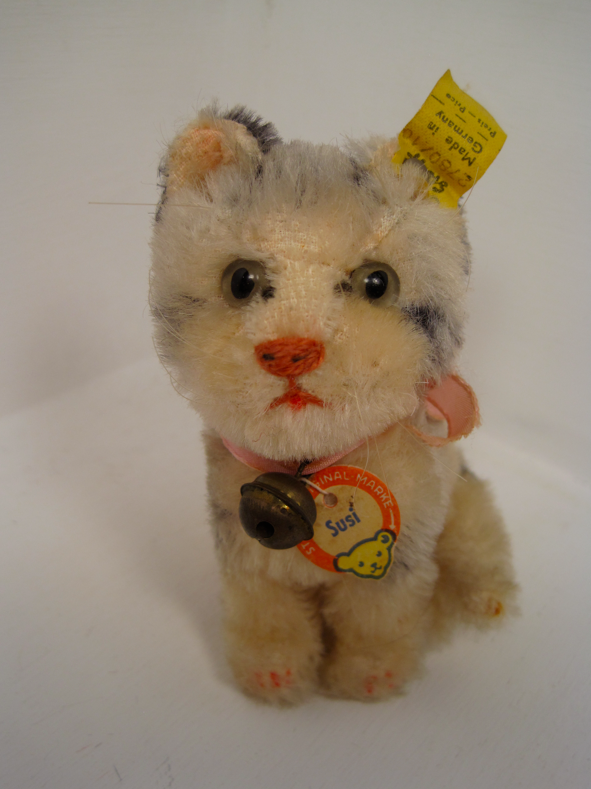
Talk about the cat's meow!  Fluffy was such a favorite that she was produced in nine standard sizes, as well as on a pincushion, as a music box, and as a tail turns head model. Fluffy appeared in the line through 1950. Her design was slowly replaced by Susi, another favorite sitting style cat, who was a line standard through 1978.


Fluffy has details that quite typical of other products Steiff created during "the roaring 20's" - or in this case, the "meowing 20's!  Items designed and produced during this decade tended to have large, childlike eyes; bright colors or details, playful textures, and a distinctly feminine touch to them.   Perfect examples of this include Steiff's Molly the Puppy (introduced in 1925), Teddy Rose (introduced in 1925), Teddy Clown (introduced in 1926), Charly the King Charles Spaniel (introduced in 1928) and Bully the Bulldog (introduced in 1927). All also had collars or ribbons, adding to their festive presentation. 

Steiffgal hopes this discussion on Fluffy has been the cat's meow for you.

Have a question about one of your Steiff treasures? Let's talk! Click here to learn more. 

Saturday, January 7, 2012

A Little Novel Mystery To Light Up Your Steiff Life!

Looking for a little something to light up your (Steiff) life? Then you've come to the right place.  The world of interesting vintage plush collectibles is quite large - but also quite interrelated on many levels.  Take a look at this note from a reader who asks about a possible novelty... could it have been made by Steiff?   Jaime writes...
"Hello,
 
Here is my dilemma... After what seems like a thousand dead-ends, a ton of time, energy, and endless "google-ing" & "bing-ing"....  I have exhausted all known avenues of search.  Can you take a look at my item and provide any information about it?


Here are his details.  He is approximately 19cm or about 7-1/2" tall, and hard stuffed with excelsior.  His body is made from mohair and is yellowish / cream or off-white, in color, with darker shaded tips and a few black, air-brushed, spots on the forehead and front paws.  His muzzle and ears are shaved or trimmed black mohair; each ear has one stitch, to help keep them held down and in place.  His nose and mouth are hand embroidered in black.  He has a pink corduroy "panting or begging" tongue.  He has a swivel head and wears a green leather collar with a silver buckle.


Here's where it gets interesting.  He has glass eyes, which are light brown/auburn with a black pupil.  Each contains  a "filament", essentially, a removable light bulb with a socket. The battery or power source is housed in the belly and is accessed by un-doing three, brass, snap-style buttons. All 3 snaps are engraved with the maker's name, "Prym."  The Prym Company, responsible for making the snaps, is located just 3 hours away from the Steiff factory in Germany.


There are no identifying marks except for the button makers name on the brass snaps. There does appear to be an "indented" area where a button would have been in the left ear.   The mohair, in that area, was matted down in the shape of a round button and there did appear to be small hole through the ear,  But I have poured over this puppy for so many exhausting months that it might just be a wishful thinking!  Please help!!  


Thank you, 
Jaime"
Electrifying, and many thanks for introducing us to this great item.  And, as you might know, Steiffgal is a pug fiend; two real live ones (pictured above) are right here by her side as she figures out this mystery.  

Don't mean to zap anyone's expectations, but Steiffgal can tell you right away that this item was not made by Steiff. However, it has two features that are quite interesting when viewed through the lens of Steiff history and product evolution: 1.  its design and 2.  its "novelty" qualities.  The big challenge is that there were a zillion toy companies in business in Europe and the US about the time that he was made, and little documentation or history on many of these manufacturers.  So, as a result, Jaime may never really know his origins.  And that's ok. But there are a few things Steiffgal can glean about this dog which do relate directly to Steiff.  

Let's first take a look at his dog-gone design.  It is Steiffgal's opinion that has many of the same elements of two documented Steiff dog designs.  These are Tino, who is from the early to mid 1930's, and Pug, who is from the mid to late 1920's.  They are pictured above; Tino is on the left and Pug is on the right.  Both are little known, very rare, and seldom seen on the secondary or collector's marketplaces.   

It is very interesting to note that it was (and still sort of is) really, really common that plush companies would all but replicate their competitor's lines with the slightest of modifications and call that pattern their own.  Well known examples of this with Steiff include early Teddy bear designs, tumbling animals, and even their Treff the bloodhound, who was based on the English Dalmatian "Dismal Desmond," manufactured by the Deans Rag Book Co. of London.  

So, when can a dog really be a cat?  When it's a copycat!  Despite a Steiff look, there are two design elements that strongly suggest that the item was not made by Steiff.  First, his design is too "clunky" to be made by Steiff; the pattern is very simple and the lines are not curved and elegant.  (This is not meant to be derogatory in any way, it just is what it is.)  Additionally, thinking back, Steiffgal can't think of one time Steiff ever used corduroy on any item, except way post war on some doll, bear, and character's clothing items.  So this also all but rules out Steiff as the manufacturer.   

Second, let's take a look at the novelty features of this pug.  Steiff created many early novelty items - including hand bags, puppets, pajama bags, animal dolls, dangling car mascots, and even a record cleaner - but Steiffgal is all but certain that Steiff themselves never made "electric" eyed items.  (However, she has seen "aftermarket" creations, meaning someone got creative with a Steiff Ted, some wiring, and light bulbs in their garage!) The novelties that Steiff produced were always based on their most popular and well known characters, including Bully the Bulldog, Molly the Puppy, and Charly the King Charles Spaniel.  Jaime's dog design, although adorable, would not fit into this tier of classic Steiff patterns.  Steiffgal's favorite Steiff novelty of all time, Jocko as a purse - from around 1930 - is pictured here on the left. 

It's time to plug into the topic of electrified plush!  Light-up eyed items first came on the market around 1907 or so.  They were produced as novelties and mostly seen on bears.  The eyes would light up if the bear's belly was pressed, a switch was pressed, or a limb was moved up or down.  The early ones had the batteries buried in the body so you pretty much had to take the animal apart to replace them.  Jaime's pug seems to have a much nicer battery setup, with snaps or the like, implying that it is a more sophisticated, therefore slightly younger design than the early ones, perhaps from the late 1920's or so.

So what does this all mean?  Steiffgal's best guess, and that's all she can offer here, is that this was made in Europe by one of Steiff competitors in the early 1930's or so.  The light up eyes were designed to "one up" the Steiff design, but the materials used, and the overall design details are somewhat inferior to traditional Steiff standards.   Anyone else have any ideas? 

Steiffgal hopes you got a real charge out of learning about this vintage electric-eyed pug.  

Have a question about one of your Steiff treasures? Let's talk! Click here to learn more. 
The teddy bear search engine