Showing posts with label Ladenburger Spielzeugauktion GmbH. Show all posts

Friday, November 15, 2024

These Three Dog Highlights Take The Blue Ribbon At Ladenburger Spielzeugauktion's November, 2024 Steiff Archive Sale

Ladenburger Spielzeugauktion of Ladenburg, Germany is presenting its 415 lot Steiff Archive Auction on November 23rd, 2024. This breathtaking sale features century spanning treasures directly from the Margarete Steiff GmbH archives in Giengen. In an effort to consolidate space within their storage areas, Steiff decided to deaccession some redundant items from their overflowing archives. As such, the Giengen company has partnered with Ladenburger Spielzeugauktion to find new homes for these fine archival items.

Every item on offer in this amazing event is worth a shout out, so it is nearly impossible to select highlights. Given her affinity for all things canine, here are three incredibly rare dogs that are documented in Steiff's literature that Steiffgal has never actually handled or seen in real life (but would love to!)

You can't help but smile when it comes to this first auction doggie selection.
This is lot #4, Steiff's Tino. He is cataloged as: TINO, made in 1936, with button, block letters, unused red flag, number on flag: 3322.2, seat height: 22 cm, yellow/brown mohair plush, black snout, lovely expression, orig. silk bow, rotating head, expressive, hand pattern from the Steiff archive with original Steiff archive trailer. Tino has an opening bid of 360 euro.

It is not exactly clear what breed terrific Tino represents.
According to Pfeiffer's 1892-1943 Steiff Sortiment, he is simply an ingenious dog. This might mean he doesn't have a specific breed - much like the company's legacy and popular Molly design who was simply referred to as a puppy. Molly's gentle, sitting, and fluffy aesthetic opened the floodgates to an influx of prewar dog designs between 1925-1938, when nearly 40 new pup patterns were noted in the Steiff catalog - Tino being one of them. Tino's distinctive black facial mask, ears, and tail, as well as body shape and form, have playful, pug-like qualities - which might be the reason he catches Steiffgal's eye! Tino was produced in 17 and 22 cm from 1936-1939.

The next auction pick has a face only a mother (or any vintage Steiff collector) could love.
Here we have lot #8, Bertha The Cartoon Dog, with an opening bid of 650 euro. She is cataloged as: Siberian cheese hunting dog made in 1927, item no.: 5332, hand sample in a special small size, caricatured dog, brown tipped mohair, 5-fold jointed, felt insert on the face, embroidered eyes, colored outlines of the eyes, nose and mouth area , H: 18 cm, L: 29 cm, orig. red silk bow, extremely rare, exceptional, hand sample from the Steiff archive produced without button, shield and flag, with original Steiff archive trailer.

The auction house also shares:
Bertha is the Steiff-created replica of the funny dog ​​from the American comic "Boob McNutt" by illustrator Rube Goldberg, popular in the 1920s. The little Siberian cheese dog pulled all sorts of pranks in his comics. The comic short stories were published in the Sunday editions of most Western newspapers in the United States from 1915 to 1934. The unusual dog was produced by Steiff in 1927 with 24 copies in two different sizes and variants (with sewn eyes and with glass eyes). Unfortunately, production was stopped due to low demand.

Steiff often used animals or characters from popular comic strips as inspiration for new product introductions, which helps to explain Bertha's origins. You can see one of Bertha's original 1920s era cartoon strips just above... please click on it to make it bigger. This trend began at the turn of last century, when Steiff produced a series of fully jointed dolls based on the comic strip series Happy Hooligan. Steiff's Bertha has several design features that are very typical to the mid-1920s. These include tipped mohair, a dimensional eye treatment, and a distinctive, youthful appearance. According to Pfeiffer, Berta was made commercially in 22 cm in 1926 only. For more information on Bertha, check out:
http://strippersguide.blogspot.com/2022/09/toppers-bertha-siberian-cheesehound.html

There's not a hair out of place with today's final highlight.
Here we have lot #31, Steiff's Puli, with an opening bid of 280 euro. She is cataloged as: Puli, made on September 7th, 1935, dog, with button, shield and flag, block letters, elongated f, unused yellow flag, No. 1328.02, handwritten inscription on the breastplate “Puli”, glass eyes, shaggy long mohair, red original . Leather collar, blue-gray coloring, fixed head, unused condition, H: 26 cm, L: 35 cm, with orig. Steiff archive trailer.

Puli dogs are very smart, loyal dogs - and are best known for their corded, dreadlock style coat.
Their waterproof fur can be kept long or trimmed, but either way requires way more attention than most other dogs. It is possible that Steiff made a Puli for its general line in the 1930s because the dog was starting to gain global popularity as well as visibility at the time. The American Kennel Club (AKC) recognized the Puli as a dog breed in 1936. The company's long, curly mohair was a great material to replicate the breed's distinctive coat. 

Steiffgal hopes this discussion on these amazing and rare canines has been a fetching experience for you!


Have a question about one of your Steiff treasures? Let's talk! Click here to learn more.

Friday, September 29, 2023

Moving And Grooving With This Extraordinary Steiff Auction Rarity

No need to brush off this week's special blog guest! Ladenburger Spielzeugauktion GmbH recently held its annual early fall auction on September 22nd and 23rd, 2023. The sale included a number of interesting vintage toys, dolls, and bears... but one incredibly rare and often misunderstood Steiff rarity really rose to the top. It also caught Steiffgal's eye in a major way. Check out this very early turn of last century novelty. It's guaranteed to have you moving and grooving!

This special lot was number 3158, a Steiff "Bristles Bear." It was cataloged as: "Bristles bear, produced between 1902 and 1904, 20 cm, short plush, brown, attending, dancing on a circular wooden board, with feet made of bristles, with elephant button, shoe button eyes, and tip of the nose made of a shoe button, with original label, D.H. Wagner & Sohn, Spielwarenhandlung, Leipzig Grfmmaische Str. 6., Naschmarkt-Gegenüber, unused original condition, very rare, unusual." It had a starting bid of 850 euro and hammered at an amazing 7,700 euro.

So just what makes this guy so important?
Besides its breathtaking condition and extraordinary elephant button, this very early style of bear was one of the inspirations behind Richard Steiff's invention of the fully jointed Teddy bear as we know and love him today. Really! At the turn of last century, Richard was thinking of ways to make his family's toys more fun, interactive, and kinetic. This bear, in the form of a circus bear with a nose ring and chain, stands on a wooden platform which is mounted on little brushes like toothbrush brushes. When the toy is place on a table or flat surface, and the surface is tapped, the vibrations cause the bear to shake and shimmy on the platform. So the bear moves, sort of, but Richard knew there was a better design out there. You can see some of Steiff's earliest turn of last century "moving" bears on the picture above on the left; they include (from left to right) two Bristles bears, a bear on a four wheeled cart, and three tumblers on weighted wooden half spheres. 

Richard also spent a lot of time at the local zoo, watching how animals interact and get around, and making sketches of them in the flesh.
He was very interested in trying to figure out how to reproduce these lifelike movements in his toy designs. Also around this time, in 1903, mohair became available on a commercial level and in supplies adequate enough for the toymaking business. It wasn't long before it became crystal clear that this soft, durable, and furry fabric would be perfect for making world class soft bears and animals. 

So how does this all come together? After a lot of thinking, planning, and creative energy, Richard took the best of his current "moving" product line, his observations of bears ambling about in real life, and the opportunities presented by mohair fabric and came up with the company's first fully jointed string bear in 1902 - PB55. Although this pattern proved not to be commercially viable, it was quickly updated to rod and then cardboard disk style jointing, and the rest - as they say - is history!

Steiffgal hopes this little history lesson, based on Steiff's early Bristles bear, has been a hair raising experience!

Have a question about one of your Steiff treasures? Let's talk! Click here to learn more.

Sunday, July 30, 2023

Less Is More When It Comes To Steiff's Early Felt Doll Production

Size defies with today's blog special guest.
Steiffgal tries to adopt at least one special Steiff bear, doll, or animal tied to major Steiff events, auctions, and happenings she attends. Here is the little button-in-ear buddy that made his way home to the United States with her via the recent Steiff Special Auction held in Giengen, Germany on July 1st, 2023. Read on to hear his story and to see what makes him so precious from many perspectives.

Like many Steiff collectors, Steiffgal poured over the Ladenburger Spielzeugauktion GmbH Special Steiff Auction catalog from their July 1, 2023 sale.
A million things caught her eye online and on the printed catalog pages... but not this tiny treasure for some reason. However, that all changed when she attended the live auction preview, held in the gallery adjacent to Steiff's museum and gift store, right on the company's campus. Here on the left you can see a photo of Steiffgal attending this auction preview the day before the big sale.  

It was an amazing experience touring this preview room filled with world class treasures - in a world class space! All the auction items were stored in rectangular, glass and wooden cases. You could walk all the way around them and see every angle of the treasures on display. Of course, all eyes were on the 1912 black mohair Titanic Mourning Bear and the google eyed Petsy bear - the stars of the show who were displayed right at the entrance to the room.  

Steiffgal saw this little guy sitting on a shelf and she could not look away.
Yes, he was in the catalog, but he presented so differently in real life than in his pictures. This happens a lot, and a good reason to attend live previews! He was TINY! And his size was further in the spotlight as he was posed with medium and larger Steiff felt dolls. His scale and presentation were so adorable, and so unusual, that Steiffgal immediately decided he was the one! Here on the left you can see this little guy as he was displayed for the auction preview event. 

So this little doll, who has since been named Little Eddy, stands a mere 22 cm.
He is made from felt, fully jointed, and comes to life with a blonde inset wig, blue and black glass pupil eyes, painted eyebrows, prominent dimensional ears, and distinctive horizontal (near his eyes, to give him a youthful, rounded look) and vertical (right down the middle of his face) stitching. His hands are simple and fist style. He wears a red and white sweater and shorts set, with white socks and black felt shoes. This outfit is period appropriate but not original to him. Steiff's 22 cm dolls are few and far between, and this is the first one Steiffgal has ever seen - and now owns! They were produced from 1917-1919 in several boy and girl models over that time frame. You can see Little Eddy standing next to his 28 cm big brother and big sister here on the left - that's the best way to highlight his scale and proportions. 

Little Eddy is also very interesting from the design perspective for two quirky reasons. First, he has typical early Steiff style fist hands with stitched digits. Steiff's dolls from his late 19-teens era production usually have fingered hands or at least hands with prominent fingers. Perhaps his scale made it difficult to give him more detailed hands. And, second, his amazingly tiny silver button - which looks original to him based on its placement and condition - also appears to be more of a short trailing "f" button than a long trailing "f" button. The long trailing "f" button appeared the line through the mid-1930s, and the short trailing "f" button appeared in the line from the mid-1930s through the early 1950s. So his ID is bit of a mystery there as well.

This petite prince is the perfect size to be a special traveling companion.
And, he jumped at the opportunity as soon as his adoption was finalized! He fits snugly in a purse or backpack and makes friends wherever he goes. His big first adventure was an eight hour train ride from Heidelberg, Germany to Prague in the Czech Republic. Here you can see him in his "first class" train seat enjoying the scenery as it whizzed by. He looks forward to many more sightseeing trips in the future. 

Steiffgal hopes this story about Little Eddy has brought you big joy!

Have a question about one of your Steiff treasures? Let's talk! Click here to learn more!

Wednesday, July 26, 2023

Watching Steiff Record Making History In Person!

Stop the presses!
Steiff history has been made again! Check out this article that Steiffgal prepared for the online news source Auction Daily detailing the sale of Mrs. Wiley's all but perfect 1912 black mohair Steiff Titanic Bear! He is pictured here on the left, and the photo is from 
Ladenburger Spielzeugauktion GmbH. Here is the story in its entirety - it was originally published on July 23, 2023. Thank you to Auction Daily for allowing Steiffgal to share this fantastic news!

On July 1st, 2023, the auction house Ladenburger Spielzeugauktion GmbH of Ladenburg, Germany presented their Special Steiff Auction in Giengen, Germany - the home of the Margarete Steiff GmbH factory. The Steiff Company is best known for designing and producing the fully jointed Teddy bear as we know him today starting in 1902. This signature, annual sale is traditionally held during the Steiff Company's "Steiff Sommer" event, a three day long family-centric fair that includes carnival rides, a petting zoo, food and souvenir vendors, and button-in-ear activities. This year, the auction included the second half of the Susan Kilgore Wiley collection, an outstanding collection of Steiff prewar bears, animals, novelties, and absolute rarities. The first half of this collection was sold in January, 2023 and realized over $475,000.

The highlight of this midsummer sale was lot #82, an extraordinarily rare, fully jointed 50 cm black mohair Steiff Titanic Mourning Bear.
This bear was the pride and joy of Mrs. Wiley's collection and was accompanied by photos and ephemera related to it. (As a matter of fact, she named her car's license plate after him as well... as you can see on the photo on the left!) She bought the bear at Sotheby’s in London in 1990 for over $40,000; that purchase made international collecting headlines at the time. Since 2000, original antique Steiff Titanic Mourning Bears have rarely come up for auction. When they do, they usually trade hands in about the $20,000-40,000 range. Mrs. Wiley's Titanic Mourning Bear had a starting bid of 4,500 euro, but there was talk the Steiff collecting community that the bear could easily realize six figure, it was so outstanding. They were right - sort of. 

There was great anticipation in the gallery as lot #82 came up for sale. The auction house noted that this bear had five international bidders competing for the bear on telephone lines. However, the winning bidder was live in the audience! This is somewhat unusual in the auction world with sales of this magnitude. Auctioneer Pia Fast Seidel was at the podium and skillfully managed the blizzard of bids and interest in this once-in-a-lifetime lot. Mrs. Wiley's Titanic Mourning Bear would go on to hammer at 180,000 euro or $202,020, and realize $250,505. 


So how does this rank in terms of record sale prices for antique Teddy bears? The most expensive Teddy bear of antique origins to date was a Steiff bear owned by Colonel Bob Henderson named Teddy Girl. She was sold by Christie's in London for £110,000 ($171,600) on December 5th, 1994. However, Mrs. Wiley's Teddy bear traded hands at over a quarter million dollars - breaking this previous high mark by over $78,000! 

There are many factors that made this 1912 Steiff Titanic Mourning Bear so incredibly special. These included a perfect storm of history, rarity, condition, and being at the right place at the right time. It is also possible that the recent spike in interest in all things Titanic, because of the headline making submarine disaster, also further cast the spotlight on Mrs. Wiley's extraordinary bear on offer. (Here on the left you can see Steiffgal in the Steiff museum gallery with Mrs. Wiley's Titanic bear, along with her google-eyed Petsy. These two cubs were the stars of the show for sure!)

There are many factors that made this 1912 Steiff Titanic Mourning Bear so incredibly special. These included a perfect storm of history, rarity, condition, and being at the right place at the right time. It is also possible that the recent spike in interest in all things Titanic, because of the headline making submarine disaster, also further cast the spotlight on Mrs. Wiley's extraordinary bear on offer.

In terms of the bear's place in history, Steiff's Titanic Mourning Bears are tied to one of the most significant worldwide events of the 20th century.
In the early 1900s, Steiff produced a number of all black mohair bears for the general marketplace. However, these did not sell very well and the thought at the time was that they were scary for children. So the company stopped making them. Then, in 1912, the Titanic disaster struck. At that time, nearly everyone in England was personally touched by this event, or had a friend or relative who was. The entire country was in shock and mourning. In response, Steiff produced a handful of all black mohair bears with red felt behind their eyes - to indicate sadness and crying - for the English market. (Here on this picture on the left you can see members of Mrs. Wiley's family and Steiffgal talking to a photographer sent from the Washington Post to cover this sale. As you can see, this very special bear caught the eye of collectors on nearly every continent!)

This black bear also was in breathtaking shape with a very special feature.
It retained its Steiff button and featured the company's most desirable "center seam" face construction. In the early 1900's, every seventh bear that Steiff made had a seam down the center of its face to make the most efficient use of the mohair fabric used to create them. The dimensions of the fabric supplied at the time were such that the Steiff could manufacture six full heads from it, but there was some remaining material from this cutting process. As such, Steiff found a way to "patch" these remainders into another head and as such not waste any fabric. This was the first center seamed black mohair Titanic Mourning Bear to come to public auction, as far as this author could unearth. (Here on this picture on the left you can see Mrs. Wiley's bear enjoying some time in her garden. The sunlight on his face makes his center seam especially prominent!)

Steiffgal hopes you've enjoyed witnessing a breathtaking and probably once in a lifetime bit of Steiff history!

Have a question about one of your Steiff treasures? Let's talk! Click here to learn more!

Monday, January 23, 2023

The Top Lot Winners From The Susan Kilgore Wiley Steiff Auction Are...

Wow! Talk about a bear-affair! Steiffgal's head is spinning over the results of the Steiff auction held on January 21st through Ladenburger Spielzeugauktion GmbH. This sale, which included the first half of the Susan Kilgore Wiley collection, included 195 premier lots, lasted nearly 5 hours long, and had a 99% sell through rate! It hammered at $381,000, with buyer's premiums varying across different selling platforms. Here are the three top selling lots from the sale, and what might have made them so sought after from the collector's perspective.

Here's a hot tip... Steiff's Petsy bears seem to continue to capture the hearts, imaginations, and wallets of collectors worldwide! 
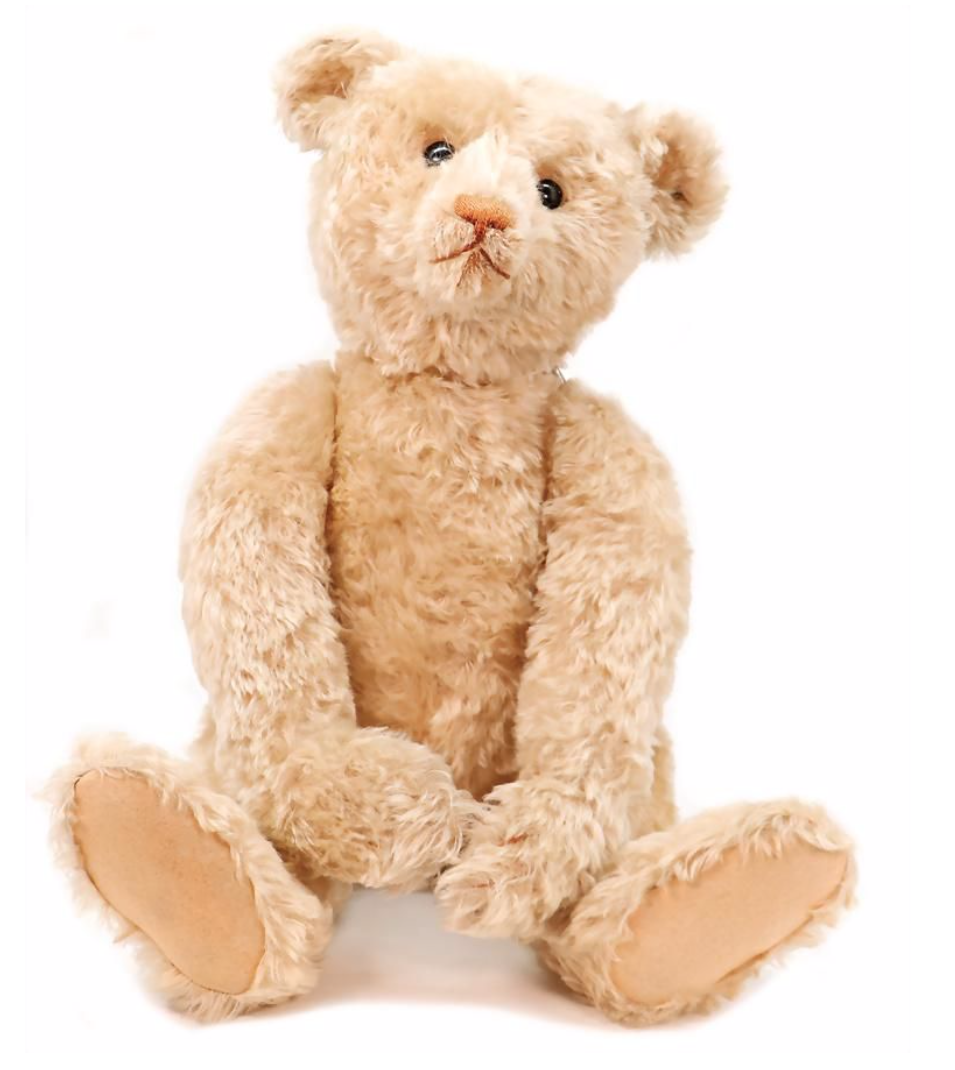
Lot #6115, a magnificent Petsy the Baby Bear, was the gold medal winner in this exciting sale. He generated 50 bids and hammered at a breathtaking $57,772. He was cataloged in part as:

"One of the highlights of the auction, Petsy-bear, in unused condition, with button, block letters, long trailing f, minimally rests of the white cloth tag label, big ears, seam at the middle of the head, felt paws in very good condition, long snapped off arms, clearly hump, 45 cm, very nice strong colors, exceptional."

So what made this Ted so desirable at auction? 
Most importantly, more than one collector was determined to add him to their hug! Clearly, he was in wonderful condition, with great coloration, and IDs. He also must had that "X" factor that really called to his new owner. Petsy bears traditionally do really well at auction, especially at Ladenburger Spielzeugauktion. In July, 2022, they sold a most impressive 74 cm version of Petsy for $45,782. Steiffgal also believes that Mrs. Wiley's Petsy has set a new world's record price for a Teddy bear sold at auction in the 21st century.

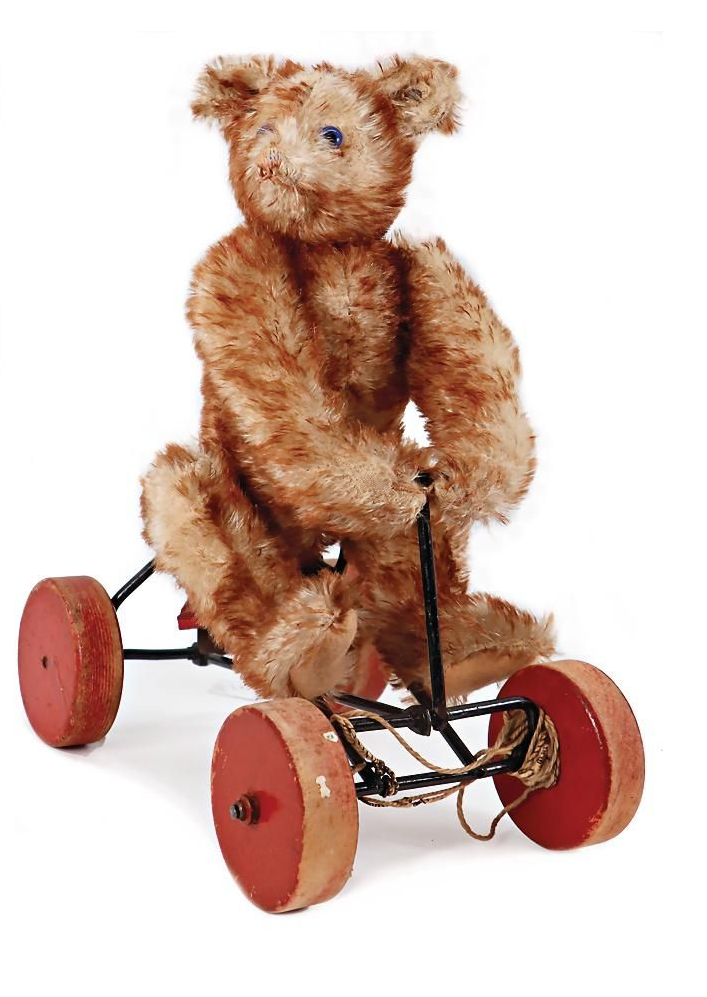
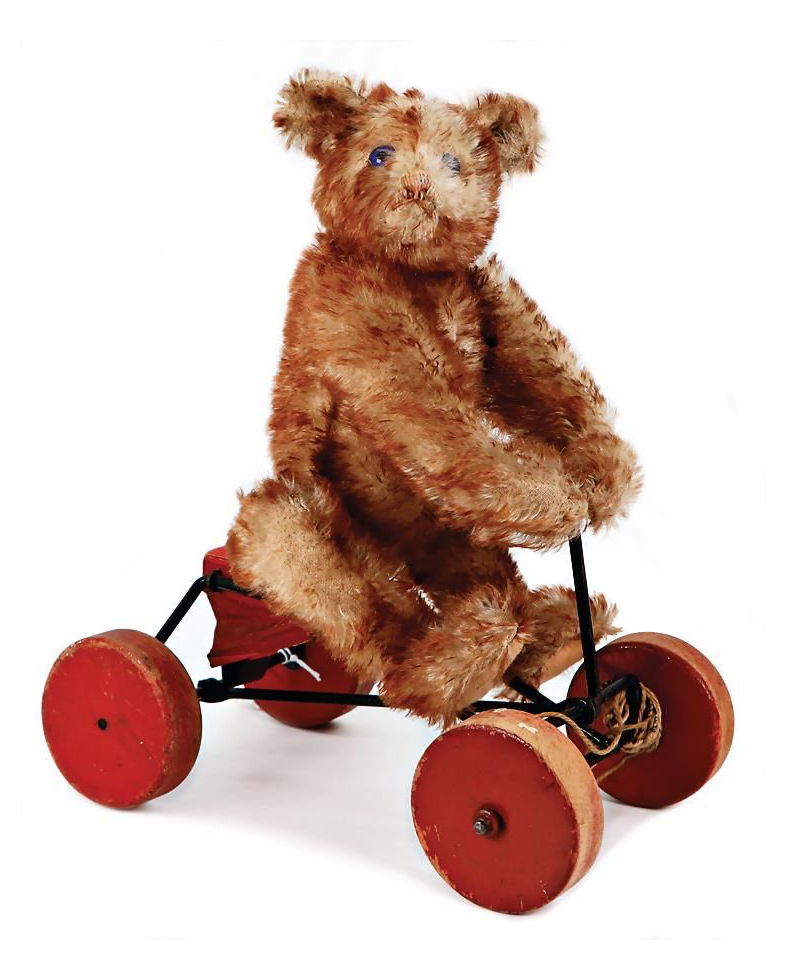
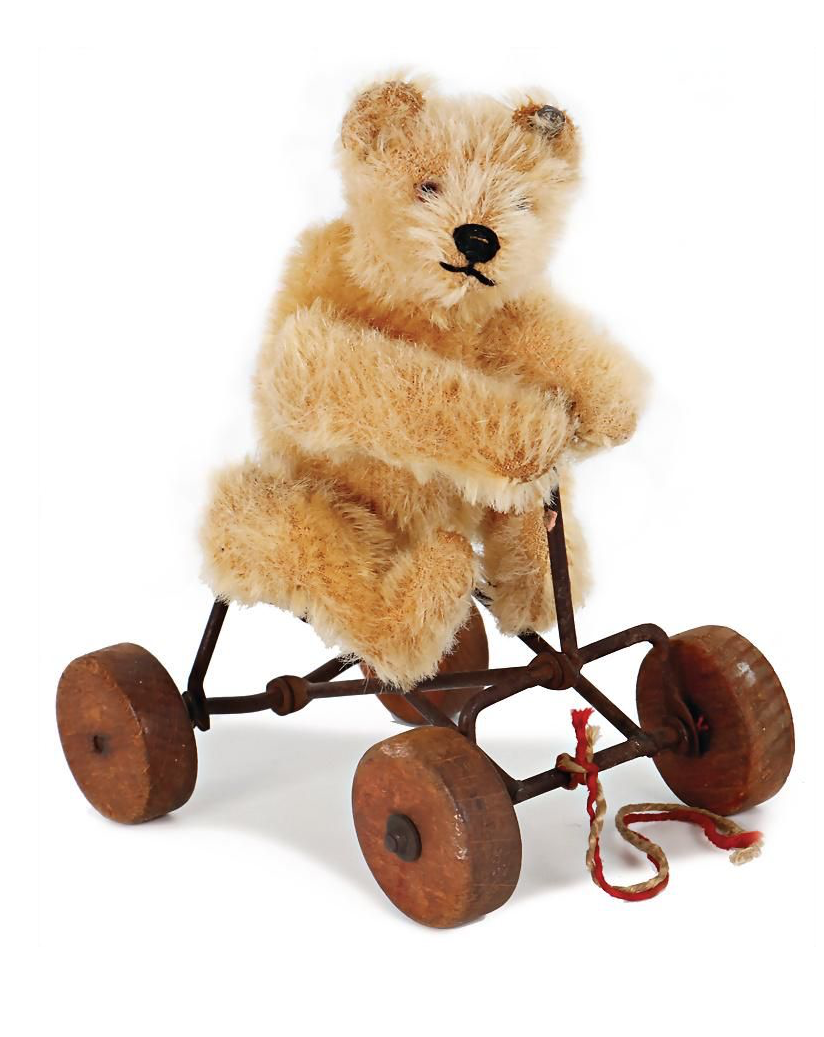
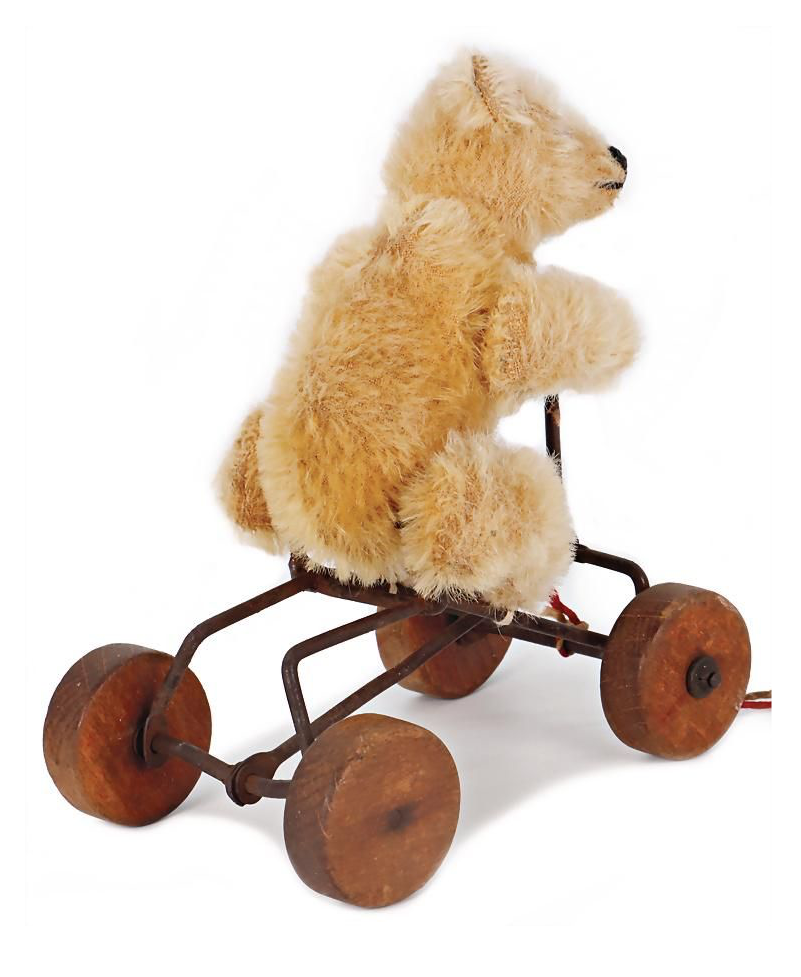
Taking the silver slot at this Steiff sale was another version of Petsy, this time on a four wooden wheeled cart.
This was lot #6071, an astonishingly rare Record Petsy. It hammered at $21,801 and generated nearly 100 bids! He was cataloged in part as:

"Rare Record-Petsy, produced around 1928-1929, length: 25 cm, brown pointed mohair, blue glass eyes, bright embroidering at snout, with seam at the middle of head, with button, block letters, long trailing f, minimally rests of the white cloth tag label, smaller mohair loss at the thighs and at the hand, very nice strong colors of the mohair, red wood wheels, extremely expressive."

Clearly, this Petsy on the go was the wheel deal!
Record Petsy was made in 20 or 25 cm from 1928-1929 only. According to Cieslik's Button In Ear reference book, only 1,462 examples were made. Steiffgal has only seen two of these - ever! Unlike full bodied Petsy bears which do appear with some regularity on the secondary market, this prewar pull toy version is the only example Steiffgal can find that EVER appeared online at public sale. That - plus his irresistible presentation - certainly help to explain why he raised so many paddles during this amazing button-in-ear event.

The bronze medal at last weekend's event goes to lot #6187, Steiff's smallest (and arguably cutest!) prewar Record Teddy.
It hammered at $8,829 and generated 90 bids. He was cataloged in part as:

"Rare Record teddy, in the small manufactured size, height: 10 cm, 1924-1927, on a self-propelling vehicle with motion, with original drawstring, with button, block letters, long trailing f, glass eyes, a little bit flash rust, mohair is a bit thin."

Again, collectors always seem to go into fifth gear when it comes to Steiff's prewar wheeled novelties.
This is the smallest sized version Steiff ever made of its legacy Record Teddy pattern. He really translated well into miniature form, so his petite scale and irresistible presentation most certainly added to his bottom line at this sale. Like his cousin Record Petsy, this guy is amazingly rare - The only other tiny Record Teddy Steiffgal nows of sold at Christies in 2010 for 6,250 GBP.

Steiffgal hopes this auction review has perhaps bid up your interest in future Steiff sales!

Have a question about one of your Steiff treasures? Let's talk! Click here to learn more!

Thursday, September 29, 2022

Breakthrough Bear Surprises At Ladenburger Spielzeugauktion's Fall 2022 Event!

Auctions always deliver surprises, and that's one of the reasons many collectors love them! Ladenburger Spielzeugauktion's recent Steiff sale, held in the wee hours (at least on the East coast!) of Saturday, September 24th, 2022, produced some really outstanding results - especially on some "under the radar" items. Here are three that bubbled to the top, in the most delightful ways possible.

The first head-spinning highlight from this sale was also the top lot in the entire button-in-ear offering. This was lot #3047, a large, lovely, and important prewar white center seamed bear. It was cataloged in part as, "...bear with seam at the middle of head, with button, block letters, long trailing f button, shoe button eyes, white mohair, bright embroidering at snout, 60 cm, felt paws in very good condition, long snapped off arms, hump, nice bright mohair, voice isn't intact, extremely expressive." 

This bear was estimated a €2,500-€5,000, generated 70 bid, and hammered for a whopping €38,000!

This big beauty was certainly the package when it comes to all the things vintage Steiff enthusiasts adore. His white mohair, black eyes, and center seam facial construction checked all the boxes. He also retained his original Steiff button-in-ear, which only added to his appeal. And then of course was his adorable personality and presentation - classic, timeless, and just plain irresistible. It is interesting to note that this cub hammered almost twice that of a Happy Teddy bear (€20,000) or a fine rod bear (€20,000) also sold through this sale.

This next auction highlight is certain to bring a smile to your face.
Here we have lot #3049, an impish, blonde mohair Steiff Dicky bear. He was cataloged in part as, "...with button, red cloth tag label, No. 5322,2, glass eyes, velvet paws, airbrush is partially a bit subtle visible, 34 cm, long snapped off arms, very expressive, mohair is a bit thin at minimally places, otherwise beautiful." 

Dicky was estimated at €950-€1,900, generated 81 bits, and hammered for €14,500.

Dicky bears are among Steiff's most desirable prewar novelty cubs. Steiffgal suspects, but has no proof, that the pattern may have been named in honor of Richard Steiff. Dicky bears were produced at a challenging socio-economic period in Germany and designed with features which made them faster and more efficient to manufacture than Steiff's standard line Teddy bears. Steiff's marketing materials described them as, "A new, improved, and less expensive Steiff Teddy Bear. Attractive design, newly formed head, strong squeeze growler, soft filling, blond or white mohair with painted pads, movable head and joints, famous workmanship." This fine example had a great attitude, retained its premier and fully legible red ear tag and Steiff button... and clearly radiated an "X" factor which spoke to many bidders!

And three's a charm with lot #3037, a terrific Ted from the mid 1920s to early 1930s timeframe.
He was cataloged as, "...exceptional, pre-war era, with button, block letters, faded, red cloth tag label, glass eyes, bright embroidering at snout, white mohair, exceptional size, 75 cm, clearly damages at the felt paws, long snaped off arms, hump, nice, bright mohair, scattered mohair loss, very expressive." 

Big Ted was estimated at €1,200-€2,400, generated 55 bids, and hammered for €6,700. 

This cute cub is good for a few supersized Teddy hugs! He was the second biggest standard sized prewar Teddy bear produced, with the largest being 115 cm. This example - with his oversized glass pupil eyes, fuzzy muzzle, and toddler-esque proportions - perfectly embodied the playful and upbeat aesthetic of "the red ear tag" era. In retrospect, it should have come as no surprise that he caught the hearts, eyes, and wallets of collectors worldwide. 

Steiffgal hopes this discussion on these three top auction lots has you going for the gold today.


Have a question about one of your Steiff treasures? Let's talk! Click here to learn more!

Saturday, March 26, 2022

Making A Material Difference At Ladenburger Spielzeugauktion's April 2nd, 2022 Auction

It's nothing short of a bear affair at Ladenburger Spielzeugauktion GmbH's upcoming Special Steiff Auction event on April 2nd, 2022. With over 260 century spanning button-in-ear treasures, there's certainly something on offer for every collector and budget! Of particular interest among all the lots are a group of 20th century bears made from a variety of unconventional or substitute materials. Steiff's Teds are usually rendered in fine mohair fabrics, but there are exceptions - especially around exceptional time periods. Here are three lots that really caught Steiffgal's eye - and why.

The first is lot #5028, a paper plush Teddy bear most likely made just after the conclusion of World War I.
It is cataloged as, "teddy, pre-war era, paper, mohair-plush-substitute, cellulose-plush, brown jointed, shoe button-eyes, strongly used condition, partially fill loss at the disc joints, with button, block letters, long stretched F, 28 cm, in need of restoration, collection Koskinen." This very rare bear has an opening bid of 280 euro.

So just what makes this paper bear worth his weight in gold - despite his apparent condition issues? In order to continue soft toy production in the c. 1918-1920 timeframe, Steiff was forced to come up with some alternative products, as well as materials given the shortage of traditional felt and mohair. Given the abundance of wood in the area, the company started producing things like building sets and furniture for children. Steiff also found a way to produce a tweed-like material from local natural products. This "paper plush" was made from nettles and called "Brennessel." Paper plush items appeared in the line from 1919 through 1921, and included popular models of the company's standard line bears, dogs, cats, and rabbits. 

Size defies with this second sensational Steiff. He is lot #5140, a very big boy made from a seldom seen material. He is cataloged as, "Steiff 1930s-era Teddy bear. Five ways jointed, 100 cm tall, and made from substitute blonde plush fabric. With slightly trimmed muzzle, four claws, glass pupil eyes, and a giant back hump. With long trailing f button and traces of the yellow ear tag as IDs. Extremely impressive and unusual presentation. In excellent condition; with minor playwear and pads with light loss and dust." He has an opening bid of 3,300 euro.

There's so many interesting angles to this rare bear. First, of course, is his size. It is possible that he was intended originally as a display item, or store window display, given his prehistoric proportions. It is somewhat unlikely he was made as a toy, as in some cases he would be larger, and heavier than a child! He was clearly not used as a toy, given his current condition and lack of playwear. Then of course is his materials. As previously noted, Steiff's bears traditionally are made from mohair which gives them a cuddly look and durability to last generations. But this example is made from wartime era substitute blonde plush fabric - and a lot of it. Starting in the early 1930s, items made from wool plush, woolen mohair, silk plush, and other substitute fabrics began appearing in the line. This is the largest - by far - of any item made from alternative fabrics that Steiffgal has ever seen!

And good things come in threes with this third shout out.
Here we have lot #5151, a larger wool plush bear from the 1930s. He is cataloged as, "A most interesting and unusual 60 cm Steiff blonde wool plush bear from the 1930s. Made from war-era materials and featuring long and narrow proportions. With brown and black pupil eyes and black embroidered details. With long trailing F button as ID. In good to very good condition with moderate playwear and generalized thinning." He has an opening bid of 850 euro.

This bear has two key areas of interest - form and fabric. 

First, let’s talk about his presentation. Steiff's bear proportions tend to reflect the period in which they were made. For example, items made in the 1920s were often fluffy, colorful, and upbeat - much like the "roaring twenties" aesthetic, while items introduced in the 1950s tended to reflect the wholesome optimism of the early postwar period. Such is the case for items from the 1930s and 1940s. Steiffgal has noticed that these often have a long, lean, and pensive look to them... reflecting the uncertainty of the time frame in which they were produced. You really can see those distinct elements in this bear.

Now let's focus on his fabric. Wool plush is a distinctive material which holds a key place in the company's product development timeline history, and helps to date this bear pretty accurately. You generally see wool plush items made in the c. 1930 through mid 1950 time frame, but a few models - like the company's Wotan ram - incorporated it through the 1970s. Wool plush is pretty hearty and ages well. Its structure and texture make it less likely to fade, thin, or bald like mohair fabrics. Unlike artificial silk plush, wool plush can also can be cleaned gently like other fine woolen fabrics.

Steiffgal hopes this discussion on rarer fabrics used in Steiff toymaking has made a material difference in your love of the brand!

For more information about Ladenburger Spielzeugauktion GmbH's upcoming Special Steiff Auction event on April 2nd, 2022 please click here!

Have a question about one of your Steiff treasures? Let's talk! Click here to learn more!

Monday, October 11, 2021

A Fine Selection Of Century-Spanning Steiff Teddy Baby Bears Headlines Ladenburger Spielzeugauktion's November 6th Sale!


Extra! Extra! Read all about it! Big news on the Steiff front... Ladenburger Spielzeugauktion GmbH is holding a simply awesome premier Steiff sales event on November 6th. The catalog has just been published online and features 368 button-in-ear temptations. In all honesty, there are so many breathtaking options it's a bit overwhelming to pick overall highlights. That being the case, let's take a look at the "cream of the crop" per category or character over the next few weeks. There's not a better place to start this series than with a peek at Ladenburger's offering of century spanning Teddy Baby bears.

All Steiffgal can say is "Ohhhh baby..." when it comes to this first pick.
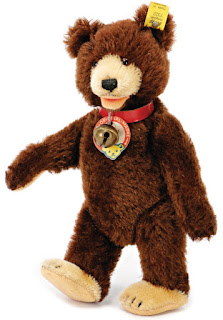
Here we have lot #3977, a most appealing Teddy Baby made from golden artificial silk plush. His starting bid is a very conservative 750 euro. It is cataloged simply as, "teddy-baby, synthetic silk plush, complete with button, sign and cloth tag label, red writing on sign, very nice original-condition, with original-collar and bell, 30 cm, rare." This sweet cub appears to have all of his IDs, including his button, yellow ear tag, and red bear faced chest tag. Given his IDs, materials, and appearance, Steiffgal suspects this irresistible imp may have been made in the late 1940s.

What is not to love about this fine fellow?
The catalog pictures suggest his condition is quite wonderful, and his happy-go-lucky expression lights up any room. Artificial silk plush is a delicate fabric which loses its shine and soft texture easily, so to find a vintage example which still has its "sheen" is unusual. Although his paw pads are not specifically called out, Steiffgal has a much loved, artificial silk plush Steiff Teddy baby from this similar time period in her collection. She has linen paw pads. That might just be the case for lot #3977 as well.

Steiffgal's second pick is also quite the head turner.
This is lot #4234, an early postwar brown mohair Teddy Baby with all IDs and a million watt smile. His starting bid is 220 euro and he is cataloged as, "teddy-baby, produced 1949-53, with button, chest label and cloth tag label, No. 7322, original condition without damage , additional with US-zone cloth tag label, paws in very good condition, 22 cm, nice full mohair, condition without damage."

The auction catalog photos suggest that this sweet guy is in practically like new condition. Steiffgal is always a little sad when it is clear that a precious toy was not loved by a child as it was intended. On the other side of the coin, this example would make for a crown jewel in any collection, so there is some justice there. Over time, Teddy Baby bears have been produced in sizes ranging from a few inches to over five feet! In Steiffgal's opinion, the smaller sized ones - like this guy - are particularly appealing in their scale, presentation, and proportions. He would be easy to display, doesn't take up too much shelf or cabinet space, and would look charming as a companion for a larger scaled doll or Ted from any era.

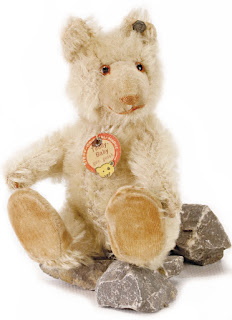
And last but not least, check out lot #4314, a super sweet - and super rare - prewar white Teddy Baby.
His starting bid is 520 euro. He is cataloged as, "teddy-baby, white, with button, long stretched F, breast sign, inscription Teddy Baby, inset velvet in face and velvet feet, with painted claws, 13 cm, produced from 1930 to 1933, white mohair, except of minimally place with mohair loss in very nice condition, very expressive, unusual, collection Koskinen."

There's something really magical about white mohair Teddy Baby bears.
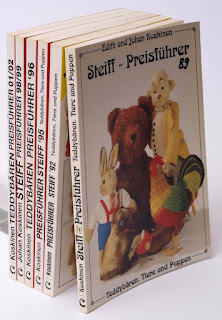
Unlike their blonde and brown mohair peers, the white versions were made for only a handful of years - from 1930 to 1933 overall. Blonde and brown mohair versions appeared from 1930 to 1943. As such, far fewer white mohair versions were produced over time, and most collectors would love to add one to their hugs. Like most coveted collectibles, it’s a supply and demand thing, and Steiffgal suspects this petite treat will be on many auction watchers' wish lists. It is also interesting to note that this example comes from the Koskinen collection. Edith and Johan Koskinen authored several well respected Steiff reference books and price guides over the years. You can see a few of them here on the left, the photo is from Bloss Auktionen. His top shelf provenance certainly adds to his appeal - if that's even possible!


Steiffgal hopes this discussion on Teddy Baby auction highlights has brought out a bit of your inner child today!

Have a question about one of your Steiff treasures? Let's talk! Click here to learn more!
The teddy bear search engine