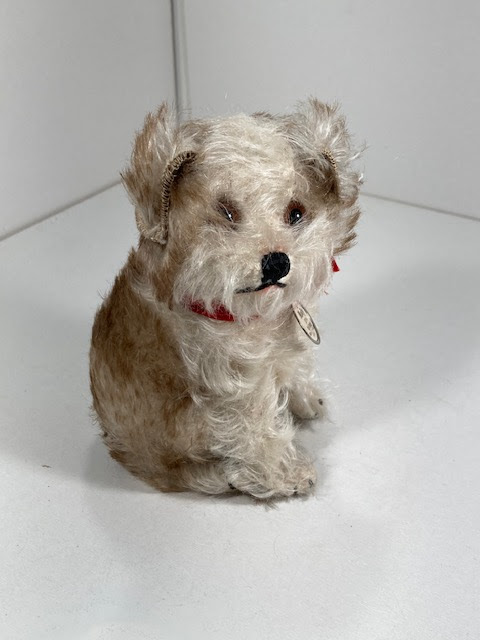
Showing posts with label Molly. Show all posts

Saturday, January 25, 2025

This Charly Purse Is A Crown Jewel In Steiff's Prewar Novelty Production

Hold everything and check out this absolutely amazing rarity!
Steiffgal has a thing for Steiff novelties, especially those made in the prewar era. And it is certainly the best of all worlds when it comes to this breathtaking example. This Charly the King Charles Spaniel handbag will undoubtably have your vote for “Best of Show” in terms of her beauty, design, and willingness to lend a paw in service!

What we have here is Steiff’s Charly Handtasche or Charly Purse.
 This novelty is based on Steiff's beloved and legacy Charly The King Charles Spaniel pattern which debuted in the late 1920s. This precious pooch purse is 25 cm long, in a standing (albeit slouchy) position, and head jointed. She is made from long and short mohair plush. Her ears and tail are brown-tipped mohair, while her body and face are off-white mohair which has mellowed to a vanilla color. Her face is detailed with oversized brown and black glass pupil eyes and a simple black hand embroidered nose and mouth. She also has black embroidered claws on her hands and feet. And here’s what makes her a purse: her torso is hollow like a pouch, and is lined in bright orange velvet. You can see that detail in the photo on the left.  Her back opening closes with a study brass zipper. The pouch volume is quite small; it probably is the volume of about a small sized apple. This fantastic and very rare prewar novelty was produced in 22 and 25 cm from 1927 through 1940.

Steiff debuted a series of zippered, mohair purses in 1927 based on some of their most beloved characters of the era.
These measured 17 to 29 cm in size, measured horizontally. Each featured a velvet or silk lined, hollow back pocket which closed with a zipper. The zipper had a mohair ring pull to it, which probably also was designed as a small handle. These rings tend to get lost to time or wear given their function. The first button-in-ear handbag designs to appear included this Charly, as well as Jocko the Chimp, Petsy the Baby Bear, Bully the Bulldog, and Molly the puppy. Other patterns rolled out over time, with the final design being a Pip in 1941. 

Now let's do a bit of time travel. Check out this image on the left from Steiff's 1929 catalog. You can click on the image to make it bigger. The page is dedicated to their line of mohair handbags. Three young ladies are happily modeling the purses, including one with the Charly bag under discussion here today. Steiffgal thinks she looks the happiest of the gals, and for good reason! You can also see the circular mohair zipper pulls on the purses. The words on the advertisement translate roughly to, "Elegant in the arm of the lady, funny with the little ones.” The catalog page also notes that the purses were decorated with a collar or silken ribbon. 

Steiffgal hopes this discussion on Steiff's animal handbags has got you carried away - in the best possible way!

Have a question about one of your Steiff treasures? Let's talk! Click here to learn more.

Saturday, December 9, 2023

Flying High With This Amazing Steiff Marketing Postcard From 1928

Can you hold history in your hand? This blog has recently discussed a number of examples of antique Steiff ephemera, including photos and calling cards. Now let's take a look at an extraordinary postcard that sold recently on eBay. Its image, subject matter, transport logistics, destination, and detailing were simply off the chart interesting. Check out this tiny time capsule from 1928 and see what makes it so fascinating from the design and historical perspectives.


WARNING - A LONG (BUT SUPER INTERESTING) READ AHEAD!


The front of this standard size postcard should be captioned "The Best of 1928!"
Pictured is a charming vignette of Steiff toys enjoying a fun outing together. Steiff has a rich history of creating marketing materials that bring their items to life through clever placement, body positions, and facial expressions. This is a perfect example of that. As for the featured items, the wooden cart and pony on wheels is the company's "Sandkar" or horse drawn wagon which was produced in four sizes from 1921-1936. The puppy is Steiff's sitting Molly, who was produced in 12 sizes ranging from 7 to 80 cm from 1925-1943 overall. The blonde Ted was made in 14 sizes ranging from 10 to 115 cm from 1905-1933 overall. And the bird is Steiff's duck; he was produced in 14, 17, and 22 cm from 1925-1932. One of each, please! You can see the front of the card pictured above, the image is from eBay. You can click on it to make it bigger. 

The back of the card is an astonishing collection of historical facts, highlights, and period information
. Many of the card's details have to do with the card's delivery source, the Graf Zeppelin. This airship, the pride and joy of the German aviation community, debuted in 1928 - the year of this postcard! The Graf Zeppelin, also known as LZ 127, was in service for nine years. During that period, it made 590 flights, including 144 ocean crossings. You can see the Graf Zeppelin here on the left, the image is from www.upi.com.

Here are a few highlight and hidden "gems" tucked within the back copy of this card. The back is pictured below, the image is from eBay. You can click on it to make it bigger. 


First, starting on the upper left corner, you can see two dates in pencil.
They correspond to the date that the card was mailed in Germany and the date that it arrived in the USA. It left Germany on October 10th, 1928 and arrived in the USA on October 16th, 1928 - for a travel time of 6 days. Pretty amazing - even for today, given today international mail often takes weeks to go "across the pond." 

Next, check out the copy on the left hand side of the card. "Place your orders with Fred Wander early to insure Zeppelin deliveries next years. Many novelties will be on display at our old stand. Margarete Steiff & Co. Inc. Borgfeldt Building, 115-119 East 16th Street, New York." Among other things, this tells us the name of Steiff's rep in the USA through the Borgfeldt company nearly a century ago, and the address of that distributor. Even more interesting here is that the card hints that all Steiff deliveries to the USA will be shipped via Zeppelin aircraft!

Now move to the middle of the card. The information that appears there tells us a lot about how the card was transported, and the obvious and international pride the German postal service and aviation authorities had in their Zeppelin program. The orange stamp in the middle of the card translates to: Mit Luftpost (airmail in German) and Par Avion (by plane in French). Right under that, there is a block of copy which translates roughly to: "To the post office in Friedrichshafen (a German town) to be sent via the airship Graf Zeppelin LZ 127 from Friendrichshafen (where there was an airport to handle Zeppelin aircraft.)" And right under that is a blue oval stamp with the translated words "Transported with airship LZ 127". So we can be 99.99% certain that this exact card traveled on the world famous LZ 127 Graf Zeppelin.

The blue and white postage stamp on the upper right hand corner of the card is also revealing. This idealized image pictures the Zeppelin gliding effortlessly and peacefully over the Earth - high enough to see the curve of the planet. The words on the stamp read "America, German Airmail, Europe, and 2 Reichmark". According the Historical Dollar-to-Marks Currency Conversion Page, in 1928, 1 RM was equal to about $4.19, so this stamp cost about $8.38 at the time. This little stamp gives off big vibes that this early airmail program was big, bold, ambitious... and expensive!


And lastly, the recipients! This card was sent to the toy buyers at Gimbel Brother department store in Milwaukee, WI. This legacy store brand and chain would go on to become one of largest and most beloved retailers in the United States, eventually operating over 50 storefronts. Gimbel's started the original Thanksgiving Day parade tradition in 1920. Its chief rival was Macy's - who would debut their version of a turkey day celebration parade in 1924. It is no surprise that Steiff would be doing business with Gimbels (or trying to!). This city block long institution with a river front facade certainly had a toy department and attracted high end customers that would be interested in the Steiff brand. You can see Gimbel's in Milwaukee here on the left in the late 1920's. The photo is from www.thedepartmentstoremuseum.org. 

Steiffgal hopes this discussion on this fascinating Steiff postcard has been the trip of a lifetime!


Have a question about one of your Steiff treasures? Let's talk! Click here to learn more.

Sunday, September 24, 2023

Racing To The Finish Line With This Amazing Steiff Gallop Novelty

There's no horsing around when it comes to this week's blog featured guest. Or guests, in this case! This amazing Steiff rarity came to Steiffgal somewhat out of the blue, and belonged to a collector on the West Coast who really, really loved precious Steiff items. Check out this prancing pair on wheels and see what makes them so delightful from the design and product development timeline perspectives.

It's off to the races with this Steiff Gallop novelty.
It consists of two standing, unjointed 8 cm mohair pets on a metal cart with red wooden wheels. The first animal is little Molly dog. She is made from tan and brown tipped mohair and is solidly stuffed with excelsior. Her face comes to life with brown and black glass pupil eyes and a black hand embroidered nose and mouth. Her ears are seamed on their outside edges, and are folded over in typical Molly style. Her IDs have been lost to time. Her companion is a distinctive cat made from silver tipped mohair. She has a trimmed muzzle, a pink hand embroidered nose and mouth, green and black slit style glass pupil eyes, and a few remaining clear monofilament whiskers. She retains her long trailing "f" button. This Molly and cat Gallop novelty appeared in the line in this size and configuration from 1926-1929.

Now let's check out the lucky passengers on this very special ride!
Standing Molly appeared in the line in 8, 12, 14, 17, 22, 28, and 35 cm from 1925-1936 overall. She was not produced standing postwar. This Gallop Molly is most likely an example of the 8 cm standard line Molly. The cat, on the other hand, did not appear in Steiff's catalog, as far as Steiffgal can tell, except on this exact novelty. This prewar black mohair cat design is just one of a tiny handful of kittens - other than the company's famous arched back Tom Cat - produced in this color and fabric before WWII.

This Gallop toy was one of three novelty pull toy designs Steiff produced from the mid-1920s through the mid-1930s. These included Roly-Drolys, Wiwags, and Gallop toys. Each of these three patterns used pairs of small, standard line items on wooden carts. All were created in response to product development need identified by Richard Steiff. He was living in America at the time and insisted that these sorts of "mobile" items were necessary in the line to keep up with the demands of the marketplace, consumer preferences, and growing worldwide competition.

And just how did these pull toys rock and roll?
Roly-Droys appeared in the line from 1924–1934. The animals rotated in circles as their cart was pulled along. "Roly-Droly" comes from the German words "rollen" (to roll) and "drollig" (funny or droll). Wiwags appeared in the line from 1924–1927; its passengers see-sawed up and down as their cart was propelled forward. And Gallop toys, like the one under review here, were made from 1926–1929. The riders glided back and forth as their cart's wheels turned round and round. Each of these metal and wooden toys came with a pull string that was tipped with a wooden knob decorated with a Steiff button. You can see Steiff's range of Gallop toys as pictured in the company's 1929 catalog. The image is from Carsten Esser's Steiff Katalog 1920-1929. 

According to Steiff's advertising, Gallop toys consisted of
..."Two different animals of fine plush on car of special construction. When pulled along, the galloping moment is produced." Gallop toys were produced in a number of configurations. These included one with a brown and white standing bear; one with a standing lion and elephant; one with a standing fox and hare; one with a Barney Google doll and a standing bear; one with a Barney Google doll and a standing Spark Plug horse; one with a Spark Plug horse and an ostrich; one with two standing goats; and one with a Molly and black cat. The advertisement on the left is from the mid-1920s and features the Molly and black cat version under discussion here today. 
The image is from Carsten Esser's Steiff Katalog 1920-1929. 

Steiffgal hopes this discussion on Steiff's Gallop novelties has put a fun spring in your step today. 

Have a question about one of your Steiff treasures? Let's talk! Click here to learn more.

Sunday, February 26, 2023

Detailing The Differences Between Steiff and Pappe's Sweet Sitting Puppy Dogs

Good golly - this is NOT a Steiff Molly!
But she is adorable nonetheless, and a great example of how the toy industry has always capitalized on good ideas and best sellers. Take a look at this sweet girl... you can't help but notice several similarities between her and Steiff's beloved prewar puppy matriarch!

This darling, prewar doggie is sitting, unjointed, and stuffed with excelsior. She is 15 cm tall and made from off white and brown tipped mohair. She has black hand embroidered claws on her front legs, a black hand embroidered nose and mouth, a long narrow tail that sticks straight out, and brown and black glass pupil eyes. Her ears are lined in chocolate brown velvet and are stitched to her head. Her ID is a tan cardboard tag printed in red; it is sewn into the seam in her ear. It has the stylized letters M and P on it, and the words "Made in Germany." The M and P are for Moritz Pappe, a toy company that was started in 1869 in Liegnitz, Germany. 

So what is the story behind this mysterious pup?
Let's name her "Polly", as she was made by Pappe and most likely inspired, at least in part, by Steiff's Molly design. It is Steiffgal's best guess that this Polly was made in the mid- to late 1920s as Pappe used this distinctive, initialed ear tag as its product ID at that time. 

Many Steiff collectors are familiar with Pappe's Teddy bears, which often had sweet, babylike qualities to them. However, this company did make a full range of stuffed mohair playthings, and was especially active in the prewar era when Steiff was also taking a worldwide leadership role in soft toy production. Apparently, Pappe just focused on "local" and not global distribution. According to the Cieslik's German Teddy Bear Encyclopedia, "There is... no indication to overseas (i.e., not European) partners or customers so that one can assume that the companies were only concentrated on the European market."

Molly the Puppy design debuted in 1925.
 She is pictured here on the left. She would become the grand-matriarch of Steiff’s vast dog world. Steiff's first Molly dogs were sitting, made from long white and brown tipped mohair plush, had a swivel head, proportionally large brown and black pupil eyes, and a hand-embroidered black nose and mouth. All left the factory in Giengen wearing a ribbon and jingle bell. Pre-war, this sitting model was produced in 12 sizes ranging from 7-80 cm. Sitting Molly was one of the very first models reintroduced post war, reappearing again in 1949 in five sizes through 1969. Molly was a smashing success from her introduction, and is still universally beloved nearly a century onward. 

There has always been alot of "borrowing," as well as form and variation, amongst the toys produced by manufacturers over the years. This is especially the case with best sellers. So it should be no surprise that factories in addition to Steiff would market a two colored, tipped mohair, gentle looking puppy dog. As a matter of fact, it is thought that Molly's design may have been inspired in part by an early 1920s-era puppy named “Beauty” produced by the English company Farnell. It is quite possible that Pappe saw how well Steiff's Molly and/or Farnell's Beauty were selling, and decided to design their own version... with just enough differences to avoid patent infringement. 

Here are a few basic design and construction variations between Pappe's "Polly" (pictured on the right hand side of the comparison photos) and Steiff's "Molly", pictured on the left hand side of the comparison photos.) 

1.  Pappe's version has a long, thin white tan mohair tail; Steiff's has a very short, tipped mohair tail.

2.  Pappe's version had simple hind legs with no claws; Steiff's had well formed hind legs with claws.

3.  Pappe's version was unjointed with velvet lined mohair ears; Steiff's version was jointed with full mohair ears. 
 
Steiffgal hopes this discussion on this dog made by Pappe has made you quite happy.

Have a question about one of your Steiff treasures? Let's talk! Click here to learn more.

Monday, October 17, 2022

Care To Go On A Date With This Prewar Steiff Scotty?

It's never appropriate to ask someone how old they are - right? But in this case, this vintage Steiff friend proudly advertises his "birthday" in a very special, and very prominent, way. Intrigued? Then check out this little black Scotty and his amazing and informative chest tag to learn more.

Here we have Steiff's 1930s-era Scotty dog. He is standing on all fours, head jointed, and solidly stuffed with excelsior. He has a non-working side squeaker in his torso. He measures 12 cm tall and 18 cm long, not including his tail. He is made from black mohair, with a longer mohair beard. His pert triangular ears are lined in felt. He comes to life with a black hand embroidered nose and lovely white, black, and brown glass pupil eyes in the shape of almonds. He retains his long trailing "f" button, trace of his red ear tag, and his named chest tag as his IDs. This pattern was made in 8, 10, 14, 17, 22, 25, 28, and 35 cm in grey or black or dark grey from 1930-1943 overall.

Now let's take a closer look at his chest tag.
It is amazing how much information is squeezed onto this tiny piece of cardboard measuring just a pinch more than 1/2" in diameter. The design features Steiff's prewar and angular yellow and blue Teddy bear face. Its center copy reads in red: SCOTTY, D.R. Patent, U.S. Patented Jan. 9, 1932. This means that the Scotty pattern was registered in D.R. - which is short for "Deutsches Reich," the constitutional name for the German nation state that existed from 1871 to 1945. The tag also gives the EXACT date that the design was also patented in the United States - January 9, 1932!

The vast number of Steiff prewar chest tags simply had the bears, animal, or doll's name noted in the center of the label. However, it is interesting to note that in some cases, like this one, that the tag also specifically mentioned that the item's patent protection status in the United States. For example, check out the tags on a 14 cm Molly and a 10 cm Tabby from the 1920s as pictured here on the left. Both have the  on this words, "Reg. U.S. Pat. Off." on their chest tags as well.

Scotty, Tabby, and Molly were extremely popular 1920s-era patterns. So it would be reasonable to assume that the Steiff management team in Germany was concerned about other companies - especially those in America - "stealing" these beloved designs. Steiff's business in the USA was really booming in the mid-1920s through early 1930s, partially due to the efforts of Richard Steiff. He moved to the States in the early 1920s with his family to grow the family business, alongside the company's US distributor, George Borgfeldt & Company. For Steiff to take the time and expense to register their designs with the US Patent Office says suggested that they really meant business when it came to design intellectual property, that they were in the United States market for the long run, and that they wanted to perhaps "American-ize" their line, making it less foreign or exotic, to add to its marketing appeal and potential.

Steiffgal hopes this discussion on chest tag details has had patent appeal with you. 

Have a question about one of your Steiff treasures? Let's talk! Click here to learn more!

Sunday, April 17, 2022

Tune In For More Information About This Fabulous Steiff Novelty!

Today's blog post is going to be music to your ears - really! In the prewar era, Steiff produced a number of really marvelous novelties based on their most popular characters of the time. Check out this remarkable find from a new friend across the pond who asks about an antique dog that can carry a tune probably better than most of us. Zoe shares:

"I'm really interested to find out if my lovely dog is a genuine Steiff, I have done a little research but can't seem to find a dog the same as him which contains musical bellows, when his tummy is squeezed he makes a lovely twinkling noise! He has the Steiff button in his ear with the underling f which I've found out that he was made between 1908 and 1920, he also has his original pink ribbon! I have enclosed some pics I'd love to know if he is real? He also has most of his fur but has faded as under his ears is darker. Best wishes, Zoe" 

Let's put the spotlight on this wonderfully talented Steiff dog. What we have here is Steiff's Musical Molly. She is standing, 28 cm tall, and made from long white mohair. When she left the factory over a century ago, her mohair was brown-tipped on her ears, around her eyes, and on her rear back. Sometimes this fades over time. She comes to life with oversized black and brown glass pupil eyes, a black hand embroidered nose and mouth, and folded over ears. She has black embroidered claws on each of her paws. When you squeeze her midsection, she plays a merry tune. Her notes are produced by a "press and release" style music box. 

Zoe's blue ribbon buddy was produced in this size only from 1928-1931. Molly was also produced as a sitting "press and release" musical animal in 25 cm during the same time frame. This production timeline corresponds perfectly to the IDs on this musical dog under review today. Standing musical Molly sports a long trailing "f" button and remains of her red ear tag, both which appeared in tandem on items in the late 1920s-early 1930s. 

Musical animals have been featured sporadically in the Steiff line since the mid-1920s. Given that the company's items were mostly designed as "friends for life" for children, it would make sense that some higher end models would also feature the ability to lull a child to sleep with imbedded musical features. 

High quality, European made music boxes became available on a large, commercial scale in the mid 1920's. Seeing this as a product development opportunity, Steiff created a series of "Music-Animals" in 1928. This chorus included Molly dogs, a Teddy bear, Petsy the baby bear, Bully the bulldog, Cheerio the laughing puppy, Fellow the puppy, Charly the King Charles Spaniel, Treff the bloodhound, Fluffy the cat, a clown, and a standing lamb. Most had a "press and release" style music box; standing Charly's music box was activated by pulling on his tail. These items appeared overall in sizes ranging from 17 through 43 cm. However, despite their charming appearance and musical features, these collectibles were quite expensive and few were made. Unfortunately at the time, sales were minimal - probably because of cost - and they were last featured in the catalog in 1930/1931.

Steiffgal hopes this discussion on Zoe's Musical Molly dog has added a chorus of delight to your day.

Have a question about one of your Steiff treasures? Let's talk! Click here to learn more.

Monday, May 18, 2020

For He's A Jolly Good Fellow!

Dog-gonnit, it's always the perfect time for a little Steiff surprise! Steiffgal most unexpectedly came across this darling doggie. It was the first time she'd ever seen or handled one of these absolute rarities in person. Come take a look at this black and white beauty named Fellow and see what makes him so interesting, and important, from the design and product development perspectives. 

This precious puppy is a fine Fellow indeed. He 17 cm tall, sitting, and head jointed. He is made from long, shaggy black and tan mohair. His precious and pouty face comes to life with oversized black and brown glass pupil eyes, and a black hand embroidered nose and mouth. He has a non-working squeaker in his belly, folded over ears, and three black hand embroidered claws on each of his feet. He retains his long trailing "f" button and traces of his red ear tag as his Steiff ID. This model was produced sitting in 7, 10, 14, 17, 22, 25, 30, 35, 43, 50, and 60 cm from 1928 through 1931 overall.

Like many of Steiff's beloved c. 1925-1935 pet patterns, Fellow was also produced in a number of variations and novelties. He was made standing on all fours in 12, 14, 17, 22, 28, and 35 cm from 1928 through 1931 overall. He appeared on regular or eccentric wheels in 7, 10, 12, 14, 17, 22, and 28 from 1928 through 1931 overall. And the 17 and 22 cm sitting versions, and the 22 cm standing version, were also fitted with a Swiss made press and release music box.

Steiff fans can't help but notice the striking resemblance between Fellow and another beloved button in ear buddy of the same era - Molly the Puppy. You can see the two side to side in the photo below. Molly was introduced in 1925 and was an immediate sensation. She could easily take the title of "mitochondrial Eve" behind the 40 new canine species Steiff introduced between 1925 and 1938. Steiff used Molly's basic appealing, endearing “young dog” pattern on other little known dogs of the 1920s and 1930s, including Trolly (a white, yellow, and brown St. Bernhard puppy), Flock (a blonde and white puppy), Zotty (a white puppy), and this Fellow. 

It is not clear why Fellow only appeared in the catalog for a handful of years. It is possible that his sales were not strong, or that his black mohair material was either very expensive or simply not available on a commercial scale. Another factor might just be Molly's popularity. According to the Cieslik's Button in Ear The History of the Teddy Bear and his Friends, ..."Molly was Steiff's greatest success after the Teddy bear... Between 1925 and 1932, over half a million Molly products were made." As such, Steiff may have decided to "fish where the fish are" and focus on its Molly production, given her sales superstar status.

Steiffgal hopes you've enjoyed learning all about this fabulous Fellow!

Have a question about one of your Steiff treasures? Let's talk! Click here to learn more!

Saturday, February 22, 2020

Pick Up The Pace And Check Out This Amazing Steiff Galop Novelty!


And we're off to the races with this next remarkable Steiff find! Steiffgal recently had the opportunity to see this rolling rarity firsthand, thanks to a friend. Its clever and period design, as well as place in Steiff's product development history timeline, are quite unique. Care to learn more? Then take a look at this gorgeous "Galop"... it's truly the wheel-deal!

Things are twice as nice with this Steiff "Galop" pull toy. Its passengers are two petite pets, a Molly the puppy and a black mohair cat. Both are standing and unjointed. Molly is 2.5" tall and the cat is about 3" tall. These cuties each retain their long trailing "f" ear buttons as their Steiff IDs. Molly and the cat are mounted upon an elaborate metal wire chassis via metal loops that are inserted into each of their four legs. Their cart glides upon four red wooden wheels. With a Galop toy of this configuration, the riders shuffle back and forth in opposite tandem as the novelty is pulled along; the rotation of the front wheels is responsible for Molly's movement, while the rotation of the back wheels is responsible for the cat's movement. 

Galop style toys appeared in the Steiff product line from c. 1926 – 1929 overall. In addition to this Molly and black cat model, versions included two bear cubs; an elephant and lion; a fox and a rabbit; Barney Google and a bear cub; Barney Google and Sparkplug; and two goats. 

You'd be cat-atonic not to take special notice of the black kitty aboard this particular Galop example. Steiff did make standing, mohair "tabby" style cats as well as black mohair "Tom" style cats in the 1920s. But Steiffgal has never seen a black mohair "tabby cat" style version from this era. So it is quite possible that this black mohair tabby cat was designed and produced exclusively for this Galop. Producing exclusive items for 1920s-era pull toy novelties does have some precedent. Here on the left, you can see a print advertisement for the company's Galop line, featuring the Molly dog and black mohair cat version under discussion here today. The tri-lingual copy notes, "Two different animals of fine plush on car of special construction. When pulled along, the galloping movement is produced."

Galop novelties - and a series of similar pull toys - were developed in the mid-1920s to meet growing international expectations for dynamic, playful, and charming products that reflected the mood and aesthetics of the "roaring 20s." Through a series of letters to his family in Germany, Richard Steiff himself stressed the need for these sorts of products in the Steiff line, in order that the company appeared forward thinking and "modern" in terms of its production and offerings. Other "two passenger" novelties produced in this series included Roly-Drolys, which appeared in the line from 1924 – 1934, and Wiwags, which appeared in the line from 1924 – 1927. Roly-Droly carts moved their passengers around in circles, while Wiwags see-sawed them up and down, as the toys were rolled about. You can see the mid-1920s catalog page advertising Steiff Galops here on the left. 

Steiffgal hopes this discussion on this rare Steiff Galop pull toy got your heart rate up, just a bit!

Have a question about one of your Steiff treasures? Let's talk! Click here to learn more!

Sunday, November 4, 2018

Rolling Out The Red Carpet For This Amazing Steiff Ball Rabbit

It's easy to have a ball with Steiff! Especially when it comes to the company's tiny and wonderful "baby balltier" or ball animals designed for babies. Steiffgal recently had the pleasure of adding one of these bitty bunnies to her Steiff hug. Check out what makes these unusual novelties so interesting from the historical and product development perspectives.

Rounding things out, this adorable, 9 cm tall bunny is head jointed and made from tan colored mohair. His body is a simple, round form about the size of an apricot. His head is about the size of a ping-pong ball and is detailed with black and brown glass pupil eyes and a simple, red hand embroidered nose and mouth. His ears are made from felt. Rabbit's two front limbs and little tail are all made from tan colored woolen pom-poms. His clear monofilament whiskers have unfortunately been lost to time. This ball rabbit pattern was made from 1934 through 1943. This excellent example has a long trailing "F" button, dating him to the earlier part of this time frame.

Steiff also produced a larger 15 cm version of this bouncing bundle of joy from 1932 through 1942. This bigger bunny featured dimensional mohair ears and limbs as well as a rubberized, pastel colored ribbon band so he could be used as a "toss and catch" toy or perhaps even as a pram toy. This ribbon feature is so ephemeral that Steiffgal has never actually seen one in person. The 15 cm version of this novelty is pictured here on the left; the photo is from Pfeiffer's Steiff 1892-1943 Sortiment.

Steiff rolled out a series of teeny-tiny ball animals starting in the early 1930s. This would prove to be a challenging decade for the company. Germany entered a period of economic depression and widespread unemployment in 1929. At the same time, growing overseas sentiment began negatively impacting Steiff's export markets. As a result, Steiff's product development strategy included focusing on creating a range of lower-tier (i.e. affordable and efficient to produce) products for their domestic market to keep their toymaking business viable. It is interesting to note that the company's inexpensive, palm sized woolen miniature animals (including numerous rabbits in various body positions) also debuted around this same time. 

Coming full circle, Steiff produced about eight types of ball style animals overall. These were all based on simplified patterns of the company's most popular designs of the time. In addition to the rabbits discussed above, the collection also included Teddy bears, elephants, ducks, cats, lions, a Chin-Chin dog, and a Molly the Puppy. What's amazing about these items is that any survived at all given they were made to fit in the palm of a child's hand and designed as toys for youngsters! Here on the left you can see the page from the 1938 Steiff catalog featuring an assortment of these well-rounded items. 

Steiffgal hopes this discussion on these charming Steiff baby toys has put you in a playful mood indeed.

Have a question about one of your Steiff treasures? Let's talk! Click here to learn more!

Sunday, October 7, 2018

Let The Good Times Roll With This Vintage Steiff Molly Dog On Wheels

Mark Twain once wrote, “The dog is a gentleman; I hope to go to his heaven not man’s.” And who could disagree? No company can match Steiff's attention to detail, quality, and appeal when it comes to our favorite canines. Next to Teddy bears, dogs have always been Steiff's most beloved and popular editions.  

Steiff's pre-war dogs on wheels could easily be considered the best of all worlds. These endearing, softly proportioned pets are adorable on their own, as well as the perfect pals for turn of last century dolls. Their wheels give them a distinctly playful - and old fashioned - appearance. So Steiffgal was more than delighted to learn of a very large - perhaps lifesized - 1920s era Steiff Molly on the go! This particular Molly on wheels is scaled to be either a large pull toy, or a small riding animal for a toddler. 

This Steiff pretty puppy is the wheel-deal indeed. She is standing, unjointed, and 35 cm tall. She is made from very long tipped tan mohair which has faded overall to a vanilla color over time, but is still very lush and full. Her floppy ears are "folded over" as they have been since her launch in the mid-1920's. She has oversized brown and black pupil eyes and a black hand embroidered nose and mouth. She rides upon four red wooden wheels. Molly on wheels was made in 28 and 35 cm from 1927-1943 overall. This example was made in the earliest part of that time frame, given that she retains her long trailing "f" button and traces of her red ear tag, as pictured here.  

Steiff's Molly the Puppy is a very important design for three key reason.

1.  First, she is one of the very few Steiff dogs that doesn’t have a “breed” associated with her. For example, Terry is the Steiff Airedale, Foxy is the Steiff Fox Terrier, and Snobby is the Steiff Poodle. This model is simply known as Molly the Puppy.

2.  Second, her 1925 introduction was so successful that she can be credited for opening the floodgates to a huge influx of Steiff dog designs. Between 1925 and 1938, close to 40 new canine species were noted in the Steiff catalogs after her debut. These included the now classic Bully Bulldog, Arco the German Shepherd, and Peky the Pekinese, as well as some lesser-known designs including Cheerio, the laughing dog, Putzi, a caricatured standing dog, and Lord the Great Dane.

3.  And third, she was a prime source of highly successful “theme and variation” product launches. Through the early 1940s, Molly appeared sitting and standing and in numerous color combinations, including red and white, green and white, and blue and white. She appeared as a puppet, purse, pincushion, music box, and Charleston animal, among other items. Smaller versions appeared standing on eccentric wheels, while larger ones, like the example under discussion today, appeared on centered wheels. Steiff used her basic appealing, endearing “young dog” pattern on other lesser known dogs of the 1920s and 1930s, including Trolly (a white, yellow, and brown St. Bernhard puppy), Flock (a blonde and white puppy), Zotty (a white puppy) and Fellow (a black and white puppy). A picture of Fellow and Molly are featured here on the left, the photo is from Theriaults. 

Steiffgal hopes this discussion on Steiff's prewar Molly the Puppy on wheels has been more fun than a joyride for you!

Have a question about one of your Steiff treasures? Let's talk! Click here to learn more!

Friday, December 16, 2016

Outfoxing The Mystery Behind This Very Vintage Steiff Dog

Who doesn't love a surprise? Especially when it may have to do with Steiff! Check out this note from a new friend who writes about a "foundling" discovered in the home of a relative. Caroline shares,

"Hi there,

I was wondering if you could help me identify this charming straw stuffed dog? It was found in the basement of my mother-in-law's house back in the 60's but clearly it's a lot older. It has a hole in the right ear (there is velvet inside the ears) which made me think it could be Steiff if there was once a button there. I'm not sure if they were ever stuffed with straw or made of this material?

Anyway I know he's not not worth a lot but I love him and I'd love to know a bit more about him. Thank you so much for your time. 

Kindest regards,
Caroline"

Well, let's pull up a chair and check out this sitting sweetie. From what Steiffgal can make out from the photos, it is her best guess that this is an early Steiff Fox Terrier. It is not clear about his measurements, but based on his remaining materials, it is most likely that he originally was made from white mohair; the woolen covering has entirely been lost to time in this case. If he has a "crunchy" feeling to him when he is squeezed, then he is stuffed with excelsior, which would be consistent with his era of production. 

This early and beloved Steiff pattern is known for several design features.  These include one white ear and one orange one; pert black shoe button eyes and a black hand embroidered nose and mouth; a black circle drawn around the dog's right eye; velvet lined ears; and adorable, perfectly-to-scale prominently formed back leg haunches. Steiffgal has also seen several of these early Fox Terriers detailed with an orange airbrushed ring around their tail end, although it is not clear if this model has this based on these limited photos.  

Steiff has a long history with Fox Terriers, and they have always been an important breed in Steiff's kennel club. They made their first appearance in 1899, just a handful of years after the company's debut commercial catalog launch in 1892. This particular sitting version, named simply "Foxterrier," has its origins as far back the very early 1900's, when a similar model was produced in felt in 10, 17, and 22 cm from 1902 to 1924. This sitting pattern was produced in mohair in 7, 17, 22, 28, and 35 from 1902 through 1929, as well as lamb's wool plush in 12, 17, 22, and 28 cm from 1903 through 1917.   

This basic sitting Foxterrier pattern made a somewhat interesting "solo" appearance in 1928. For that year only, this design was also produced in mohair in 7, 17, 22, 28, and 35 cm but was specifically given the name "Spotty." This name appeared on a white tag with a metal wire rim worn as a chest tag. Two of these 1928 Spotty dogs are pictured here on the left; the photo is from Pfeiffer's 1892-1943 Steiff Sortiment book.    

And what's up with this name-game? It is Steiffgal's best guess that this update from a generic breed to a more "playful" name in 1928 was not random, but part of a larger strategy. In the mid- to late 1920's, Steiff began producing a great number of beloved dogs and giving them endearing, child-like names. This was a directive straight from company management and was made to help reinvigorate the product line and align design priorities to the societal trends and preferences of the time. This marketing tactic proved quite successful, starting with the introduction of "Molly" the puppy dog, who debuted in 1925. Other named pups introduced around this era include "Treff" the Bloodhound in 1928, "Fellow" the puppy dog in 1928, and "Bully" the Bulldog in 1927.  You have to admit, the name "Spotty" is much sweeter and appealing than "Foxterrier!"

In 2013 - perhaps in honor of his 85th birthday? - Steiff produced a charming 17 cm replica of 1928's Spotty in an edition size of 1,000 pieces for the worldwide market.

Unfortunately, due to its condition, it is difficult to put a firm date on Caroline's Steiff dog. However, given the information available about the pattern and assuming that it did have a button-in-ear at one time, it would be safe to say that it was manufactured in the 1904 through 1929 time frame.  

Steiffgal hopes this discussion on Caroline's vintage Foxterrier has made you sit up and take notice!

Have a question about one of your Steiff treasures? Let's talk! Click here to learn more!

Saturday, October 8, 2016

Sitting Pretty With This Rare And Unusual Prewar Steiff Sealyham Dog

Pull up a chair and make yourself comfortable! Today's Steiff find really takes sitting down on the job to a new level - in the best way possible. Check out this remarkable sitting Sealyham and see what makes him so interesting from the design and historical perspectives.

Let's paws and check out sitting Sealy's details.  This white wonder is 22 cm tall, head jointed, and made from very long white mohair, which has mellowed to a vanilla color. He has three black claws on each of his padless paws, and a pert little tail. His adorable face comes to life with a fuzzy muzzle, oversized black and brown glass pupil eyes, and a black hand embroidered nose and mouth. There is just a trace of pink airbrushing on his mouth, as often seen on Steiff's dogs. His prominent, triangular shaped ears are lined in tan felt. He retains his long trailing "f" button as his Steiff ID. When he left the factory in Giengen he wore a leather collar with a bell; unfortunately these accessories have been lost to time. Sitting Sealy was produced in 8, 10, 14, 17, 22, and 25 cm from 1930 through 1939. 

The Sealyham breed was considered one of the more stylish and desired breeds of the late 1920's and early 1930's. As such, Steiff created several versions of this "it" dog. In addition to this sitting style, Steiff also produced a similar standing model. The standing version came in eight sizes ranging from 8 to 35 cm and appeared from 1930 through 1943. Pre-1943, Steiff made numerous Sealyhams on wheels, a tail turns head version, a few nomotta wool woolen miniature or "woolie" Sealyhams, and a 30 cm Sealyham night dress bag. Sealyhams were produced again immediately after the factory reopened for business in the late 1940's. However, only standing examples were produced. These models, which appeared through 1957, had very minor if any changes in fundamental design from the model launched in 1930.

This Sealyham pattern was introduced during what could only be called Steiff's "dog days." This period began in the mid-1920's with the introduction of the company's "Molly the Puppy" pattern. Molly's 1925 debut proved so popular that she is credited for opening the floodgates to a huge influx of Steiff dog designs, including Sealyhams and their black mohair Scotty "cousins." (If you look at the photo on the left, you can see several similarities between sitting Sealy and Molly, including their identical oversized eyes, gentle expressions, and body positions and general presentations.) Between 1925 and 1938, close to 40 new canine species were noted in the Steiff catalogs. These included the now classic Bully Bulldog, Arco the German Shepherd, and Peky the Pekinese, as well as some lesser-known designs including Cheerio, the laughing dog, Putzi, a caricatured standing dog, and Lord the Great Dane.

Steiffgal hopes this discussion on this rare and unusual sitting Sealyham has been a welcome respite in your busy day.

Have a question about one of your Steiff treasures? Let's talk! Click here to learn more.

Sunday, June 5, 2016

Happiness Is A Warm (Steiff) Puppy From Morphy Auctions' Upcoming Toy Sale Event!

In the market for a new blue ribbon addition to your Steiff collection? There's practically an entire kennel of fabulous and unusual Steiff dogs on offer at Morphy Auctions' upcoming Premier Toy Sale on June 24th-26th, 2016. Paws and check out these collectible canine highlights and see what makes them so interesting from the design and feature perspectives.

Steiffgals' going out on a limb with this first pick - a Molliette "Charleston" dangling dog with ID. This is auction lot #802 and is cataloged as...

"This is a delightful 20 cm example of Steiff's "Molliette". She has a mohair puppy head; long, soft unjointed dangling limbs; and mohair hands, paws, and tail. Her body, arms, and legs are made from a lovely shade of lilac velvet that has darkened slightly over time. She has very large black and brown glass pupil eyes and black, hand embroidered claws, nose, and mouth. She retains her original bell, tattered lime green neck ribbon, ring, and pompom as accessories; her tan hanging ribbon may be a replacement. Molliette is one of a series of "play and car dolls" in the Steiff catalog from 1927-1932. These were based on the most popular named Steiff characters of the time. Each had the head of the character, mohair paws and feet, and dangling velvet limbs. Most were available in several bright, happy "jelly bean" colors and in 20, 30, and 43 cm. It has been suggested that the design of this series was based on a similar line from the Chad Valley Toy Company of England called "Tango Toys." Molliette has her most exceptional metal-rimmed chest tag as her Steiff ID. Condition: As noted. Slightly dusty but in very good to excellent condition overall. Provenance: From a Florida estate. Size 8-1/2'' T. Estimate: $800 - 1,600."

Good golly, what a great Molly! This Molliette design is a example of many of the influences that really took priority in the 1920's for Steiff. Its core "Molly the Puppy" pattern, introduced in 1925, was specifically designed to be as soft, fluffy, and child-like as possible. Her candy hued body - appearing in blue, pink, orange, purple, green, or yellow - reflected Richard Steiff's directive to add color and interest to the company's product lines, as well as a distinctly feminine appeal. And her novel design, based on the Charleston dance craze, shows how Steiff - despite its location in rural southern Germany - was keenly aware of worldwide cultural trends and their importance in growing their footprint and reputation as an international leader in the toy industry. Teddy Rose, pictured here on the left, was also in the line around the same time as Molliette, and shares many of these same design priorities. 

Steiffgal's second highlight, an early King Charles Spaniel, is eye candy in many ways. This is auction lot #818 as is cataloged as...

"This very interesting and early Steiff King Charles Spaniel is 21 cm tall and 37 cm wide, unjointed, and standing on all fours. She is made from white and copper colored mohair, which has thinned and darkened over time. She has long ears and a playful tail. Most interestingly, her oversized black eyes are backed in orange felt; this is the first time this cataloger has ever seen this outstanding and all original detailing. Her pouty face comes to life with a hand embroidered brown nose and mouth. This handsome design was produced in 17, 22, and 25 cm from 1924-1927. Condition: As noted. Spaniel retains her tiny trailing "F" Steiff button. Dog has been professionally cleaned and partially restuffed. With surface losses commensurate to age. In good to very good condition overall. Size 14'' L. Estimate: $200 - 300."

This sweet King Charles Spaniel is a prince of a pick. And, his felt backed eyes make him quite the looker. It was not that uncommon in the past for Steiff to add a felt backing to an animal's eye to help give its face a bit more depth and emotion. Perhaps the best example of this is the red felt the company used behind the eyes of its all-black Titanic Mourning bears from 1912. An 18" tall example of these rare and beloved bears - sold by Morphy's for $34,800 in 2011 - is pictured here on the left. Steiff has also used felt backed eyes on some of their rabbits, birds, and squirrels, among other species. However, this is the first time that Steiffgal knows of where the company has used orange felt to back the eyes of a dog, or any species at all!

This final auction highlight is truly Ivy League. This is lot #861, an extraordinarily rare Steiff standing Yale Bulldog. He is cataloged as...

"This standing, head jointed Yale Bulldog does not appear in the standard Steiff reference books. However, he is pictured in the 1951 FAO Schwarz catalog, along with seven other Steiff college and military mascots. His price at the time was $10.00. The dog is made from mohair and is realistically hand airbrushed with black, tan, and brown highlights. His comical face comes to life with one black ear and one tan ear; unusual “squint” style black and blue eyes; a black glass button nose; and elaborate jowls. He wears a blue and white felt Yale blanket and a red studded collar. He retains his US zone tag, button, and yellow ear tag as his Steiff IDs. Condition: As noted. Very good to excellent condition overall. Estimate: $600 - 1,200."

And just what makes this one top dog? His marvelous, clean condition; extremely appealing presentation; fantastic construction (with a face only a Steiff collector could love); and absolute rarity, to start with! It's also easy to take a shine to his black glass nose and black and blue glass eyes - both which are quite distinctive for his period. This style black glass nose is also seen on Steiff's early postwar poodles, while these blue and black eyes are also key design element of the company's legacy Lulac rabbit, introduced in 1952. This is only the second standing example Steiffgal has ever seen of this particular mascot pattern, the sitting ones are a bit more common. This examples is in by far the best shape of them all. You can see the original catalog page from the FAO Schwarz catalog here; click on the image to enlarge it a bit in a new window. 

Steiffgal hopes this review of fine canine highlights from Morphy's upcoming June, 2016 toy auction has got your tail a-wagging for this great event!

Have a question about one of your Steiff treasures? Let's talk! Click here to learn more.
The teddy bear search engine