Showing posts with label 1920s. Show all posts

Saturday, June 24, 2023

Keeping It In The Family With This Nearly Century-Old Steiff Bear

Old friends make for the best of friends. And so it is with this heirloom who calls the Western part of the USA home. He has lived his nearly century long life with the same family, which is wonderful for both the bear and his people! His owners simply write...

"We are interested in getting more info on a red tag bear who measures approximately 28” standing and 20" sitting. He's been in the family since the 1930s. Thank you."


This delightful and most appealing five ways jointed cub is Steiff's legacy, standard line blonde mohair Teddy bear. This pattern in this color was made in 10, 15, 18, 22, 25, 30, 32, 35, 40, 46, 50, 60, 70, and 115 cm from 1906-1933. Like most prewar blonde Steiff bears, he has black hand embroidered nose, mouth, and claw stitching. He has longish arms with spoon shaped paws and a moderately sized back hump. His paw pads are made from felt and appear to be original to him. His eyes are brown and black glass pupil style, perhaps slightly oversized in proportion.

Bear's red ear tag, long trailing "f" button, and proportions date his production to the c. 1926-1933 time frame.
This aligns really well with the history his family shared. Steiffgal suspects that he was born probably towards the beginning of that time frame as he has more of a 1920s era look to him. Bears from the 1920s tend to be more fuzzy, full figured, and youthful looking. Those from the 1930s often are less fuzzy, more serious looking, and leaner all around. You can check out an image of Steiff's bears from the company's 1929 catalog here on the left for reference. As you can see, they really have a fun and upbeat look to them. 

Given Ted's dimensions - 20 inches/50 cm sitting and 28 inches/70 cm standing - this bear is technically the company's 70 cm version.
This suggests his article number would be 5350,2. This translates to 5=jointed, 3=mohair, 50=size sitting, and ,2=has a growler (noisemaker) in the belly. Sometimes these growlers work but often they break over time. It is not clear if this Ted still talks. However, 5350,2 is the number that would be most likely on his red tag if it were still legible.

As for value, something is worth what someone will pay for it. Steiffgal has not seen or handled this bear firsthand, and does not know if he has any significant losses or condition issues, including those that don't show up in pictures. These include things like dry mohair, smoke damage, or insect damage. However, given he is as nice - and as "healthy" - as he appears in his photos, Steiffgal suspects he may trade hands in the c. $2,500-4,500 range.

Steiffgal hopes this discussion on this heirloom prewar Ted has timeless appeal to you.

Have a question about one of your Steiff treasures? Let's talk! Click here to learn more.

Sunday, February 26, 2023

Detailing The Differences Between Steiff and Pappe's Sweet Sitting Puppy Dogs

Good golly - this is NOT a Steiff Molly!
But she is adorable nonetheless, and a great example of how the toy industry has always capitalized on good ideas and best sellers. Take a look at this sweet girl... you can't help but notice several similarities between her and Steiff's beloved prewar puppy matriarch!

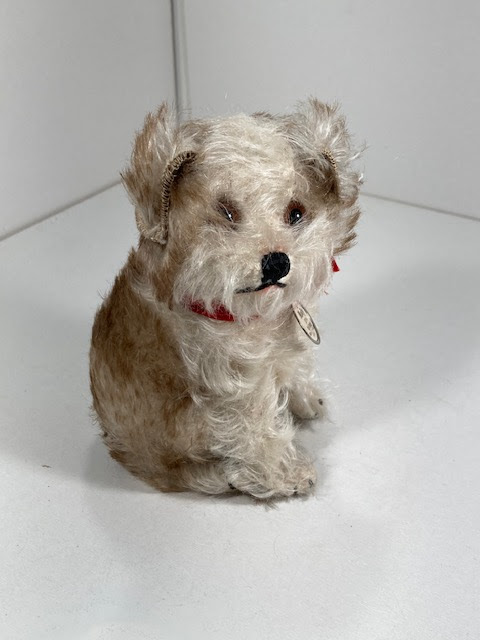
This darling, prewar doggie is sitting, unjointed, and stuffed with excelsior. She is 15 cm tall and made from off white and brown tipped mohair. She has black hand embroidered claws on her front legs, a black hand embroidered nose and mouth, a long narrow tail that sticks straight out, and brown and black glass pupil eyes. Her ears are lined in chocolate brown velvet and are stitched to her head. Her ID is a tan cardboard tag printed in red; it is sewn into the seam in her ear. It has the stylized letters M and P on it, and the words "Made in Germany." The M and P are for Moritz Pappe, a toy company that was started in 1869 in Liegnitz, Germany. 

So what is the story behind this mysterious pup?
Let's name her "Polly", as she was made by Pappe and most likely inspired, at least in part, by Steiff's Molly design. It is Steiffgal's best guess that this Polly was made in the mid- to late 1920s as Pappe used this distinctive, initialed ear tag as its product ID at that time. 

Many Steiff collectors are familiar with Pappe's Teddy bears, which often had sweet, babylike qualities to them. However, this company did make a full range of stuffed mohair playthings, and was especially active in the prewar era when Steiff was also taking a worldwide leadership role in soft toy production. Apparently, Pappe just focused on "local" and not global distribution. According to the Cieslik's German Teddy Bear Encyclopedia, "There is... no indication to overseas (i.e., not European) partners or customers so that one can assume that the companies were only concentrated on the European market."

Molly the Puppy design debuted in 1925.
 She is pictured here on the left. She would become the grand-matriarch of Steiff’s vast dog world. Steiff's first Molly dogs were sitting, made from long white and brown tipped mohair plush, had a swivel head, proportionally large brown and black pupil eyes, and a hand-embroidered black nose and mouth. All left the factory in Giengen wearing a ribbon and jingle bell. Pre-war, this sitting model was produced in 12 sizes ranging from 7-80 cm. Sitting Molly was one of the very first models reintroduced post war, reappearing again in 1949 in five sizes through 1969. Molly was a smashing success from her introduction, and is still universally beloved nearly a century onward. 

There has always been alot of "borrowing," as well as form and variation, amongst the toys produced by manufacturers over the years. This is especially the case with best sellers. So it should be no surprise that factories in addition to Steiff would market a two colored, tipped mohair, gentle looking puppy dog. As a matter of fact, it is thought that Molly's design may have been inspired in part by an early 1920s-era puppy named “Beauty” produced by the English company Farnell. It is quite possible that Pappe saw how well Steiff's Molly and/or Farnell's Beauty were selling, and decided to design their own version... with just enough differences to avoid patent infringement. 

Here are a few basic design and construction variations between Pappe's "Polly" (pictured on the right hand side of the comparison photos) and Steiff's "Molly", pictured on the left hand side of the comparison photos.) 

1.  Pappe's version has a long, thin white tan mohair tail; Steiff's has a very short, tipped mohair tail.

2.  Pappe's version had simple hind legs with no claws; Steiff's had well formed hind legs with claws.

3.  Pappe's version was unjointed with velvet lined mohair ears; Steiff's version was jointed with full mohair ears. 
 
Steiffgal hopes this discussion on this dog made by Pappe has made you quite happy.

Have a question about one of your Steiff treasures? Let's talk! Click here to learn more.

Sunday, August 22, 2021

This Dressed Steiff Rabbit Doll Is The Best Of Both Worlds!

Overall, this next fantastic find is certain to put a joyful spring in your step! Steiffgal found this bitty bun in the recent United Federation of Doll Club's salesroom - lying upside down and backwards in a case piled full of mohair and treasures. All she could see was one very large foot with red claw stitching... and the rest is history. Come take a look at this dolly-delightful bun and see what makes him so interesting from the design and collector's perspectives.

This happy hopper measures 17 cm (without his ears), is begging, and head jointed. He originally was covered in white and tan mohair - but not a hare/hair remains on him! He is detailed with extra long, skinny feet, a tiny pert tail, and oversized ears. His face comes to life with big brown and black glass pupil eyes, a typical 1920s era style hand embroidered nose and mouth, and traces of once brown airbrushed highlights. He dons his original and totally adorable blue cloth overalls. He retains his long trailing "f" button and traces of his red ear tag as his Steiff IDs.

This seldom seen pattern appeared in the line from 1929-1932 overall in 17, 22, 28, and 35 cm. Steiff's rabbits are measured without their ears, so they actually are a little larger in real life than these measurements suggest. This model was produced in one of six documented outfits. According to Pfeiffer's 1892-1943 Sortiment, these included a blue playsuit, a red skirt and white apron, a purple jacket, a red skit and purple jacket, a red and white dress, or a pink dress. This example under discussion here is the one in a blue playsuit - which is detailed with tiny faux front pockets, contrasting tan colored stitching, back black snaps, and a perfect opening for his pert tail. It is interesting to note that this pattern is considered a "doll" in terms of his category - most likely because of his toddler-esque shape, standing form, and the fact that he is dressed. 

This guy is really shy - and seldom if ever appears in public! Despite being launched in 1929, as far as Steiffgal can tell, an example does not appear in the company's primary catalog of that year. The only other one Steiffgal is aware of is one that was sold at Christies in 2010. That particular example was cataloged as, "A STEIFF DRESSED BOY RABBIT, (4317,61), light brown and white mohair, brown and black glass eyes, pink and red stitching, whiskers, swivel head, inoperative squeaker, blue dungarees and FF button with red cloth tag, circa 1930 --6¼in. (16cm.) (some slight fading)." It was estimated at GBP 1,000 - GBP 1,500 and realized GBP 1,375. You can see that listing here on the left, the image is from Christies. You can click on it to make it bigger.

Steiffgal hopes this discussion of this rare and usual animal doll has been the best of both worlds for you.

Have a question about one of your Steiff treasures? Let's talk! Click here to learn more.

Saturday, June 12, 2021

What's The Tattle On This Unexpected Steiff Rattle?

Don't you just love a good surprise? Like when you buy something online, and when it arrives, it's even BETTER than your wildest hopes? That just happened to Steiffgal today, and she can't wait to share this auspicious treat with you. So 'ears what's happening....

Steiffgal took a leap of faith with this purchase. The electronic pictures weren't so great, and the description wasn't glowing. Yet, it called to her!


What we have here is Steiff's late 1920s sitting rabbit. He is head jointed, about 13 cm sans ears and 19 cm with them, and made from faded purple and cream colored velvet. His pert ears are lined in wires and are posable. His darling face comes to life with oversized brown and black pupil eyes, a wide forehead, and Steiff's legacy 1920s era rabbit nose and mouth embroidery. This consists of a horizontally stitched, triangular shaped nose, outlined in a slightly different color floss, and a simple "v" shaped mouth. He retains his long trailing "f" button and bits of his red ear tag. These hoppy handfuls were produced sitting in 11, 15, and 18 cm (measured without ears) in blue, purple, maize, orange, and white velvet from 1927-1933 overall.

So just what makes this purple bunny such a royal find? Two things come to mind. 

The first is his monarchal color - lilac - which is so lovely and typical to Steiff's 1920s era production. In the late 1920s through early 1930s, Steiff made a series of "jellybean" colored velvet and mohair rabbits. In addition to this sitting, velvet version, the company also produced sitting mohair and begging velvet or mohair rabbits in playful colors including orange, pink, yellow, and light blue, among others. These were made to match the aesthetics of the "Roaring 20s." 
You can see a Steiff catalog image from 1929 featuring a number of these "jellybean jumpers" at the bottom of this blog post. Today, many of these items have faced a bit, much like this rabbit. You can usually tell their original color by looking in their cracks and crevices. In this case, the folds in his ears retained their vivid violet color.

And now let's make some noise over his second highlight. Believe it or not, this beautiful bun is also a RATTLE! Yes, when you shake him, he makes a happy plink-plinka noise! This feature was not noted in his listing, which makes it even more thrilling to discover.

To keep things moving and shaking, Steiff sometimes tucked a rattle into some of the smallest or almost smallest versions of its most popular prewar models. As far as Steiffgal can tell, there is/was no formal numbering or ID system to identify those items specifically produced with a rattle feature. In her personal collection, Steiffgal has a velvet sitting Pip dog rattle, a lying wool plush rabbit rattle, a white mohair Teddy rattle, and a velvet and mohair begging squirrel rattle. All were discovered to be rattles by accident... in the best possible way. Next time you handle a small, prewar item, shake it gently.... and you may happily surprised as well!


Steiffgal hopes this discussion on this princely purple rabbit reigned supremely well with you.

Have a question about one of your Steiff treasures? Let's talk! Click here to learn more!

Thursday, April 8, 2021

Rolling Out The Red Carpet For This Precious Prewar Doxie On Wheels!

What goes around, comes around... especially if it's on wheels. This darling Doxie on-the-go recently popped by to say hi and Steiffgal couldn't help but roll out the red carpet for her! Come take a look at this great example of Steiff's prewar novelty production and see what makes her so noteworthy from the historical and product development perspectives. 

Doxie on wheels is standing, unjointed, and constructed from mohair.
The dog itself measures 11 cm vertically and 20 cm horizontally. Her top, forehead, ears, and tail are made from black mohair and her muzzle, limbs, and underbelly are made from brownish tipped mohair. Her face comes to life with proportional brown and black glass pupil eyes and a black hand embroidered nose and mouth. She is mounted on two metal axles. She glides along on four wooden eccentric wheels which are painted blue. She is attached to the axles through metal loops that are inserted into her limbs. Doxie on eccentric wheels was produced in 17, 20, and 22 cm from 1930 through 1933 overall. She was also made on traditional round wheels in 28 and 35 cm from 1929 through 1935 overall.

Doxie on wheels is one of many wonderful prewar Dachshunds produced by Steiff.
 Like Fox Terriers and Pointers, Dachshunds are a legacy breed for Steiff, and perhaps one of the company's most famous and prolific dog lines as well. Steiffgal suspects this is because Dachshunds traditionally have been a very popular pet choice across Germany, and even were the animal companions of choice of the Steiff family at the turn of last century! Although this exact pattern under discussion here today was not produced postwar, if you look closely at her face, you can see it is somewhat similar in size and expression to Bazi, who was introduced in 1950. 

Moving along, this particular example three design characteristics that firmly root its production in the late 1920s to early 1930s. These include:

1. Patched mohair construction. Many items that debuted in the 1920s feature different color mohair that is patched and seamed together to create the visual effect of a multi-hued animal. From the mid-1930s onward, the company was much more likely to create an animal from one shade of fabric and then apply color via paint for a similar effect. This was probably done to create labor and material efficiencies.

2. Mohair coloring. This Doxie's brown mohair is actually more like a deep orange or copper color, and is tipped. This creates a wonderful aesthetic effect of depth and richness. Tipped mohair (think of Petsy the Baby Bear, for example) was a very popular fabric choice and treatment during the "Roaring 20s" era. 

3. Novelty detailing.
This Doxie is a novelty, meaning she has a fun feature not seen on standard line playthings. In this case, she's on eccentric wheels. You can see a closeup of this configuration here on the left. A very similar pattern to this Doxie was produced as another novelty - a tail moves head version. This mover and shaker appeared in 14, 17, and 22 cm from 1931 though 1934 overall. Steiff's novelty production exploded in the mid to late 1920s with the introduction of Molly the Puppy and Bully the Bulldog. These popular designs translated well into charming product line extension items like music boxes, purses, animal dolls, various pull toys, Charleston animals, puppets, and tail-move-head characters. Today, late 1920s-early 1930s dogs, cats, and rabbits with a novelty twist universally top collector's wish lists. 

Steiffgal hopes this discussion on this Dachshund novelty has been tremendously entertaining for you. 

Have a question about one of your Steiff treasures? Let's talk! Click here to learn more.

Sunday, March 28, 2021

Isn't This Amazingly Rare Steiff Bear Pretty In Pink?

This next Steiff inquiry has Steiffgal tickled pink. And chances are, you will be too, after learning about this fantastic Steiff find. Fabienne from Europe shares the following...

"Hello, I have bought an antique Steiff and can't find anything about it in the Pfeiffer catalogue. He is about 38 cm standing, many bald spots but the remaining hair is fair blonde and long mohair. He is excelsior stuffed, some is showing through small holes near the nose etc. He still has his button. His covering is light pink, the mohair looks a very light blonde, but it could be faded. His glass eyes are a bit different than the others I have from that same period, they are a bit oversized. The nose stitching is light brown and still in good condition.

I live in Belgium and bought this bear on a local online marketplace, not only for bears, but everything someone wishes to sell, sort of an online fleamarket ;) I immediately noticed him and saw he was a bit different than my other Steiffs. He lives now happily ever after in my private museum (I have more than 500 bears) not all of them are Steiff. Yours sincerely, Fabienne"

A rose by any other name... just might be this terrific Ted!
Based on the photos provided, it is Steiffgal's best guess that this beautiful bear is a rare example of Steiff's Teddy Rose. As her name suggests, she was made from long, luxurious light pink colored mohair, but also appeared in bright gold mohair. She was manufactured in five sizes, ranging from 23 to 36 cm, measured sitting. These sizes were different than Steiff's standard line bears, possibly as a way to show that her pattern was a new direction for the company. Teddy Rose was stuffed with excelsior and kapok or just excelsior; had a hand embroidered nose, mouth, and claws; and oversized brown and black glass pupil eyes. She had a chunky build and a less prominent back hump. All of these design elements gave her a distinctly youthful appearance. Given her era of production, all Teddy Rose bears would have left the factory with a long trailing "f" Steiff button, just like this one has. According to company records, 5,271 yellow and 4,794 pink versions of Teddy Rose were manufactured in the c. 1925-1930 timeline. 

Today, examples of Teddy Rose are extremely rare on the secondary market. A fine example traded hands at about 19,000 euro (including buyer's premium) at the June 30, 2018 Ladenburger Spielzeugauktion GmbH Steiff Special Auction. The bear had a presale estimate of 2,200-4,400 euros and received an astounding 92 bids. Her cataloging read as follows, "teddy Rose, 44 cm, mohair, pink dyed, caused of old age faded, c. 1928, felt was at 1 paw retouched, mohair is except of minimally places in good condition, rare." She is pictured here on the left; the photo is from www.Liveauctioneers.com.

The Teddy Rose pattern plays a significant role in Steiff's 1920s-era product development and business expansion strategies.
It evolved in part from a directive from Richard Steiff, who was in America from the early 1920s onward growing his family’s business in North America. He noted that by the early 1920’s, the company’s legacy designs - which were almost two decades old by this point - had run their course and did not match the aesthetic or culture of the roaring 1920s. On February 6, 1925, he wrote to his family in Germany, “I am asked almost daily for new products; and I always have to answer that we do not really want to develop new products, since we can hardly cope with the delivery orders we receive for our old toys. However, the stiff competition here means we must be on our toes.”

Also in 1925, he notes, “…Our teddies, in the show room here in New York, appear colorless, sober, and insipid. I feel inclined to decorate all the teddies we have left with huge, colorful silk ribbons; only then can we ask a slightly higher price.”

The folks in Germany took Richard’s directives seriously, and the company's design team started working on entirely new Teddy Bear patterns.
For the most part, these patterns were softer and rounder than the company’s legacy patterns; incorporated longer, often playfully colored mohair into their designs; had larger eyes and childlike personalities and presentations;  and had distinctive facial or paw detailing. Some were distributed with collars, ribbons, or other accessories. And, for the first time ever, these new Teddy Bear designs were given appealing “real” names. They included Happy, Teddy Clown, Petsy, Teddy Baby, Dicky, and the cub under review here today - Teddy Rose. Several of these beloved friends are pictured here on the left; the advertising image is from Carsten Esser's 1920-1929 Steiff Kataloge.

Steiffgal hopes you've found this discussion on the company's Teddy Rose as joyful as a colorful bouquet of spring flowers!

Have a question about one of your Steiff treasures? Let's talk! Click here to learn more.
The teddy bear search engine