Showing posts with label Bully. Show all posts

Saturday, January 25, 2025

This Charly Purse Is A Crown Jewel In Steiff's Prewar Novelty Production

Hold everything and check out this absolutely amazing rarity!
Steiffgal has a thing for Steiff novelties, especially those made in the prewar era. And it is certainly the best of all worlds when it comes to this breathtaking example. This Charly the King Charles Spaniel handbag will undoubtably have your vote for “Best of Show” in terms of her beauty, design, and willingness to lend a paw in service!

What we have here is Steiff’s Charly Handtasche or Charly Purse.
 This novelty is based on Steiff's beloved and legacy Charly The King Charles Spaniel pattern which debuted in the late 1920s. This precious pooch purse is 25 cm long, in a standing (albeit slouchy) position, and head jointed. She is made from long and short mohair plush. Her ears and tail are brown-tipped mohair, while her body and face are off-white mohair which has mellowed to a vanilla color. Her face is detailed with oversized brown and black glass pupil eyes and a simple black hand embroidered nose and mouth. She also has black embroidered claws on her hands and feet. And here’s what makes her a purse: her torso is hollow like a pouch, and is lined in bright orange velvet. You can see that detail in the photo on the left.  Her back opening closes with a study brass zipper. The pouch volume is quite small; it probably is the volume of about a small sized apple. This fantastic and very rare prewar novelty was produced in 22 and 25 cm from 1927 through 1940.

Steiff debuted a series of zippered, mohair purses in 1927 based on some of their most beloved characters of the era.
These measured 17 to 29 cm in size, measured horizontally. Each featured a velvet or silk lined, hollow back pocket which closed with a zipper. The zipper had a mohair ring pull to it, which probably also was designed as a small handle. These rings tend to get lost to time or wear given their function. The first button-in-ear handbag designs to appear included this Charly, as well as Jocko the Chimp, Petsy the Baby Bear, Bully the Bulldog, and Molly the puppy. Other patterns rolled out over time, with the final design being a Pip in 1941. 

Now let's do a bit of time travel. Check out this image on the left from Steiff's 1929 catalog. You can click on the image to make it bigger. The page is dedicated to their line of mohair handbags. Three young ladies are happily modeling the purses, including one with the Charly bag under discussion here today. Steiffgal thinks she looks the happiest of the gals, and for good reason! You can also see the circular mohair zipper pulls on the purses. The words on the advertisement translate roughly to, "Elegant in the arm of the lady, funny with the little ones.” The catalog page also notes that the purses were decorated with a collar or silken ribbon. 

Steiffgal hopes this discussion on Steiff's animal handbags has got you carried away - in the best possible way!

Have a question about one of your Steiff treasures? Let's talk! Click here to learn more.

Sunday, December 1, 2024

This Prewar Steiff Riding Bulldog Is The Wheel-Deal Indeed!

Look at what just rolled under the Christmas tree of this lucky collector! What a bow-wow beauty for sure! But just who is this captive canine, and what is the story behind him? A new friend shares,

"Hi, my name is Jeanette and have been dabbling with collecting bears, etc. for near on 45 years. My latest find is a Steiff pull along Bully Bulldog. He stands 15" tall not including the wooden wheeled frame. From nose to tail, he is 17" long, his ears have long gone. He has a leather collar with remnants of horse hair still attached to it, it also has Steiff buttons all around it, in total 12 buttons are present. He also has his original bell attached to the collar. He has a pull string still attached, but unfortunately no noise is made when it is pulled. He has large amber and black glass eyes, a black stitched nose, and velvet muzzle. The wooden wheels measure 2.5" in diameter. The pull along frame has a moving front axle, so it can change direction. Any help you can give me, i.e. date, etc. would be greatly appreciated. Thanks in advance!"

This dog on the go would take the pole position in any vintage Steiff enthusiast's collection. What Jeanette has here is Steiff's Bully Bulldog riding animal. This fine fellow was made in 28, 35, 43, and 50 cm in black and white, orange and white, or tan and white from 1927-1936 overall. This model is measured vertically from the top of their heads to their toes, not including their wheels. As such, Jeanette's treasure is the either a large version of the 35 cm or a small version of the 43 cm version; it is Steiffgal's best guess he started out life closer to 43 cm and sort of shrunk over time (like the best of us.)

The condition of Jeanette's Bully is commensurate and typical to that of a beloved ride-on animal.
These realities include things like alot of wear on the back/top areas where a child would sit, a silent squeaker from overuse, and the loss of ears which were probably used as handles for much of its working life! Fortunately, it is not terribly difficult to replace the black velvet ears on this pattern, and Steiffgal would consider doing that restoration if this Bully was in her collection.

One thing that really pops on this example is his great BLING! According to Pfeiffer's 1892-1943 Sortiment, this item is described in part as, "mohair plush, horse hair or leather collar, standing, riding animal, wheels, connecting frame, swivel head, squeaker (barks.)" Jeanette's Bully has a fantastic collar featuring a combination of horse hair detailing as well as a cascade of long trailing f buttons - truly the best of all worlds.

The Bully Bulldog that we all know and love was introduced in 1927.
This design was an instant sensation with both children (as a plaything) and adults (as a collectible and an accessory). He was modeled on the French Bulldog—the “it” companion of those in the know at the time. Bully's pattern featured oversized glass pupil eyes, a black embroidered nose, and a snout and jaw constructed to give him his requisite breed jowls. Full bodied Bully was made in velvet and mohair, as well as sitting and standing, in sizes ranging from 10 to 50 cm through 1939 overall. Here on the left, you can see Bully as he appeared in the company's June, 1927 catalog. This image is from Carsten Esser's Steiff Catalogue 1920-1929.

Given his popularity, beautiful Bully was also produced in numerous novelty forms. These included as a pincushion, pull toy, dangling Charleston doll, jointed dog doll, puppet, purse, and pajama bag, among others. Today, prewar Bullies are one of the most universally desirable and sought-after pre-war Steiff designs among collectors - especially those like this one on wheels! Prewar Bully has been replicated numerous times over the past few decades and even these newer models are coveted by collectors.

Steiffgal hopes you've enjoyed this discussion on this Riding Bully, even if just in a roundabout sort of way.

Have a question about one of your Steiff treasures? Let's talk! Click here to learn more.

Thursday, October 28, 2021

Bow-Wow Beauties Coming Up For Auction Soon!

Dog-gonnit! The blue ribbon temptations are endless at the Ladenburger Spielzeugauktion GmbH Special Steiff Auction on November 6th! This can't miss event features over 350 simply awesome button-in-ear goodies. The catalog reads like a "who's who" in the vintage Steiff world. Steiffgal recently offered her top Teddy Baby and "one-derfuls" top picks from this sale; now here are her canine cutie favorites.
 
This first pick is the wheel deal indeed.
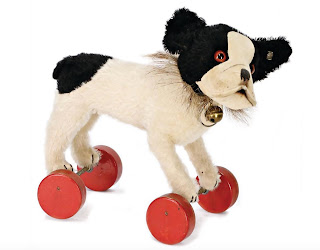
This is lot #4179, a standing Bully the Bulldog on wheels. The cataloging reads, "Bully, on excenter-wheels, black/beige mohair, velvet insert in very good condition, very nice colouring at the snout, with button, long stretched F, minimally rests of the white color, with paper breast sign with metal edge, produced around 1930, length: 23 cm, height: 22 cm, very expressive, except of minimally places mohair in very good condition, original ruff." He carries a presale estimate of €220 to €440.

Steiffgal can't imagine that there is a collector out there who doesn't just love Steiff's legacy Bully pattern. This particular item was produced in 10, 14, 17, and 22 cm from 1927-1935 overall. This guy is the best of all worlds. His condition looks lovely. He is standing - not sitting - and the standing ones are generally seen far less often on the secondary market. He has his original horsehair ruff, and these tend to fall apart or get lost to time. He has his button AND metal rimmed tag. And, like you needed any more reason to love him - he's on wiggly eccentric wheels. This guy is the package indeed. Hubba hubba hubba. 

Steiffgal's next pick is a bit of a "sett-up", but more about that in just a bit.
 This fave is lot #4036 and is cataloged as "
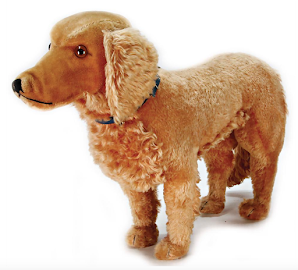
dachshund, with button, rests of the yellow cloth tag label, pull voice, faulty, full mohair, slightly faded, lenght: 53 cm, glass eyes." His presale estimate is €160 to €320. 

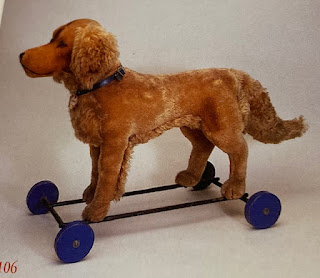
What's not to love about this pretty pooch? But here's a little secret. It is Steiffgal's best guess, given his color, mohair detailing, presentation, and long legs, that he is actually the company's much rarer pre-war Setter. Setter was made in 17, 22, 28, and 35 cm from 1933-1940 overall; he was also made on wheels in 35, 43, and 50 cm from 1933-1941 overall. You can see the wheeled version pictured here on the left; the photo is from Pfeiffer's 1892-1943 Sortiment. See the resemblance? Given the one in the sale noted at 53 cm and has a pull voice, it is very possible that he started out life as a riding animal on wooden wheels. A quick check on the condition of his paw pads would solve that mystery, but that is not possible right now. Steiffgal has never personally handled a prewar Steiff Setter; they so seldom appear on the secondary market.

And now let's raise a glass to today's final prize pup pick.
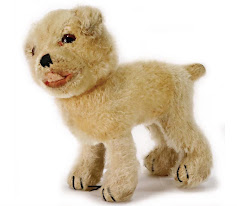
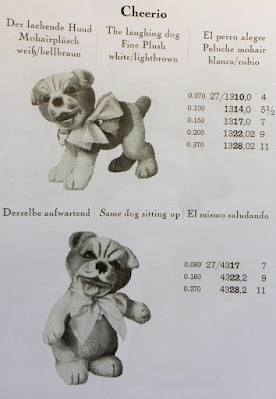
Here we have lot #4024, a standing Cheerio. He is cataloged as, "Cheerio, date of production 1928-1932, mohair-plush, standing, idealized model of a laughing dog, svivel head , inset eyes, opened snout with tongue, standing height 16 cm, mohair good, minimally faded, rare, minimally mohair loss around the eyes, 1 claw is loose, without button, chest label and cloth tag label." He has a presale estimate of €160 to €320.

Blink and you would have missed Cheerio's time in the Steiff product line.
This happy go lucky pooch was inspired by the likeness of Bonzo, who was a popular cartoon character at the time. Steiff was not able to win the license to produce Bonzo, so they designed "Cheerio, the Laughing Puppy" instead. Cheerio's mouth design - open, smiling, and with a prominent tongue - is most unusual in the prewar era. Cheerio was made in a variety of sitting, standing and novelty editions from 1928-1931. You can see the sitting and begging versions as they appeared in a late 1920s catalog here on the left. Cheerio dogs are so rare on the secondary market, probably because folks who have one just love them and don't want to part with them! This example is not pristine, but its rarity, legacy, and presentation still make it incredibly desirable from the collector's perspective. 

Steiffgal hopes this discussion on top dog auction picks has been tail-wagging good for you!

Have a question about one of your Steiff treasures? Let's talk! Click here to learn more!  

Sunday, May 9, 2021

A Penny For Your Thoughts About This Antique Steiff And Kufeke Promotional Postcard

It's always fun to spot vintage Steiff featured in antique advertising, photographs, or other ephemera. While recently browsing eBay listings, Steiffgal found a most adorable prewar mailer featuring one of our all-time favorite Steiff prewar superstars - Bully the Bulldog! Take a look at this period piece - does it motivate you to buy the product on offer?

There's no need to mail it in when it comes to this precious postcard. What we have here is a direct mailer piece for Kufeke, a German company that produced special dietary drinks and supplements for babies and adults with delicate digestive issues. Steiffgal suspects it is from the late 1920s or early 1930s, given the image, its subject matter, and the history of the Kufeke company. There is no date or postage cancellation anywhere on the piece that Steiffgal can positively identify. 

The front of the card features a black and white image of a sitting, glowing, chubby toddler and a Steiff Bully dog. The way the child is leaning towards the dog, along with his body language, makes you feel that he is actually chatting with Bully. The pup is sitting, head tilted, and listening intently. You can make out his dark horsehair collar and bell detailing. The Bully pictured is probably the black and white version, and most likely measures 35 or 43 cm, given the scale of everything in the photo. The postcard's caption translates to, "Do you drink Kufeke, too?"... suggesting that this baby beverage gives both the Bully and the Baby their robust and healthy appearances and charming good looks! Other prewar advertising pieces from Kufeke also feature beaming, healthy children but this is the only one that Steiffgal was able to find that also included a button-in-ear friend. 

Bully the Bulldog is a legacy design for Steiff.
He was introduced in 1927 and was an instant sensation with both children (as a plaything) and adults (as a collectible and an accessory). He was modeled on the French Bulldog—the “it” companion of those in the know all across Europe at the time. Bullies were head jointed, had large brown and black glass pupil eyes, a hand-embroidered black nose, and a simple snout and jaw constructed to give him his requisite jowls. Most were black and white or orange and white, but a rare blue-and-white version was also produced. Bully was made in velvet and mohair, as well as sitting and standing, in sizes ranging from 10 to 50 cm. Most Bullies came detailed with a horsehair ruff or leather collar. The original Bully appeared in the Steiff catalog through 1939; today, this precious pooch is one of the most universally desirable and sought-after pre-war Steiff designs among collectors. The picture on the left is a Bully from Steiffgal's personal collection. 

On the flip side, the back of this postcard mailer also is interesting for what it highlights.
Boldly noted on the reverse are the words, "das Beste fur ihr kind." This translates to “the best for your child,” meaning that the Kufeke company believed that its product was the premier dietary supplement for children. This, of course, is remarkably similar to the Steiff tagline of “only the best for children.” Steiffgal wonders if Kufeke was trying to piggyback on Steiff's outstanding, world class reputation in words (with this marketing claim) and in images (by featuring Bully in this photo) in this business development effort. It would be interesting to know if folks at Steiff were aware of this postcard and promotional outreach at the time, and if the company received any compensation for this "association." If we could only turn back time to answer such questions!

Steiffgal hopes this discussion on Steiff prewar product placement has been picture perfect for you.

Have a question about one of your Steiff treasures? Let's talk! Click here to learn more!

Saturday, December 12, 2020

Putting On A Show Of Support For Steiff's Fantastic And Early Handpuppets!

Hands in the air if you love Steiff puppets!
These great novelties are universally treasured by Steiff, toy, and puppet collectors, and are a great cross-collectible. Although the first Steiff catalog was produced in 1892, hand puppets did not appear in these publications until 1911. However, the designs for a puppet bear, cat, and dog had all been registered in a German patent office since 1909. Through pure serendipity - in the best possible way- Steiffgal recently met an amazing collector with a passion for Steiff's puppets, especially the company's pre-war rarities. Come learn more about puppets and what makes Steiff's puppets so spectacular from the perspective of a lifelong puppet enthusiast.

Steiffgal: Please tell us your name, where you live, and what you collect.

Marcus Sampaio: My name is Marcus Sampaio. I was born in Salvador, the birth city of Brazil. In 2009 I immigrated to Canada and since then I’ve been living in Toronto, an amazing multicultural city. I’m a passionate collector of all sorts of puppets from different parts of the world.

Steiffgal: How did you get interested in puppets? Please describe your puppet collection, and how you store or display it.

Marcus: Puppets have always fascinated me since I was a little kid. All the great memories of attending marionette shows and playing with hand puppets — fostered by my parents during my childhood — led me to a side career as a puppet performer and theatre producer of A RODA puppet Company

My collection is very broad. I have Shadow Puppets made of animal hide, Wooden Marionettes (also called string puppets), Rod Puppets and, of course, the beloved and most known Hand Puppets! Some were once used professionally but many are well loved old toys.

Steiff stole my heart at the very first moment I saw a Jocko puppet. Today I have quite a large collection of these adorable Steiff critters and a soft spot for monkeys. Within the plush world, I also have puppets by interesting manufacturers like Schuco, Kersa, Eduard Cramer, Hermann Teddy, Grisly, Clemens, Anker, Invicta, SAF, Alpha Farnell, Hamiro and the list goes on…

I live in a condo and I don’t have much display space available. So most of my puppets are stored away, sadly! I use a barrister bookcase to display my favourite plush puppets. Some other special ones keep popping out of the trunks and hanging around the house.

Steiffgal: Do you actually use the puppets as puppets in performances? Or are they more like fine collectibles that are appreciated for their beauty, aesthetics, and rarity?

Marcus: I used to perform with the wooden puppets created by my artistic partner Olga Gomez, within the context of our puppet company A RODA in Brazil. The wooden puppet on the left is from A RODA's show "Love and Madness." Currently I collect puppets for their beauty, craftsmanship and also to preserve such an important part of the culture they come from. People would be amazed to know that pretty much every corner of the world has a form of puppetry.

Steiffgal: What about Steiff brand puppets particularly catches your eye?

Marcus: Steiff is truly an amazing brand! The attention to detail, craftsmanship and understanding of how toys are used, impress me. They are not only incredibly beautiful but they also function very well technically, as puppets. Their designs are so well thought out. Just as an example, if you take a close look at the back of a mid-century Steiff hand puppet, you will notice that it is slightly wider than its front. This pattern fits the puppeteer’s hand very nicely and even gives the puppet a nicer shape. 

Steiff is also very consistent in their production. Once I had 2 Dally Dalmatian hand puppets and decided to compare their black dots. I was amazed to see that they were identical but at the same time, their expressions were slightly different, as if they had different souls. I don’t see this design consistency and attention to detail very often when it comes to toy puppets.

Steiffgal: What are the top three favorite puppets in your collection, and why?

Marcus: Wow, that’s a tough one! My collection is so wide and the puppets that I have are so different in styles, origin and materials that it is hard to compare and pick one. But I can say that some pre-war Steiff Jockos are among my favourite plush puppets, probably due to my early memories of a play with a monkey puppet climbing a coconut tree. One named Blondie is pictured here on the left. My other two favourites are a late 19th Century Czech marionette of a noble man with a moustache and a full body Japanese Bunraku puppet.

Steiffgal: And finally, what is the holy grail you would like to find to add to your puppet collection? 

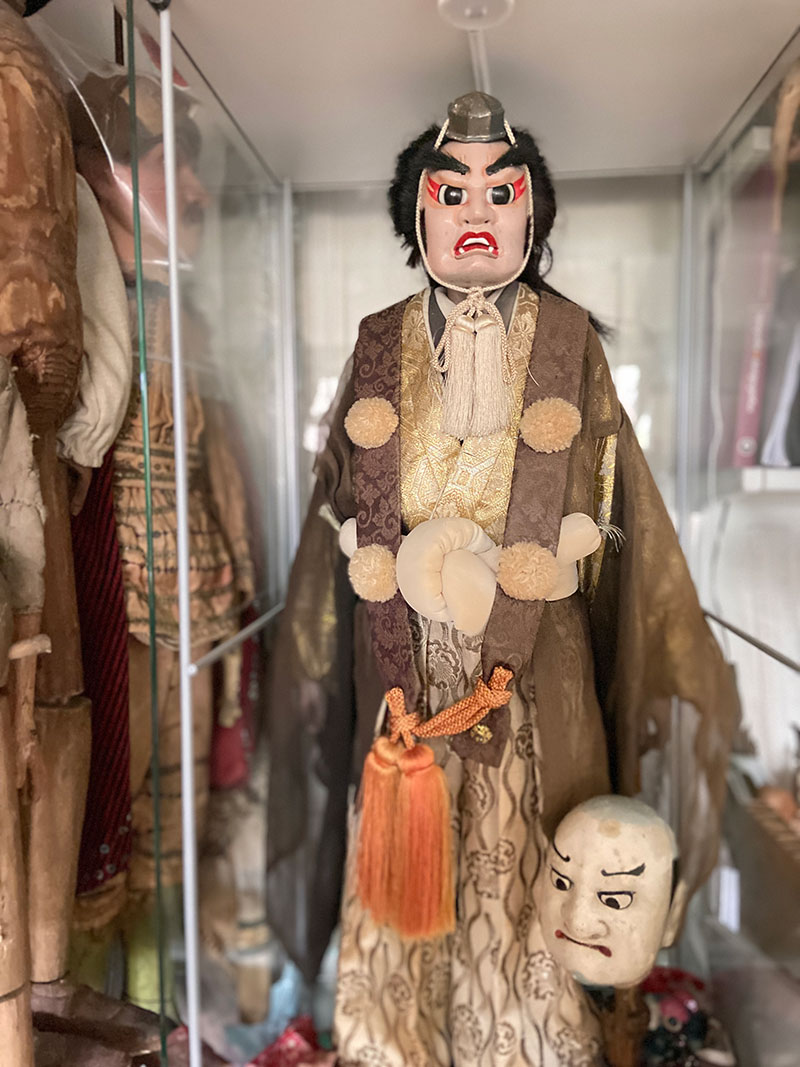
Marcus: Just in the beginning of 2020, I had the amazing opportunity to purchase a full body Japanese Bunraku puppet. I never thought I would be able to have such a treasure in my hands one day, but it happened! He is pictured here on the left. Most puppeteers cherish this highly respected form of puppetry that dates as far back as the 16th century in Japan. And when it comes to Steiff, I would love to add some of the rare and beautiful pre-war puppets that I’m still missing. An old Steiff Teddy Bear Puppet would be a dream come true!


Steiffgal: Thank you so much for sharing your knowledge and insights with the Steiff collecting community today! 

For more information on Marcus and his puppet passion, check out his website at https://onceuponapuppet.com.

Have a question about one of your Steiff treasures? Let's talk! Click here to learn more.

Sunday, September 6, 2020

This Tiny Steiff Prewar Bully On Wheels Is One Happy Handful Indeed!

What can be tiny and larger than life at the same time? Steiff's utterly charming, miniature sized pets on wheels from the 1920s! Check out this teeny tiny Bully dog on the go. His proportions, presentation, and personality are simply perfect!


This happy handful is the wheel deal indeed. Bully is standing, 10 cm tall, and head jointed. His body is made from black and tan mohair. His face has a velvet inset muzzle. It comes to life with oversized black and brown glass pupil eyes, a black hand embroidered nose, a few airbrushed freckles and highlights, and dimensional jewels. His factory original accessories include his all original horsehair collar and little brass bell. Some came with this horsehair style collar while others had a studded leather collar. Bully is connected to a metal chassis and rides upon four red wooden eccentric wheels. He retains his long trailing "F" button as his Steiff ID. This adorable rarity was produced in 10, 14, 17, and 22 cm from 1927-1935 overall.

One feature that makes this Bully dog design so timeless, and eternally appealing, is that it scales up or down in size so well. This tiny version really does look like an impish pup, ready to get into marvelous mischief. Larger sized Bully dogs take on a more adult personality and presentation. Admit it, you are having a hard time not falling in love with this petite pooch!


It is also interesting to note that this Bully on eccentric wheels novelty was introduced in 1927 - the same year as his general debut. Usually, form and variation items - like versions on wheels, with music boxes, as puppets, and pincushions, for example - come out a year or two after a new design is launched. Clearly, Steiff knew they had a winner on their hands with this beautiful Bull dog, and wasted no time in presenting numerous novelty temptations based on his core pattern. And the numbers rang true - over 250,000 Bully dogs were produced and sold within five years of his introduction.

Steiff's page from their 1929 catalog features a charming illustration featuring a number of Bully dogs - including the one under discussion here today. This image can be seen here on the left, and the photo is from Carsten Esser's Steiff Kataloge 1920-1929. You can click on it to make it bigger. The copy on the page roughly translates to... "The character Bully dog has found many admirers in both children and adults." The model was designed as a toy - for children - but also as a companion and collectible for adults. He did a great job in both roles. The catalog page notes Bully as a standing model, on eccentric wheels, as a riding toy, in velvet and a variety of mohair color combinations, as a long limbed car or boudoir doll, as a puppet, as a purse, as a pincushion, and as a musical dog, among others. 

Steiffgal hopes that size defies when it comes to this discussion on this itty bitty buddy. 


Have a question about one of your Steiff treasures? Let's talk! Click here to learn more. 

Sunday, July 19, 2020

And They Call It Puppy Love!

Steiffgal is in seventh heaven! And why is that? Because she's just welcomed this teeny-tiny and completely irresistible 7 cm pup into her collection! Come take a look at this petite pooch and see what makes him so hugely interesting from the scale and design perspectives.

This bitty baby is, of course, an example of Steiff's prewar Bully the Bulldog design. He is sitting, made from black and tan velvet, and unjointed. His adorable face comes to life with an inset muzzle, dimensional jowls, black and brown glass pupil eyes, a hand stitched black nose, and a touch of black and pink airbrushed highlighting. Even though he is only 7 cm tall, he still has a delightful and realistic form, including defined haunches, a pert tail, and a muscular build. He retains his original bell, as well as his metal rimmed chest tag, long trailing "f" button, and traces of his red ear tag as his Steiff IDs. 

Sitting black and white velvet Bully dogs were produced in 4 sizes ranging from 7 to 17 cm from 1927 through 1939 overall. They also appeared in blue and white velvet and orange and white velvet in that timeframe as well. Given his ID configuration, it is Steiffgal's best guess that this example was manufactured at the very beginning of this production timeline.

Hold your horses! This happy handful retains his important early 20th century accessory - his original and traditional horsehair collar. It is made from long, thin strips of tan fabric which are doubled over width-wise; the horsehair fibers are sewn in between the faces of the material. The collar is held together with a little knot under Bully's chin. The horsehair collar was a typical accessory of the 1920s and indicated a "regal" nature of the item wearing it. 

And what a difference a little more than an inch makes! The smallest black and white velvet Bully dogs were produced in 7 and 10 cm. There are several subtle design modifications between the two, most likely because of manufacturing realities and ease. Smaller items can be tricky to cut out, sew, and turn the fabrics right side out, given their scale. As such, it is not uncommon to see the smallest versions of some of Steiff's beloved legacy designs with light simplifications from their larger brothers and sisters. In this particular case, they include:

  • Jointing. The 7 cm Bully is unjointed while the 10 cm Bully is head jointed.
  • Materials. The 7 cm Bully has a felt muzzle while the 10 cm Bully is entirely made from velvet.
  • Coloration. The 7 cm Bully has an all tan velvet body, while the 10 cm Bully has a tan velvet body with a black velvet inset rear end and tail. 
Steiffgal hopes this discussion on this baby Bully has generated a whole bunch of puppy love for you. 

Have a question about one of your Steiff treasures? Let's talk! Click here to learn more. 

Wednesday, January 30, 2019

And The Blue Ribbon For The Most Unusual Steiff Bully the Bulldog Goes To...

Are you looking for blues clues about a most unusual Steiff treasure? Then check out this fabulous - and fabulously rare - example of Steiff's beloved prewar Bully the Bulldog. There's no doubt he'd be top dog in anyone's Steiff canine kennel!

The sky's the limit with this outstanding blue and white Bully. He's sitting, head jointed, and made from velvet. His blue has oxidized to more of a green color since his "birthday" nine decades ago. You see this often with vintage materials and dye colors. (Check out where the sun doesn't shine - like armpits and crotches - to find areas untouched by time.) Like the Bully dogs of his era, he has large, metal lined, and poseable ears and patched construction. His face comes to life with oversized black and brown glass pupil eyes, a hand embroidered nose, a few freckles, and an elaborately constructed and very detailed muzzle. Blue Bully retains his original horsehair collar and bell, as well as his long trailing "f" button as his ID. This bouncing bundle of joy was produced in 7, 10, 14, and 17 cm from 1927 through 1934 - and is only the second blue Bully Steiffgal has ever seen!

It is interesting to note that in the late 1920s through early 1930s, Steiff produced a number of animal and novelty patterns in fun, "jellybean" hues - both in mohair and velvet. These included rabbits, bears, dogs, pincushions, and other favorites. It is Steiffgal's best guess that these colorful critters were designed to match the mood and aesthetic of the "roaring 20s" and were produced not only as toys for children but as gifts and collectibles for adults. 

Small, unusually hued, prewar Steiff rarities with IDs and accessories like this only surface once in a blue moon - and always generate lots of dollars, and interest, at auction. For example, in 2016, an 8 cm version generated 12 bids and hammered at €2,400 (roughly $2,800) on its €330 - €660 (roughly $376 - $750) estimate. And why is that? Like most marketplace or economic situations, it has to do with supply and demand. For example, consider....

  • Petitely proportioned items are/were often a child's "best friend" and as such, were loved to death as playthings, or lost to time. So there are not alot of them in general still around. 
  • These small treasures span several collecting categories, including general antiques, Christmas items, dollhouse items, dolls, and Steiff. So many people are interested in them. 
  • They don't take up too much space in a collection.  So they are very desirable from the collection management and logistics perspectives, especially amongst more "seasoned" collectors. 
  • And they are simply just plain wonderful. Collectors seldom if ever tire of them, and very rarely sell them unless they absolutely have to.
Steiffgal hopes you've enjoyed learning about this blue ribbon beauty.

Have a question about one of your Steiff treasures? Let's talk! Click here to learn more.

Sunday, October 21, 2018

All Treats and No Tricks With These Tiny Orange Steiff Treasures

When you were a kid, what was your favorite Halloween score? For Steiffgal, it was Reese's Peanut Butter Cups. How times have changed! Today, a REAL hair-raising treat would be a palm sized Steiff goodie in a Halloween pail, wouldn't you agree? So, to celebrate this spooky season in a more grownup fashion, here are a few orange hued "snack sized" treats to satisfy your Steiff sweet tooth. (Please click on any photo to enlarge it for viewing and study.) 

It's hard to outfox this teeny tiny Steiff woolen miniature Pitty fox. He is sitting, measures 5 cm, and is made from orange and white woolen threads. His face comes to life with an itty-bitty black bead nose and eyes and felt ears. Steiff's woolen miniatures are often head jointed, but Steiffgal is not sure if this is the case here as he remains in his original cardboard and plastic packaging. Steiff created a series of ten Pitty woolen miniature animals in the 1977 through 1981 time frame; all were distributed in similar bubble style packaging. It is Steiffgal's best guess is that this is the case so they could be merchandised and sold off of a standard counter rack.

Steiffgal's also nuts over this woolen miniature squirrel. She is also from the "Pitty" line. She is begging, measures 5 cm, and is made from orange woolen threads. She has a peach colored base and hands, orange felt ears, and a black button nose and eyes. Like Pitty fox, it is not clear if she is head jointed or not. On the back of her cardboard packaging, she has a white paper price tag from Saks Fifth Avenue. It notes that she costs $5. Adjusted for inflation, $5.00 in 1980 is equal to $16.07 in 2018. Pitty squirrel certainly packs alot of personality into a very small presentation!

This next happy handful is a late 1920s-era Steiff Charly King Charles Spaniel dog. He has distinctive orange mohair highlights on his ears, backside, and tail. Most of Steiff's Charly dogs were produced with brown mohair highlights, so this one is a little more unusual. Charly is sitting and head jointed. He has extremely long fuzzy ears; large, childlike brown and black-pupil eyes; a very detailed facial seam structure; and a prominent tail. Steiff made this Charly pattern both sitting (10, 14, 17, 22, 25, 30, and 35 cm) and standing (7, 10, 12, 14, 17, 22, 25, and 36 cm) through 1939.

Charly likes to troop the colors with this similarly hued Bully the Bulldog. This white and orange mohair pup is 10 cm, sitting, head jointed, and made from orange and white mohair. Orange and white Bully dogs are a little rarer than black and white Bully dogs as they were in the line for fewer years. Bully's face and muzzle area are tan velvet. He has very large brown and black glass pupil eyes and a black, hand-embroidered nose. Most remarkably, Bully retains his original and traditional horsehair collar. This is made from a long, thin strip of material which is doubled over width-wise; the horsehair fibers are sewn in between the faces of the material. The horsehair collar was a typical pre-war accessory and indicated a "regal" nature of the item wearing it. Bully was made in velvet and mohair, as well as sitting and standing, in sizes ranging from 10 to 50 cm in the 1927 through 1937 time frame overall. 

And this discussion would be unbearable without a cub representative in the mix. Here we have a 6 cm Teddy Baby Replica 1930. He is technically cataloged as "maize" in color to reflect his corn colored hue. This tiny Ted is fully jointed and has all the traditional Teddy Baby characteristics - including downturned wrists, flat feet made for standing, and a charming, youthful face - albeit on a super small scale. Maize Teddy Baby appeared in the line from 1998 through 2001.

Steiffgal hopes you found this discussion of tiny orange treasures all treats and no tricks. 


Have a question about one of your Steiff treasures? Let's talk! Click here to learn more!

Saturday, February 10, 2018

Getting All Ruffed Up Over This Steiff Studio English Bulldog


Dog-gonnit! It's safe to say you're barking up the wrong tree if you feel you've seen everything ever made by Steiff! A reader shared this supersized, smiling rarity and asked about his background and history. Jennifer writes,

"I have been unable to find this piece (except for smaller versions.) He is 36" long and 24" tall. He's got wooden eyes and teeth, appears to be hand painted, and has scrunched up mohair wrinkles on his face. Thank you in advance for any insights!"


As Jennifer suggests, this proper gentleman appears to be a larger-than-life version of Steiff's English Bulldog. Many collectors are familiar with the "pint" sized version of this very desirable Steiff canine, pictured here on the left. Steiff's standard line English Bulldog is 18 cm, standing, and head jointed. He is made from tan mohair that has been hand detailed with multicolored airbrushed "spots" over his body and tail end. His face is also painted with "wrinkles" on his forehead. He has black and white googly eyes, a black stitched nose, and outstanding mouth-area "jowls", much like a real bulldog. He has an open, peach colored felt mouth with two lower pointy canine teeth. He left the factory in Giengen donning a red leather collar and a horsehair ruff. He was made from 1956 through 1961 as a US exclusive, appearing on the shelves of high-end retailers such as F.A.O. Schwarz.

It is no bull that Steiff's US exclusive English Bulldog was based on the company's post war, standard line Bully Bulldog. This dog, pictured here on the left, was produced in 10, 17 and 22 cm from 1951 through 1974. The company's English Bulldog has the same basic body as the standard line Bully, but sports a far more elaborate head. It was not uncommon for Steiff to make design tweaks to its standard line, postwar dogs and present them as exclusives to F.A.O. Schwarz. Among others, Steiff produced a standing Dally Dalmatian (the standard line version was sitting) and an open mouthed Biggie Beagle (the standard line version had a closed mouth) as specials for this high end retailer.

Now let's try and figure out big Bully's age in dog years. Shortly after the conclusion of World War II, the company was determined to regain its prewar status as a premier, global toy maker. One arm of this strategy was to produce a number of very interesting (but not cataloged) "over the top" display pieces for trade fairs - including a lifesized, "begging" zebra Steiffgal has recently learned of. It is possible that Jennifer's large English Bulldog was produced during the very early 1950's as part of Steiff's "let's wow them!" production emphasis. If that was the case, it is likely that Jennifer's English Bulldog has, or had, a linen US Zone tag sewn into his leg seam like other items produced in the c. 1948-1952 time frame. 

It is also possible that Jennifer's model was made in the 1960's - often considered Steiff's "blue ribbon" period of display animal production. Given the standard sized, 18 cm version was available from 1956 through 1961, it would not be out of the question that this display version was made at the "tail end" of that timeline. From around 1960 through 1967, the company produced dozens and dozens of different types of lifesized animals, often in different sizes and positions. For example, Steiff's 1967 Display Animal Catalog has almost 80 individual pages of these marvels, including five "kingsized" canines! Like big Bully, several of these 1960's era patterns had prominent hand painted eyes (like the Basset Hounds) or open, felt lined mouths with wooden teeth (like the the lions and tigers). Many of are simply hugely scaled up versions of the smaller pieces many of us have in our collections. Others, like the display open mouthed Snobby Poodle pictured here on the left, look quite different than the closed mouthed, standing Snobby we all know and love. 

So let's paws and consider all of this and what we can fetch from it. First, given the facts surrounding this uber-dog's design and historical context, it is Steiffgal's best guess that Jennifer's Bulldog was made sometime in the very early 1950's through the mid-1960's. Second, i
t is clear from its elaborate design, detailing, and features that big Bully was extremely labor and time intensive to produce (read: EXPENSIVE and COMPLICATED), reducing its manufacturing appeal and business/sales potential.  And third, Steiffgal also knows of one other example of this pattern, located in Connecticut. So this Big Bulldog is not a one of a kind, but probably one of a handful produced at the time.  And that's about all that Steiffgal can dig up on this top dog. 

Steiffgal hopes you enjoyed sinking your teeth into this great Bulldog mystery.

Have a question about one of your Steiff treasures? Let's talk! Click here to learn more.

Saturday, May 27, 2017

This Orange Tipped Bully The Bulldog Hand Puppet Is On Fire!

You gotta hand it to Steiff - their early character puppets are simply marvelous! Often based on their most popular patterns of the time, favorite pre-war models include Molly the Puppy, Teddy baby, and Treff the Bloodhound. Recently, Steiffgal got to meet another top dog from this rare category - a Bully the Bulldog puppet! Check out this happy handful and see what makes this puppet so special from the design and collector's perspectives.

This Bully is on fire - really! His body and arms are made from white mohair, his ears are made from vibrant flame-orange tipped mohair, and his muzzle is made from tan velvet. Bully stands 17 cm tall. His head and the tips of his arms are stuffed with excelsior. He has three black hand embroidered claws on each of his padless paws. Bully's pouty face comes to life with oversized black and brown glass pupil eyes, a black hand embroidered nose, freckles, and brown airbrushed highlights. His ears are lined in wire and are posable; this is a great feature also seen on other playful patterns of his era including Petsy the Baby Bear.  Bully puppet wears his original decorative horsehair collar and bell and retains his long trailing "f" button and traces of his white ear tag as his Steiff IDs. This hand puppet was made in 17 or 18 cm in orange and white or brown and white from 1927 to 1935 overall; he was also produced with a hand-activated voice for a few years as well. 

So just how old is this example, in either dog or people years? Given this Bully had/has a white ear tag, which technically appeared through 1926, it is quite possible that he was manufactured at the beginning of his production timeline, in early 1927.  As such, he was most likely branded with a leftover white ear tag on hand instead of the company's newer red version.  These red ear tags were introduced in 1927.  How can you resist this face??

This pattern has a most colorful history. Steiff introduced Bully to the world in 1927 and he was an instant sensation with both children (as a plaything) and adults (as a collectible and an accessory). He was modeled on the French Bulldog—the “it” companion of those in the know all across Europe at the time. These top dogs were produced in a number of color combinations, including black and white, orange and white, and brown and white.  A rare blue-and-white version was also manufactured, and Steiffgal has even seen a photo of a red and white one! This was probably a prototype and never put into production. Full bodied versions are usually seen in sitting or standing positions, in sizes ranging from 10 to 50 centimeters. This original Bully pattern was produced overall through 1939.  


Like many of Steiff's most beloved patterns, Bully the Bulldog was also produced in a number of theme and variation items and novelties.  These included a pincushion, music box, dog-doll, nightdress bag, wheeled and riding versions, and this puppet example, among other product line extensions. Most Bullies came detailed with a horsehair ruff or a button-studded leather collar.  It is extra-special to find a Bully with his horsehair collar intact, as these are quite ephemeral and tend to break or fall off over time. Today, this precious prewar pooch pattern is one of the most universally desirable and sought-after pre-war Steiff designs among collectors. He has been replicated numerous times over the past few decades and even these newer models are coveted by collectors.  The photo on the left is from a 1929 catalog and pictures a number of Steiff's beloved character puppets including an orange and white Bully; this illustration is from Carsten Esser's fabulous new book, Steiff Kataloge 1920-1929. Just click on the image to make it larger.  

Steiffgal hopes that you'll give a thumbs up to this interesting hand puppet discussion!

Have a question about one of your Steiff treasures? Let's talk! Click here to learn more.

Saturday, May 13, 2017

This Tiny Steiff Bully Dog Has Enormous Wheel-Appeal!


Don't you just love it when you come across a Steiff treasure that you didn't realize even existed? That's the case with this week's fine find, a tiny and early post war Bully Bulldog on wheels. Steiffgal found him hiding amongst a delightful collection of vintage playthings at a booth at a regional doll and antique toy show in the New England area. Come take a look at this petite treat and see what makes him so dog-gone charming from the collector's perspective. 

This diminutive doggie has enormous wheel-appeal. Bully on wheels is based upon Steiff's smallest standard line postwar Bulldog pattern. He is 10 cm, standing, made from tan mohair, and is head jointed. His head, body, and tail are gloriously hand-painted with delightful brown and black spots and striping. He has brown and black pupil eyes, a black hand embroidered nose, felt ears, and an elaborately and realistically constructed velvet muzzle. His airbrushed claws are black. Bully retains his original red collar and raised script style Steiff button as his ID. Steiff's overall Bully Bulldog pattern was produced in 10, 17, and 22 cm from 1951 through 1974; Bully on wheels was produced in 10 cm only from 1954 through 1957 and then again in 1960.

Rolling along, now let's take a look at Bully's dynamic details. Bully glides along on four red off-center wooden eccentric wheels.  The wheels are connected with two silver metal rods - one in the front and one in the back. This wheel configuration gives Bully the appearance of bobbing up and down as he is pulled along. Each of his four feet is connected to the rods with tan thread stitching. There are little grooves in the rods that secure the stitching in place. Bully had a matching pull string attached to his front rod when he left the factory in Giengen, Germany; this unfortunately has been lost to time.  

Steiff has a long and lovely history of putting their most popular animal patterns on wheels. The earliest rolling Steiff treasures were on metal wheels; by the nineteen-teens to early 1920's most if not all examples had wooden wheels. Wooden wheels were sometimes left natural in color, other times they were brightly painted in bright, primary hues including red, green, and blue. 


Strangely, Steiff's "eccentric wheel" detailing debuted in 1912. Steiff even holds a patent for this unusual wheel and axle configuration! Eccentric wheels were "invented" accidentally, but Steiff quickly realized the opportunity created by their roller drilling mistakes. Steiff's dogs, cats, birds, and farm animals look particularly charming on eccentric wheels, given the way they waddle and jiggle in real life! The photo on the left shows two of Bully's eccentric wheeled 10 cm "canine colleagues" from his same general timeframe. Bazi the Dachshund (on red wheels) was made in 10 and 14 cm from 1950 to 1961 overall and Cockie the Cocker Spaniel (on blue wheels) was made in 10 cm from 1954 through 1957 and then again in 1960.

Steiffgal hopes this discussion on this unusual Steiff Bully on wheels has been enjoyable to you, even in a roundabout sort of way.  

Have a question about one of your Steiff treasures? Let's talk! Click here to learn more. 
The teddy bear search engine