Showing posts with label ephemera. Show all posts

Saturday, December 9, 2023

Flying High With This Amazing Steiff Marketing Postcard From 1928

Can you hold history in your hand? This blog has recently discussed a number of examples of antique Steiff ephemera, including photos and calling cards. Now let's take a look at an extraordinary postcard that sold recently on eBay. Its image, subject matter, transport logistics, destination, and detailing were simply off the chart interesting. Check out this tiny time capsule from 1928 and see what makes it so fascinating from the design and historical perspectives.


WARNING - A LONG (BUT SUPER INTERESTING) READ AHEAD!


The front of this standard size postcard should be captioned "The Best of 1928!"
Pictured is a charming vignette of Steiff toys enjoying a fun outing together. Steiff has a rich history of creating marketing materials that bring their items to life through clever placement, body positions, and facial expressions. This is a perfect example of that. As for the featured items, the wooden cart and pony on wheels is the company's "Sandkar" or horse drawn wagon which was produced in four sizes from 1921-1936. The puppy is Steiff's sitting Molly, who was produced in 12 sizes ranging from 7 to 80 cm from 1925-1943 overall. The blonde Ted was made in 14 sizes ranging from 10 to 115 cm from 1905-1933 overall. And the bird is Steiff's duck; he was produced in 14, 17, and 22 cm from 1925-1932. One of each, please! You can see the front of the card pictured above, the image is from eBay. You can click on it to make it bigger. 

The back of the card is an astonishing collection of historical facts, highlights, and period information
. Many of the card's details have to do with the card's delivery source, the Graf Zeppelin. This airship, the pride and joy of the German aviation community, debuted in 1928 - the year of this postcard! The Graf Zeppelin, also known as LZ 127, was in service for nine years. During that period, it made 590 flights, including 144 ocean crossings. You can see the Graf Zeppelin here on the left, the image is from www.upi.com.

Here are a few highlight and hidden "gems" tucked within the back copy of this card. The back is pictured below, the image is from eBay. You can click on it to make it bigger. 


First, starting on the upper left corner, you can see two dates in pencil.
They correspond to the date that the card was mailed in Germany and the date that it arrived in the USA. It left Germany on October 10th, 1928 and arrived in the USA on October 16th, 1928 - for a travel time of 6 days. Pretty amazing - even for today, given today international mail often takes weeks to go "across the pond." 

Next, check out the copy on the left hand side of the card. "Place your orders with Fred Wander early to insure Zeppelin deliveries next years. Many novelties will be on display at our old stand. Margarete Steiff & Co. Inc. Borgfeldt Building, 115-119 East 16th Street, New York." Among other things, this tells us the name of Steiff's rep in the USA through the Borgfeldt company nearly a century ago, and the address of that distributor. Even more interesting here is that the card hints that all Steiff deliveries to the USA will be shipped via Zeppelin aircraft!

Now move to the middle of the card. The information that appears there tells us a lot about how the card was transported, and the obvious and international pride the German postal service and aviation authorities had in their Zeppelin program. The orange stamp in the middle of the card translates to: Mit Luftpost (airmail in German) and Par Avion (by plane in French). Right under that, there is a block of copy which translates roughly to: "To the post office in Friedrichshafen (a German town) to be sent via the airship Graf Zeppelin LZ 127 from Friendrichshafen (where there was an airport to handle Zeppelin aircraft.)" And right under that is a blue oval stamp with the translated words "Transported with airship LZ 127". So we can be 99.99% certain that this exact card traveled on the world famous LZ 127 Graf Zeppelin.

The blue and white postage stamp on the upper right hand corner of the card is also revealing. This idealized image pictures the Zeppelin gliding effortlessly and peacefully over the Earth - high enough to see the curve of the planet. The words on the stamp read "America, German Airmail, Europe, and 2 Reichmark". According the Historical Dollar-to-Marks Currency Conversion Page, in 1928, 1 RM was equal to about $4.19, so this stamp cost about $8.38 at the time. This little stamp gives off big vibes that this early airmail program was big, bold, ambitious... and expensive!


And lastly, the recipients! This card was sent to the toy buyers at Gimbel Brother department store in Milwaukee, WI. This legacy store brand and chain would go on to become one of largest and most beloved retailers in the United States, eventually operating over 50 storefronts. Gimbel's started the original Thanksgiving Day parade tradition in 1920. Its chief rival was Macy's - who would debut their version of a turkey day celebration parade in 1924. It is no surprise that Steiff would be doing business with Gimbels (or trying to!). This city block long institution with a river front facade certainly had a toy department and attracted high end customers that would be interested in the Steiff brand. You can see Gimbel's in Milwaukee here on the left in the late 1920's. The photo is from www.thedepartmentstoremuseum.org. 

Steiffgal hopes this discussion on this fascinating Steiff postcard has been the trip of a lifetime!


Have a question about one of your Steiff treasures? Let's talk! Click here to learn more.

Sunday, November 21, 2021

Good Things Come In Threes At Teddy Dorado's December 4th, 2021 Sales Event!

Care to go for the gold? Then check out the upcoming Steiff auction presented by our friends at Teddy Dorado auction house! Their signature winter sale, to be held on December 4th, 2021, features more than 400 new, vintage, and antique button-in-ear temptations - with new goodies being listed regularly. Here are three outstanding lots that caught Steiffgal's eye - and why. 

The first lot is a sweet-tweet-treat indeed.
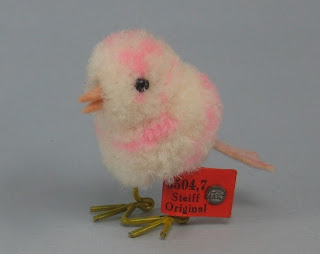
Steiff's earliest prewar woolen miniatures are loved and collected universally - with the rarest ones frequently realizing four figures at auction. Its hard to resist lot #28-4023, which is cataloged as, "Songbird made of white & pink Nomotta wool; black glass eyes; Beak made of skin-colored felt; white felt tail with pink stripes on both sides; Metal legs painted yellow & in perfect condition; Head rotatable & body tillable; approx. 4 mm large FF button slightly rusted, but not visible to the naked eye; red Steiff flag preserved in the best possible way; very clean, absolutely lightfast, odorless & completely unplayed; Premium top condition. approx. 4 cm high." 

This pretty-in-pink treasure has an opening bid of 1,000 Euro.

Bird's the word with this lovely treasure which is fantastic on so many levels. It is amongst the absolute earliest woolen miniatures ever made. This sweet bird design debuted in 1931, the first year Steiff's woolen miniatures were produced on a commercial scale. It was manufactured in six color combinations in 4 or 8 cm. Don't you think his color - pink - is WAH-HOO good? This example is the only Steiff woolen miniature prewar bird that Steiffgal knowns of featuring this great and novel hue. And the condition looks to be as close to like-new as humanly possible. 

You'll be all ears over this next auction highlight.
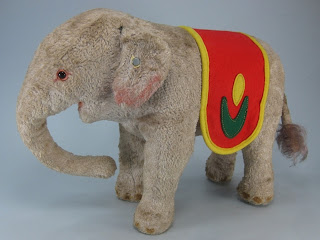
His expression, era, and materials are all so ele-phantastic. He is lot #28-4021, and is cataloged as, "Play elephant, made of light gray rayon plush; black glass eyes underlaid with pink felt; open mouth made of skin-colored felt; Tail tip made of mohair; tightly stuffed with wood wool; large double pressure voice defective; Saddle pad made of red, yellow & dark green felt; approx. 6 mm large, bright silver, shiny & shiny button in the ear; white paper ear tag missing; Artificial silk plush & felt without annoying flaws; very clean, absolutely lightfast, odorless & unplayed; Top condition approx. 21 cm high & without tail approx. 27 cm long." 

This playful pachyderm has an opening bid of 200 Euro. 

It's interesting to note that this distinctive elephant's "birthdate" is not specified. This great design bridged the pre- and postwar periods. It was produced in artificial silk plush in 17, 22, and 28 cm from 1938 through 1943 overall, and postwar in 22 cm only in 1948 though 1949. Given this big baby has a blank button and traces of his yellow ear tag, it is a safe bet that he is a postwar version. He's unforgettable for sure, don't you agree?

And good things come in threes with this final auction highlight.
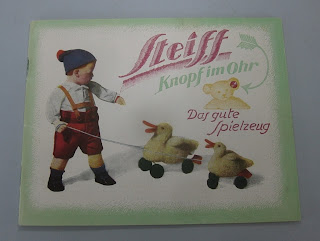
Steiff ephemera - catalogs, photographs, sales sheets, postcards, and other paper items associated with the company - is a fun, educational, and visually exciting complement to a button-in-ear collection of any era. If you are interested in the company's 1920s era production and aesthetic, be sure to check out lot #28-4003, which is cataloged as, "Customer brochure "The good toy" A6 +, 36 pp. 1925–1926 without Steiff printed matter no. German Premium Steiff customer brochure "The good toy" for Germany in the format approx. A6 plus landscape with 36 pages; inside black and white with a light green border; Text in German & without prices; Title shows Schlopsnies doll Theo with two yellow mohair (pulling) ducks, each lying on eccentric wheels; without printer's note or Steiff printed matter no .; original Steiff brochure & no reprint; very clean, absolutely lightfast, odorless & completely unread; Premium top condition." 

This time capsule quality brochure has an opening bid of 100 Euro. 

It's hard to picture a more interesting collection of images than those that appear in this great catalog. It features illustrations of the company's very rare mid-1920s white chimp with a tail, little known wooden toys on wheels, and charming, lifelike, and toddler-esque Schlopsnies dolls, among many other outstanding characters. And what makes these visuals so heartwarming is that they show our favorite button-in-ear favorites in playful and interactive vignettes... as if they were truly alive! Flipping through this period catalog is like taking a trip back in time, in the best possible way.

Steiffgal hopes this discussion on some of Teddy Dorado's upcoming sale highlights has been almost exciting as a live auction event!  Check out the entire catalog for this December 4th sale by clicking here. 

Have a question about one of your Steiff treasures? Let's talk! Click here to learn more.

Sunday, May 9, 2021

A Penny For Your Thoughts About This Antique Steiff And Kufeke Promotional Postcard

It's always fun to spot vintage Steiff featured in antique advertising, photographs, or other ephemera. While recently browsing eBay listings, Steiffgal found a most adorable prewar mailer featuring one of our all-time favorite Steiff prewar superstars - Bully the Bulldog! Take a look at this period piece - does it motivate you to buy the product on offer?

There's no need to mail it in when it comes to this precious postcard. What we have here is a direct mailer piece for Kufeke, a German company that produced special dietary drinks and supplements for babies and adults with delicate digestive issues. Steiffgal suspects it is from the late 1920s or early 1930s, given the image, its subject matter, and the history of the Kufeke company. There is no date or postage cancellation anywhere on the piece that Steiffgal can positively identify. 

The front of the card features a black and white image of a sitting, glowing, chubby toddler and a Steiff Bully dog. The way the child is leaning towards the dog, along with his body language, makes you feel that he is actually chatting with Bully. The pup is sitting, head tilted, and listening intently. You can make out his dark horsehair collar and bell detailing. The Bully pictured is probably the black and white version, and most likely measures 35 or 43 cm, given the scale of everything in the photo. The postcard's caption translates to, "Do you drink Kufeke, too?"... suggesting that this baby beverage gives both the Bully and the Baby their robust and healthy appearances and charming good looks! Other prewar advertising pieces from Kufeke also feature beaming, healthy children but this is the only one that Steiffgal was able to find that also included a button-in-ear friend. 

Bully the Bulldog is a legacy design for Steiff.
He was introduced in 1927 and was an instant sensation with both children (as a plaything) and adults (as a collectible and an accessory). He was modeled on the French Bulldog—the “it” companion of those in the know all across Europe at the time. Bullies were head jointed, had large brown and black glass pupil eyes, a hand-embroidered black nose, and a simple snout and jaw constructed to give him his requisite jowls. Most were black and white or orange and white, but a rare blue-and-white version was also produced. Bully was made in velvet and mohair, as well as sitting and standing, in sizes ranging from 10 to 50 cm. Most Bullies came detailed with a horsehair ruff or leather collar. The original Bully appeared in the Steiff catalog through 1939; today, this precious pooch is one of the most universally desirable and sought-after pre-war Steiff designs among collectors. The picture on the left is a Bully from Steiffgal's personal collection. 

On the flip side, the back of this postcard mailer also is interesting for what it highlights.
Boldly noted on the reverse are the words, "das Beste fur ihr kind." This translates to “the best for your child,” meaning that the Kufeke company believed that its product was the premier dietary supplement for children. This, of course, is remarkably similar to the Steiff tagline of “only the best for children.” Steiffgal wonders if Kufeke was trying to piggyback on Steiff's outstanding, world class reputation in words (with this marketing claim) and in images (by featuring Bully in this photo) in this business development effort. It would be interesting to know if folks at Steiff were aware of this postcard and promotional outreach at the time, and if the company received any compensation for this "association." If we could only turn back time to answer such questions!

Steiffgal hopes this discussion on Steiff prewar product placement has been picture perfect for you.

Have a question about one of your Steiff treasures? Let's talk! Click here to learn more!

Monday, April 9, 2018

This Rare Steiff 50th Anniversary Booklet Is Worth Its Weight In Gold!

It's easy to celebrate all things Steiff! Steiff introduced the world to its fully jointed Teddy bears in 1903. In honor of the golden anniversary of this accomplishment in 1953, the company designed and produced an entirely new and novel Teddy bear design. It was named Jackie and she was made in 17, 25, 35, and 75 cm from 1953-55 only.

Collectors could bearly get enough of Jackie. For many reasons - including her charming appeal, airbrushed belly button, pink-highlighted nose, and short time in the line - Jackie remains one of the most beloved Steiff bear designs of all times. Accompanying Jackie was a small celebration booklet, which told the history of the company in words and pictures. To find a mid century Jackie bear in very good condition with IDs is a dream come true for many collectors; to find one with this original booklet is practically unheard of!

But sometimes wishes do come true, at least in part. Steiffgal recently had the pleasure of finding one of these original Jackie booklets for sale, and was delighted to add it to her Steiff ephemera collection. The piece itself is very small - measuring 10.5 cm x 7.5 cm closed, or 10.5 cm x 15 cm opened up.  There are 14 total printed pages, and all words are in German. The booklet is bound by one staple. It is printed on paper which has most likely mellowed to a tan color over time. Let's take a peek into this time capsule and see what secrets it might hold about the company we all know and love. 

You can click on any of the pictures of the spreads to make them bigger on your screen!

Here is the front and back spread of the booklet. As you can see, the cover features the delightful Jackie bear, complete with her special anniversary chest tag. It is interesting to note that she is pictured without her Steiff button or ear tag. The front reads, "a small teddy travels in the wide world," probably in reference to Steiff's humble beginnings which progressed to international standing and recognition. The back very roughly translates to, "This is the story of the Teddy bear with the button in ear by Margarete Steiff GmbH."

Featured on pages 2 and 3 of the booklet are two iconic Steiff images.  The first is of company founder, Margarete Steiff.  The other is of the two very distinctive church steeples which are the prominent features on the Giengen horizon - even today. The headline of the spread reads, "The history of the Teddy bear." 

Pages 4 and 5 are graced with the headlines, "At the beginning was a small felt elephant" and "Richard Steiff, the inventor of the teddy bear." The illustrations include a small grey felt elephant, which was Margarete's first "toy," a picture of her in her wheelchair hand sewing something, and a handsome headshot of Richard Steiff. Richard, Margarete's nephew, came up with the idea of the fully jointed Teddy bear after studying how real bears move and interact at a local zoo.  

The next pages - 6 and 7 - are dedicated to 1903, the year Steiff Teddy bears really went global. The headlines roughly translate to, "In New York from 1903 onward" and "The Leipzig Fair debut in 1903." The page is illustrated with a skyline of New York City, an early and very fuzzy Steiff Teddy, and a man hammering shut a wooden crate, presumably filled with Steiff Teddy bears heading to the USA. This page most likely references how 3,000 early Steiff bears were ordered by an American distributor (The George Borgfeld Company of NYC) at the 1903 Leipzig Fair. The whereabouts of those Teds have been lost to time. This mystery is still ongoing today.  

Pages 8 and 9 are all words. Given the headline, which translates to "Theodore (Teddy) Roosevelt gave him his name," these key passages probably explain why Steiff's Teddy bears from Germany were branded after the famous American President. Roosevelt refused to shoot a baby bear cub on on a hunting adventure in Mississippi at the turn of last century.

Next up on pages 10 and 11 are a charming series of illustrations featuring Steiff's "Nimrod" bears. Like Jackie, the Nimrod bears were produced in honor of the 50th anniversary of the Teddy bear. They appeared in the line in 1953 and 1954 in 22 and 50 cm. Four versions were made in a variety of hunting themed outfits. These "outdoorsmen" bears are a gentle nod back to President Roosevelt - who was instrumental in his own way in helping Steiff grow and thrive in the early 1900's. 

The headline on page 11 translates to "The Steiff factory is built entirely of glass" and is referencing the illustration that is found on page 12.

And here on page 12 you can see this glass factory. This feat of architecture is sometimes referred to the "1903 Building" because that's when it was built, or the "Maiden's Aquarium," because you could see from the outside of the building all of the beautiful seamstresses working inside. The headlines roughly translate to, "Steiff animals, the beloved toys of all children," "Only the best for our children," and "Steiff button in ear - adorable playmates." These statements, now over half a century old, still ring completely true today.

The final spread of the booklet, which includes pages 14 and 15, present a playful quartet of photos featuring company's now most iconic designs of the early 1950's. Most of these charmers were completely new post-war introductions. The items pictured are:

  • A standing duck, made in 11 and 18 cm from 1952-76. 
  • A grey elephant, made in 7, 10, 17, 22, and 35 cm from 1950-78.
  • A Niki rabbit, made in 14, 17, 22, 28, and 35 cm from 1951-64.
  • A Zotty Teddy, made in 9 sizes ranging from 17 to 100 cm from 1951-78.
  • A young lying lion, produced in 17, 28, 43, and 60 cm from 1953-59.
  • A Mecki hedgehog doll, produced from 1951 onward in 17, 28, 50, and 100 cm over time.
  • A Papa lion, made in 14 and 22 cm from 1949-61.
  • A Jocko, made in 9 sizes ranging from 10 to 80 cm from 1949-81.
  • A Disney Bambi, made in 14 and 22 cm from 1951-1972.
  • A Pucki dwarf, made in 13, 18, 30, 55, and 115 cm from 1963-73. 
  • A Peky dog, made 8, 10, 14, and 22 cm from 1952-77.

Steiffgal hopes you enjoyed this quick time-travel adventure back to 1953!

Have a question about one of your Steiff treasures? Let's talk! Click here to learn more.
Sunday, June 21, 2015

Steiff's Window Display Guidelines From The Late 1950's

It's hard to argue that it's "the more the merrier" when it comes to Steiff.  Our sweet mohair friends from Giengen certainly look their finest when grouped with others.  Their gatherings always seem to say, "Let the fun begin!"  Recently, Steiffgal purchased a vintage Steiff catalog from 1957-58.  The front of this great piece of ephemera is pictured here on the left. In addition to the delightful illustrations and interesting product descriptions, this particular reference also included two groupings of specific presentation guidelines for storekeepers.   Let's take a look at these recommendations.  Is this the way you display your Steiff treasures as well?

Taking things by the book, the first group of helpful hints were....


Window Decoration and General Display of Steiff Animals

Steiff animals lend themselves most formidably in the creation of countless display motives e.g. circus, zoo, barnyard, meadow, etc. * A cleverly designed display will attract the passerby. * You too can center your whole display around one of these popular motives. * Whenever it is possible, please acquaint the buying public with the vast Steiff assortment.  Make your display as neat as possible, for the first impression of the product you are displaying should be a favorable one. * The public will buy Steiff products in the store showing the largest selection. * The collectors, constantly on the prowl for new species in the Steiff line will single out the store exhibiting the greatest variety. * Steiff animals should be on display constantly. Should space problems however not permit disposal of an entire window, group your Steiff animals together and do not scatter them individually all over the window.  * When arranging a display large or small make certain that you have a Steiff sign (see next page), to place in the center of your animal group.

And the second group were...


Helpful Hints in Selling Steiff Animals

After unpacking:
1.  Straighten ears. Face animal, place both thumbs in the ear and bring them into the correct position.
2.  Straighten ribbon or collar.  Ribbon or collar should not be twisted and the name tag denoting the animal should always be in front center.
3. Brush the animal. Brush the animal against the grain with a coarse brush to give it the "Natural Look."

The display:
Steiff animals look lost and forlorn if placed singly and amidst other toys.  Place them in groups or families, and whenever possible use a Steiff sign with your display.  

If showcases are available use same, for your Steiff animals look even more lifelike when displayed under or behind glass. The bigger your assortment the bigger your potential sales volume.  

Your importer of Steiff toys will assist you further with any display and advertising problem you may have, concerning the Steiff product.  

Please remember that many of your customers are "Steiff collectors" and would like to see the best possible variety in your store.  They also want to be kept abreast of "What is new in the Steiff animal kingdom." 

It is interesting to note that in both sets of display tips, the use of a Steiff sign was mentioned. And in the photographs associated with the second set, one was featured in all of the vignettes. Here on the left, you can see a close up of this sign from the late 1950's. It measures 12 cm wide and 8 cm tall. It is oval in shape and is made from cardboard. The front face is black velvet. The letters and logo are dimensionally printed in red. The sign stands via a small cardboard easel on the back. Steiffgal keeps this example in with a collection of 1950's era dogs and it indeed adds an interesting focal point to the display.
 

Steiffgal hopes this review of vintage Steiff presentation guidelines has brought a touch of order to you day!

Have a question about one of your Steiff treasures? Let's talk! Click here to learn more. 
The teddy bear search engine