Showing posts with label collectible. Show all posts

Monday, July 6, 2026

Bibbed Beauties: Steiff's Rare And Wonderful White Zotty Bears

Steiff's White Zotty bear, in the line for only two years, remains a collector's favorite more than six decades post his introduction.
Here's a little more about this pattern, within the context of his legacy Zotty bear design. 

“Zotty” is from the German word “zottel,” which means “shaggy," and as such, is the perfect name for this signature Steiff bear. He was designed as a breath of fresh air after the factory reopened for toymaking business post WWII as his elements truly reflected the optimism and aesthetics of the 1950s. He was instantly popular, and many other toy companies introduced copycat Zotty bears as a result of his success. These companies would vary the pattern just enough not to infringe on the Steiff version.

Zotty’s legacy (and perhaps namesake) goes back over a century. In 1914, Steiff debuted their first “Zottlebaer” or “Shaggy Bear. ” He was in the line through 1927 and was known for his shaggy coat, sweet face, and soft texture.

Steiff's debut, midcentury Zotty bear was produced in 9 sizes ranging from 17 - 100 cm from 1951 through 1978.
He was fully jointed and made from long shaggy caramel tipped mohair with an orange bib and a shorter mohair muzzle. His paw pads were made from felt. Earlier versions had glass pupil eyes, while later versions had plastic pupil eyes, for safety reason. Depending on size and era, Steiff sometimes backed the eyes in felt. Zotty featured an open, felt lined mouth, an embroidered nose, and distinctly toddler-like proportions. Zotty was created by Steiff designer Mr. Siegfried Zeller (1915-2000) around 1949-1950. His son, Rolland Zeller (1944-2008) also worked for Steiff and designed over 2,000 items over the course of his career there. You can see this great Steiff duo, along with an original caramel Zotty bear, in this photo on the left. 

Given his supersonic rise in popularity, Steiff debuted a white version of Zotty in 1960.
He was made in 28 or 35 cm. He had almost identical design details as his caramel tipped cousin, but was made from very shaggy white mohair. In Steiff's 1960 new releases catalog, he is pictured along with a Disney Perri squirrel and a mohair Nagy beaver who were also relatively new products in the line at that time. Both Perri and Nagy which would go on to appear in the catalog for decades. You can see this catalog page here in the photo on the left. 

It is not clear why White Zotty was produced in so few sizes, relative to the standard line Zotty, or why he was discontinued just a year later in 1961.
Traditionally, white mohair Steiff bears are quite popular and sell really well. It is possible that he just did not take off with customers, and/or the finances did not make sense. It is also possible that his white mohair was not available, or really expensive, or simply was challenging to work with. Whatever the reason - only he knows for sure!

Steiffgal hopes this discussion on the history of Steiff's white mohair Zotty bear has been a hair raising experience for you!


Sunday, February 12, 2023

Going Out On A Limb Over This Extraordinary Midcentury Steiff Lion

If this isn't the mane event, Steiffgal is not sure what is! To make a long story short, look who popped over for a visit... a supersized Steiff lion with mile long legs. Just who is this tall drink of water? Check out his story right here!

Steiffgal's not lyin' when she says this guy is wah-hoo good.
This supersized lion is 80 cm tall, fully jointed, and made from blonde mohair. He has oversized brown and black glass pupil eyes, a prominent pink hand embroidered nose, a black embroidered mouth and painted freckles, and clear mono-filament whiskers. He has a white mohair chin. His mane is made from very long, brown tipped mohair; the same mohair details the tip of his tail. Steiffgal thinks this particular lion has a delightful, innocent "toddler" look to him. He was made in 1958 only as an exclusive for the United States. Other extra-large (80+ cm) long and leggy exclusives of this period also included a 90 cm tiger and a 80 cm grey poodle.

This lovely lion is a rare example of Steiff's beloved and legacy lulac style design.
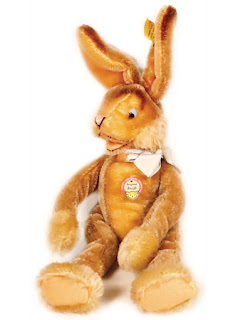
Steiff's lulacs all have comically long arms, legs, and torsos. They are long and lanky, usually fully jointed, and have a very playful air about them. It is interesting to note that the German verb “to laugh” is lachen, and the word for smile is lächeln, perhaps suggesting that this style was designed to have a comical appearance and to bring a smile to the face of the owner. The original Steiff lulac animal was a rabbit, which debuted in the line in 1952. He was made in 43 cm through 1974, and in 60 cm from 1964-1966. Due to the success of this beautiful bunny, Steiff quickly followed with several additional lulac animal patterns, including dogs, cats, donkeys, zebras, bears, and others. Steiff's rare and goofy 40 cm black mohair lulac tomcat, made from 1964-1966, is pictured below. 

The lulac lion under discussion here today was designed and produced at a most creative period at Steiff - the mid 1950s through the mid 1960s.
It was during this time that the company made a number of unique, well designed products for their United States customers, as well as distributors at the time - Reeves International and Loucap. Other noteworthy US editions of that era were the company's dinosaur range, basset hounds, animal head trophies, and school and institutional mascots. These items, made in relatively small numbers for a short period of time, seem to always catch the eye - and pocketbooks - of collectors worldwide.

Steiffgal hopes this discussion on this fabulous lulac lion has given you a leg up on your day.

Have a question about one of your Steiff treasures? Let's talk! Click here to learn more.

Saturday, July 30, 2022

The More The Merrier With Steiff's Charming Fox Terriers

Fox Terriers are - and for the most part have always been - one of the most sought after, and prolific breeds in Steiff's kennel club. These energetic and fearless pups have appeared in Steiff's product line since the late 1800s. Here's an overview of their history to explain why they are considered top dogs by so many button-in-ear collectors. (A "real life" one is pictured here on the left for reference; the photo is from Purina.)

Steiff has traditionally taken inspiration for new product introductions from popular cultural trends. Fox Terriers started to gain prominence in the last quarter of the 19th century. In 1876, the Fox Terrier Club of England was established, and in 1885 the American Fox Terrier Club followed suit. Fox Terriers took top honors at the Westminster Kennel Club Dog Show in 1907, 1908, and 1909. It was clear that this breed captured the hearts and minds of dog fans.

As such, Steiff wasted no time in providing enthusiasts with their versions of these popular pups. Fox Terriers made their first appearance in the Steiff line in 1899, just a handful of years after the company's commercial catalog launch in 1892. The earliest ones were made from felt or velvet. Typical to the period, Steiff's debut Fox Terrier came on metal wheels and was made from felt. Mohair became available on a commercial scale in 1903 and shortly after, mohair Fox Terriers graced the pages of the Steiff catalog. Through the mid-1940s, close to 40 different models were produced in practically all forms, including sitting, standing, and lying toys; woolen miniatures; hand puppets; pincushions; pull toys on wheels; ride-on toys; and waterproof bath toys, among others. The Fox Terrier pictured here on the left is fully jointed and dates from around 1909.

Naming products took on new meaning and importance in the mid-1920s at Steiff. Around 1924, the company started to adapt their product development and marketing strategies to match the carefree, upbeat culture of the "roaring 20s." They updated or launched many new dogs and cats that featured distinctly youthful, playful, and innocent personalities. And they began giving them gentle, childlike names. Prior to that, most dogs and cats were noted generically or as their biological breed. Given their popularity, Fox Terriers were a big part of this strategy. As such, new Fox Terriers introduced in the 1920s and 1930s were named "Ajax," "Spotty," "Foxy, and "Strupp" (pictured here on the left), among others.

Midcentury, Fox Terriers continued to be a blue ribbon breed for Steiff.
They were among the first items produced once the factory was up and running for toy making business in the late 1940s. A Fox Terrier made from artificial silk plush in four sizes ranging from 10 to 29 cm in 1949 lead the pack. The little mohair Fox pictured here on the left measures only 7 cm and was produced around 1949. Starting in the early 1950s, when mohair became available again on a commercial scale, playful Steiff Fox Terriers in a full range of sizes would be produced as stand-alone toys, puppets, and on wheels. Steiff would go on to design and produce over 20 Fox Terrier designs from the late 1940’s onward, and a Fox Terrier of one sort or another has appeared in the line almost continuously to this day.

Perhaps the most popular vintage Steiff Fox Terrier among collectors today is the company's version produced from 1949 - 1975.
He is beloved for his gentle yet authentic appearance as well as his natural charm posing with dolls. This design was called Fox up to 1953 and Foxy from 1954 onwards. He was made in 11 sizes ranging from 7 to 36 cm over time. F
ox/Foxy dogs were standing on all fours and made from white mohair detailed with black and tan airbrushed spots. The smallest versions had felt ears while the larger ones had mohair ears. All had brown and black pupil eyes and a simple hand embroidered nose and mouth. This model was also produced as a pull toy on wooden wheels in 17 and 22 cm from 1949 - 1961, as a ride-on model from 1949 - 1966, and sitting in three sizes ranging from 10 to 17 cm in 1953 - 1955. Collectors may recognize the 8 cm version as the one sold with the Vogue Doll Company's "Ginny" doll as Ginny's pup "Sparky" in 1956. You can see Sparky here on the left; he is wearing his all original plaid jacket and wearing his black leash.  

Steiffgal hopes this discussion on the history of Steiff's popular Fox Terrier breed has been a real crowd pleaser for you.

Have a question about one of your Steiff treasures? Let's talk! Click here to learn more!

Sunday, June 19, 2022

This Steiff Special Edition Chin Chin Is A Win-Win!

The Steiff Sommer Festival will be here before you know it!
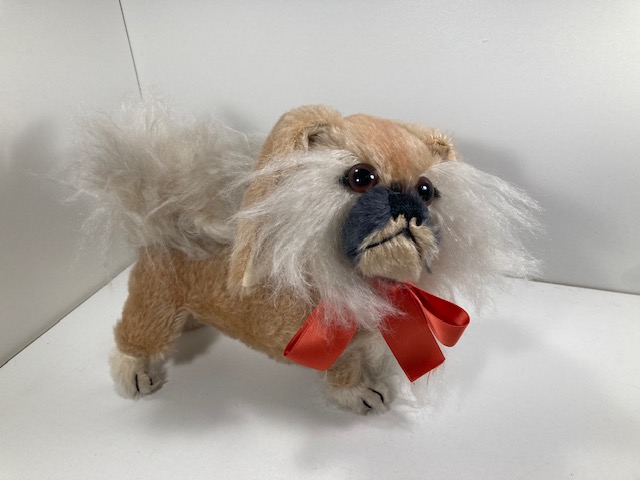
This annual celebration, held this year from June 24th-26th, 2022, will be the first live gathering of its type on the Steiff factory campus in Giengen since 2019! One of the exciting components of this happening - or at least it was in the past - was an extremely limited edition produced in honor of the event. These editions have taken a number of forms over the years, including a series of colorful Teddy baby bears. After several years of searching, Steiffgal finally got her hands on one of the lesser known event editions - a dog modeled on a prewar era button-in-ear-buddy. This pretty pooch was made during the manufacturing demonstration held at the Steiff Festival of 1998. Come take a look at this bow-wow beauty!

This Chin Chin is a win-win!
She is standing on all fours, head jointed, and measures 17 cm tall and 22 cm wide. Her tail, sideburns, and bib are made out of outrageously long, soft blonde mohair. Her body, forehead, ears, and legs are made from shorter blonde mohair, and her feet are made from very short mohair. Her delightfully detailed face comes to life with oversized brown and black eyes; a dimensional, grey and tan mohair inset muzzle; a black and embroidered nose and mouth; and a spot of airbrushed highlights. She has three hand embroidered claws on each foot. Her special event chest tag reads, "Pekinese Chin Chin 1931 Replica." She also has her special ear tag, indicating she is #149 of 300 produced, and the date of the Steiff event. Her hang tag doubles as her certificate. 

Tag- you're it - when it comes to deciphering this dog's somewhat cryptic design inspiration.
She is documented as a "Pekinese Chin Chin" on her chest tag. Let's dig a little deeper into this name game - as these really are two very different dog breeds! Steiff did produced a Pekingese, as well as a Chin Chin, in their prewar line. The company's Pekingese was made in 10, 14, 17, 22, and 25 cm from 1938 - 1943. You can see an example of this dog here on the left. Their Chin Chin was produced in 10, 14, 17, 20, 22, 25, 28, and 35 cm from 1931 - 1939. The designs in many ways were similar - both dog patterns were standing on all fours, head jointed, and featured dramatic tails that curved over their rumps and were stitched in place. However, Peky the Pekingese had short, cropped ears while Chin Chin had long, floppy, triangular shaped ears. So it's not entirely clear why this Festival edition was called both a "Pekinese" and a "Chin Chin"... maybe to appeal to owners of either dog breed?

It is also interesting to note what happened to Steiff's similar Pekingese and Chin Chin patterns over time.
Despite her delightful appeal and personality, a Chin Chin did not appear in the line postwar. Her cousin Peky did, though. The company's Pekingese had a major makeover post war and was reintroduced to the collector's world in 1953. This updated Peky was produced in 8, 10, 14, and 22 cm though 1977. The post-war Peky was standing, made from light brown mohair, had a detailed black muzzle (mostly velvet in the smaller sizes; mohair in the larger ones), and a darling, pouty mouth. This pattern was also produced as an 18 cm hand puppet from 1963 through 1964.

Steiffgal hopes this discussion on this special event dog has put you in a festive mood indeed.

Have a question about one of your Steiff treasures? Let's talk! Click here to learn more.

Thursday, October 28, 2021

Bow-Wow Beauties Coming Up For Auction Soon!

Dog-gonnit! The blue ribbon temptations are endless at the Ladenburger Spielzeugauktion GmbH Special Steiff Auction on November 6th! This can't miss event features over 350 simply awesome button-in-ear goodies. The catalog reads like a "who's who" in the vintage Steiff world. Steiffgal recently offered her top Teddy Baby and "one-derfuls" top picks from this sale; now here are her canine cutie favorites.
 
This first pick is the wheel deal indeed.
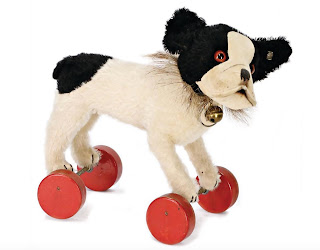
This is lot #4179, a standing Bully the Bulldog on wheels. The cataloging reads, "Bully, on excenter-wheels, black/beige mohair, velvet insert in very good condition, very nice colouring at the snout, with button, long stretched F, minimally rests of the white color, with paper breast sign with metal edge, produced around 1930, length: 23 cm, height: 22 cm, very expressive, except of minimally places mohair in very good condition, original ruff." He carries a presale estimate of €220 to €440.

Steiffgal can't imagine that there is a collector out there who doesn't just love Steiff's legacy Bully pattern. This particular item was produced in 10, 14, 17, and 22 cm from 1927-1935 overall. This guy is the best of all worlds. His condition looks lovely. He is standing - not sitting - and the standing ones are generally seen far less often on the secondary market. He has his original horsehair ruff, and these tend to fall apart or get lost to time. He has his button AND metal rimmed tag. And, like you needed any more reason to love him - he's on wiggly eccentric wheels. This guy is the package indeed. Hubba hubba hubba. 

Steiffgal's next pick is a bit of a "sett-up", but more about that in just a bit.
 This fave is lot #4036 and is cataloged as "
dachshund, with button, rests of the yellow cloth tag label, pull voice, faulty, full mohair, slightly faded, lenght: 53 cm, glass eyes." His presale estimate is €160 to €320. 

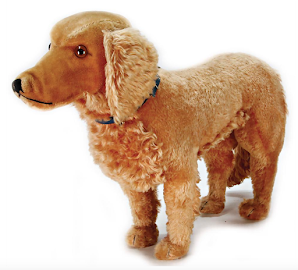
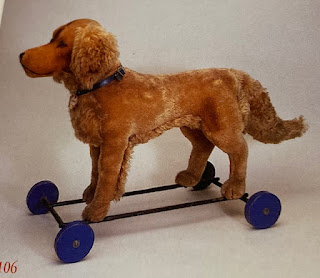
What's not to love about this pretty pooch? But here's a little secret. It is Steiffgal's best guess, given his color, mohair detailing, presentation, and long legs, that he is actually the company's much rarer pre-war Setter. Setter was made in 17, 22, 28, and 35 cm from 1933-1940 overall; he was also made on wheels in 35, 43, and 50 cm from 1933-1941 overall. You can see the wheeled version pictured here on the left; the photo is from Pfeiffer's 1892-1943 Sortiment. See the resemblance? Given the one in the sale noted at 53 cm and has a pull voice, it is very possible that he started out life as a riding animal on wooden wheels. A quick check on the condition of his paw pads would solve that mystery, but that is not possible right now. Steiffgal has never personally handled a prewar Steiff Setter; they so seldom appear on the secondary market.

And now let's raise a glass to today's final prize pup pick.
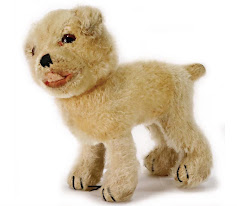
Here we have lot #4024, a standing Cheerio. He is cataloged as, "Cheerio, date of production 1928-1932, mohair-plush, standing, idealized model of a laughing dog, svivel head , inset eyes, opened snout with tongue, standing height 16 cm, mohair good, minimally faded, rare, minimally mohair loss around the eyes, 1 claw is loose, without button, chest label and cloth tag label." He has a presale estimate of €160 to €320.

Blink and you would have missed Cheerio's time in the Steiff product line.
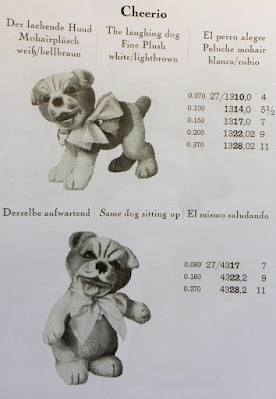
This happy go lucky pooch was inspired by the likeness of Bonzo, who was a popular cartoon character at the time. Steiff was not able to win the license to produce Bonzo, so they designed "Cheerio, the Laughing Puppy" instead. Cheerio's mouth design - open, smiling, and with a prominent tongue - is most unusual in the prewar era. Cheerio was made in a variety of sitting, standing and novelty editions from 1928-1931. You can see the sitting and begging versions as they appeared in a late 1920s catalog here on the left. Cheerio dogs are so rare on the secondary market, probably because folks who have one just love them and don't want to part with them! This example is not pristine, but its rarity, legacy, and presentation still make it incredibly desirable from the collector's perspective. 

Steiffgal hopes this discussion on top dog auction picks has been tail-wagging good for you!

Have a question about one of your Steiff treasures? Let's talk! Click here to learn more!  

Friday, October 22, 2021

One-derful Highlights From Ladenburger Spielzeugauktion November 6th Auction!

The countdown continues towards November 6, 2021 for Ladenburger Spielzeugauktion GmbH's Special Steiff Auction! This amazing sale, offers 367 OFF THE CHARTS vintage button-in-ear temptations. It's so hard to pick highlights here as practically every lot qualifies as a headliner. Steiffgal offered her top Teddy Baby selections a few days ago; now here are her WAH-HOO good favorites. To qualify for today's elite list, these items (as far as Steiffgal can tell) were not produced on a commercial scale and/or have not appeared in any standard Steiff reference book, such as the Sortiment tomes. So here we go!

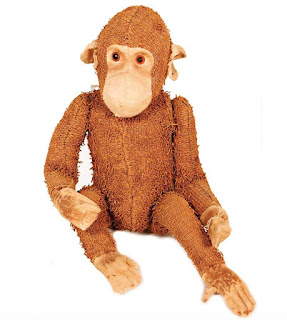
There's no monkeying around when it comes to lot #3967, a Steiff monkey made from paper plush.
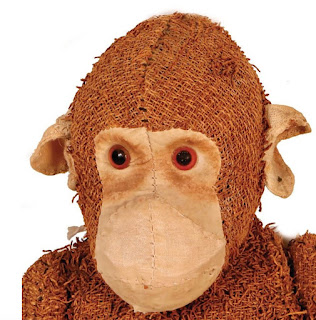
The cataloging for this item is: "paper monkey, probably produced from 1919-1920, exceptional monkey, in paper plush substitute, wood pulp plush, jointed, with small button, block letters, long stretched F, glass eyes, seat height 18 cm, used condition, exceptional, extremely rare." The presale estimate for this little guy is €220-€440.

There are many things that make this five ways jointed chimp such a champ. His design, scale, and presentation are really appealing. But of course, you can't help but notice his "unconventional" construction of paper plush and linen. Steiffgal has seen, or has known about, a few paper plush Teddy bears. But nothing like this monkey, ever!

During and immediately following the First World War, Steiff was unable to procure adequate supplies of high end fabrics.
Mohair and felt manufacturing had decreased, and the materials produced were allocated towards military purposes. In order to continue some production, Steiff was forced to come up with some alternative products, as well as materials. Given the abundance of wood in the area, the company started producing things like building sets and furniture for children. Steiff also found a way to produce a tweed-like material from local natural products. This "paper plush" was made from nettles and called "Brennessel." Paper plush items appeared in the line from 1919 through 1921, and included popular models of the company's standard line bears, dogs, cats, and rabbits... and apparently this monkey, too!

Next, size defies with this teeny tiny Lulac rabbit, lot #3993.
This is kind of an oxymoron here, as Lulacs are famous for their size and cartoonishly long limbs. He is cataloged as: "Lulac, '60s, with button, chest label and cloth tag label, number on cloth tag label 1322,00, without damage, this size couldn't be found in the STEIFF-catalog, it is probably a sample item." His presale estimate is €250-€500.

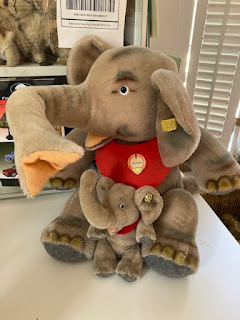
It's difficult to tell just from the photo here, but this guy is like an extra from the movie "Honey I Shrunk The Kids!" This bitty bunny really is only a petite 22 cm tall, measured vertically from the top of his head to his toes. As noted, he probably was a small scaled sample of a popular pattern of the time - created as a possible product line extension. And there is precedent for this; Steifgall has a 15 cm version of Steiff's sitting Jumbo elephant which appeared in the line from 1952-1975. Jumbo was produced commercially at 22 and 35 cm. You can see this little guy along with his 35 cm mama below.

Steiff's wonderful five ways jointed Lulac rabbits debuted in 1952.
It is Steiffgal's best thinking that their name derives from the German verb “to laugh” which is lachen, and the word "smile" which is lächeln. Lulacs are famous for their comically long arms, legs and torsos, goofy eyes, and playful personalities. Standard line Lulac rabbits were produced in produced in 43 cm from 1952-74 and 60 cm from 1964-66. So this 22 cm version is one rare rabbit indeed.

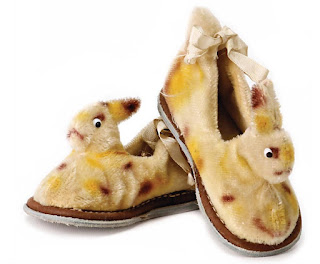
And finally, this last auction rarity is certainly a shoe-in for WAH-HOO good status. Check out lot #4318, a pair of fancy mohair kicks for kids. They are noted as, "exceptional children's hares shoes, probably '50s, very nice, strong colors, sole is 16.5 cm long, unused condition, rare, collection Koskinen." They carry a presale estimate of €120-€240. 

These shoes are worthy of walking the red carpet. And Steiffgal so wishes they were made in her size! They feature a rabbit design which is somewhat like Steiff's lying rabbit pattern. This little cutie is known for her stretched out body position and black and white google eyes. These often have the appearance of giving a side glancing "stink eye." Lying Rabbit was made in 6, 9, and 12 cm from 1953 through 1970.

Steiff's tradition of creating innovative product line extension items goes back to the turn of last century. The company has a long history of creating unusual novelties based on their most popular designs of the time. These things include purses, puppets, tea cosies, roly polys, tail moves head items, music boxes, and other functional and/or fun treasures.

It is entirely possible that someone at Steiff made these shoes as an experiment, for fun, or as simply an end of day or whimsy item - perhaps as a birthday or even Easter gift for a child or grandchild. It is also possible, given that the rabbit pattern's detailing is not exactly identical to Steiff, that they don't seem to have any IDs, and the painting and detailing of them is so unusual to Steiff, that they were made by another very high quality manufacturer also producing really appealing midcentury novelties. For example, the company Felpa Zurich MUTZLI created a series of children's hangers; they were covered in mohair and featured the face of a soft mohair Teddy bear or other animal. Only the shoes know for sure - and it is clear they are keeping their origins deep within their sole!

Steiffgal hopes this discussion on these WAH-HOO good auction picks has totally energized your day!

Have a question about one of your Steiff treasures? Let's talk! Click here to learn more!

Sunday, August 22, 2021

This Dressed Steiff Rabbit Doll Is The Best Of Both Worlds!

Overall, this next fantastic find is certain to put a joyful spring in your step! Steiffgal found this bitty bun in the recent United Federation of Doll Club's salesroom - lying upside down and backwards in a case piled full of mohair and treasures. All she could see was one very large foot with red claw stitching... and the rest is history. Come take a look at this dolly-delightful bun and see what makes him so interesting from the design and collector's perspectives.

This happy hopper measures 17 cm (without his ears), is begging, and head jointed. He originally was covered in white and tan mohair - but not a hare/hair remains on him! He is detailed with extra long, skinny feet, a tiny pert tail, and oversized ears. His face comes to life with big brown and black glass pupil eyes, a typical 1920s era style hand embroidered nose and mouth, and traces of once brown airbrushed highlights. He dons his original and totally adorable blue cloth overalls. He retains his long trailing "f" button and traces of his red ear tag as his Steiff IDs.

This seldom seen pattern appeared in the line from 1929-1932 overall in 17, 22, 28, and 35 cm. Steiff's rabbits are measured without their ears, so they actually are a little larger in real life than these measurements suggest. This model was produced in one of six documented outfits. According to Pfeiffer's 1892-1943 Sortiment, these included a blue playsuit, a red skirt and white apron, a purple jacket, a red skit and purple jacket, a red and white dress, or a pink dress. This example under discussion here is the one in a blue playsuit - which is detailed with tiny faux front pockets, contrasting tan colored stitching, back black snaps, and a perfect opening for his pert tail. It is interesting to note that this pattern is considered a "doll" in terms of his category - most likely because of his toddler-esque shape, standing form, and the fact that he is dressed. 

This guy is really shy - and seldom if ever appears in public! Despite being launched in 1929, as far as Steiffgal can tell, an example does not appear in the company's primary catalog of that year. The only other one Steiffgal is aware of is one that was sold at Christies in 2010. That particular example was cataloged as, "A STEIFF DRESSED BOY RABBIT, (4317,61), light brown and white mohair, brown and black glass eyes, pink and red stitching, whiskers, swivel head, inoperative squeaker, blue dungarees and FF button with red cloth tag, circa 1930 --6¼in. (16cm.) (some slight fading)." It was estimated at GBP 1,000 - GBP 1,500 and realized GBP 1,375. You can see that listing here on the left, the image is from Christies. You can click on it to make it bigger.

Steiffgal hopes this discussion of this rare and usual animal doll has been the best of both worlds for you.

Have a question about one of your Steiff treasures? Let's talk! Click here to learn more.

Saturday, August 14, 2021

Hold Everything And Check Out This Unusual Steiff Poodle PJ Bag!

Care to noodle a most mysterious poodle? Then check out this delightful Steiff Snobby - in the form of a pajama bag! This mohair marvel appeared out of nowhere on an online auction, and Steiffgal had no idea this pattern even existed. She studied her listing closely, first suspecting she was "mommy made" or even a "Frankenstein" item - made of bits and pieces of other items sewn together to make a "new" item. But a careful check of the photos detailing her construction and materials - including her zipper pull, belly lining, and seaming - confirmed she truly was all original. Cue the happy dance!

This nifty napper measures about 23 inches long, is lying flat on her belly, and unjointed. She is in the form of Steiff's legacy, mid-1950s Snobby poodle. Her arms, legs, beard and forehead are made from very long, soft grey mohair while her body, feet, tail, ears, and face are made from shorter matching grey mohair. Her face is detailed with lovely tricolored glass pupil eyes, a black hand embroidered nose and mouth, and a round, red felt tongue. On her belly, she has a long, silver colored zipper; when you pull it open, her hollow belly is lined in a lovely grey colored silken material. This pajama bag retains its raised script button in ear as its Steiff ID. She is in great, clean condition with little or no playwear to her at all. 

Pajama bag Snobby is clearly part of the Steiff Snobby poodle family tree.
This classic Snobby pattern made its debut in 1953 as a full bodied, standing pup and appeared in the line through 1974 in 10, 14, 22, 35, and 43 cm. The design proved so popular that it was soon being produced in a number of novelties, including a riding toy, a puppet, and as a soft, curled up resting animal, among others However, Steiffgal cannot find reference anywhere to a standard line Steiff Snobby pajama bag.

However, there is precedence for sleepers like this.
Steiff produced a fantastic, beautifully rendered mohair pajama bag as an exclusive for F.A.O. Schwarz from 1962 - 1972 in the form of a walrus. Like this Snobby, the walrus also has an identical zipper down its belly and a silk lined interior. And Steiffgal has a similarly constructed and also undocumented large black and white mohair Cockie Cocker Spaniel pajama bag, as well as a mohair lying tiger pajama bag. She does know through the original owner of the Cockie bag that he was purchased at F.A.O Schwarz as well in the late 1960s or early 1970s. This hints that Pajama bag Snobby might have been produced in a very small edition size for F.A.O. Schwarz, or another upscale toy retailer, during this time frame as well.

Steiffgal hopes this discussion on this Steiff Snobby pajama bag has added a little zip to your day.

Have a question about one of your Steiff treasures? Let's talk! Click here to learn more.

Saturday, June 5, 2021

Check Out This Purr-fectly Lovely, Time Traveling Steiff Cat!

There's no need for a fluff factor to describe how lovely this sweet kitten really is!
Cats have been a key part of Steiff's offering since the very beginning, and have evolved in their presentation and construction over time. Just a handful of cat designs bridge the company's pre- and postwar production. This excellent example just squeezes into that elite category.

Here's a tip: this darling cat is going to steal your heart! What we have here is a 14 cm version of Steiff's Fluffy cat. Fluffy is sitting, head jointed, and made in part from 
blueish/lilac tipped mohair - which is just spectacular. Her little tail wraps sweetly around her body. Fluffy's face is detailed with large deep turquoise green and black pupil eyes, a simple hand embroidered pink nose and mouth, and clear monofilament whiskers. Her claws are indicted by pink paint, and she retains her original pink silken ribbon.

And just what makes her such a time traveler? For the most part, Fluffy is usually considered to be a legacy prewar production item. Her childlike proportions and colorful presentation (and personality!) all reflect the aesthetics of the time she was born, the "roaring '20s". Fluffy appeared in 7, 10, 14, 17, 22, 25, 30, 35, and 43 from 1926-1943 overall. However, this particular model IDs include traces of a white ear tag, a raised script button, a named, red imprinted chest tag, and a US Zone tag, suggesting that she left the factory in Giengen in the very early 1950s.

Well, it turns out this pattern also tiptoed its way into Steiff's postwar production on little cat's feet. Sitting, head jointed Fluffy in the prewar tipped bluish lilac mohair pattern was produced in 14, 17, and 22 cm from 1949 through 1950! The branding on this sweet girl really does align perfectly to this manufacturing timeframe.

Given her popularity, it is curious to think about why her production ended midcentury. This might have to do with her distinctive, signature material - a blueish/lilac tipped mohair. This distinctively old fashioned looking fabric may not have been produced in sufficient quantities or just "timed out" in popularity in the early 1950s. For the most part, Steiff rolled out a huge number of brand new, or updated dog, cat, bear, and animal patterns starting in the 1950s, perhaps to re-launch and re-invigorate its brand post war. Perhaps Steiff felt Fluffy's presentation was "too dated" for the midcentury marketplace which was focused on the space race, technology, television, and rock and roll music. In terms of sitting cats, Fluffy's design was slowly replaced by Susi, another favorite design that spanned the pre- and postwar periods. Susi was a line standard through 1978. 

Steiffgal hopes this discussion on this midcentury cat has been as close to purr-fect as possible.

Have a question about one of your Steiff treasures? Let's talk! Click here to learn more!

Sunday, April 11, 2021

Chilling Out With This Life-sized Steiff Polar Bear

It's white-out conditions - in a very big way - when it comes to this next SteiffLife blog inquiry. Who knew Polar bears roamed Salt Lake? But apparently they do, at least in this lucky collector's home. Greg from Utah writes:

"Dear Steiffgal, 
Greetings from Salt Lake. Please find attached photos of a Polar bear we acquired recently. It is almost 6 feet long and 3 feet tall. We found it in Utah. Do you have any ideas on when it was made, where it came from or if he has a name? Thank you in advance for your help here."


Size certainly defies when it comes to this big boy. Given Greg's note, and the bear’s IDs, materials, and presentation, Steiffgal can confirm that this is a Steiff Studio Polar bear, and that it probably dates from the mid 1970s through the early 1980s. The size certainly confirms its Studio status - meaning that the item is life-sized, or created in pre-historic proportions. As far as Steiffgal can tell, he does not have a "name" other than something descriptive like Studio Standing Polar Bear, so Greg has the opportunity to name him anything he'd like! And, for his origins... it is possible that he made his way from Giengen to an area museum, toy store, or zoo awhile back as a display or window feature. But only the Polar bear knows for sure!


The devil is in the details - and their interpretation - when it comes to dating this polar pal, as Steiffgal was not able to find any specific reference to this design in her reference materials at hand. This bear's materials and detailing are consistent with display sized items of the mid 1970s through the early 1980s, with three factors rising to the tip of the iceberg. 


1. Material. The "heyday" of premier Steiff Studio animal production was in the 1960s, when the company produced many extraordinary, lifesized species in mohair. As this fabric became more expensive in the 1970s onward, the company started transitioning production towards synthetic materials, including long woven fur like this.


2. Facial detailing. Mid-century Studio items also usually had finely executed facial detailing, including elegant and lifeline hand embroidered noses and mouths. This example has a solid black nose which has been inserted into his facial muzzle. This sort of nose treatment - using cloth, faux leather material, or a 3D plastic or rubber version - is seen frequently on items from the third quarter of the 20th century onward. 


3. IDs. The appearance of the item's yellow cloth ear tag and Steiff button is consistent with the time frame under discussion. Throughout the 20th century, it was not unusual for Steiff animals that were not standard line, or that were produced in very small numbers, to have hand-written numbers on their oversized eartags. Steiffgal has several "larger than life" 1950s through 1980s era items with yellow ear tags and hand-written numbers. And for the larger metal script style button - this exact detailing appears on her standing Studio Panda, which was produced most likely in the 1972 through 1980 timeframe.


Steiffgal hopes you found this discussion on this Studio Polar bear a great opportunity to chill out - in the best possible way. 


Have a question about one of your Steiff treasures? Let's talk! Click here to learn more.

Tuesday, March 23, 2021

Bringing History To Life With These Amazing Gifts From Richard Steiff Himself!

Are you ready for something SUPER STEIFF exciting? Of course you are! Check out this email from Merleen, who writes from Michigan about two precious family treasures with amazing ties to one of Steiffgal's heroes, Richard Steiff. She shares...

"Greetings! My mother Elizabeth Newhouse Jones, who is 92 years old, received 2 Steiff animals when she was a child from one of the Steiff brothers. My mother said the name of the gentleman who gave the toys to her was Richard Steiff and he was the nephew of the woman who founded the company. My mom's father was a pharmacist and Mr. Steiff came into his drug store in Jackson, Michigan back in the 1930s and gave my mother a cow and a fox hand puppet. The name of the pharmacy was the Flat Iron Drug Store." 

Here on the left you can see a photo of Liz holding these incredible treasures today.

Talk about bringing history to life! Richard Steiff lived in Jackson, Michigan at 610 Harwood Avenue from at least the mid-1920s until he passed away in 1939. Awhile back, Steiffgal visited this home. According to Merleen, her grandfather's drug store was a short walking distance from Harwood Avenue. So it makes perfect sense that Richard may have frequented the pharmacy for medication and other home health needs during this timeframe. 

Now let's take a look at the two items that Richard gifted Merleen's mom.
The first is actually an ox, not a cow, at least according to Pfeiffer's 1892-1943 Sortiment reference book. The ox is standing, unjointed, and made from lovely white and copper colored mohair with patched construction. His head and face are detailed with black button eyes and velvet horns. This design was produced in 17, 22, and 28 cm from 1929-1943 overall. From the photos, it appears that Merleen's ox has a red ear tag, suggesting it was produced in the c. 1929-1934 time frame - aligning perfectly time wise with her mom's recollections. 

The second item is a field and forest favorite.
It is Steiff's beloved "Punch Fox" or fox hand puppet. He is 17 cm tall and made from copper and white mohair. He is unjointed and his head, and the tips of his paws, are solidly stuffed with excelsior. When he was new, he would have had a cardboard finger tube in his head. His ears are lined in black mohair, and his face comes to life with black and brown glass pupil eyes and a black hand embroidered nose and mouth. He would have had black hand embroidered claws, but it's hard to tell from the photos if those have been lost to time or not. This mohair puppet was produced from 1913-1927 overall. He is based on the company's legacy full bodied, fully jointed fox who appeared in the line from 1909-1933 overall in 14, 17, 22, 35, and 43 cm.

It is so exciting to learn of these treasures and their direct connection to Richard Steiff.
What is also quite interesting is the nature of these items, particularly the puppet. Richard was a real advocate of hands on, kinetic, interactive play - which is one of the reasons he invented the jointed Teddy bear as we know him today. He also really loved puppets and the role they could play in creativity and storytelling - given how they could be used so interactively and with movement. It is possible he wanted to personally and directly share that belief with Merleen's mom with this puppet gift. In a hand written letter dated December 22, 1926, Richard writes from Jackson to a toy industry colleague here in America about the company's chimp puppet, or Hand Monkey:

“I demonstrated the Hand Monkey for a few days in Jury Rowe’s store. It was very interesting and convinced me that we have a good business to come.... Only one out of a couple hundred persons has ever seen a Hand Monkey! I would not believe this to anyone but I experienced it. Already in Atlantic City I gave Mr. Schaufelberger the idea how to build a simple demonstrating machine for Hand Monkeys.” 

Steiffgal hopes you enjoyed learning about this Steiff ox and fox puppet duo with profound and perfect provenance!

Have a question about one of your Steiff treasures? Let's talk! Click here to learn more.

Saturday, March 13, 2021

This Old School Steiff Mule Is Nothing But Cool!

Feeling a little stubborn today? Well, that just may come in handy in this particular situation! Take a look at this mysterious Steiff mule. Have you ever seen anything like him before? His rarity alone is worthy of military honors.

What we have here is Steiff's seldom seen, largest sized US Army Mule mascot.
He is standing, unjointed, and excelsior stuffed. He measures 34 cm long and 22 cm high. Mule is made from grey mohair that has been highlighted with darker grey airbrushing on his back and neck. His tail and the lining of his ears are made from dark grey felt. His mane and the tip of his tail are made from long black mohair. Mule's facial mask is made from slightly shorter mohair. He has an open, smiling peach colored felt lined mouth. And of course, you cannot help but notice his amazing eyes! They are made from turquoise and black glass and can be tilted to the left and right to create funny and varying facial expressions. Army mule is detailed with a red cord harness and two long, thin orange wool pom-poms - one on either side of his face. He has a squeaker in his belly. 

As far as Steiffgal can tell, this large mohair Army Mule does not appear in any standard Steiff reference books.
He retains his raised script button, traces of his yellow ear tag, and a frayed US Zone tag as his IDs. Given this configuration of IDs, and the dating available on other similar Steiff mascots, it is Steiffgal's best guess that he was made around 1952.

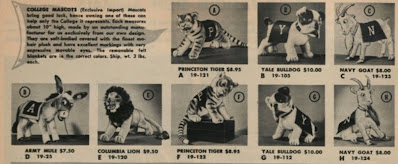
One place this fine fellow has made an appearance is in the F.A.O Schwarz catalog of 1952, along with a number of other Steiff mascots. You can see this catalog page here below; you can click on it to make it bigger. The Steiff Army Mule, on the far left, is listed at $7.50. Adjusted for inflation, $7.50 in 1952 is equal to $73.72 in 2021. The copy for this catalog page reads:

"COLLEGE MASCOTS (Exclusive Import) Mascots bring good luck, hence owning one of these can help only the college it represents. Each measures about 10" high, made by an outstanding manufacturer for us exclusively from our own designs. They are soft-bodied covered with the finest mohair plush and have excellent markings with very expressive, moveable eyes. The removable felt blankets are in the correct colors. Ship. wt. 3 lbs. each."

One thing that really stands out in this design is the Mule's eyes, which are even called out in the F.A.O. Schwarz catalog copy. This eye style appears infrequently on Steiff items, but when it does, it is Steiffgal's opinion that it is the company's way of saying, "don't take this piece too seriously - or literally!" This playful, cartoonish eye style debuted in the 1920's on some of Steiff's Cheerio dogs and Petsy the Baby Bears. Postwar, they appeared on Steiff's 1950's era Lulac rabbit models, as well as these larger mohair 1952 mascots. 

The 1950's and very early 1960's were Steiff's heyday years of producing mascots for the US market.
During this timeframe, Steiff made mascots for institutions including the US Army (mules) and Navy (goats), Columbia University of NY (lions), Princeton University of Princeton, NJ (tigers), Yale University of New Haven, CT (bulldogs), and Duke University of Durham, NC (doll devils), among others. Most of these mascots were based on existing designs in the Steiff portfolio that were modified via different eyes, proportional changes, and/or were accessorized with a lettered felt blanket. The Duke Devil was a completely new design. He was jointed, with a felt body and a rubber head with horns. He was detailed with a blue felt suit, long blue felt tail, and white felt shoes, and carried a pronged spear. You can see this handsome - ah, devil - here on the left; the photo is from Worthpoint. 

Steiffgal hopes this discussion on Steiff's largest mohair military mule ranks highly with you. 

Have a question about one of your Steiff treasures? Let's talk! Click here to learn more.
The teddy bear search engine