Showing posts with label vintage. Show all posts

Wednesday, March 5, 2025

It's Hip To Be Square With This Steiff Prewar Charly The King Charles Pajama Bag

You snooze, you lose! But everyone who is interested in this next fantastic find is a clear winner. Check out this short inquiry from Steiff superfan Michael, who writes about an unusual novelty. He simply writes...

"Hi, could you give some detail and history on this pajama case, I think?"

It's hip to be square with this marvelous 1930s era Steiff Charly the King Charles pajama bag. The bag itself is 30 x 30 cm, square shaped, and made from long, soft tan mohair. It closes with a metal zipper with a pull ring and is fully lined in textured light green fabric. All of these details appear to be original to the bag. The bag itself is decorated with the head of Steiff's signature Charley the King Charles Spaniel. Charly's head is made from mohair and measures about 15 cm long. It is head jointed to the bag and was designed to rotate. His face is detailed with oversized brown and black glass pupil eyes (one appears to be missing), a black hand embroidered nose and mouth, and oversized, floppy ears, just like the real dog. And cue the happy dance - this great novelty retains its long trailing "f" button as its Steiff ID. 


This functional favorite was made as part of a series of children's pajama bags in the late prewar period. They were formally called "night dress bags" and were the first style of pajama bags that Steiff launched to the world. For the most part, they are really rare and seldom seen on the secondary market as they were designed to be used and loved as toys as well as functional items. As such, most wore out or were lost to time. Their basic "template" was a simple, square shaped and lined bag with the head of a well-known Steiff pet of the era. They were produced from 1930-1937 overall and came with Teddy baby, Bully, Charly, a Scotty, a Sealyham, Molly, or a Siamese cat as the animal detailing. This is the first one Steiffgal has seen with a Charly as its featured animal.


This rare pajama bag appears to be in really nice condition overall. It is missing an eye, which sometimes happens. Replacing the lost eye would add to its appeal and presentation, and is not that difficult to do with the right needle and thread. However, it is sometimes challenging to find an exact ocular match in terms of size and era. And for some reason, eyes that don't match often look a little strange. As such, if Michael is not able to find an exact match, he may consider replacing BOTH eyes on this item to give the face a pleasing and authentic balance. Of course, it is important to note and disclose any and all known restoration on a vintage item if you are considering selling it at some point in the future.  


Steiffgal hopes this discussion on Steiff's Charly the King Spaniel pajama bag has been the crown jewel in your day today. 


Have a question about one of your Steiff treasures? Let's talk! Click here to learn more.

Thursday, September 5, 2024

Japan Celebrates All Things Othello At The Upcoming Teddy Bear With Friends Convention in Tokyo

It's the perfect time for a little get-away... even if it's just virtual! The Japan Teddy Bear Association is holding its 34th Japan Teddy Bear With Friends Convention on October 19th-20th, 2024 in Tokyo. This year, the weekend-long gathering celebrates Othello, the AMAZING and all original 1912 Steiff Titanic Mourning Bear that set a new world's record for the most expensive antique Steiff bear sold at auction in July, 2023. Steiffgal spoke with Shuya Tanaka, the Director of the convention, to learn more about this can't miss event.

Please introduce yourself and tell us about your experience with Steiff and this Teddy bear festival. 

Shuya Tanaka: My name is Shuya Tanaka. I am the youngest director of the Japan Teddy Bear Association and an antique Teddy bear dealer. I was born in Hiroshima in 1991. I studied Western Art at the University of the Arts in Kyoto, and then trained at Ladenburger Toy Auction in Germany. I studied under Mr. Götz Seidel and learned about antique Teddy bears though this internship. After that, I returned to Japan at the age of 26 and started my own business. My company sells antique Teddy bears to regular customers at high-end Japanese department stores. I also work for the Japan Teddy Bear Association to develop the Japanese Teddy bear market. Ladenburger Toy Auction is a business partner and I take my clients to their auctions in Germany several times a year.


Tell us about the 34th Annual Japan Teddy Bear With Friends Convention to be held on October 19th and 20th in Tokyo at the Haneda Airport Garden convention center. How many people will attend?


Shuya Tanaka: The Japan Teddy Bear Convention is the largest Teddy bear show in Asia. We have a partnership with Teddy Total in Germany and Hugglets in the United Kingdom. Our event features over 200 exhibitors. We expect to welcome about 5,000 attendees over the two day celebration. In addition to selling Teddy bears and animals, we also hold charity raffles and auctions, and offer seminars and programs given by Steiff and antique experts from the international Teddy bear community. The event is being held at the new Haneda Airport Garden complex, which is conveniently located to Tokyo International Airport, Terminal 3. You can see a photo of this huge facility here on the left. This all-inclusive space, which could be a travel destination on its own, includes two premier hotels, a rooftop hot-spring bath with views of Mt. Fuji, more than 60 retail stores, and 20 restaurants.


The star of the convention is Othello. Can you tell us about Othello and why he lives in Japan now?

Shuya Tanaka: Othello was sold at auction last summer in Giengen, Germany - also the location of Steiff's world headquarters. The buyer is a client of mine here in Japan, and they entrusted me with Othello's management. When Othello finally arrived in Japan, we decided to have a grand welcoming party for him at our annual Japan Teddy Bear Convention. As such, we will have many delightful black Teddy bear souvenirs available for purchase at this event to celebrate all things Othello. These include a Steiff's 1912 limited edition replica bear, key chains, bags, cookie boxes, and Teddy bears, among many others. 


The festival has a competition for Teddy bear artists. Please tell us about this contest.

Shuya Tanaka: Every year, the Japan Teddy Bear Association holds a contest to determine Japan's number one Teddy bear artist. This year, in addition to the regular contest, there will also be an Othello contest. The theme for this special contest is "Black and Red." We have invited artists to design and sew their best interpretation of Othello for this competition. We expect about 100 entries to the Black and Red contest. Our panel of expert judges comes from all over the world and even includes the President of a Teddy bear company. The judging criteria is confidential, but individual judges will score different elements of each contest bear. The grand prize will be awarded to the bear with the highest overall total score as determined by the judges. 


This event also includes an auction of sorts. Can you please describe this part of the convention. 


Shuya Tanaka: The auctions we hold at the convention are not formal auctions, but simple ones designed to raise money for local and regional charities. The items on offer include Steiff items and other Teddy bears that have been gifted to the Japan Teddy Bear Association. All have very low opening bids. The proceeds from this auction, minus expenses, will be donated to support reconstruction efforts following the major earthquake that occurred in Ishikawa Prefecture in January of this year. And speaking of traditional auctions, you can see a picture of Othello being sold in Giengen in July, 2023 here on the left. He set a new world's record price for the sale of an antique Steiff bear... realizing nearly $250,000!


For our readers outside of Japan and Asia, can you tell us what it is like to collect or be interested in Steiff in Japan?


Shuya Tanaka: There are many individuals in Japan who collect Teddy bears. Of course, there are classic Teddy bear enthusiasts, but Japan has many famous fictional and media characters and a well-developed stuffed animal culture, too. Emotional education that enriches the soul is important here in Japan. So collecting these soft, playful, and appealing items is meaningful to many people for lots of reasons. There are Steiff distributors in Japan, and you can buy new Steiff Teddy bears at many department stores. Although there are few antique shops, our Teddy Bear Convention brings together everything from 100-year-old Teddy bears to the latest Steiff Teddy bears that have yet to be released.


I hear you saying is that this upcoming Teddy bear convention is the ideal destination for anyone - anywhere - that loves Steiff, Teddy bears, artist bears, and other collectible soft toys and playthings! I could not agree more! And thank you for chatting with us!


For more information on the 34th Annual Japan Teddy Bear With Friends Convention to be held on October 19th and 20th in Tokyo, please click here... you will need to use your English (or other preferred language) website translator as the site is in Japanese. 


Have a question about one of your Steiff treasures? Let's talk! Click here to learn more!

Saturday, August 17, 2024

Here's A Delightful Steiff Auction "Tip" For You!

In the mood for a little trip across the pond? Steiffgal has just learned of a very exciting Teddy bear sale to be held on December 3, 2024 through Special Auction Services in Newbury in the U.K. The items under the hammer are all from the collection of Ian Pout, the founder of the legendary store Teddy Bears of Witney. This mecca, which unquestionably tops the short list of must visit places for cub collectors worldwide, opened in 1985 and was the first retailer in the U.K. to specialize in antique, vintage, and new Teddy bears. Ian is pictured here on the left, the image is from Special Auction Services.

Steiffgal has visited the Teddy Bears of Whitney at least twice.
The first time, in the very early 2000s, she made the voyage to Witney from London solo, traveling on a series of trains and buses to get to the store. She remembers spending hours in the cozy space, viewing old and new Teds, and how magical it was to see the original red mohair Alphonso in person. Ian Pout was there, and was incredibly gracious and kind, touring her around the museum parts of the store. The next time Steiffgal went, it was with friends, so the fun was multiplied many times over. She and her fellow collectors also spent hours oohing and ahhing over the temptations on display. Of course, all left with at least one shopping bag of souvenirs! You can see a photo of this beloved destination here on the left, the image is from www.cotswolds.com. 

Now back to the sale. There is a preview of highlights from the event already listed at https://www.specialauctionservices.com/Auction-Calendar/2024/A-Special-Teddy-Bear-Collection, and Steiffgal suspects that the auction company will continue to post more as the collection is cataloged, photographed, and prepared for sale. It is a lot of work and very time consuming to prepare precious objects for sale - especially of this caliber - so patience is everything here. But, from what has been made public already, it is clear that Steiff factors heavily in the collection, with rare button-in-ear examples that also have amazing and universally recognized histories taking many of the top lot slots at this event. 

One thrilling highlight from this sale is Happy, a roaring 20s-era bear with so many tales to tell.
According to Special Auction Services, this marvelous example is noted as, "Happy, a rare large eyed brown tipped Steiff teddy bear from circa 1926, which sold at Sotheby’s in 1989 for a world record auction price of £55,000 ($86,000) and bought by Paul Volpp for his wife Rosemary as an anniversary present. An enchanting girl bear with real presence, has since travelled the world raising over $100,000 for charity." She carries a presale estimate of £20,000-30,000. It is Steiffgal's understanding that the underbidder for Happy in 1989 was none other than a member of the British Royal Family! You can see this Happy here on the left, the image is from Special Auction Services. 


Happy dates from a joyful time in the company's product development history - the mid to late 1920s. It was during this era that several of Steiff's beloved named, novelty bears were introduced. These included Teddy Rose, Teddy Clown, Petsy, Teddy Baby, and of course, Happy! Happy was produced for a short time - from 1926-1927 only - in relatively low numbers. As such, examples are very few and far between on the secondary market. That is one of the reasons that this fine Ted - who is truly the package in so many ways - should catch the eyes and pocketbooks of collectors and historians worldwide. For context and comparison, the most recent Happy public auctions sale Steiffgal could find dates from a few years ago. A 51 cm example in fine condition hammered for 20500€ at Ladenburger Spielzeugauktion's Fall, 2022 sale. You can see that Ted pictured here on the left. 


For more information on this upcoming Teddy Bears of Whitney Sale, follow SAS' Facebook page at www.facebook.com/Specialauctionservices or check out their website at www.specialauctionservices.com.


Steiffgal hopes this auction announcement has put you in a very Happy mood indeed. 

Have a question about one of your Steiff treasures? Let's talk! Click here to learn more.

Saturday, June 22, 2024

Timecapsule Treasures On Offer At Ladenburger Spielzeugauktion's 2024 Steiff Special Auction

What's old is new again at this year's Ladenburger Spielzeugauktion's Steiff Special Auction on June 29th, 2024. This sale tempts collectors with almost 230 amazing and well curated lots of century-spanning button-in-ear treasures. One especially noteworthy category in this sale is items from the company's earliest production period - just before and just after the turn of the 20th century. Here are three "golden oldies" definitely worth checking out!


Let's start this trip back in time with lot #10. This is an extremely early dressed Steiff monkey, with an opening bid of 850 €. It is cataloged as:

"Steiff monkey, crouching, around 1900, pre-button era, felt, shoe button eyes, for shirr (missing), height: 17 cm, original felt clothes, smaller faults in the felt, nice original condition."

This sitting sweetie would love to hang out with you!
 It is Steiffgal's best guess that this is an example of the company's turn of last century felt monkey designed as a catch and release toy. If you notice his well formed hands, they look like they were designed to be holding something. Steiffgal thinks this would have been a piece of elastic string. So, someone could bounce him around as a toy on this cord. According to Pfeiffer's 1892-1943 Sortiment, this novelty was produced in 17 cm from 1897-1911 and was described as, "felt, brown, begging, elastic cord, tailcoat and slippers of felt." You can see the photo from this reference book here on the left for study and comparison. 

This next very vintage selection will have you moving and grooving.
 This is lot #6, a Steiff dancing bear, which carries an opening bid of 1800 €. It is cataloged as:

"Steiff dancing bear, around 1900, pre-button era, short plush, in very good condition, attending, dancing on a metal disc, casting wheels with spokes rubber coated, rubber is very worn, therefore the turn function isn't possible, squeaker, length: 68 cm (catalog proof 70 cm), shoe button eyes, one eye is a bit scratched, nose chain and stick, original pull rod, black and white picture in the Pfeiffer catalog page 37, and picture in the Steiff catalog from 1900, book Jürgen & Marianne Cieslik "Knopf im Ohr" page 27, an unusual piece from the beginnings of the Steiff-production, is a museum piece."

This amazing and little known mechanical bear, which was produced in 70 cm from 1898-1907, has a key role in the history of the development of the jointed Teddy bear as we know him today.
 In the late 1890's, Steiff produced a number of circus bear novelties. These were considered "action toys" as they designed to give movement to the toys. These included this dancing bear on a circular wheeled cart; bears on platforms with bristles supporting them; a bear on a cart with metal wheels; and tumblers in different configurations and sizes. The bears on the platforms with bristles would move when someone tapped the table on which they were standing - so they would sort of "shimmy" about. You can see a few of these early examples here on the left, the photo is from Cieslik's Button in Ear: The History of the Teddy Bear and His Friends.

Richard Steiff wanted to create more playful, dynamic, and child-friendly versions of these static/moving bears, and he took this challenge seriously. He studied the way real bears move at the zoo. Mohair became available on a commercial level around 1902. He married those two facts, inserted his creativity, and came up with the patterns for a series of fully jointed bears, starting with string jointing, then rod jointing, then disk jointing. Steiff's disk jointing system has not changed much since its introduction over a century ago. 

At the tail end of this discussion is lot #9, a very large and early monkey.
 He has an opening bid of 1800 € and is cataloged as:

"Steiff monkey, 1904, length: 80 cm, mohair plush, velvet ears, face and hands, PPB, shoe button eyes, elephant head, nice full mohair, velvet is a bit worn, small open place at the head mounting in the back, the wire mounting is visible, very expressive, an early unusual piece from the beginnings of the Steiff production."

This big boy is a fine example of Steiff's early - but not earliest - monkey patterns. This basic design debuted in 1904 and appeared in the line through the 1920s in a variety of slightly modified versions over time. He was produced with and without a tail, in a number of fabrics including brown and white mohair, and with felt or velvet hands and facial features. Given his elephant button, the one under discussion here was produced in the c. 1904-1905 time frame. 

One super interesting thing about this marvelous monkey is the company he keeps. 
This monkey appears in a 1903/04 catalog photo used to debut the company's new editions at the annual Leipzig Spring Fair. But what's so special about that? It's the same picture that debuted PB55... the world's first jointed Teddy bear. Talk about being at the right place at the right time, eh? A snapshot of this catalog page is shown here on the left. You can spot this monkey in the very far back right of the picture - just click on the image to make it bigger. 
The photo is from Cieslik's Button in Ear: The History of the Teddy Bear and His Friends.

Steiffgal hopes this discussion on these time capsule treasures has brought history to life for you. 


For more information on this June 29, 2024 sale, please check out the company's website at https://www.spielzeugauktion.de/.


Have a question about one of your Steiff treasures? Let's talk! Click here to learn more.

Friday, May 24, 2024

This Steiff Teddy Bear From 1964 Is One Merry Mash-Up!

Talk about hiding in plain sight! Steiffgal was checking out the latest listings on eBay to see if she could find a hidden treasure. And lo and behold, the shopping gods aligned and this rarity appeared out of nowhere! He doesn't look like much - and could be easy to miss. Check out this merry mash-up of a bear and see what makes him so distinctive from the design and marketing perspectives. 


Cosy Teddy is 28 cm, unjointed, and softly stuffed. His body shape and proportions are a bit like the company's childlike Lully baby bear. Cozy Teddy is made from white dralon. His paw pads are made from pinky-peach colored dralon. He has four brown dimensional felt claws on each of his paws. His face comes to life with smaller scaled black and white cartoon eyes and a hand embroidered brown nose and mouth. This pattern of facial stitching is similar to that seen on the company's postwar Original Teddy bears. He also has a little airbrushing around his peepers to give them some depth. When he left the factory, Cosy Teddy was decorated with a blue ribbon. This guy was produced in this size only in 1964. He retains his raised script button and bits of his yellow tag as his IDs. Given his washable construction, size, and simplicity, it is quite possible he was designed a hands on plaything for kids. 


This bear has two key design elements that make him quite distinctive. First, he has wool felt claws, which is most unusual in the Steiff line. A few other bears from his mid-1960s era, including Zooby the zoo bear, Cosy Nauty the polar bear, and Zipper Nauty the PJ bag, also have this detailing... but the vast majority of Steiff's cubs from all eras have embroidered or painted claws. And second, he sports round black and white plastic cartoon eyes, which are somewhat too small for his face. This configuration is also an outlier in Steiff's bear production. The only other example with this style and scale of eyes Steiffgal can think of is the company's Cosy Bruni Collar bear; he was made from 1965-1966. 


Steiff clearly had big plans for Cosy Teddy, as he was the "cover bear" for its 1964 "New Models" catalog. You can see that cover shot here on the left. Like Cosy Teddy, this four page catalog introduced a significant collection of new editions made from dralon materials. This publication is also very interesting because it debuted a number of items that were only produced for a year or so. Steiffgal refers to these now hard to find treasures as "One-derfuls" to note their single year appearance in the line. Cosy Teddy is one of these 1964 "One-derfuls"; others pictured in this brochure include Reinhold the Rhino, Loopy the Wolf, Zipper Cockie, and Sneba the Snowman puppet. Today, many of these rarities top enthusiasts' wish lists given how few were produced over a very short period of time. 


Steiffgal hopes this discussion on Cosy Teddy and his discovery has added a soft spot to your day. 


Have a question about one of your Steiff treasures? Let's talk! Click here to learn more. 

Wednesday, April 17, 2024

Swept Away Over This Latest Midcentury Steiff Discovery!

Isn’t this guy simply "one-derful?" Look who just joined Steiffgal's hug. She had been looking for a fine example for decades, and apparently good things come to those who wait. Make it your lucky day and say hello to this super Steiff Sweep!

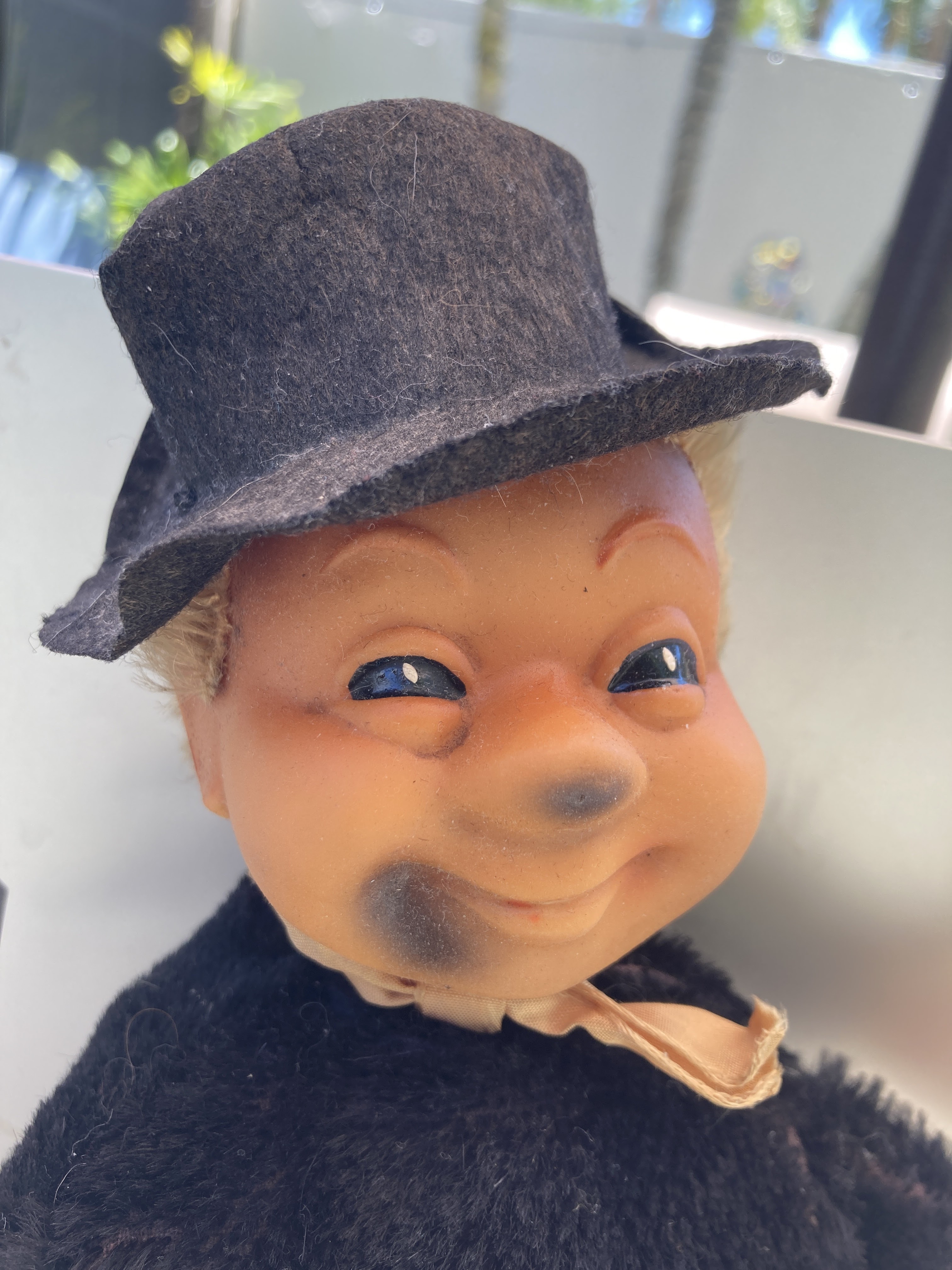
This adorable chimney sweep puppet named Blacky is 17 cm tall. His head is made from a soft rubbery material. He has a plastic finger tube inside his head. His hair is once copper colored mohair, and his body is jet back mohair. His oversized hands are made from felt and are lightly stuffed with excelsior. He wears a traditional black felt top hat and carries a black plastic ladder. His face comes to life with black and white painted eyes and some not-so-random coal smudges. His "outfit" is accessorized with a partial black leather belt and a neck tie. This puppet rarity was made in this size only in 1964.

The chimney sweep profession goes back as far as the 16th century in Europe. According to legend, chimney sweeps have been associated with ushering in health and happiness. As such, many brides in the past would have their chimney swept on their wedding day. Steiff probably added a chimney sweep to its line because of his centuries-long reputation as a good luck charm. 


Blacky debuted in the company's "New Models 1964" catalog.
This four page, full color brochure featured a number of now rare Steiff novelties, including a few that also were made for one year only. Steiffgal refers to these sorts of treasures as Steiff's "One-derfuls." Blacky is pictured on the back page of the catalog, and you can see that part of that page here above. You can also click on the image to make it bigger. 

His neighbor in this catalog is none other than Steiff's equally as rare and interesting Sneba snowman puppet. Sneba is 17 cm, unjointed, and made from white dralon. His face comes to life with button black eyes, an orange felt carrot nose, a red stitched mouth, and a touch of pink blush on his cheeks. He has two black "coal" woolen pompoms on his chest. Like his buddy Blacky, he wears a black felt hat and was made in one size only in 1964. 

You might just recognize Blacky's mug - as the same mold was used for a number of other rubber headed puppets in the 1960s through 1980s.
These include Happy the clown, Hansel and Gretel puppets, a princess, a modernized Shockheaded Peter, and even a grandmother, among others. It is interesting to see how this mold was used to represent male and female characters of all ages. And there is precedence for "recycling" facial molds on Steiff's dolls and puppets. If you look carefully, Steiff's beloved and legacy Dwarfs Lucki, Pucki, and Gucki all have the same face.... and share those good looks with the company's rubber faced Santa Claus dolls of the same era.

Steiffgal hopes this discussion on Blacky the Sweep has been a happy windfall for you.

Have a question about one of your Steiff treasures? Let's talk! Click here to learn more.

Monday, January 8, 2024

How Do You Make Vintage Steiff Buying Decisions?

Steiffgal had an interesting thought question posed to her the other day by one of her Steiff collecting-colleagues.
This person had been collecting for many years, and had accumulated a significant collection of favorites and rarities. Sensing that they were at a new point in their collecting path, they simply asked, "How do I know when I should buy something for my collection, and when I should pass on an opportunity?" 


Of course, there is no one right (or wrong) answer to this inquiry, and it totally varies from person to person.
Clearly, one's budget, buying patterns, available space, collection management strategies, preferences, and other factors play a huge role in "thumbs up" or "thumbs down" Steiff buying investments. However, after noodling the question for a while, Steiffgal came up with five general guideline recommendations for her colleague. She thought they might be helpful to some SteiffLife blog readers who may also be wondering about these sorts of things as well. 


1. If you have a mature collection, and/or have pivoted your interests to more expensive and rarer items, it is probably time to buy more with your head than with your heart. When many of us started collecting, we bought tons of Steiff items willy-nilly because they were available and we fell in love with them, or with the idea of growing our collection through them. That is buying with your heart. By buying with your head, Steiffgal means that collectors might want to think about each purchase a little more strategically, taking into full consideration the price of the item, the condition of the item, and how it fits into their collection. 


2. If you have been building your hug for a while, aim to have each new addition ELEVATE - not just expand - your collection. Consider purchasing non-redundant pieces that complement your existing inventory or take it in a new and exciting direction. For example, Steiffgal recently started collecting antique Steiff ephemera (catalogs, postcards, advertising materials, etc.) to display with her prewar items. This has opened many new doors as well as research opportunities. 


3. As your collection evolves over time, seriously consider only buying an item if you don't already have an example in your collection, or if it significantly upgrades one you already own. 


4. Following up on recommendation #3... if you are upgrading or replacing an item, rehome the replaced item ASAP. Don't hang onto it. This is one simple way to keep the potential for "collection clutter" in control, as well as paying (perhaps in part) for the replacement. "The more the merrier" doesn't hold true for most well curated collections. Depending on what you are selling, options for moving items along include eBay, Facebook marketplace, Craigslist, doll club sales and events, auctions, and other online channels. 

5. And, if you are still not sure if you should buy something after much consideration, ask yourself "What are the chances I will find another one in the foreseeable future?" All things being equal, if the answer is "slim to none," buy the item. If it is "likely to definitely” don’t buy the item. If it is somewhere in the middle, circle back to recommendations #1-4.


Steiffgal hopes this Steiff food for thought has added a little spice to your collecting outlook. 


Have a question about one of your Steiff treasures? Let's talk! Click here to learn more!

Thursday, October 26, 2023

Barking Up The Right Tree With This Petite And Princely Steiff Pinscher

And they call it puppy love! And for good reason. This sweet sitting pup recently joined Steiffgal's hug. He came in a giant box lot. But as all collectors know... sometimes these types of purchases contain unexpected treasures like this.

Sit and stay and check out this sweet pup.
He is a sweet example of Steiff's Pinscher dog. He is 17 cm tall, sitting, and unjointed. He is made from long tan mohair that was tipped in brown when he was new. You can see this tipping in his armpits, folds, and other places where the sun does not shine! Pinscher
 has black hand embroidered claws on his front and back paws. His face is detailed with charming proportional brown and black glass pupil eyes, a black hand stitched nose and mouth, a spot of red on his lips, and a center-seamed muzzle. His pert triangular mohair ears are lined in tan felt, and as is customary to the breed, he has a proportionally very small tail. He has a nonworking squeaker in his belly. 

Like most of Steiff's creations, this Pinscher is lovingly and authentically rendered.
He in a very appealing and authentic sitting position; his back legs are angled and bent in the way a real puppy sits - especially when they are trying coax you into giving them a snack! This guy retains his long trailing "f" Steiff button and bits of his red tag as his Steiff IDs. This tipped mohair Steiff Pinscher pattern was produced in 17, 22, 28, 35, 43, and 50 cm from 1914 though 1931 overall.

Pinschers are few and far between in the Steiff line. Over time, three versions were produced prewar. As far as Steiffgal can tell, there has not been one in the line after the early 1940s. It is interesting to note that Steiff's debut Pinscher was produced at the same time as the company's rod jointed bears. Like the rod jointed bears, this guy was also fully rod jointed, had black wooden shoebutton eyes, and a handmade black gutta percha nose. He appeared in 35 cm from 1903 through 1906. He had a distinctly Teddy bear look to him but his limbs were more slender and he did not have felt paw pads. You can see a picture of him here on the left; the image is from Pfeiffer's 1892-1943 Sortiment.

After an eight year hiatus, Pinschers again graced the Steiff catalog. The Pinscher under discussion here today followed the rod jointed version. Steiff's final Pinscher was similar to the tipped version, but made in long grey brown mohair in 17, 22, and 28 cm from 1935-1942. 

Pinschers are a distinctly German breed, so it should be no surprise that Steiff chose to produce a few for their line.
These dogs originated in southern Germany (also where the Steiff company is located.) They were first officially recognized in 1885 and accepted into the American Kennel Club in 2003. German Pinschers were one of the foundation breeds in the origins of the Doberman Pinscher and the Miniature Pinscher as we know them today. German Pinschers were almost lost to time both post WWI and WWII. According to the AKC, there were no litters registered in West Germany from 1949 to 1958. Due to the heroic efforts of one man, the breed was rescued via intensive breeding and conservation efforts.

Steiffgal hopes this discussion on this petite Pinscher has brought a little more happiness to your day.

Have a question about one of your Steiff treasures? Let's talk! Click here to learn more. 

Saturday, October 14, 2023

Thinking Outside The Box With This Delightful Steiff Moving Display

Would you climb every mountain for a wonderful Steiff rarity? How about an actual Steiff hillside scene with moving parts? Check out this note from a new friend in Europe who has inherited such a crated treasure in working order. Just what do we have here? Jeanette shares:

Hello! I have inherited this Steiff display, but do not know anything about it, except for what Google tells me, and that is how I found your website. The display has been standing in a shop window for many years and works fine mechanically. All the figures have a Steiff mark on the chest. The hedgehogs all stand up and are about 27cm tall, have mohair, velvet, soft arms that can move and a plastic face. Dark blue eyes. There are hedgehogs, dogs, cows, monkeys, mice, mountain goats and a mountain ram. It is a mechanical setup and everything mechanical moves fine. Without music. A serial number is noted on a hedgehog: 7627/28. 
Do you know if it could be worth anything?

Kind regards, 
Jeanette from Denmark

There's so much to unpack here, so let's get started.
Jeanette has an example of one of Steiff's legacy mechanized displays. It features a pastoral scene consisting of a simple wooden building with a mountain scape in the background. It is populated by a family of Micki and Mecki hedgehog dolls, as well as farm, forest, and mountain animals. The animals on display all appeared in the line from the late 1960s onward; the Mecki noted, with article number 7627/28 was produced from 1968-1990. Steiffgal suspects that this display was assembled in 1969 (give or take a year or two) given the "date" on the sign on the shelter. This sign also notes "Mecki Alm." The word "alm" is very interesting and does not really have an equivalent in English. It refers to a simple hut as well as the broad swath of meadows, forests, and hills surrounding it. That perfectly describes what's going on here. 

Steiff has a rich history of creating these can't-look-away moving displays. They debuted around 1910 as a natural extension of the company's advertising and promotional efforts. Over time, they have been produced in sizes ranging from less than a meter to almost the length of a city block. These vignettes were often reflective of life in a small town, farming, nature, a circus, or sports. Today, Steiff's moving displays are created, serviced, and maintained in what the company calls its Exhibition Department. Because they are made in Giengen and installed all over the world, how they are designed, assembled, and disassembled for transport are almost as critical as their presentations and themes.

Given some online research, it appears that Steiff produced a number of examples of Jeanette's alm display. These have appeared at public auction over the years. On December 11, 2016, Morphy Auctions of Denver, PA sold an almost identical version of this display. It was estimated at $500-1,000 and traded hands at $3,125, including the buyer's premium. It was cataloged as: 

"This automaton measures approximately 41” x 28” x 48” overall and features 15 Steiff animals at a mountainside farm. The automaton base is made from wood and includes faux cliffs, rocks, plants, and a farmhouse. The animals include monkeys, rams, marmots, goats, woolen miniature birds, cows, and a three member dressed hedgehog family. This display was purchased directly from Margarete Steiff GmbH at New York’s annual ToyFair trade show in the 1980’s. It was on display once or twice a year at Steiff collector events, usually for 3 days at a time, over a 25-year period. When not on display, it was stored in its individual wood shipping crate (included) in a controlled warehouse. This display is in working order with Steiff factory installed 110v US plugs. Condition: As noted. In clean, very good condition overall. Provenance: From a fine Ohio collection."

Now let's get to 
Jeanette's question about value.
As always, something is worth what someone will pay for it, and Steiffgal has not seen this item firsthand to account for condition. Other more recent sales of this item include a similar version sold in December, 2022 by Hindman of Chicago. Estimated at $1,000-1,500, it realized $2,064, including the buyer's premium. So the selling price has gone down a little in the past few years, at least based on information available. Given these metrics, it is not out of the question that this item under review her might realize in the c. $2,000-2,500 at auction today. 

Steiffgal hopes this discussion on Jeanette's alm display has been a breath of fresh air for you today.

Have a question about one of your Steiff treasures? Let's talk! Click here to learn more.

Saturday, September 9, 2023

Does This Lifesize Steiff Sheep Call To Ewe?

Sometimes it's ok to be a little sheepish.
Especially when it comes to delightful Steiff button-in-ear mysteries like this one! Check out this fabulous and fuzzy farm friend who just might be larger than life. What do you think? Danna shares, 

"Could you offer any assistance in figuring out the mystery of the sheep? His coat is darker and the feet are different than the two I found on the web, his eyes also have different centers and there is no yellow tag in the front. I think it's older. Any help would be appreciated. Thank you!"

This member of the flock truly rocks!
What we have here is a great example of one of Steiff's rarer studio, or life-sized sheep. He is standing on all fours, unjointed, and made from now faded brown tipped wool plush. His legs and ears are made from white wool plush. His inset muzzle is detailed with oversized green and black slit pupil eyes, a simple mouth and nose, and airbrushed highlights. He is solidly stuffed with excelsior and most likely has a metal skeleton inside to support his size and weight. He left the factory wearing a Steiff chest tag, but this has been lost to time. These brown tipped sheep were made in 80 and 90 cm from 1966-1967 only. The 80 cm version is also standing but his head his bowed to the ground as if he is nibbling on the grass. 

It is interesting to note that Steiff also created a 95 cm standing display ram produced in the same brown tipped wool plush as Danna's life-sized sheep. 

Now let's shepherd this sheep discussion to his IDs.
Danna's sheep has a product number of 1590,90 which is the 90 cm version made in 1966. Those made in 1967 have a product number of 3459/09. His numbers correspond as... 1= standing, 5= wool plush, 90= 90 cm, 9= display animal or special edition, and 0= normal (in reference to coloring.) Here on the left you can see these tipped sheep as they appeared in Steiff's 1967 studio line catalog.

Steiffgal hopes this discussion on Danna's sheep has put ewe in a great mood today. 

Have a question about one of your Steiff treasures? Let's talk! Click here to learn more.

Saturday, September 2, 2023

Going Out On A Limb Over This Unusual Steiff Prewar Novelty

Look what I found! That's exactly what a new friend from Florida said when she came across an interesting button-in-ear treasure at an estate sale local to her. But what exactly is this creature? Is it a merry mashup, or a loved to (almost) death standard line novelty? Valerie shares in part,

"This odd little fellow has a bear head; a caramel colored velvet body; a maybe muslin head, ears, hands, and feet; but also a 2" long tail! His skinny arms and legs are sewn/unjointed. His hands and feet have red embroidery threads roughly delineating his fingers and toes. All of his "fur" has been lost over time, except for very scant tufts of grey mohair inside his right ear. There's a dark metal button in his left ear, with Steiff in all capital letters with the tail of the second F extending to the "e." His nose and mouth are embroidered with faded pink thread. His eyes are sew-on green glass with black centers, and stick away from his face. I think the head is stuffed with excelsior, but the body, hands and feel softer.

Ancient bears had long tails, but I'm wondering if somebody sewed a Steiff bear head onto another beloved animal's body? The only thing that throws me off is that the material of the head, hands, feet and tail are the same. What do you think?"


Fingers crossed that Valerie can bear the news that her fabulous find is not a bear, but actually a cat!
This cute cat is named Fluffiette, and she was one of a series of long limbed lovelies featured in the Steiff catalog from 1927-1932. These "play and car dolls" included Bulliette the bulldog, Molliette the puppy, Rabbiette the rabbit, Cherrioette the open mouthed puppy, and this cat - named Fluffiette (after the company's popular and beloved 1920s era cat named Fluffy.) Each animal doll had the mohair or velvet head of the character, mohair or velvet paws and feet, and dangling velvet limbs. Most were available in several colors and in 20, 30, and 43 cm, with the larger sizes having a squeaker. Each left the factory suspended from an elastic cord and was detailed with an ivory ring for hanging and a decorative pom-pom. Fluffiette was produced in pink or orange velvet, which is completely consistent with Valerie's example. Here on the left you can see what Fluffiette looked like when new, the image is from Pfeiffer's 1892-1943 Sortiment.

It has been suggested that the design of this series was based on a similar line from the Chad Valley Toy Company of England called "Tango Toys." Steiff modified the design to fit their characters and manufacturing processes, and named the line "Charleston Animals," based on the Charleston dance crazy of the 1920’s, with its fast moving arm and leg movements. You can see Steiff's full line of Charleston Animals here on the left; this image appeared in the company's 1929 product catalog. Fluffiette is third in from the right, sandwiched between a standing Molliette and a standing Rabbiette. 

Steiffgal hopes this discussion on this Fluffiette Charleston Animal has put a little spring in your step today.

Have a question about one of your Steiff treasures? Let's talk! Click here to learn more.

Monday, May 29, 2023

Simply The Best: Highlights From Ladenburger Spielzeugauktion's July 1, 2023 Steiff Auction Event

Last January, Ladenburger Spielzeugauktion GmbH presented the first installment of the Susan Kilgore Wiley collection of breathtaking, antique Steiff bears, animals, and novelties. This awesome event realized over $475,000 and was the talk of the international vintage Steiff collecting community. Now it's time for the second part of the sale, which is most fittingly being held on July 1st, 2023 in Giengen, Germany in association with Steiff's annual Steiff Sommer celebration. Here are three over the top items on offer as part of that auction. Steiffgal did not even know these items existed until now, they are that rare and that AMAZING. Please sit down, fasten your seatbelt, and read on!

It's the best of all worlds with this first Wiley auction highlight.
Here we have lot #45, an early 20th century Steiff Teddy bear girl doll. It is cataloged by the auction house in part as:

"One of the of the highlights of the auction, probably a prototype by the Fa. STEIFF, unusual doll, felt head, blue glass eyes, bright mohair hair, with button, block letters, long trailing f, bear body, with white mohair, probably original silk ribbon and silk collar, height: 35 cm, small felt faults at the right cheek, exceptional, stronger mohair loss on the reverse of the legs and at the back, otherwise single places with slightly thin mohair, exceptional, probably an unique specimen." It has an opening bid of 1500 €.

This beautiful treasure probably dates around 1912, given her presentation, glass pupil eyes, and facial seaming. It was around that time that Steiff's proportional dolls were becoming very popular. The company was producing a number of adorable student and childlike dolls that were dressed in everyday clothes, Sunday best, and regional attire. These charming examples were even sold through FAO Schwarz in the United States! Steiffgal suspects that Steiff was looking at ways to expand their doll offering through different novelty options, and knows of a Steiff topsy-turvy style doll prototype from c. 1912. It makes perfect sense that Steiff would experiment with a doll head and a Teddy bear body, as the company specialized in both deigns and other manufacturers had these "hybrid" items in their lines. This doll bear probably did not go into production because it was very expensive and labor intensive to manufacture on a commercial scale.

This next highlight is truly on fire.
Here we have lot #49, a most colorful Steiff Teddy on the go. The auction house catalogs it in part as:

"STEIFF Record-teddy, produced 1927-1930, with button, block letters, long trailing f, red fiery mohair, glass eyes, felt paws, except of minimally places in good condition, scattered thin mohair, and mohair loss, swivel head, color is wear down at the wooden wheels, height: 24 cm, length: 24 cm, extremely exceptional, very strong colors, rare." It has an opening bid of 1200 €.

Collectors will recognize this delightful pull toy as an example of the company's legacy Record pattern. This pull toy design debuted around 1912 in the form of Record Jocko, a chimp on wheels. Bears and dolls on wheels quickly followed this introduction as they made for perfect passengers on Steiff's simple but charming four wheeled cart design. According to Pfeiffer's Sortiment, this particular Record Teddy was produced in 20 and 25 cm from 1927-1930. What's so interesting about this time frame is that it exactly corresponds with the "heyday" of the appearance of brilliantly colored, tipped mohair items in the Steiff line. Steiffgal has never seen an orange tipped Steiff bear in this size, and it is possible that they were only created for this novelty, and not as a freestanding item. Other tipped mohair highlights from the "roaring 20s" include rabbits, cats, dogs, and other eye-catching pets. 

And last but not least, please check out lot #54, a musical Teddy clown bear.
The auction house catalogs it in part as:

"Teddy clown, rare, with music mechanism, probably a single-item production, yellow gold mohair plush, glass eyes, bright embroidering at snout, softly stuffed, kapok filling, a rarity, with hat, standing height 39 cm, with button, block letters, long trailing f, scattered small faults at the felt paws, nice, full mohair, with music mechanism, long snaped off arms, on the reverse here and there with places with minimally mohair loss, original ruff and hat, produced c. around 1927." It has an opening bid of 1900 €.

These sorts of rarities make collectors want to break out in song! Teddy Clown bears themselves are quite rare on the market, given they were only made from 1926-1930 overall. In 1928, Steiff debuted a series of "Music-Animals" based on their most popular designs and patterns of the time. These items were standard line animals with a music box imbedded in their torsos. According to company documents, they included a Teddy bear, Petsy, Bully dogs, Molly, Cheerio, Fellow, Charly, Treff, Fluffy, a lamb, and a clown. There is no mention of a musical Teddy Clown in any materials Steiffgal can find. However, given the range of characters and novelties produced as music box toys, it is not out of the question that Steiff would have considered producing Teddy Clown as a musical edition. Perhaps this example was created as a prototype for this product development experiment.

For more information on this amazing sale to be held on July 1, 2023 and to see all of the great lots on offer, please see the auction house's website at https://www.spielzeugauktion.de.

Steiffgal hopes this discussion on these absolute auction rarities has further cataloged your interest in vintage Steiff!

Have a question about one of your Steiff treasures? Let's talk! Click here to learn more.
The teddy bear search engine