Showing posts with label Germany. Show all posts

Friday, April 3, 2026

A Brief Revue Of All Steiff Things 'Goo!

Marsupials are a subclass of mammals, with one key difference: all females deliver their babies prematurely and nurture them in their pouches, sometimes for up to a year.
Today, there are only 344 species of marsupials on the planet; most live in Australia, New Guinea, and the surrounding island nations. Perhaps the best known marsupials are kangaroos - who also happen to have a long history in the Steiff line! A fine example of the company's late midcentury 14 cm Linda Kangaroo is pictured here on the left. 

These “pocketed pretties” were one of the very earliest animals made by Steiff. The first ones were produced in 1897 – only five years after the company published their first catalog in 1892, and nine years before the introduction of the button-in-ear trademark in late 1904. These 1897 standing, unjointed 'goo debuts included a 28 cm version made from short pile plush and a felt model made in 12, 17, and 28 cm. 

Soon after, in 1902, Steiff introduced a velvet kangaroo in 12 and 17 cm that was similar in design to its felt offering.
 The 12 cm velvet version also was produced with a basket on its back as a pincushion from 1902-1905. The 17 cm versions of both the felt and velvet kangaroos were made as tumblers on wooden hemispheres from 1901-1905 overall. You can see an example of that here on the left, the photo is from Pfeiffer's 1892-1943 Sortiment. These turn of last century models may have been male as none had pouches. All were basic in design and in some ways looked more like little rodents than the bouncing beauties intended.   
 
That possible case of “mistaken identity” did not last long. In 1906, Steiff updated their original kangaroo pattern to make it more lifelike; the new model was now five ways jointed, made from short pile plush, had a robust curved tail and shapely limbs, and a much more detailed face. New kangaroo was produced in 35, 43, 50, and 120 cm and was available through 1917. 

It was not until 1929 that Steiff’s kangaroos were again updated; many of these new design features remained on kangaroos through the 1970s. Most importantly, this late 1920’s pattern finally included a pouch and a joey, starting in 1933! These models were made from mohair and were manufactured in 35, 43, and 50 cm through 1939. The joey was 10 cm and also made from mohair; interestingly, his construction consisted just of a head and body and no limbs. He resembled a cute bottle-stopper with a mouse-like head. 

Fast forward to 1953. 
The factory had reopened after the war and Steiff was jumping at the bit to rebuild its toy empire. They introduced Kangaroo “Kangoo”, who was very similar to the prewar design. Mohair Kangoo was made through 1966 in 14, 28, 50, and 65 cm. The biggest one debuted in 1958; here on the left, you can see the 65 cm version as it was introduced in the company's catalog that year. The larger versions were arm jointed; all sizes were made with a pouch. The 14 and 28 cm Kangoos had plastic joeys, the 50 cm size had a velvet joey, and the 65 cm size had a mohair joey; all the joeys were “full body." Kangoo also appeared, albeit less frequently, without a pouch as a male Kangaroo. You can see an example of the "pouchless" Kangoo below on the left. 

A newer but similar kangaroo design named "Linda" took Kangoo’s place in the Steiff line from 1967 through 1974. 
Linda was made in 14, 28, and 50 cm; like Kangoo, the 14 and 28 cm Lindas had plastic joeys and the 50 cm size had a velvet joey. In 1960, Steiff debuted its postwar Studio Kangaroo; this big bouncing beauty was head and arm jointed and had a prominent pouch and darling joey. This model appeared in the line in 150 cm through 1967; she was also made in 120 cm in 1967. 

Steiffgal hopes this discussion on the history of Steiff's 20th century kangaroo evolution has you jumping for joy!

Have a question about one of your Steiff treasures? Let's talk! Click here to learn more.

Saturday, July 5, 2025

You Are Certain To Have A Plush Crush On This Amazing Steiff Prewar Rarity!

No need to sugar coat this amazing rarity! Here we have a wonderful example of Steiff's little known sitting "coat plush" cat. Have you ever seen a Steiff animal in this little known fabric? She is just about purr-fect in every way. 

This pretty kitty is 17 cm tall, sitting, unjointed, and made from grey and white coat plush.
Her back is covered in now faded black stripes. Her tail wraps around her rear, as often noted in Steiff's sitting cat patterns over the years. She has green and black pupil eyes and a pink painted nose and mouth. Her face is detailed with black stripes. Any whiskers have been loved off or lost to time. Her bow is not original to her, but her bell might be. She retains her button as her Steiff ID. This fantastic feline was made in 14, 17, 22, and 28 cm from 1931-1939 overall. 

Let's now take a look at how she is cataloged in Pfeiffer's 1892-1943 Sortiment. It says, "Rauhstoff, Grau/weiss, sitzend, billige Series." This translates to English as "Rough cloth, grey/white, sitting, cheap series." These descriptors are very telling about her construction and era of production in two key ways.

First, let's consider her material.
It is called rough cloth or coat plush. This is the first time that Steiffgal had handled an item made from this wartime era fabric, it is that unusual. More commonly noted substitute fabrics found on items produced just before and just after WWII include wool plush, artificial silk plush, cotton plush, and linen. From an aesthetic perspective, this material looks and feels a bit like flannel cloth - the fabric usually seen on nightclothes and plaid shirts! It has a very slightly fuzzy surface. Steiffgal suspects that the absence of this fabric appearing over a wide range Steiff prewar designs suggests that it was unpopular, hard to work with, and/or unavailable on a commercial level.

However, it is interesting to note that coat plush was used on two other cat models around the same time as this one. One, a standing version, was made in 14, 17, and 22 cm from 1931-1933. This same model was also produced on blue eccentric wooden wheels as a pull toy in 14, 17, and 22 cm from 1931-1932.

And second, let's noodle what Pfeiffer might mean by the words "cheap series."
It is unclear if this specifically means "cheap to manufacture" or "cheap (or cheaper) to purchase", or both. The early 1930s at Steiff were a time when the company was implementing numerous strategies to slash costs and create efficiencies throughout the entire organization. So the chronology of these words does make sense. This sitting cat was made at the same time as a number of the company's now legacy sitting cats, including Susi, the sweet tabby; Siamy, the Siamese cat; and Fluffy, the adorable blue tipped kitten. Clearly, these head jointed mohair cats were far more elegant in their materials, construction, and detailing than this basic, unjointed one. This "cheap series" cat also has simple painted facial features - not embroidered ones - which are far more economical to apply than hand embroidered ones.

All of these small tweaks in the aggregate certainly brought her costs down... but not her appeal or importance in the company's product development timeline in any way.

Steiffgal hopes this discussion on this prewar era coat plush rarity has warmed your heart and soul!

Have a question about one of your Steiff treasures? Let's talk! Click here to learn more.

Friday, March 28, 2025

Getting Cosi With Steiff's Poodle Named Tosi

Poodles are amongst the most popular dog breeds globally and are regularly celebrated for their distinctive good looks, superior intelligence, and fun-loving personalities. These wonderful dogs, often sporting fantastic hair-dos, are so important to Steiff that several were featured in the company's debut catalog in the early 1890's. Since then, Poodles have appeared almost continuously in the Steiff line to this day.

One of the rarer Steiff poodles, Tosi, tops the wish lists of many collectors today. This is most likely due to her unique presentation, unusual detailing, and place in the company's product development timeline. A deeper dive into her history suggests she is a case study in early postwar design, development, and distribution. Here is the story behind this precious pup!

Given the breed's appeal, Steiff started manufacturing Poodles as soon as possible once the factory reopened for toy making business after the conclusion of WWII.
The first new postwar Steiff Poodle design was Tosi. Here you can see her on the cover of the company's 1950 product catalog. Tosi's design strategy was based on two of Steiff's key business drivers at the time - to produce quality, appealing toys as quickly and efficiently as possible and to regain their status as a premier, worldwide toy manufacturer. However, Steiff still had alot to manage operationally in the earliest midcentury period, including rebuilding their infrastructure, optimizing new regulations and distribution channels, and dealing with material and talent shortages, among other factors.

Many of Tosi's design elements reflects these postwar realities.
She was standing and simple in design and only head jointed in the larger sizes. She had minimal seams and labor intensive details. Because mohair fabrics during this period were limited and expensive, this model was made from wool plush. Her coat was in a "Karakul" trim, meaning that it was fluffy but uniformly the same length all over her body. This gave her a sweet and youthful appearance, but also required no additional hand-trimming or work on her legs and torso. Tosi's face was detailed with a round, black glass button nose and soulful, almond shaped white, brown, and black eyes. These facial features did not require facial hand embroidery, which can be time consuming and require special expertise to execute. Her accessory was a simple red leather collar, which was easy to manufacture and attach to the dog. And, her small size and compact form made her light and easy to pack and ship worldwide. Here on the left you can see Tosi in a variety of color and size combinations as she appeared in Steiff's 1950 new product catalog. 

Overall, Tosi was produced in black or white wool plush in four sizes ranging from 14 to 28 cm from 1950 through 1953.
Because of her time of manufacturer, Tosi would have left the factory with either a short trailing f, blank, or raised script button; yellow ear tag; a red or blue imprinted chest tag; and a cloth US Zone tag in her leg seam as her Steiff IDs. You can see these IDs on the white Tosi above; the image is from www.invaluable.com. Examples in excellent to as new condition with all IDs today can trade hands in the high three digits - low four digit range.

Steiffgal hopes this discussion on Steiff's Tosi poodles has you feeling quite rosy!

Have a question about one of your Steiff treasures? Let's talk! Click here to learn more.

Saturday, January 25, 2025

This Charly Purse Is A Crown Jewel In Steiff's Prewar Novelty Production

Hold everything and check out this absolutely amazing rarity!
Steiffgal has a thing for Steiff novelties, especially those made in the prewar era. And it is certainly the best of all worlds when it comes to this breathtaking example. This Charly the King Charles Spaniel handbag will undoubtably have your vote for “Best of Show” in terms of her beauty, design, and willingness to lend a paw in service!

What we have here is Steiff’s Charly Handtasche or Charly Purse.
 This novelty is based on Steiff's beloved and legacy Charly The King Charles Spaniel pattern which debuted in the late 1920s. This precious pooch purse is 25 cm long, in a standing (albeit slouchy) position, and head jointed. She is made from long and short mohair plush. Her ears and tail are brown-tipped mohair, while her body and face are off-white mohair which has mellowed to a vanilla color. Her face is detailed with oversized brown and black glass pupil eyes and a simple black hand embroidered nose and mouth. She also has black embroidered claws on her hands and feet. And here’s what makes her a purse: her torso is hollow like a pouch, and is lined in bright orange velvet. You can see that detail in the photo on the left.  Her back opening closes with a study brass zipper. The pouch volume is quite small; it probably is the volume of about a small sized apple. This fantastic and very rare prewar novelty was produced in 22 and 25 cm from 1927 through 1940.

Steiff debuted a series of zippered, mohair purses in 1927 based on some of their most beloved characters of the era.
These measured 17 to 29 cm in size, measured horizontally. Each featured a velvet or silk lined, hollow back pocket which closed with a zipper. The zipper had a mohair ring pull to it, which probably also was designed as a small handle. These rings tend to get lost to time or wear given their function. The first button-in-ear handbag designs to appear included this Charly, as well as Jocko the Chimp, Petsy the Baby Bear, Bully the Bulldog, and Molly the puppy. Other patterns rolled out over time, with the final design being a Pip in 1941. 

Now let's do a bit of time travel. Check out this image on the left from Steiff's 1929 catalog. You can click on the image to make it bigger. The page is dedicated to their line of mohair handbags. Three young ladies are happily modeling the purses, including one with the Charly bag under discussion here today. Steiffgal thinks she looks the happiest of the gals, and for good reason! You can also see the circular mohair zipper pulls on the purses. The words on the advertisement translate roughly to, "Elegant in the arm of the lady, funny with the little ones.” The catalog page also notes that the purses were decorated with a collar or silken ribbon. 

Steiffgal hopes this discussion on Steiff's animal handbags has got you carried away - in the best possible way!

Have a question about one of your Steiff treasures? Let's talk! Click here to learn more.

Friday, September 20, 2024

This Prewar Steiff Hobby Horse Takes The Pole Position

And we are off to the races with our next Steiff mystery. Steiffgal is certain Steiff enthusiasts of all things equestrian will love this mane event! A new friend in the U.K. shares in part:

"I buy and sell interesting items as a hobby, around 6 years ago we stumbled across our hobby horse at a vintage show in the U.K. priced up at only a few pounds. Looking closer we were surprised to see the steiff rivet in his ear so we brought him home and he got lost in our detritus in the garage. 

I came across him again this week and I’ve had a look online and the only info I can is from your blog from 2015 where you look at a similar horse for someone else, although ours does have similarities to this it is different in it only having a single wheel and the rains being completely different (as I know these could have been added later.)

I just wanted to ask if he is rare or if you know anything about him, he’s been well played with so I know he isn’t mint but we do love him anyway. Thank you in advance for your help."


This fine antique Steiff hobby horse holds the pole position here. He was produced in 80 and 100 cm from 1924-1941 overall. Pfeiffer's 1892-1942 Sortiment describes this prewar rarity as, "hardwood, transparently lacquered, stick with two wheels, leather reins, head painted in colors." Given this example has the long trailing '"f" ear button as its ID, that likely means it was produced in the c. 1924-1935 time frame. It is also interesting to note that this example under discussion today appears to have only one wheel, not two, as described in the literature.  


This design could be considered a legacy one for Steiff - given the number of years it appeared in the line overall. Postwar, a very similar example was made in 100 cm only from 1949-1973. Minor design differences between the pre- and postwar models include the color of the blaze (white on the postwar ones, natural on the prewar one); facial painting (simpler and less colorful on the prewar version and more dramatic and vivid on the postwar version) and possibly the number of wheels (two on the postwar version, one on the prewar version.) A picture of the postwar version from Pfeiffer's 1947-2003 Sortiment is pictured here on the left for reference. 


The collector also asks about his horse's reins.
It is Steiffgal's best guess that the ones currently on the hobby horse are not factory original to it. She suspects that the original ones were most likely red leather, to match the painted accessories on the horse. Steiff tends to coordinate an item's detailing, and it seems likely (although ANYTHING is possible!) that these reins are replaced. When you think about it, the reins would be one of the areas of most wear on this sort of toy. It is not out of the question they simply wore out over time. And, this item cannot be used without reins, so it is probable that a clever Mom or Dad simply replaced them with something sturdy. 

Now for the question that will set the barnyard a-buzz... how much is he "worth?" As always, something is worth what someone will pay for it, and Steiffgal has not seen the item firsthand to check for condition issues and other factors that are hard to capture in pictures. That all being said, given the item is as presented and described, it is Steiffgal's best guess that something like this may trade hands today in the $125-250 range. 

Steiffgal knocks on wood that this discussion on this prewar hobby horse has been a lot of fun for you!

Have a question about one of your Steiff treasures? Let's talk! Click here to learn more.

Sunday, September 15, 2024

Strike Up The Brass Band Over This Mysterious Steiff Fawn

Oh deer!
What do we have here? This charming field and forest friend is not only just lovely and elegant in design, but she also has a less obvious but totally WAH-HOO good surprise element to her as well. Get ready to fawn over this precious prewar rarity!

Here we have Steiff's 22 cm mohair fawn. She is standing, unjointed, and made from tan mohair. The lining of her ears and her tail are made from white mohair. Her face is detailed with black button eyes and a black hand embroidered nose and mouth. Her legs are particularly thin, shapely, and elegant and are made from velvet. She has a gentle, distinctly old fashioned look to her. This pattern was produced in 17 and 22 cm from 1934-1943.

Now for her little secret.
Given her era of production, she would have left the factory with either a long or short trailing "f" style knopf, depending on her specific year of manufacture - with earlier versions having the long trailing "f" version and the later versions having the short trailing "f" version. However, this gal proudly wears an unusual BRASS colored short trailing "f" Steiff button and has traces of her yellow ear tag. The button measures 6 mm in diameter. This seldom seen branding appeared on a few Steiff items from 1933/34 through 1943. You can see that brass button in the photo below.  

So just how rare is this brass prewar button?
It is really hard to quantify, as Steiffgal has only handled - literally - a handful of items with this distinctive ID in memory. In her personal collection, she has one prewar treasure with this distinction. This is a small standing Waldi dog. He 10 cm, unjointed, and made from copper colored mohair. He has long, floppy ears. His face is detailed with shiny black glass eyes and a black hand embroidered nose. His mouth is indicated by a little black airbrushing. Waldi wears his original green leather collar and has his "watermelon" shaped bare faced tag, with his name imprinted in crimson. This guy was made in 10, 14, 17, 22, and 28 cm from 1933 - 1943... the identical time frame as the fawn under discussion today. This prewar Waldi is pictured below on the left. 

It remains a mystery why Steiff used a brass button for branding some of their items during this turbulent geopolitical period.
It might have to do with availability of materials, or shortages, or other rationing reasons. It is also not clear why some items would have a brass button, and others would not - as Steiffgal has seen examples of both the prewar Waldi and this fawn with Steiff's standard silver colored prewar IDs. Only these precious treasures know for sure... and they aren't talking!

Steiffgal hopes this discussion on Steiff's lovely prewar fawn with her unusual button has put the pedal to the metal for you.

Have a question about one of your Steiff treasures? Let's talk! Click here to learn more.

Saturday, August 24, 2024

Color Me Beautiful With This Fabulous Antique Felt Steiff Rooster

Bird's the word with this next Steiff inquiry. A collector friend with a great eye just added this fine feathered friend to her Steiff hug. His coloration and form are simply outstanding! Julie shares, 


"I just got this adorable little felt Steiff rooster! I am excited to know more about him and to learn when he was made. The closest I can find to him in the Sortiment is on page 546, which is a little rooster on a wheeled platform. The colors are exactly the same. Mine is about 10 cm high, and that's accounting for him being bent over a bit. If he had a button would it have been in his tail? He has a rusty old pin stuck in his side which is interesting. His tail is in really great shape, I don’t see any potential holes for a button in it. Was there maybe something with the style of feet and legs or tail to distinguish him from the very early 1892-1905 production? I see some may have had felt covered feet. The seller said that his great grandmother was born in Austria and brought this rooster with her to the US around 1900 or a little later."


This fantastic find wins Steiffgal's admiration with flying colors! What we have here is one of Steiff's earliest commercially successful legacy animal patterns. This classic, full bodied standing felt rooster was produced for the standard line in 12, 22, 29, and 35 cm from 1892-1929 overall. Very similar patterns were made on eccentric wooden wheels in 12 and 22 cm from 1917-1929 overall; as a tumbling 17 cm version on a weighted wooden hemisphere from 1894-1918; as an 8 cm pull toy on a wheeled wooden cart from 1916-1919; and as the kingpin in a set of hen skittles from 1894-1914 overall. 


What makes this pattern so exceptional, and so timely, is its materials and form. In terms of fabric, Margarete Steiff launched her company in the late 1800s; she initially specialized in producing felt items including garments, functional pockets, and household items. Felt material was readily available and relatively easy to cut and sew. When she started to produce animals a few years later, Margarete discovered that felt also translated perfectly into feathers when precisely cut, layered, and placed in cascading natural hues. In terms of form, Steiff's turn of last century product development was based on "everyday" animals - those farm, field, and forest animals that folks in Giengen would come across on a regular basis. As such, this particular rooster pattern is practically a time capsule example of Steiff's earliest commercial production. 


Given its popularity, Steiff's felt rooster pattern appeared in the line in one form or another for nearly 40 years. As such, it can be challenging to exactly date any given example. The felt supplied for this item certainly had some natural variations in color and quality over time; this can account for minor differences in product appearances. Many artisans cut and sewed this rooster over its four decade long appearance in the catalog; because of this, variations in size, presentation, and button placement are also expected. For the most part, older versions of legacy items have a more distinctive, handmade, and organic look to them than their cousins produced a few years or decades onward. Julie's example has metal feet and legs which are wrapped in string to finish them. This detailing is seen on many of Steiff's earlier birds from the turn of last century, as well as on some smaller and/or baby birds through the 1920s. 


Given these factors, and that his original family can date him to the very beginning of the 20th century, it is Steiffgal's best thinking that this example might date from the pre-button period (i.e., produced before 1904). Also supporting this age guesstimate is the fact that there is no indication anywhere on the rooster of a small hole where a button may have been placed originally. Steiffgal has seen a Steiff button inserted in the tail feathers, waddle, or comb of the company's early felt rooster and hen production. She also thinks that Julie's bird is most likely a 12 cm version that was either made a little on the small side or which bent or shrunk a little over its nearly century and a quarter existence. 


Here's one final point about this barnyard buddy. Interestingly, is possible that this pint-sized rooster was used at one time as a pincushion. This would make sense given his size and materials, and may explain the rusty pin found in his side! And/or, it is possible that this pin could have been used during his production in Giengen and never removed by accident... but only he knows for sure!


Steiffgal hopes this discussion on this antique felt rooster has you crowing about Steiff's earliest production. 

Have a question about one of your Steiff treasures? Let's talk! Click here to learn more.

Sunday, August 11, 2024

Begging For More Information On This Nearly Century Old Steiff Rabbit

Everyone loves a Steiff bouncing bundle of joy. And the bigger, the better - especially in this case! Check out this note from a new friend from London who asks about a begging bunny purchased at a fundraising event over four decades ago. His owner shares,

"Thank you for the facility to ask about Steiff toys. I'm 73 now and 40 years ago bought an old, straw stuffed toy rabbit at charity sale. He is 50 cm tall, not including his ears. As I'm a bit of a hoarder I only just came across it after some decades. It's large, in good condition, German mohair, has sewn eyes not glass ones and I gave it a new bow and bell. I was working in a youth club which had been established by ex-POW veterans who'd been incarcerated in Brunswick, Germany in WW2. So I wondered if perhaps one of them had brought it back to the UK. Is there anything more you could possibly tell me about it including its value?"


What a cheerful earful!
What we have is Steiff's Hase or Rabbit. He is simply and generically named after his species and does not have a more personal or endearing name. This particular design was made from 1927 through 1941 in 11, 15, 18, 23, 29, 36, 44, 50, and 70 cm. Steiff's rabbits are usually measured vertically from head to toe and do not include the length of the ears. So this example under discussion here is the 50 cm size. Steiff produced this head jointed, excelsior stuffed rabbit in light brown tipped, white, gold, purple pink, and light blue mohair. All examples left the factory in Giengen decorated with a silk ribbon and a bell. 

This pattern was a home run for Steiff at the time, and continues to be a collector's favorite nearly a century onward.
Given how adorable and popular this design was, Steiff also made it in velvet from 1927 through 1932 in 11, 15, and 18 cm in white, purple, orange, light brown, light blue, pink, and yellow. Steiffgal often refers to Steiff's 1920s-era playfully hued rabbits as "the jellybean bunch," given their joyful (and super sweet) colors. You can see examples of the velvet version of this pattern above on the left; the image is from Pfeiffer's 1892-1943 Sortiment. Below to the left is another late 1920's advertising photo for Steiff's rabbit line featuring the jellybean bunch; that image is from Esser's 1920-1929 Steiff Kataloge. 

Now for the question that always sends Steiffgal down a rabbit hole.
How much is he worth? As always, something is worth what someone will pay for it, and Steiffgal has NOT seen or handled this rabbit in person. Condition is key when establishing a valuation, and he might have some issues (like smoke or insect damage) that just don't show up on photos. What we do know about him is that he has a little playwear to him, he is missing his oversized brown and black glass pupil eyes, and he does not appear to have any IDs. He looks like he might have been brown tipped originally, but that has faded a bit over time. It is also possible that his facial stitching has been augmented at some point. Given all that, it is Steiffgal's best estimate (sans a crystal ball) that this guy could trade hands in the c. $250-500 range on an online auction platform like eBay. 

Steiffgal hopes this discussion on this large, prewar rabbit has put a spring in your step today.

Have a question about one of your Steiff treasures? Let's talk! Click here to learn more.

Monday, June 10, 2024

The Tail Of Two Marvelous Steiff Midcentury Weasels

Not every toy design Steiff has made has been as precious and endearing as the company's beloved Teddy bears, family pets, and farm friends. In the late 1950's and early 1960's, Steiff launched a whole series of innovative but unconventional designs that can best be described as "creepy crawlers." Most were from the field and forest product categories, and many were produced from unexpected materials. It's pretty safe to say that these items - in real life - would be the last animals most people would want to keep and cuddle as "friends for life!" 

Two of the more unusual editions from this unofficial series have to be a pair of weasels.
The first, Wiggy, was made from all white dralon. She had a white pipe cleaner style tail that was detailed with a black tip. She is shown here on the left, you can click on the image to enlarge it. The second was Waggy, who was made from white dralon that was airbrushed brown, and had a brown pipe cleaner tail. She is shown just below; please click on her picture for a more detailed view. 

These marvelous mammals both were cataloged at 12 cm; they physically measured about 3 inches tall and 6 inches long.
Both were standing on all fours and unjointed, with felt ears and feet. They came to life with black button eyes, a pink hand embroidered mouth and nose, and clear monofilament whiskers. Both were produced in this size only and for one year in 1962. Today, it is extremely rare to see a Wiggy or Waggy in very good or better condition on the secondary market; their dralon material tends to get dirty and ratty looking, and often times their pipe cleaner tails simply snap off with age and wear.

It is possible that both Wiggy and Waggy are Ermines, which is a woodland animal that lives across North America and Eurasia.
Ermines have different coloration over the course of the year. In the warm weather, their coat is brown, with a whitish throat, chest, and belly. In climates with a very cold winter, the fur turns white, except for the black tail tip. In locations with moderately cold weather, their the fur becomes only partly white. So this pair may represent Steiff's take on a winter Ermine (Wiggy) and a summer Ermine (Waggy.)

It's interesting to note that Wiggy and Waggy may have "royal connections" as well. White Ermine fur was traditionally used to decorate the robes of kings and queens in Europe and was seen as a status symbol for the wealthy. Fast forward to today... these 60 years old oddities often play the aristocratic role as the crown jewels in the collections of vintage Steiff enthusiasts around the world.

Steifgal hopes you've enjoyed this tail of two midcentury Steiff rarities!

Have a question about one of your Steiff treasures? Let's talk! Click here to learn more.

Friday, May 24, 2024

This Steiff Teddy Bear From 1964 Is One Merry Mash-Up!

Talk about hiding in plain sight! Steiffgal was checking out the latest listings on eBay to see if she could find a hidden treasure. And lo and behold, the shopping gods aligned and this rarity appeared out of nowhere! He doesn't look like much - and could be easy to miss. Check out this merry mash-up of a bear and see what makes him so distinctive from the design and marketing perspectives. 


Cosy Teddy is 28 cm, unjointed, and softly stuffed. His body shape and proportions are a bit like the company's childlike Lully baby bear. Cozy Teddy is made from white dralon. His paw pads are made from pinky-peach colored dralon. He has four brown dimensional felt claws on each of his paws. His face comes to life with smaller scaled black and white cartoon eyes and a hand embroidered brown nose and mouth. This pattern of facial stitching is similar to that seen on the company's postwar Original Teddy bears. He also has a little airbrushing around his peepers to give them some depth. When he left the factory, Cosy Teddy was decorated with a blue ribbon. This guy was produced in this size only in 1964. He retains his raised script button and bits of his yellow tag as his IDs. Given his washable construction, size, and simplicity, it is quite possible he was designed a hands on plaything for kids. 


This bear has two key design elements that make him quite distinctive. First, he has wool felt claws, which is most unusual in the Steiff line. A few other bears from his mid-1960s era, including Zooby the zoo bear, Cosy Nauty the polar bear, and Zipper Nauty the PJ bag, also have this detailing... but the vast majority of Steiff's cubs from all eras have embroidered or painted claws. And second, he sports round black and white plastic cartoon eyes, which are somewhat too small for his face. This configuration is also an outlier in Steiff's bear production. The only other example with this style and scale of eyes Steiffgal can think of is the company's Cosy Bruni Collar bear; he was made from 1965-1966. 


Steiff clearly had big plans for Cosy Teddy, as he was the "cover bear" for its 1964 "New Models" catalog. You can see that cover shot here on the left. Like Cosy Teddy, this four page catalog introduced a significant collection of new editions made from dralon materials. This publication is also very interesting because it debuted a number of items that were only produced for a year or so. Steiffgal refers to these now hard to find treasures as "One-derfuls" to note their single year appearance in the line. Cosy Teddy is one of these 1964 "One-derfuls"; others pictured in this brochure include Reinhold the Rhino, Loopy the Wolf, Zipper Cockie, and Sneba the Snowman puppet. Today, many of these rarities top enthusiasts' wish lists given how few were produced over a very short period of time. 


Steiffgal hopes this discussion on Cosy Teddy and his discovery has added a soft spot to your day. 


Have a question about one of your Steiff treasures? Let's talk! Click here to learn more. 

Saturday, May 11, 2024

Wool You Be My Baby?

It may sound corny, but this small scaled maize wool plush Teddy baby bear has captured Steiffgal's heart in a really big way! This happy handful has seen a lot in his nearly century of life, based on his loved condition. But the world hasn't seen a lot of him - or his pattern - based on his absolute rarity and short stint in Steiff's product catalog. Take a look at this beautiful baby and see what makes him so special from the design and promotional perspectives.

Teddy baby is 15 cm tall, fully jointed, and made from fuzzy maize colored wool plush.
His feet are made from slightly shorter wool plush. He has felt pads and four black claws on each paw. He has a side squeaker in his torso. Typical to his legacy namesake pattern, he has flat feet designed for standing, downturned arms, and a distinctly toddler-esque appearance and proportions. Although most Teddy baby bears are open mouthed, this particular model was produced with a closed mouth in all sizes. As such, his pensive face comes to life with proportional glass pupil eyes, a shorter wool plush inset muzzle, and a probably restitched black floss nose and mouth. He retains his long "trailing f" button as his Steiff ID.

Wool plush, closed mouth Teddy baby was produced in 12, 15, 20, 22, 28, and 35 cm (measured sitting) from 1929-1932 overall.
This pattern is one of the rarer prewar Teddy baby varieties. This is the first of his kind Steiffgal has ever seen or handled. The vast majority of prewar Teddy baby bears were produced in brown, blonde, or white mohair with smiling, velvet or felt lined open mouths.

Despite his relative rarity, this wool plush Teddy baby was featured in its own Steiff print advertisement.
This was produced and distributed in 1929, the year this Teddy baby was introduced. The main copy on the advertisement translates basically as: "The cute, fluffy bear child with the new expressive face, the loyal look and the cuddly paws, a great performance, fully mobile, and well-positioned." According to the print advertisement, Teddy baby is offered in maize mohair plush or wool plush. Both versions are available in 12, 15, 20, 22, 28, and 35; those at 22 cm and larger came with a growler. You can see this print advertisement here on the left. If you click on it, you can view it in a larger format.

It is also very interesting to note that the two different versions had significantly different prices as noted in Reichsmarks, the German currency of the era. You can see this in the third column of information describing each of the two Teddy baby variations. The wool plush versions generally are around 20% more expensive than the mohair plush versions. Steiffgal suspects that this likely reflected the actual costs of the fabric to make these items as the time and effort to make these two variations had to be almost identical.

Steiffgal hopes this discussion on this unusual prewar Teddy baby model has helped to rejuvenate your day!

Have a question about one of your Steiff treasures? Let's talk! Click here to learn more.

Sunday, March 17, 2024

Bleating With Happiness Over This Marvelous Moving Steiff Goat!

Could this next Steiff discovery be the GOAT (greatest of all time)?
Well, it depends who you ask, but he certainly qualifies by genetics! Check out this absolute rarity from the early 1930s and see what makes him so delightful in multiple ways!

What we have here is Steiff's tail-moves-head goat. He is standing, head and tail jointed, firmly stuffed with excelsior, and made from tan mohair. The backs of his ears and the underside of his tail are made from black mohair. He has gorgeous teal and black slit glass pupil eyes and a simple black hand embroidered nose and mouth. When he left the factory nearly a century ago, he had lovely and realistic hand airbrushing over his body to give him texture and dimension. His bow and bell are not original to him, but he also sported these accessories when he was new. 

This adorable barnyard buddy was produced in 18, 23, and 29 cm from 1931-1934.
This guy is the baby of the bunch at 18 cm. His precious presentation plus his 
tail-moves-head feature really put him in a class all by himself. 

So what are the deets behind this mechanical marvel? When you very gently twist his mohair covered tail in a circle, his head follows in tandem. He has an internal metal jointing system which enables this. You can often tell tail-moves-head items because they have an especially long and thick and somewhat undefined neck area. That is necessary to hold the jointing apparatus as well as allow for room for the fabric to move a bit. And more times than not, tail-moves-head items are missing the mohair covering on their tails. You usually see just a naked metal loop or tag, but in this case goat has managed to retain his mohair tail over all of these years. Guess he was good at protecting his assets!

It is interesting to note that this guy, and other Steiff tail-moves-head items from his era had an additional ID tag.
 This was a round, Steiff branded cardboard tag that read "turn here and I will move my head" in three languages. It was attached on or near the animals rear end. Unfortunately, goat's extra tag has been lost to time in this case. 

They heyday for Steiff's tail-moves-head production occurred in the years leading up to WWII. The mechanism, which consisted of a metal apparatus, was patented in the early 1930s. Over 25 different animals were produced with this feature. These included cats, dogs, rabbits, penguins, goats, and lambs, and an elephant, among others. They were considered "luxury toys" at their time and even appeared on the cover of one of the company's 1931 catalogs for their debut. They were promoted as, “The year 1931 has presented us with the animals with the new head movement… The simplicity of the mechanism, though which the splendid movement is produced, cannot be beaten, yet it is unbreakable and allows lifelike play, full of variety and mimics… When buying new supply in plush toys please be sure to include the STEIFF animals with the new head movement; all numbers equipped with it are marked ‘H."

Steiffgal hopes this discussion on this delightful tail-moves-head goat has you jumping for joy.

Have a question about one of your Steiff treasures? Let's talk! Click here to learn more.

Sunday, March 3, 2024

Hop-ping To Find Answers About This Fantastic Steiff Prewar Rabbit On Wheels

Orange you glad you checked in with this blog today? Well you will be for sure after learning more about this super cool prewar rarity living with a new friend from far away. Alena shares...

"Hello from the Czech Republic,

I have a question about my toy - rabbit on the wooden wheels. I couldn't find any information whether the Rabbit has been produced in Steiff factory in this color. Toy hasn't got any button neither any else marking. 

Thank you very much in advance for the answer and maybe some more information about that."

This happy hopper is the wheel-deal indeed.
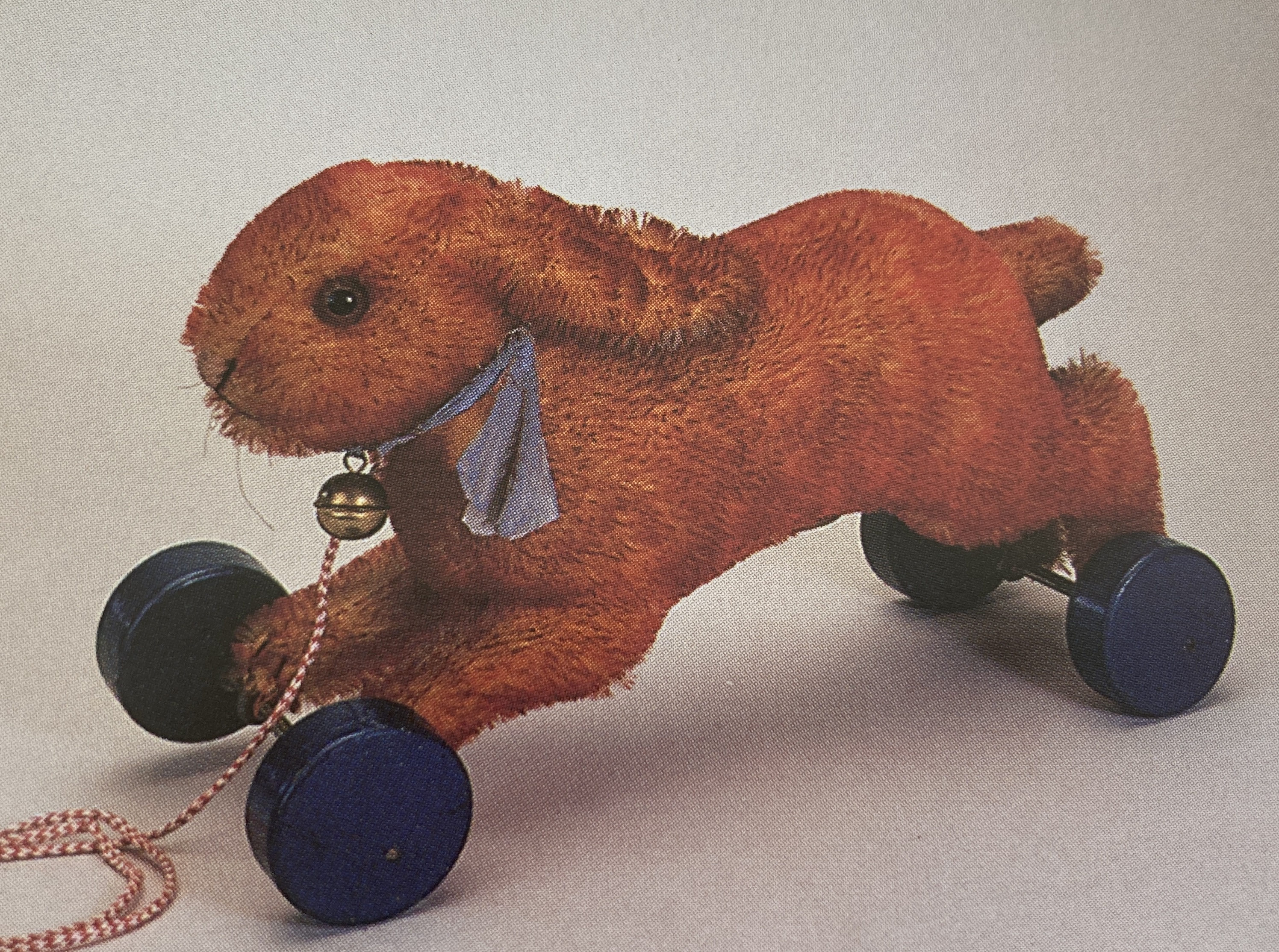
It is Steiffgal's best thinking that he is one of Steiff's standard line rabbits on wheels from the late 1920s. Here on the left, you can see the photo from Pfeiffer's 1892-1943 Sortiment illustrating what Steiffgal believes is this exact item. He is in a "hopping" position, meaning he is on all fours and about ready to take off! The name of this body position was later changed to "running", which also makes alot of sense.

Alena's treasure is one beautiful bunny. Here you can see him relaxing with some WAH-HOO good vintage friends in the photo on the left. Rabbit is unjointed, solidly stuffed with excelsior, and features large brown and black glass pupil eyes, a hand embroidered pink and black nose and mouth, and clear monofilament whiskers. He has once vivid orange mohair. He rides upon four asymmetrical wooden "eccentric" style wheels. As such, he appears to sway back and forth as he is pulled along. This item was produced in 12, 15, 18, and 23 cm (measured vertically, top of the head to toe, not including ears or wheels) from 1927-1930 overall in this stunning color. He was also produced in an almost identical pattern in brown tipped mohair in 14, 17, and 22 cm in 1928.


Brightly colored animals, including rabbits, dogs, cats, and bears - were a delightful feature of Steiff's late 1920s to very early 1930s product line.
These sweet pets appeared in orange, pink, blue, green, gold, or other "jellybean” colored mohair or velvet fabrics, and usually had playful, youthful personalities to match! Tipped mohair - meaning mohair with just the ends or tips dyed a complementary or eye-catching color - also had its heyday in the product line around the same time. You can see a number of these colorful rabbits in the photo on the left, the image is from the company's 1929 product catalog. 

Steiff also produced a few other fun novelties featuring "larger than life" colors like Alena's wheeled rabbit.
One of particular interest is a delightful orange and white begging style rabbit on eccentric wheels. In July, 2023, the auction house Ladenburger Spielzeugauktion GmbH of Ladenburg, Germany sold this 20 cm tall rarity from 1926-1932 for nearly $4,000. He is pictured here on the left, the image is from Ladenburger Spielzeugauktion.

Steiffgal hopes you enjoyed learning about this darling, 24 carrot gold prewar novelty!

Have a question about one of your Steiff treasures? Let's talk! Click here to learn more.
The teddy bear search engine