Showing posts with label catalog. Show all posts

Saturday, January 25, 2025

This Charly Purse Is A Crown Jewel In Steiff's Prewar Novelty Production

Hold everything and check out this absolutely amazing rarity!
Steiffgal has a thing for Steiff novelties, especially those made in the prewar era. And it is certainly the best of all worlds when it comes to this breathtaking example. This Charly the King Charles Spaniel handbag will undoubtably have your vote for “Best of Show” in terms of her beauty, design, and willingness to lend a paw in service!

What we have here is Steiff’s Charly Handtasche or Charly Purse.
 This novelty is based on Steiff's beloved and legacy Charly The King Charles Spaniel pattern which debuted in the late 1920s. This precious pooch purse is 25 cm long, in a standing (albeit slouchy) position, and head jointed. She is made from long and short mohair plush. Her ears and tail are brown-tipped mohair, while her body and face are off-white mohair which has mellowed to a vanilla color. Her face is detailed with oversized brown and black glass pupil eyes and a simple black hand embroidered nose and mouth. She also has black embroidered claws on her hands and feet. And here’s what makes her a purse: her torso is hollow like a pouch, and is lined in bright orange velvet. You can see that detail in the photo on the left.  Her back opening closes with a study brass zipper. The pouch volume is quite small; it probably is the volume of about a small sized apple. This fantastic and very rare prewar novelty was produced in 22 and 25 cm from 1927 through 1940.

Steiff debuted a series of zippered, mohair purses in 1927 based on some of their most beloved characters of the era.
These measured 17 to 29 cm in size, measured horizontally. Each featured a velvet or silk lined, hollow back pocket which closed with a zipper. The zipper had a mohair ring pull to it, which probably also was designed as a small handle. These rings tend to get lost to time or wear given their function. The first button-in-ear handbag designs to appear included this Charly, as well as Jocko the Chimp, Petsy the Baby Bear, Bully the Bulldog, and Molly the puppy. Other patterns rolled out over time, with the final design being a Pip in 1941. 

Now let's do a bit of time travel. Check out this image on the left from Steiff's 1929 catalog. You can click on the image to make it bigger. The page is dedicated to their line of mohair handbags. Three young ladies are happily modeling the purses, including one with the Charly bag under discussion here today. Steiffgal thinks she looks the happiest of the gals, and for good reason! You can also see the circular mohair zipper pulls on the purses. The words on the advertisement translate roughly to, "Elegant in the arm of the lady, funny with the little ones.” The catalog page also notes that the purses were decorated with a collar or silken ribbon. 

Steiffgal hopes this discussion on Steiff's animal handbags has got you carried away - in the best possible way!

Have a question about one of your Steiff treasures? Let's talk! Click here to learn more.

Friday, May 24, 2024

This Steiff Teddy Bear From 1964 Is One Merry Mash-Up!

Talk about hiding in plain sight! Steiffgal was checking out the latest listings on eBay to see if she could find a hidden treasure. And lo and behold, the shopping gods aligned and this rarity appeared out of nowhere! He doesn't look like much - and could be easy to miss. Check out this merry mash-up of a bear and see what makes him so distinctive from the design and marketing perspectives. 


Cosy Teddy is 28 cm, unjointed, and softly stuffed. His body shape and proportions are a bit like the company's childlike Lully baby bear. Cozy Teddy is made from white dralon. His paw pads are made from pinky-peach colored dralon. He has four brown dimensional felt claws on each of his paws. His face comes to life with smaller scaled black and white cartoon eyes and a hand embroidered brown nose and mouth. This pattern of facial stitching is similar to that seen on the company's postwar Original Teddy bears. He also has a little airbrushing around his peepers to give them some depth. When he left the factory, Cosy Teddy was decorated with a blue ribbon. This guy was produced in this size only in 1964. He retains his raised script button and bits of his yellow tag as his IDs. Given his washable construction, size, and simplicity, it is quite possible he was designed a hands on plaything for kids. 


This bear has two key design elements that make him quite distinctive. First, he has wool felt claws, which is most unusual in the Steiff line. A few other bears from his mid-1960s era, including Zooby the zoo bear, Cosy Nauty the polar bear, and Zipper Nauty the PJ bag, also have this detailing... but the vast majority of Steiff's cubs from all eras have embroidered or painted claws. And second, he sports round black and white plastic cartoon eyes, which are somewhat too small for his face. This configuration is also an outlier in Steiff's bear production. The only other example with this style and scale of eyes Steiffgal can think of is the company's Cosy Bruni Collar bear; he was made from 1965-1966. 


Steiff clearly had big plans for Cosy Teddy, as he was the "cover bear" for its 1964 "New Models" catalog. You can see that cover shot here on the left. Like Cosy Teddy, this four page catalog introduced a significant collection of new editions made from dralon materials. This publication is also very interesting because it debuted a number of items that were only produced for a year or so. Steiffgal refers to these now hard to find treasures as "One-derfuls" to note their single year appearance in the line. Cosy Teddy is one of these 1964 "One-derfuls"; others pictured in this brochure include Reinhold the Rhino, Loopy the Wolf, Zipper Cockie, and Sneba the Snowman puppet. Today, many of these rarities top enthusiasts' wish lists given how few were produced over a very short period of time. 


Steiffgal hopes this discussion on Cosy Teddy and his discovery has added a soft spot to your day. 


Have a question about one of your Steiff treasures? Let's talk! Click here to learn more. 

Wednesday, April 17, 2024

Swept Away Over This Latest Midcentury Steiff Discovery!

Isn’t this guy simply "one-derful?" Look who just joined Steiffgal's hug. She had been looking for a fine example for decades, and apparently good things come to those who wait. Make it your lucky day and say hello to this super Steiff Sweep!

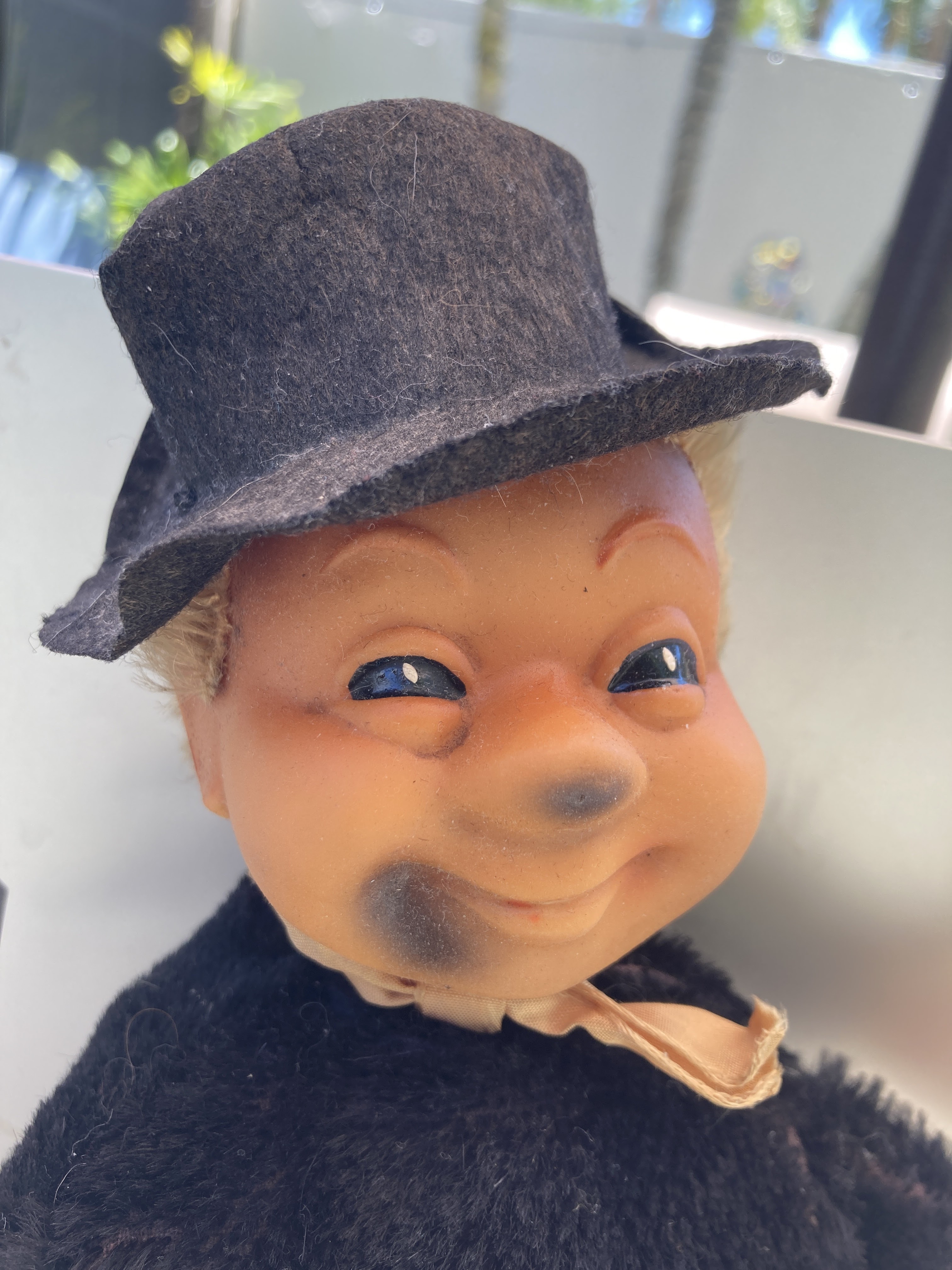
This adorable chimney sweep puppet named Blacky is 17 cm tall. His head is made from a soft rubbery material. He has a plastic finger tube inside his head. His hair is once copper colored mohair, and his body is jet back mohair. His oversized hands are made from felt and are lightly stuffed with excelsior. He wears a traditional black felt top hat and carries a black plastic ladder. His face comes to life with black and white painted eyes and some not-so-random coal smudges. His "outfit" is accessorized with a partial black leather belt and a neck tie. This puppet rarity was made in this size only in 1964.

The chimney sweep profession goes back as far as the 16th century in Europe. According to legend, chimney sweeps have been associated with ushering in health and happiness. As such, many brides in the past would have their chimney swept on their wedding day. Steiff probably added a chimney sweep to its line because of his centuries-long reputation as a good luck charm. 


Blacky debuted in the company's "New Models 1964" catalog.
This four page, full color brochure featured a number of now rare Steiff novelties, including a few that also were made for one year only. Steiffgal refers to these sorts of treasures as Steiff's "One-derfuls." Blacky is pictured on the back page of the catalog, and you can see that part of that page here above. You can also click on the image to make it bigger. 

His neighbor in this catalog is none other than Steiff's equally as rare and interesting Sneba snowman puppet. Sneba is 17 cm, unjointed, and made from white dralon. His face comes to life with button black eyes, an orange felt carrot nose, a red stitched mouth, and a touch of pink blush on his cheeks. He has two black "coal" woolen pompoms on his chest. Like his buddy Blacky, he wears a black felt hat and was made in one size only in 1964. 

You might just recognize Blacky's mug - as the same mold was used for a number of other rubber headed puppets in the 1960s through 1980s.
These include Happy the clown, Hansel and Gretel puppets, a princess, a modernized Shockheaded Peter, and even a grandmother, among others. It is interesting to see how this mold was used to represent male and female characters of all ages. And there is precedence for "recycling" facial molds on Steiff's dolls and puppets. If you look carefully, Steiff's beloved and legacy Dwarfs Lucki, Pucki, and Gucki all have the same face.... and share those good looks with the company's rubber faced Santa Claus dolls of the same era.

Steiffgal hopes this discussion on Blacky the Sweep has been a happy windfall for you.

Have a question about one of your Steiff treasures? Let's talk! Click here to learn more.

Thursday, February 15, 2024

Does This Steiff Prewar Tom Cat Tickle Your Whiskers?

This great Steiff inquiry walked in on little cat's feet!
And talk about launching a collection with a rockstar! A new friend from Germany writes about her debut vintage Steiff purchase. She is curious about its birth year, give or take a bit. Rebecca shares,

"I bought my first vintage Steiff animal and it's the famous Tom cat. As I know that she was produced over many many years I'm now super curious which exact time it was that mine was produced. It's the smallest one. And it has the old button with the long "f" at the end. So I think that means that it can be between 1923 and 1953, right? Do you think you can say it more specific? I just can't find more information. Kind regards from Germany!"

Wow, Rebecca's purchase is truly the cat's meow
. It is Steiff's mid- to later prewar Tom cat. This fantastic feline was made for the standard line in 8, 10, 14, 14, 22, and 28 cm from 1923-1943 overall. The 8 cm and the 10 cm versions had a pitch black velvet body and a fuzzy black mohair tail. From 14 cm onward, all sizes were made entirely from black mohair. These cats were technically measured vertically, from the top of their heads to their toes. Their long vertical tails almost "doubled" their height measurements. They were detailed with green and black round or slit glass pupil eyes, a simple hand embroidered mouth and nose (Steiffgal has seen both pink and red examples), and clear monofilament whiskers. They left the factory wearing a decorative silk ribbon and sometimes a little bell to match. The bow on Rebecca's example is not factory original. 

Now back to the question - his birthday.
The best telling clue here is that he has the short trailing 'f' style button. This button appeared on items in the line from about 1936 through the very early 1950s. So we know that the earliest the cat was produced was 1936. As noted above, this particular cat with a black velvet head and body and mohair tail was made in 8 or 10 cm from 1933-1943 overall. This skinnies down his production timeframe to most likely in the c. 1936-1943 timeframe. So he's clearly from the late prewar period. 

One thing that's nearly purr-fect about this feline pattern is how long it has appeared in the Steiff line.
 The earliest version made its grand public debut in a photograph featured in the 1903-1904 Steiff catalog... in the same picture that introduced PB55... the world's first jointed Teddy bear! This puts Tom in very good company for sure. This photo is here on the left - you can click on it to make it bigger. And Tom CONTINUES to make guest appearances in the line on and off to this day in the form of replicas and special editions. His timeless, universal popularity and appeal have truly earned him legacy status within the Steiff collecting community.

Steiffgal hopes this discussion on Steiff's prewar black Tom cats has tickled your whiskers in a most happy way. 

Have a question about one of your Steiff treasures? Let's talk! Click here to learn more.

Saturday, September 9, 2023

Does This Lifesize Steiff Sheep Call To Ewe?

Sometimes it's ok to be a little sheepish.
Especially when it comes to delightful Steiff button-in-ear mysteries like this one! Check out this fabulous and fuzzy farm friend who just might be larger than life. What do you think? Danna shares, 

"Could you offer any assistance in figuring out the mystery of the sheep? His coat is darker and the feet are different than the two I found on the web, his eyes also have different centers and there is no yellow tag in the front. I think it's older. Any help would be appreciated. Thank you!"

This member of the flock truly rocks!
What we have here is a great example of one of Steiff's rarer studio, or life-sized sheep. He is standing on all fours, unjointed, and made from now faded brown tipped wool plush. His legs and ears are made from white wool plush. His inset muzzle is detailed with oversized green and black slit pupil eyes, a simple mouth and nose, and airbrushed highlights. He is solidly stuffed with excelsior and most likely has a metal skeleton inside to support his size and weight. He left the factory wearing a Steiff chest tag, but this has been lost to time. These brown tipped sheep were made in 80 and 90 cm from 1966-1967 only. The 80 cm version is also standing but his head his bowed to the ground as if he is nibbling on the grass. 

It is interesting to note that Steiff also created a 95 cm standing display ram produced in the same brown tipped wool plush as Danna's life-sized sheep. 

Now let's shepherd this sheep discussion to his IDs.
Danna's sheep has a product number of 1590,90 which is the 90 cm version made in 1966. Those made in 1967 have a product number of 3459/09. His numbers correspond as... 1= standing, 5= wool plush, 90= 90 cm, 9= display animal or special edition, and 0= normal (in reference to coloring.) Here on the left you can see these tipped sheep as they appeared in Steiff's 1967 studio line catalog.

Steiffgal hopes this discussion on Danna's sheep has put ewe in a great mood today. 

Have a question about one of your Steiff treasures? Let's talk! Click here to learn more.

Thursday, November 17, 2022

This 1930s Steiff Tail-Turns-Head Novelty Is Simply Ele-Fantastic!

Steiff wishes can come true! Check out this note from Carey, a new friend from north of the border. She was gifted a jumbo surprise from her husband - one that just happens to be simply ele-fantastic. Steiffgal is certain you'll agree. She shares in part:

"Hi Steiffgal! I’m emailing from Ontario, Canada. Yesterday my husband gifted me an amazing find from Kijiji from an elderly couple who were downsizing. The elephant belonged to the woman’s father, and they immigrated to Canada from Poland.

Our new blushy pink/mauve Steiff elephant, based on what I could find from the button, is I think from the 30s. The tail makes the head move in a circle and the trunk is posable. It’s stuffed with straw, and due to the wear of the mohair around the foot pads, which are heavy felt, you can see black toes stamped onto the fabric. It’s about 8" tall, and the body excluding the tail and trunk is about 10" long. If it made any sounds when it was new, it doesn’t now."

There's not a drop of junk in the truck when it comes to this playful pachyderm.
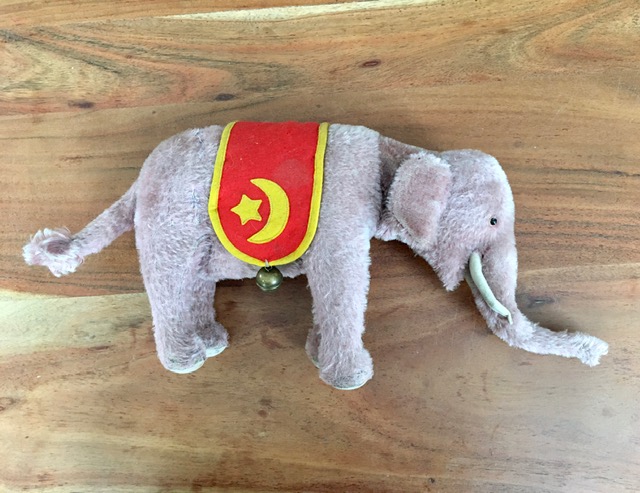
This tail-move-head example is standing, head jointed, and made from mohair which has mellowed to a light pink color over time. This sometimes happens with originally grey mohair over time. His pads are made from grey felt, and his prominent tusks are made from white felt. He comes to life with floppy ears, black button eyes (which may be backed in felt - but it’s not clear from his photos) and a smiling, open mouth. His red and yellow felt blanket with bells is original to him. When you twist his mohair tipped tail in a circle, his head moves 360 degrees as well. This amazing tail-moves-head elephant was produced in 18, 23, and 29 cm from 1931-1934 overall; Carey's example is most likely the 18 cm version.


Steiff introduced its patented tail-moves-head line in 1931.
These nifty novelties were made with an internal metal movement mechanism that enabled the heads to move in a circle when the tails were rotated. These items were stuffed with excelsior to hold this mechanism firmly in place. Tail-moves-head animals appeared in the line from the early 1930s - early 1940s; over time, about 25 different examples were made. The line included cats, dogs, rabbits, penguins, goats, and lambs, and even Mickey Mouse! Most were based on popular designs of the ear, but a few - like a bulldog - were brand new patterns. These tail-moves-head items were considered luxury toys of the time. You can see Carey's elephant in action in the video above. 

Carey's elephant appeared on the cover of a 1931 marketing brochure titled "1931 Addendum to the Main Catalogue."
The other "cover girls and boys" included a Scotty, penguin, tabby Bulldog, Rattler Terrier, Molly, chimp, Fox Terrier, lamb, cat, and goat. The copy on the brochure, in part, translates to:

"The year 1931 has presented us with the animals with the new head movement… The simplicity of the mechanism, though which the splendid movement is produced, cannot be beaten, yet it is unbreakable and allows lifelike play, full of variety and mimics… When buying new supply in plush toys please be sure to include the STEIFF animals with the new head movement; all numbers equipped with it are marked ‘H.’" You can see this brochure cover here on the left; you can click on the image to make it bigger. 

Steiffgal hopes this discussion on this really rare elephant has made a huge impression on you.

Have a question about one of your Steiff treasures? Let's talk! Click here to learn more.

Thursday, August 11, 2022

This Steiff Primate Makes For One Fantastic Tale Of A Tail!

Now we are truly on a roll!
Steiffgal recently returned from a trip to St. Louis, MO to celebrate all things dolls, bears, and toys at the 2022 United Federation of Doll Clubs annual event. The salesroom associated with this gathering always has some of the finest Steiff temptations on offer - and this year did not disappoint! Check out this charming and unusual Steiff primate on wheels Steiffgal found on opening night of the festivities. You'd have to agree - he makes for one heck of a souvenir!

This handsome and unusual prewar Steiff sweetie pull toy is "officially" named Record Peter. He is 18 cm and fully jointed. He is made from white mohair. His hands, feet, face, and ears are made from tan colored felt. His pensive face comes to life with green and black glass pupil eyes, a seamed mouth, and light purple-ish and pink colored airbrushed highlights on his nose area and forehead. He rides upon a black metal, four-wheeled cart. The centered wheels are solid wood and painted red. When Record Peter is pulled along, his arms and legs move back and forth vigorously, giving the appearance that he’s working hard to keep his cart moving. When he left the factory in Giengen, Germany about a century ago, he had a pull cord attached to the front of his vehicle. Record Peter retains his long trailing "f" button and traces of his white ear tag as his Steiff IDs.

Prewar, Record Peter appeared in the standard Steiff catalog in 10, 15, 20, 25, and 30 cm in deep chocolate brown from 1913-1943 and in white in 18 cm from 1925-1934. He was also produced in a few other "surreal" colors, including blue, yellow, green, red, and black! These hues are so incredibly rare that Steiffgal has only seen photos of them. Given this Peter's ID configuration, it is Steiffgal's best thinking that he was "born" in the very beginning of his manufacturing time frame.

Now let's take a step back and look at one of the features that makes this Record Peter so unusual - in addition to his white mohair. If you study his rear end (and its ok to stare in this case) you will notice he has a tail. Unlike many other standard line tail-less primates produced by Steiff, this model indeed has a long, thin mohair tail. This appendage probably was challenging to manufacture, given its size and shape.

Here on the left, you can see the 1929 catalog page advertising some of the company's primate line for the year.
 You can click on the image to make it bigger. This page has a subtle bit of information that adds some insight to the tail issue. Here, items noted as product category "9" are chimpanzees, while items noted as product category "10" are monkeys or Record Peter items. From the scientific perspective, chimps, gorillas, and orangutans do not have tails – classifying them as "apes." Those primates with a tail are classified as "monkeys." That is why the tail-less brown mohair "Jocko" pattern we know and love is considered a "9". However, it is curious that a white, freestanding mohair primate with a tail on this page is classified as a "9," suggesting it should NOT have a tail. Perhaps something here got lost in translation?

On the way bottom on the right of the catalog page, you can spot the white primate on wheels under discussion today.
 A close-up of him is here on the left. 
You can click on the image to make it bigger. The copy reads, "Record-Peter, Speedaway movement of amusing effect. No clockwork or mechanism to get out of order, simply pull cord. Strong colored wire frame, varnished wood wheels, voice, each in a box." He is also noted as product number 10/318 (10 = a Record Peter, 3 = sitting, and 18 = size in cm); that he weighs .31 kilograms (which was important for shipping and logistics) and that he was packed one to a box.

Steiffgal hopes you've enjoyed this tale of a tail detective story!

Have a question about one of your Steiff treasures? Let's talk! Click here to learn more!

Sunday, November 21, 2021

Good Things Come In Threes At Teddy Dorado's December 4th, 2021 Sales Event!

Care to go for the gold? Then check out the upcoming Steiff auction presented by our friends at Teddy Dorado auction house! Their signature winter sale, to be held on December 4th, 2021, features more than 400 new, vintage, and antique button-in-ear temptations - with new goodies being listed regularly. Here are three outstanding lots that caught Steiffgal's eye - and why. 

The first lot is a sweet-tweet-treat indeed.
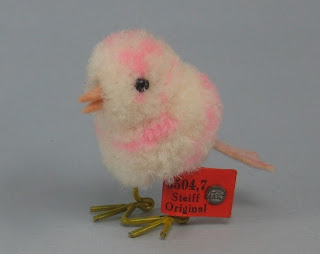
Steiff's earliest prewar woolen miniatures are loved and collected universally - with the rarest ones frequently realizing four figures at auction. Its hard to resist lot #28-4023, which is cataloged as, "Songbird made of white & pink Nomotta wool; black glass eyes; Beak made of skin-colored felt; white felt tail with pink stripes on both sides; Metal legs painted yellow & in perfect condition; Head rotatable & body tillable; approx. 4 mm large FF button slightly rusted, but not visible to the naked eye; red Steiff flag preserved in the best possible way; very clean, absolutely lightfast, odorless & completely unplayed; Premium top condition. approx. 4 cm high." 

This pretty-in-pink treasure has an opening bid of 1,000 Euro.

Bird's the word with this lovely treasure which is fantastic on so many levels. It is amongst the absolute earliest woolen miniatures ever made. This sweet bird design debuted in 1931, the first year Steiff's woolen miniatures were produced on a commercial scale. It was manufactured in six color combinations in 4 or 8 cm. Don't you think his color - pink - is WAH-HOO good? This example is the only Steiff woolen miniature prewar bird that Steiffgal knowns of featuring this great and novel hue. And the condition looks to be as close to like-new as humanly possible. 

You'll be all ears over this next auction highlight.
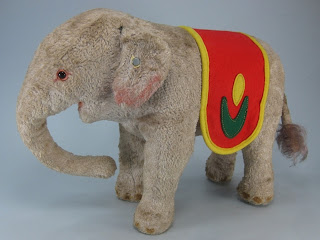
His expression, era, and materials are all so ele-phantastic. He is lot #28-4021, and is cataloged as, "Play elephant, made of light gray rayon plush; black glass eyes underlaid with pink felt; open mouth made of skin-colored felt; Tail tip made of mohair; tightly stuffed with wood wool; large double pressure voice defective; Saddle pad made of red, yellow & dark green felt; approx. 6 mm large, bright silver, shiny & shiny button in the ear; white paper ear tag missing; Artificial silk plush & felt without annoying flaws; very clean, absolutely lightfast, odorless & unplayed; Top condition approx. 21 cm high & without tail approx. 27 cm long." 

This playful pachyderm has an opening bid of 200 Euro. 

It's interesting to note that this distinctive elephant's "birthdate" is not specified. This great design bridged the pre- and postwar periods. It was produced in artificial silk plush in 17, 22, and 28 cm from 1938 through 1943 overall, and postwar in 22 cm only in 1948 though 1949. Given this big baby has a blank button and traces of his yellow ear tag, it is a safe bet that he is a postwar version. He's unforgettable for sure, don't you agree?

And good things come in threes with this final auction highlight.
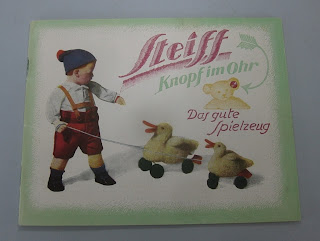
Steiff ephemera - catalogs, photographs, sales sheets, postcards, and other paper items associated with the company - is a fun, educational, and visually exciting complement to a button-in-ear collection of any era. If you are interested in the company's 1920s era production and aesthetic, be sure to check out lot #28-4003, which is cataloged as, "Customer brochure "The good toy" A6 +, 36 pp. 1925–1926 without Steiff printed matter no. German Premium Steiff customer brochure "The good toy" for Germany in the format approx. A6 plus landscape with 36 pages; inside black and white with a light green border; Text in German & without prices; Title shows Schlopsnies doll Theo with two yellow mohair (pulling) ducks, each lying on eccentric wheels; without printer's note or Steiff printed matter no .; original Steiff brochure & no reprint; very clean, absolutely lightfast, odorless & completely unread; Premium top condition." 

This time capsule quality brochure has an opening bid of 100 Euro. 

It's hard to picture a more interesting collection of images than those that appear in this great catalog. It features illustrations of the company's very rare mid-1920s white chimp with a tail, little known wooden toys on wheels, and charming, lifelike, and toddler-esque Schlopsnies dolls, among many other outstanding characters. And what makes these visuals so heartwarming is that they show our favorite button-in-ear favorites in playful and interactive vignettes... as if they were truly alive! Flipping through this period catalog is like taking a trip back in time, in the best possible way.

Steiffgal hopes this discussion on some of Teddy Dorado's upcoming sale highlights has been almost exciting as a live auction event!  Check out the entire catalog for this December 4th sale by clicking here. 

Have a question about one of your Steiff treasures? Let's talk! Click here to learn more.

Saturday, August 28, 2021

This Pretty, Prewar, And Purple Steiff Princess Rains Supreme!!

WARNING! You are about to get all out joint over today's blog special guest!
This pretty kitty has just about everything going for her, including her looks, color, era, and "secret skill." Check out this fine feline and see what makes her so fabulous from the design and collector's perspective. 

This (now) purple kitten rains supreme. Here we have Steiff's fully jointed "Kitty." She is 15 cm tall and 21cm wide, not including her impressive tail. She is made from blue/black tipped mohair that has faded overall and evenly to a delightful, dark purple hue. Her underbelly, ears, muzzle, feet, and the tip of her tail are made from white mohair. Her face comes to life with a pink hand embroidered nose and mouth and teal green and black slit pupil eyes. Kitty was produced in 15, 18, 21, and 23 cm from 1931-1935. This example retains her long trailing "f" button as her Steiff ID. 

But wait, there's more!
Kitty's long tail is functional as well as aesthetic. This model is actually a tail turns head model, meaning that when her tail is rotated in a circle, her head follows in tandem. This technology was patented by the Steiff company in the early 1930s and basically consists a system that connects the head and the tail through a series of internal metal connectors and joints. 

Head jointed animals were an important part of the Steiff line in the early 1930s. Over time, about 25 different tail turns head models were produced through the very early 1940s. For the most part, these were based on the best selling standard line patterns of the time and included cats, dogs, rabbits, penguins, goats, and lambs, and even Mickey Mouse, among others. However, as far as Steiffgal can tell, this Kitty was one of the few tail moves head items that was only made as a tail moves head animal and not produced in any other form. It is interesting to note that she is neither pictured or mentioned in Steiff's 1931 novelty catalog where many of the other tail moves head animals debuted. 

Now, let's use some colorful language to describe her hue.
Today, Kitty is a marvelous shade of deep purple. But she did not start out life that way. According to Pfeiffer's 1892-1943 Steiff Sortiment, this model was produced in "blue/black tipped" mohair. But it has clearly mellowed to a pretty purple color over time. Another wonderful novelty produced with "blue/black" mohair at about the same time as Kitty was Steiff's King Peng penguin. You can see and example of a King Peng here on the left, the photo is from Christies. Today, when you find a King Peng, often his once blue/black mohair has become a similar purple color as Kitty's. As such, Steiffgal suspects that Steiff's 1930-era blue/black mohair was produced with a dye or dyes that oxidized or somehow had a chemical reaction with air or moisture over time. If this color change was due to something simple like direct sunlight, the change would not be so even or so consistent.

Steiffgal hopes that this discussion on this pretty purple princess has crowned your day.

Have a question about one of your Steiff treasures? Let's talk! Click here to learn more.

Sunday, April 25, 2021

Getting Down To Monkey Business With This Lovely And Very Early Steiff Chimp

Do you like Steiff's cheeky monkeys? Of course you do! This very early and very sassy girl named Clara recently joined Steiffgal's hug and she's understandably just bananas over her. Come take a look and see what makes Clara so interesting from the design and product development perspectives. 

There's no monkeying around when it comes to this precious primate!
Clara measures 24 cm sitting and 40 cm standing. She is fully jointed and made from white mohair which has mellowed to a vanilla color over time. She has a long, thin mohair tail that is lined in wire and is posable. Her hands, feet, facial mask, and ears are made from white felt. Clara has a non-working squeaker in her torso. Her face comes to life with simple black button eyes, a seamed mouth, and a few stitches around her nose. Clara's pattern was produced in 28, 35, 43, 50, and 60 cm (measured sitting) from 1908 through 1915 overall. She is probably a petite version of the standard line 28 cm version. 

This charming chimp was introduced at a very interesting time in the company's product development timeline.
Clara is based on an almost identical brown, fully jointed mohair monkey with a tail design that was introduced in 1904. The brown version was produced in 28, 35, 43, 50, 60, 70, 80, 90, and 120 cm from 1904 through 1919 overall. Mohair became available on a commercial scale in Germany around 1903, and this added whole new dimensions and possibilities to the company's product design options. This fully jointed, playful chimp design translated beautifully in this appealing and soft-to-the-touch fabric. 

You can't also help but notice Clara's facial construction.
This monkey pattern has a very endearing, human-like expression.  And, like the company's earliest cloth dolls introduced in 1903, has a prominent vertical seam that goes the entire length of her face. This feature emphasizes how symmetrical her face is, as well as enables a pleasing roundness to her construction. Steiff's doll line featured this similar detailing through the late 1920s. However, when it came to Steiff's monkeys, it is interesting to note that this center seamed pattern was quickly eclipsed by the company's mostly smooth felt faced mohair Jocko monkey pattern, introduced in 1909.

It's always fun to take a look at original advertising for early pieces such as this. 
Here on the left you can see the listing for this fully jointed, white mohair monkey from the company's 1912 United States catalog. It was published in conjunction with George Borgfeldt & Company, Steiff's American distributor at the time. This pattern is noted as joined and made from fine plush in brown and white. In 1912, the white version was available in 28, 35, and 43 cm. At the time, the 28 cm version cost $1.10, the 35 cm version cost $1.70, and the 43 cm cost $2.20. In 2021 dollars, that is the equivalent of about $30.04, $46.42, and $60.08, respectively.

Steiffgal hopes you've found this discussion as entertaining as a barrel full of monkeys!

Have a question about one of your Steiff treasures? Let's talk! Click here to learn more.

Thursday, December 24, 2020

A Century of Steiff's Santa Claus Production

The big man in red is in the house - just about! In honor of Santa's imminent arrival, Steiffgal wanted to share this article on Steiff's vintage Santa dolls with you. She prepared it originally for Auction Daily and also appears on their website. 

Margarete Steiff GmbH, the legendary toy company from Germany, has created a number of irresistible Santa dolls over the years. For many families, especially of German descent, Steiff dolls are just as much of a holiday tradition as trees and stockings. That’s easy to understand, given their appeal! Let’s take a look at some of the highlights of Steiff’s Santa Claus dolls.

The earliest references to Christmas in Steiff’s collateral appeared in the early 1910s, when the company produced holiday advertising featuring standard line items under trees and used as ornaments.
However, none of the items featured were specifically made for Christmas. The first Santa Claus appeared in the general line in the early 1920s, but it was not a doll in the traditional sense. It was a 20 cm wooden Santa Claus toy on a rocking base. Rocking Santa was featured in the catalog from 1923 through 1927. According to the 1924 catalog, this “wobbly figure“ cost 2.5 marks and was “made of the best wood, finely crafted, and colorfully painted with luminous colors.“ You can see this early Santa pictured here on the far left. 

Christmas became a higher priority for Steiff in the early 1950s, when the company was re-establishing its presence as a leading international toymaker post World War II.
Like Santa at the helm of his sled, racing across a dark wintery sky, the arrival of a Steiff Santa doll in 1953 was a very welcome sight indeed. Steiff’s earliest Santa doll was 31 cm and five-ways jointed. He had a rubber head, felt body, bright red felt suit and cap, and a white, fluffy mohair beard. By 1955, this design was also produced in 13 and 18 cm. These Santa dolls appeared in the line through 1963 and were, and remain, year-round favorites with collectors worldwide. The 13 and 31 cm versions are pictured here on the left. 

Due to his popularity, Steiff’s Santa Claus doll pattern was also made as a 21 cm hand puppet from 1954 through 1961.
This puppet had a molded head identical in design to the full-bodied doll. He was detailed with a white full mohair beard and hair, felt hands with stitched digits, and a felt body. He was a little larger in scale than other hand puppets of the time, which generally measured 17 cm. He was dressed in a handsome red felt jacket and hat. His outfit, like the doll from which he was based, was detailed with real white mohair trim down the front of his coat, around his hat, and around his cuffs. His hat was topped off with a white wooly pom-pom. You can see this happy handful, pictured here on the left. 

One of the most astonishing of Steiff’s Santa Claus dolls is the company’s display or practically life-sized version.
This big daddy- 150 cm, or nearly 5 feet tall -was manufactured in the 1960s. These supersized Steiff Santa dolls were dressed to the nines in fine felt tailored suits trimmed in mohair, just like their rock star namesake! Today, these are extremely rare, as, for the most part, time has not been kind to them. Because their faces were made from rubber, they tend to dry out, sink, and crack as the years go by. Few were made, and not too many are still around, making existing examples as rare as hen’s teeth. Here on the left you can see this display doll; he is pulling a wagon-full of some of the company's most popular mid- 1960s era animal designs. 

In the 1970s, due to pressure from other toy manufacturers, Steiff began economizing on their design and production to control costs and stay competitive.
They produced a series of unjointed, inexpensive, and cone-shaped plush dolls and animals in the “Buzzel” style. One noteworthy example of Steiff’s 1970-era Buzzel production is the company’s 20 cm standing Buzzel Santa Claus doll. He is made from red and white dralon material and felt, with a long, white dralon beard. His face is precious and simple; he has small blue felt eyes, a round peach colored felt nose, and a tiny red circle for his lips. Santa is wearing his traditional Santa suit which is integral to his body. He carries a brown Santa sack, which has a little bell in it. This particular doll was produced in this size only from 1972 to 1974. These dolls were designed for fun, play, and love so, it is really rare to find one in collectible condition nearly half a century after manufacturing. A nice example of Steiff's Buzzel Santa is pictured here on the left. 

From the 1980s onward, Steiff’s line regularly featured Santa Claus-themed items and novelties. Although a few humanized Santa dolls were issued, most of these editions were in the form of Teddy bears dressed as the merry man in red. These have included holiday ornaments, soft baby toys, musical items, and even nutcrackers, smokers, and festive candelabras. Given his legacy status, the company’s 1950s-era Santa doll was reissued in 19 and 28 cm as a US exclusive from 1984 through 1988. This happy fellow is pictured here on the left. However, many enthusiasts who came of age with Steiff consider the company’s 1970 and early-era Santa Claus items to be the most authentic representation of the Steiff holiday spirit.

Steiffgal ho-ho-ho hopes this discussion on Steiff's vintage Santa dolls has put you in the Christmas spirit!

Have a question about one of your Steiff treasures? Let's talk! Click here to learn more.

Sunday, September 27, 2020

A Vintage Steiff Picture Is Worth A Thousand Words!

What's old is new again when you recreate it using older Steiff friends! One thing Steiffgal has noticed, especially on really image-centric platforms like Instagram and Facebook, is that folks are "recreating" scenes from their childhood as adults - and often incorporating original props, backgrounds, or outfits. These are usually really fun, and cheerful, and show the effect of time on people, beloved artifacts, and settings. Here on the left you can see Steiffgal attempting to "recreate" a fantastic Steiff image she found online. This little girl is NOT Steiffgal, but they clearly share the love for fantastic vintage button-in-ear playthings. 

As Steiffgal was preparing for another Steiff project, she came across a charming company catalog from the late 1930s. This prewar brochure from her collection was printed in sepia tones and featured a number of utterly adorable product vignettes that really called to her - including this one of two farm friends and a cat-doll on a little stroll. So she thought... let's bring this to life again! You can see this vintage image here on the left. 

A picture is worth a thousand words - especially those featuring some of our most beloved vintage button in ear friends. Steiffgal has "recreated" this image using analogous items from her own collection; you can see this attempt here on the left. The calf is standing, unjointed, and made from white and light brown wool plush. He was produced in 14, 17, and 22 cm; Steiffgal's version is the 17 cm size. The lamb is standing, unjointed, and made from white wool plush with a "lumpy-bumpy" texture. He was made in 14, 17, 22, and 28 cm; Steiffgal's version is the 14 cm version. And the cat doll is standing, head jointed, and is available dressed in a number of different outfits. She was made in 22 and 28 cm; Steiffgal's version is the 22 cm version. 

It's always fun to use the information documented in vintage ephemera to learn a little bit more about the items being promoted. In this case, we can use the prices listed to figure out how much they would "cost" today. So, here's how each item noted was priced in 1938, and the approximate cost of each today in US dollars using an inflation calculator:

  • The 14 cm calf was 1.90 DM, which is about $14.01 in 2020.
  • The 17 cm calf was 2.50 DM, which is about $18.43 in 2020.
  • The 22 cm calf was 3.50 DM, which is about $28.81 in 2020.
  • The 14 cm lamb was 1.90 DM, which is about $14.01 in 2020.
  • The 17 cm lamb was 2.50 DM, which is about $18.43 in 2020.
  • The 22 cm lamb was 3.50 DM, which is about $28.81 in 2020.
  • The 28 cm lamb was 5.00 DM, which is about $36.87 in 2020.
  • The 22 cm cat doll was 2.50 DM, which is about $18.43 in 2020.
  • The 28 cm cat doll was 3.50 DM, which is about $28.81 in 2020.

Steiffgal hopes that this discussion on recreating vintage images has been a picture perfect experience for you!

Have a question about one of your Steiff treasures? Let's talk! Click here to learn more.

Wednesday, August 19, 2020

Sending Gigantic Midcentury Teddy Hugs To You!

Steiffgal's got news.
Really big news! Super-humongous news! A brand new cub has joined her hug, and she couldn't be more excited or pleased. But this isn't just any Ted, he's really in a class all to himself. Come learn more about this bouncing bundle of joy and what makes him so interesting from the design and historical perspectives.

This big, beautiful bear is of course a huge Teddy baby. He measures 40 inches or 100 cm tall. He is solidly stuffed with excelsior and weighs a whopping 16 pounds. He is five ways jointed and made from glowing, long shaggy blonde mohair. His inset facial muzzle and the tops of his flat toddler feet are made from shorter matching blonde mohair. His nose and claws are hand embroidered in brown. He has a smiling, open, peach colored felt lined mouth and a touch of tan airbrushing to give his face a bit more definition. The same peach colored felt lines his paw pads. His eyes are oversized, brown and black pupil style. And he wears a blue leather color that is decorated with a bell and 16 raised script style buttons. His working growler is activated by a metal pull string and loop on his back.

The Teddy Baby pattern is a legacy one for Steiff.
It debuted in 1929; pre-World War II, Teddy Baby was made in 9, 12, 13, 15, 20, 22, 25, 30, 35, 38, 40, 45, and 65cm sizes. It is interesting to note that Teddy Baby was one of the very first items Steiff started producing when the factory in Germany opened after the war. Due to limited supplies and logistical complications, he was made in artificial silk plush in 1948. Then, once supplies and operations were back in order, he was produced in blonde or brown mohair in 9, 22, 28, 30, and 40 cm in the identical pattern made before the war. All sizes over 9 cm came with a leather collar with a bell. Teddy Baby remained in the Steiff line from 1949 to 1957, although due to his popularity with collectors, has been replicated many times in numerous limited edition series. Here above you can see a variety of early postwar standard line Teddy baby bears ranging from 9 to 40 cm. 

So... what's the history behind this larger than life version? He's only had one family, so Steiffgal was able to get the entire scoop on him from his original owners. Here's what she learned. This bear was purchased in about 1950 from Macy's on 34th Street in New York City. The woman who Steiffgal purchased this bear from was a little girl at the time and accompanied her father to the store to pick out a special present for her mother. Their mom loved Teddy bears, so of course Steiff would be a perfect fit for this mission. The two walked into Macy's toy department and saw him there... and it was love at first sight! They bought the bear right away for $100 at the time. Today, $100 in 1950 dollars has the buying power of almost $1,100 today! A pretty penny both then and now. Mom loved the bear, and treated him like a prince - bringing him out once a year to add to the family's Christmas celebrations. 

Size defies in a number of ways when it comes to this Ted.
Clearly, he is not from the standard line, which topped out at 65 cm early postwar. Steiff did make a display, or studio sized brown mohair Teddy baby in 60 inches or 150 cm in the mid-1960s. You can see the 1967 catalog page promoting this bear above. And, he's not a "one of a kind" as other almost identical one was sold at auction a few years back. It is Steiffgal's suspicion that this bear in this size may have been produced in very low numbers for "special" or high profile customers around 1950. This was exactly the timing in which Steiff was trying to regain its worldwide distribution, reputation, and visibility right after WWII. As such, it is possible that the company produced these "monumental" sized and styled bears to catch the eye, attention, and wallets of affluent midcentury consumers. And what better place than Macy's in NYC to make that happen!?

Finally, Steiffgal can't emphasize enough the power of a good scrub when it comes to welcoming a new vintage friend into your hug.
Yes, this Ted is GORGEOUS and his original family took extra loving care of him. However, he's been around almost 70 years without a bath... so that's the first thing Steiffgal did when she got him home. Over the course of two hours, he went from totally handsome to POSITIVELY GLOWING with the help of a dozen white washcloths, a light cleaning solution, and lots of elbow grease. You can see his "before" and "after" cleaning photos here on the left.   

Steiffgal hopes this discussion on this huge Teddy baby has brought you enormous joy today.

Have a question about one of your Steiff treasures? Let's talk! Click here to learn more.

Sunday, August 9, 2020

There's Never A Dull Moment When It Comes To Steiff's Wild Boars

Can you be a
 big boar and the life of the party at the same time? Well, yes, definitely if you were made by Steiff! Check out this portly prince - a fine example of Steiff's 1960s era life-sized studio display handiwork - and see what makes him so delightful from the cultural, design, and historical perspectives. 

This happy hog is Steiff's lifelike and accurately proportioned Young Wild Boar. He measures 24 inches wide and 12 inches tall, is unjointed, and standing on all fours. His body is made from longish mohair that has been painted and stenciled in various shades of brown and copper. His mouth is open and lined in felt. He has a felt tipped snout and a long, skinny, twisted mohair tail. His face is detailed brown and black pupil eyes and a few touches of airbrushing. This sweet field and forest friend was produced in this size (cataloged at 35 cm) from 1963-1967. 

One of the things that makes Steiff's production so legendary is the company's ability to create really authentic looking animals at different points in their lifecycles.
This particular example is named Young Boar - and he really looks like his namesake. He was produced alongside an adult boar, who is named Wild Boar. Wild Boar is not just a scaled up version of Young Boar; he has the adult features of this species including a thick brown coat, relatively thin legs and a stocky body, and pronounced tusks. The baby, on the other hand, is most noted for his striped coat as well as more youthful, rounded proportions. You can see the 1967 Steiff Studio display catalog page featuring these two beautiful boars just below. What an impressive family, indeed!

Wild boars have been part of the German culture, cuisine, and ecosystem for centuries.
One even "starred" in The Singing Bone, a German fairy tale published by the Brothers Grimm in 1812. However, one did not show up in the Steiff line until 1952 in the form of a 7 cm velvet young boar. This popular pet was produced through 1973. In 1961, Steiff introduced its first mohair wild boar. The smallest version, at 10 cm, was designed as a baby and made from short airbrushed mohair. The 15 and 20 cm versions resembled adults with spiky mohair. All were standing and unjointed. Steiff's early postwar mohair boars remained in the line through the mid-1970s. And making up for lost time, soft plush adult and young wild boars designed for play have appeared almost continuously in the catalog from the early 1970s onward. 

Steiffgal hopes this discussion on vintage button in ear boars has made you as happy as a pig in muck!

Have a question about one of your Steiff treasures? Let's talk! Click here to learn more.
The teddy bear search engine