Showing posts with label tag. Show all posts

Thursday, June 20, 2024

Remarkable Rarities At Ladenburger Spielzeugauktion's 2024 Steiff Special Auction!

The countdown is on for the most exciting Steiff auction event of the year - Ladenburger Spielzeugauktion's annual Steiff Sonder Auction or Steiff Special Auction! This event is famous for offering WAH-HOO good temptations - as well as producing world record breaking results. This year, it will be held on June 29, 2024 in Giengen, Germany as part of the Steiff Company's annual Steiff Sommer Festival. For more information on the sale, click here!

This year, nearly 230 premier century-spanning button-in-ear treasures will go under the hammer. In addition to rockstar offerings most of us can only dream about - including a google eyed Petsy Bear, a rod bear, and a full set of early skittles - the sale also features a number of hidden jewels. These are items with very special or unique details that really make them extraordinary from the collector's perspective. Here are three that caught Steiffgal's eye... and what makes them so quietly remarkable. 

Let's twist and shout over this first auction hidden jem.
This is lot #28, a Steiff Turbo "Purzelbär" or somersaulting bear. He has an opening bid of 250 € and is cataloged as follows:

"Turbo "Purzelbär" with clock mechanism, arm-wound mechanism and clock mechanism are intact, only produced in 1951, button and cloth tag label number 9315,4, rests of the US zone cloth tag label, 15 cm, original neck label and felt vest, very nice unused condition, rare, only c. 1000 pieces were produced."

In the early 1950s, Steiff made a handful of little known novelties featuring movements that were introduced prewar. These included tail moves head items (which debuted in the early 1930s) in the form of bears and dogs; musical items (which debuted in the late 1920s) in the form of bears, monkeys, cats, and dogs; and a tumbler (which debuted around 1909) in the form of this bear. It is not clear why the company "reintroduced" these old school style novelties postwar, especially given the emphasis on launching new patterns that reflected the contemporary, forward thinking vibe of the times. These early postwar novelties - including this somersaulting bear - only appeared in the catalog for a year or so. This suggests that they were not commercially successful, and/or were expensive and time consuming to produce. Given their very short production time and output, these tumbling bears are extremely few and far between on the secondary market - especially in nice condition like this with IDs. This would be a delightful addition to a collection of midcentury rarities, mechanical novelties, or Teddy bears. 

Steiffgal doesn't want to let the cat out of the bag here, but be sure to check out lot #181 in this signature summer sale.
It is a woolen miniature cat, with an opening bid of 160 €. He appears in the catalog as:

"Cat, produced 1931-1938, with button inscription: Muster, Nomotta-wool, grey/white, lying, swivel head, green glass eyes, height: 6 cm, length: 8 cm, very nice strong colors, extremely rare, exceptional, unused condition."

This pretty kitty is in such lovely condition, with a great presentation and personality. However, what makes her off the charts great is her Steiff ID, which is a MUSTER button. This form of ID was used by Steiff pre-WWII on items considered samples, evolving designs, or prototypes. In general, the button indicated that the item was Steiff property and was not intended for sale or distribution. "Muster" translates loosely from German to English as "pattern" and in a sense, these "muster" items were just that. And, the button is located on her ribbon. This is probably because her ears are not large enough to handle the button. The combination of her condition, unusual ID, and its atypical placement, truly makes her the cat's meow among the woolen miniatures on offer in this fine sale. Purrr-fect in every way. 

And finally, tag - you're it - with this last auction rarity with a happy ending. 
This lot is #147, a Steiff tail turns head Rattler sitting dog. It has a starting bid of 160 € and is cataloged as:

"Rattler, with mechanism for turning head, produced 1931-1942, with button, chest label and cloth tag label, number on cloth tag label: 3310H, red inscription Raddler INT. PAT. APPID. FOR, and with separate paper label: "dreh mich hier herum, ich schau rundherum", 12 cm, colouring is fine shaded, very nice original condition."

This little fellow has two big features that make him a top dog in this exciting sale. The Rattler tail turns head pattern in itself is charming, but not terribly rare. Overall, he appeared in the Steiff line in 8, 10, 14, 17, 22, 25, 28, and 35 cm in the 1930 through 1943 time period. So, it's not challenging to find one these days. However, this particular example, in addition to being in lovely condition, retains his most coveted "tush tag." This is a round cardboard tag on his tail that reads "turn here and I will move my head." These instructions appear in German, English, and Spanish. What's amazing about this is that these moving marvels were designed as fun toys for kids. So it's a miracle that this tag was not removed or lost to time, given its postioning and ephemeral nature! This guy also gets a shout out for his great IDs, including his legible red ear tag. Noted on its is his article number, which is 3310H. This corresponds to 3=sitting, 3=mohair, 10=10 cm tall, and H=tail moves head feature. 

Steiffgal hopes this discussion on these secretly special auction picks has meant a lot to you!

For more information on this June 29, 2024 sale, please check out the company's website at https://www.spielzeugauktion.de/.

Have a question about one of your Steiff treasures? Let's talk! Click here to learn more.

Saturday, April 22, 2023

Tag, You're It With This Rare Steiff Badger And Her Equally Fabulous Bonus ID

Steiffgal doesn't want to badger you about this, but have you checked out this fantastic Steiff rarity? This well designed field and forest friend only appeared in the Steiff catalog for two brief years. So blink and you would have missed her! Come Dig a little deeper and learn more about this wonderful member of the weasel family... and her most unusual "bonus" ID. 

This happy handful is Steiff's Diggy badger.
She is 10 cm tall, standing on all fours, unjointed, and made from tipped cream mohair on the top, white mohair on her head area, and black mohair on her bottom section. Her sides and face are beautifully airbrushed with tan and black highlights, giving her a most realistic look. Her tiny ears are made from mohair. She has black felt foot pads, round brown and black pupil eyes, and a simple black nose and mouth. Diggy was produced in 10 and 17 cm from 1963 through 1964 only, making her very rare on the secondary market.

Little Diggy and big Diggy are almost identical, except for one interesting detail. Big Diggy has four white felt triangular shaped claws on each of her limbs, while little Diggy has none. These finger and toe nails remind Steiffgal of those on another Steiff rarity of the same time, Zooby the bear.

In addition to her standard Steiff IDs, this particular example also has an additional tag stapled to her ear.
It is a green linen tag with the word Steiff in cursive letters across the top, and the words Commonwealth of Pennsylvania Department of Labor and Industry in tiny letters encircling a crest with the number "55" on it. What's that all about?

Steiffgal did a little digging (pun intended) and it turns out that the State of Pennsylvania, here in the United States, has something called the Stuffed Toy Law. According to the official PA government website, this law establishes a standard of safety for stuffed toys distributed throughout the Commonwealth. 

This is how this law works, according to this website:
"The Bedding and Upholstery Section receives samples of toys and checks them for flammability, contents and safety of design. Manufacturers of stuffed toys intended for distribution in Pennsylvania by sale or as gifts must be registered with the Department. Stuffed toys must have a tag attached identifying the Pennsylvania registration number of the manufacturer. This tag indicates to the consumer that the toy has been reviewed by the Department and the manufacturer has registered with the Department."

So now let's figure out what we can deduce, and not, concerning this state law. It is interesting to note that  this law was put into place in 1961, just a few years before Diggy debuted in the Steiff catalog. So that timing and her tag align. And it is safe to assume that this particular Diggy started her life in America in PA. But three aspects of her tag remain somewhat of a mystery. 

  • First, it is possible that the number "55" on the tag is Steiff's "official" registration number in the PA system, or it could mean something else. 
  • Second it is not clear who registered Steiff to distribute its products in PA in the early 1960s. It could have been the company itself, or one of its distributors at the time like Reeves International, or it could have been an independent store or business selling Steiff at the time in PA. 
  • And finally, it is difficult to tell whether this tag was put on Steiff's items intended for sale or distribution in PA in Giengen, before they were exported, or in PA, once they arrived in the states.
Steiffgal hopes this discussion on this rare Diggy badger and her great (and mysterious) ear tag has added a pleasant distraction to your day!

Have a question about one of your Steiff treasures? Let's talk! Click here to learn more!

Thursday, December 1, 2022

Sit and Stay and Check Out This Tiny Steiff Mechanical Marvel!

Now who is a good dog? Those are every puppy's favorite words, and in some ways, Steiffgal's as well! Check out this happy handful of a Steiff 'herd... German Shepherd, that is! This prewar treasure packs a lot of features and design elements into a very small body. He'll have you smiling ear to ear for sure.

This blue ribbon buddy is Steiff's tail-turns-head German Shepherd dog.
He is 15 cm tall, sitting, and made from wool plush (that has practically been entirely loved off.) His cheerful face comes alive with pert triangular ears; brown and black glass pupil eyes; a black hand embroidered nose; and an open, felt lined, smiling mouth. He is solidly stuffed with excelsior, which is a manufacturing feat in itself, given how small he is, and how narrow his limbs are. The excelsior stuffing holds his metal tail-moves-head apparatus in place; it would tend to shift or settle if it was packed in kapok or other lighter filling. This mechanism enables his head to move in a circle when his sweet little tail is twisted. 
This little lovely was made in 15, 18, 23, 29, and 36 cm from 1931-1935 overall. 

One of the most astonishing things about this example is his IDs.
They are great in themselves, but it is sort of a miracle that they even exist at all, given how much love and use this guy clearly has had over the years. He wears his all original brown leather collar. It is held together with two long trailing "F" Steiff buttons. He also retains his original, red imprinted, watermelon shaped named chest tag. It is interesting that on the back of the chest tag, it is stamped "Int. pat. app. for" meaning "International Patent Applied For". Steiff was very proud of its tail-moves-head technology, and other companies were starting to copy it starting in the early 1930s. It really is amazing that he still has his collar and tag, given how ephemeral they really are, relative to his sturdy overall construction.

This pretty puppy has a great place in Steiff's prewar and early midcentury German Shepherd production history.
German Shepherds have been featured almost continuously in the line since 1923. Perhaps the best known Steiff German Shepherd design is Arco, who was introduced in 1935 but got his name in 1937. Pre-war Arco was made from mohair and had prominent, felt lined ears and a smiling, open, felt lined mouth. He was made standing on wheels (in 35, 43, 50, 60, and 70 cm), standing (in 14, 22, 28, 35, 43, 50, and 60 cm), and sitting (in 17, 22, and 28 cm) from 1937 to 1943. During this time, Arco was sometimes also referred to as "The Police Dog." As one of Steiff's most beloved late pre-war dog designs, early Arco again graced the line from 1951-1956 in the form of a 10, 17, and 22 cm standing version. These guys strongly resembled their pre-war pattern. A 43 and 50 cm standing version on wheels was also manufactured from 1949-1956.

Steiffgal hopes this discussion on this tiny Steiff treasure has brought a big slice of joy to your day.

Have a question about one of your Steiff treasures? Let's talk! Click here to learn more.

Monday, October 17, 2022

Care To Go On A Date With This Prewar Steiff Scotty?

It's never appropriate to ask someone how old they are - right? But in this case, this vintage Steiff friend proudly advertises his "birthday" in a very special, and very prominent, way. Intrigued? Then check out this little black Scotty and his amazing and informative chest tag to learn more.

Here we have Steiff's 1930s-era Scotty dog. He is standing on all fours, head jointed, and solidly stuffed with excelsior. He has a non-working side squeaker in his torso. He measures 12 cm tall and 18 cm long, not including his tail. He is made from black mohair, with a longer mohair beard. His pert triangular ears are lined in felt. He comes to life with a black hand embroidered nose and lovely white, black, and brown glass pupil eyes in the shape of almonds. He retains his long trailing "f" button, trace of his red ear tag, and his named chest tag as his IDs. This pattern was made in 8, 10, 14, 17, 22, 25, 28, and 35 cm in grey or black or dark grey from 1930-1943 overall.

Now let's take a closer look at his chest tag.
It is amazing how much information is squeezed onto this tiny piece of cardboard measuring just a pinch more than 1/2" in diameter. The design features Steiff's prewar and angular yellow and blue Teddy bear face. Its center copy reads in red: SCOTTY, D.R. Patent, U.S. Patented Jan. 9, 1932. This means that the Scotty pattern was registered in D.R. - which is short for "Deutsches Reich," the constitutional name for the German nation state that existed from 1871 to 1945. The tag also gives the EXACT date that the design was also patented in the United States - January 9, 1932!

The vast number of Steiff prewar chest tags simply had the bears, animal, or doll's name noted in the center of the label. However, it is interesting to note that in some cases, like this one, that the tag also specifically mentioned that the item's patent protection status in the United States. For example, check out the tags on a 14 cm Molly and a 10 cm Tabby from the 1920s as pictured here on the left. Both have the  on this words, "Reg. U.S. Pat. Off." on their chest tags as well.

Scotty, Tabby, and Molly were extremely popular 1920s-era patterns. So it would be reasonable to assume that the Steiff management team in Germany was concerned about other companies - especially those in America - "stealing" these beloved designs. Steiff's business in the USA was really booming in the mid-1920s through early 1930s, partially due to the efforts of Richard Steiff. He moved to the States in the early 1920s with his family to grow the family business, alongside the company's US distributor, George Borgfeldt & Company. For Steiff to take the time and expense to register their designs with the US Patent Office says suggested that they really meant business when it came to design intellectual property, that they were in the United States market for the long run, and that they wanted to perhaps "American-ize" their line, making it less foreign or exotic, to add to its marketing appeal and potential.

Steiffgal hopes this discussion on chest tag details has had patent appeal with you. 

Have a question about one of your Steiff treasures? Let's talk! Click here to learn more!

Sunday, September 18, 2022

Check Out All The Doggy Details On This Rare Prewar Steiff Wolfspitz!

What a prize winning beauty!
Steiffgal recently had the pleasure of handling a beautiful prewar pup with the most appealing facial expression and presentation. And she really did come with a blue ribbon - but more about that in a moment! Take a look at this simply lovely sitting sweetie and see what makes her such a top dog in so many ways.

Here we have Steiff's simply wonderful Wolfspitz. She is 22 cm tall, sitting, unjointed, and made from tawny colored mohair. She is solidly stuffed with excelsior. Her face, ears, and legs are made from shorter mohair while her back, tail, back legs, and torso are made from very long matching mohair. She has lifelike brown and black shading on her back and tail. Wolfspitz has three hand embroidered black claws on each paw. Her face comes to life with felt lined ears, brown and black glass pupil eyes, a black embroidered nose and mouth, and brown airbrushed highlights. You can feel her nonworking squeaker in her belly.

This lovely lady was made in 17, 21, 22, and 25 cm from 1934
 
- 1943 overall. She was also made standing on all fours in 22 and 35 cm from 1934 - 1943 overall, and standing on eccentric wheels in 22 cm from 1934 - 1943. You can see a picture of the Wolfspitz on wheels as pictured in a 1938 company brochure here on the left; she is in the middle row and on the very right hand side of the page. Just click on the image to make it larger. The caption under her reads Wolfspitz, Mohair, 1322 ex, 6.-. The ex refers to her eccentric wheels and the 6.- refers to the price in German marks. Today, 6 marks in 1938 is ROUGHLY the equivalent of $50 in 2022, according to the US Inflation Calculator.   

Besides her striking good looks, this Wolfspitz also is in wonderful condition and retains her long trailing "f" button as well as her all original red ear tag as her IDs.
Her article number is 3322,2. This stands for 3=sitting, 3=mohair, 22=22 cm tall, and ,2=squeaker. According to Pfeiffer's Steiff Sortiment 1892-1943 book, this particular Wolfspitz with this exact numbering only appeared in the line from 1934 - 1936.

Now - what's with her blue ribbon?
Wolfspitz retains her all original red leather collar. She also has a light blue ribbon tied to a metal ring which is part of her collar. When Steiffgal first saw this, she thought maybe a previous owner had put that onto her as a decoration. It turns out that all the Wolfspitz dogs pictured in Pfeiffer's Sortiment also are decorated with a blue ribbon. You can spot the blue ribbon on the photo from that book her on the left. As all collectors can attest, it’s very exciting to find an "almost" antique item which retains this sort of factory original accessory!

Steiffgal hopes this discussion on this stunning Steiff Wolfspitz has added a beautiful spot to your day.

Have a question about one of your Steiff treasures? Let's talk! Click here to learn more!

Sunday, December 12, 2021

Jumping For Joy Over This Sample Steiff Frog Find!

Steiffgal's simply jumping for joy with her latest auction find.
A few weeks ago, she spotted this funky frog as part of a lot on an online auction. Something about him really called to her, and she knew she had to have him. Thankfully, the auction gods aligned, and she was able to place the winning bid. After an anxious week of waiting for his international delivery, he finally arrived at her doorstep. Check out this unusual amphibian and what makes him so wonderful from the collector's perspective.

It's easy being green when it comes to this sample frog.
He measures about 8 cm tall and about 10 cm long. His body and thighs are made from green mohair. His mohair is airbrushed with black stripes to add texture and dimension to these areas. His arms, hands, lower legs, and feet are made from double thick, die cut tan felt. They are airbrushed green, and then detailed with black airbrushed stripes and fingernails to bring them to life. His distinctly pouty face features an airbrushed mouth and oversized green and black google style cartoon eyes.

When Steiffgal saw him online, she truly did not recognize his hybrid felt and mohair design.
That is because he was - and is - a sample design. His pattern never went on to be produced on a commercial scale. His most unusual IDs include a brass Steiff button and his sample yellow tag located on his leg. The front of this tag looks just like a regular red and yellow single-thick ribbon style tag with the words "made in Germany by Steiff knopf im ohr" and the Steiff logo. However, on the back, the tag notes in German and English, "not for sale, Handmuster (hand sample) property of Margarete Steiff GmbH." Given his button and tag, he probably was produced within the last two decades.

It's difficult - if not impossible - to figure out why he was designed, whether he was envisioned as a stand-alone or accessory item, and why he never was manufactured on a commercial scale.
He is so appealing that Steiffgal is sorry that the rest of the world cannot enjoy his quirky yet irresistible charms. Perhaps - given his hybrid materials - he was a concept for a lower cost frog design, given that felt is less expensive and easier to transform into a product than mohair? It is possible he might have been designed as a keyring or purse dangler, given his petite proportions. Or maybe as a companion for a lucky princess doll or bear? But only he knows for sure - and his lips are sealed.

Steiffgal hopes this discussion on this sample frog has been a one of a kind experience for you!

Have a question about one of your Steiff treasures? Let's talk! Click here to learn more.

Sunday, October 17, 2021

It's Easy To Outfox This Early Postwar Steiff Mystery!

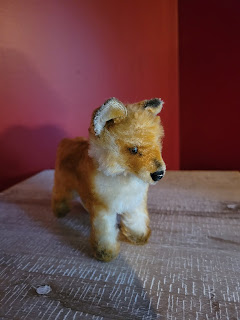
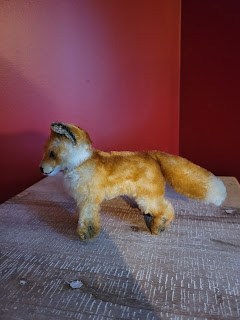
Tag - you're it - when it comes to this week's Steiff inquiry. Check out this note from a new friend who has found a mystery fox. He seems Steiff-y... but was he indeed made by the Steiff factory in Germany? And when? She shares:

Hi - came across this little guy and thought he was cute - intrigued by the made in US Zone Germany tag located on the back of his right leg seam so I started researching and now I am wondering if he is vintage Steiff? He does not have a button or flag or anything identifying him as Steiff. He is approximately 6 inches from tail to end with another 3 inches for his tail. His head is articulated. He appears to be made of mohair and I am not sure what the filling is but it is very firm and stiff. Here are some pictures. Thank you!"

This sweet field and forest friend was indeed made by Steiff, and is one of the most beloved early post war designs amongst collectors today. This fox pattern is known for its great coloring, big fuzzy tail, and really appealing presentation. These foxes come to life with realistic airbrushed highlights on their feet, ears, and faces. Each is detailed with brown and black glass pupil eyes, a black hand embroidered nose and mouth, and a bit of pink airbrushing to on their lips. This legacy pattern was produced in 10, 14, and 17 cm from 1950-1957.  The smallest size is unjointed while the medium and larger sized ones are head jointed. The example under discussion today is most likely the medium or 14 cm version. 

Now let's get into the zone and talk about this fox's tag.
The US Zone tag on this fox is sort of a Steiff ID, but more a general indication of the time frame in which it was made. This is so because many German companies were required to note this production detail following the end of World War II. For example, 
Steiffgal has also noted similar text on items produced by Schuco - including white cloth tags on their soft plush toys as well as imprints on the chassis of their metal vehicles. White linen or ribbon tags were attached to all Steiff soft toy items from 1947 through 1953 (although Steiffgal has only personally seen them on items from 1951 onward.) These all read: Made in US - Zone Germany. Given this fox was in production from 1950-1957 and Steiff used these tags consistently from 1951-1953, it is safe to say that he was manufactured in the very early 1950s. 

The "US Zone Tag" has an interesting story behind it.  At the end of WWll, the Allied powers divided Germany west of the Oder-Neisse line into four areas: American, British, French, and Soviet occupational zones.The Americans were responsible for the southern part of Germany, which is where Steiff is located. The forces were tasked at "demilitarizing" Germany, which included shutting down many factories that did, or had the potential to produce items that could be used for combat or aggressive purposes. 

When Steiff's very limited postwar production slowly started up again in 1945 - 1946, items could only be sold to the American troops. These restrictions were gradually eased and by 1947 Steiff could sell domestically; by 1949 the company's products were once again available internationally. The "US Zone Tag" insured to the outside world that items produced in Germany were done so in a "civilian" factory and met business and distribution standards set up by the American military government overseeing the occupational zone. 

Steiffgal hopes this discussion on this mystery fox has been an engaging tail for you!

Have a question about one of your Steiff treasures? Let's talk! Click here to learn more.

Sunday, July 1, 2018

Getting All Wound Up Over This Amazing Auction Discovery

Good things come in threes, but sometimes in the most unexpected ways. Steiffgal, and probably a significant number of other Steiff enthusiasts, spent a few hours on Saturday, June 30th watching the annual Steiff Festival auction on the computer. Hosted by Ladenburger Spielzeugauktion GmbH and broadcast on Liveauctioneers.com, this comprehensive sale offered 183 lots of fine vintage Steiff, with prices realized ranging from 43 to 18,910 euro or about $56 to $22,131. From the business and collector's perspectives, it was very encouraging to see the number of bids and the robust results of the sale. As always, the finest and rarest items will always generate lots of interest and top dollar.

So what's the connection to the number 3? Well, the one offering that really got Steiffgal's wheels spinning in this sale was lot #78, an utterly fantastic Steiff doll on a three wheeled scooter. It was estimated at 2,500-5,000 euro and cataloged as.... 
                               
"Steiff Urboy, produced 1926, felt doll on a three-wheeled vehicle with clock mechanism drive, case is made of sheet metal, wheels are made of wood, maneuverable, 21 cm, button with long stretched F, good readable white cloth tag label, item No.: 9322 (in the literature the Urboy is wrongly mentioned with the item-No.: 9318, but that is the item-No. of the monkeys Urfips. the correct item-No. is 9322, as it was mentioned in the main catalog from 1926 ), swivel head, black glass eyes, whole clothes and cap original, while driving the Boy is pedalling with the feet, clock mechanism is intact, because of the adjustable front wheel the Urboy can drive straight ahead or in a circle, extremely rare,perfect unused original condition." 

This wind-up wonder had 82 bids and hammered at 12,500 euro ($14,629) and realized 15,250 euro ($17,848.)

There are so many things to love about this crossover item, which may help to explain its popularity on the auction block. It has enormous appeal to doll collectors, Steiff collectors, wind-up and tin toy collectors, as well as vehicle collectors. Steiff produced a series of novelty clockwork vehicles - both three and four wheeled - in the 1926 through 1929 time frame. Their drivers included this boy, a white mohair chimp, a brown mohair chimp, and a Teddy. According to the Cieslik's Button in Ear book, 724 examples of the boy were produced and 1,583 examples of the Teddy bear were produced. The 1927 catalog page advertising these high-end items is pictured here on the left, the illustration is from Carsten Esser's Steiff Kataloge 1920-1929.  

It's so easy to have a plush crush on the doll driver. His condition appears all but flawless. The little fellow has an irresistible, impish presentation and personality. Although the company started to move away from their center seamed face design in the early 1920's with the introduction of the Schlopsnies dolls, this late 1920's novelty clearly has this legacy facial construction. It is also interesting that the Urboy doll has black eyes, and not distinctive, two color glass pupil eyes, like most dolls produced after around 1910 or so. His green and blue felt outfit is relatively simple, but its hard to miss his pert yellow newsboy styled cap detailed with brown embroidery. 


His tricycle is also the wheel-deal. The chassis is made from red and yellow painted metal and houses the clockwork mechanism in its underside. The wheels are made from wood. The boy's feet are sewn to the bike's pedals, so when the toy is wound up, it appears like he is pedaling. This is very cool and life-like. Given the appeal - and the rarity - of these novelties, Steiff made replica versions of two of their 1920s-era clockwork tricycle riding monkeys in the late 1990s. You can see a demonstration of the mechanics behind this model's movement in the video posted above. It was made by filming the clockwork mechanism of a 1996 replica of the company's 1926 "Urfips" motorized tricycle monkey.

Buttoning up this discussion is a review of Urboy's IDs. As noted in the cataloging, his article number is actually 9322, not 9318 as shown in the Steiff Sortiment. 9318 is the article number of the clockwork chimp on a tricycle. It is interesting to note that 9322 means 9=clockwork, 3=mohair, and 22=22 cm.  Given he is almost entirely made from felt, it is surprising that the "3" in his numbering is not actually a "1," which means "felt." If you look at his tag, which is shown here on the left, you can see that it is made of a white linen-paper with small threads woven throughout it, probably to strengthen it. The red ear tag was introduced in 1926, so his white tag is most likely one of the last ones used in production before this change was made. 

Steiffgal hopes this discussion on this clockwork tricycle boy has been worth your time!

Have a question about one of your Steiff treasures? Let's talk! Click here to learn more!

Friday, March 31, 2017

Tag, You're It With These Frozen-In-Time Steiff Treasures


For many collectors, Steiff remains timeless in a fast changing world. Some of us have family heirloom treasures that have been passed down from generation to generation. Others collect vintage pieces that may represent a little piece of childhood, happy memories, or a favorite decade. Given the company's extensive ID system and records, it is pretty easy to date a piece of vintage Steiff. But sometimes, a great vintage item in "tissue new" condition also comes along with a big bonus - its retail price tag from the store that originally sold it. These tags help shed more information on the origins of the piece - and often generate a little nostalgia, too. Here are a few items from Steiffgal's collection with these great original sales tags.

All panda-monium broke out when this sweet cub joined Steiffgal's hug. This of course is Steiff's smallest fully jointed, post war panda. He is 15 cm, made from black and white mohair, and has an open, peach colored velvet lined mouth lined in black. His absolutely irresistible face is detailed with brown and black pupil eyes and a black hand embroidered nose; the black circles around his eyes are airbrushed. He retains his original pink silk ribbon. This particular model was made in 15, 22, 28, 35, 43, and 50 cm from 1951 through 1961. This panda was produced with grey felt paw pads from 1951 through 1956 and suede-like grey rubber material paw pads from 1956 onward. This panda has felt pads, dating it from the early 1950's. 


Panda retains his original white string tag from the high end, national department store Lord and Taylor. This store is still in business, and still sells Steiff items in their larger stores with toy and baby departments. The tag itself has four rows of numbers and codes. The only ones that Steiffgal can decipher is a code the second row - "5315" which matches his ear tag number, "6" on the third row which probably corresponds to 6 inches tall (his height), and 1.95 on the last row, which is most likely his price in dollars. Assuming that he sold in 1951, $1.95 in 1951 had the same buying power as $18.83 in 2017.

Now let's add this fantastic Tabby cat into this meow mix. Here we have Steiff's largest "Tabby" cat. She is 17 cm from head to toe, standing, unjointed, and made from off white mohair. Her back, arms, legs, tail, and the sides of her head are beautifully airbrushed with grey shading and black stripes, making her truly the cats meow! She has black and green plastic slit pupil eyes, a pink hand embroidered nose and mouth, and clear whiskers. She retains her original red ribbon and bell and purple hang tag indicating that her exterior is washable. Tabby was produced from 1949 through 1977 in 7, 10, 14 and 17 cm. This particular example, with her lentil style button and article number 2700/17, was made in the 1969-1977 time frame.

Tabby has her pricetag from Marshall Field and Company, a department store that began in the Chicago, IL area but expanded rapidly to other states in the mid to late 20th century. Steiffgal grew up in the Chicago area, and spent many happy hours in these stores, often nibbling on their legendary "Frango Mint" candies. Sadly, Marshall Field does not exist anymore, having been bought by the Macy's chain in the early 2000's. This tag has three rows of numbers. The only one that Steiffgal can decipher is the last row, being "18.00," most likely her price at the time. Assuming that she sold in 1969, $18.00 in 1969 had the same buying power as $122.42 in 2017.

Given Easter is on the horizon, let's take a look at a fine bunny as our last example of "tag, you're it!" Here we have the smallest example of Steiff's sitting rabbit. She is 8 cm, not jointed, and made from tan mohair that is airbrushed with tan, brown, pink, and black details all over her back, sides, and ears. She has beautiful black and brown pupil eyes, a red hand embroidered nose and mouth, and clear, playful whiskers. She retains her original blue silk ribbon and bell. This particular pattern was produced 8, 9, 15, and 18 cm from 1950 through 1974; she was called Rabbit from 1950 to 1966 and Sonny from 1967 onward. This particular example is numbered 3308,03, dating her in the 1965 to 1967 time frame.

This petite treat has her pricetag from Hahne and Company. Hahne's was a chain of department stores that was based in Newark, NJ and had branches throughout the central and northern parts of the state. The company was purchased by Lord and Taylor in the late 1980's. Rabbit's tag has three lines of numbers and codes. The last one, "3.00," is most likely her price at the time. Assuming she sold in 1965, $3.00 in 1965 had the same buying power as $23.21 in 2017.

Steiffgal hopes this discussion on retail tags on vintage Steiff treasures didn't leave you hanging!

Have a question about one of your Steiff treasures? Let's talk! Click here to learn more.

Sunday, March 19, 2017

Singing A Happy Tune Over This Unusual Steiff Musical Tiger!

Well, this interesting find should be like music to your ears if you like Steiff tigers. And why is that? This wonderful jungle gem has a secret - he's got a special and most unusual music feature hidden in his belly. Check out this terrific tiger and see what makes him one of the coolest cats around!

It's easy to break out in song over this pretty kitty. "Music Tiger" is unjointed and about 20 cm tall and 30 cm long (not including his tail.) He is in Steiff's "lying" position, meaning he is curled up with his legs resting gently to his side. His face is detailed with piercing green and black eyes, a pink embroidered nose, a black embroidered mouth with a touch of pink airbrushing, and tufts of longer mohair around his jowls. He has many long, clear, monofilament whiskers.  He is made from short mohair, which has been hand airbrushed and stenciled to give his coat a most authentic and realistic look.  Even his paw pads have charming "footprints" on them.  On his underside, there is a small brass winder that activates his happy tunes; it is in working condition. 

Collectors will recognize this beloved pattern as the one identical to Steiff's popular lying tiger cub design, which was produced from 1953 through 1978 in 17, 28, 43, and 60 cm.

Let's take a look at some of the special IDs of this singing sweetie, which does not appear - as far as Steiffgal knows of - in any regularly referenced Steiff book. The first is his eye-catching chest tag.  It is Steiff's regular, colorful bear faced version with his name on it.  Given the "secret location" of his music box, and the fact that his basic pattern is relatively standard in the Steiff line, this tag is essential in identifying him from pictures as something really unique. The second is his special musical item tag.  The tag is metallic silver, red, and blue, and features a Steiff logo and the word "Musicanto" on each side. It is in four languages, and reads, "Contains a genuine Swiss music box. To wind: Turn knob in the tail or underneath tummy."  

It's not polite to ask someone their age, so let's figure out another way to date this Music Tiger. Steiffgal has two other Steiff musical animals that have this tag. The first is the company's Music Kitty. This fancy feline is 17 cm, head jointed, and resembles Steiff's beloved sitting Susi cat pattern. Music Kitty was made in 1955 through 1957, and then again in 1961; she is pictured here on the left. The second is Steiff's Music Cockie Cocker Spaniel. Cockie is 17 cm and sitting. She is made from black and white mohair and is head jointed. She has a large, open, smiling mouth. Her face is detailed with large, friendly brown and black pupil eyes and a black hand embroidered nose.  Music Cockie was produced from 1955 through 1957 only.  Both Music Kitty and Cockie's music features are activated by winding up their tails.  And of course, who can forget Steiff's fabulous Music Teddy, which was made in 35 cm from 1951 through 1957?

Given all of that, it is Steiffgal's best guess that this Music Tiger, like his other talented and performing cousins, was most likely made in the 1955 through 1957 time frame, give or take a pinch.

It was not terribly unusual for Steiff to take some of its most popular patterns and try "theme and variation" items from them. Some of these "experiments" were produced on a commercial level and appeared in the catalog; others were made in extremely limited quantities if at all. For example, Steiffgal also has a larger lying tiger made as a silk-lined and zippered pajama bag. This also does not appear, as far as Steiffgal knows, in any standard Steiff reference book. In 2009, Ladenburger Spielzeugauktion featured two marvelous musical rarities; a musical Lulac rabbit and a very large musical tiger.  The auction house dated each from approximately 1952. Both are pictured here on the left - click on the photo to enlarge it!

Have a question about one of your Steiff treasures? Let's talk! Click here to learn more.

Steiffgal hopes this discussion on this Music Tiger has been a high note in your day.

Monday, December 12, 2016

This Unusual Steiff Penguin Is All Dressed Up With No Place To Go!


Now that the holiday hooligans are in full swing, Steiffgal thought it would be a good time to invite readers to chill out and meet one of her favorite seasonal friends - a wonderful and unusually sized early postwar Steiff penguin. There's just something about these delightful black and white buddies that make them universal favorites. Perhaps it is their charming appearance, playful personalities, or their adorable wiggle walk (or all of the above!) What do you think?

Consider this your formal introduction to Steiffgal's beloved "Tux." Tux is a super-sized version of Steiff's early and original Peggy penguin design. He is pictured here on the left, towering over his 10 cm cousin of the same pattern. Tux measures a little over 50 cm tall. He is standing, unjointed, solidly stuffed with excelsior, and made from black and white mohair. His beak and oversized, fat feet are made from red felt and have black painted detailing on them. His wings are floppy and hang gently at his sides. His face comes to life with green and black slit pupil style eyes. His squeaker works loudly and clearly! Tux's Peggy pattern appeared in the line from 1952 through 1956 and was produced on a commercial scale in 10, 14, and 22 cm.

In the mid-1950s, Steiff gave its standard line Peggy penguin design a little makeover. The “new” Peggy was now more angular and lifelike; she had additional airbrushed details, a pointy beak, and slimmer grey feet. Larger versions were head jointed. The updated Peggy penguin appeared in the line from 1956 through 1975 in 10, 14, 22, 35, and 50 cm. She was also produced as a studio edition in 80 cm for a few years in the 1960s.

It is interesting to note that Tux at 50 cm is more than twice as big as the largest standard sized Steiff early Peggy of the era. However, he is about the same size as the smaller and beloved real-life "Gentoo" breed of penguins, for which he has a somewhat similar appearance. You can see a happy trio of Gentoo penguins here on the left. As such, perhaps Tux could be considered an early postwar "Studio" example by default!

Tux's IDs are consistent with his era of production. He has a linen "US Zone" tag sewn into his front hip seam, a raised script button, and a yellow tag with the numbers 4350,2 printed on it. This corresponds to 4=sitting up or begging, 3=mohair, 50=50 cm tall, and ,2=double press voice, growler, or pull cord voice - all which truly describe him in the broadest sense.  

Steiffgal hopes that Tux has added a touch of elegance and sophistication to you day.

Have a question about one of your Steiff treasures? Let's talk! Click here to learn more!

Wednesday, November 2, 2016

Bridging Time With This Remarkable Steiff Doll In Her Original Packaging

Do you think time travel is real? Well, this remarkable Steiff find will take you back many decades, even if you are a non-believer! Check out this fantastic vintage Steiff doll, in her all original packaging! It is as if she were made yesterday. But how old is she really? Let's look at her details to try and figure that out.

Here we have Steiff's “Cenzi” doll in her original labeled box, including its original tissue paper. She is one of Steiff's "pressed felt faced dolls," which debuted in the company's catalogs in the mid to late 1930's. Cenzi is 35 cm tall, head and leg jointed, and made from felt. She wears a dress made from red and blue artificial silk fabric. It is detailed with a felt collar, white sleeves, and a matching apron. Her hat is made from yellow felt and her shoes are made from red felt. Cenzi has all of her IDs, including her named chest tag, Steiff button, and yellow tag, which are worn on a red rubber bracelet around her wrist. 

Cenzi's box is made from heavy brown cardboard. It is held together with metal staples. On one end, there is a tan and blue label that is printed with the words "Steiff, Made in Germany, Importe D'Allemagne, and Marke Knopf Im Or," and a Teddy bear face. The label is printed with the words "Cenzi 95/35." The other end of the box is plain, without any marks.   

What's so interesting about Cenzi is that her detailing really spans both pre- and postwar norms for these sorts of dolls. Even her IDs, including her tiny trailing "F" button, watermelon shaped bear faced chest tag, and yellow wrist tag are seen on both pre- and early postwar models. According to records, Cenzi was “officially” produced in 1949-50. However, she has several subtle features that could possibly put her production up to a decade earlier.

First, Cenzi has her US Zone tag hand stitched into her apron. This might be because she was originally made without one before the factory shut down for toy making operations during WWII. As all toys leaving the factory in the late 1940's and very early 1950's required this tag, it might have been sewn on in a convenient place just before her distribution. Other similar post 1950 Steiff dolls usually have this tag sewn into one of their limb seams. You can see this detailing here on the left on another Steiff doll of the period.

Second, Cenzi has "quality control" issues that suggest she was produced at a very challenging time with limited resources - perhaps in the early 1940's. It is interesting to note that she has mismatching ribbons on her hat. They are not faded, they really are different. One is pink and the other one is red. This is most unusual in terms of quality control for Steiff. And even though she is "new in box" with no other play wear, 2 out of 3 of her dress snaps are are missing paint and appear chipped. It is entirely possible that her clothing was manufactured with these damaged buttons and left over scraps of ribbon were used on her hat as no alternatives were available. She also has a cheek rub, but upon close inspection it appears from the factory and not as a result of rough handling. 

Finally, the series and article numbers printed on her label correspond to the company's pre-war doll numbering system. According to the Sortiment books, the pre-war pressed felt faced dolls had a series number of 95, while the postwar pressed felt faced dolls had a series number of 90.

So when indeed was this timeless beauty's birthday? Only she knows for sure, and she's not talking! But what is certain is that like all of Steiff's wonderful dolls, bears, and animals, she has stood the test of time and will be admired - and studied - for generations to come.  

Steiffgal hopes this discussion on Steiff's "Cenzi" has thrown you into a frenzy. 

Have a question about one of your Steiff treasures? Let's talk! Click here to learn more.

Saturday, February 7, 2015

Color Your World With This Mysterious Vintage Steiff Donkey

It's a rather gray day around these parts, and the almost four feet (that's over 120 cm for friends abroad!) of snow on the ground already is not helping things.  But this little grayish friend is just the opposite of gloomy - so Steiffgal thought it would be the perfect time to introduce you to this happy-go-lucky fellow.  Take a look at this fantastic vintage farm friend who just arrived on the east coast from Germany.  Although not technically "young" anymore - he is certainly young at heart... and will warm yours, too!

Here we have a most adorable and vintage looking donkey.  This farm friend measures 22 cm tall (top of head to foot) and 30 cm long (tip of nose to backside.)  He is standing, unjointed, and made of tan mohair which has been lovingly airbrushed with grayish-purple highlights.  His tail and mane are made from long, soft, black mohair.   His face comes to life with longer tan mohair on his "sideburns" and forehead, a shorter mohair muzzle, pert black eyes, and a black airbrushed nose and mouth.  The coloring on his face truly gives him him a youthful, playful appearance.  He retains his long trailing "F" button and illegible yellow ear tag (pictured below) as his Steiff IDs.  

Like many things Steiff, this donkey has details that make him hard to date and identify with 110% accuracy.  His long trailing "F" button initially suggests that he may have been manufactured in the c. 1933 - 1935 time period.  If that were the case, he most resembles the company's Jung Esel or Young Donkey, which was made in 22 and 28 cm from 1933 through 1943 overall.  Young Donkey is pictured here on the left; the photo is from Pfeiffer's 1892-1943 Sortiment book.  Like the example under discussion today, Steiff's Young Donkey pattern is famous for his grey-purple highlights and innocent looks.  However, it is clear that there are some key differences between the Young Donkey pattern and the donkey under discussion here.  Young Donkey is made from long grey wool plush; this example is made from highlighted mohair.  Young Donkey has grey felt (or perhaps leather) hooves; this example does not.  Young Donkey has a grey tail and mane; this example has black detailing.  And Young Donkey has his ears positioned forward; this example has the ears positioned to the rear.   

So how do his design elements and early IDs all align?  Well, only this donkey knows for sure, but here are two ideas.  

1.  The mid 1930's through the early 1950's were a really rough time for manufacturing at Steiff, and supplies and fabrics were available on an inconsistent basis.  It is possible that this donkey was indeed made to the Jung Esel pattern as best as possible, but with the materials and technology available on hand, in the late 1930's to early 1940's.  It is not unusual to see wool plush and mohair plush interchanged on items from this time frame.  

2.  Steiffgal thinks it's more probable - given his distinctive overall coloring - that this donkey under discussion today is a transitional model between the company's pre- and post- war donkey models.  As such, he may have been produced in the very late 1940's and given a long trailing "F" button... as that's what was on hand at the time.   Steiff launched its post-war donkey in 1950 in 12, 14, 22, and 28 cm; this updated pattern has several design elements of the pre-war Jung Esel, especially in the muzzle area, but no purple-grey highlights at all.   For comparison, a nice example of Steiff's postwar 22 cm mohair donkey is pictured here on the left.

Steiffgal hopes this discussion of this mystery donkey has added a touch of color to your day!

Have a question about one of your Steiff treasures? Let's talk! Click here to learn more.  
The teddy bear search engine