Showing posts with label lion. Show all posts

Sunday, February 12, 2023

Going Out On A Limb Over This Extraordinary Midcentury Steiff Lion

If this isn't the mane event, Steiffgal is not sure what is! To make a long story short, look who popped over for a visit... a supersized Steiff lion with mile long legs. Just who is this tall drink of water? Check out his story right here!

Steiffgal's not lyin' when she says this guy is wah-hoo good.
This supersized lion is 80 cm tall, fully jointed, and made from blonde mohair. He has oversized brown and black glass pupil eyes, a prominent pink hand embroidered nose, a black embroidered mouth and painted freckles, and clear mono-filament whiskers. He has a white mohair chin. His mane is made from very long, brown tipped mohair; the same mohair details the tip of his tail. Steiffgal thinks this particular lion has a delightful, innocent "toddler" look to him. He was made in 1958 only as an exclusive for the United States. Other extra-large (80+ cm) long and leggy exclusives of this period also included a 90 cm tiger and a 80 cm grey poodle.

This lovely lion is a rare example of Steiff's beloved and legacy lulac style design.
Steiff's lulacs all have comically long arms, legs, and torsos. They are long and lanky, usually fully jointed, and have a very playful air about them. It is interesting to note that the German verb “to laugh” is lachen, and the word for smile is lächeln, perhaps suggesting that this style was designed to have a comical appearance and to bring a smile to the face of the owner. The original Steiff lulac animal was a rabbit, which debuted in the line in 1952. He was made in 43 cm through 1974, and in 60 cm from 1964-1966. Due to the success of this beautiful bunny, Steiff quickly followed with several additional lulac animal patterns, including dogs, cats, donkeys, zebras, bears, and others. Steiff's rare and goofy 40 cm black mohair lulac tomcat, made from 1964-1966, is pictured below. 

The lulac lion under discussion here today was designed and produced at a most creative period at Steiff - the mid 1950s through the mid 1960s.
It was during this time that the company made a number of unique, well designed products for their United States customers, as well as distributors at the time - Reeves International and Loucap. Other noteworthy US editions of that era were the company's dinosaur range, basset hounds, animal head trophies, and school and institutional mascots. These items, made in relatively small numbers for a short period of time, seem to always catch the eye - and pocketbooks - of collectors worldwide.

Steiffgal hopes this discussion on this fabulous lulac lion has given you a leg up on your day.

Have a question about one of your Steiff treasures? Let's talk! Click here to learn more.

Sunday, June 12, 2022

Things Are Heating Up For Ladenburger Spielzeugauktion's Steiff Summer Auction On June 25th!

After a two year pause due to COVID-19 public health concerns, Ladenburger Spielzeugauktion's Special Steiff Auction will again take place in Giegnen as part of Margarete Steiff GmbH's annual three day Sommer event. This signature festival happens on June 24th-26th 2022, and Ladenburger's auction takes place the evening of June 25th in the town's historic Schranne hall. This sale always features the best of the best - and this year is no different. Here are three rare and interesting temptations from the auction that really caught Steiffgal's eye. 

This first pick is fit for a king - of the jungle, that is. It is lot #6018, a turn of last century lion pincushion. It has an opening bid of €550 and is cataloged as....

"Pin-cushion, lion, around 1905, velvet lion with mohair mane, very nice clearly visible colors, great condition, small STEIFF button with block letters, long trailing F, on a green mohair pin-cushion, minimally faults at the mohair of the pin-cushion, otherwise very nice condition, length of the cushion: 16 x 11 cm, height with lion: 14 cm, exceptional, very nice condition."

Steiff has a long tradition of creating novelties like pincushions from some of their most popular designs of the time. This particular lion pattern appeared in the catalog in 10 and 14 cm from 1904-1919 overall. The lion itself - sans cushion - was produced in 10 and 14 cm from 1903-1912 overall. Other prewar pincushion designs included animals wearing backpack style pincushions made from baskets and velvet, pets perched on fluffy mohair pillows, and woolen miniatures posed on thick felt leaves. This particular example is in wonderful condition with ID. The lion's royal personality just radiates from within, don't you think? 

The next pick is truly a looker.
It is lot #6071, a mid-century manufacturing display. It has an opening bid of €130 and is cataloged simply as...

"Show piece, board made of cardboard, development of a Steiff-lion 5312, 43 cm and 30 cm, around 1954."

This dashing display shows the steps needed to create the company's "Mama Lioness." This early prewar design was produced in 12 and 21 cm from 1949 through 1957 and is considered relatively rare and desirable on the secondary market. So the date on the display of 1954 makes perfect sense. 


The words on the sign basically summarize how the lioness comes together. They roughly translate to: "History of a Steiff Lion 5312. Work steps: cut, sew, turn around, sew limbs on, ears, garnish the nose, shape, paint, check, protect." The poster also includes examples of the raw materials used at each step of the process, and a finished Lioness. It is interesting to imagine what this display was created for.... training, public relations, part of a museum or traveling exhibit? Today, it is just a fabulous time capsule and a great piece of visual as well as teaching art. 


The final auction pick today is certain to get your goat, in the best possible way. It is lot #6124, a midcentury era goat advertising specialty. It has an opening bid of €220 and is cataloged as:

"Billy-Goat (billy goat), advertising item by the company Scabal, 1959, wool plush, with monocle and caricature eyes, standing height with hat 40 cm, complete, No. 6535,90, very good condition, hat is a bit creased."

What a fun item! Goat's playful, blue and black glass eyes are meant to be silly and cartoon-like, and are almost identical to those seen on the Steiff's beloved Lulac rabbits of the same period. His "proper topper" and black vest add a touch of formality to him. And his numbering describes him accurately, with 6 = young, 5 = wool plush, 35 = his height, almost; 9 = display animal or special edition, and 0 = natural coloring. 

But what's the tie between goats and the company Scabal? According to Wikipedia, Scabal is... "a Belgian textile company founded in 1938 by Otto Hertz as a cloth merchant and supplier of fabrics. "Scabal" is an acronym for Société Commerciale Anglo Belgo Allemande Luxembourgeoise." Goats are famous for producing mohair and cashmere, and Scabal may use these fine fibers in their cloth production. It is also possible that this goat design somehow was part of the company's branding or identity in the late 1950s. So the dandy goat design really does tie back to the business of Scabal. 

Steiffgal hopes this discussion on these fabulous Steiff auction treasures has further buttoned up your love of the brand. 

For more information about Ladenburger Spielzeugauktion GmbH's upcoming Special Steiff Auction event on June 25th, please click here!

Have a question about one of your Steiff treasures? Let's talk! Click here to learn more!

Sunday, April 24, 2022

This Charming Steiff Prewar Find Is Certain To Put A Tiger In Your Tank

Take a seat and check out this darling and little known Steiff tiger!
Tigers are a popular, legacy item in the Steiff catalog, with the first big beasts of their type debuting in the company's line in 1915. They translate well from real life to plush, and their handsome looks and wild origins bring out the animal instincts in most collectors! Steiffgal stumbled across this unusual prewar example on an online auction. The fates smiled upon her, and now he's part of her permanent hug.

This striped sweetie is quite the looker.
 His official name is "Tiger Cub." He is 22 cm tall (measures vertically from head to toe), sitting, and head jointed. He is made primarily from tawny colored wool plush. His long sideburns are made from longer white mohair. Tiger is stenciled and airbrushed in typical tiger style; he is highlighted in orange with prominent black stripes on his limbs, back, tail, and head. In true cat fashion, his little tail curls up around his backside. He has black hand embroidered claws on each of his paws. His distinctly youthful face is detailed with teal green and black glass eyes, a black hand embroidered nose and mouth, and a spot of pink paint on his lips. His ID is a short trailing "F" Steiff button. Overall, this big cat appeared in the line in 17 and 22 cm from 1939-1943.

It's always fun to discover new Steiff surprises, and this tiger cub definitely qualifies as that for Steiffgal.
This is the first of his kind she's ever handled, or really knew about. According to Pfeiffer's 1892-1943 Sortiment, this model is cataloged as, "woolen mohair, tawny-colored, tiger striped, sitting, soft, young, funny." It is unusual for Steiff or Pfeffer to use endearing adjectives in their descriptions - usually they are quite literal and objective. So the word "funny" really pops here, and in a way it is accurate. This guy does have a playful and mischievous look to him.

Tiger cub's shape and presentation also may ring a bell with collectors interested in Steiff's sitting big cat production over time.
His sitting, head jointed form is also noted on the company's pre- and postwar Young Lion design. This mane event was made in 17 and 22 cm in wool plush from 1938-1943, in artificial silk plush in 17 cm from 1948-1949, in 10 and 17 cm in wool plush from 1949-1954, and finally in mohair in 10 and 17 cm from 1955-1961. You can see the 17 cm, early postwar artificial silk plush version of young lion here on the left. Clearly the sitting young lion design was more popular than the sitting young tiger design, which only appeared in 10 cm from 1951-1961.

Steiffgal hopes this discussion on this prewar, wool plush cub has put a tiger in your tank!

Have a question about one of your Steiff treasures? Let's talk! Click here to learn more.

Sunday, July 11, 2021

Well Hello, Handsome... Before And After!

You clean up pretty nice! That's usually a compliment given to a person who presents themselves in an usually attractive way. But it can also apply to Steiff animals as well - especially those who have been cleaned with TLC. Check out this note from Hannah from Manchester, England who shares....

"I have just watched your excellent YouTube video on how to clean mohair Steiff. We have inherited my mother-in-law's mid-century Steiff Leo lion and I would like to give him a little clean... do you have any advice about how to tackle the longer hair of his mane?"

How exciting! This question is the mane focus of today's blog post. If you are interested in watching the Steiffgal cleaning video, you can catch it on Youtube here. You can also read about cleaning by clicking here.

Now let's focus on Hannah's inquiry.
Here's Steiffgal's best take on cleaning Leo's longer mohair. Leo's mane is also mohair, so the cleaning technique is pretty much the same as cleaning shorter mohair. But, because it is longer, it can trap a whole lot more dust and dirt that the shorter mohair. So you may have to go over it a few times. And make sure to get all of the long mohair clean, not just the tips and edges. You might lose a little bit of color when you scrub the mane. That is ok, it will show up on the white wash clothes you are using, but the color won't really fade or bleed on the mane mohair. So don't be upset if the color seems to be coming off, it is not really.

Post cleaning treatment is also important here. Once you are done cleaning the mane, let it dry, and then gently fluff it up with a wire or rubber toothed brush with bristles that bend and are flexible. Don't pull and yank the mane with the brush as this might break some of the fibers. Just do it lightly, and over time, and it will really become quite fuzzy again. Many lions have mane thinning on the very top of their heads (like middle aged men!!!) but that normal and you can't do anything about that.


So now the grand reveal. How did Hannah do? Check out Leo here - post cleaning. There's no question this is one handsome beast... and his cleaning will help insure his longevity and structural integrity for years to come. According to Hannah, "Leo is now feeling all clean and fluffy! We think he had about 60 years of coal dust and general muck on him so he's feeling much better! The mane took ages but he thinks all the brushing was probably worth it (there were a lot of snags)!"

Steiffgal hopes this information about cleaning longer mohair has given you the warm fuzzies.

Have a question about one of your Steiff treasures? Let's talk! Click here to learn more.

Friday, February 8, 2019

Getting A Leg Up On This Midcentury Steiff Mystery!

This inquiry from a new friend is simply ele-phantastic! Kati has something very special in her collection, but one that so far has defied identification.  Let's take a look at her note and use our grey matter to figure out what this mystery item just might be! 

Kati shares,

"I have a very unusual Steiff that I am having a hard time identifying. Not sure if you can point me in the right direction. I am not in anyway wanting an appraisal but just a little bit more information on the piece. I have searched EVERYWHERE and have not been able to come up with anything. 

It is an elephant with a Steiff tag and he has extremely long legs. The number on his tag is 7330. He measures 12.5” inches tall and 12” from trunk to tail. His legs alone are 7.5” tall. He has wood tusks and a red felt bib/collar. 

I am hoping you either know a little about him or can point me in the direction to a site or someone who might. Thanks for your time!"

There's no junk in the trunk when it comes to this absolute rarity. What we have here is Steiff's wonderful and seldom seen Lulac elephant. He is as Kati describes above; his delightful details include a jointed head; a smiling, open, felt lined mouth; and playful black and white google eyes. His upturned trunk is a sign of good luck, too. "Lulac" refers to his goofy, exaggerated form consisting of really long arms and legs. Other Lulac style animals produced at or around the same period include a Zotty bear, rabbit, Cocker Spaniel, donkey, zebra, tiger, lion, and poodle. This particular Lulac elephant was made as an exclusive for the United States market in this size only in 1958.

If you look hard enough, you can find jumbo clues about a Steiff treasure by examining its small details. In this case, check out what Kati says about his ear tag. The code on it reads 7730. According to Steiff reference materials, this corresponds to... 7 = in caricature, 3 = mohair, and 30 = 30 cm tall. But these numbers don't shed any light on how unusual this pattern truly is. To put things in context, the only other example Steiffgal has even come across was one at auction in 2010 at Christies. You can see that auction listing by clicking here.

Now for that "elephant in the room" question that everyone undoubtedly has on their minds about now. How does this great item value in today's marketplace? As always, something is worth what someone will pay for it, and Steiffgal has not seen the item firsthand to inspect for condition. Many critical condition items, like dry rot, odors, insect damage, etc., do not show up on photos, and that's why it is essential to see an item firsthand to give it a fair review. Given the Lulac elephant is as described and as presented, with no essential structural or aesthetic issues, it is Steiffgal's best guess sight unseen that this item may sell on an online channel or auction in the c. $1,000-2,000 range.


Steiffgal hopes that you found this discussion on Kati's elephant absolutely unforgettable.


Have a question about one of your Steiff treasures? Let's talk! Click here to learn more.

Sunday, November 4, 2018

Rolling Out The Red Carpet For This Amazing Steiff Ball Rabbit

It's easy to have a ball with Steiff! Especially when it comes to the company's tiny and wonderful "baby balltier" or ball animals designed for babies. Steiffgal recently had the pleasure of adding one of these bitty bunnies to her Steiff hug. Check out what makes these unusual novelties so interesting from the historical and product development perspectives.

Rounding things out, this adorable, 9 cm tall bunny is head jointed and made from tan colored mohair. His body is a simple, round form about the size of an apricot. His head is about the size of a ping-pong ball and is detailed with black and brown glass pupil eyes and a simple, red hand embroidered nose and mouth. His ears are made from felt. Rabbit's two front limbs and little tail are all made from tan colored woolen pom-poms. His clear monofilament whiskers have unfortunately been lost to time. This ball rabbit pattern was made from 1934 through 1943. This excellent example has a long trailing "F" button, dating him to the earlier part of this time frame.

Steiff also produced a larger 15 cm version of this bouncing bundle of joy from 1932 through 1942. This bigger bunny featured dimensional mohair ears and limbs as well as a rubberized, pastel colored ribbon band so he could be used as a "toss and catch" toy or perhaps even as a pram toy. This ribbon feature is so ephemeral that Steiffgal has never actually seen one in person. The 15 cm version of this novelty is pictured here on the left; the photo is from Pfeiffer's Steiff 1892-1943 Sortiment.

Steiff rolled out a series of teeny-tiny ball animals starting in the early 1930s. This would prove to be a challenging decade for the company. Germany entered a period of economic depression and widespread unemployment in 1929. At the same time, growing overseas sentiment began negatively impacting Steiff's export markets. As a result, Steiff's product development strategy included focusing on creating a range of lower-tier (i.e. affordable and efficient to produce) products for their domestic market to keep their toymaking business viable. It is interesting to note that the company's inexpensive, palm sized woolen miniature animals (including numerous rabbits in various body positions) also debuted around this same time. 

Coming full circle, Steiff produced about eight types of ball style animals overall. These were all based on simplified patterns of the company's most popular designs of the time. In addition to the rabbits discussed above, the collection also included Teddy bears, elephants, ducks, cats, lions, a Chin-Chin dog, and a Molly the Puppy. What's amazing about these items is that any survived at all given they were made to fit in the palm of a child's hand and designed as toys for youngsters! Here on the left you can see the page from the 1938 Steiff catalog featuring an assortment of these well-rounded items. 

Steiffgal hopes this discussion on these charming Steiff baby toys has put you in a playful mood indeed.

Have a question about one of your Steiff treasures? Let's talk! Click here to learn more!

Saturday, December 31, 2016

Is This Steiff Jungle Gem A Diamond In The Rough?

Let's end 2016 in a wild way! Check out this note from a reader on the east coast who found an Ivy-League tier Steiff treasure and wants to learn more about it. Jacob, in part, writes...

"I was hoping you could tell me a bit more about a Steiff tiger that I found recently. It is similar to one you've written a blog post about already but with some noticeable differences. It is an approximately 40 cm long, 23 cm tall mohair tiger wearing a black felt vest with an orange "Princeton" P. It has a Steiff button in the ear and a tag that says "US Zone Germany." It is standing, rather than sitting and does not have a jointed head as the one you've written about did. However, it does have the "cartoon" eyes."

Wow, Steiffgal is seeing stripes over this cool cat. This indeed is the standing, larger version of Steiff's early 1950's Princeton Tiger. He is unjointed and made from mohair that has been hand airbrushed with black stripes. His face comes to life with a prominent, felt lined open mouth, white wooden teeth, and green and black "squint" style glass eyes. And, of course, what makes him head of the class is his orange and black felt "P" blanket. He was made as an exclusive for the upscale US toy retailer F.A.O. Schwarz in the c. 1951-1952 timeframe.

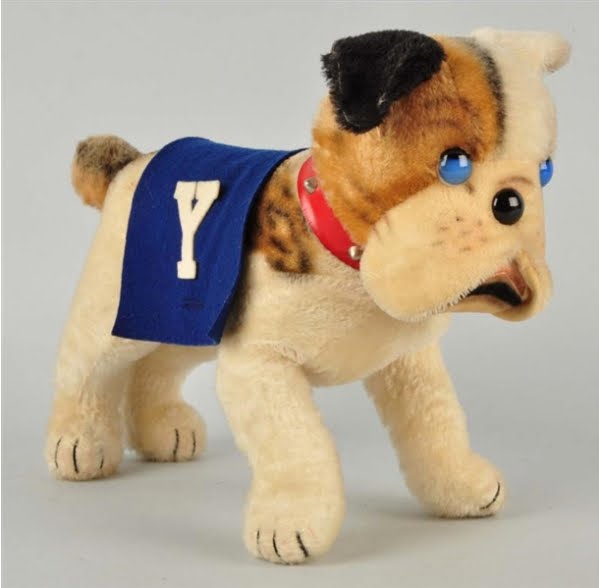
Now let's take a little trip backwards in time and check out some interesting things about this grrrr-eat example. Here you can see this tiger's original advertising from the 1951 F.A.O. Schwarz catalog. Other Steiff mascots listed with him include the sitting Princeton Tiger, a sitting and standing Yale Bulldog, a sitting and standing Navy Goat, an Army Mule, and a Columbia Lion. They ranged in price at the time from $7.50-10.00. This is the equivalent of $69.62 to $92.83 in 2016 dollars. Steiff is, and always has been, a premium product. Ironically, the mascots pictured just below the Steiff versions that were made in France are more expensive than the Steiff ones upon their introduction. It is Steiffgal's strongest suspicion that they would have mostly sentimental value today.

Steiff also created other smaller scaled school and institutional mascots in the late 1950's and early 1960's. These were all standing and included a 14 cm Yale Bulldog in 1957, a 10 cm Princeton Tiger in 1957-1958, 12 and 14 cm Army Donkeys in 1957, a 15 cm Navy Goat in 1957, and a 25 cm Navy Goat in 1957-60.

Is this jungle gem a diamond in the rough? Well, as always, something is worth what someone will pay for it. These marvelous mascots come on the secondary market quite infrequently, so "comps" are hard to come by. However, in June 2016, a standing Yale Bulldog illustrated along with the standing Princeton Tiger in the 1951 F.A.O. Schwarz catalog sold at auction here in the US. Estimated at $600-1,200, it realized $900.  This "Handsome Dan" is pictured here on the left. 

Steiffgal hopes this discussion of Jacob's great tiger puts you on the prowl for some great Steiff finds in 2017! Happy New Year, dear readers!

Have a question about one of your Steiff treasures? Let's talk! Click here to learn more.

Sunday, October 18, 2015

Be Brave And Check Out This Amazing Steiff Artificial Silk Plush Lion!

No 'lion! A very rare Steiff big cat just wandered into Steiffgal's collection, and she couldn't be more pleased. Its time to go on the prowl and and see what makes this sweet prince so interesting from the design and product evolution timeline.

This heir to the jungle throne in none other than Steiff's Young Lion. He is 17 cm, sitting, head jointed, and made from tan colored artificial silk plush fabric. This fabric is very soft, silky, and shiny.  His back is covered in very lightly airbrushed spots, stripes, and zig-zags. His chin and the lining of his ears are made from white artificial silk plush; his "sideburns" are made from much longer white artificial silk plush. He has three black hand embroidered claws on each foot. His sweet tail wraps around his backside. His adorable face comes to life with black and brown glass pupil eyes, black paint highlighting, and a black hand embroidered nose and mouth. He retains his short trailing "F" style Steiff button. Young Lion was made in this material and this size only in 1948 through 1949.
 
Despite this exact example's brief appearance, his closest relatives wore the crown for almost three decades in the Steiff line. Prewar, the first sitting lion cub appeared in the line in 14 and 17 cm from 1932 through 1937. He is pictured here on the left; the photo is from Gunther Pfeiffer's 1892-1943 Steiff Sortiment book. Like many of Steiff items of the period, these two cubs were made from wool plush. In 1939, this sitting pattern was modernized slightly with the addition of sideburns and more elaborate painting. This updated pattern was manufactured in 17 and 22 cm through 1943. 

The Young Lion pattern roared right back on the scene once the factory reopened for toy making business in the late 1940's. The pre-war Young Lion was produced in artificial silk plush instead of woolen fabrics in 17 cm in 1948 and 1949 - this is where the little fellow under discussion here fits into the timeline. Steiff produced many of the company's most popular and beloved pre-war patterns items in this inexpensive, transitional fabric in the late 1940's through the early 1950's. Common examples of this include rabbits, dogs, traditional Teddy bears, and Teddy Babies, among other favorites.
 

By 1949, woolen fabrics were beginning to be produced again in large enough scale for industrial manufacturing purposes. As such, Steiff was able to begin making the sitting Young Lion pattern in wool plush in 10 and 17 cm from 1949 through 1954. An example of the 10 cm version is pictured here on the left. Then, in its final appearance, the beloved Young Lion pattern was made in mohair 10 and 17 cm through 1961. Even these relatively more recent mohair versions have a delightful, vintage look to them, and remain favorites with collectors of all ages.
 

Steiffgal hopes this discussion on Steiff's rare and interesting artificial silk plush Young Lion has been the mane event of your day!
 

Have a question about one of your Steiff treasures? Let's talk! Click here to learn more.

Saturday, November 24, 2012

Honoring A Very Special Veteran and His Steiff Guardian Angel


Every Steiff treasure has a story, but the one Steiffgal is about to share with you is simply astonishing.  A few weeks ago, a woman named Donna Bell contacted Steiffgal to get a little more information about a Steiff lion cub she had seen on a website.  Apparently the one online was identical to one that had helped her father, Don Bell, a US soldier in WWII, survive his tour of duty despite horrendous hardships and near death experiences.   Don was one of the soldiers who stormed the beaches of Normandy on June 6, 1944 and fought heroically in Europe for the allies during the war.  During his early days in France, Don found a little Steiff cat that would be his companion - and guardian angel -  from that moment forward.  Donna, Don, and the Steiff cat are pictured above. 

Don documented the story of how he found his cat and their relationship during the war.  He shares in part...

"Three sleepless nights into the fighting, I came upon a bombed out farmhouse. I dropped to a crouch and studied it carefully. It was an eerie scene. The yard was full of toys and an overturned tricycle. There was a sandbox, but no people anywhere that I could see. I crept closer. That's when I spotted him sitting in the sandbox. He was an orange stuffed toy tiger cat - just sitting there looking at me with shiny glass eyes. Without thinking, I reached out. Maybe it was a combination of fear and exhaustion, but I wanted that tiger cat. I snatched him up and slipped him inside my shirt.  

(The cat pictured above, which was made about 1951, shows what Don's toy most likely looked liked when he found him in the farmhouse.)

I remember saying to him at the time, "Me and you are gonna make it parnder."

We battled through June. In July, we faced elite German paratroopers. The fighting was ferocious. During a break in the siege, I was sitting alone behind a hedgerow eating cold beans from a can. What happened next I don't remember. They say you never hear the gun that gets you, and it's true. Next thing I knew, I lay in the weeds, unable to get up. My right ankle was shattered and my right shoulder didn't work. I looked at my tiger cat peeking from inside my bloody shirt and said, "Looks like we're done for, cat."


I lay there for some time staring at the stuffed toy. Suddenly I remembered Sunday school classes from my childhood, and Ma reading Bible stories to me at bedtime in our little shack on the Colorado plain. I remembered how simple it was to pray back then. I just sat back and talked to God. Nothing fancy. Just talk. Squeezing the tiger cat in my left hand I closed my eyes and tried to bring back that long ago feeling.


The medics didn't find me until after dark. They hauled me back to Omaha Beach for evacuation to England. I was taken to a hospital and prepared for surgery. My cat was black with blood and a nurse took him away from me. Then it was lights out.


My first thought when I came to was for that tiger cat. Sure enough, there was my mascot, washed clean and sitting on a nightstand, staring with those same shiny eyes that had caught my attention back at the farmhouse. I sure was glad to see him.


Months later, I was back in action at the Battle of the Bulge, tiger cat and all.


When I learned I would be heading home, I looked my tiger cat right in his glass eyes, and then yelled into his ear, "We are going home to America, cat! We are going to that freedom loving country called the United States!" I boarded the troopship Liberty for the journey back to the states. When we sailed past the Statue of Liberty, whistles were blowing all over the harbor. I felt so lucky and I gave my toy cat a squeeze through my shirt. I came out of the war with a couple of Bronze Star Medals and returned to Colorado in one piece. After I married and had kids, my cat became my daughter's favorite plaything. Today, he sits on a mantle in her house."


If that story doesn't win medals for bravery, courage, and loyalty, Steiffgal isn't sure what would!  Donna's father's cat is actually a lion, not a tiger and is Steiff's Junglowe or Young Lion. Many people think this model appears more "tiger-ish" than "lion-ish" because of his coloring and stripes. Young Lion debuted in 1938 and was produced in 17 and 22 cm through 1943.  After the war, this king-in-waiting was manufactured in 10 and 17 cm from 1950 through 1954. Both pre- and post-war Young Lions are sitting and head jointed.  Steiffgal has seen examples in both wool plush and mohair.   All are carefully hand airbrushed with light and dark stripes, spots, and highlights and are detailed with brown and black pupil eyes, a black hand embroidered nose and mouth, and his clear monofilament whiskers. Larger sized Young Lions are detailed with long white mohair "sideburns;" you can see this feature on the Young Lion pictured to the left. 

Steiffgal hopes this salute to Don Bell's lion cub encourages you to be a hero to somebody today.

Have a question about one of your Steiff treasures? Let's talk! Click here to learn more.  

Friday, December 2, 2011

This Steiff Riding Lion Is Clearly The Mane Event

Talk about the mane event!  Many collectors particularly favor Steiff's big cats - tigers, lions, and leopards - and for good reason.  The company has excelled at producing them since the late 1800's!  So take a look at this note from a reader who recently adopted one of these vintage jungle gems into her hug, and wants to know all about him.  Colleen writes...

"Steiffgal,

This Steiff Riding Lion was purchased by my neighbor at the factory when they visited Germany probably 40 years ago or longer.  She allowed her children to use it as a toy when they were little and she recently sold it to my husband when she was cleaning out her house in an effort to get ready to sell as her husband passed away.  She herself purchased it.  She said there originally was a tag in the ear or somewhere, but she knows her kids probably removed it.  I can't seem to find it.  

As you will see from the photos this guy has been "well loved" and enjoyed.  He is approx. 20" tall at the top of his head and 25" long from the tip of his nose to the end of his bottom.  His fur is not in good shape on his mane, but the rest of him is in fairly good condition for a toy of his age.  He has been sewn back together along the top of his back, or possibly that was how he was sewn originally and the matting of his fur shows it now. 

He has a very solid handle on his back that the children would hold onto as they rode him and he does have a pull string for his growler.  The growler does work and the wheels on his base are in very good condition.  He is well attached to the base. He may have no value to anyone other then myself.  To be able to enjoy his beauty and know where he has been and where he came from is all the pleasure I need.  I just thought you may know more about him that I would enjoy hearing about.

Thank you in advance for any info you have to share and for taking the time to look at my new Steiff friend!

Best, Colleen"

As to be expected, Steiffgal is roaring to help out here!  What Colleen has here is called Reit Loewe or Riding Lion.  He is standing; his body is made from short blond mohair while his most impressive mane, tail tip, and underbelly is made from from very long, brown tipped mohair.  He is mounted on a metal carriage that rolls along on metal disc wheels with rubber tires.  He has a grip handle and a cord-activated voice, meaning you would pull the string and he would "growl."  It is interesting to note that he has an internal metal frame, adding to his stability.  This is the same construction method that Steiff has used for decades in producing many of its "life sized" or studio animals.  This particular design was produced in 43 and 50 cm from 1949 through 1966; Colleen's lion is the 50 cm version.

This big boy has been king of the jungle for a very long time.  The first Steiff lion on wheels appeared in the catalog as early as 1894 and was made from felt!  Colleen's lion design is based on a standing riding/pull lion introduced in 1909.  This early model was made from mohair and appeared in 22, 28, 35, 43, and 50 cm through 1919. Then in 1925, Steiff updated the design slightly and produced the piece with a cord activated voice (which is like the metal ringed item just below the grip handle pictured here on the left).  This model appeared through 1943.  When the factory reopened post war for business in the late 1940's, Riding Lion was one of the first items to be produced... probably due to its handsome good looks and proven sales success!  In 2007, Steiff produced a replica of their 1909 version as a worldwide limited edition; it is no surprise it was a huge hit and sold out almost immediately. 

Now there's no need for any lion about this collectible's value.  As always, Steiffgal is not a formal appraiser and believes something is worth what someone will pay.  This is a lovely and classic design, with a legacy that touches back more than 100 years.  And animals on wheels hold a very special place with certain collectors, who love to display them with other Steiff friends as riders.  However, the piece lacks ID and appears to be well loved in ways that are complicated if not impossible for restoration.  That all considered, Steiffgal would value this item in the $150 to $300 range.

Steiffgal hopes this discussion about Colleen's riding lion has been a pure joy ride for you.

Have a question about one of your Steiff treasures, wheeled or otherwise? Let's talk! Click here to learn more.
The teddy bear search engine