Showing posts with label Treff. Show all posts

Sunday, September 11, 2022

Fantastic Steiff "Firsts" On Offer Through Ladenburger Spielzeugauktion's September 24th, 2022 Event!

Love at first sight! That's the best way to describe some of the temptations coming up for sale at Ladenburger Spielzeugauktion's Fall event. This can't miss auction features 107 delightful vintage to antique Steiff selections and will be held on Saturday, September 24th, 2022. Here are three wah-hoo good treasures from this auction that Steiffgal has never seen come up for sale before. Enjoy this "one-derful" eye candy!

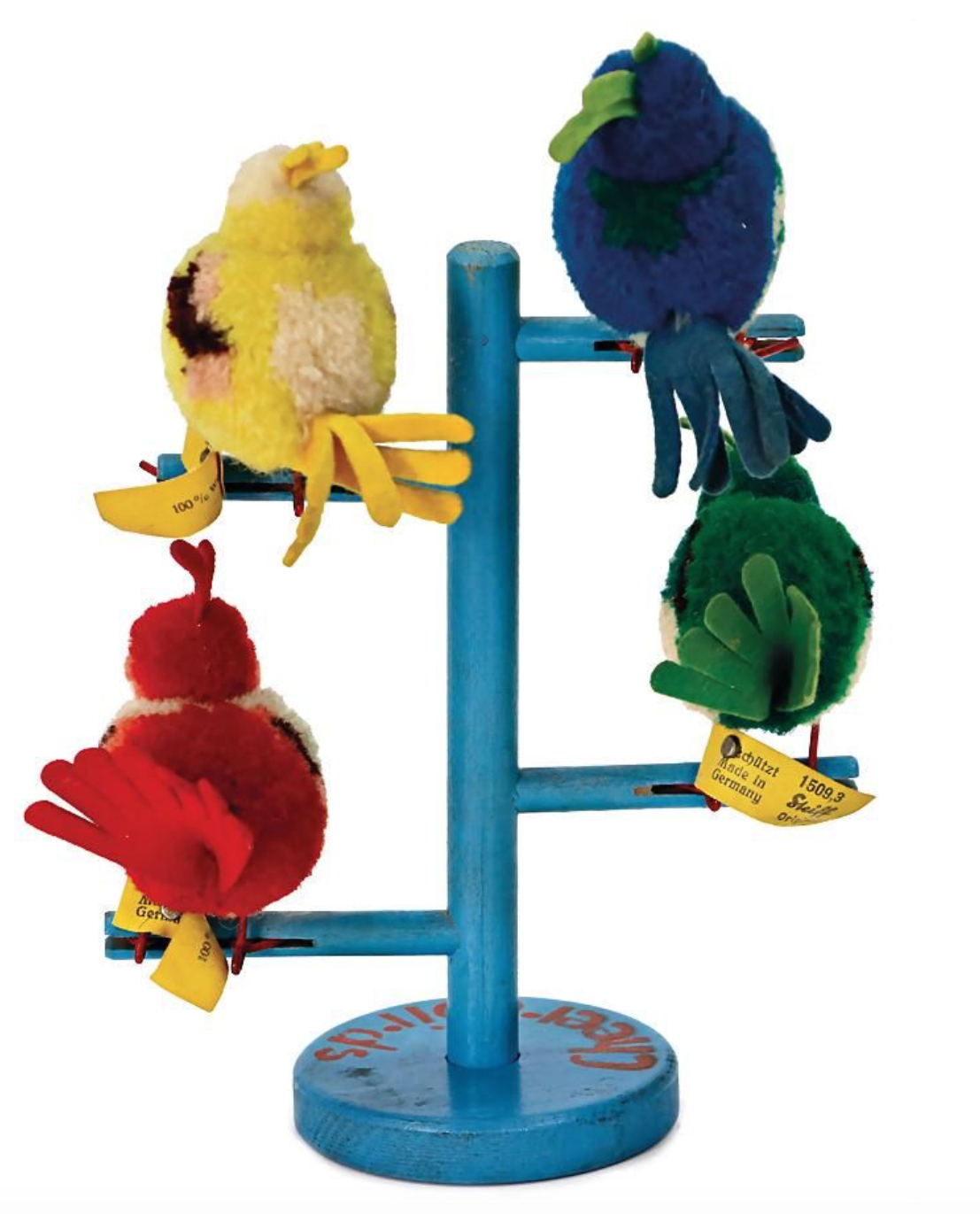
Bird's the word when it comes to this first auction debut item highlight. It is lot #3097, a most unusual woolen miniature bird display, estimated at 220-440 euros. It is cataloged in part as:

"Cheerubirds, rare bird tree, 4 x paradise birds, 100 % wool, with rare original breast sign, Blue Bird No. 1509,2, St. Patrick Bird No. 1509,3, Birthday Bird No. 1509,1, St. Valentine Bird, No. 1509,4, 22 cm, probably special design for the American market, extremely rare, unusual."

Who wouldn't love to feather their nest with this fantastic display? According to the Sortiment, this item appeared in the line from 1953-1956 with its own article number of 5204 Ch. Its overall design gives off a great midcentury vibe. But what makes this rarity so special - in addition to its amazing condition - is that each of the birds not only has a chest tag, but a very custom one. Steiffgal cannot think of any other woolen minis that have chest tags, probably due to their construction and size. The birds featured on this display are otherwise standard line "woolen exotic birds" which appeared in the line from 1953-1966; the earliest ones had red metal feet and legs and those from 1956 onward had plastic feet and legs. 

Now let's take a tumble for this next auction debut highlight. This is lot #3073, a felt, fully jointed circus performer doll, estimated at 280-560 euro. It is cataloged in part as:

"Acrobat, produced between 1911-1918, felt, jointed, from the circus series, with button, block letters, long trailing f, blue glass eyes original clothes, 40 cm, felt is a bit darken, small felt faults at 1 hand, and at stomach and at 1 shoulder, otherwise nice condition, exceptional, rare."

This fine, flexible fellow is a wonderful and seldom seen acrobat doll from Steiff's legacy "Schlopsnies Circus" display. This large scale, dynamic, and extremely popular exhibit was designed and created by Steiff doll freelancer Albert Schlopsnies in the c. 1910-1920 time frame. It consisted of over 30 circus themed dolls and acrobats, based on real life performers at the world famous Circus Sarrasani of Dresden, Germany. The acrobat dolls were often posed in death-defying or upside down poses in the displays. Sometimes they were even animated via camouflaged mechanisms. Steiffgal has seen or handled several of this acrobat's colleagues, including clowns, stagehands, and other performers, but she has never seen or handled this acrobat before. 

And last but hardly least, this final debut auction highlight just begs for attention. Here we have lot #3069, a charming prewar canine themed display, estimated at 280-560 euro. It is cataloged in part as:

"Exceptional show piece, Waldi, on a mohair plate, plate partially with a bit mohair loss, height: 30, width: 30 cm, depth: 22 cm, attending, with huntsman's hat, with button, chest label and a  very beautiful preserved red cloth tag label, with No. 4328,2, probably 1930, nice full mohair, breast sign is a bit faded, with small Treff, sitting, 14 cm, swivel head, exceptional, extremely rare."

This probably one of a kind treasure stands and delivers. It features one of Steiff's most beloved and prolific dog designs, Waldi the Dachshund. Waldi is most often on all fours. However, from 1933-1936, he was produced in a begging position in 17, 22, and 28 cm. His red ear tag numbers perfectly corresponds to that, with 4= begging or standing on back legs, 3= mohair, 28=28 cm tall, and ,2=with a voice. So the dog in itself is a total rarity! The fact that he is mounted on a factory original green mohair mat (probably to resemble grass), wears a  typical German style hat, and is accompanied by a perfectly paired and period Treff friend, make him over the top interesting. 

How this rare pair came to be remains a mystery, though. This charming display could have been produced as part of a larger exhibit, assembled by employees and presented to their friend or colleague as a special tribute gift, or perhaps made as a whimsy, end of day, or prototype that never went into production. Only Waldi and Treff know for sure!


Steiffgal hopes this discussion on these debut Steiff auction treasures has been like an opening night celebration for you. 


For more information about Ladenburger Spielzeugauktion upcoming Steiff event on September 24th, please click here!


Have a question about one of your Steiff treasures? Let's talk! Click here to learn more!

Friday, December 16, 2016

Outfoxing The Mystery Behind This Very Vintage Steiff Dog

Who doesn't love a surprise? Especially when it may have to do with Steiff! Check out this note from a new friend who writes about a "foundling" discovered in the home of a relative. Caroline shares,

"Hi there,

I was wondering if you could help me identify this charming straw stuffed dog? It was found in the basement of my mother-in-law's house back in the 60's but clearly it's a lot older. It has a hole in the right ear (there is velvet inside the ears) which made me think it could be Steiff if there was once a button there. I'm not sure if they were ever stuffed with straw or made of this material?

Anyway I know he's not not worth a lot but I love him and I'd love to know a bit more about him. Thank you so much for your time. 

Kindest regards,
Caroline"

Well, let's pull up a chair and check out this sitting sweetie. From what Steiffgal can make out from the photos, it is her best guess that this is an early Steiff Fox Terrier. It is not clear about his measurements, but based on his remaining materials, it is most likely that he originally was made from white mohair; the woolen covering has entirely been lost to time in this case. If he has a "crunchy" feeling to him when he is squeezed, then he is stuffed with excelsior, which would be consistent with his era of production. 

This early and beloved Steiff pattern is known for several design features.  These include one white ear and one orange one; pert black shoe button eyes and a black hand embroidered nose and mouth; a black circle drawn around the dog's right eye; velvet lined ears; and adorable, perfectly-to-scale prominently formed back leg haunches. Steiffgal has also seen several of these early Fox Terriers detailed with an orange airbrushed ring around their tail end, although it is not clear if this model has this based on these limited photos.  

Steiff has a long history with Fox Terriers, and they have always been an important breed in Steiff's kennel club. They made their first appearance in 1899, just a handful of years after the company's debut commercial catalog launch in 1892. This particular sitting version, named simply "Foxterrier," has its origins as far back the very early 1900's, when a similar model was produced in felt in 10, 17, and 22 cm from 1902 to 1924. This sitting pattern was produced in mohair in 7, 17, 22, 28, and 35 from 1902 through 1929, as well as lamb's wool plush in 12, 17, 22, and 28 cm from 1903 through 1917.   

This basic sitting Foxterrier pattern made a somewhat interesting "solo" appearance in 1928. For that year only, this design was also produced in mohair in 7, 17, 22, 28, and 35 cm but was specifically given the name "Spotty." This name appeared on a white tag with a metal wire rim worn as a chest tag. Two of these 1928 Spotty dogs are pictured here on the left; the photo is from Pfeiffer's 1892-1943 Steiff Sortiment book.    

And what's up with this name-game? It is Steiffgal's best guess that this update from a generic breed to a more "playful" name in 1928 was not random, but part of a larger strategy. In the mid- to late 1920's, Steiff began producing a great number of beloved dogs and giving them endearing, child-like names. This was a directive straight from company management and was made to help reinvigorate the product line and align design priorities to the societal trends and preferences of the time. This marketing tactic proved quite successful, starting with the introduction of "Molly" the puppy dog, who debuted in 1925. Other named pups introduced around this era include "Treff" the Bloodhound in 1928, "Fellow" the puppy dog in 1928, and "Bully" the Bulldog in 1927.  You have to admit, the name "Spotty" is much sweeter and appealing than "Foxterrier!"

In 2013 - perhaps in honor of his 85th birthday? - Steiff produced a charming 17 cm replica of 1928's Spotty in an edition size of 1,000 pieces for the worldwide market.

Unfortunately, due to its condition, it is difficult to put a firm date on Caroline's Steiff dog. However, given the information available about the pattern and assuming that it did have a button-in-ear at one time, it would be safe to say that it was manufactured in the 1904 through 1929 time frame.  

Steiffgal hopes this discussion on Caroline's vintage Foxterrier has made you sit up and take notice!

Have a question about one of your Steiff treasures? Let's talk! Click here to learn more!

Sunday, January 31, 2016

Warming Up To Some Of Steiff's More Unusual Dog Designs

Given it's just about the midpoint of the cold, dark winter (at least around these parts!) Steiffgal thought readers might appreciate a few warm fuzzies sent their way.  Perhaps you are aware of the saying "a three dog night?" This historically referred to the number of dogs a person would have to cuddle with at night to stay comfortable during frigid weather.  So, to REALLY help crank up the temperature, here are FIVE interesting and somewhat rare Steiff hounds that just might add a degree or two to your day!

Let's get started by taking a "peek" at this first great Steiff dog.  Here we have a large, lesser known Steiff Pekingese named Peky. Her pattern is very different from the company's better known, more common, and smaller Peky designs.  Peky is 30 cm, head jointed, and sitting. Her ears, back and tail are made from very tan long mohair while her face and legs are made from short mohair. Her face is detailed with huge, round black and white google eyes, a black hand embroidered nose, and airbrushing on her eyebrows and elaborately constructed muzzle. She has the most endearing, pouty expression... she is probably thinking, "Hand me over a taste of whatever you're eating right now!"  This large Peky pattern was made between 1965 and 1976; this example has a raised script button placing her production at or before 1969.  

It's time to hand off the spotlight to this most adorable puppet pup.  This is Steiff's Treff the Bloodhound hand puppet.  Treff is 17 cm tall and made from bright blond mohair. She has three black hand embroidered claws on each hand. Her head is modeled after the company's beloved Treff pattern, and comes to life with long droopy ears, oversized black and brown glass eyes set deep into eye pockets; a black hand embroidered nose; simple jowls; and airbrushed freckles. She retains traces of her original red ribbon.  This happy handful was produced in this size only from 1928 through 1940.  This example retains her long trailing f button, early chest tag, and traces of her red ear tag, putting her at the early part of the production timeline.

Rolling right along, here are two great and early examples of Steiff's wonderful dogs on wooden eccentric wheels.  Both have the appearance of bobbing up and down as they are pulled along.


The first coppery example begs a penny for your thoughts.  Here we have a lovely version of the company's beloved Waldi Dachshund pull toy.  Waldi is standing, 16 cm tall and 30 cm long nose to backside, unjointed, and made from long, glorious copper colored mohair.  His tail adds another 10 cm to his length. His face, arms, and legs are made from shorter copper colored mohair. Waldi has a simple black hand embroidered mouth and nose and black eyes. He glides upon four oversized, blue off-center wooden wheels. Waldi retains his original green leather collar, long trailing f button, and fully legible red ear tag.  Pre-war, Waldi was produced on eccentric wheels in 14, 17, and 22 cm from 1933 through 1943; this example is from the early part of that period. Once the factory opened for toymaking business after the war, he again was produced in 17 and 25 cm from 1949 through 1970. 

This second Steiff dog on wheels comes sealed with a kiss.   This Sealyham is standing, 17 cm tall and 24 cm long nose to backside, unjointed, and made from long white mohair. His tail adds another 5 cm to his length. Sealy has a simple black hand embroidered mouth and nose, brown and black glass pupil eyes, and felt lined ears. He rides on four red off-center wooden wheels. Sealy retains his original red leather collar and brass bell, along with his long trailing f button.  He was produced on eccentric wheels in 17 and 22 cm from 1939 through 1943.  And, like Waldi, this model again appeared in the line post war, but for a much shorter interval.  He was available in 14 and 17 cm from 1949 through 1954.

Today's final highlight is a shoe in as a collector's favorite.  Here we have a nice example of a Hush Puppy Basset hound made for the footwear company of the same name.  He is sitting, unjointed, and is made from tan mohair that has been lovingly airbrushed in multiple shades of tan, brown, and black. He has has wonderfully long, droopy ears; a hand embroidered black nose; and realistic, dimensional soft jowls. Basset has brown airbrushed claws and extremely round, realistic-looking eyeballs that are embedded into his facial mask structure.  He retains his original red collar and all IDs, including his specially imprinted "Hush Puppies" chest tag.  

This delightful customer special was produced in 14 and 14 cm from 1970 through 1972, and is quite similar to Steiff's earlier, standard line 1960s-era Basset hounds.  These were produced from 1961 through 1963 in 12, 14, and 22 cm.  There are three main differences between the standard line Bassets and the Hush Puppy Bassets.  The Hush Puppy Bassets are unjointed, have a red collar, and have a special logo'ed chest tag.  The standard line Bassets are head jointed, have green collars, and have the word "Basset" on their chest tags.  

Steiffgal hopes this tour through Steiff's "kennel club" has lit a bit of a Steiff fire under you!

Have a question about one of your Steiff treasures? Let's talk! Click here to learn more.

Tuesday, June 17, 2014

Something Old, Something New, Something Borrowed, Something Blue At The Upcoming Withington Steiff Auction Event!

June - at least around these parts - has got to be one of the finest months of the year. It's not too hot, the flowers are in full bloom, and its the prime season for wonderful happenings, including lots of weddings and happy family times together. And, apparently, auctions as well! Steiffgal has just learned of a wonderful collection of Steiff treasures coming up for sale at Withington Auctions. This event will be held in Nashua, NH on Friday, June 20, 2014. In keeping with the theme of happy seasonal events - especially those involving brides and grooms - let's take a look at some of the highlights from this upcoming sale!

It would only be proper to start out this review with "SOMETHING OLD." Steiffgal's eye went immediately to lot S96, which can be found by clicking here. Of course, collectors will recognize these delightful doggies as a group of three Steiff Treff the Bloodhounds, who are also pictured here on the left. According to Withington's, they are cataloged as... "3 Steiff Treff Bloodhounds, Beige, brown glass eyes, dark brown yarn nose and paws. Large one is 12 ½” sitting; Medium one is 10” sitting and Medium one is standing on all fours. All swivel necks." 

Care to sniff out some additional details about this great design? Treff appeared in the Steiff line from 1928 through 1938. Models were produced in mohair, velvet, and an inexpensive alternative material called "coat plush" in sizes ranging from 7 to 50 cm overall. This design is famous for its long, floppy ears which are lightly stitched down; brown and black pupil eyes which are set in eye pockets; hand embroidered black noses; dainty muzzle “freckles"; and red facial highlights on their lips and under their eyes. Every Treff left the Giengen factory adorned with a large pastel-colored silk ribbon. These ribbons were meant to add a little lightness and color to Steiff's items; this mandate came directly from Richard Steiff around 1925. Treff was so popular that she was produced sitting, standing, on wheels, as a music box, and on a pin cushion during her time in the line. 

Now onto "SOMETHING NEW." Well, that's a bit challenging with this wonderful vintage collection, but something in LIKE NEW condition really caught Steiffgal's eye. Check out lot S126, which can be found by clicking here. The lot is simply cataloged as, "3 – Steiff mohair plush animals, “Sonny” rabbit 5”, “Hush Puppy” 11”, small standing Bear 5 ½." And yes, all three treasures in the lot are dear. But one is exceptional! That is the 11" Steiff Hush Puppy! 

Steiffgal certainly cannot keep quiet about this bashful Basset! Steiff's Hush Puppy examples are quite rare and desirable, and are based on the company's standard line Basset hounds that appeared in the line from 1961 through 1963 in 12, 14, and 22 cm. Steiff's standard line Bassets are sitting, head jointed, and made from mohair that has been carefully airbrushed in multiple shades of tan, brown, and black. Each has long, droopy ears; hand embroidered black noses; and realistic, dimensional soft jowls. The larger ones have extremely round, realistic-looking eyeballs that are embedded into their facial mask structure. The 12 cm model one has flatter, but no less realistic looking, eyes that seem to have a reflective quality to them. Standard line Steiff Bassets wear green collars and usually have "Basset" on their named chest tags.

But here's where it gets interesting. According to company records and literature, Steiff produced Hush Puppy branded 12 and 14 cm Basset hounds as premiums from 1970 through 1972; these were differentiated from the standard line of Basset hound items by a red collar and a special chest tag that had the “Hush Puppies” logo on it. However, this model on offer is 22 cm, and as far as Steiffgal can tell, does not appear in the standard Steiff reference books. A rare beast indeed!
 

Ok, now in keeping with our celebratory theme, it's time for "SOMETHING BORROWED." These two items were selected by Steiff for replication as they have always been of such great interest to collectors. Check out this ORIGINAL pair of Steiff's spiders, lot S68, by clicking here! According to the catalog, these are... "Lot of 2 - Steiff Spider, “Spidy”. 4 ½” length. Three beady eyes, eight wired legs, two antennas, two mouths, red/brown/green coloring on back and neck. Wool and cotton. Raised button, C.T. 2312,00, Steiff Spider, “Spidy”. 9” length. Five beady eyes, eight legs, four antennas. Beige mohair, red, green and brown coloring design on back and neck. Raised button on left leg."
 
It's certainly time to get a leg up on these great vintage spiders! This small and large sized Spidy pair are 12 and 22 cm respectively. Both have bead-like black glass eyes and are manufactured from light beige mohair, which is gloriously hand airbrushed in brown, red, and green. Small Spidy has legs and feelers made from gray pipe cleaners, while the larger size has thin mohair legs and feelers. Both large and small Spidy spiders were produced in 1960 and 1961 only, making them quite collectible. Spidy was produced at a time when the company was experimenting with different unconventional materials such as pipe cleaners, rubber, and plastic sheeting to create a series of "creepy crawlers." These included bats, salamanders, snails, and of course, these spiders. And, indeed Steiff did "borrow" a good idea from themselves, creating a replica set of a large and small Spidy in 1991 and 1992 in an edition size of 4,000 pieces.

And finally, it would not be a celebration without "SOMETHING BLUE." And there's not much that's more "true blue" than the US Navy and their mascot the goat! Check out lot S05, a pair of Steiff Navy Goats, by clicking here! According to the catalog, these are... "Steiff Navy Goat, 8” height (to his ear), 12” length. Beige, plush, leather horns and hoofs, green glass eyes. Navy felt blanket. Raised ear button. Cotton tag #1228.0. 1940s, Steiff Navy Goat, 5 ½” height (w/out horns). Grey mohair (long) on body. Mohair (short) on face and feet, short tail, green googly eyes, felt striped horns, black yarn nose, navy blanket with “N”. #7315.90, MINT"
 

Let's give a salute to these great goats and their interesting history. During the 1950's and very early 1960's, Steiff produced a number of mascots especially for the US market. Mascots were produced for several of top-tier schools, as well as the country's military training institutes - including the United States Naval Academy. The official launch of Steiff's mascot program began in 1951 with the production of two caricatured versions of the US Navy goat. Both were 28 cm; one was sitting and one was standing on all fours. This lot features this early standing version. Each was made from white mohair and had leather hooves and horns; green and black "squint" style eyes, a long beard, and wore a blue and gold felt blanket with a large "N" on the side. These goats were entirely original designs and were manufactured through 1959. Steiff also produced a smaller Navy goat in 15 and 25 cm from 1957 through 1960. This is the smaller goat in the lot. The smaller navy goat's pattern is quite similar to the one that would later be seen on the standard line item Rocky the Capricorn goat, who appeared in the line from 1963 through 1976. 

Steiffgal hopes this celebratory post has put you in the mood for love - Steiff auction love, that is!

Have a question about one of your Steiff treasures? Let's talk! Click here to learn more. 

Saturday, January 18, 2014

I Get By With A Little Help From My Steiff Friends!

Steiffgal once had the great pleasure of interviewing author Maureen Stanton about her wonderful book about collectors and collections, called Killer Stuff and Tons of Money Maureen noted during the conversation that there is nothing collectors enjoy more than sharing their collections with other enthusiasts.  And Steiffgal could not agree more!  So earlier this week, she and two other Massachusetts collectors hit the road to visit two other Steiff collectors in Connecticut.  And it is very safe to say "A grand and Steiff-y time was had by all!"  Here are some of the amazing things Steiffgal and gang shared during their button-in-ear play date!

The first stop on the Steiff tour was to view the collection of Sandy Booth, where we were treated to a magnificent and well curated exhibit of Steiff rarities, most in excellent condition with all IDs!  Here is one of her display units - and it's ok to stare!  Which are your favorites?


There were so many great things to see at Sandy's, that Steiffgal felt like a kid in a candy store.  It's hard to pick out highlights when everything is so lovely, but here's a few things that really caught every one's eye. The first was this precious duo of a very large vintage Treff the Bloodhound and her little duckling friend. Treff is 35 cm, made from mohair, and sitting. Sitting Treffs were produced in 7, 10, 14, 17, 22, 28, 35, 43 and 50 centimeters. Treff proved to be a very successful design and was produced in a number of sizes, materials, and models through 1938. The darling duck is Steiff's Spiel Ente or Play duck.  He is standing, made from yellow wool plush, and 22 cm. His big feet and open beak are made from yellow felt.   He has red felt disks behind his black button eyes.  Pre-war, Play duck was produced in this size only from 1933 through 1943.  

Another cool item with wheel - ahem, real - appeal was Sandy's marvelous donkey on wheels. Donkey is 14 cm, standing, unjointed, and made from mohair. He has a very short black mane. His tail is made from felt with a black mohair tip. He has black airbrush highlights down his back, on the tips of his ears, and indicating his hooves. Donkey's face is sweet and baby-like; it is detailed with shiny black button eyes and delicate airbrushing to define his nose and mouth area. He sports his original red leather reins.  Donkey is mounted on a simple metal chassis and glides along on four red wooden eccentric wheels.  This donkey on wheels was produced in this size only from 1954 through 1961.

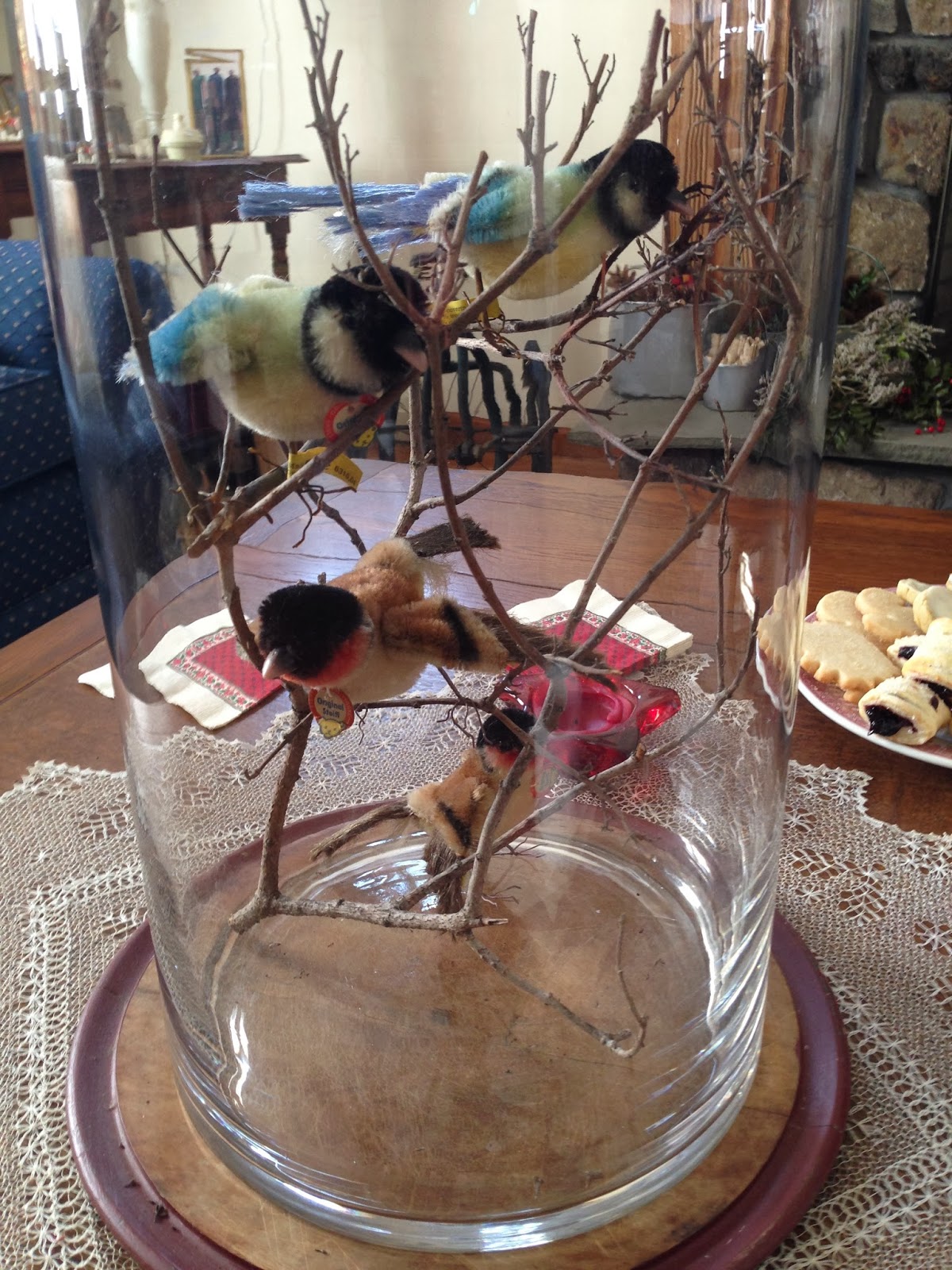
In addition to Sandy's great taste in Steiff, she also has a wonderful sense of how to display her collection.   Take for example, this glass domed vignette of four early Steiff birds perched on just the perfect branch.  Two of the birds are Finches, while the other two are Blue Tits.  The birds are all 10 cm, made from mohair, with stiffened braided hair wing tips, plastic beaks, and early metal feet.  Both the Finches and the Blue Tits were produced in this size from 1959 through 1961.  

After a delicious lunch, the Steiff Superteam was off to their second and final destination of the tour.  After a brief car ride, we arrived at the lovely home museum of Shelley Smith.  In addition to Steiff, Shelley also collects and sells antiques, dolls, miniatures, and Christmas related collectibles.  So viewing this remarkable setting was truly like being in Santa's magical workshop!  Choosing highlights from Shelley's collection was as challenging as it was to do with Sandy's.  Here is just the tip of the iceberg of the things that really called to Steiffgal.


It's hard not to oodle these two marvelous poodles! Here we have spectacular examples of two rare, 1950's era Steiff poodles. The white one on the left is the early version of Snobby. This top dog is standing and made from wool plush. She came in black or white. Her face is detailed with a black glass button nose and round brown and black glass pupil eyes. Her mouth and claws are defined by embroidery. Her coat is in what Steiff refers to as the "French" trim, meaning that it is fluffy basically from the waist area up; her lower torso and backside are more closely cropped. She also has longer tufts of fur around her knees, elbows, and the tip of her tail. This original Snobby was produced in 17 or 22 cm in 1952 only.  The black poodle on the right is Maidy.  She is standing and unjointed, and made from delightful and really unusual "Persian Lamb" style mohair. She has a slightly longer mohair "beard" around her chin. Her mouth and claw stitching is done in mauve colored embroidery floss. She was produced in 25 and 30 cm in 1959 only.

Eye bet you cannot resist this next highlight from Shelley's outstanding collection.  This sitting sweetheart is the early Susi cat.  She is 17 cm, made from grey mohair and is head jointed.  Her little tail wraps gently around her backside.  She his lovingly hand airbrushed with black stripes.  Her face is detailed with bluish-green and black slit pupil eyes, a pink hand embroidered mouth and nose, and large, pert ears.  Susi, who is named for a member of the Steiff family, was produced pre-war in 14, 14, 22, and 28 cm from 1936 through 1943.

You don't have to be from the Boston area to fall in love with this fourth highlight from Shelley's hug.  Here we have Steiff's extremely rare Boston Terrier on metal wheels.  The dog itself is 28 cm, unjointed, standing, and made from brown and tan felt.  His face is detailed with black button eyes and a simple black hand embroidered nose and mouth.  When he was new, he had a few black dots around his muzzle to indicate his whiskers.  Boston Terrier is mounted to metal axles with regular, not eccentric, round wheels.  Although his neckwear is not original, he did leave the factory in Giengen a century ago with a handsome leather collar.  Boston Terrier on wheels was produced in 22, 28, and 35 cm from 1913 through 1919.

Many thanks to Sandy and Shelley for opening up their homes to the Steiff community, as well as providing such gracious hospitality.

Steiffgal hopes this virtual tour has inspired you to share your collection with new friends, too!

Have a question about one of your Steiff treasures? Let's talk! Click here to learn more.

Monday, April 22, 2013

Fantastic Steiff Finds at the Sturbridge Doll, Toy, Bear, and Holiday Show

It's been a pretty tough week in the Boston neighborhoods that are in close proximity to Steiffgal's home.  Thankfully things do seem to be returning to normal after a really high anxiety few days.  There is no better way, at least in Steiffgal's mind, to help improve one's mood than to surround themselves with good friends and Steiff.  And that's exactly what she did, by attending the annual Sturbridge Doll, Toy, Bear, and Holiday Show last Sunday in Sturbridge, Massachusetts.  The show, produced by Steiffgal's colleague Kim Kittredge, was a wonderful way to temporarily escape from Boston Marathon bombing madness... and enjoy some really remarkable Steiff treasures.  Here are a few great items that really caught Steiffgal's eye.

Does this goat float your boat?  Well, he certainly got Steiffgal's attention.  Here we have Steiff's Ziege or Goat.  He is five ways jointed and made from very long, white shaggy mohair.  His face is made from shorter white mohair, and is detailed with hand embroidered black nostrils and a simple line mouth.  His round pupil eyes are made from green and black glass, and his ears are lined in velvet.  Goat was produced in 22, 28, 35, and 43 cm from 1906 through 1927.

So what makes this goat "best of the barnyard?" Besides being really just marvelous, he also has two Steiff buttons in his left ear:  a large one (8mm) and a small one (4mm).  Both have the long trailing "f" style Steiff writing on them.  Some early Steiff items do have two buttons; this was sometimes done to indicate an item was an early prototype or model - but usually this was indicated by a button with the word "muster" on it, plus a regular Steiff button.  Steiffgal has never seen anything quite like this button configuration before.


So how much is that doggie in the window? Readers may recognize this tiny treasure as the smallest sized mohair version of Treff the bloodhound.  This feminine, droopy-eyed dog design was introduced to the world in 1928. The first Treff examples - like this 7 cm version -  were sitting, head jointed and made in light brown mohair or velvet. They all have long, floppy ears, brown and black pupil eyes set in eye pockets, hand embroidered black noses and dainty muzzle “freckles.” Every Treff left the Giengen factory adorned with a large pastel-colored silk ribbon. Early sitting Treffs were produced in 7, 10, 14, 17, 22, 28, 35, 43 and 50 centimeters.

Treff’s popularity certainly lived up to her blue-ribbon looks and personality. As a result, Steiff quickly expanded her role in the product line. She was soon manufactured in a standing position, as a large ride-on toy, a side-squeeze musical animal, a pin cushion, a dressed dog-doll toy, a child-sized purse, and a tail-turns-head model. It is interesting to note that she was also manufactured in a less-expensive coat-plush material from 1932 through 1937. Politics and the world economic situation during this time frame greatly limited both Steiff’s ability to obtain high-quality materials and its customer’s ability to afford such “luxuries.” Overall, Treff appeared in the Steiff catalog through 1938.

You've been a doll to read this far, so let's thank you with just that.  Here we have an approximately 16 inches tall or 43 cm Steiff doll.  She is made from felt and is fully jointed.  Her "typical" Steiff style face is center-seamed and is detailed with brilliant cobalt blue and black glass pupil eyes.  This sweet lady is wearing a peasant style removable dress and full skirted apron, as well as a bandana on her head.  It is Steiffgal's best guess, based on her size, styling, and removable clothing,  that she is the Brenz Farmer's Wife doll, which was made in 43 cm in 1912 and 50 cm from 1912 through 1921.

Well hello Dolly!  Given this model was only produced in this size for one year, this is indeed one fantastic find indeed!

Let's get a leg up on this final great show find.  This "tall drink of water" is Rabbiette, a design that Steiff produced from 1927 through 1932. She has a standard line mohair rabbit head, long, soft unjointed dangling limbs; and mohair hands and paws. Her body, arms, and legs are made from lilac colored velvet.  She has glass, very large black and brown pupil eyes and an embroidered nose and mouth.  When she was new, she had a bright, sherbet colored silk ribbon. 

Rabbiette is one of a series of long limbed lovelies in the Steiff catalog from 1927-1932. These "play and car dolls" included Bulliette, the bulldog, Fluffiette, the cat, Molliette, the puppy, and Cherrioette, the open mouthed puppy. These were based on the most popular named Steiff characters of the time; it is interesting that there was not a bear in this series.  Each play and car doll had the head of the character, mohair paws and feet, and dangling velvet limbs. Most were available in several bright, happy "jelly bean" colors and in 20, 30, and 43 cm, with the larger sizes having a squeaker. 

Steiffgal hopes these special finds have added some highlights - and happiness - to your day today.  (And be sure to mark your calendars for next year's Sturbridge Doll, Toy, Bear, and Holiday Show, which will be held on Sunday, April 27th 2014 at the Sturbridge Host Hotel, Sturbridge, Massachusetts.) 

Have a question about one of your Steiff treasures? Let's talk! Click here to learn more.

Sunday, February 24, 2013

Getting A Handle on Steiff's Handbags

Steiffgal must take this reader's inquiry quite purse-sonally, but in the best way possible.  Take a look at this note from Juliet, who asks about a recent addition to her collection - a little bulldog that doubles as a handbag. Could it have been made by Steiff?  She writes in part...

"Dear Steiffgal,

This looks like a Steiff Bulldog face.  
I can't find any info on this item.  
Did Steiff ever make child's handbags? 

Best regards, 
Juliet"

Steiffgal's got this one in the bag.  Yes, Steiff has a long history of making handbags.  In most cases, they were not designed specifically for children, but their diminutive size does suggest that they were designed to hold few or very small things!  As far as Steiffgal can tell, the first Steiff purses, or "handtasche" were produced starting in 1927.  These earliest bags were actually based on Steiff's most popular designs of the time, and included beloved characters including Jocko the Chimp (pictured here on the left, sold for $890 at the 2010 Steiff Auction at Christie's in London), Petsy the blue eyed baby bear, Bully the bulldog, and Molly the puppy.  Items were sitting or standing, but in either case, were modified to have a hollow back pocket to hold purse-related items.  This pocket was lined in silk or velvet, and closed with a zipper.  In some cases the zipper had a pull, in others it had a circular round handle.  As time went on, Steiff added additional characters to its purse line, including Strupp the foxterrier, Treff the bloodhound, and even Pip, the cartoon dog, as late as 1941.  Steiff's early mohair character purses ranged in sizes from 17 to 29 cm overall. 


Steiff's purse line re-emerged in the late 1970's with a series of flat woven fur items.   These included a Teddy bear face in 12 and 26 cm, a little rabbit face bag in 26 cm (pictured here on the left), and a special edition Lake Placid Olympics raccoon souvenir purse in 18 cm.  Then, in the late 1980's, Steiff launched a new series of woven fur animal purses.  This introduction included a Teddy bear, panda bear, rabbit, and dog - all 17 cm heads - and a mouse, fish, owl, and hedgehog - all in full 18 cm body.  Since 1996, Steiff has also produced small plush animal faced handbags in the forms a Teddy bear, elephant, cow, cat, frog, and pig.  Steiff has not done much recently with handbags; the company's most recent purse creation was done in 2005 and was a replica of the 1927 through 1940 mohair Charly handbag.


Now, getting back to Juliet about her bulldog bag.  Although this is a charming and interesting treasure, Steiffgal does not believe he was made by Steiff.  A photo of Steiff's standing Bully purse, which was produced in 22, 23, 28, and 29 cm in black and white or sandy tan mohair from 1927 through 1934, is pictured here on the left for comparison.  The illustration is from Gunter Pfeiffer's 1892-1943 Sortiment book.  Steiffgal does think, however, that Juliet's bulldog bag was most likely produced around the same time as Steiff's model, and may even be based in part on his design.  

Steiffgal hopes you now have a handle on the history of Steiff's wonderful handbag production.

Have a question about one of your Steiff treasures? Let's talk! Click here to learn more.  
The teddy bear search engine