This bearded beauty is the wheel-deal indeed! Scotty is 17 cm tall, standing, and head jointed. His body and head are made from grey and light black mohair plush fabric. His ears are made from pitch black mohair. Scotty is detailed with proportional black and brown round glass pupil eyes, a black embroidered nose and mouth, and dark pink embroidered claws on each of his four paws. His ears are lined in black mohair. The dog is mounted on a metal carriage and glides along on four blue wooden eccentric wheels. He retains his original collar and brass bell. His collar is white and dark blue or black leather, and closes with a ring and two (now very rusty) Steiff buttons. He retains his long trailing "f" button in ear and traces of his chest tag as his Steiff IDs.
Showing posts with label pulltoy. Show all posts
Saturday, August 12, 2023
Rolling Along With This Early 1930s Steiff Scotty On Wheels
Great Scot! Check out this utterly charming prewar pup on wheels. Despite his small size, he's got a few interesting "time capsule" details that help to date him to a "T". Read on to learn more.
This bearded beauty is the wheel-deal indeed! Scotty is 17 cm tall, standing, and head jointed. His body and head are made from grey and light black mohair plush fabric. His ears are made from pitch black mohair. Scotty is detailed with proportional black and brown round glass pupil eyes, a black embroidered nose and mouth, and dark pink embroidered claws on each of his four paws. His ears are lined in black mohair. The dog is mounted on a metal carriage and glides along on four blue wooden eccentric wheels. He retains his original collar and brass bell. His collar is white and dark blue or black leather, and closes with a ring and two (now very rusty) Steiff buttons. He retains his long trailing "f" button in ear and traces of his chest tag as his Steiff IDs.
This model was made in 14, 17, and 22 cm (measured vertically, without wheels) from 1932-1943. He was produced in grey and black mohair plush from 1932 through 1934; after 1934 he appeared in all black mohair. Given those dates, it is safe to say that this guy was "born" in the 1932-1934 time frame.
Scotty dogs debuted in the Steiff line in 1930 and were an immediate success with customers. Their size, personality, and proportions translated well into soft toys designs, and Steiff created a number of sitting, standing, wheeled, and novelty versions over the next decade. Some had round glass pupil eyes like this example, while others had brown, white, and black almond shaped glass eyes. Steiffgal has never been able to figure out why that was the case, but both style of eyes are original to Steiff.
The Scotty under discussion here has two distinctive early 1930s-era details that Steiffgal has not seen on items produced during any other time. The first is his body fabric, which is a mostly black mohair plush with grey fiber details. It is not "spiky" like traditional mohair, but smoother and more elegant, with the longer fibers really resembling a dog's coat. This lovely material was used for awhile on the company's Scotties, but then disappeared in 1934 - about the time that things really started getting difficult at Steiff - and throughout Germany due to geopolitical realities. It is possible that the grey and black fabric was expensive, and the company was trying to save money on materials, and/or that it was no longer being produced, and/or it was entirely allocated by the government for wartime material production. Through the early 1940s, Scotty dogs would go on to be produced in mohair, wool plush, cotton plush, and silk plush - apparently coming to life in the fabrics available at the time.
Also of note is this Scotty's prominent leather collar. Steiffgal has only noted this woven style, light and dark belled collar on dogs from the early 1930s. It is possible that this accessory was designed and produced to give the dogs wearing it a more "upscale" look and feel. The collar, which is not removable, needed to be manually attached to the dog and finished with two inserted buttons. This of course required many more assembly steps than the signature, simple red buckled collar which would be used on the model just a few years later.
Steiffgal hopes this discussion on this early 1930s Scotty on wheels was a joy ride for you!
Have a question about one of your Steiff treasures? Let's talk! Click here to learn more!
Saturday, December 25, 2021
Care To Feather Your Steiff Nest With This Grand Goose On Wheels?
This fine feathered Steiff friend is certain to give you goosebumps! Bird's the word when it comes to this adorable goose on wheels. She's flown a little under the radar relative to other birds in the Steiff line, but has a most impressive history worth a honk - or two! Check out her story below.
This gorgeous goose is 17 cm tall and 23 cm wide. She is lying on her belly and is made from white mohair. Her neck and head are airbrushed with a touch of grey. Her wings are splayed outward, in a most realistic and playful way. Her feet and legs are made from single thick orange felt. Her face comes to life with black button eyes backed in red felt and a proportionally large and dimensional orange felt beak. She rests on a metal carriage and glides along on four green wooden eccentric wheels. When she moves, her back axle activates a squeaker in her belly. Goose on the go was made postwar in 17 cm from 1949-1964.
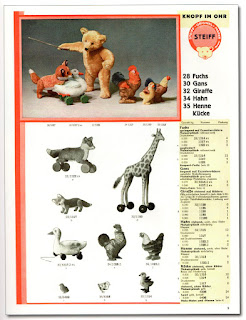
This timeless pattern must also have been an unassuming best seller for Steiff. That is because it appeared both in the prewar and postwar period. Interestingly, it does not seem that this goose model was ever made without wheels. Prewar, it was made in 14 and 17 cm from 1914-1943. It is really likely that the pattern was updated just a bit in the 1914-1943 time frame - given how aesthetics, economics, and manufacturing realities evolved so quickly during that nearly three decade long period of production. Nonetheless, technically this goose on wheels was noted in every Steiff catalog published for a stretch of 50 years! This longevity is right up there with the company's legacy Molly the puppy (1925 - 1969, about 44 years overall), Waldi the Doxi (1933 - 1980, about 47 years overall) and Susi the cat (1936 - 1978, about 42 years overall.) You can see goose on wheels as she was presented in Steiff's 1929 catalog; the image is from C. Esser's Steiff Kataloge 1920-1929. You can click on the photo to make it larger.
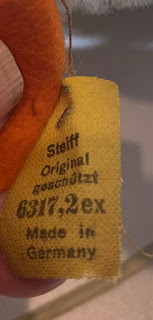
Goose's yellow tag is unusually descriptive in this case and helps to nail down her birthyear. The words on it include "Steiff Original geschuzt (protected)"; this copy was only used in the late 1940s and very early 1950s. And the numbering is quite telling as well. It reads, 6317,2 ex. This means, 6 = young, 3 = mohair, 17 = 17 cm, ,2 = double press voice, growler, or pull cord voice, and ex = on eccentric wheels. She also has her raised script button but no evidence of a US Zone tag. All of this information suggests that this particular goose on wheels was produced probably around 1952 or 1953.
Steiffgal hopes this discussion on this timeless toy has made you feel young at heart today.
Have a question about one of your Steiff treasures? Let's talk! Click here to learn more.
Saturday, February 22, 2020
Pick Up The Pace And Check Out This Amazing Steiff Galop Novelty!
Things are twice as nice with this Steiff "Galop" pull toy. Its passengers are two petite pets, a Molly the puppy and a black mohair cat. Both are standing and unjointed. Molly is 2.5" tall and the cat is about 3" tall. These cuties each retain their long trailing "f" ear buttons as their Steiff IDs. Molly and the cat are mounted upon an elaborate metal wire chassis via metal loops that are inserted into each of their four legs. Their cart glides upon four red wooden wheels. With a Galop toy of this configuration, the riders shuffle back and forth in opposite tandem as the novelty is pulled along; the rotation of the front wheels is responsible for Molly's movement, while the rotation of the back wheels is responsible for the cat's movement.
Galop style toys appeared in the Steiff product line from c. 1926 – 1929 overall. In addition to this Molly and black cat model, versions included two bear cubs; an elephant and lion; a fox and a rabbit; Barney Google and a bear cub; Barney Google and Sparkplug; and two goats.
You'd be cat-atonic not to take special notice of the black kitty aboard this particular Galop example. Steiff did make standing, mohair "tabby" style cats as well as black mohair "Tom" style cats in the 1920s. But Steiffgal has never seen a black mohair "tabby cat" style version from this era. So it is quite possible that this black mohair tabby cat was designed and produced exclusively for this Galop. Producing exclusive items for 1920s-era pull toy novelties does have some precedent. Here on the left, you can see a print advertisement for the company's Galop line, featuring the Molly dog and black mohair cat version under discussion here today. The tri-lingual copy notes, "Two different animals of fine plush on car of special construction. When pulled along, the galloping movement is produced."
Galop novelties - and a series of similar pull toys - were developed in the mid-1920s to meet growing international expectations for dynamic, playful, and charming products that reflected the mood and aesthetics of the "roaring 20s." Through a series of letters to his family in Germany, Richard Steiff himself stressed the need for these sorts of products in the Steiff line, in order that the company appeared forward thinking and "modern" in terms of its production and offerings. Other "two passenger" novelties produced in this series included Roly-Drolys, which appeared in the line from 1924 – 1934, and Wiwags, which appeared in the line from 1924 – 1927. Roly-Droly carts moved their passengers around in circles, while Wiwags see-sawed them up and down, as the toys were rolled about. You can see the mid-1920s catalog page advertising Steiff Galops here on the left.
Steiffgal hopes this discussion on this rare Steiff Galop pull toy got your heart rate up, just a bit!
Have a question about one of your Steiff treasures? Let's talk! Click here to learn more!
Labels:
antique,
black,
button in ear,
cat,
dog,
galop,
mohair,
Molly,
plaything,
pulltoy,
puppy,
Richard Steiff,
roaring 20s,
roly droly,
Steiff,
Steiffgal,
toy,
vintage,
wiwag
Friday, February 26, 2016
Is This The Steiff Spring Hare-binger We've All Been Waiting For?
Are you looking for a "hare-binger" that a welcome change of season is slowly on its way? Steiffgal certainly is! As such, she couldn't be more delighted to receive this inquiry about one of spring's favorite sons. So hop to it and check out this interesting note that Steiffgal just received from a new Steiff friend from the United Kingdom. Andrea from Reading, Berkshire writes...
"Hi Steiffgal,
I brought this for my son a few years ago from a charity shop and recently found it in the loft.
Please can you clarify that this is an original Steiff product and how much the value of it would be worth as it matches all the descriptions on your website?
Thank you, Andrea."
For the record... it is Steiffgal's best guess, based on the pictures provided, that this indeed is a Steiff "Record Rabbit." Steiff's "record" style animals are those that are mounted on a wheeled metal chassis (sometimes called "Irish mail carts") and appear to move back and forth as they are pulled along... giving the impression that they are the ones powering the vehicle! This is different than most other Steiff items on wheels, which remain entirely stationary as the tires rotate. Steiff's debut "record" animal was the now famous Jocko the Chimpanzee, who was produced "record style" in 10, 15, 29, 25, and 30 cm in brown or white mohair from 1912 through 1943 overall. You can see an early version of this record primate here on the left.
Now let's race back to the rabbit under discussion today. This happy hopper is 25 cm, fully jointed, and made from mohair. He has long floppy ears, oversized and expressive black and brown pupil eyes, and a hand embroidered nose. His smiling, open mouth is lined in peach colored felt. This item was produced postwar in this size only from 1949 through 1964. His features, including his facial detailing and distinctive mouth, are quite similar to the company's beloved, fully jointed Niki Rabbit pattern. Niki appeared in the Steiff line in 14, 17, 22, 28, and 35 cm from 1951 thorough 1964.
Steiff's postwar Record Rabbit's design is based on a prewar carriage riding bunny, also named Record Rabbit. This prewar rabbit is also 25 cm, fully jointed, and made from mohair. However, the prewar version of this pattern has a few very subtle differences between it and the postwar version. For example, the postwar version has an open mouth; the prewar version has a closed mouth. The postwar version has a rounder, "toddler" appearance; the prewar version is more curvy and angular. And the postwar version has broad, felt padded feet; the prewar version has extremely thin, padless feet. The prewar version appeared in the line form 1926 through 1943; a photo of him appears on the left.
Rolling right along, its time to answer the dreaded valuation question. As always, something is "worth" what someone will pay for it. Steiffgal has not seen this item firsthand, and cannot check for condition issues that do not appear on these photos, such as weak areas, odors, rot, thinning, excessive playwear, possible restoration, presence (or absence) of IDs, etc. On the upside, this 14 carrot cutie looks to be in good to very good condition, with minimal losses on the wheels. Steiffgal even spots a few of his original monofilament whiskers! Given all that, it is Steiffgal's best guesstimate that he may sell on an online channel like eBay in the $150-250 range.
Steiffgal hopes this discussion on Andrea's postwar record rabbit has put a nice spin to your day.
Have a question about one of your Steiff treasures? Let's talk! Click here to learn more!
"Hi Steiffgal,
I brought this for my son a few years ago from a charity shop and recently found it in the loft.
Please can you clarify that this is an original Steiff product and how much the value of it would be worth as it matches all the descriptions on your website?
Thank you, Andrea."
For the record... it is Steiffgal's best guess, based on the pictures provided, that this indeed is a Steiff "Record Rabbit." Steiff's "record" style animals are those that are mounted on a wheeled metal chassis (sometimes called "Irish mail carts") and appear to move back and forth as they are pulled along... giving the impression that they are the ones powering the vehicle! This is different than most other Steiff items on wheels, which remain entirely stationary as the tires rotate. Steiff's debut "record" animal was the now famous Jocko the Chimpanzee, who was produced "record style" in 10, 15, 29, 25, and 30 cm in brown or white mohair from 1912 through 1943 overall. You can see an early version of this record primate here on the left.
Now let's race back to the rabbit under discussion today. This happy hopper is 25 cm, fully jointed, and made from mohair. He has long floppy ears, oversized and expressive black and brown pupil eyes, and a hand embroidered nose. His smiling, open mouth is lined in peach colored felt. This item was produced postwar in this size only from 1949 through 1964. His features, including his facial detailing and distinctive mouth, are quite similar to the company's beloved, fully jointed Niki Rabbit pattern. Niki appeared in the Steiff line in 14, 17, 22, 28, and 35 cm from 1951 thorough 1964.
Steiff's postwar Record Rabbit's design is based on a prewar carriage riding bunny, also named Record Rabbit. This prewar rabbit is also 25 cm, fully jointed, and made from mohair. However, the prewar version of this pattern has a few very subtle differences between it and the postwar version. For example, the postwar version has an open mouth; the prewar version has a closed mouth. The postwar version has a rounder, "toddler" appearance; the prewar version is more curvy and angular. And the postwar version has broad, felt padded feet; the prewar version has extremely thin, padless feet. The prewar version appeared in the line form 1926 through 1943; a photo of him appears on the left.
Rolling right along, its time to answer the dreaded valuation question. As always, something is "worth" what someone will pay for it. Steiffgal has not seen this item firsthand, and cannot check for condition issues that do not appear on these photos, such as weak areas, odors, rot, thinning, excessive playwear, possible restoration, presence (or absence) of IDs, etc. On the upside, this 14 carrot cutie looks to be in good to very good condition, with minimal losses on the wheels. Steiffgal even spots a few of his original monofilament whiskers! Given all that, it is Steiffgal's best guesstimate that he may sell on an online channel like eBay in the $150-250 range.
Steiffgal hopes this discussion on Andrea's postwar record rabbit has put a nice spin to your day.
Have a question about one of your Steiff treasures? Let's talk! Click here to learn more!
Subscribe to:
Posts (Atom)