Showing posts with label novelty. Show all posts

Sunday, May 31, 2026

Having A Quack-Attack Over Steiff's Fantastic Duck Chain History


Steiff's Duck Chains are charming novelties that were traditionally produced in the form of a mother duck with two, three, or five babies in tow.
 These birds on the go rode upon eccentric wooden wheels which truly captured their natural strides. This Duck Chain image above with five ducklings is from
 Ladenburger Toy Auctions. 

Toys with "eccentric wheels" have appeared in the Steiff line for over a century. Steiff even owns a patent on this mechanism! The way it works on rolling items is that the wheels are aligned off center or on a bent axle, causing them to move up and down when rotated. Eccentric wheels were invented accidentally, but Steiff realized the opportunity created by their drilling mistakes. The first animal to appear on eccentric wheels was a duck. Steiff launched this item in 1912 as... "This waddling felt duck with brightly colored fathers is fixed onto solidly built, eccentric wooden wheels, which provide the duck with its characteristic waddle. Also fitted with a deceptively realistic "quack-quack" voice. A droll little toy."


Steiff's first and legacy Duck Chain, also on eccentric wheels, debuted in 1917 and was made from felt. 
It consisted of a 10 cm mother duck (pictured here on the left) and two or five 6 cm ducklings (pictured just below.) All were unjointed and stuffed with excelsior. They had grey bodies and green wings and heads. Their wings were decorated with embroidery. Their beaks, legs, and feet were made from orange felt, and their eyes were little black buttons. The mother was cataloged as article number "2110,42 ex," and the ducklings were cataloged as article number "2106 ex." These numbers translate to: 2= lying; 1=felt; 10= 10 cm and 06= 6 cm; 42= simple pattern with a voice; and ex= eccentric wheels. These were branded with Steiff buttons and tags on their felt feet. 
 

In terms of their vehicles, the mother sat on a square metal wire carriage with four wooden eccentric wheels. When she was pulled, she waddled and made a peep sound which was generated by a movement activated voice box embedded in her belly. The ducklings were each mounted on a diamond shaped metal wire carriage with two wooden eccentric wheels. They did not have a voice box. Loops and hooks at the end of the carriages kept the family linked together. This felt Duck Chain was featured in the Steiff catalog through 1932.
 

Duck Chains were also produced in other materials over the years. In the prewar era, the felt version was produced from 1919-1921 in a substitute plush because felt was in short supply for toy making purposes during and shortly after World War I. From 1925-1936, Steiff produced its Duck Chain with two or five ducklings in mohair. Duck Chains appeared in colorfully painted wood from 1924-1927 overall and then in an updated model with integral wheels from 1932-1943. After the debut of the woolen miniature line in the early 1930s, a woolen miniature Duck Chain featuring a drake and three ducklings, all on wooden wheeled metal carriages, appeared in the catalog from 1934-1941. You can see this petite treat here above on the left; the image is from Ladenburger Toy Auctions. 

Postwar, Duck Chains were produced from colorfully painted wood in families of four birds riding on integral eccentric wheels from 1949 through 1966. You can see an example of a 1950s era Steiff wooden duck chain here above on the left; the image is from Ladenburger Toy Auctions. Duck Chains made their final appearance in the catalog from 1969-1973, as a family of four birds in sanded beechwood, decorated with burned-in markings and riding upon large red eccentric wheels that were integral to their bodies. 


Steiffgal hopes this discussion on the history of Steiff's Duck Chain production has fully aligned with your expectations!

Have a question about one of your Steiff treasures? Let's talk! Click here to learn more.

Saturday, January 25, 2025

This Charly Purse Is A Crown Jewel In Steiff's Prewar Novelty Production

Hold everything and check out this absolutely amazing rarity!
Steiffgal has a thing for Steiff novelties, especially those made in the prewar era. And it is certainly the best of all worlds when it comes to this breathtaking example. This Charly the King Charles Spaniel handbag will undoubtably have your vote for “Best of Show” in terms of her beauty, design, and willingness to lend a paw in service!

What we have here is Steiff’s Charly Handtasche or Charly Purse.
 This novelty is based on Steiff's beloved and legacy Charly The King Charles Spaniel pattern which debuted in the late 1920s. This precious pooch purse is 25 cm long, in a standing (albeit slouchy) position, and head jointed. She is made from long and short mohair plush. Her ears and tail are brown-tipped mohair, while her body and face are off-white mohair which has mellowed to a vanilla color. Her face is detailed with oversized brown and black glass pupil eyes and a simple black hand embroidered nose and mouth. She also has black embroidered claws on her hands and feet. And here’s what makes her a purse: her torso is hollow like a pouch, and is lined in bright orange velvet. You can see that detail in the photo on the left.  Her back opening closes with a study brass zipper. The pouch volume is quite small; it probably is the volume of about a small sized apple. This fantastic and very rare prewar novelty was produced in 22 and 25 cm from 1927 through 1940.

Steiff debuted a series of zippered, mohair purses in 1927 based on some of their most beloved characters of the era.
These measured 17 to 29 cm in size, measured horizontally. Each featured a velvet or silk lined, hollow back pocket which closed with a zipper. The zipper had a mohair ring pull to it, which probably also was designed as a small handle. These rings tend to get lost to time or wear given their function. The first button-in-ear handbag designs to appear included this Charly, as well as Jocko the Chimp, Petsy the Baby Bear, Bully the Bulldog, and Molly the puppy. Other patterns rolled out over time, with the final design being a Pip in 1941. 

Now let's do a bit of time travel. Check out this image on the left from Steiff's 1929 catalog. You can click on the image to make it bigger. The page is dedicated to their line of mohair handbags. Three young ladies are happily modeling the purses, including one with the Charly bag under discussion here today. Steiffgal thinks she looks the happiest of the gals, and for good reason! You can also see the circular mohair zipper pulls on the purses. The words on the advertisement translate roughly to, "Elegant in the arm of the lady, funny with the little ones.” The catalog page also notes that the purses were decorated with a collar or silken ribbon. 

Steiffgal hopes this discussion on Steiff's animal handbags has got you carried away - in the best possible way!

Have a question about one of your Steiff treasures? Let's talk! Click here to learn more.

Sunday, December 1, 2024

This Prewar Steiff Riding Bulldog Is The Wheel-Deal Indeed!

Look at what just rolled under the Christmas tree of this lucky collector! What a bow-wow beauty for sure! But just who is this captive canine, and what is the story behind him? A new friend shares,

"Hi, my name is Jeanette and have been dabbling with collecting bears, etc. for near on 45 years. My latest find is a Steiff pull along Bully Bulldog. He stands 15" tall not including the wooden wheeled frame. From nose to tail, he is 17" long, his ears have long gone. He has a leather collar with remnants of horse hair still attached to it, it also has Steiff buttons all around it, in total 12 buttons are present. He also has his original bell attached to the collar. He has a pull string still attached, but unfortunately no noise is made when it is pulled. He has large amber and black glass eyes, a black stitched nose, and velvet muzzle. The wooden wheels measure 2.5" in diameter. The pull along frame has a moving front axle, so it can change direction. Any help you can give me, i.e. date, etc. would be greatly appreciated. Thanks in advance!"

This dog on the go would take the pole position in any vintage Steiff enthusiast's collection. What Jeanette has here is Steiff's Bully Bulldog riding animal. This fine fellow was made in 28, 35, 43, and 50 cm in black and white, orange and white, or tan and white from 1927-1936 overall. This model is measured vertically from the top of their heads to their toes, not including their wheels. As such, Jeanette's treasure is the either a large version of the 35 cm or a small version of the 43 cm version; it is Steiffgal's best guess he started out life closer to 43 cm and sort of shrunk over time (like the best of us.)

The condition of Jeanette's Bully is commensurate and typical to that of a beloved ride-on animal.
These realities include things like alot of wear on the back/top areas where a child would sit, a silent squeaker from overuse, and the loss of ears which were probably used as handles for much of its working life! Fortunately, it is not terribly difficult to replace the black velvet ears on this pattern, and Steiffgal would consider doing that restoration if this Bully was in her collection.

One thing that really pops on this example is his great BLING! According to Pfeiffer's 1892-1943 Sortiment, this item is described in part as, "mohair plush, horse hair or leather collar, standing, riding animal, wheels, connecting frame, swivel head, squeaker (barks.)" Jeanette's Bully has a fantastic collar featuring a combination of horse hair detailing as well as a cascade of long trailing f buttons - truly the best of all worlds.

The Bully Bulldog that we all know and love was introduced in 1927.
This design was an instant sensation with both children (as a plaything) and adults (as a collectible and an accessory). He was modeled on the French Bulldog—the “it” companion of those in the know at the time. Bully's pattern featured oversized glass pupil eyes, a black embroidered nose, and a snout and jaw constructed to give him his requisite breed jowls. Full bodied Bully was made in velvet and mohair, as well as sitting and standing, in sizes ranging from 10 to 50 cm through 1939 overall. Here on the left, you can see Bully as he appeared in the company's June, 1927 catalog. This image is from Carsten Esser's Steiff Catalogue 1920-1929.

Given his popularity, beautiful Bully was also produced in numerous novelty forms. These included as a pincushion, pull toy, dangling Charleston doll, jointed dog doll, puppet, purse, and pajama bag, among others. Today, prewar Bullies are one of the most universally desirable and sought-after pre-war Steiff designs among collectors - especially those like this one on wheels! Prewar Bully has been replicated numerous times over the past few decades and even these newer models are coveted by collectors.

Steiffgal hopes you've enjoyed this discussion on this Riding Bully, even if just in a roundabout sort of way.

Have a question about one of your Steiff treasures? Let's talk! Click here to learn more.

Friday, July 5, 2024

This Amazing Steiff Prewar Treasure Is No Optical Illusion!

Eye, eye, eye... look what we have here! Steiffgal just got an inquiry about an eye-popping rarity and she could not wait to share this exciting find with you. Let's not monkey around and jump right into the details of this precious prewar primate right away!

What we have here is Steiff's Mimocculo Orang Utan.
This example is about 35 cm tall, fully jointed, and made from long, fuzzy red-orange mohair. His hands, feet, ears, and face are made from felt. He features an open, dimentional mouth as well as really unusual and abundant facial seaming. This is because he has a remarkable moving eye feature imbedded in his head. These seams hold his facial fabric, and in turn his eye-movement hardware, securely in place. With Mimocculo, when you pull gently on his ear, his white, brown, and black round glass eyeballs move left and right, as well as up and down. This great example retains his long trailing "f" button and traces of his red ear tag as his Steiff IDs. 

This nifty novelty was produced from 1930 through 1936 in 8, 10, 12, 14, 17, 22, 25, 28, 35, 43, and 50 cm.
 Sizes from 17 cm had the distinctive rolling eye mechanism and deep eye pockets; the smaller ones had standard, stationary glass pupil eyes and closed mouths. Given Mimocculo's charm and collector's appeal, Steiff created a 35 cm tall rolling eye replica of this treasure in 1998. It was produced in an edition size of 3,000 pieces overall and very closely resembled the prewar version.

In the early 1930s, when 
Mimocculo debuted, one of Steiff's business development strategies was to produce high end items with distinctive mechanical features. Other products with amazing jointing or advances from this era included the company's snap jointed tail moves head Circus Elephants (made in 24 and 30 cm from 1931-1940 overall) a snap jointed tail turns head Circus Bear (made in 32 cm from 1935-1939), and a series of press and release music box animals based on Steiff's most popular prewar pet designs. Mimocculo, with his fabulous flirty eyeballs, fit perfectly into this exclusive club of mechanical marvels.

And just how rare are these outrageously outstanding Orang Utans?
Steiffgal has only seen a handful come up for public auction over the past decade or two. Most recently, Ladenburger Spielzeugauktion offered a 10 cm version at their Special Steiff Auction held on June 29th, 2024 in Giengen, Germany. You can see this happy handful here on the left, the image is from Ladenburger Spielzeugauktion. This "mini Mimo" had a starting bid of 180 €, hammered at 3100 €, and was cataloged simply as:

"Monkey, orangutan, MIMOCCULO, made 1930-1933, 10 cm, rust-colored mohair, small glass eyes, felt feet, hands and face as well as ears in very nice condition, unusual."  

Orange you glad you checked out this discussion on Steiff's Mimocculo Orang Utan?

Have a question about one of your Steiff treasures? Let's talk! Click here to learn more.

Sunday, April 21, 2024

Jumping For Joy Over This Tiny Steiff Prewar Mystery Rabbit

It's off to the races with this next Steiff mystery. Size defies when it comes to this bitty hare on the go. Her proportions, IDs, and detailing date her to the Roaring Twenties - but who exactly is she? Let's go down the research rabbit hole and see what we can infer about her origins. 

Steiffgal is jumping for joy over this teeny tiny running rascal.
Baby bunny is on all fours and about to spring into action. She measures about 8 cm tall and 10 cm wide. She is unjointed and made from mohair that has faded over time to appear brown with silver tipping. Rabbit has a simple pink hand-embroidered mouth and nose, brown and black glass pupil eyes, and a few remaining clear monofilament whiskers. She also has "rough" stitching on the edge of her ears. You occasionally see that on some mid-1920s era items, including early Molly dogs. Running rabbit retains her long trailing "f" button and traces of her red ear tag as her Steiff IDs. 

As far as Steiffgal can tell, this item does not appear in the Sortiment as a regular line item.
After a little digging, she suspects that it was made especially to be one of the passengers on the company's mid to late 1920s-era pull toy novelties. Specifically, given the rabbit's size, color, era, and presentation, it is possible that she was produced to ride on the company's Galop-Fux novelty. This is pictured here on the left; this wheeled wonder was in production from 1926-1929. This image is from Pfeiffer's 1892-1943 Sortiment.

Galop-Fux consisted of a little grey running rabbit and a red brown fox that were mounted upon an elaborate metal wire chassis. Their cart had four red wooden wheels. When pulled along, passengers on a Galop toy shuffled back and forth in opposite tandem; the rotation of the front wheels was responsible for one animal's movement, while the rotation of the back wheels was responsible for the other one's movement. The running rabbit form would be perfect for this sort of effect. 

Galop style toys appeared in the Steiff product line from 1926-1929 overall.
In addition to this fox and rabbit model, Steiff also made Galop toys with a Molly and black cat; two bears; an elephant and a lion; Barney Google and a bear cub; Barney Google and Sparkplug; and two goats.

It is interesting to note that there is precedence for Steiff making unique items for their 1920s-era pull toy novelties. Like this rabbit, these rarities did not appear in any other sizes or as stand-alones in the line at all. For example, the Galop featuring a Molly and black cat version included a c. 10 cm tall standing and unjointed black Tom cat. He is fabulous for sure - but does not make an appearance anywhere else in the catalog ever, as far as Steiffgal can tell.

Steiffgal hopes this discussion on this mystery rabbit has improved your day by leaps and bounds. 

Have a question about one of your Steiff treasures? Let's talk! Click here to learn more.

Sunday, March 24, 2024

Would You Take A Tumble For This Early And Fantastic Feline Steiff Novelty?

This next Steiff inquiry comes in on little cat's feet. A new friend has reached out about a special family heirloom with provenance. Just what is this very early turn of last century treasure? And what makes it so fantastic from the collector's perspectives? Tom shares in part,

"I've attached photos of my Rolly Polly cat. I've had this since I was a child (50+ years ago)... It originally came from a relative who inherited it from their partner who came from a wealthy family from New England."


This guy is simply the cat's meow. But, given his form, he is "technically" a tumbler and not a roly-poly. Steiff's early 20th century roly-polys are all fabric and shaped sort of like an inverted balloon. Most are head and arm jointed, without legs. Examples include mohair cats (made in 16 and 23 cm from 1909 through 1919 overall); mohair Teddy bears (made in 16, 19, 23, and 29 cm from 1909 through 1916 overall)mohair rabbits (made in 23 cm from 1909 through 1918); and a series of mohair and felt dolls from the same basic time frame.

On the other hand, tumblers are full bodied and mounted to a very heavy, weighted wooden half circle base. As such, they wobble about like a weeble but always return to an upright position. Their bases are simply stained and are a natural wood color. Most tumblers measure 12 to 17 cm tall and are standing, sitting, or begging. Steiff did make a few oversized circus bear style tumblers in 35 and 43 cm through 1918 overall.

Tumblers debuted as early as 1894 and appeared in the general line with frequency through the late 19-teens. In the late 1930s, Steiff produced a series of three begging style tumblers on green or red painted wooden bases from 1936 through 1943 overall. Models included a velvet and mohair squirrel, a mohair Waldi Dachshund, and a mohair kitten holding a pom pom ball.

So back to Tom's cat.
 The photos suggest that he is made entirely from felt. Steiffgal suspects he is the company's Tumbling Cat, which appeared in the line in 17 cm (not including his base) from 1894 through 1919. The cat is solidly stuffed with excelsior and features black shoe button eyes and simple facial embroidery. It is hard to tell if he ever had a button, based on the photo of his face. It is entirely possible that he was manufactured pre-1904. Other early Steiff cat tumblers include a spotted velvet version made in 12 cm from 1904 through 1917 and a velvet striped version made in 17 cm from 1901 through 1919.

What makes this tumbler even more remarkable is its condition. He is made from felt, which tends to get grubby over time and attract insects. He was also designed as a toy, but it is clear he received little hands on play. Also of note is his tail. These are actually super thin, not terribly sturdy, and are attached to the animal's rear with just a few stitches. Often, these go missing or break off given their construction and natural aging. However, in this case, Tom's tumbler appears clean and damage free against all odds! Super score all around!

Steiffgal hopes this discussion on Steiff's early tumblers has got you rocking and rolling!

Have a question about one of your Steiff treasures? Let's talk! Click here to learn more.

Sunday, March 3, 2024

Hop-ping To Find Answers About This Fantastic Steiff Prewar Rabbit On Wheels

Orange you glad you checked in with this blog today? Well you will be for sure after learning more about this super cool prewar rarity living with a new friend from far away. Alena shares...

"Hello from the Czech Republic,

I have a question about my toy - rabbit on the wooden wheels. I couldn't find any information whether the Rabbit has been produced in Steiff factory in this color. Toy hasn't got any button neither any else marking. 

Thank you very much in advance for the answer and maybe some more information about that."

This happy hopper is the wheel-deal indeed.
It is Steiffgal's best thinking that he is one of Steiff's standard line rabbits on wheels from the late 1920s. Here on the left, you can see the photo from Pfeiffer's 1892-1943 Sortiment illustrating what Steiffgal believes is this exact item. He is in a "hopping" position, meaning he is on all fours and about ready to take off! The name of this body position was later changed to "running", which also makes alot of sense.

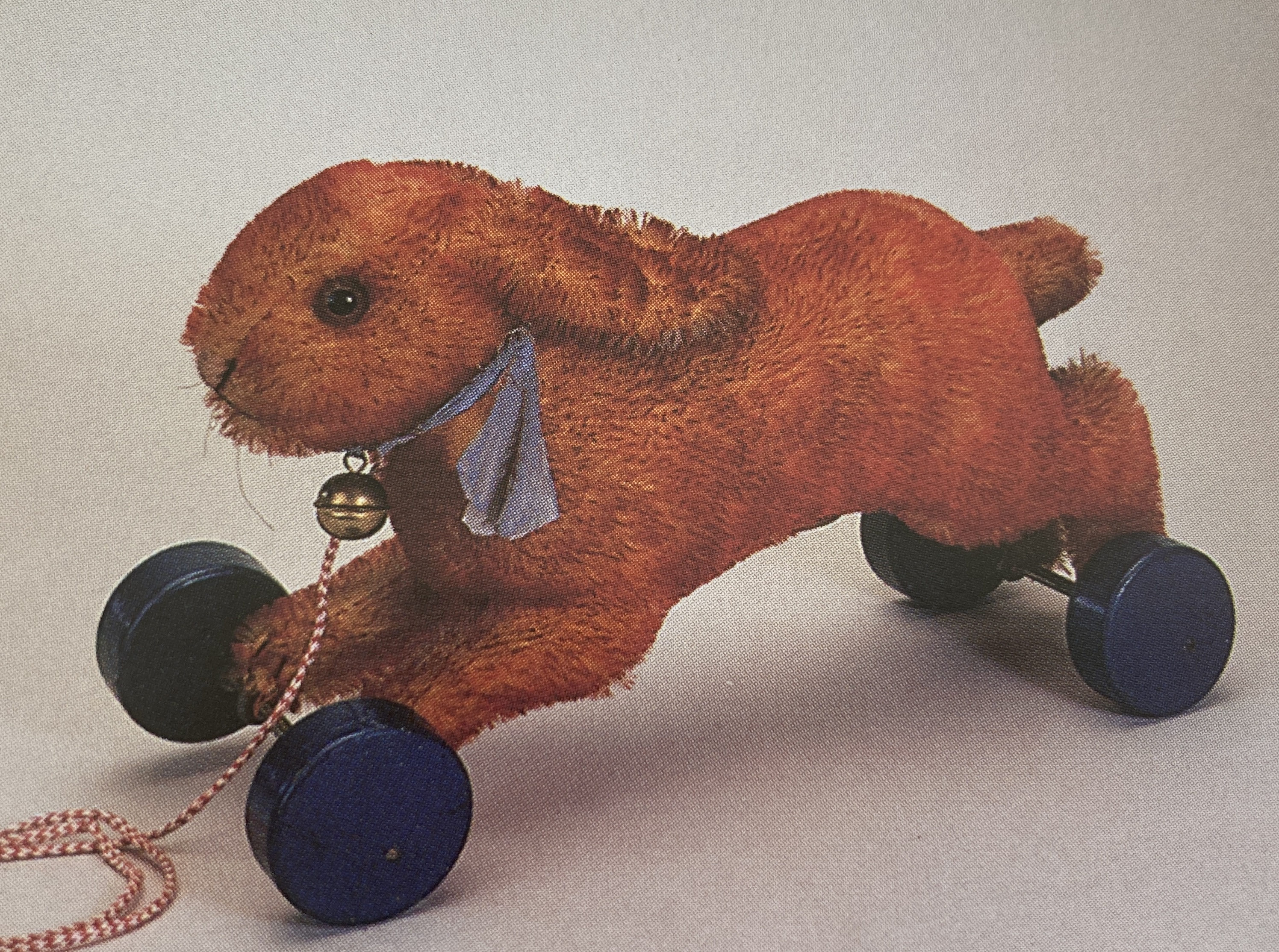
Alena's treasure is one beautiful bunny. Here you can see him relaxing with some WAH-HOO good vintage friends in the photo on the left. Rabbit is unjointed, solidly stuffed with excelsior, and features large brown and black glass pupil eyes, a hand embroidered pink and black nose and mouth, and clear monofilament whiskers. He has once vivid orange mohair. He rides upon four asymmetrical wooden "eccentric" style wheels. As such, he appears to sway back and forth as he is pulled along. This item was produced in 12, 15, 18, and 23 cm (measured vertically, top of the head to toe, not including ears or wheels) from 1927-1930 overall in this stunning color. He was also produced in an almost identical pattern in brown tipped mohair in 14, 17, and 22 cm in 1928.


Brightly colored animals, including rabbits, dogs, cats, and bears - were a delightful feature of Steiff's late 1920s to very early 1930s product line.
These sweet pets appeared in orange, pink, blue, green, gold, or other "jellybean” colored mohair or velvet fabrics, and usually had playful, youthful personalities to match! Tipped mohair - meaning mohair with just the ends or tips dyed a complementary or eye-catching color - also had its heyday in the product line around the same time. You can see a number of these colorful rabbits in the photo on the left, the image is from the company's 1929 product catalog. 

Steiff also produced a few other fun novelties featuring "larger than life" colors like Alena's wheeled rabbit.
One of particular interest is a delightful orange and white begging style rabbit on eccentric wheels. In July, 2023, the auction house Ladenburger Spielzeugauktion GmbH of Ladenburg, Germany sold this 20 cm tall rarity from 1926-1932 for nearly $4,000. He is pictured here on the left, the image is from Ladenburger Spielzeugauktion.

Steiffgal hopes you enjoyed learning about this darling, 24 carrot gold prewar novelty!

Have a question about one of your Steiff treasures? Let's talk! Click here to learn more.

Tuesday, January 2, 2024

Farming For Answers About This Unusual Midcentury Steiff Donkey

Let's enter the fray - oops, I mean the bray - of 2024 with a peek at a super sweet and super rare Steiff novelty.
This darling and unusual velvet baby is a recent addition to Steiffgal's collection. He's based on a beloved Steiff pattern, but is accessorized in a most eye-catching way. Take a look at this old-new friend and see what makes him so noteworthy from the design and product development perspectives. 

This barnyard buddy would love to be your beast of burden.
This is a well attired version of Steiff's legacy Esel or Donkey. He is 12 cm, standing, unjointed, and made from velvet that has darkened overall and evenly over time. He has a short black mohair mane. His tail is made from cord. He has black airbrush highlights down his back, on the tips of his ears, and marking his hooves. Esel's face is youthful and endearing; it is detailed with shiny black button eyes and delicate airbrushing to define his nose and mouth area. Esel retains his original accessories, including a red floss and plastic brindle with tiny green felt dots and a red and white checkered sack with a green tie. The bag is stuffed and dimensional, and stitched onto his back. His IDs include a raised script button, very early postwar ear tag, and a chest tag. He does not have a US Zone tag, and there is no evidence that he ever did. 

Steiff's regular line, postwar Donkey appeared in the line in 12, 14, 22, and 28 cm.
The smallest size was made in velvet from 1950 through 1969 while the larger sizes were made in mohair from 1950 though 1961. This particular example under discussion here today does not appear in the standard Steiff Sortiment reference books, as far as Steiffgal can tell. However, he does appear on page 246 of the Cieslik's Button in Ear The History of The Teddy Bear and His Friends. In this image - pictured here on the left - he is simply noted as "Donkey, 5 inches, 1951."

The immediate post war era brought much change and opportunity to Steiff as well as other important European toy manufacturers.
Button-in-ear products designed and manufactured during the c. 1948-1955 time frame bridged the company's prewar quality and appeal, while at the same time introduced new design elements with playful, midcentury vibes. It was also a time of trying new things and experimentation. This Donkey design is a great example of this. 

It is safe to say that most collectors are familiar with the standard line, 12 cm version of this Donkey pattern.
He was made with a cord tail and wore a red leather brindle. However, Steiffgal has handled other 12 cm examples with dimensional, excelsior stuffed felt tails with black mohair tips. And she even has one in her collection donned in his factory original red leather brindle with tiny green tassels and a red and black checkered felt blanket secured to him by a ribbon. You can see this other variation pictured here on the left.

Excelsior stuffed tails and extra accessories require more time and labor.
As a result, Steiffgal suspects that the company's standard line, post 1951 velvet 12 cm Donkey design is a simplified version of the original concept behind this pattern. He may have started out on the drawing board with a fancier tail, detailed brindle, and blankets or sacks, and the earliest examples of may include them. But these "nonessential" elements were quickly jettisoned, with no huge impact on the pattern's integrity or appeal. It is interesting to note that many of the smallest, early postwar animal editions, including the company's zebras and camels, were made from velvet and had cord tails, so this direction is somewhat consistent with trends of the era.

Steiffgal hopes this discussion on this well dressed Donkey has been a clothes call for you.

Have a question about one of your Steiff treasures? Let's talk! Click here to learn more!

Wednesday, December 20, 2023

Rockin' Around the Christmas Tree, Steiff Style!

It's the most wonderful time of the year... and Steiffgal is hoping you are celebrating with beloved family and friends, tasty treats, and treasured memories in the making.
For many folks, the dark days associated with the end of the calendar year are practically synonymous with brightly lit Christmas trees. And believe it or not, Steiff has made their own button-in-ear version of this legacy Christmas symbol. Take a look at this most unusual Steiff novelty, one of Steiffgal's most favorite modern editions of all time... so much so, that she leaves it on full display all year long!

This fabulous Steiff collectible gets the green light for its rarity, beauty, and clever design.
Here we have Steiff's Weihnachtsbaumor Christmas tree. It is 25 cm tall and made from soft green velour like material. The branches and limbs are all dimensional but not stuffed. This greenery is arranged around a wooden dowel mounted on a circular wooden stand. The tree is decorated with flat yellow felt stars, round red fabric balls, and a garland of tiny, opal-esque stars. It is topped with a larger yellow felt star. Of course a tree does not have ears, so its "button-in-ear" branding of a tag and button are located on one of its lower green fabric limbs.

This holiday themed rarity was made in 2004.
It was not a limited edition, but manufactured in very small quantities. Steiffgal suspects that it was somewhat challenging to produce on a commercial scale, given its construction and form, as well as the number of seams it requires. As a result, they appear few and far between on the secondary market.

It is pretty unusual for Steiff to create items that are not primarily based on living human or animal forms. The company has made other novelties, like rattles, pram toys, and music boxes resembling flowers (and even fruit!) in the distant past. More recently, the Christmas line has featured Teds in felt Christmas tree suits, and holding trees. But as far as Steiffgal can tell, this is Steiff's only free standing Christmas tree design produced on a somewhat commercial scale to date. 

Steiffgal hopes this discussion on Steiff's soft plush Christmas tree has added a holly-jolly touch to your day!

Have a question about one of your Steiff treasures? Let's talk! Click here to learn more.

Sunday, September 24, 2023

Racing To The Finish Line With This Amazing Steiff Gallop Novelty

There's no horsing around when it comes to this week's blog featured guest. Or guests, in this case! This amazing Steiff rarity came to Steiffgal somewhat out of the blue, and belonged to a collector on the West Coast who really, really loved precious Steiff items. Check out this prancing pair on wheels and see what makes them so delightful from the design and product development timeline perspectives.

It's off to the races with this Steiff Gallop novelty.
It consists of two standing, unjointed 8 cm mohair pets on a metal cart with red wooden wheels. The first animal is little Molly dog. She is made from tan and brown tipped mohair and is solidly stuffed with excelsior. Her face comes to life with brown and black glass pupil eyes and a black hand embroidered nose and mouth. Her ears are seamed on their outside edges, and are folded over in typical Molly style. Her IDs have been lost to time. Her companion is a distinctive cat made from silver tipped mohair. She has a trimmed muzzle, a pink hand embroidered nose and mouth, green and black slit style glass pupil eyes, and a few remaining clear monofilament whiskers. She retains her long trailing "f" button. This Molly and cat Gallop novelty appeared in the line in this size and configuration from 1926-1929.

Now let's check out the lucky passengers on this very special ride!
Standing Molly appeared in the line in 8, 12, 14, 17, 22, 28, and 35 cm from 1925-1936 overall. She was not produced standing postwar. This Gallop Molly is most likely an example of the 8 cm standard line Molly. The cat, on the other hand, did not appear in Steiff's catalog, as far as Steiffgal can tell, except on this exact novelty. This prewar black mohair cat design is just one of a tiny handful of kittens - other than the company's famous arched back Tom Cat - produced in this color and fabric before WWII.

This Gallop toy was one of three novelty pull toy designs Steiff produced from the mid-1920s through the mid-1930s. These included Roly-Drolys, Wiwags, and Gallop toys. Each of these three patterns used pairs of small, standard line items on wooden carts. All were created in response to product development need identified by Richard Steiff. He was living in America at the time and insisted that these sorts of "mobile" items were necessary in the line to keep up with the demands of the marketplace, consumer preferences, and growing worldwide competition.

And just how did these pull toys rock and roll?
Roly-Droys appeared in the line from 1924–1934. The animals rotated in circles as their cart was pulled along. "Roly-Droly" comes from the German words "rollen" (to roll) and "drollig" (funny or droll). Wiwags appeared in the line from 1924–1927; its passengers see-sawed up and down as their cart was propelled forward. And Gallop toys, like the one under review here, were made from 1926–1929. The riders glided back and forth as their cart's wheels turned round and round. Each of these metal and wooden toys came with a pull string that was tipped with a wooden knob decorated with a Steiff button. You can see Steiff's range of Gallop toys as pictured in the company's 1929 catalog. The image is from Carsten Esser's Steiff Katalog 1920-1929. 

According to Steiff's advertising, Gallop toys consisted of
..."Two different animals of fine plush on car of special construction. When pulled along, the galloping moment is produced." Gallop toys were produced in a number of configurations. These included one with a brown and white standing bear; one with a standing lion and elephant; one with a standing fox and hare; one with a Barney Google doll and a standing bear; one with a Barney Google doll and a standing Spark Plug horse; one with a Spark Plug horse and an ostrich; one with two standing goats; and one with a Molly and black cat. The advertisement on the left is from the mid-1920s and features the Molly and black cat version under discussion here today. 
The image is from Carsten Esser's Steiff Katalog 1920-1929. 

Steiffgal hopes this discussion on Steiff's Gallop novelties has put a fun spring in your step today. 

Have a question about one of your Steiff treasures? Let's talk! Click here to learn more.

Saturday, September 2, 2023

Going Out On A Limb Over This Unusual Steiff Prewar Novelty

Look what I found! That's exactly what a new friend from Florida said when she came across an interesting button-in-ear treasure at an estate sale local to her. But what exactly is this creature? Is it a merry mashup, or a loved to (almost) death standard line novelty? Valerie shares in part,

"This odd little fellow has a bear head; a caramel colored velvet body; a maybe muslin head, ears, hands, and feet; but also a 2" long tail! His skinny arms and legs are sewn/unjointed. His hands and feet have red embroidery threads roughly delineating his fingers and toes. All of his "fur" has been lost over time, except for very scant tufts of grey mohair inside his right ear. There's a dark metal button in his left ear, with Steiff in all capital letters with the tail of the second F extending to the "e." His nose and mouth are embroidered with faded pink thread. His eyes are sew-on green glass with black centers, and stick away from his face. I think the head is stuffed with excelsior, but the body, hands and feel softer.

Ancient bears had long tails, but I'm wondering if somebody sewed a Steiff bear head onto another beloved animal's body? The only thing that throws me off is that the material of the head, hands, feet and tail are the same. What do you think?"


Fingers crossed that Valerie can bear the news that her fabulous find is not a bear, but actually a cat!
This cute cat is named Fluffiette, and she was one of a series of long limbed lovelies featured in the Steiff catalog from 1927-1932. These "play and car dolls" included Bulliette the bulldog, Molliette the puppy, Rabbiette the rabbit, Cherrioette the open mouthed puppy, and this cat - named Fluffiette (after the company's popular and beloved 1920s era cat named Fluffy.) Each animal doll had the mohair or velvet head of the character, mohair or velvet paws and feet, and dangling velvet limbs. Most were available in several colors and in 20, 30, and 43 cm, with the larger sizes having a squeaker. Each left the factory suspended from an elastic cord and was detailed with an ivory ring for hanging and a decorative pom-pom. Fluffiette was produced in pink or orange velvet, which is completely consistent with Valerie's example. Here on the left you can see what Fluffiette looked like when new, the image is from Pfeiffer's 1892-1943 Sortiment.

It has been suggested that the design of this series was based on a similar line from the Chad Valley Toy Company of England called "Tango Toys." Steiff modified the design to fit their characters and manufacturing processes, and named the line "Charleston Animals," based on the Charleston dance crazy of the 1920’s, with its fast moving arm and leg movements. You can see Steiff's full line of Charleston Animals here on the left; this image appeared in the company's 1929 product catalog. Fluffiette is third in from the right, sandwiched between a standing Molliette and a standing Rabbiette. 

Steiffgal hopes this discussion on this Fluffiette Charleston Animal has put a little spring in your step today.

Have a question about one of your Steiff treasures? Let's talk! Click here to learn more.

Thursday, July 13, 2023

Rounding Out A Ball Animal Collection With This Unusual Steiff Rabbit

Things are really "hoppening" around here with the addition of this delightful rabbit novelty to Steiffgal's collection. Although not terribly vintage, this was the very first of his type Steiffgal had ever seen in person. She saw him in a booth at the 2023 Steiff Sommer Festival, and knew right away he would be one of her souvenirs from a delightful trip. Take a look at this funny bunny and see if he calls to you as well, even if in just a round-about sort of way.

This cheerful-earful is Steiff's Ball Rabbit.
He is 16 cm tall (not including his ears), sitting, and head jointed. His ears add another 7 cm to his height. He is softly stuffed with foam. Rabbit is made from longer tan dralon. His ears, muzzle, and foot pads are made from shorter dralon, and his fuzzy chest is made from longer mohair. His face is detailed with round black and white plastic cartoon style eyes, a black hand embroidered nose, monofilament whiskers, and a funny little dimensional mouth made from fabric. He has stenciled footprints on his foot pads and light airbrush highlighting here and there to give him a little more dimension. He retains his original blue silken ribbon. He has a non-working squeaker in his belly. This guy appeared in the line from 1960-1961 in this size only.

Steiff made three ball style animals in the 1960-1961 time frame, and this rabbit is one of them.
All were 16 cm, made from dralon, stuffed with foam, and featured a fuzzy mohair chest. The others were Ball Mopsy, a pug, and Ball Sulla, a cat. Overall, these ball animals are really hard to find, especially in good condition — because they were designed to be used as playthings and stuffed with foam, which deteriorates over time, and were made for only a handful of years. Steiffgal is happy to finally have all three versions in her collection. 

Finally, let's take a look at Rabbit's chest tag.
It looks original to the item, with wear and loss commensurate to the toy, and the thread appears consistent to Steiff. It notes that his name is Hoppy, which would make sense given he is a rabbit. However, there is no indication in any reference materials that this model was given a name beyond simply "Ball Rabbit." However, the pug and the cat of the same design and era were given playful names, so it is possible that he was named Hoppy for consistency, but this never made it into the records. This sometimes happens when something appears in the line for a very short time. Hoppy was also the name of a running style mohair Steiff rabbit made in 8, 14 and 17 cm from 1950 through 1976. So there is a little overlap there with the name as well. But only Ball Rabbit knows for sure....

Steiffgal hopes this discussion on this unusual rounded Steiff rabbit has been a ball for you!

Have a question about one of your Steiff treasures? Let's talk! Click here to learn more.

Thursday, November 17, 2022

This 1930s Steiff Tail-Turns-Head Novelty Is Simply Ele-Fantastic!

Steiff wishes can come true! Check out this note from Carey, a new friend from north of the border. She was gifted a jumbo surprise from her husband - one that just happens to be simply ele-fantastic. Steiffgal is certain you'll agree. She shares in part:

"Hi Steiffgal! I’m emailing from Ontario, Canada. Yesterday my husband gifted me an amazing find from Kijiji from an elderly couple who were downsizing. The elephant belonged to the woman’s father, and they immigrated to Canada from Poland.

Our new blushy pink/mauve Steiff elephant, based on what I could find from the button, is I think from the 30s. The tail makes the head move in a circle and the trunk is posable. It’s stuffed with straw, and due to the wear of the mohair around the foot pads, which are heavy felt, you can see black toes stamped onto the fabric. It’s about 8" tall, and the body excluding the tail and trunk is about 10" long. If it made any sounds when it was new, it doesn’t now."

There's not a drop of junk in the truck when it comes to this playful pachyderm.
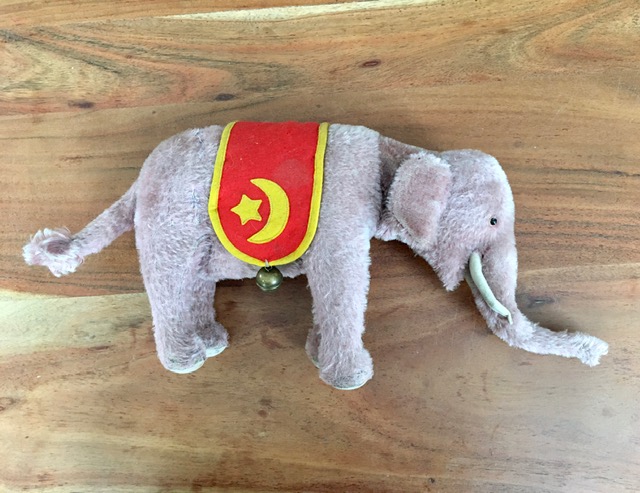
This tail-move-head example is standing, head jointed, and made from mohair which has mellowed to a light pink color over time. This sometimes happens with originally grey mohair over time. His pads are made from grey felt, and his prominent tusks are made from white felt. He comes to life with floppy ears, black button eyes (which may be backed in felt - but it’s not clear from his photos) and a smiling, open mouth. His red and yellow felt blanket with bells is original to him. When you twist his mohair tipped tail in a circle, his head moves 360 degrees as well. This amazing tail-moves-head elephant was produced in 18, 23, and 29 cm from 1931-1934 overall; Carey's example is most likely the 18 cm version.


Steiff introduced its patented tail-moves-head line in 1931.
These nifty novelties were made with an internal metal movement mechanism that enabled the heads to move in a circle when the tails were rotated. These items were stuffed with excelsior to hold this mechanism firmly in place. Tail-moves-head animals appeared in the line from the early 1930s - early 1940s; over time, about 25 different examples were made. The line included cats, dogs, rabbits, penguins, goats, and lambs, and even Mickey Mouse! Most were based on popular designs of the ear, but a few - like a bulldog - were brand new patterns. These tail-moves-head items were considered luxury toys of the time. You can see Carey's elephant in action in the video above. 

Carey's elephant appeared on the cover of a 1931 marketing brochure titled "1931 Addendum to the Main Catalogue."
The other "cover girls and boys" included a Scotty, penguin, tabby Bulldog, Rattler Terrier, Molly, chimp, Fox Terrier, lamb, cat, and goat. The copy on the brochure, in part, translates to:

"The year 1931 has presented us with the animals with the new head movement… The simplicity of the mechanism, though which the splendid movement is produced, cannot be beaten, yet it is unbreakable and allows lifelike play, full of variety and mimics… When buying new supply in plush toys please be sure to include the STEIFF animals with the new head movement; all numbers equipped with it are marked ‘H.’" You can see this brochure cover here on the left; you can click on the image to make it bigger. 

Steiffgal hopes this discussion on this really rare elephant has made a huge impression on you.

Have a question about one of your Steiff treasures? Let's talk! Click here to learn more.
The teddy bear search engine