Showing posts with label elephant. Show all posts

Thursday, November 17, 2022

This 1930s Steiff Tail-Turns-Head Novelty Is Simply Ele-Fantastic!

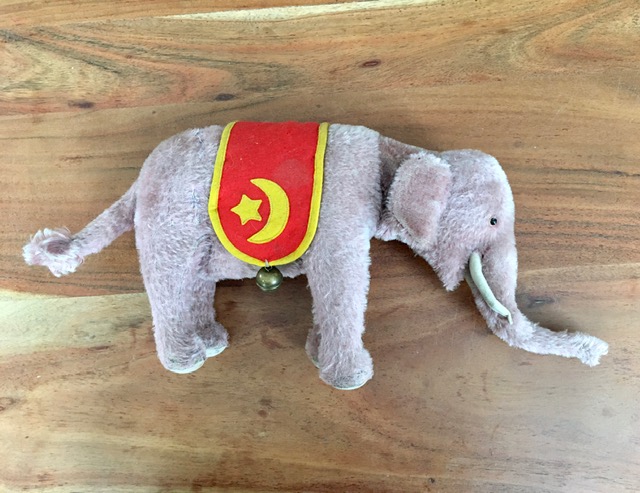
Steiff wishes can come true! Check out this note from Carey, a new friend from north of the border. She was gifted a jumbo surprise from her husband - one that just happens to be simply ele-fantastic. Steiffgal is certain you'll agree. She shares in part:

"Hi Steiffgal! I’m emailing from Ontario, Canada. Yesterday my husband gifted me an amazing find from Kijiji from an elderly couple who were downsizing. The elephant belonged to the woman’s father, and they immigrated to Canada from Poland.

Our new blushy pink/mauve Steiff elephant, based on what I could find from the button, is I think from the 30s. The tail makes the head move in a circle and the trunk is posable. It’s stuffed with straw, and due to the wear of the mohair around the foot pads, which are heavy felt, you can see black toes stamped onto the fabric. It’s about 8" tall, and the body excluding the tail and trunk is about 10" long. If it made any sounds when it was new, it doesn’t now."

There's not a drop of junk in the truck when it comes to this playful pachyderm.
This tail-move-head example is standing, head jointed, and made from mohair which has mellowed to a light pink color over time. This sometimes happens with originally grey mohair over time. His pads are made from grey felt, and his prominent tusks are made from white felt. He comes to life with floppy ears, black button eyes (which may be backed in felt - but it’s not clear from his photos) and a smiling, open mouth. His red and yellow felt blanket with bells is original to him. When you twist his mohair tipped tail in a circle, his head moves 360 degrees as well. This amazing tail-moves-head elephant was produced in 18, 23, and 29 cm from 1931-1934 overall; Carey's example is most likely the 18 cm version.


Steiff introduced its patented tail-moves-head line in 1931.
These nifty novelties were made with an internal metal movement mechanism that enabled the heads to move in a circle when the tails were rotated. These items were stuffed with excelsior to hold this mechanism firmly in place. Tail-moves-head animals appeared in the line from the early 1930s - early 1940s; over time, about 25 different examples were made. The line included cats, dogs, rabbits, penguins, goats, and lambs, and even Mickey Mouse! Most were based on popular designs of the ear, but a few - like a bulldog - were brand new patterns. These tail-moves-head items were considered luxury toys of the time. You can see Carey's elephant in action in the video above. 

Carey's elephant appeared on the cover of a 1931 marketing brochure titled "1931 Addendum to the Main Catalogue."
The other "cover girls and boys" included a Scotty, penguin, tabby Bulldog, Rattler Terrier, Molly, chimp, Fox Terrier, lamb, cat, and goat. The copy on the brochure, in part, translates to:

"The year 1931 has presented us with the animals with the new head movement… The simplicity of the mechanism, though which the splendid movement is produced, cannot be beaten, yet it is unbreakable and allows lifelike play, full of variety and mimics… When buying new supply in plush toys please be sure to include the STEIFF animals with the new head movement; all numbers equipped with it are marked ‘H.’" You can see this brochure cover here on the left; you can click on the image to make it bigger. 

Steiffgal hopes this discussion on this really rare elephant has made a huge impression on you.

Have a question about one of your Steiff treasures? Let's talk! Click here to learn more.

Sunday, November 21, 2021

Good Things Come In Threes At Teddy Dorado's December 4th, 2021 Sales Event!

Care to go for the gold? Then check out the upcoming Steiff auction presented by our friends at Teddy Dorado auction house! Their signature winter sale, to be held on December 4th, 2021, features more than 400 new, vintage, and antique button-in-ear temptations - with new goodies being listed regularly. Here are three outstanding lots that caught Steiffgal's eye - and why. 

The first lot is a sweet-tweet-treat indeed.
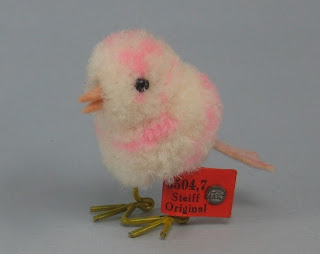
Steiff's earliest prewar woolen miniatures are loved and collected universally - with the rarest ones frequently realizing four figures at auction. Its hard to resist lot #28-4023, which is cataloged as, "Songbird made of white & pink Nomotta wool; black glass eyes; Beak made of skin-colored felt; white felt tail with pink stripes on both sides; Metal legs painted yellow & in perfect condition; Head rotatable & body tillable; approx. 4 mm large FF button slightly rusted, but not visible to the naked eye; red Steiff flag preserved in the best possible way; very clean, absolutely lightfast, odorless & completely unplayed; Premium top condition. approx. 4 cm high." 

This pretty-in-pink treasure has an opening bid of 1,000 Euro.

Bird's the word with this lovely treasure which is fantastic on so many levels. It is amongst the absolute earliest woolen miniatures ever made. This sweet bird design debuted in 1931, the first year Steiff's woolen miniatures were produced on a commercial scale. It was manufactured in six color combinations in 4 or 8 cm. Don't you think his color - pink - is WAH-HOO good? This example is the only Steiff woolen miniature prewar bird that Steiffgal knowns of featuring this great and novel hue. And the condition looks to be as close to like-new as humanly possible. 

You'll be all ears over this next auction highlight.
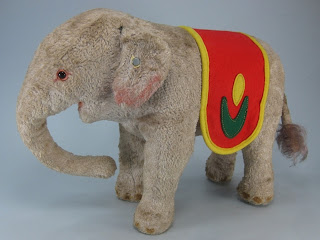
His expression, era, and materials are all so ele-phantastic. He is lot #28-4021, and is cataloged as, "Play elephant, made of light gray rayon plush; black glass eyes underlaid with pink felt; open mouth made of skin-colored felt; Tail tip made of mohair; tightly stuffed with wood wool; large double pressure voice defective; Saddle pad made of red, yellow & dark green felt; approx. 6 mm large, bright silver, shiny & shiny button in the ear; white paper ear tag missing; Artificial silk plush & felt without annoying flaws; very clean, absolutely lightfast, odorless & unplayed; Top condition approx. 21 cm high & without tail approx. 27 cm long." 

This playful pachyderm has an opening bid of 200 Euro. 

It's interesting to note that this distinctive elephant's "birthdate" is not specified. This great design bridged the pre- and postwar periods. It was produced in artificial silk plush in 17, 22, and 28 cm from 1938 through 1943 overall, and postwar in 22 cm only in 1948 though 1949. Given this big baby has a blank button and traces of his yellow ear tag, it is a safe bet that he is a postwar version. He's unforgettable for sure, don't you agree?

And good things come in threes with this final auction highlight.
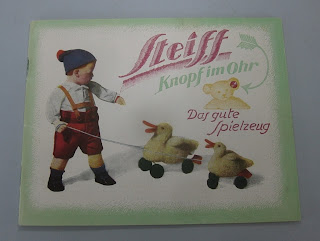
Steiff ephemera - catalogs, photographs, sales sheets, postcards, and other paper items associated with the company - is a fun, educational, and visually exciting complement to a button-in-ear collection of any era. If you are interested in the company's 1920s era production and aesthetic, be sure to check out lot #28-4003, which is cataloged as, "Customer brochure "The good toy" A6 +, 36 pp. 1925–1926 without Steiff printed matter no. German Premium Steiff customer brochure "The good toy" for Germany in the format approx. A6 plus landscape with 36 pages; inside black and white with a light green border; Text in German & without prices; Title shows Schlopsnies doll Theo with two yellow mohair (pulling) ducks, each lying on eccentric wheels; without printer's note or Steiff printed matter no .; original Steiff brochure & no reprint; very clean, absolutely lightfast, odorless & completely unread; Premium top condition." 

This time capsule quality brochure has an opening bid of 100 Euro. 

It's hard to picture a more interesting collection of images than those that appear in this great catalog. It features illustrations of the company's very rare mid-1920s white chimp with a tail, little known wooden toys on wheels, and charming, lifelike, and toddler-esque Schlopsnies dolls, among many other outstanding characters. And what makes these visuals so heartwarming is that they show our favorite button-in-ear favorites in playful and interactive vignettes... as if they were truly alive! Flipping through this period catalog is like taking a trip back in time, in the best possible way.

Steiffgal hopes this discussion on some of Teddy Dorado's upcoming sale highlights has been almost exciting as a live auction event!  Check out the entire catalog for this December 4th sale by clicking here. 

Have a question about one of your Steiff treasures? Let's talk! Click here to learn more.

Sunday, November 15, 2020

Steiff and Teddy Temptations Galore At Special Auction Services' November 2020 Doll and Teddy Bear Event!

In the mood for something fun? Our friends at Special Auction Services near London are hosting their signature late fall Dolls and Teddy Bears Auction on Tuesday, November 24th and Wednesday, November 25th. Mark your calendars for two days of century spanning toy temptations! As always, Steiffgal dove right into the sale catalog, looking for eye-catching treasures that might have a backstory to them. Here are three that called to her... plus some BONUS insights on each from SAS' own toy man, Daniel Agnew. 

This first auction highlight really takes the pole position. It is lot #83, a Steiff woolen miniature rabbit on skis. It is cataloged as, "A rare Steiff pom-pom woolen skiing rabbit (Skihas 17) 1936-40, with brown and black glass eyes, pom-pom yellow and white rabbit, pom-pom green trousers, whiskers, mohair ears, orange wool scarf, wired body, wooden skis and poles and FF underscored button with crisp yellow cloth tag in ear --8in. (20.5cm.) long." It is estimated at £800 - £1,200.

Steiffgal: Daniel, could you please share with us why Steiff's pre-war woolen miniatures are so appealing to collectors. Could you also tell us anything else about this lot - for example, in the broadest sense its history, or how it was discovered in such fine condition nearly a century after its production?

Daniel:
I was delighted to see this ski rabbit. He belongs to a good client who is slowly selling his collection with me. I have known him from antique fair for years since I was around 10 years old. He has a huge collection of toys and hasn't brought in his best items yet. He didn't really know what he had. I let out a little gasp when I saw this toy and its exceptional condition. When you see the flag or tag behind the button in such crisp clean condition, it's such a thrill. These woolens, often called pom-poms in the UK, have their own charm. There are some collectors who specialize in them. Who can remember winding wool around two donut shaped pieces and then tying and cutting them to make a pom-pom ball? We did as children. These are like them, but 100 times more skillful than a childish attempt! Steiff made an amazing range.

This second auction highlight is really elephant-tactic. It is lot #94, an early Steiff fully jointed elephant. It is cataloged as, "A rare and fine Steiff jointed elephant circa 1908, with grey mohair, black boot button eyes, white felt tusks, swivel head, jointed limbs with black stitched toes, tail and squeaker --10 ¼in. (26cm.) height seated (slight tear to one tusk and slight matting)." It is estimated at £800 - £1,200.

Steiffgal: Daniel, can you give the readers a little history on this design, and why elephants are so important in Steiff's legacy?

Daniel: This Steiff elephant is in exceptional condition; this type of fully jointed elephant was one of the first animated or jointed toy animals. Before 1902, all Steiff animals were static models. It was Richard Steiff who experimented with various ways to make Steiff products move. This resulted in a handful of jointed animals, like the now famous rod jointed bear and an elephant. The whole Teddy Bear market is based around this one concept, taking a bear or elephant and making their limbs moveable, so they end up standing on their hind legs, with front legs like arms. As such, a new toy was created, a humanized animal. Anthropomorphism is attributing human characteristics to an animal; this was a hugely popular concept in the late 19th to early 20th centuries and led to the birth of the world's most popular toy. This example, missing the famous button in ear, so making hard to date precisely, probably dates to around 1908 and is a prized example.

And bear with Steiffgal as she chooses a non-Steiff selection as her third pick.
She not-so-secretly has eyes for 20th century-era Cramer bears, given their appeal and precious detailing. As such, lot #109, a sweet Cramer cub takes the bronze here. He is cataloged as, "An Eduard Crämer teddy bear 1930s with light brown mohair, brown and black glass eyes, inset short blonde mohair face mask, brown stitched nose, mouth and remains of claws, swivel head, jointed elongated limbs with felt pads, hump and growler --15in. (38cm.) high (bald spots, holes in lower head around neck from moth attack, general wear, thinning and fading)." It is estimated at £250 - £350.

Steiffgal: Daniel, can you give the readers a brief history on Cramer bears and what makes them so appealing... as well a reason or two why Cramer items should be of interest to Steiff Teddy bear collectors, too?

Daniel:
Cramer is an interesting firm. 20to 30 years ago, we would not have known a great deal about this company. Thanks to research by the Ciesliks, we now know how to identify their bears. Eduard Cramer took over his father-in-law's Schalkau (Germany) toy factory in 1885. It is thought that he made his first Teddy bear in 1905/06, but little is known about his early bears. By the 1920s, Cramer Teds are known as very good quality bears, made from the finest mohair and felt. Their most distinct bear, like lot #109, has a very characteristic inset heart-shaped face mask. I think it's all about the nose stitching; once you get used to the way Cramer made their bears, they become fairly easy to identify. There is a delicate way they are stitched with finer than typical thread. Another non-Steiff bear that would be of interest to Steiff collectors is lot #100, an incredibly rare Strunz jester teddy bear. He's pictured here on the left. He is rod-jointed and dates from c. 1904. Strunz and Steiff had huge rivalry and there were many lawsuits between the two companies. This clown costume is identical to Steiff's jester clown doll from the same era.

For more information on this great sale, and to see the catalog in its entirety, please click here!

Steiffgal hopes this discussion on SAS' upcoming Steiff and toy auction highlights has added a playful touch to your day.

Have a question about one of your Steiff treasures? Let's talk! Click here to learn more.

Sunday, April 7, 2019

This Petite Steiff Pachyderm Is Simply Unforgettable!

How can something so small be absolutely jumbo at the same time? Well, that's a riddle most Steiff collectors have no trouble answering. The very first "plaything" Margarete Steiff produced - albeit by "accident" - was a felt elephant in 1880. Since then, the company's elephants, regardless of size, have always garnered lots of love and interest from collectors worldwide. Steiffgal challenges you NOT to fall in love with this petite prince under discussion today!

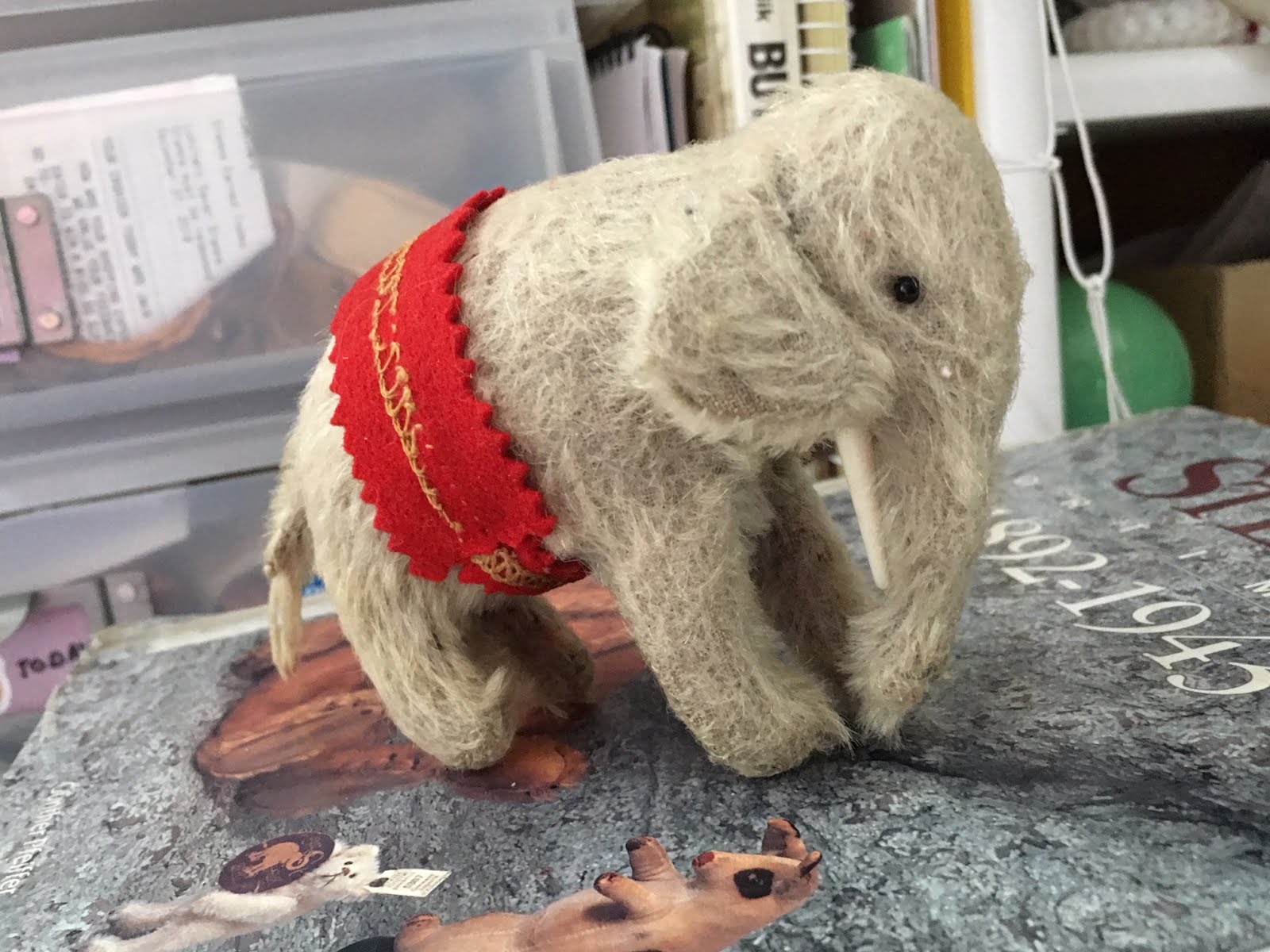
There's not room for much junk in the trunk when it comes to this happy handful. Here we have a 10 cm standing baby elephant. He is unjointed and made from blue mohair. His little face come alive with simple black button eyes, proportional ears, a slightly tucked under trunk, and ivory tusks. His mohair tail is tipped in what feels to be like woolen yarn. His red saddle cloth is vintage, but probably not original to him given its "homemade" presentation. It is decorated with gold colored embroidery. Elephant retains his long trailing "f" button and traces of his red ear tag as his Steiff IDs. 

This little guy is absolutely ele-fantastic, but exactly who is he? It's a little confusing. He doesn't EXACTLY appear in Pfeiffer's 1892-1943 Sortiment. Steiff did produced a blue standing 8 cm elephant as a "pram toy" in 1926 through 1933. He came with a bell on the tip of his trunk, a cord, a pom-pom decoration, and an ivory hanging ring. However, this pram toy did not have tusks and had black and brown glass pupil eyes. So as they say, close but no cigar with a match here. 

A bit more research finds a 10 cm blue mohair elephant with black button eyes and ivory tusks pictured in the Sortiment. However, this model is described as having eccentric wooden wheels. That wheeled model was made in 1924 only. The elephant under discussion today looks very much like the one pictured in the Sortiment, but shows no evidence of ever being on wheels - there are no stitches, holes, or indicators on the bottom of his feet that would suggest he was once "on a roll." It is Steiffgal's best guess that the elephant noted in the Sortiment was produced with or without wheels, and that was just an oversight in his cataloging. This can happen on items that were produced in limited quantities, and/or for a short period of time. 

Now for a little color commentary. Although this elephant looks grey today, if you look in his "nooks and crannies," his baby-blue coloring is obvious. Steiff introduced many items in the mid to late 1920s in happy, jelly bean colors like this, so his hue perfectly aligns with his production period. These colors - especially pink and blue - tend to really fade over time. This probably has to do with the chemistry and properties of the pigments used to make fabric color dyes last century.  

Steiffgal hopes you found this discussion on this little blue elephant absolutely unforgettable. 

Have a question about one of your Steiff treasures? Let's talk! Click here to learn more.

Friday, February 8, 2019

Getting A Leg Up On This Midcentury Steiff Mystery!

This inquiry from a new friend is simply ele-phantastic! Kati has something very special in her collection, but one that so far has defied identification.  Let's take a look at her note and use our grey matter to figure out what this mystery item just might be! 

Kati shares,

"I have a very unusual Steiff that I am having a hard time identifying. Not sure if you can point me in the right direction. I am not in anyway wanting an appraisal but just a little bit more information on the piece. I have searched EVERYWHERE and have not been able to come up with anything. 

It is an elephant with a Steiff tag and he has extremely long legs. The number on his tag is 7330. He measures 12.5” inches tall and 12” from trunk to tail. His legs alone are 7.5” tall. He has wood tusks and a red felt bib/collar. 

I am hoping you either know a little about him or can point me in the direction to a site or someone who might. Thanks for your time!"

There's no junk in the trunk when it comes to this absolute rarity. What we have here is Steiff's wonderful and seldom seen Lulac elephant. He is as Kati describes above; his delightful details include a jointed head; a smiling, open, felt lined mouth; and playful black and white google eyes. His upturned trunk is a sign of good luck, too. "Lulac" refers to his goofy, exaggerated form consisting of really long arms and legs. Other Lulac style animals produced at or around the same period include a Zotty bear, rabbit, Cocker Spaniel, donkey, zebra, tiger, lion, and poodle. This particular Lulac elephant was made as an exclusive for the United States market in this size only in 1958.

If you look hard enough, you can find jumbo clues about a Steiff treasure by examining its small details. In this case, check out what Kati says about his ear tag. The code on it reads 7730. According to Steiff reference materials, this corresponds to... 7 = in caricature, 3 = mohair, and 30 = 30 cm tall. But these numbers don't shed any light on how unusual this pattern truly is. To put things in context, the only other example Steiffgal has even come across was one at auction in 2010 at Christies. You can see that auction listing by clicking here.

Now for that "elephant in the room" question that everyone undoubtedly has on their minds about now. How does this great item value in today's marketplace? As always, something is worth what someone will pay for it, and Steiffgal has not seen the item firsthand to inspect for condition. Many critical condition items, like dry rot, odors, insect damage, etc., do not show up on photos, and that's why it is essential to see an item firsthand to give it a fair review. Given the Lulac elephant is as described and as presented, with no essential structural or aesthetic issues, it is Steiffgal's best guess sight unseen that this item may sell on an online channel or auction in the c. $1,000-2,000 range.


Steiffgal hopes that you found this discussion on Kati's elephant absolutely unforgettable.


Have a question about one of your Steiff treasures? Let's talk! Click here to learn more.

Tuesday, January 15, 2019

Vectis Auctions' Upcoming January 2019 Doll & Teddy Bear Sale To Offer Lots Of Steiff Temptations


Temptations, temptations... as Steiff collectors, we all are excited to learn about interesting sales and opportunities on the horizon. So Steiffgal was delighted to hear from her colleague Joanne McDonald at Vectis Auctions about an upcoming event featuring fantastic vintage Steiff selections. The company's Doll & Teddy Bear Sale will be held on January 29, 2019 starting at 10:30 AM GMT at the Vectis galleries, located in Stockton on Tees in the United Kingdom. Here are three outstanding Steiff lots from that sale that really caught Steiffgal's eye - and why. 

There's no horsing around that this first pick, lot #4616, is one of the mane events of this toy auction. It's a rare, antique Steiff horse on early metal wheels, estimated at £300 - £500 ($385 - $642.) It is cataloged as:

"Steiff vintage rare Muster (sample) horse on wheels, German, circa 1907 (produced from 1907-1920), Art No 1359, with rare Muster button to left ear (also has remains of white fabric tag behind button), Steiff button is missing, cinnamon and white mohair, black boot button eyes, black velveteen inner ears, inserted black cotton mane, tail is missing, upon metal chassis with connecting frame, original cord is still attached to frame (faded), four six-spoked metal wheels, curb bit with long metal shank (inserted within horse's closed mouth), curb chain, bridle is missing, leather saddle with tooled edging, leather girth, stirrups with leathers, crupper, red felt saddle cloth with gold embroidered edge (felt is holed, particularly under the seat of the saddle where a piece is missing), white felt surcingle, mohair is worn and faded / discoloured with some areas of balding overall, muzzle is holed to front, left ear has hole, Fair Plus to Good, 19.75"/50cm. NB: Steiff "Muster" button was used by the company on sample pieces- defining the piece to be a 'sample.'"

Collectors are certain to jockey for position over this eye-catching and unusual example. The size is perfect - not too big, not too small - and won't take up alot of room... which is a issue with many items on wheels. He has an authentic, early presentation and would look would look charming posed alone, or even better, with doll or Teddy riders on his back. It is great that he still retains his accessories, including his stirrups, saddle, blanket, and reins. And buttoning things up here, his seldom seen and desirable "muster" button is the frosting on the cake. It is Steiffgal's understanding that Steiff used the "muster" button pre-WWII on items considered samples, evolving designs, prototypes, or the "gold standard" for production. In general, the button indicated that the item was Steiff property and was not intended for sale or distribution. "Muster" translates loosely from German to English as "template" and in a sense, these "muster" items were just that.  

There's no grey area when it comes to this next auction highlight. It is lot #4621, a Steiff vintage rare Purzel or somersaulting elephant, estimated at £1,000 - £1,500 ($1,285 - $1,927.) It is cataloged as:

"Steiff vintage rare Purzel (somersault) elephant, German, Art No 9323, 1909-1910, button with underscored "f" and remains of white paper tag, grey mohair, black boot button eyes, felt tusks, fully jointed, black toe stitching, mohair and felt tusks a little discoloured, slight bald patch to left forehead, tip of trunk and left hind leg, mechanism is free and partially engaging but does not operate, otherwise Excellent, 12.75"/32cm. NB: The elephant is the rarest of all Steiff tumbling animals- only appearing in the catalogue for two years."

This great tumbler is truly ele-fantastic.  His design itself is really appealing, but his clockwork feature would make any enthusiast go head over heels over him. Steiff's tumblers are all time collector's favorites, and seldom appear on the secondary market. These somersaulting sweeties are activated by an internal clockwork mechanism and literally do somersaults when their arms are wound up. Steiff "purzel" production included bears, monkeys, elephants, and a few doll models, including Eskimos and clowns. For context, in 2016, a similar one changed hands at auction in the USA at $3,300 (£2,568).

And this last auction highlight is more fun than a barrel of monkeys. Check out lot #4622 a rare vintage Steiff Jocko monkey, estimated at £700 - £900 ($900 - $1,156.) It is cataloged as:

"Steiff vintage rare Jocko monkey, German, c 1930, uppercase letters with underscored "f" button (with remains of white tag behind), ginger* mohair, brown and black glass eyes, felt inset face, cream mohair chin, felt ears, hands and feet, fully jointed, slight discolouration / wear to mohair and felt, small hole to felt left cheek, left little felt finger is holed, mohair thinning to right cheek and torso (inoperative press squeaker), otherwise Good Plus to Excellent, 11"/28cm. NB: *This is not a standard Steiff line item and is highly desirable in this colour."

This spicy guy is a ginger prince indeed. Unlike Steiff's regular line Jocko monkeys, which were produced in brown or white mohair, this fantastic rarity was manufactured in an almost orange colored mohair. It is easy to think that he "faded" or "oxidized" to this color, or was somehow treated to produce this color, but indeed he was "born this way." Prewar, Steiff sometimes produced standard line items in small quantities in "un-standard" materials for a few reasons. These include 1) using materials on hand to make an item when its regular materials were not available, 2) testing a new fabric on a standard item to see if it was appealing or made sense from the monetary or product line extension perspectives, and 3) fulfilling an order for a window display, customer special request, or other business purpose. Steiffgal knows of two other 1930-era gloriously hued Jockos like this one, and in both cases, they are considered collection "royalty" by their owners.  

Steiffgal hopes this discussion on Vectis' upcoming sale has given you "lots" to think about. Please check out the company's website at www.vectis.co.uk to learn more and to see the auction's 650+ wonderful toy treats firsthand. 

Have a question about one of your Steiff treasures? Let's talk! Click here to learn more.

Sunday, November 4, 2018

Rolling Out The Red Carpet For This Amazing Steiff Ball Rabbit

It's easy to have a ball with Steiff! Especially when it comes to the company's tiny and wonderful "baby balltier" or ball animals designed for babies. Steiffgal recently had the pleasure of adding one of these bitty bunnies to her Steiff hug. Check out what makes these unusual novelties so interesting from the historical and product development perspectives.

Rounding things out, this adorable, 9 cm tall bunny is head jointed and made from tan colored mohair. His body is a simple, round form about the size of an apricot. His head is about the size of a ping-pong ball and is detailed with black and brown glass pupil eyes and a simple, red hand embroidered nose and mouth. His ears are made from felt. Rabbit's two front limbs and little tail are all made from tan colored woolen pom-poms. His clear monofilament whiskers have unfortunately been lost to time. This ball rabbit pattern was made from 1934 through 1943. This excellent example has a long trailing "F" button, dating him to the earlier part of this time frame.

Steiff also produced a larger 15 cm version of this bouncing bundle of joy from 1932 through 1942. This bigger bunny featured dimensional mohair ears and limbs as well as a rubberized, pastel colored ribbon band so he could be used as a "toss and catch" toy or perhaps even as a pram toy. This ribbon feature is so ephemeral that Steiffgal has never actually seen one in person. The 15 cm version of this novelty is pictured here on the left; the photo is from Pfeiffer's Steiff 1892-1943 Sortiment.

Steiff rolled out a series of teeny-tiny ball animals starting in the early 1930s. This would prove to be a challenging decade for the company. Germany entered a period of economic depression and widespread unemployment in 1929. At the same time, growing overseas sentiment began negatively impacting Steiff's export markets. As a result, Steiff's product development strategy included focusing on creating a range of lower-tier (i.e. affordable and efficient to produce) products for their domestic market to keep their toymaking business viable. It is interesting to note that the company's inexpensive, palm sized woolen miniature animals (including numerous rabbits in various body positions) also debuted around this same time. 

Coming full circle, Steiff produced about eight types of ball style animals overall. These were all based on simplified patterns of the company's most popular designs of the time. In addition to the rabbits discussed above, the collection also included Teddy bears, elephants, ducks, cats, lions, a Chin-Chin dog, and a Molly the Puppy. What's amazing about these items is that any survived at all given they were made to fit in the palm of a child's hand and designed as toys for youngsters! Here on the left you can see the page from the 1938 Steiff catalog featuring an assortment of these well-rounded items. 

Steiffgal hopes this discussion on these charming Steiff baby toys has put you in a playful mood indeed.

Have a question about one of your Steiff treasures? Let's talk! Click here to learn more!

Sunday, June 25, 2017

Unearthing A Few Hidden Gems From The July, 2017 Steiff Sommer Auction

Wouldn't it be nice to stumble upon an overflowing treasure chest of unusual vintage Steiff treasures? And even better, wouldn't it be divine if they were available to add to your collection? Such is the case with Ladenburger Spielzeugauktion's upcoming Steiff Special Auction to be held on July 1st, 2017 in Giengen, Germany as part of Steiff's annual summer celebration. It's worth checking out the catalog, even if just to dream big. You can find it online here. A few outstanding "hidden gem" lots amongst the offerings really caught Steiffgal's eye. Here are three that truly make her heart skip a beat - or two!

This first pick will have you singing the blues - in the best way possible. This is lot #1704, a blue tipped circus elephant with a starting bid of 650 euro. It is cataloged as:

"Circus elephant, mohair plush, grey/blue flamed, jointed, with neck mechanism and snap joints, velvet paws with toes, with felt down below of the snout and also at the point of the trunk, blue glass eyes, 32 cm, there is no snap mechanism in the snout, the elephant was X-rayed at Steiff, many parts of the mechanism are identical to the subsequent serial model, this is a test version, it is known that a similar elephant was in possession of the family Steiff (Klara Steiff, great second cousin Magarete Steiff) and a few years before it returned to the Steiff-archive, after that was a replica produced with red flamed mohair, in Giengen it was common practice that this test models were presented to relatives of employees or on the occasion of special events, version without tusks, small places with pelt loss, this version isn't listed in the Pfeiffer catalog."

And just what makes this petite pachyderm so unforgettable? It is always thrilling to learn of one of a kind Steiff treasures, and it is clear to see where this particular model fits in with the company's line of "snap" models. These high end novelties had spring joints and were designed to have movement and snap back and forth into different playful positions. Snap jointing could appear on an item's hands, feet, legs, and mouth. Original Steiff snap style items are all extremely rare to begin with, so to find a sample or prototype of one is really extraordinary. Standard line models produced included a Snap Dicky, a Snap Circus Bear, this general style of Snap Elephant, and a little known doll with snap jointing in her legs, enabling her to stand or sit easily. All of these variations were produced in the 1930's.

The blue mohair color of this sample is also very interesting. Steiffgal can only think of a handful of standard line prewar Steiff mohair items were produced in blue - including a few novelty rabbits and dogs. It is possible that this item was not produced in blue was because blue mohair was expensive, challenging to work with, or just not available on a commercial scale. 

Rolling right along, now let's have a go at lot #1583. This is a Steiff Record orang-utang, No. 320, 1929 - 1933, with a starting bid of 750 euro. It is cataloged as:

"Record orang-utang, No. 320, 1929 - 1933, mohair, felt face, glass eyes, 18 cm, with button, felt is except of minimally places in face and a small place at one hand in good condition, good mohair, the color on the wheels is worn, rare, voice is faulty."

This monkey on the go is the wheel-deal indeed. A few details about this item are certain to send collectors on a joy ride. The first, of course, is his form.  Orangutangs are extremely rare in the early Steiff line. The most familiar pre-war version is the company's playful and very appealing Mimocculo. This great pattern was produced in 11 sizes ranging from 8 to 50 cm from 1930 through 1936 overall. The middle and larger sizes featured a most unusual "pull the ear and the eyeballs move" feature. In 2010, a 13.5 cm example sold for close to $10,000 at an auction at Christies in London.  

The second is the fact that this first class example rides upon a four wheeled "Irish Mail Cart." This means that the carriage appears to be propelled by the rider pumping a handlebar back and forth with their arms. These "record" style animals on carts were introduced in 1912 and were an immediate hit. Bears, rabbits, monkeys, felt novelty dolls, and even Felix the Cat and Mickey Mouse appeared on these rolling carts. It is easy to understand why early items on working carriages seem to always drive auction bidders into fifth gear! 

And finally, let's pay full attention to lot #1551, a felt Steiff Hungarian soldier doll. His opening bid is 360 euro, and he is cataloged as:

"Caricature figure, Hungarian, produced between 1912 - 1917, felt, jointed, national costume, item description "Ung 50 Völkertypen", shoe button eyes, traditional costume and also head with holes in the felt, original leather shoes with tassels, nailed shoes, c. 50 cm, without hat, left arm is mended and also a small red felt insert, otherwise good condition, rare."

This fine example has uniform appeal, especially among the small army of Steiff military doll enthusiasts. Steiff’s uniformed dolls were a significant percentage of the company’s line and business in the early part of the 20th century. All of these dolls had most or all of their clothing integral to their bodies and were five ways jointed; some 50 cm and larger also had jointed knees. In a span of about 20 years, Steiff produced examples representing German, Scottish, Moroccan, Turkish, Dutch, Russian, American, Belgian, French, Italian, Hungarian, and Austrian armed forces, among others. All were known for their well tailored and authentic clothing, extraordinary to-scale accessories, and, of course, their perfect posture. Check out this soldier's fantastic jacket buttons and embroidery as well as the tiny tassels on his well constructed boots! Steiff made over 100 distinctly designed military dolls over time; most of these patterns were made in two or three sizes each. In tribute to some countries, like Germany, England, and the United States, Steiff produced dolls at numerous ranks and in various uniform types. 

Steiffgal hopes this auction preview tour has been a highlight of your day!  And good luck if you do bid on any of the sale's fantastic treasures!

Have a question about one of your Steiff treasures? Let's talk! Click here to learn more. 

Saturday, March 11, 2017

This Unusual Steiff Curled Wool Pachyderm is Simply Ele-Fantastic!


Oh baby!  A new vintage friend has arrived from overseas and Steiffgal can't wait to introduce you to him. Steiffgal was checking out some online auctions and came across an interesting find on offer from an auction house in The Netherlands.  The stars aligned and she won this somewhat rare prewar Steiff elephant.  And, it turns out, he has several very charming and unusual design features that are not obvious from photos or cataloging.  Let's check out this petite pachyderm and explore his interesting assembly. 

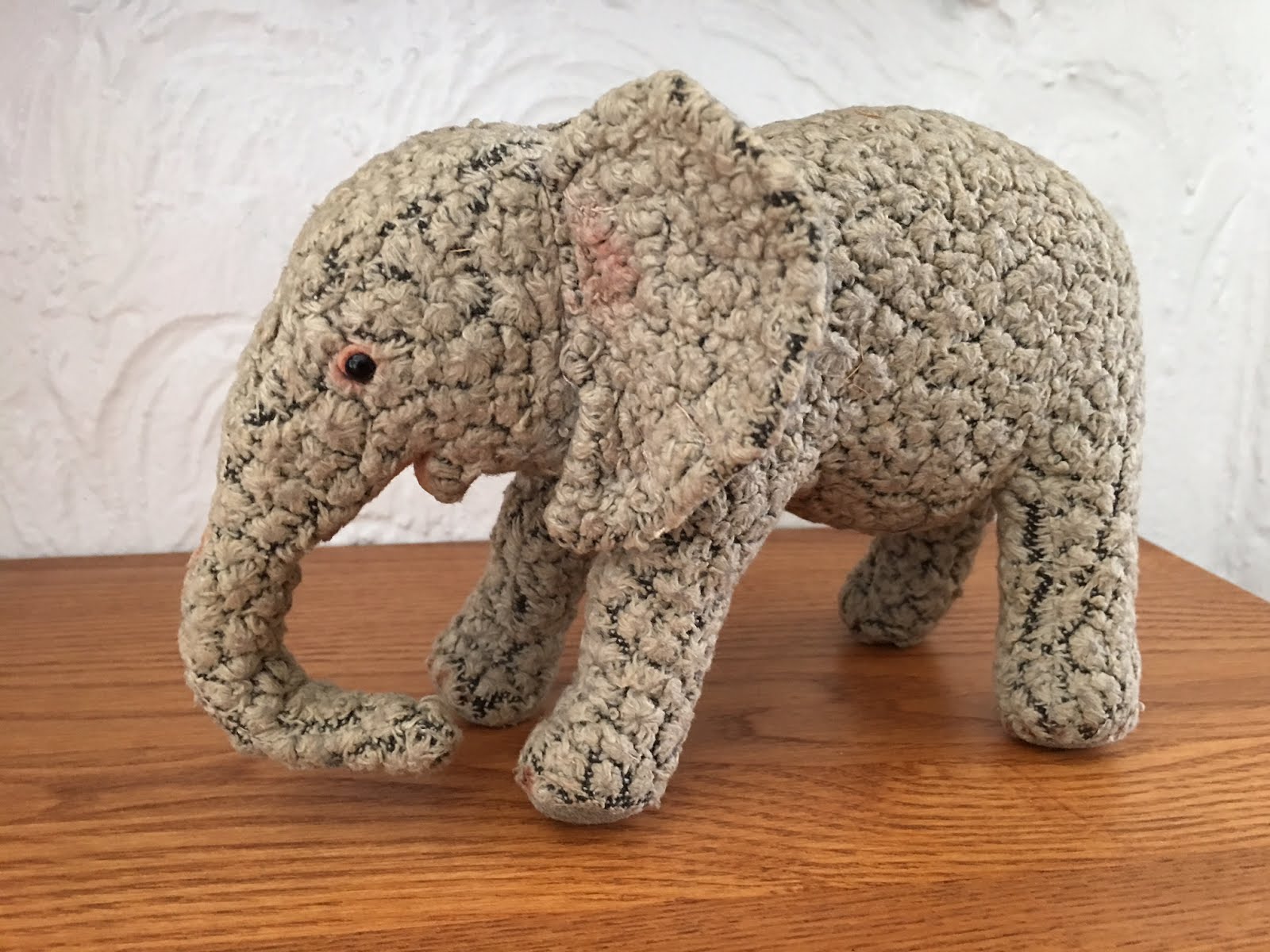
Steiff calls this beautiful baby "Play Elephant." He is 14 cm tall and 20 cm long, standing, and unjointed. His body is made from an interesting material called "curled wool plush."  This fabric has the look and of bumpy Persian lamb material, but with a softer, friendlier feel to it.  The backing is a dark grey or black, and the front is light grey in color.  He has red airbrushed highlighting on his ears, as well as nails on each of his feet. His distinctly babylike face comes to life with simple black button eyes that are backed in pink-airbrushed felt; an open, peach colored felt mouth; and a posable, wire lined trunk.  He is excelsior stuffed and has a working squeaker  Play Elephant retains his long trailing "F" style Steiff button. When he was new, he had a colorfully striped blanket; sadly, this has been lost to time.  Play Elephant in this unusual material appeared in the line from 1935 through 1941 overall in 14 and 17 cm; the 17 cm version was also produced as a pull toy on eccentric green wooden wheels.  

Above on the left you can see a c. 1935 German print advertisement featuring Play Elephant; also pictured is the little known "Dream Baby No. 103" which appeared in the line from 1934 through 1936 and a mohair ball duck, which appeared in the line from 1932 through 1943.

So let's take a closer look at three subtle features that make this elephant a jungle gem.  

The first is the use of additional, unusual fabrics on this period item. Elephant's paw pads, tail, and ear backing material is not felt, but another light grey material that has a cotton backing and a soft, velvet-like nap to it. It feels very much like the flesh-colored material used on the bodies of the company's pre- and early postwar animal dolls.  The tip of his tiny tail is also detailed in long, soft black material. It looks somewhat like mohair fabric that could be used to represent the mane on a horse or zebra, but it is much softer, easily bendable, and doesn't feel like wool in any way.  

The second is some unique stitching detailing on his oversized, floppy ears.  Each ear has six simple grey seams which fan out from where the ears join to his head.  These are both decorative as well as hold the front and back fabrics making up the ears together.  Because of the texture of the curled wool plush, the stitches are not visible on the front of the ears.  Steiffgal has several prewar elephants in her collection based on this "Play Elephant" pattern - including a 22 cm silk plush version - and none have this distinctive ear stitching detailing.   

The third is a mouthful - literally!  Steiff is famous for how the company inserts and secures the eyes on its bears and animals.  This is usually done by inserting the eyes into the front of the head, pulling the threads to the rear of the head, and knotting them firmly in the back at the base of the neck.  In the case of this particular pre-war curled wool plush elephant, this distinctive knot is located right inside the baby's mouth. This was really hard to photograph but hopefully you can see this feature here on the left. It is the first time Steiffgal has seen this assembly detail on any Steiff item. 

Steiffgal hopes you find this sweet baby elephant as unforgettable as she does!

Have a question about one of your Steiff treasures? Let's talk! Click here to learn more!
The teddy bear search engine