Showing posts with label Dicky. Show all posts

Thursday, September 29, 2022

Breakthrough Bear Surprises At Ladenburger Spielzeugauktion's Fall 2022 Event!

Auctions always deliver surprises, and that's one of the reasons many collectors love them! Ladenburger Spielzeugauktion's recent Steiff sale, held in the wee hours (at least on the East coast!) of Saturday, September 24th, 2022, produced some really outstanding results - especially on some "under the radar" items. Here are three that bubbled to the top, in the most delightful ways possible.

The first head-spinning highlight from this sale was also the top lot in the entire button-in-ear offering. This was lot #3047, a large, lovely, and important prewar white center seamed bear. It was cataloged in part as, "...bear with seam at the middle of head, with button, block letters, long trailing f button, shoe button eyes, white mohair, bright embroidering at snout, 60 cm, felt paws in very good condition, long snapped off arms, hump, nice bright mohair, voice isn't intact, extremely expressive." 

This bear was estimated a €2,500-€5,000, generated 70 bid, and hammered for a whopping €38,000!

This big beauty was certainly the package when it comes to all the things vintage Steiff enthusiasts adore. His white mohair, black eyes, and center seam facial construction checked all the boxes. He also retained his original Steiff button-in-ear, which only added to his appeal. And then of course was his adorable personality and presentation - classic, timeless, and just plain irresistible. It is interesting to note that this cub hammered almost twice that of a Happy Teddy bear (€20,000) or a fine rod bear (€20,000) also sold through this sale.

This next auction highlight is certain to bring a smile to your face.
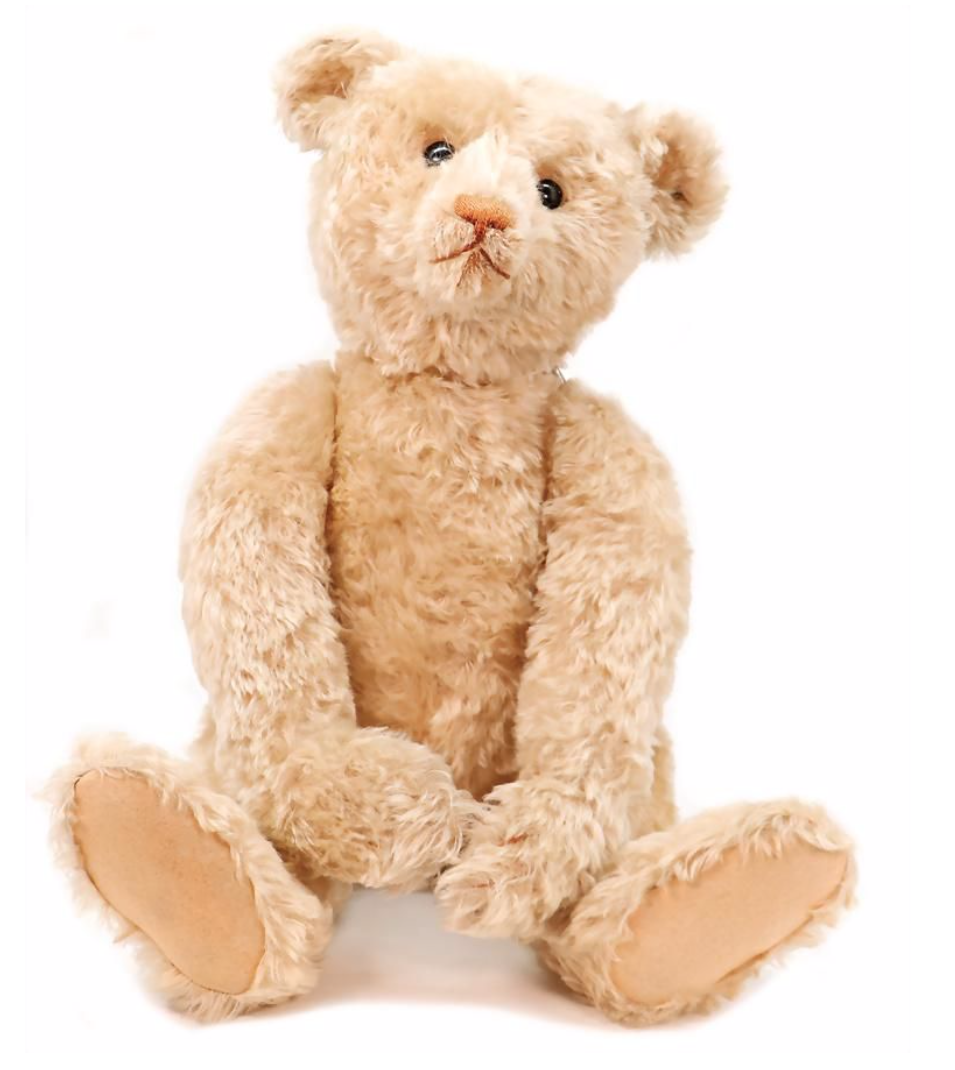
Here we have lot #3049, an impish, blonde mohair Steiff Dicky bear. He was cataloged in part as, "...with button, red cloth tag label, No. 5322,2, glass eyes, velvet paws, airbrush is partially a bit subtle visible, 34 cm, long snapped off arms, very expressive, mohair is a bit thin at minimally places, otherwise beautiful." 

Dicky was estimated at €950-€1,900, generated 81 bits, and hammered for €14,500.

Dicky bears are among Steiff's most desirable prewar novelty cubs. Steiffgal suspects, but has no proof, that the pattern may have been named in honor of Richard Steiff. Dicky bears were produced at a challenging socio-economic period in Germany and designed with features which made them faster and more efficient to manufacture than Steiff's standard line Teddy bears. Steiff's marketing materials described them as, "A new, improved, and less expensive Steiff Teddy Bear. Attractive design, newly formed head, strong squeeze growler, soft filling, blond or white mohair with painted pads, movable head and joints, famous workmanship." This fine example had a great attitude, retained its premier and fully legible red ear tag and Steiff button... and clearly radiated an "X" factor which spoke to many bidders!

And three's a charm with lot #3037, a terrific Ted from the mid 1920s to early 1930s timeframe.
He was cataloged as, "...exceptional, pre-war era, with button, block letters, faded, red cloth tag label, glass eyes, bright embroidering at snout, white mohair, exceptional size, 75 cm, clearly damages at the felt paws, long snaped off arms, hump, nice, bright mohair, scattered mohair loss, very expressive." 

Big Ted was estimated at €1,200-€2,400, generated 55 bids, and hammered for €6,700. 

This cute cub is good for a few supersized Teddy hugs! He was the second biggest standard sized prewar Teddy bear produced, with the largest being 115 cm. This example - with his oversized glass pupil eyes, fuzzy muzzle, and toddler-esque proportions - perfectly embodied the playful and upbeat aesthetic of "the red ear tag" era. In retrospect, it should have come as no surprise that he caught the hearts, eyes, and wallets of collectors worldwide. 

Steiffgal hopes this discussion on these three top auction lots has you going for the gold today.


Have a question about one of your Steiff treasures? Let's talk! Click here to learn more!

Saturday, September 15, 2018

Playing the Name Game With This Adorable Vintage Steiff Bear


Looks can be deceiving! This sweet vintage Steiff bear looks sad or thoughtful, but he's actually just trying to tug at your heartstrings. At least that's what Steiffgal thinks! This petite prince joined Steiffgal's hug over the summer, and she couldn't be happier about it! Let's take a look at his history and design and see what makes him so interesting from the collector's perspective.

What we have here is a smaller scaled Steiff Dicky bear. He measures 23 cm standing and is fully jointed. His body is made from blonde mohair and his muzzle is made from white mohair. His dear face comes to life with brown and black glass pupil eyes and a black hand embroidered nose and mouth. His mouth is somewhat asymmetrical, adding to his appeal and personality. Unlike the majority of Dicky bears, this particular example has plain tan colored felt paw pads and not stencilled velvet ones. 

Dicky was produced in blond, white, and brown in a wide range of sizes. All were five ways jointed and had the same distinctively shaped and constructed muzzle. His pattern was specifically designed to be as cost, labor, and material efficient as possible, given that he was launched during a period of economic depression and widespread unemployment in Germany. The blond and white versions were mohair and were made in 15, 29, 23, 25, 30, 32, 35, 43, 45, 50, 65, and 75 cm (measured standing) from 1930 to 1937 overall. A dark brown wool plush version was made in 25, 32, and 43 cm (measured standing) from 1935 thorough 1941. This particular Dickie has a long trailing "f" button and tiny traces of a red ear tag, dating him to the beginning of this production timeline.

One thing that has always been interesting to Steiffgal about this pattern is its name. Some of Steiff's bears and animals started having "endearing" names in the 1920's. Before that, most things were just cataloged as their species or breed. For example, Petsy the Baby Bear, Molly the Puppy, Bully the Bulldog, and and Charly the King Charles Spaniel all debuted during the "roaring '20s." A quick search of the most popular German boy names in 1930 reveals that "Richard" was the 50th most common of the year. So chances are, this bear was not named for popular cultural appeal. Steiffgal wonders if perchance he was named endearingly for Richard Steiff, the genius who invented the fully jointed Teddy bear as we know him today, for Steiff around 1903? Naming a model for a member of the Steiff family is not without precedence; it is thought that the company's adorable Susi cat, introduced in 1936, was also named for a Steiff family relative. Only Dickie knows for sure!

It's also a clothes call with Dicky's new wardrobe. As pictured above, Dicky arrived from overseas naked, and clearly had been someone's best friend for a number of years - given his somewhat "threadbear" presentation! Sometimes, if this is the case, it is a good idea to give a new vintage friend some protective clothing. As such, Steiffgal's sister jumped into action and handmade this sweet boy his trousers, red t-shirt, and grey sweater. Notice how the button on his cardigan matches the mushroom design on his pants! Isn't he stylin'? A shout-out to Steiff Sis for such a great job.

Steiffgal hopes this discussion on this pensive Dicky has been thought provoking for you.

Have a question about one of your Steiff treasures? Let's talk! Click here to learn more!

Sunday, January 4, 2015

Time Travelling Steiff Auction Highlights - Part 2!

Last week, we took a peek back in time and checked out a few auction highlights from a long ago sale. The event was held on Saturday, April 25, 1998 in Germany and managed by auctioneer Horst Poestgens. Steiffgal recently purchased the catalog from this sale and was just floored at some of the amazing treasures it featured. Here are three more absolute standouts from this wonderful Steiff event.


You can't help but think, "oh, baby" with this first auction highlight under review today. This lot, #49, is cataloged in part as... "Prototype of a Steiff snap-joint teddy baby with neck mechanism, 1936. Pre-war button in ear, corn colored mohair, velvet paws and soles, brown-black painted back glass eyes, turnable arms (discs), nose embroidered vertically with light brown tread, open felt mouth, lower jaw notchlessly movable via a built-in hinge, legs movable by snap joint mechanism, excelsior stuffed, head turnable from tail by means of neck mechanism, known from Steiff (like the circus bears or snap joint Dicky bears from the 1930's), standing 30 cm/12", sitting 24 cm/9-1/2", very nice pot bellied bear shape.  Very attractive friendly expression.  This teddy is the only known specimen in the finish worldwide (sample)!! He dates from the time and trial series the snap joint Dicky of 1936." 


Let's snap to it and see what make this little love such a remarkable bear. In the 1930's, Steiff designed and produced a number of items capable of mechanical movements. This started with a tail-moves-head feature. Several of the most popular dogs, rabbits, and cats of the time were made with this detailing. Steiff then took this "movement momentum" one step further by experimenting with just a handful of "snap" style items, which had internal metal joints that allowed these top-tier toys further flexibility in their body positioning. As far as readily available references and sources reveal, Steiff officially produced four such "snap" models: a 30 cm blonde Snap Dicky (pictured here on the left, photo from Christie's), a 30 cm brown Circus bear, a 25 or 28 cm grey or white Circus Elephant, and four variations of a very rare 28 cm "Dream Baby No. 103" doll.  


The Horst Poestgens Snap Teddy Baby in some respects looks a little bit like a Snap Dicky. It is interesting to note that like Snap Dicky, this Snap Teddy Baby also has velvet paw pads. Teddy Baby models from this period in this size were usually made with felt pads.  However, unlike Snap Dicky, this Snap Teddy Baby's pads do not have stenciled footprints, are round and toddler-like, and lack snap fingers and toes.  There is precedence for previously undocumented snap style items to appear on the secondary market; in 2010, Christie's sold a petite 18 cm Snap Dicky bear (pictured here on the left, photo from Christie's).  So, it is entirely possible, given the exploratory and evolutionary nature of its development, the limited number of snap items produced, and the fact that previously unknown snap-style examples occasionally surface in the secondary market, that this Snap Teddy Baby is indeed an utterly charming, insanely rare, one of a kind, uncataloged prototype.


Although Snap Teddy Baby is indeed a hard act to follow, this next auction highlight also gives a terrific performance.  This lot, #57, is cataloged as... "Somersault chimpanzee, Steiff, circa 1910, button in ear and remains of white tag, cinnamon colored mohair, light brown felt face, ears, hands, and feet, the thumbs on both hands expertly repaired (hardly visible), right hand likewise on back of hand, implanted painted back glass eyes, somersault clockwork functions, absolute mint condition, very rare, sitting size 23 cm/9 inches."  

Doesn't this sweetie just make your head spin?  Steiff's tumblers are all time collector's favorites, and seldom appear on the secondary market in delightful, working condition.   This somersaulting chimp example is actually only the second one Steiffgal has ever seen for sale.  These tumbling treasures are activated by an internal clockwork mechanism and literally do somersaults when their arms are wound up. Steiff produced several types of "purzel" animals, including bears, monkeys, and elephants, and a few doll models, including Eskimos and clowns.  Steiff's somersaulting chimp was produced in 23, 26, and 36 cm overall from 1909 through 1919.  

All of Steiff's purzel tumblers are based on popular standard line items of the time with slight tweaks to their design and assembly.  These items tend to have their arms attached slightly lower on their shoulders than their non-tumbling brothers.  And, the arms can sometimes look slightly less "flush" with the body than with the static versions. Tumblers are also significantly heavier than their non-tumbling counterparts, due to their internal metal mechanisms. You can see the physical differences here with the picture on the left of a regular Steiff bear (L) and the tumbling version (R); both bears are 28 cm and were produced in the 1906-09 time frame.


Steiffgal's just quackers over this final auction highlight from this Horst Poestgens auction.  This lot, #82, is cataloged as... "Doll duck pair, Steiff, 1920's, button in ear and white paper tag, article no. 28, linen body with loosely sewn on wings, yellow mohair head, wing tips and back of felt, painted brown claws, pretty head coloring, turning head, orange felt beaks, white wool pom pom on head, black shoe button eyes, original felt/cotton clothes, slightly used condition, interesting early collector's item."


Steiffgal has a very special place in her heart for Steiff's 1930 - 1950's era dressed animal dolls, and these are no exception.  According to Pfeiffer's 1892-1943 Sortiment book, these duck dolls were produced in 14, 22, and 28 cm from 1931 through 1935 overall.  Each size was detailed in one of six styles of clothing, which included a sports shirt and blue trousers (probably the boy duck in this case), pajamas, red patterned trousers, a swimsuit, a salmon red dress (probably the girl duck in this case), or a blue playsuit.  Another more pristine example of the company's duck-doll is pictured here on the left; the photo is from Pfeiffer's 1894-1942 Sortiment. It is interesting to note that the duck in the red shorts does not have a white pom pom on his head, while the pair on offer do.  Another point to consider about the duck couple is their identification.  The cataloging specifically mentioned a white paper tag. However, technically, the white paper tag was only used through 1925/26, and these dolls were made in the early 1930's.  As such, they "should" have red ear tags. In this case, it is entirely possible that Steiff had a bunch of extra "28" imprinted white ear tags in inventory, and simply used the white tags in the place of the red tags for efficiency.   

Steiffgal hopes this discussion of three amazing Steiff lots inspires you to find some wonderful Steiff treasures at auction in 2015!

Have a question about one of your Steiff treasures? Let's talk! Click here to learn more. 

Sunday, May 18, 2014

Snap To It And Check Out This Truly Remarkable Steiff Dicky Bear!

Steiffgal hates to be bossy... but she totally encourages you to SNAP TO IT and take a look at an exceptional Steiff Teddy on offer at the upcoming James D. Julia Antique Advertising, Toy, and Doll auction event on June 13, 2014.  This item, produced only as a prototype, is as interesting as it is rare.  Let's take a look at this utterly dandy Dicky Bear and see what makes him so fascinating from the design and historical perspectives.

It's hard not to get bent out of shape over this Steiff "Snap Dicky" Teddy bear. Dicky is 30 cm, made from golden blond mohair and stands on two flat feet.  He is head and arm jointed. His face is detailed with an inset muzzle, brown and black pupil eyes, a brown hand stitched nose, and three stitches to his lower lip. Like many Dicky bears, he has peach colored velvet pads with stenciled paw prints.  But here's where it gets interesting... very, very interesting!  Snap Dicky has spring joints on his hands, feet, legs, and mouth, meaning that they were designed to have movement and snap back and forth into different playful positions.  And, just when you thought things could not get any better with this rarity, they do!  Snap Dicky further comes to life with a working tail turns head mechanism.  A little research reveals that this bear is one of six known examples, three of which are in the Steiff archive.  Snap Dicky retains his long trailing “F” style button and traces of his red ear tag as his Steiff ID.  Steiff Dicky does not appear in the standard Steiff reference books;  and it is best estimated that he was produced in the circa 1933 to 1936 time frame.

Dicky's unusual jointing was an experiment in the Steiff line that lasted about as long as a finger-snap.  In the early 1930's, Steiff introduced its tail moves head mechanism, which gave their toys movement, interest, and premium status in the line.  Steiff selected some of their most popular items of the time for this feature, including dogs, rabbits, and cats.  The way this worked was when the tail was shifted gently to the right or the left, the head would shake in tandem. To build on this "movement momentum," Steiff experimented with a handful of "snap" style items, which had internal metal joints which allowed these top tier toys further flexibility in their body positioning.  

From what Steiffgal can tell, four such "snap" models were produced. The first, of course, is this wonderful Snap Dicky.  There is little published historical information on him, consistent with his prototype status.  The second, and perhaps best known, was a 30 cm brown mohair Circus Bear with disk jointed arms, leg snap joints, and a tail moves head mechanism.  He was in the line from 1935 through 1939 and approximately 897 models were manufactured.  The third was a grey or white mohair Circus Elephant with disk jointed arms, leg and mouth snap joints, and a tail moves head mechanism.  Like Snap Dicky, he had velvet paws with stenciled pads.  He was produced in 25 and 28 cm from 1931 through 1940 and approximately 1,040 models were manufactured. Circus Elephant is pictured above along with an xray of his amazing (for the time) snap jointing system.  This photo is from Cieslik's excellent book, Button in Ear The History of the Teddy Bear and His Friends.    

The fourth snap item was called "Dream Baby No. 103" and is so rare that Steiffgal had not even heard of it until doing research for this post.  According to Cieslik...

"The head was made by the Rheinische Gummi Co. (turtle mark) and filled with excelsior.  The body was in good quality felt, and the doll had a "Mama" voice box. The doll had the new jointing in the legs, so that it could assume both sitting and standing positions.  Four versions of the doll were made - all 11 inches tall, with white skirts, colored sweaters and caps:  "Greta" in light green; "Blonda" in light blue; "Rose" in pink; and "Angeli" in orange.  (1934 - 1937 - total production = 4,553."  "Rose" is pictured here on the left; the photo is also from Cieslik.

Even though these snap items were long on appeal, they lasted a short time in the Steiff catalog.  And why would that be?  It is Steiffgal's best guess that alot had to do with timing, finances, and supply and demand factors.  It is possible that towards the later part of the 1930's, the materials needed to manufacture these toys were becoming scarce or even rationed based on the geo-political realities of the time.  Additionally, these treasures were quite complicated to manufacture and required a great deal of time and resources to do so.  As a result, they were undoubtedly quite expensive to purchase.  As such, given the economic situation across the region, demand may not have been terribly high and Steiff may have determined that it did not make financial sense to continue production of these top-tier items. 

Despite their brief - if at all - appearances in the line, Steiff has created relatively recent replicas of their Snap Dicky, Circus Bear, and Circus Elephant rarities. A blond Snap Dicky was produced in 1996 in an edition size of 5,000, a brown Circus bear was produced in 1994 in an edition size of 4,000, and a novel orange tipped Circus Elephant was produced in 2009 in an edition size of 1,000. Each would be a delightful addition to any Steiff collection!

Steiffgal hopes this discussion on Steiff's wonderful and rare metal jointed items from the 1930's - including this remarkable prototype Dicky - has added a little snap, crackle, and pop to your day!

Have a question about one of your Steiff treasures? Let's talk! Click here to learn more. 

Sunday, September 9, 2012

This Huge Steiff Surprise Appeared Right Out Of The Blue!

Steiffgal's about to share a GIANT surprise with you... because it certainly was to her!  One of the most magical things about Steiff is that "new" vintage treasures seem to always appear "out of the blue...." and in this case, that's exactly what we have here!  Take a look at this note from a reader from the northeast part of the USA who asks about a larger than life family heirloom. Jeanne writes in part:

"Hi, 

I was hoping that you would have some information about our big Steiff Teddy Bear.  Here is a photo of him wearing a top hat and ribbons on his ears. 

Our Teddy was given to my grandmother when she was a child; Grandma is now 91 years old. My great-grandmother was shopping during the Great Depression when she saw this huge Teddy Bear is a shopkeeper’s display window. She wanted to buy it for my grandmother who was her only child. She brought the Teddy Bear home on the bus; I guess it was quite a struggle. The Teddy took up a whole seat by himself! My great-grandmother lived way out in the country so it was a long ride.

Soon afterwards, my great-grandmother passed away and my grandmother was raised by a nanny.

We really don’t know too much about our Teddy Bear. He’s got blue eyes and he’s very large. He’s about 75 cm while sitting. He’s got enormous feet; his foot pads measure about 10” long. He’s got a Steiff button in his ear. He’s in okay condition considering that he’s been mauled by a dozen grandchildren over the years. He’s been very well enjoyed by the past 4 generations of our family.

One of his ears has a tear near his head. He’s got a few loose threads hanging from his nose. One of his foot pads has some loose stitches. His feet have a few small stains. His fur is a bit threadbare and faded in a few areas. His growler doesn’t work. He’s getting droopy from age. But we still love him!

My grandfather used to display the bear on floats during parades. He enjoyed dressing the bear up. 

I really enjoyed your website. I love to see pictures of Steiff bears.

Thanks so much, 

Jeanne"

WOWZA...Steiffgal's gotta catch her breath on this one.  What Jeanne has here is a humongous Steiff Petsy bear.  This bear is simply awesome in so many ways, including the fact that his entire history with Jeanne's family has been documented over the years.  From the historical and collector's perspective, Petsy had a very short, but very sweet, appearance in the Steiff catalog, only appearing from 1928 through the very early 1930's.  What made him different than past designs, among other factors, was his prominent middle facial seam which ran vertically from his forehead across his snout, and his metal lined ears, which allowed them to be posed in many fun and comical ways. 

During his years in the line, Petsy was produced in two "flavors."  The first was a brown tipped mohair version with blue eyes (like Jeanne's here) with pink/red facial and claw stitching.  Some of these tipped Petsy bears had black and blue traditional glass pupil eyes; others had the more playful black and blue cartoon style eyes.  The second Petsy version was made from brass mohair; they were detailed with brown and black pupil eyes and black facial and claw stitching. The tipped version appeared in ten sizes ranging from 15 to 50 cm sitting (or 22 to 75 cm standing) while the brass version was only produced in one size:  22 cm sitting or 32 cm standing.  Tipped Petsy was also produced as a musical Ted in 17 and 20 cm (or 25 and 30 cm standing), on a four wheeled rolling cart in 20 and 25 cm, as a 17 cm puppet, and as a 17 cm purse. 

Notice that a 75 cm sitting or 115 cm standing version of Petsy is not mentioned here? 

Steiff's big bruins have always generated huge interest with collectors and those interested in the company's product design evolution.  And there is evidence and precedent for 115 cm sized bears in the late 1920's and early 1930's.  For example, the 1892-1943 Steiff Sortiment book documents the following three bears in 115 cm (standing size): a "Happy" Teddy bear, in the line in 1926; a Teddy clown in the line from 1926 through 1930; and a Dicky in the line from 1931 through 1935.  Clearly, the company produced a 115 cm Petsy as well; perhaps so few were made that the company did not keep a sample of one for the archives or just unintentionally omitted keeping a record of their manufacture.  

Now for the big question, the really big question... his possible worth.  As always, Steiffgal is not a formal appraiser, and fully believes something is worth what someone will pay for it.  She has also not seen the bear firsthand -yet- so she cannot truly take into account structural issues that cannot be captured on film well, such as rips, tears, odors, and dry rot.  It is interesting to note that a 35 cm/49 cm (sitting and standing size) brown tipped, blue eyed Petsy sold for £23,600 or close to $40,000 at the 2012 London Toy Auction; this gorgeous example is pictured here on the left.  Given that Jeanne's bear is an original, early Petsy (one of the most sought after Steiff bear designs of all times,) his unusual, uncatalogued size, and fabulous provenance, and assuming that he is in as hearty condition as his owner describes, he may value in the $40,000 to $50,000+ range today.

Steiffgal hopes that this discussion on Jeanne's Petsy has got you dreaming about Steiff in a super sized way!

Have a question about one of your Steiff treasures? Let's talk! Click here to learn more.
The teddy bear search engine