


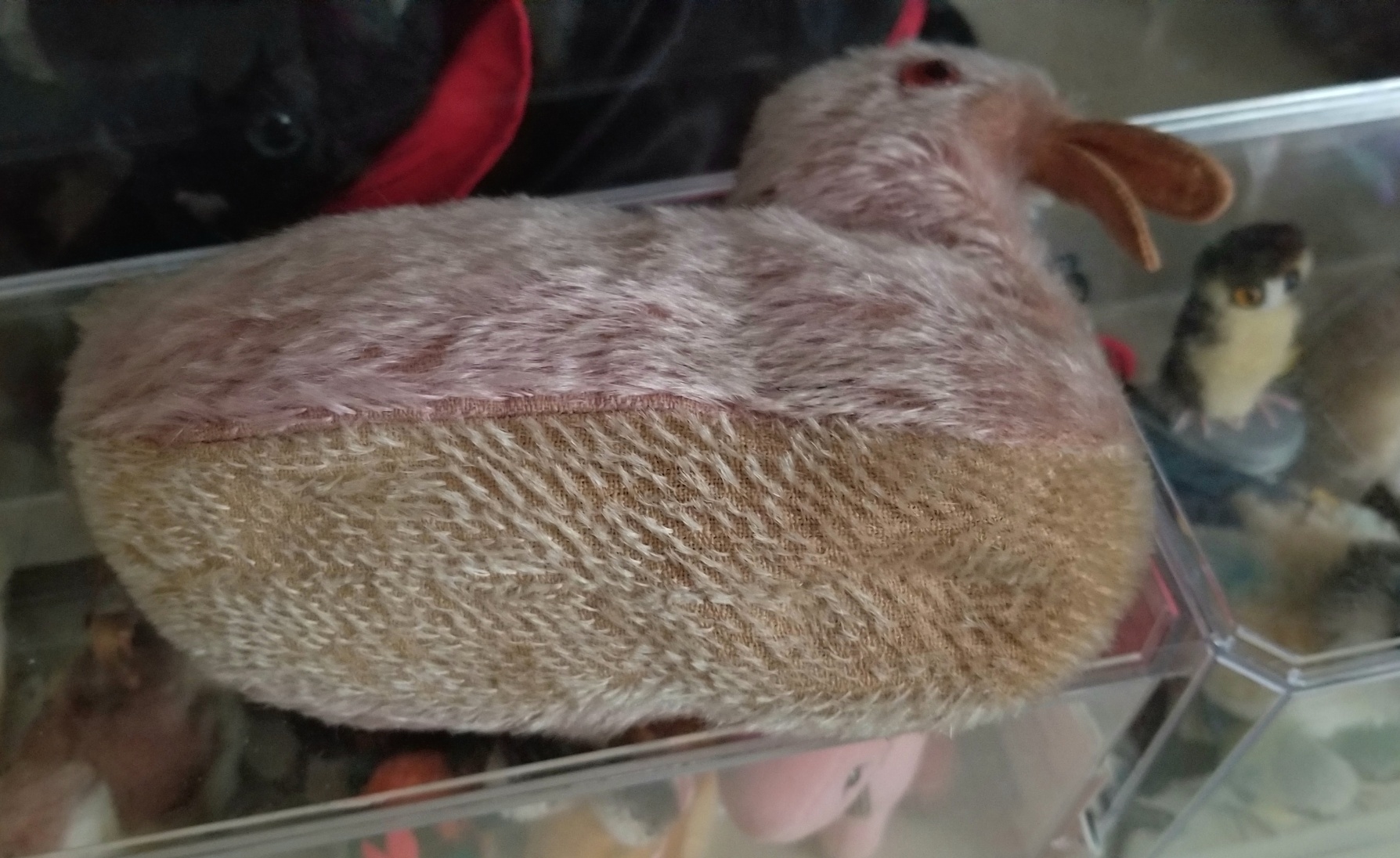

Steiffgal hopes this discussion on this novelty duck has made your day pretty in pink.
Have a question about one of your Steiff treasures? Let's talk! Click here to learn more.

This blog focuses on vintage Steiff finds, Steiff antiquing and travel adventures, international Steiff happenings, and the legacy and history of the Steiff company.


 Posts
All Comments
Posts
All Comments


 What collector would not want to feather their nest with this dapper duck? This toy is officially named "Play Duck." He is standing, 22 cm tall, unjointed, and stuffed with excelsior. Play Duck is made from yellow wool plush fabric. His beak and feet are dimensional and are made from matching yellow felt. His feet are lined in wire and are posable. His two small wings are spread out playfully along his back. Play Duck's eyes are made from black buttons and are backed in red felt circles - a design feature often seen on Steiff's birds. He has a nonworking squeaker in his torso. He retains his short trailing "f" style Steiff button in his wing as his ID. Play Duck was made in this size only from 1933 through 1943.
 It's hard not to notice Play Duck's interesting material. Wool plush is a lovely toy making fabric as it is durable, high quality, and gives items a charming, old fashioned look. It has a "fuzzy" feeling to it, and even though it is also produced on a cotton backing like mohair, its fibers are more "continuous" than mohair fibers, which tend to be a little more "prickly" and distinctive. Steiff often used wool plush as a substitute fabric in the place of mohair for a few years before and a few years after World War II, when the company's more traditional mohair and felt fabrics were sanctioned or not available at all. When you see a vintage Steiff item made from wool plush, there's a really good chance that it was made in the 1930's through early 1950's time frame.
 First... his tootsies. His somewhat oversized feet are actually webbed, like a real duck, and allow him to stand and balance easily. His "toes" are formed by the stitching on his feet.
  Second... his beak. His two part, open beak is positioned in such a way that he appears to be smiling. It is detailed with two small grey marks on the top, indicating his nostrils. Most prewar Steiff ducks either have closed dimensional beaks, or simpler beaks made from orange single or double thick flat felt. As such, this is one lucky ducky! Remarkably, both Play Duck's feet and his beak are stuffed with excelsior. Just imagine the precision, time, and skill required to do that!
 Let's toss up some basic facts about this Steiff rarity. Steiffgal purchased this brown beauty at a recent Teddy Dorado auction. The ball itself is 15 cm in diameter and is made from a total of 12, five sided pentagons which are sewn together to make the rounded shape; Steiff calls this their "Mosaic Ball" design. It was described in the catalog as follows:
  The fabric selections on this particular example, including mohair, artificial silk plush, and wool plush, perfectly align with its estimated date of production. It is possible that this example was designed as a prototype for an item that never went into full scale production. But it is more probable, given its origins from a consignor in Giengen, that it was created by an industrious Steiff seamstress on one of her breaks or even at home; these sorts of "one off" pieces are often referred to as "whimsies" or "end of day" items in the antique industry. The most interesting fabric on this ball is a tan wool plush decorated with what appears to be hand-airbrushed black, brown, and orange spots. Steiffgal does not recognize this fabric from any other Steiff item. Have you seen it before?
  In a round-about way, balls designed for play have been part of the Steiff program since the late 19th century. Perhaps their earliest cataloged appearance was in 1892, when felt covered wooden balls were included with the company's standard skittle sets. Steiff also made soft play balls for children in felt and mohair through the early 19-teens. All of these earliest balls were designed in two or three colors and were constructed in wedges, like today's beach balls. You can see two of these early felt skittle set balls here on the right; the photo is from Morphy Auctions.
 Let's piece together what happened next. In around 1912, Steiff debuted its "Mosaic Ball" pattern. This ingenious design turned out to be the perfect blend of geometry, visual interest, and material efficiency. The shape naturally takes form from the way the pentagons are stitched together. Its presentation can include up to twelve different colors, although Steiff traditionally used two pentagons each of white, red, black, blue, yellow, and green mohair. And in terms of production efficiency, this pattern is ideal, and can incorporate the "left over" and scrap fabric from other items being produced. From their introduction onward, Steiff frequently featured its Mosaic Balls in its advertising. This is understandable, given their festive and attractive appearance as well as popularity. You can see a Steiff advertisement from 1912 featuring its Mosaic Balls here on the left, the photo is from Ayers and Harrison's Advertising Art of Steiff Teddy Bears and Playthings.
  Steiff's Mosaic Balls had a practically seamless, almost seventy year long appearance in the line. Pre-war, the company's standard line Mosaic Ball was produced in 13 sizes ranging from 6 to 35 cm from 1912 through 1943 overall. This pattern was also incorporated into a hanging toy for a baby's crib from 1913 through 1917, and as a "catch toy" on an elastic string from 1914 through 1918. Just after World War I, when mohair was scarce, Steiff produced its Mosaic Ball design in felt as well as substitute plush; in the early 1930's the ball was produced in lighter pastel colors as well. Once the factory reopened for toy making business in the late 1940's, this beloved pattern again appeared in the catalog in five sizes ranging from 15 to 25 cm from 1950 through 1982.

 It's game on with this fantastic Steiff "play elephant." This gentle giant is 22 cm tall, standing, and unjointed. He is stuffed with excelsior and has a working squeaker in his belly. He is made from grey artificial silk material; the tip of his tail is decorated with longer mohair. His face comes to life with soft, floppy ears; black button eyes backed in felt, and a youthful, open, and smiling felt lined mouth. His red felt blanket, which is original to him, is decorated with yellow edging and a stylized yellow and green flower on either side. His Steiff ID is a tiny, 4 mm trailing "F" button.
 Let's change things up a bit and look at the economics behind this excellent elephant. The photo on the left shows a Steiff advertisement from around 1940. (If you click on it, it should be large and legible on your screen.) On the bottom you can see the pre-war version of this silk plush elephant; at the time, the 17 cm version cost 4.30 DM; the 22 cm version cost 6.50 DM; and the 28 cm version cost 9.50 DM. Given that in 1940 there were approximately 2.5 DM to the dollar, these prices roughly translate to $1.72, $2.60, and $3.80 in 1940 US dollars. Using an online inflation calculator which adjusts any given amount of money for inflation, according to the Consumer Price Index, this roughly translates to $29.38, $44.40, and $64.90 in US dollars in 2015. Steiff has always been a premium product at a premium price!


