Showing posts with label German. Show all posts

Thursday, October 26, 2023

Barking Up The Right Tree With This Petite And Princely Steiff Pinscher

And they call it puppy love! And for good reason. This sweet sitting pup recently joined Steiffgal's hug. He came in a giant box lot. But as all collectors know... sometimes these types of purchases contain unexpected treasures like this.

Sit and stay and check out this sweet pup.
He is a sweet example of Steiff's Pinscher dog. He is 17 cm tall, sitting, and unjointed. He is made from long tan mohair that was tipped in brown when he was new. You can see this tipping in his armpits, folds, and other places where the sun does not shine! Pinscher
 has black hand embroidered claws on his front and back paws. His face is detailed with charming proportional brown and black glass pupil eyes, a black hand stitched nose and mouth, a spot of red on his lips, and a center-seamed muzzle. His pert triangular mohair ears are lined in tan felt, and as is customary to the breed, he has a proportionally very small tail. He has a nonworking squeaker in his belly. 

Like most of Steiff's creations, this Pinscher is lovingly and authentically rendered.
He in a very appealing and authentic sitting position; his back legs are angled and bent in the way a real puppy sits - especially when they are trying coax you into giving them a snack! This guy retains his long trailing "f" Steiff button and bits of his red tag as his Steiff IDs. This tipped mohair Steiff Pinscher pattern was produced in 17, 22, 28, 35, 43, and 50 cm from 1914 though 1931 overall.

Pinschers are few and far between in the Steiff line. Over time, three versions were produced prewar. As far as Steiffgal can tell, there has not been one in the line after the early 1940s. It is interesting to note that Steiff's debut Pinscher was produced at the same time as the company's rod jointed bears. Like the rod jointed bears, this guy was also fully rod jointed, had black wooden shoebutton eyes, and a handmade black gutta percha nose. He appeared in 35 cm from 1903 through 1906. He had a distinctly Teddy bear look to him but his limbs were more slender and he did not have felt paw pads. You can see a picture of him here on the left; the image is from Pfeiffer's 1892-1943 Sortiment.

After an eight year hiatus, Pinschers again graced the Steiff catalog. The Pinscher under discussion here today followed the rod jointed version. Steiff's final Pinscher was similar to the tipped version, but made in long grey brown mohair in 17, 22, and 28 cm from 1935-1942. 

Pinschers are a distinctly German breed, so it should be no surprise that Steiff chose to produce a few for their line.
These dogs originated in southern Germany (also where the Steiff company is located.) They were first officially recognized in 1885 and accepted into the American Kennel Club in 2003. German Pinschers were one of the foundation breeds in the origins of the Doberman Pinscher and the Miniature Pinscher as we know them today. German Pinschers were almost lost to time both post WWI and WWII. According to the AKC, there were no litters registered in West Germany from 1949 to 1958. Due to the heroic efforts of one man, the breed was rescued via intensive breeding and conservation efforts.

Steiffgal hopes this discussion on this petite Pinscher has brought a little more happiness to your day.

Have a question about one of your Steiff treasures? Let's talk! Click here to learn more. 

Sunday, March 17, 2019

It's Sofa, So Good When It Comes To Steiff's Unusual Prewar Couch Animals

Steiffgal promises today's blog will be as laid back as possible. That's because we're going to put our feet up and look at a very cool Steiff rabbit who would want it no other way. Check out this lovely honey bunny and see what makes her so interesting from the historical and product development perspectives.

It's sofa, so good when it comes to this Steiff "Couch Rabbit." Rabbit is 11 cm tall and 20 cm wide. She is head jointed, made from white mohair, and solidly stuffed with excelsior. Her ears are lined in tan velvet. She has wonderful, well designed, long, skinny legs and feet; each padless foot has three hand embroidered claws on it. Her oversized head and face come to life with pink and red glass albino eyes, a pink nose, light pink mouth, and traces of her original monofilament whiskers. She left the Steiff factory wearing a silk ribbon and brass bell, and lying on an oval shaped felt mat finished with a ruffled ribbon edge. Couch Rabbit was made in 11 and 13 cm from 1928 through 1930.

The truth is - as far as Steiffgal can tell - is that Steiff made very few versions of these lying pets. It is possible that this design concept emerged as the company was actively pursuing all sorts of "novelty" patterns in the mid-1920s; these included a series of pull and clockwork toys on wheels. The only other documented sofa animal she can find is the company's "Couch Cat." This chill-axing cat was also made in two sizes (10 and 12 cm) and during the 1928 through 1930 time frame. Their names, body positions, and accessories suggest that the company's "couch animals" were designed as decorative items to display on living room furniture like sofas. After all, that's where you find household pets resting comfortably in real life, right? The page from the company's 1929 catalog advertising these sweet treats is here on the left, the photo is from Carsten Esser's Steiff Katalog 1920-1929.

Despite its relative rarity, Couch Rabbit has many details that are typical to the company's rabbits of the period. For example, her childlike appearance, with an oversized head and eyes, exactly mirrors the company's design aesthetic of the late 1920s. Her long, skinny, padless feet and chunky thighs are almost identical in shape and proportion to the company's beloved Record Hase. And her nose and mouth stitching, consisting of a solid triangular outlined nose and a simple cross-style mouth, is also seen on many rabbits of her era. You can see these design elements here on the Record Hase (made in 25 cm from 1926 through 1943) pictured here on the left. 

Steiffgal hopes this discussion on the company's Couch Rabbit has been a restful experience for you.

Have a question about one of your Steiff treasures? Let's talk! Click here to learn more.

Saturday, February 24, 2018

Spinning A Yarn Over This Unusual Steiff Woolen Miniature Teddy Bear

Are you ready for yet(i) another Steiff treasure? This one is so unusual that its hard to believe it was really made by Steiff - but it was, and at a really challenging time in history. Take a look at this small white Teddy bear that Steiffgal recently purchased on eBay. Despite its obvious condition issues, its rarity and unusual form make it simply irresistible!  Come take a look at what makes this "blizzard baby" so interesting from the design and historical perspectives.

This "abominable snowman" looking sweetie is actually Steiff's woolen miniature Teddy bear. He measures 22 cm tall standing and is made from white wool yarn "pom-poms" supported by a small wire skeleton in his torso. His coloring has aged to a mellow vanilla over time - perhaps to match his laid-back personality today! His arms and legs are probably string jointed; they hang loosely at his sides but can be moved about. His two half-circle shaped ears are made from white mohair. His very simple face comes to life with two brown and black glass pupil eyes. When he was new, he had a very small black hand painted nose and mouth. He retains his short trailing "f" Steiff button in ear. According to the 1892-1943 Sortiment, this really unusual design was produced in 22 cm from 1936 through 1938. 

It is clear that Old Yeti today has a face only a mother (or a diehard Steiff collector) could love. But it was not always that way. He started out life looking like the bear pictured here on the right. The photo is from Christies, from their October 2010 Steiff sale. He is cataloged here as "A Steiff Wool Pom-Pom Teddy Bear, (5522), standing, white, brown and black glass eyes and FF button with yellow cloth tag, 1936-1938 - 9in. (23 cm.) high." The catalog also notes, "Only 955 examples of this bear were made between 1936 and 1938." This tissue-new example realized GBP 5,250 at auction.

Despite old Yeti's appearance today, you can still make out some of the traditional Teddy bear features Steiff was trying to capture in this woolen miniature version. These are most prominent in the shape of his limbs. His arms do feature clearly curved wrists and suggest small hand paws. And his legs are also defined with proportional feet. These shapes are not wired and it is hard to figure out how Steiff pulled this off using pom-poms, but they did. Steiffgal suspects that the ears are mohair as they would be able to support and sustain a button-in-ear while a pom-pom version could not. You can see a close up of Old Yeti's button in ear here on the left. 

Old Yeti has a great yarn to spin.  He is a part of the company's long history of woolen miniature production. The very first woolies, introduced in 1931, were a series of six birds. Each was a different color and made in 4 or 8 cm. They had metal legs and feet and felt beaks and tails. They wore their buttons and earflags as tiny “ankle bracelets” around their sturdy legs. Soon after, Steiff added rabbits, cats, mice, monkeys, ducks and other animals to their line. Despite their proportions, most had jointed heads and, where appropriate, charming details that included tiny metal legs; felt beaks, wings and ears; colorful slippers; and headwear, including bonnets, top hats and lacy veils. Most of the standard line woolies were made in the 5 to 15 cm size range; this Teddy bear was among the largest if not the largest sized "miniature" produced. You can see a small collection of Steiff's prewar woolen miniature birds here on the left.

Collectors can certainly admire Steiff for trying to create a Teddy bear in the woolie style.  And, given his years of production - when mohair fabrics were in short supply but wool threads less so - could understand why the company would use this type of material in its Teddy bear production strategy.  

Steiffgal hope this discussion on Steiff's prewar woolen miniature bears has added a few Teddy hugs to your day.

Have a question about one of your Steiff treasures? Let's talk! Click here to learn more. 

Saturday, June 10, 2017

Care To Feather Your Nest With This Vintage Steiff Play Duck?

It's easy to go quackers over Steiff's ducks.  These fantastic fowl favorites have made a red carpet appearance in Steiff's commercial catalogs since their debut in 1892, first appearing in felt.  Steiffgal recently adopted a vintage and very darling duckling into her collection.  Waddle on over and check out some of his interesting, prewar design features.

What collector would not want to feather their nest with this dapper duck?   This toy is officially named "Play Duck." He is standing, 22 cm tall, unjointed, and stuffed with excelsior. Play Duck is made from yellow wool plush fabric.  His beak and feet are dimensional and are made from matching yellow felt. His feet are lined in wire and are posable.  His two small wings are spread out playfully along his back. Play Duck's eyes are made from black buttons and are backed in red felt circles - a design feature often seen on Steiff's birds.  He has a nonworking squeaker in his torso. He retains his short trailing "f" style Steiff button in his wing as his ID.  Play Duck was made in this size only from 1933 through 1943.

It's hard not to notice Play Duck's interesting material.  Wool plush is a lovely toy making fabric as it is durable, high quality, and gives items a charming, old fashioned look.  It has a "fuzzy" feeling to it, and even though it is also produced on a cotton backing like mohair, its fibers are more "continuous" than mohair fibers, which tend to be a little more "prickly" and distinctive.  Steiff often used wool plush as a substitute fabric in the place of mohair for a few years before and a few years after World War II, when the company's more traditional mohair and felt fabrics were sanctioned or not available at all. When you see a vintage Steiff item made from wool plush, there's a really good chance that it was made in the 1930's through early 1950's time frame.

Play Duck's felt features are also quite charming, and give him a toddler-esque look.  

First... his tootsies.  His somewhat oversized feet are actually webbed, like a real duck, and allow him to stand and balance easily.  His "toes" are formed by the stitching on his feet.  

Second... his beak. His two part, open beak is positioned in such a way that he appears to be smiling. It is detailed with two small grey marks on the top, indicating his nostrils. Most prewar Steiff ducks either have closed dimensional beaks, or simpler beaks made from orange single or double thick flat felt. As such, this is one lucky ducky! Remarkably, both Play Duck's feet and his beak are stuffed with excelsior.  Just imagine the precision, time, and skill required to do that!

Steiffgal hopes this discussion on her new fine feathered friend had all its ducks in a row.

Have a question about one of your Steiff treasures? Let's talk! Click here to learn more.

Friday, December 23, 2016

Steiffgal's Just Boy Crazy Over This Late 1930's Steiff Doll!

Oh boy!  Literally!  Santa stopped off at Steiffgal's house a tad early, delivering this sweet little guy just in time for the holidays.  He came all the way from Germany and was won at a recent toy sale there. Steiffgal has a thing for Steiff's early felt dolls, but she was particularly excited about this darling little man. Here's a little bit about him, and what makes him so interesting from the collector's perspective.

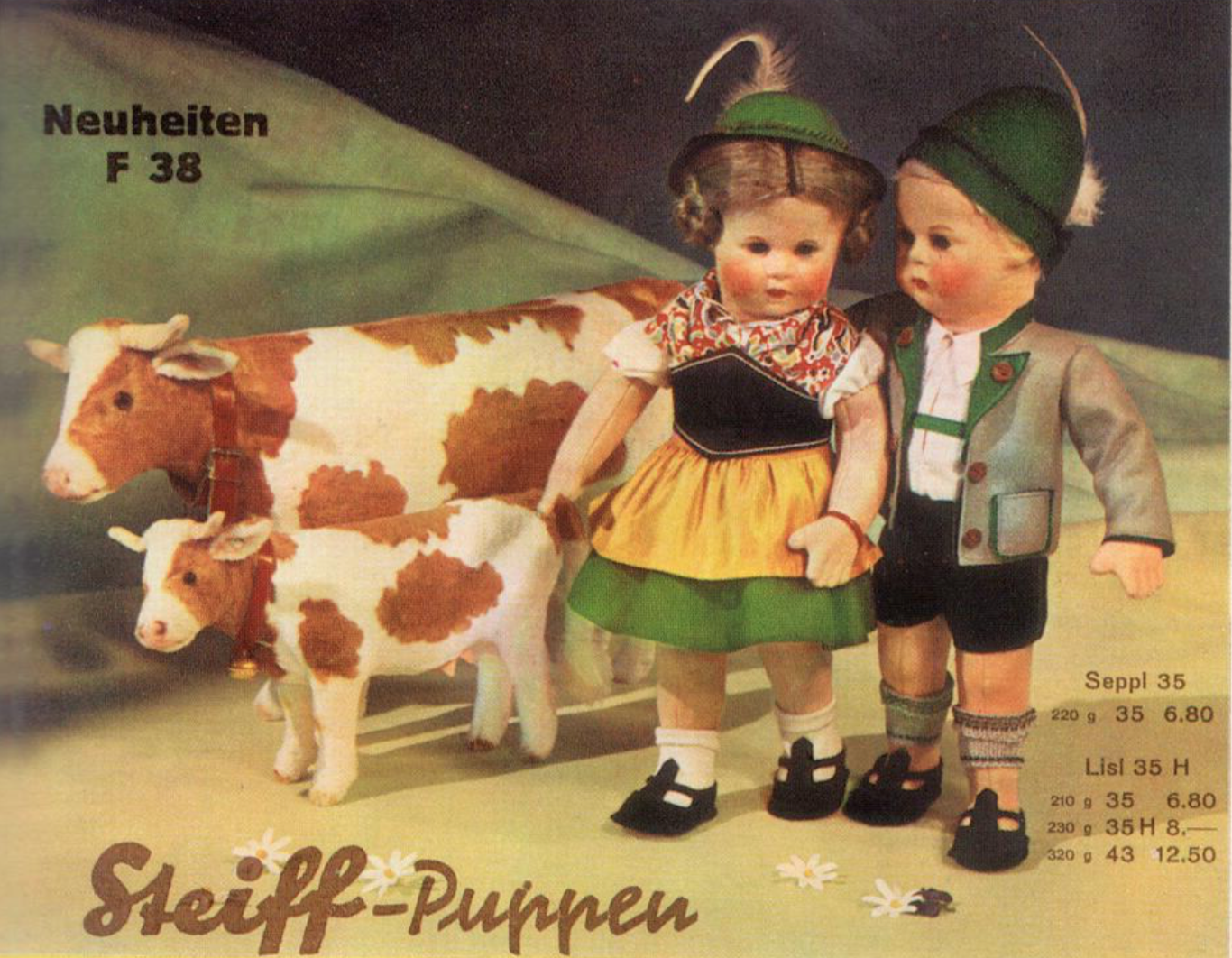
This handsome devil is Steiff's Seppl.  He is a great example of the company's pressed felt faced dolls, which appeared in the line overall from about 1936 through the very early 1950's.  Seppl is 35 cm tall, standing, solidly stuffed with excelsior, leg and head jointed, and made from felt.  He has lovely and very real looking blue, white, and black glass pupil eyes, a mischievous facial expression, and a shock of blond mohair hair.  He wears a very traditional German outfit.  This consists of black wool shorts with green embroidery; green suspenders; a white button down cotton shirt with a collar; a grey wool jacket trimmed in green with leather buttons; a green Alpine style hat; black tie style shoes; and grey and green knitted calf socks.  Seppl was produced in this size only from 1938 through 1943.

Seppl and his fellow seamless felt faced dolls were introduced in the late 1930's and were the "stars" of many of the company's advertising and sales materials at that time. This is understandable, given their charming presentation and personalities.  Here on the left you can spot Seppl and his gal-pal Lisl, who is also dressed in traditional clothing, as they appeared in one of the company's sales catalogs from 1938/1939.  You can see from his information that he is supposed to weigh 220 g (Steiffgal weighed her Seppl, who came in at 213 g); measure 35 cm (true) and cost 6.80 marks at the time. In 1938, 2.49 marks = $1 USD; as such, 6.80 marks = $2.73 USD. According to inflation calculators, $2.73 in 1938 had the same buying power as $44.84 in 2016.

Steiff has a half century of tradition of creating delightful cloth dolls, starting around 1903.  It is interesting to note that Steiff's earliest dolls were, for the most part, overwhelmingly male in gender.  Models included policemen, soldiers, soccer players, scouts, and other truly masculine designs. It wasn't until around 1909 that Steiff started creating both male and female doll models on a relatively large scale.  However, through the late 19-teens or early 1920's, many were still male, as the company's lines of international soldier and police dolls were a major emphasis on production.  You can see three typical male Steiff felt dolls here on the left from the c. 1909 through 1916 time frame. 

After WWI, the gender balance in Steiff's doll production changed significantly.  The soldier and police dolls were no longer of great interest, and Steiff's production of them dropped dramatically.  Female dolls started gaining popularity, and more and more were seen in the catalog.  By the time that seamless pressed felt faced dolls like Seppl appeared in the catalog, the company was really focusing on producing girl dolls for little girls.  For example, Steiff produced 27 versions of its pressed felt faced dolls in the 1938-1943 period.  Of those models produced, only 7 were boys, Seppl being one of them. As such, Steiff boy dolls from this period are quite rare.  You can see Seppl's cousin Rosl, who was produced from 1939 through 1941, here on the left. Once the factory reopened for toy making business in the late 1940's, Steiff again produced these pressed felt faced dolls for a handful of years.  However, all of the post war models were girls.  

Steiffgal hopes that you have enjoyed learning about Seppl, and that Santa also brings you a marvelous vintage Steiff treasure this year as well.  Happy holidays, dear Steiff readers!

Have a question about one of your Steiff treasures? Let's talk! Click here to learn more!

Saturday, July 23, 2016

Just When You Think You Have Seen Everything...

Have you ever said to yourself... there's no question about it, I have definitely seen it all? That's what Steiffgal thought in terms of Steiff, and now she has egg on her face. Apparently with Steiff, that's clearly impossible! Recently, Steiffgal was invited on a "housecall" to see a most unusual treasure.  And guess who was there to greet her? Check out this fantastic, fine feathered friend and see what makes him so interesting from the design and collector's perspectives.

Bird's the word when it comes to this enormous Steiff display ostrich. He is standing, unjointed, excelsior stuffed, and extremely lifelike! He stands at 220 cm, or about 7-1/2 feet tall. (He's so large that Steiffgal had to stand on a sofa to take a full body photo of him!) He has an internal metal "skeleton" for structure and stability. His head comes off for ease of packing and shipping. Starting from the top, his head and neck are made of white and tan dralon. His beak is made from yellow felt, and he has oversized brown and black pupil eyes and long eyelashes. (Steiffgal's studio zebra, from the same era, has these identical eyes and eyelash detailing.) Ostrich's face comes to life with black airbrushed highlights. His body and wings are made from very long, black, wavy mohair, while his tail feathers are made from the same style mohair in white. His muscular looking legs are totally fabulous, and made from short yellow mohair that has been highlighted and sculpted with black airbrushing. His feet have two "toes" on each, and have a metal support rod in them to help with standing and stability. At one time, he may have had a metal base to help with this as well.

This marvelous bird - clearly outstanding in so many ways - was produced by Steiff in 1960 and 1967 only, according to Steiff publications. 


Ostrich also has a great owner history. He was purchased in the very early 1970's as a "gag" birthday gift for his owner, who is indeed a Steiff collector. She had originally wanted a Steiff studio deer, but when her college sorority sisters went to try and purchase one at Kaufman's Department Store in Pennsylvania, the retailer did not have one in stock. However, they did have this ostrich available. It originally was priced at $350 - a lot of money at the time, and even more so when you are a college student - but was marked down to $50. The friends did not have enough money in their pockets at the time, so they went to other friends so they could contribute towards the ostrich. They quickly collected $5 from 10 friends, and purchased the ostrich for the owner. Of course, the gift was enormously successful, and today, almost 50 years later, the ostrich remains the star of the family's Steiff collection. 

Today, the ostrich "feathers the nest" of her daughter and son-in-law's family living room and makes for quite the focal point indeed.

Interest in these "big birds" has really taken flight recently. At the June, 2016 toy sale at Morphy Auctions in Denver, PA, five vintage Steiff display birds came under the hammer. There was enormous, global interest in this event's Steiff studio peacock, vulture, turkey, flamingo, and parrot. The turkey was the star of the day - which is pretty unusual for the species, except at Thanksgiving - realizing $5,185! It is Steiffgal's guess, given this recent sales history and having seen this ostrich firsthand, that this piece would probably sell at auction at this level as well. Now that's what Steiffgal would call a pretty good nest egg.

Steiffgal hopes this discussion on this rare Steiff ostrich has been a larger than life experience for you.  

Have a question about one of your Steiff treasures? Let's talk! Click here to learn more.

Sunday, November 1, 2015

Playing Dress Up With This Gorgeous And Very Rare Steiff Pressed Felt Faced Doll

All dressed up and nowhere to go? Not this beautiful Steiff girl doll! Although Steiff is best known for its wonderful mohair Teddy bears and animals, the company also produced extraordinary and high quality felt dolls through the early 1950's. This sweet treat is the best of all possible worlds, with her fabulous and well coordinated outfit and amazingly appealing presentation.  Let's take a look at her and see what makes her so special from the product design and historical  perspectives. 

This sweet flower is Steiff's Rosl. She is 35 cm, standing, head and leg jointed, and made from flesh colored felt. Her arms hang softly at her sides. She has well defined hands, a sweet and toddler-esque face, and shapely limbs. She comes to life with a blond mohair wig, lovely inset blue glass pupil eyes, and delicately hand painted facial features. She was made in this size only from 1939 through 1941.  

Like all of Steiff's early felt dolls, Rosl is absolutely dressed to the nines. Her elaborate, well coordinated outfit consists of a red and white cotton calico dress, a blue and white silken apron, lace trimmed white cotton underwear and slip, white socks and felt shoes, and a blue hood. The material on her apron and hood is the same. Each garment is gorgeously tailored and detailed with ric-rac, lace, and/or matching trims. It has always been Steiff's tradition to dress their dolls, especially the girl ones, in great shoes and head wear.

Steiff's pressed felt faced dolls debuted in 1936 and were produced on a commercial scale from 1937 through 1943, and then again in 1949 and 1950. Overall, about 27 different versions of these dolls appeared in the line through 1950. Over time, both boys and girl models were produced in 35 ad 43 cm. These dolls were created to replace the company's better known and very collectible early dolls with center seamed faces. Steiff had been working since the 1920's to find a way to produce seamless faced dolls. But due to the nature of the felt material, this proved to be very complicated from a production standpoint. After years of trying, the Steiff designers finally mastered the art of creating felt pressed faces by reinforcing the molded material with a plastic backing.  
 
Rosl, and all of her pressed felt faced cousins, have very delicate and well formed head features - including lifelike ears. However, her ear shape and position was not conducive for the company's traditional "button in ear" branding. As such, instead of Steiff buttons in their ears, each Steiff pressed felt faced doll was given a special red rubber bracelet that had their button and yellow flag attached like a charm, as well as a named chest tag.
 

Steiffgal hopes this discussion on Steiff's delightfully dressed Rosl doll has you feeling pretty today.
 

Have a question about one of your Steiff treasures? Let's talk! Click here to learn more.

Wednesday, September 24, 2014

On A Roll With These Steiff Hightlights From The Upcoming James D. Julia Auction Event!

The temperature is dropping - but the fall auction season is really starting to heat up!  And that means many opportunities to add a new - or a few - new vintage Steiff treasures to your collection!  

To kick off the sales calendar, Steiffgal is very excited to announce that the next James D. Julia, Inc. toy auction features several collections of simply marvelous button-in-ear rarities and collectibles. These include groupings of exciting Steiff treasures, single items that will take your breath away, and also a bunch of very early "button-in-ear" pull toys. These items are all currently being photographed and cataloged for this event, which will occur in Fairfield, Maine on November 7th, 2014. The online catalog should be available in a few weeks. But with Steiffgal on your side, there's no need to wait for a special preview! Here is a sneak peek at a few exceptional items from a fine collection from New Hampshire that will be featured at this can't miss sale!

Size defies when it comes to this amazing duo of teeny-tiny felt farm animals on wheels! And Steiffgal really did do a happy dance when she first learned of these petite treats! Here we have the smallest sized donkey and horse ever produced by Steiff; both are made as pull toys on wheels. Oh baby - each is only 8 cm tall!! The donkey is c. 1917, standing, unjointed, and made from grey felt. He has a tiny grey felt tail and traces of his grey mohair mane. His face is detailed with black button eyes and felt ears. He rides upon a metal carriage mounted on four natural colored wooden eccentric wheels. He retains the blue leather belt that was part of his saddle cloth detailing, and his tiny Steiff button as his ID. This tiny donkey was manufactured in this size only from 1917-1933.

Donkey's neighhh-bor, the horse is also c. 1917, standing, and unjointed. He is made from rust brown felt. He has a black woolen tail and traces of his black mohair mane. His face is detailed with black button eyes and felt ears. He rides upon a metal carriage mounted on four natural colored wooden eccentric wheels. He retains his blue felt saddle cloth and brown belt. His IDs have been lost to time. This handful-sized horse was manufactured in this size only from 1917-1927. 

The next featured Steiff pull toy in this auction is truly the wheel-deal as well. This blue-ribbon buddy is a charming example of the earliest model German Shepherd dog produced by Steiff. And it is doubly interesting to note that according to the Steiff Sortiment reference book, this pattern was first produced on wheels and then without... it is usually the other way around. Although many collectors assume that Steiff has called their wonderful and popular German Shepherds "Arco" since their introduction, the breed did not actually  official receive its official "Arco" moniker until 1937.

So here are the Shepherd's doggy-details. He is standing, unjointed, and made from brown and tan mohair. His appealing and realistic face is detailed with a prominent brown muzzle, a black hand embroidered nose and mouth, and black and brown glass pupil eyes. He has a curvy tail and black embroidered claws. He rides upon four regular green wooden wheels. He retains his original leather collar, but his IDs have been lost to time. This model, an absolute favorite with vintage Steiff collectors worldwide, was manufactured in 28, 35, 43, and 50 cm from 1923-1928 and due to his limited production and time frame, rarely comes up for sale on the secondary market.

Today's final Julia's auction highlight, a very vintage Steiff zebra on wheels - may just have you seeing stripes. That's just what happened to Steiffgal when she first laid eyes on this jungle gem! These striped sweethearts have been gracing the Steiff catalog since 1899, and collectors have been "lining up" since then to add these beautiful beasts to their hugs.

Here are zebra's facts, in black and white. Here we have an utterly fantastic and seldom seen early woolen plush zebra on wheels. He is standing, unjointed, and made from textured grey material that has been lovingly and painstakingly hand painted with black stripes. He has a grey and black yarn mane and a black mohair tipped tail. His charming and distinctly old fashioned looking face is detailed with black button eyes. He rides upon four early metal wheels. He retains his Steiff button as his ID. This absolute rarity was manufactured in 28, 35, 43, 50, and 60 cm from 1910-1919 and is seldom, if ever, seen up for public auction.  

Steiffgal hopes this preview of some of the wheeled wonders to be sold at James D. Julia's November 2014 toy auction is worthy of a round of applause! The full catalog is now online and can be accessed by clicking here.


Have a question about one of your Steiff treasures? Let's talk! Click here to learn more.

Wednesday, April 17, 2013

Using A Little Steiff ESP To Identify A Vintage Dog Friend

Mind you, Steiffgal is no psychic when it comes to Steiff.  The company has made thousands and thousands of different products since the late 1800's when it first started producing playthings for children.  And photos are so important when assessing subtle differences between similar products.  However, in the case of this reader's question, Steiffgal was able to use a little ESP (Essential Steiff Powers) to help identify an old friend simply by description.  Hazel writes:

"Steiffgal:

I don't know if you can assist me. I stumbled upon your website recently whilst trying to find some history re: my little Steiff item.

I have a Steiff German Shepherd measuring 10" or 26 cm from paw to tail. He has a red velvet tongue and he is lying down slightly on one side. He has a yellow Steiff label in his ear with a worn silver looking stud. He has some wear to him and is a lovely shabby shade of browns and darker on his back.

I am sorry I do not know how to add photos to my email so any information you could offer would be great.

Many thanks I look forward to your reply.

Kind regards, Hazel" 


Unless she's in a "dog-daze" Steiffgal is all but certain that Hazel's pooch is Steiff's lying Arco German Shepherd.  This precious pooch is unjointed, lying to one side, and made from tan mohair that has been gloriously and realistically airbrushed with patches of black, brown, and tan.  He has pert ears, large and floppy paws, and an impressive tail.  His face is detailed with black and brown pupil eyes, a well defined muzzle, and a happy open mouth with a large red felt tongue.  Lying Arco was produced in 22, 35, and 50 cm from 1957 through 1976.  Steiff usually doesn't count the tail in measurements, so it is Steiffgal's best guess that Hazel's dog is the 22 cm size.  

Steiffgal is unable to fetch details about Arco's button from Hazel's note.  However, if his button is the raised script version, he would have been produced approximately in the 1957 through 1968 time frame.  If he has the domed lentil style button, he would have been produced approximately in the 1969 through 1976 time frame. 


German Shepherds are one of Steiff's beloved "Best in Show" dogs that have been in the line almost continuously in one form or the other since 1923.   They have appeared over time in mohair and wool plush and standing, sitting, lying, on wheels, as studio (life sized) models, and even as dog-dolls in the late 1930's through early 1940's.  The photo on the left of the Pupp-Arco or Arco Doll is from Pfeiffer's 1892-1943 Steiff Sortiment book.  Pupp-Arco is extremely rare; Steiffgal has never actually seen one in person.  Overall, the presence - or absence - of a tongue on Arco is one of the key clues collectors use to date Steiff's German Shepherds! Those produced before 1957 did not have tongues while those produced from 1957 onward did.

Steiffgal hopes this Arco identification has been an ESP (Exciting, Surprising, and Phenomenal) experience for you!

Have a question about one of your Steiff treasures? Let's talk! Click here to learn more. 

Wednesday, September 26, 2012

All Ears Over This Wonderful And Early Steiff German Shepherd

Listen up!  Steiffgal just got back from a visit with collectors from the Orlando area, at a wonderful Steiff event sponsored by Judy's Dolls of Longwood, Florida.  And guess what just "rolled" into the appraisal clinic?  This fabulous but somewhat mysterious Steiff dog with large floppy ears, perched upon wooden wheels.   When Steiffgal saw him, he sort of rang a bell with her - but something wasn't exactly lining up.  After a few minutes of noodling, she finally figured him out.  So, just who is this delightful doggie?

Hear, hear... what we have here is Steiff's early Arco German Shepherd on wheels.  He is 43 cm standing, made of mohair, and unjointed.  He has an open, felt lined mouth and felt lined ears.  His body is detailed with brown, tan, and black airbrushing, giving his fur and coat nice texture and a realistic appearance.  His face is detailed with brown and black glass pupil eyes and a black hand embroidered nose.  His claws are indicated by black stitches, and he has a thick and impressive tail.  He rides upon a black metal carriage and four red wooden wheels.  Arco has his original red and white pull cord and red wooden handle.  Overall, Arco on wheels was made in 35, 43, 50, 60, and 70 cm from 1937 through 1943.  This design was also called "Police Dog" and some models had this name imprinted on their chest tags.

This blue ribbon beauty is clearly "man's best friend" as well as a "friend for life."  As a result, he has suffered a bit of wear that in some ways made his exact identity a bit challenging initially.  Much of this focuses around his facial area.  One of the details that makes the early Arco design so particularly life-life and irresistible is his ears.  They were made to stand straight up, much like the real dog.  (You can see this here on the left, in a photo from the Steiff Sortiment book, which shows what this example looked like when new.) This was done by lining the ears in a metal wire, much like Steiff's ear construction on their beloved Petsy bears.  However, in this example, the ears were extremely floppy and positioned high up on the dog's head.   It was apparent that over time, the ears had come loose and someone tried to sew them back on, albeit in a somewhat sloppy way.  It is Steiffgal's best guess that when the ears were sewn back on, someone removed the wires so they would not stick out on the ends of repair.  When she felt along the perimeter of the ears, she did feel small pieces of wire; it is also possible that the wire broke over time and when the ears were replaced, the seamstress took out as much of the wire as possible.  

Arco's other facial issue, was, well, easy to see.  His eyes just didn't look right.  One was much larger and rounder than the other.  Steiff traditionally attaches eyes to their products by sewing them securely through the head (yes, this requires a mighty big needle, great skill, and strength!) and tying the two threads in a large knot at the the back base of the neck. You can usually feel this as a significant bump or indent on an item.  However, Steiffgal could not find this feature on this Arco.  She also noticed that when she ran her finger around the perimeter of the eyes, she felt a hard glue-like residue.  It is Steiffgal's best guess that the original eyes had fallen out, and over time, someone had found replacement eyes and glued them back into place. 

To repair, or not to repair, that is the question.  Steiffgal realizes that every collector and enthusiast has their own feelings about this question.  Issues of authenticity, value, cost, and personal preference all come into play here.  However, in this case, Steiffgal recommended to Arco's owners that they consider having him professionally restored, given that the dog is in otherwise really nice condition, is relatively rare in this size and configuration,  and appears to be completely structurally sound.  No surprise here, but they were all ears over this suggestion!  This relatively simple two step facial restoration, if done professionally by an expert, would bring back his absolute charm and help draw attention to his most impressive features.

Steiffgal hopes this discussion on this vintage Steiff Arco has shepherded you into a new way of thinking about restoration.  

Have a question about one of your Steiff treasures? Let's talk! Click here to learn more.
The teddy bear search engine