Showing posts with label wool plush. Show all posts

Tuesday, August 5, 2025

Check Out This Bearded Beauty From The Steiff Archives!

It's easy to be all smiles over this next Steiff mystery. Check out this note from a friend in Germany, who has just added a very special bearded beauty to his collection. But who exactly is this rarity, and what might be the back story behind him? Orlando writes:

"I bought a sitting Schnauzer from the Steiff archive, which I can't find in any book. He has the number 3530, which is written on the archive tag. He has a leather collar, his breastplate, and his ear flag with a button. The pressure voice, works. Maybe you can tell me something about the dog. Was it perhaps intended for the American market? Thank you for your efforts. I'm looking forward to your reply."


This darling doggie is an unusual version of the Steiff's popular and legacy Tessie Schnauzer design. These pretty pooches were made in 10, 14, 22, and 28 cm from 1954 through 1976. Tessie dogs produced for the standard line were standing and made from long, light grey mohair. They had irresistible faces that came to life with black and brown pupil eyes, a black hand embroidered mouth, a happy pink tongue, and pert triangular shaped ears. Their accessory was a red leather collar.

Orlando's version has the same general look and feel as the standard line issue Tessie dogs, with a few key differences:
  • 1. Standard line Tessie was standing and Orlando's is sitting. 
  • 2. Standard line Tessie was made from mohair and Orlando's appears to be made from a different sort of fabric. 
  • 3. Standard line Tessie has a closed mouth and Orlando's has an open, smiling mouth lined in velvet - sort of like those seen on Steiff's early 1950s Cockie Cocker Spaniels. 
  • 4. Standard line Tessie came in sizes up to 28 cm and Orlando's appears to be larger.
So what does this all mean?
The Steiff archive tag, with the numbers 3530 and 1955 on it, does help to shed some light on the dog. These numbers translate to 3=sitting, 5=wool plush, and 30=30 cm tall. So his fabric is in part wool plush, he is 30 cm tall, and he was made in 1955.

Now let's talk about his unusual form - sitting instead of standing. The sitting version was sampled in 1955, one year after standing Tessie's introduction. Steiffgal has two plausible ideas why Steiff tried out a version of their Tessie 
Schnauzer dog in sitting form.  

The first has to do with growing the company's overseas presence and market position. It was not uncommon for Steiff to make design tweaks to its standard line, postwar dogs and present them as exclusives to F.A.O. Schwarz and other high end stores in the USA in the 1950s and 1960s. For example, Steiff produced a standing Dally Dalmatian (the standard line version was sitting), a sitting black and white Cockie (the standard line version was standing), and an open mouthed Biggie Beagle (the standard line version had a closed mouth) as specials for F.A.O. Schwarz. This sitting Tessie might have been proposed for an exclusive for the USA, but never put into production for one reason or another.

The second has to do with regular business product line extension.
If a design is great and selling well - why not make it in a theme and variation form? The best analogy Steiffgal can come up with here is Steiff's foray into creating a postwar sitting Arco German Shepherd. Postwar, Arco has always appeared in the catalog standing. Steiffgal has seen just a few of the sitting versions here and there, but has never seen them documented in any reference book as a standard line item. In 2020, a 25 cm sitting Arco with all IDs sold at auction; it generated 12 bids and hammered at €2,300 / $2,481. His cataloging read, in part... 

"Arco, button, chest label and cloth tag label, cloth tag label is worn, sitting 25 cm, flat STEIFF button with embossed cursive writing in ear, item-No. 3325, cloth tag label on ear isn't readable, neck mark, Arco, mohair stuffed with wood wool , brown/black glass eyes, black nose/ mouth decoration, always 3 claws, press voice is faulty, red leather collar, this Alsatian Arco in sitting version was planned by the company STEIFF 1963 as novelty in different sizes , but wasn't put into the assortment, it were probably only a few sample items produced, very nice, unused original condition, extremely rare STEIFF rarity, expertise by the company STEIFF GmbH Giengen is enclosed." Here on the left you can see this sitting version of Arco, the image is from LiveAuctioneers

It is not clear why these sitting versions of Tessie and Arco never went into full blown production. Steiffgal suspects it has to do with production and labor costs, and/or market share or other business factors. These kinds of production decisions almost always have an economic element to them. But only they know for sure - and their lips are sealed!

Steiffgal hopes this discussion on Orlando's archival Tessie has been one for the books!

Have a question about one of your Steiff treasures? Let's talk! Click here!

Wednesday, June 18, 2025

Having A Ball With This Prewar Steiff Kitten Novelty

Without trying to be catty, Steiffgal suspects you've never seen a Steiff kitten just like this one! Check out this fancy feline who is simply having a ball - literally. This prewar novelty is totally the cat's meow!

This lovely lady is simply cataloged as "Wool Plush Cat." But her details are far more interesting! She measures 9 cm tall and 17 cm long, not including her tail. She is head jointed and in a lying position. She is made from tan wool plush with now faded black airbrushed striping. She has a pinch style squeaker in her torso. Kitty comes to life with felt backed ears, green and black glass pupil eyes set low on her face, and a pink hand embroidered nose and mouth. Her accessories include a satin bow, jingle bell, and a red, yellow, and blue woolen miniature pom pom ball which is held between her two front paws. This delightful rarity was made in 17, 22, and 28 cm (measured horizontally, not including the tail) from 1933-1942.

Kitty's design and presentation closely mirror Steiff's late prewar design aesthetic as well as business drivers and strategy. In the early 1930s, the realities of Germany's challenging geopolitical, social, and economic situation really began impacting every level of operations at Steiff. As such, the company started using less expensive and more readily available non-mohair fabrics as well as launching simplified designs to minimize materials and labor costs. Here to the left you can see this pretty kitty as she appeared in Steiff's 1938/1939 print catalog; you can click on the photo to make it bigger. 

Here's how this kitty's pattern checks many of those boxes. 

1.  She is made from wool plush, which is lovely and durable, but is less elegant than the company's signature mohair. Wool plush is considered a wartime era, substitute fabric and was often used in Steiff's production on items bookending WWII. 

2. Her face is nicely done, and very appealing and expressive, while her body is  very basic in form. Starting around 1931, Steiff began consolidating their design and manufacturing efforts on an item's head, while leaving the rest of the body as simple as possible. A great example of this is the company's line of dressed animal dolls of that era. They consisted of a lovely, detailed mohair head on a plain, generic linen or fabric body. 

3.  Kitty she has only one joint - a head joint. Jointing is very expensive and time consuming, and the fewer joints an item has, the more efficiently it can be made. 

4. And finally, her accessories are also quite telling. Her bow, bell, and simple woolen miniature pom pom are inexpensive to source and quick to attach to her, but really elevate her presentation and draw your eye forward to her finest feature, her head. Steiff debuted its general woolen miniature line, which was invented in part to address the realities of manufacturing in Germany in the 1930s, so it is interesting to see it being used here to compliment and upscale this design. 

Steiffgal hopes this discussion on this wool plush kitty has tickled your whiskers!

Have a question about one of your Steiff treasures? Let's talk! Click here to learn more.

Friday, March 28, 2025

Getting Cosi With Steiff's Poodle Named Tosi

Poodles are amongst the most popular dog breeds globally and are regularly celebrated for their distinctive good looks, superior intelligence, and fun-loving personalities. These wonderful dogs, often sporting fantastic hair-dos, are so important to Steiff that several were featured in the company's debut catalog in the early 1890's. Since then, Poodles have appeared almost continuously in the Steiff line to this day.

One of the rarer Steiff poodles, Tosi, tops the wish lists of many collectors today. This is most likely due to her unique presentation, unusual detailing, and place in the company's product development timeline. A deeper dive into her history suggests she is a case study in early postwar design, development, and distribution. Here is the story behind this precious pup!

Given the breed's appeal, Steiff started manufacturing Poodles as soon as possible once the factory reopened for toy making business after the conclusion of WWII.
The first new postwar Steiff Poodle design was Tosi. Here you can see her on the cover of the company's 1950 product catalog. Tosi's design strategy was based on two of Steiff's key business drivers at the time - to produce quality, appealing toys as quickly and efficiently as possible and to regain their status as a premier, worldwide toy manufacturer. However, Steiff still had alot to manage operationally in the earliest midcentury period, including rebuilding their infrastructure, optimizing new regulations and distribution channels, and dealing with material and talent shortages, among other factors.

Many of Tosi's design elements reflects these postwar realities.
She was standing and simple in design and only head jointed in the larger sizes. She had minimal seams and labor intensive details. Because mohair fabrics during this period were limited and expensive, this model was made from wool plush. Her coat was in a "Karakul" trim, meaning that it was fluffy but uniformly the same length all over her body. This gave her a sweet and youthful appearance, but also required no additional hand-trimming or work on her legs and torso. Tosi's face was detailed with a round, black glass button nose and soulful, almond shaped white, brown, and black eyes. These facial features did not require facial hand embroidery, which can be time consuming and require special expertise to execute. Her accessory was a simple red leather collar, which was easy to manufacture and attach to the dog. And, her small size and compact form made her light and easy to pack and ship worldwide. Here on the left you can see Tosi in a variety of color and size combinations as she appeared in Steiff's 1950 new product catalog. 

Overall, Tosi was produced in black or white wool plush in four sizes ranging from 14 to 28 cm from 1950 through 1953.
Because of her time of manufacturer, Tosi would have left the factory with either a short trailing f, blank, or raised script button; yellow ear tag; a red or blue imprinted chest tag; and a cloth US Zone tag in her leg seam as her Steiff IDs. You can see these IDs on the white Tosi above; the image is from www.invaluable.com. Examples in excellent to as new condition with all IDs today can trade hands in the high three digits - low four digit range.

Steiffgal hopes this discussion on Steiff's Tosi poodles has you feeling quite rosy!

Have a question about one of your Steiff treasures? Let's talk! Click here to learn more.

Saturday, May 11, 2024

Wool You Be My Baby?

It may sound corny, but this small scaled maize wool plush Teddy baby bear has captured Steiffgal's heart in a really big way! This happy handful has seen a lot in his nearly century of life, based on his loved condition. But the world hasn't seen a lot of him - or his pattern - based on his absolute rarity and short stint in Steiff's product catalog. Take a look at this beautiful baby and see what makes him so special from the design and promotional perspectives.

Teddy baby is 15 cm tall, fully jointed, and made from fuzzy maize colored wool plush.
His feet are made from slightly shorter wool plush. He has felt pads and four black claws on each paw. He has a side squeaker in his torso. Typical to his legacy namesake pattern, he has flat feet designed for standing, downturned arms, and a distinctly toddler-esque appearance and proportions. Although most Teddy baby bears are open mouthed, this particular model was produced with a closed mouth in all sizes. As such, his pensive face comes to life with proportional glass pupil eyes, a shorter wool plush inset muzzle, and a probably restitched black floss nose and mouth. He retains his long "trailing f" button as his Steiff ID.

Wool plush, closed mouth Teddy baby was produced in 12, 15, 20, 22, 28, and 35 cm (measured sitting) from 1929-1932 overall.
This pattern is one of the rarer prewar Teddy baby varieties. This is the first of his kind Steiffgal has ever seen or handled. The vast majority of prewar Teddy baby bears were produced in brown, blonde, or white mohair with smiling, velvet or felt lined open mouths.

Despite his relative rarity, this wool plush Teddy baby was featured in its own Steiff print advertisement.
This was produced and distributed in 1929, the year this Teddy baby was introduced. The main copy on the advertisement translates basically as: "The cute, fluffy bear child with the new expressive face, the loyal look and the cuddly paws, a great performance, fully mobile, and well-positioned." According to the print advertisement, Teddy baby is offered in maize mohair plush or wool plush. Both versions are available in 12, 15, 20, 22, 28, and 35; those at 22 cm and larger came with a growler. You can see this print advertisement here on the left. If you click on it, you can view it in a larger format.

It is also very interesting to note that the two different versions had significantly different prices as noted in Reichsmarks, the German currency of the era. You can see this in the third column of information describing each of the two Teddy baby variations. The wool plush versions generally are around 20% more expensive than the mohair plush versions. Steiffgal suspects that this likely reflected the actual costs of the fabric to make these items as the time and effort to make these two variations had to be almost identical.

Steiffgal hopes this discussion on this unusual prewar Teddy baby model has helped to rejuvenate your day!

Have a question about one of your Steiff treasures? Let's talk! Click here to learn more.

Sunday, May 5, 2024

All Smiles Over This Steiff Midcentury Musical Teddy Baby!

You will quickly understand why Steiffgal is whistling a happy tune over this next fantastic - and most unexpected - find. This sweet gal was found at an estate sale in the New England area in somewhat run down condition. But Steiffgal knew with a little TLC, spit, and polish (and a new spring outfit), she would be nearly her old self again. Take a look at this midcentury singing sweetie and see what makes her so interesting from the design and historical perspectives.

Can you bear it? Yes, what we have here is Steiff's Music-Baer or Music Bear. She is 25 cm tall, head jointed, and standing. Her body is a simple cylinder made from tan wool plush and her brown mohair arms are floppy. She has pink hand embroidered claws on each paw. Her head is based on the beloved and legacy Teddy baby design, originally introduced in the 1920s. Teddy has an internal Swiss music box which plays when her torso is pressed and released up and down like an accordion. When she was new, she left the factory dressed in a white cotton shirt and a red, black, and white rayon skirt with a green felt waistband and matching suspenders. 

This musical marvel was made from 1950 through 1951 only. She retains her original Steiff trailing f button, yellow ear tag with the numbers 9325 on it, and traces of a white linen "Made in the US Zone" tag in her left arm seam. All of these IDs perfectly align with her dates of manufacture - just a few years after the company opened for toy making business again following WWII. It is interesting to note that this musical Teddy baby's ID number translates to... 9=mechanical, 3=mohair, 25=25 cm tall. Steiff also made "girly" versions of this dressed music box product based on their popular Bazi the Doxie and Kitty the cat designs of the period.

This Teddy baby find really benefited from a little spa treatment. Sadly, her rayon skirt and white shirt had all but disintegrated over time; what was left of both items were in tatters. To honor her "plaid" origins, Steiffgal created a little neck scarf out of the skirt's salvageable material. You can see her factory original outfit here on the left, the photo is from Pfeiffer's 1947-2003 Sortiment. 

Music Teddy also was covered in at least a half century of dust and grime. With a little elbow grease and a gentle scrub, her original beauty and personality came shining through again! Her wool plush body and tan muzzle darkened a touch overall and evenly over time, and there's not much anyone can do about that. But her brown mohair really revealed quite a glow upon cleaning. 

As for her clothing, Teddy baby is again donning an all original Steiff outfit. Although these contemporary pieces were produced by Steiff more than a half century onward from Teddy baby's birth year, they still look great, are appropriate, and well scaled to her somewhat unusual body. She wears a green calico dress; the fabric features tiny versions of Steiff's most popular playthings and Steiff bear faced logos. And she's keeping warm with a light blue felt jacket detailed with a collar and round gold buttons; this coat was produced for a Steiff Peter Rabbit a few years ago.

Steiffgal hopes this discussion on this wonderful Teddy find has been music to your ears. 

Have a question about one of your Steiff treasures? Let's talk! Click here to learn more.

Saturday, December 2, 2023

Playing Doggy Detective Over This Unusual Steiff Wartime Era Canine

Paws and take a look at this interesting dog made during a really challenging time in world history. He has a familiar ring to him, don't you think... but his fabric is quite different than his standard line relatives. Just who is he, and when was his birthday - in dog years or otherwise? 

His lucky owner - Patricia from Europe - shares:

"I would be very grateful for your expertise concerning this Spitz dog. He is not catalogued in any of the Steiff Sortiment books. 

I have absolutely no idea if he is prewar? 

My concerns are his alternative coat. This is definitely not mohair plush. This is very lightly woven and the pile is flat, not fluffy.The airbrushing is bright and vibrant and his coat has full coverage. 

He is completely perfect with no damages at all. Unfortunately, he doesn't have his Steiff ID. He has beautiful glass eyes and is quite lovely. He is 22 x 22 cm in size. Any information on this little treasure will be greatly appreciated."

What an interesting find!
Some of Steiff's items made just before, and just after, WWII are not captured in the Sortiment books. This could be because very few were actually made and sold, they are extremely rare today, they might have been produced only as samples or test items, or they simply fell through the documentation cracks during a complicated geopolitical period and its aftermath. The Sortiment books are great references, but they are not a complete and comprehensive accounting of Steiff's production. And, they were not validated or published by Steiff - but by a third party. 

That being said, it is Steiffgal's best guess that this dog is a version of the company's standard line Wolfspitz dog series that was officially in production from 1934-1943 overall.
These canines were made standing on all fours in 22 and 35 cm; on eccentric wheels in 22 cm; and sitting in 17, 21, 22, and 25 cm. They were all unjointed and stuffed with excelsior. Their face, ears, and legs were made from shorter mohair while their backs, tails, and torsos were made from very long matching mohair. Each was detailed with lifelike brown and black shading on their backs and tails and had three embroidered black claws on each paw. Their faces came to life with felt lined ears, brown and black glass pupil eyes, a black embroidered nose and mouth, and brown airbrushed highlights on their foreheads. For reference, you can see the 22 cm mohair sitting Wolfspitz here on the left; the photo is from Steiffgal's collection. 

Patricia's dog appears to check many of the boxes to the company's basic prewar Wolfspitz pattern.
These details include things like the use of long and short materials to replicate the dog's coat; three painted folds on the dog's forehead; airbrushed shading on his back and tail; and a very similar facial expression and rendering, among others.

From c. 1934 - the early 1940s, and then again from c. 1946 - 1949, things were really tough from the materials, supply chain, and operations perspectives at Steiff. Premier, traditional toy making materials including mohair and felt were in short supply and were often allocated to military purposes. As such, Steiff did everything it could to keep its toy making production lines supplied and active during these times. One way to do this was to use fabrics and materials that were available in the place of felt and mohair. These often were in the forms of artificial silk plush, wool plush, cotton plush, and other hybrid fabrics that blended wool, mohair, and other fibers. 

Given its presentation, materials, size, and detailing, it is Steiffgal's best thinking that this Spitz dog dates from the late prewar period and is made in part from some type of substitute plush that has wool as an element of its weave.
 He might have been a sample or prototype to test how his design would turn out in the plush available at the time. There is no indication (as far as Steiffgal knows of) that this pattern was produced in any form in the early postwar era.  The fabric on Patricia's pooch appears somewhat similar in texture and density to the unusual "lumpy-bumpy" plush on an otherwise standard line standing play duck from Steiffgal's collection. This fine feathered friend - like the Wolfspitz - was in the line from the early 1930s through the early 1940s. You can see this duck here on image on the left. 

Steiffgal hopes this discussion on this interesting Spitz dog has you barking up the right tree!

Have a question about one of your Steiff treasures? Let's talk! Click here to learn more!

Saturday, September 9, 2023

Does This Lifesize Steiff Sheep Call To Ewe?

Sometimes it's ok to be a little sheepish.
Especially when it comes to delightful Steiff button-in-ear mysteries like this one! Check out this fabulous and fuzzy farm friend who just might be larger than life. What do you think? Danna shares, 

"Could you offer any assistance in figuring out the mystery of the sheep? His coat is darker and the feet are different than the two I found on the web, his eyes also have different centers and there is no yellow tag in the front. I think it's older. Any help would be appreciated. Thank you!"

This member of the flock truly rocks!
What we have here is a great example of one of Steiff's rarer studio, or life-sized sheep. He is standing on all fours, unjointed, and made from now faded brown tipped wool plush. His legs and ears are made from white wool plush. His inset muzzle is detailed with oversized green and black slit pupil eyes, a simple mouth and nose, and airbrushed highlights. He is solidly stuffed with excelsior and most likely has a metal skeleton inside to support his size and weight. He left the factory wearing a Steiff chest tag, but this has been lost to time. These brown tipped sheep were made in 80 and 90 cm from 1966-1967 only. The 80 cm version is also standing but his head his bowed to the ground as if he is nibbling on the grass. 

It is interesting to note that Steiff also created a 95 cm standing display ram produced in the same brown tipped wool plush as Danna's life-sized sheep. 

Now let's shepherd this sheep discussion to his IDs.
Danna's sheep has a product number of 1590,90 which is the 90 cm version made in 1966. Those made in 1967 have a product number of 3459/09. His numbers correspond as... 1= standing, 5= wool plush, 90= 90 cm, 9= display animal or special edition, and 0= normal (in reference to coloring.) Here on the left you can see these tipped sheep as they appeared in Steiff's 1967 studio line catalog.

Steiffgal hopes this discussion on Danna's sheep has put ewe in a great mood today. 

Have a question about one of your Steiff treasures? Let's talk! Click here to learn more.

Wednesday, March 29, 2023

This Midcentury Steiff Cub Is As Sweet As A Chocolate Kiss!

Now here's something you don't see every day! Check out this sweet and unusual Steiff bear. His construction is quite distinctive, most certainly reflecting the realities of manufacturing in the era in which he was "born." Four different fabrics were used to bring this happy handful to life!

What we have here is a sweet as a chocolate kiss Teddy baby bear. He stands 22 cm tall and is fully jointed. His face is detailed with brown and black glass pupil eyes and a black hand embroidered nose. His claws are also stitched in black. He retains his original red collar and named chest tag, along with his short trailing "f" button, as his Steiff IDs. Although only he knows for certain, it is Steiffgal's very best guess that he left the factory in Giengen around 1947 or 1948 as he does not specifically appear in any Steiff or Teddy bear reference book she can identify. 

Teddy baby has several fabric features that date him to the immediate postwar period. His body, head, and limbs are made from short pile artificial silk plush fabric. According to Pfeiffer's 1947-2003 Sortiment, the company did produce a 30 cm brown artificial silk plush Teddy baby bear in 1949. This guy at 22 cm is much smaller, but could still be his distant cousin. Teddy baby's muzzle and the tops of his feet are made of wartime era wool plush, not mohair. This durable fabric was often used in the place of mohair when it was not available or rationed for military purposes. It is not unusual to find Steiff items traditionally made from mohair from the mid-1930s to early 1950s produced in this substitute fabric. It is also interesting to note that Teddy baby's paw pads are made from an inexpensive, thin linen material. These would traditionally be made from felt, which was also in very short supply in the late 1940s. A loving previous owner has done a wonderful job fixing and stabilizing his linen foot pads with stitches and TLC. 

One thing that makes Teddy baby bears so universally precious is their open, felt lined, smiling mouths. And, like all but the smallest versions of this classic pattern, this one also has this charming feature - despite a felt shortage! Steiffgal thinks felt was used here for two reasons. 

The first is that it is possible that the company tried to make the mouth in linen, but it just did not look right. It is also possible that linen could not hold the shape or form required for the pattern. And the second is just how visible the mouth is. It is one of the first things you see on this design, and is so fundamental to its appeal. Making the mouth out of felt on this pattern only required a little more than a square inch of material. So many Teddy baby bears could be importantly detailed with just a touch of felt when the company had minimal felt in inventory. This bear pattern usually also has its hands and feet pads made from felt. But in this case, those areas are not nearly as visible, prominent, or key to its design. Creating this pattern with felt foot and hand pads would require about five times more felt than one that just had a felt lined mouth. This Teddy baby is equally as precious with linen pads as he would be with felt pads... at least in Steiffgal's humble opinion! 

Steiffgal hopes you found this discussion on this very early postwar Teddy baby bear materially interesting!

Have a question about one of your Steiff treasures? Let's talk! Click here to learn more!

Monday, December 19, 2022

Tag - You're It - With These Amazing Steiff Rarities From Ladenburger Spielzeugauktion's January, 2023 Sale

Here's something incredibly fantastic to look forward to! Mark your calendars for Ladenburger Spielzeugauktion GmbH's Steiff Special Auction on January 21st, 2023. The catalog has just been published online in German and English. It features nearly 200 breathtaking Steiff, Schuco, and Bing rarities from the collection of the late Susan Kilgore Wiley. Mrs. Wiley had an amazing eye for gorgeous prewar toys. Half of her antique plush collection will be sold as part of this January, 2023 event, and the second half will be offered through Ladenburger Spielzeugauktion at their July 1, 2023 Steiff Special Auction in Giengen, Germany. 

This January sale offers so many WAH-HOO GOOD options, it's almost impossible to pick highlights.
That being the case, let's look at the "cream of the crop" per category over the next few weeks. We'll kick off this auction review here today with a peek at extremely rare items with great ID. 

Size defies with this first January auction highlight. It is lot #6074, a supersized, midcentury Lulac rabbit. His starting bid is 180 €. He is cataloged in part as: 

"Lulac, exceptional size, 80 cm, with button, breast sign and yellow cloth tag label, number is partially illegible, breast sign with stronger kinks, cross-eyed with big glass eyes, jointed arms and legs, small faults in the mouth felt insert, exceptional."

It's not going out on a limb to say how exceptional this rabbit truly is.
 His pattern is in Steiff's beloved "lulac" scale. These legacy items have mile-long limbs and torsos. Lulac animals made their debut in 1952. The first to appear was a 43 cm rabbit. Like the example under discussion here, he was made from caramel mohair and his hands and feet were detailed with especially shaggy mohair. This original lulac rabbit pattern was also produced in 60 cm; the 43 cm version was in the line from 1952-1974, while the larger size made a more limited appearance from 1964-1966. Mrs. Wiley's supersized example has awesome adjustable black and blue glass google eyes retains his button, ear tag, and named chest tag as his Steiff IDs. He is the first of his type Steiffgal has ever seen.

As far as Steiffgal can tell, there is no mention in any of the standard reference books of an 80 cm version of this lulac rabbit. It is possible that he was made in very small quantities as a window display animal. Other early 1950s lulac items included a 35 cm donkey, a 40 cm elephant, a 90 cm tiger, an 80 cm poodle, and an 80 cm lion. All of these models were mohair, fully jointed, and were produced exclusively for the United States market and only for a year or so. Given the proportions of some of those early post war lulac exclusives, it is also possible that this extra large lulac rabbit was made as part of that series, but never went into full production for some reason.

This second auction highlight also doesn't have a hare out of place.
Here we have lot #6004, a prewar bunny named Ossi. His starting bid is 60 €. He is cataloged in part as:
 

"Ossi, wool plush, sitting, with button, block letters, long trailing f, swivel head, white/brown spotted, 16 cm seat height, big glass eyes, with breast sign, red inscription, small mohair loss below the right eye."

It's time to play the name game with this hoppy handful. Ossi was produced in five sizes ranging from 4 to 15 cm from 1938-1943 overall. His design elements, including his wartime era fabric, proportional eyes, and his simple hand embroidered nose and mouth, are typical to the late 1930s production era at Steiff. But what's most interesting about Ossi is that he was the first "named" rabbit produced by Steiff. All others before him were simply called "hase" or "rabbit." What are the odds that this example of Steiff's first named rabbit would retain his his "Ossi" chest tag? Steiffgal had never seen an Ossi before this one  - with or without IDs!

Steiff started to give adorable or endearing names to its standard line items starting in the 1920s.
It was at that time that Molly the Puppy, Fluffy the Cat, Charly the King Charles Spaniel, Jocko the Chimp, and many other legacy named patterns were introduced. But it was not until 1938 - about a decade and a half later - that Steiff gave a playful name to a rabbit in its line. It is possible that "Ossi" is a play on the German word "Ostern" which translates to "Easter." It's also just a very sweet name for a bunny in any language.

And three's a charm when it comes to our third auction highlight in this can't bear to miss sale.
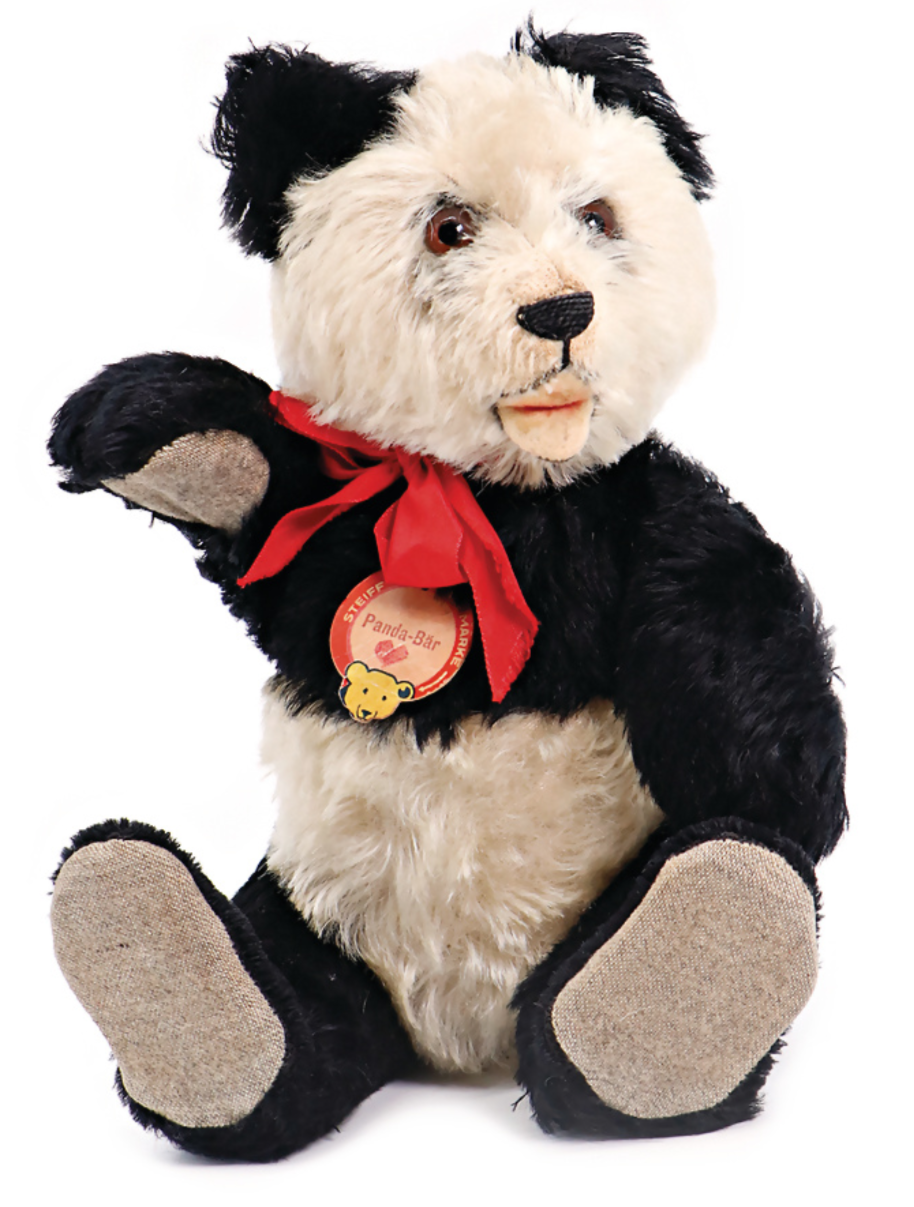
Here we have lot #6045, a precious prewar panda bear. He has an opening bid of 280 €. He is cataloged in part as:

"Panda, with button, long trailing f, writing "Panda-Bär", red with afterwards up-painted heart, mohair-plush, 2-colored, tricot paws, 26 cm, minimally mohair loss around the snout, otherwise very good condition, rare."

Pandas are a great example of Steiff using news headlines and cultural trends for product development ideas. These black and white beauties began appearing "in the flesh" in several major zoos across the globe in the late 1930s. They immediately rocketed to international superstar status. Piggybacking on the success of their real-life cousins, pandas made their debut in the Steiff line in 1938; by 1939, they were being produced in 15 and 30 cm on a commercial scale through 1942 overall. This fantastic example, with his long trailing "f" button and breathtaking named, red imprinted chest tag, is most likely from the earliest part of that time time. 

Steiff's debut pandas were five ways jointed and made from black and white mohair.
Their faces were detailed with brown and black pupil eyes, a black hand embroidered nose, and an small scaled, open, peach colored felt lined mouth. The black circles around their eyes and the black stripe across their backs were created by hand airbrushing. Because of wartime material shortages, some models - like the one under discussion here today - were produced with linen or other alternative fabrics in the place of felt on their hand and foot paw pads.

Steiffgal hopes this discussion on these rare, named Steiff auction lots has bid up your interest in this upcoming sales event!

Thursday, December 1, 2022

Sit and Stay and Check Out This Tiny Steiff Mechanical Marvel!

Now who is a good dog? Those are every puppy's favorite words, and in some ways, Steiffgal's as well! Check out this happy handful of a Steiff 'herd... German Shepherd, that is! This prewar treasure packs a lot of features and design elements into a very small body. He'll have you smiling ear to ear for sure.

This blue ribbon buddy is Steiff's tail-turns-head German Shepherd dog.
He is 15 cm tall, sitting, and made from wool plush (that has practically been entirely loved off.) His cheerful face comes alive with pert triangular ears; brown and black glass pupil eyes; a black hand embroidered nose; and an open, felt lined, smiling mouth. He is solidly stuffed with excelsior, which is a manufacturing feat in itself, given how small he is, and how narrow his limbs are. The excelsior stuffing holds his metal tail-moves-head apparatus in place; it would tend to shift or settle if it was packed in kapok or other lighter filling. This mechanism enables his head to move in a circle when his sweet little tail is twisted. 
This little lovely was made in 15, 18, 23, 29, and 36 cm from 1931-1935 overall. 

One of the most astonishing things about this example is his IDs.
They are great in themselves, but it is sort of a miracle that they even exist at all, given how much love and use this guy clearly has had over the years. He wears his all original brown leather collar. It is held together with two long trailing "F" Steiff buttons. He also retains his original, red imprinted, watermelon shaped named chest tag. It is interesting that on the back of the chest tag, it is stamped "Int. pat. app. for" meaning "International Patent Applied For". Steiff was very proud of its tail-moves-head technology, and other companies were starting to copy it starting in the early 1930s. It really is amazing that he still has his collar and tag, given how ephemeral they really are, relative to his sturdy overall construction.

This pretty puppy has a great place in Steiff's prewar and early midcentury German Shepherd production history.
German Shepherds have been featured almost continuously in the line since 1923. Perhaps the best known Steiff German Shepherd design is Arco, who was introduced in 1935 but got his name in 1937. Pre-war Arco was made from mohair and had prominent, felt lined ears and a smiling, open, felt lined mouth. He was made standing on wheels (in 35, 43, 50, 60, and 70 cm), standing (in 14, 22, 28, 35, 43, 50, and 60 cm), and sitting (in 17, 22, and 28 cm) from 1937 to 1943. During this time, Arco was sometimes also referred to as "The Police Dog." As one of Steiff's most beloved late pre-war dog designs, early Arco again graced the line from 1951-1956 in the form of a 10, 17, and 22 cm standing version. These guys strongly resembled their pre-war pattern. A 43 and 50 cm standing version on wheels was also manufactured from 1949-1956.

Steiffgal hopes this discussion on this tiny Steiff treasure has brought a big slice of joy to your day.

Have a question about one of your Steiff treasures? Let's talk! Click here to learn more.

Sunday, June 12, 2022

Things Are Heating Up For Ladenburger Spielzeugauktion's Steiff Summer Auction On June 25th!

After a two year pause due to COVID-19 public health concerns, Ladenburger Spielzeugauktion's Special Steiff Auction will again take place in Giegnen as part of Margarete Steiff GmbH's annual three day Sommer event. This signature festival happens on June 24th-26th 2022, and Ladenburger's auction takes place the evening of June 25th in the town's historic Schranne hall. This sale always features the best of the best - and this year is no different. Here are three rare and interesting temptations from the auction that really caught Steiffgal's eye. 

This first pick is fit for a king - of the jungle, that is. It is lot #6018, a turn of last century lion pincushion. It has an opening bid of €550 and is cataloged as....

"Pin-cushion, lion, around 1905, velvet lion with mohair mane, very nice clearly visible colors, great condition, small STEIFF button with block letters, long trailing F, on a green mohair pin-cushion, minimally faults at the mohair of the pin-cushion, otherwise very nice condition, length of the cushion: 16 x 11 cm, height with lion: 14 cm, exceptional, very nice condition."

Steiff has a long tradition of creating novelties like pincushions from some of their most popular designs of the time. This particular lion pattern appeared in the catalog in 10 and 14 cm from 1904-1919 overall. The lion itself - sans cushion - was produced in 10 and 14 cm from 1903-1912 overall. Other prewar pincushion designs included animals wearing backpack style pincushions made from baskets and velvet, pets perched on fluffy mohair pillows, and woolen miniatures posed on thick felt leaves. This particular example is in wonderful condition with ID. The lion's royal personality just radiates from within, don't you think? 

The next pick is truly a looker.
It is lot #6071, a mid-century manufacturing display. It has an opening bid of €130 and is cataloged simply as...

"Show piece, board made of cardboard, development of a Steiff-lion 5312, 43 cm and 30 cm, around 1954."

This dashing display shows the steps needed to create the company's "Mama Lioness." This early prewar design was produced in 12 and 21 cm from 1949 through 1957 and is considered relatively rare and desirable on the secondary market. So the date on the display of 1954 makes perfect sense. 


The words on the sign basically summarize how the lioness comes together. They roughly translate to: "History of a Steiff Lion 5312. Work steps: cut, sew, turn around, sew limbs on, ears, garnish the nose, shape, paint, check, protect." The poster also includes examples of the raw materials used at each step of the process, and a finished Lioness. It is interesting to imagine what this display was created for.... training, public relations, part of a museum or traveling exhibit? Today, it is just a fabulous time capsule and a great piece of visual as well as teaching art. 


The final auction pick today is certain to get your goat, in the best possible way. It is lot #6124, a midcentury era goat advertising specialty. It has an opening bid of €220 and is cataloged as:

"Billy-Goat (billy goat), advertising item by the company Scabal, 1959, wool plush, with monocle and caricature eyes, standing height with hat 40 cm, complete, No. 6535,90, very good condition, hat is a bit creased."

What a fun item! Goat's playful, blue and black glass eyes are meant to be silly and cartoon-like, and are almost identical to those seen on the Steiff's beloved Lulac rabbits of the same period. His "proper topper" and black vest add a touch of formality to him. And his numbering describes him accurately, with 6 = young, 5 = wool plush, 35 = his height, almost; 9 = display animal or special edition, and 0 = natural coloring. 

But what's the tie between goats and the company Scabal? According to Wikipedia, Scabal is... "a Belgian textile company founded in 1938 by Otto Hertz as a cloth merchant and supplier of fabrics. "Scabal" is an acronym for Société Commerciale Anglo Belgo Allemande Luxembourgeoise." Goats are famous for producing mohair and cashmere, and Scabal may use these fine fibers in their cloth production. It is also possible that this goat design somehow was part of the company's branding or identity in the late 1950s. So the dandy goat design really does tie back to the business of Scabal. 

Steiffgal hopes this discussion on these fabulous Steiff auction treasures has further buttoned up your love of the brand. 

For more information about Ladenburger Spielzeugauktion GmbH's upcoming Special Steiff Auction event on June 25th, please click here!

Have a question about one of your Steiff treasures? Let's talk! Click here to learn more!

Sunday, May 8, 2022

This Prewar Steiff Bear Doll Is Simply Picture Perfect!

This next great Steiff find is dressed for success. Steiff's prewar animal dolls are beloved by collectors but are quite rare - especially in their original clothing. They are among Steiffgal's most favorite button-in-ear novelties of all time, so she was thrilled to welcome this irresistible cub into her collection recently. Check out this handsomely attired example and see why he's just about picture perfect!

Here we have Steiff's a-maiz-ing Puppbaer or Bear Doll. He is 22 cm tall, standing, and head jointed. His arms hang loosely at his sides. His body is solidly stuffed and made from a soft flannel material. His head, in the form of the company's beloved Teddy Baby, is made from shaggy maize and white wool plush. The tops of his hands and flat feet are made from white wool plush. His earnest face comes to life with an open, felt lined mouth, a brown hand embroidered nose, and glass pupil eyes. He wears well fitting red, blue, orange, white, and green plaid calico pants, a long sleeved red cloth shirt, and a blue and white fringed calico scarf. He retains his long trailing "f" button and traces of his red ear tag as his IDs. This design was produced in 14, 22, and 28 cm from 1931-43 overall; Steiffgal suspects this cub was born around 1933-34. 

It is interesting to note that over his 12 year prewar production period, this Teddy Baby bear doll was available in 11 assorted clothing options. These finely tailored outfits included play and sporting outfits, pajamas, dresses, swimsuits, and traditional Germanic attire. This particular example under discussion here is in outfit #7, which is documented simply as, "winter suit, checkered trousers." The scarf is definitely "winter-y", and there's no question his pants are plaid! Outfit #7 was manufactured from 1933 through 1942. 

And just why is this fashion plate "picture perfect?" Check out this page from the company's 1938/39 catalog. On the top of page 40 of this great reference, you can see Bear Doll modeling in the exact outfit as he wears today. In 1938/39 - according to this catalog - he was available in six total outfits and in 22 or 28 cm. 

The approximate translation of this catalog text is...

"Soft body, floppy arms, firm body, plush head, funny clothes in different versions. 

#1 is sports shirt, blue trousers. #2 is blue suit, sand colored apron. #3 is polka dot dress, belt, red cape. #5 is loose salmon red dress. #6 is red and white smocked dress. #7 is winter suit and plaid pants. #8 is green trousers and a red blouse. #9 is a blue patterned dirndl dress. 

Please specify the outfit number and the doll size when ordering this item."

Steiffgal hopes this discussion on Steiff's Bear Doll has been the best of all worlds for you.

Have a question about one of your Steiff treasures? Let's talk! Click here to learn more. 

Sunday, April 24, 2022

This Charming Steiff Prewar Find Is Certain To Put A Tiger In Your Tank

Take a seat and check out this darling and little known Steiff tiger!
Tigers are a popular, legacy item in the Steiff catalog, with the first big beasts of their type debuting in the company's line in 1915. They translate well from real life to plush, and their handsome looks and wild origins bring out the animal instincts in most collectors! Steiffgal stumbled across this unusual prewar example on an online auction. The fates smiled upon her, and now he's part of her permanent hug.

This striped sweetie is quite the looker.
 His official name is "Tiger Cub." He is 22 cm tall (measures vertically from head to toe), sitting, and head jointed. He is made primarily from tawny colored wool plush. His long sideburns are made from longer white mohair. Tiger is stenciled and airbrushed in typical tiger style; he is highlighted in orange with prominent black stripes on his limbs, back, tail, and head. In true cat fashion, his little tail curls up around his backside. He has black hand embroidered claws on each of his paws. His distinctly youthful face is detailed with teal green and black glass eyes, a black hand embroidered nose and mouth, and a spot of pink paint on his lips. His ID is a short trailing "F" Steiff button. Overall, this big cat appeared in the line in 17 and 22 cm from 1939-1943.

It's always fun to discover new Steiff surprises, and this tiger cub definitely qualifies as that for Steiffgal.
This is the first of his kind she's ever handled, or really knew about. According to Pfeiffer's 1892-1943 Sortiment, this model is cataloged as, "woolen mohair, tawny-colored, tiger striped, sitting, soft, young, funny." It is unusual for Steiff or Pfeffer to use endearing adjectives in their descriptions - usually they are quite literal and objective. So the word "funny" really pops here, and in a way it is accurate. This guy does have a playful and mischievous look to him.

Tiger cub's shape and presentation also may ring a bell with collectors interested in Steiff's sitting big cat production over time.
His sitting, head jointed form is also noted on the company's pre- and postwar Young Lion design. This mane event was made in 17 and 22 cm in wool plush from 1938-1943, in artificial silk plush in 17 cm from 1948-1949, in 10 and 17 cm in wool plush from 1949-1954, and finally in mohair in 10 and 17 cm from 1955-1961. You can see the 17 cm, early postwar artificial silk plush version of young lion here on the left. Clearly the sitting young lion design was more popular than the sitting young tiger design, which only appeared in 10 cm from 1951-1961.

Steiffgal hopes this discussion on this prewar, wool plush cub has put a tiger in your tank!

Have a question about one of your Steiff treasures? Let's talk! Click here to learn more.
The teddy bear search engine