Showing posts with label dressed. Show all posts

Sunday, July 30, 2023

Less Is More When It Comes To Steiff's Early Felt Doll Production

Size defies with today's blog special guest.
Steiffgal tries to adopt at least one special Steiff bear, doll, or animal tied to major Steiff events, auctions, and happenings she attends. Here is the little button-in-ear buddy that made his way home to the United States with her via the recent Steiff Special Auction held in Giengen, Germany on July 1st, 2023. Read on to hear his story and to see what makes him so precious from many perspectives.

Like many Steiff collectors, Steiffgal poured over the Ladenburger Spielzeugauktion GmbH Special Steiff Auction catalog from their July 1, 2023 sale.
A million things caught her eye online and on the printed catalog pages... but not this tiny treasure for some reason. However, that all changed when she attended the live auction preview, held in the gallery adjacent to Steiff's museum and gift store, right on the company's campus. Here on the left you can see a photo of Steiffgal attending this auction preview the day before the big sale.  

It was an amazing experience touring this preview room filled with world class treasures - in a world class space! All the auction items were stored in rectangular, glass and wooden cases. You could walk all the way around them and see every angle of the treasures on display. Of course, all eyes were on the 1912 black mohair Titanic Mourning Bear and the google eyed Petsy bear - the stars of the show who were displayed right at the entrance to the room.  

Steiffgal saw this little guy sitting on a shelf and she could not look away.
Yes, he was in the catalog, but he presented so differently in real life than in his pictures. This happens a lot, and a good reason to attend live previews! He was TINY! And his size was further in the spotlight as he was posed with medium and larger Steiff felt dolls. His scale and presentation were so adorable, and so unusual, that Steiffgal immediately decided he was the one! Here on the left you can see this little guy as he was displayed for the auction preview event. 

So this little doll, who has since been named Little Eddy, stands a mere 22 cm.
He is made from felt, fully jointed, and comes to life with a blonde inset wig, blue and black glass pupil eyes, painted eyebrows, prominent dimensional ears, and distinctive horizontal (near his eyes, to give him a youthful, rounded look) and vertical (right down the middle of his face) stitching. His hands are simple and fist style. He wears a red and white sweater and shorts set, with white socks and black felt shoes. This outfit is period appropriate but not original to him. Steiff's 22 cm dolls are few and far between, and this is the first one Steiffgal has ever seen - and now owns! They were produced from 1917-1919 in several boy and girl models over that time frame. You can see Little Eddy standing next to his 28 cm big brother and big sister here on the left - that's the best way to highlight his scale and proportions. 

Little Eddy is also very interesting from the design perspective for two quirky reasons. First, he has typical early Steiff style fist hands with stitched digits. Steiff's dolls from his late 19-teens era production usually have fingered hands or at least hands with prominent fingers. Perhaps his scale made it difficult to give him more detailed hands. And, second, his amazingly tiny silver button - which looks original to him based on its placement and condition - also appears to be more of a short trailing "f" button than a long trailing "f" button. The long trailing "f" button appeared the line through the mid-1930s, and the short trailing "f" button appeared in the line from the mid-1930s through the early 1950s. So his ID is bit of a mystery there as well.

This petite prince is the perfect size to be a special traveling companion.
And, he jumped at the opportunity as soon as his adoption was finalized! He fits snugly in a purse or backpack and makes friends wherever he goes. His big first adventure was an eight hour train ride from Heidelberg, Germany to Prague in the Czech Republic. Here you can see him in his "first class" train seat enjoying the scenery as it whizzed by. He looks forward to many more sightseeing trips in the future. 

Steiffgal hopes this story about Little Eddy has brought you big joy!

Have a question about one of your Steiff treasures? Let's talk! Click here to learn more!

Sunday, May 7, 2023

All Ears Over This Well Dressed Prewar Steiff Rabbit Doll

It's the best of all worlds when it comes to Steiff's dressed animal dolls. What could be finer than a darling Steiff dog, cat, rabbit, or other fine beast donned in Steiff couture from head to toe? Steiff's rabbits are very well represented in the company's history of dressed animals. The company's debut dressed rabbit was none other than Beatrix Potter's own beloved Peter Rabbit in 1904! Check out this prewar-era happy hopper - perhaps a distant cousin of Peter? - who sets Steiffgal's heart aflutter every time she looks at him.


Overall, this smallest version of Steiff's begging rabbit boy is simply adorable. He is 17 cm tall (sans ears) and head jointed. He originally was covered in white and tan mohair, but now he's simply a bare hare. He has mile long, narrow feet with red embroidered claws, downturned arms, a tiny upcurved tail, and oversized, floppy ears not lined in wires. He comes to life with oversized brown and black glass pupil eyes placed low on his face and Steiff's signature 1920s-era rabbit facial embroidery. This includes a "v" shaped nose and an upside down "v" shaped mouth in one color, and horizontal stitches filling in the "v" shaped nose in another color. You can see a close up of this stitching in the photo at the bottom of this post. Dressed rabbit retains his long trailing "f" button and traces of his red ear tag as his Steiff IDs.

You can't help but notice this bun's all original and darling playsuit. His well-constructed pants have tiny faux front pockets, contrasting tan colored stitching, back black snaps, and a perfectly placed opening for his tail.  This model in this outfit appeared in the catalog from 1929-1932 in 17, 22, 28, and 35 cm. 

Given their short time in the line, and probably low production numbers, these dressed, prewar, begging Steiff rabbit dolls are amazingly rare.
 This is only one of a handful in blue overalls Steiffgal has ever seen or handled. Steiffgal purchased this guy at a UFDC national event salesroom a few years ago. More recently, in January, 2023, a medium sized one hammered at auction for 750 euro/841 USD. This model was also produced in five other outfits; these included a red skirt and white apron, a purple jacket, a red skirt and purple jacket, a red and white dress, or a pink dress. In 2010, Christie's sold one of these rarities dressed in the red skirt and white apron for 1,625 GBP.

Steiffgal hopes you enjoyed this clothes encounter with this well dressed prewar rabbit!

Have a question about one of your Steiff treasures? Let's talk! Click here to learn more!

Saturday, December 31, 2022

These Ladenburger Spielzeugauktion Auction Highlights Are Dressed To The Nines!

Three's a charm when it comes to the third post in this blog series of auction highlight from Ladenburger Spielzeugauktion's January 21st, 2023 Collection of Susan Kilgore Wiley sale. It's no secret that Steiffgal goes all hubba-hubba over Steiff's utterly charming dressed dolls and animals. And, this sale offers some of the most appealing ones in memory. Check out this trio of well attired prewar offerings from this auction. Steiffgal is certain you will consider all of them a clothes call indeed.

This first dressed highlight doesn't have a hare out of place.
It is lot #6152, an all original and early Steiff Peter Rabbit. It is estimated at €650-€1,300, and is cataloged in part as:

"One of the highlights of the auction, exceptional hare, Peter, around 1910, with small button, block letters, long trailing f, shoe button eyes, underlaid with red felt, fine brown/beige velvet, attending, with original felt jacket, decorative seams and golden buttons, red slippers, 1 leather sole with original stamp, 1 felt slipper is a bit holey, and small holes on the blue felt jacket, standing height 26 cm, extremely rare, exceptional."

Steiff's turn of last century Peter Rabbit dolls top many collector's bucket lists. This well coutured example is in lovely condition and is a marvelous size. It is interesting to note that the exact details that make up a Steiff "Peter Rabbit" are not specifically identified in Pfeiffer's Sortiment books. It is generally understood amongst collectors that a "Steiff Peter Rabbit" is standing, unjointed, and wears a felt topcoat with buttons and embroidery and felt slippers with leather soles. The Sortiment book pictures two versions of standing rabbits wearing felt topcoats and slippers, but does not identify them as "Peter Rabbit." The first is a spotted velvet version wearing a red or navy topcoat and red slippers; he was produced in 10, 22, and 28 cm from 1904-1919. The second is a white wool plush version wearing a green felt topcoat and red slippers; he was produced in 22 cm from 1904-1918.

This next auction highlight is a pair with flair!
Here we have lot #6181, two early 20th century, fully jointed, center seamed Steiff felt dolls. They are estimated at €330-€660 and are cataloged in part as:

"Felt dolls, Anton & Lisl, Upper Bavarian, produced between 1909 and 1926, 28 cm, with traditional costume, felt-head, mohair-hair, felt body, jointed, arms and legs, original, clothes, very nice condition."

This darling duo are textbook examples of   Steiff's "children" style dolls. 
These guys appeared in the line from 1909 through the late 1920's. Unlike earlier Steiff dolls that were more caricatured, harsh, and designed for adult collectors, these dolls were realistically proportioned, had gentle personalities, and angelic, rosy faces. They truly were designed for child's fun and play. These models were all fully jointed and had felt heads and bodies - except right around WWI when felt was scarce and the bodies were sometimes made from rough cotton or linen type materials. Steiff's children dolls were all dressed head to toe in handmade clothing that included school uniforms, ethnic costumes, sporting attire, and “Sunday best." Steiffgal is certain that the boy is Anton, based on his outfit and presentation. However, she is not 110% certain the identity of the girl is Lisl as her outfit does not match the one pictured in Pfeiffer's Sortiment. Steiffgal also suspects that her clothing, however charming, is not entirely original to her. Nonetheless, the pair is simply wonderful.

And it's tag, you're it! when it comes to our final well dressed auction highlight.
This is lot #6114, a late prewar standing and dressed rabbit doll, estimated at €180-€360. She is cataloged in part as:

"Pupp-hare, Mike, with button, block letters, long trailing f, very nice good preserved, yellow cloth tag label, No. 22, wool plush at hands and feet, original traditional costume, 27 cm, very nice condition."

And just want makes this lovely lady a 10?
She's got a fantastic presentation, and is in delightful, all original condition. And if you look closely at her tag, it is says "22,11." Numbers don't lie here! Her digits mean 22 cm tall (measured without ears), while the number 11 corresponds to her costume as described by the company. Outfit #11 translates to "traditional costume with green checkered skirt, green corsage, and white shirt." Spot on! These utterly charming, dressed rabbit dolls appeared in the line in 14, 22, and 28 cm in maize or white plush from 1932-1943 overall. Eleven total outfits for these rabbits were produced; they ranged from pajamas to playsuits to trousers and dresses through regional outfits like the one featured on this premier example. 

Steiffgal hopes this discussion on these well dressed auction highlights has contributed to the fabric of your collecting life. 


For more information about Ladenburger Spielzeugauktion GmbH's upcoming Special Steiff Auction event on January 21st, please click here!

Have a question about one of your Steiff treasures? Let's talk! Click here to learn more!

Sunday, May 8, 2022

This Prewar Steiff Bear Doll Is Simply Picture Perfect!

This next great Steiff find is dressed for success. Steiff's prewar animal dolls are beloved by collectors but are quite rare - especially in their original clothing. They are among Steiffgal's most favorite button-in-ear novelties of all time, so she was thrilled to welcome this irresistible cub into her collection recently. Check out this handsomely attired example and see why he's just about picture perfect!

Here we have Steiff's a-maiz-ing Puppbaer or Bear Doll. He is 22 cm tall, standing, and head jointed. His arms hang loosely at his sides. His body is solidly stuffed and made from a soft flannel material. His head, in the form of the company's beloved Teddy Baby, is made from shaggy maize and white wool plush. The tops of his hands and flat feet are made from white wool plush. His earnest face comes to life with an open, felt lined mouth, a brown hand embroidered nose, and glass pupil eyes. He wears well fitting red, blue, orange, white, and green plaid calico pants, a long sleeved red cloth shirt, and a blue and white fringed calico scarf. He retains his long trailing "f" button and traces of his red ear tag as his IDs. This design was produced in 14, 22, and 28 cm from 1931-43 overall; Steiffgal suspects this cub was born around 1933-34. 

It is interesting to note that over his 12 year prewar production period, this Teddy Baby bear doll was available in 11 assorted clothing options. These finely tailored outfits included play and sporting outfits, pajamas, dresses, swimsuits, and traditional Germanic attire. This particular example under discussion here is in outfit #7, which is documented simply as, "winter suit, checkered trousers." The scarf is definitely "winter-y", and there's no question his pants are plaid! Outfit #7 was manufactured from 1933 through 1942. 

And just why is this fashion plate "picture perfect?" Check out this page from the company's 1938/39 catalog. On the top of page 40 of this great reference, you can see Bear Doll modeling in the exact outfit as he wears today. In 1938/39 - according to this catalog - he was available in six total outfits and in 22 or 28 cm. 

The approximate translation of this catalog text is...

"Soft body, floppy arms, firm body, plush head, funny clothes in different versions. 

#1 is sports shirt, blue trousers. #2 is blue suit, sand colored apron. #3 is polka dot dress, belt, red cape. #5 is loose salmon red dress. #6 is red and white smocked dress. #7 is winter suit and plaid pants. #8 is green trousers and a red blouse. #9 is a blue patterned dirndl dress. 

Please specify the outfit number and the doll size when ordering this item."

Steiffgal hopes this discussion on Steiff's Bear Doll has been the best of all worlds for you.

Have a question about one of your Steiff treasures? Let's talk! Click here to learn more. 

Sunday, August 22, 2021

This Dressed Steiff Rabbit Doll Is The Best Of Both Worlds!

Overall, this next fantastic find is certain to put a joyful spring in your step! Steiffgal found this bitty bun in the recent United Federation of Doll Club's salesroom - lying upside down and backwards in a case piled full of mohair and treasures. All she could see was one very large foot with red claw stitching... and the rest is history. Come take a look at this dolly-delightful bun and see what makes him so interesting from the design and collector's perspectives.

This happy hopper measures 17 cm (without his ears), is begging, and head jointed. He originally was covered in white and tan mohair - but not a hare/hair remains on him! He is detailed with extra long, skinny feet, a tiny pert tail, and oversized ears. His face comes to life with big brown and black glass pupil eyes, a typical 1920s era style hand embroidered nose and mouth, and traces of once brown airbrushed highlights. He dons his original and totally adorable blue cloth overalls. He retains his long trailing "f" button and traces of his red ear tag as his Steiff IDs.

This seldom seen pattern appeared in the line from 1929-1932 overall in 17, 22, 28, and 35 cm. Steiff's rabbits are measured without their ears, so they actually are a little larger in real life than these measurements suggest. This model was produced in one of six documented outfits. According to Pfeiffer's 1892-1943 Sortiment, these included a blue playsuit, a red skirt and white apron, a purple jacket, a red skit and purple jacket, a red and white dress, or a pink dress. This example under discussion here is the one in a blue playsuit - which is detailed with tiny faux front pockets, contrasting tan colored stitching, back black snaps, and a perfect opening for his pert tail. It is interesting to note that this pattern is considered a "doll" in terms of his category - most likely because of his toddler-esque shape, standing form, and the fact that he is dressed. 

This guy is really shy - and seldom if ever appears in public! Despite being launched in 1929, as far as Steiffgal can tell, an example does not appear in the company's primary catalog of that year. The only other one Steiffgal is aware of is one that was sold at Christies in 2010. That particular example was cataloged as, "A STEIFF DRESSED BOY RABBIT, (4317,61), light brown and white mohair, brown and black glass eyes, pink and red stitching, whiskers, swivel head, inoperative squeaker, blue dungarees and FF button with red cloth tag, circa 1930 --6¼in. (16cm.) (some slight fading)." It was estimated at GBP 1,000 - GBP 1,500 and realized GBP 1,375. You can see that listing here on the left, the image is from Christies. You can click on it to make it bigger.

Steiffgal hopes this discussion of this rare and usual animal doll has been the best of both worlds for you.

Have a question about one of your Steiff treasures? Let's talk! Click here to learn more.

Saturday, July 3, 2021

Boy Oh Boy, What A Wonderful Family Treasure!

Here's one inquiry that is definitely dressed for success! It's so nice to hear from new friends from overseas and today's technologies make it as easy as pressing a button! This question really caught Steiffgal's eye - and heart - given her love for Steiff's early through midcentury attired animal dolls. Check out this note from Denny from Germany who asks about a vintage family treasure. He shares,

"Hello I was recommended your site and I need advice on determining a Steiff-Haasen. It is an heirloom and cannot find this Steiff-Haasen anywhere. I'm interested in everything you can say about it. Thank you in advance and wish you a nice evening."


There's not a hare out of place when it comes to this sweet happy hopper. In terms of his basics, this boy bun is standing on flat feet, head jointed, and measures about 21 or 22 cm (as Steiff does not include the length of rabbit ears in its measurements.) His body is simply shaped with dangling arms and stiff, unjointed legs; it is made from a soft, pink colored fabric. His head, and the tops of his hands and feet, are made from mohair or another type of woolen fabric; it is hard to specifically tell from the photos. Steiff's items manufactured during periods of conflict or hardship - like when this guy was made - were often produced from a number of different types of fabric at any given time, given supply chain limitations.

Now let's check out his darling detailing.
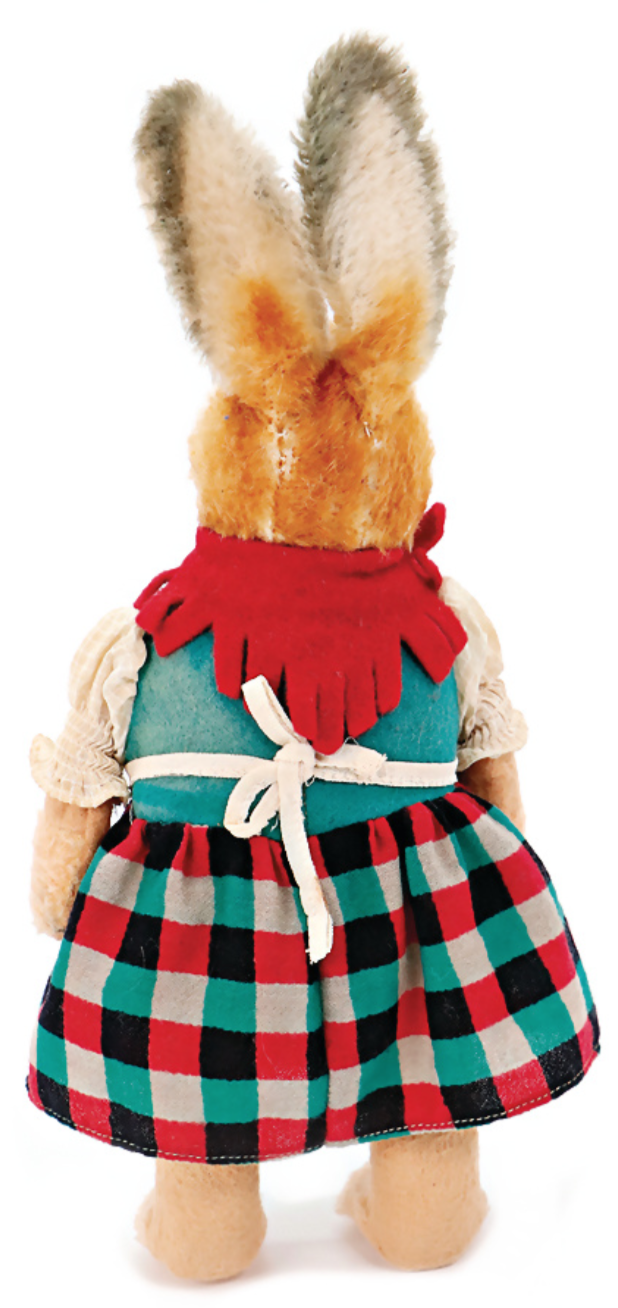
 Rabbit's ears are lined in felt and are highlighted with a touch of pink airbrushing. His adorable face comes to life with proportional black and brown glass pupil eyes and a simple, pink hand embroidered nose and mouth. His clear monofilament whiskers have been loved off. He dons black felt trousers, a white textured shirt, and red felt suspenders; these clothes are original to him. These models traditionally also left the factory in Giengen wearing a little tie or bow at the neck. Because it was not sewn on, it must have been removed at some point and simply got lost to time. Rabbit doll retains his short "trailing f" button as his Steiff ID. His model was produced in 22 and 28 cm from 1937 through 1943.

Steiff produced this sweet guy as part of a delightful hare pair.
His girl companion rabbit doll was dressed in a red shirt with a white collar and cuffs, a blue and white checkered skirt, and an orange apron. These two were called Hasbu and Hasmaid, and were the last new rabbit doll patterns launched prewar. Unlike many other animal dolls, these were only produced in one outfit style, perhaps because these were the only fabrics available at this very challenging socio-economic and political period in history. That is why is it is possible to identify Denny's rabbit with great certainty. You can see Hasbu and Hasmaid here on the left, the photo is from Pfeiffer's 1892-1943 Sortiment.

Steiffgal hopes this information about Denny's treasure has you jumping for joy!

Have a question about one of your Steiff treasures? Let's talk! Click here to learn more.

Monday, February 15, 2021

This Delightful Midcentury Steiff Treasure Is Dressed For Success!

There's no need to skirt the issue when it comes to this week's Steiff story! Check out this inquiry from Elizabeth, who asks about the history and timeline associated with an adorably dressed girl doll she recently added to her hug. She shares,

"I purchased and recently received off of eBay this cute little Teddy Baby doll, I think. I'm guessing that she is from the late 40’s because it appears she had the US Zone tag removed/worn off from her leg at some point. Her head and the tops of her paws and feet are mohair and her body is cloth and excelsior stuffed. Her arms are a little floppy. It seems like she did a lot of hand holding in her time. What do you think, am I even close to right?"

This ever-cheerful design always makes Steiffgal's heart happy. Elizabeth's doll was made in 25 cm and appeared in the line from 1950 - 1957. This head jointed model appeared as a boy, dressed in a red jacket, white shirt, and black shorts, or a girl, in a red jacket, white shirt, and green skirt. All the clothes were removable, so it finding an example today in all original clothing is quite rare. They were simply called "Boy Doll Bear" and "Girl Doll Bear" until 1954 when they were more lovingly named "Teddyli." The boy and girl dolls together are pictured here on the left; the image is from Pfeiffer's 1947-2003 Sortiment. A similar pair of boy and girl dressed Teddy baby bears, produced in a blondish-yellow wool plush, appeared in the line from 1951 - 1954.

Teddyli, of course, is based on the company's legacy Teddy Baby bear design that was introduced in the 1920s. This pattern proved so delightful, and so popular, that it because the inspiration for many novelties over the years. Post World War II Teddy baby novelties included a display sized Teddy baby (produced in 150 cm in brown mohair in 1960 and 1967); a press-and-release musical Teddy baby (produced in 25 cm from 1950 - 1951); and a tiny Teddy baby doll on a rubber body named Teddyli (produced in 12 cm in brown mohair from 1955 - 1957.) Tiny rubber and mohair Teddyli is pictured here on the left. Steiff also produced Teddy baby as a 17 cm hand puppet; he appeared in brown and maize mohair from 1929 - 1943 overall; and then again in brown artificial silk plush and then mohair from 1949 - 1978 overall.

Now let's take a closer look at this item's IDs.
When she left the factory in Giengen, she almost certainly had her Steiff button and a yellow ear tag with the article number "325 M" on it. These digits correspond to 3=mohair, 25=25 cm tall, and M=maedel (or "girl" in German.) Steiffgal has never seen one of these midcentury cubs with a chest tag. Elizabeth notes the remains of a US Zone tag in her leg seam. These tags were technically required in all German export products from the end of WWII through the early to mid-1950s to communicate that the item was produced in a "civilian" factory and met business and distribution standards set up by the American military government overseeing the United States' occupational zone in Germany. These usually actually appear on items produced in the c. 1951-1955 time frame. Given that observation, it Steiffgal's best guess that Elizabeth's Teddy Baby doll girl was made in the c. 1951-1955 time frame.

Steiffgal hopes this discussion on Elizabeth's mid-century find has tagged your interest in this collection era!

Have a question about one of your Steiff treasures? Let's talk! Click here to learn more.

Sunday, January 3, 2021

Kicking Of 2021 With A Huge Steiff Smile!

It's the best of all worlds when it comes to Steiff's prewar animal dolls! And their appeal seems to transcend borders and continents. Check out this note from a friend in the UK who asks about Steiffgal's beloved "Bub" animal doll. It should be no surprise for you to learn that Bub has a passport of his own, given he is Steiffgal's favorite travel buddy! Marcus shares:

"I keep watching your videos and love your travel companion Bub.
Especially his background, why he is constructed the way he is and the scarcity of material at the time. I was trying to find a bear like him and it was harder than I thought. I found one finally on eBay. Do you think his Lederhosen and green linen shirt are original? They seem to be as they fit beautifully. Also the linen shirt appears to be the same type of weave as his body. It is also hard to find literature. Do you know of any literature which deals with this particular design of the head jointed animal dolls in substitute material? Thank you in advance for any help or insight you can provide.
Cheers, Marcus"

It's a clothes call when it comes to this great bear.
Yes, indeed this is one of Steiff's irresistible prewar animal dolls. Not a lot is published about them and most information needs to be distilled from catalog listings and through historical context and interpretation. This cute cub has the head of the beloved Steiff Teddy Baby design and the body of a simple doll. He is head jointed, has dangling arms, and a solidly stuffed torso and legs. His head, hands, and the tops of his flat feet are made from what looks 
like light blonde woolen or mohair plush; it is hard to exactly tell from the photos. His body and limbs are made from a flesh colored fabric. His face is detailed with brown and black glass pupil eyes, a brown hand embroidered nose, and a smiling, tan felt lined mouth. You can see his long trailing "f" Steiff button in ear and traces of his red ear tag in the photo here on the left. He wears a green linen shirt and brown felt shorts. These articles are well fitting and appropriate for him but were "mommy made" and not manufactured by Steiff. You can tell because: 1. the shirt color is far too vibrant and without wear and should have faded in proportion to the aging on the bear, and 2. the shorts - they are cute - but not of Steiff clothing quality.

This Teddy Baby doll was one of several different animal dolls produced in the 1930s and 1940s.
Other popular models included a number of rabbits, a cat, a pug (picture here on the left, photo from Steiffgal's collection), an elephant, a Scotty, and a German Shepherd. Regardless of size or date of manufacture, each of these pre-war treasures produced from 1931 onward was branded as Steiff with an ear button and ear tag. However, unlike most other Steiff products of the 1930’s and 1940’s, these dolls did not leave the factory in Germany with chest tags. The IDs on Marcus' bear suggest that he was made in the early to mid-1930s at the latest.

These sweet animal dolls were all dressed for success. Their clothes were removable, charming, lovingly stitched, and produced from the finest cottons, calicos, felt, and other materials. They were dressed as boys or girls, or in in occupationally or nationally inspired clothing. Numerous outfit variations were available for some of the more popular models. For example, Steiff’s Puppkatz or cat doll, which was introduced in 1931, was available in up to 11 different outfits over time. These included pajamas, dresses, swimsuits, playsuits, and traditional German attire including dirndls and trousers. Here on the left, you can see a c. 1938 catalog page showing Marcus' Teddy Baby bear featured at the top of the image; his nine original outfits at the time are noted next to his image. You can click on the image to make it larger. 

Steiffgal hopes this discussion on Steiff's delightful Teddy Baby doll bears has been a two for one experience for you. 

Have a question about one of your Steiff treasures? Let's talk! Click here to learn more!

Saturday, September 28, 2019

Double Doggie Delights at Auction This Week!

Some things simply stand on their own merits... like Steiff's fantastic prewar animal dolls. These sweet treats - with simple, humanized bodies and animal heads representing the most popular Steiff pets of the 1930s and 1940s - are breathtaking in their beauty and rarity. Within the past few days, two remarkable canine examples came up for auction in Germany. Both really caught Steiffgal's eye. Here's a bit more about this duo of delightful doggies.

There's no question the first one will really whet your appetite. He is lot #15 from Auktionshaus Eppli's Art, Antiques, Asiatica, Jewelry & more... sale held on September 27, 2019. He is cataloged as: 

"STEIFF "Chow doll", 1939-1940. Standing dog doll, button with shortened 2nd "f", remains of yellow tag, plush head and paws, clothing of brown wool plush, belt missing, right foot damaged, signs of use. H: 30 cm."

This doll had a starting bid of €150 and realized €3,600 or $3938.77. 

This extraordinary example was made in this size only from 1939-1940 as noted. He has a simple, head jointed fabric body, feet and hands made from mohair, and a realistically constructed mohair head. He wears a brown collared, long sleeved woolen top and matching pants. They are both removable. The top had a thin brown string belt when he left the factory in Giengen eight decades ago; it is not uncommon to lose accessories like this to playwear and time. Steiffgal has never handled one of these in person and has only read about them in reference books. 

Although he is named Pupp Chow or Chow Doll, Steiffgal thinks his coloring and detailing is more like the company's Wolfspitz dogs than the company's Chow Chow dogs. The Wolfspitz dogs, made from long tawny colored mohair, appeared in the line standing, sitting, and on wheels from 1934-1943 overall. The Chow Chow dogs, made in light brown, dark brown, and white mohair, appeared in the line sitting, standing, and on wheels from 1928-1932 overall. So the Chow Chows were not even in the line at the time of his introduction in the late 1930s. It is possible that "Chow Doll" sounded a lot better than "Wolfspitz Doll", and in reality Chow dogs and Spitz dogs are very closely related genetically.   

Now let's shepherd in an introduction to today's second dog doll auction highlight. He is lot #3037 from the Ladenburger Spielzeugauktion GmbH Antique Toy Auction - Spielzeugauktion held on September 28, 2019. He is cataloged as:

"Pupp Arco, head mohair-plush, standing, with button and cloth tag label, number 22 (22 cm), 1937-1939, felt underwear good, cotton shirt, 2 spots, all in all good condition."

This doll was estimated estimated at €650 - €1,300 and realized €2,562 or $2803.09.

This irresistible rarity is clearly based on the company's beloved "Police Dog" Arco the German Shepherd dog. He is dressed in a simplified, traditional farmer's outfit. This consists of an oversized, puffy blue cotton shirt and black felt shorts. He has the identical, generic body construction as noted on the Chow doll, with the same mohair detailing on his feet and hands. His head is based on the one used on Steiff's mohair Arco German Shepherds from the mid-1930s onward. This happy, open mouthed, smiling dog was made sitting, standing, and on wheels from 1935-1943. Pupp Arco was made in 22 and 28 cm from 1937-1940 overall.

The appearance of a farmer's outfit on a police dog model is unexpected, but all original in this case. These animal dolls, for the most part, were dressed in "everyday" work or play or regional/ethnic costumes. Arco is the only animal doll that Steiffgal knows of dressed as a farmer. Although Steiffgal does not have any more factual information on this puzzle, she suspects it might have more to do with economics than anything else. The Arco head is majestic and highly detailed, with an open mouth and large, prominent, felt lined ears. It appears to be among the most labor intensive relative to the other animals represented in this doll line. Perhaps this simple, plain outfit was used to save on the overall time and effort invented in bringing this doll to life? Whatever the reason, Pupp Arco is simply dashing!

Steiffgal hopes this discussion on the company's rare dressed dog dolls has been a clothes call for you.

Have a question about one of your Steiff treasures? Let's talk! Click here to learn more!

Saturday, July 16, 2016

It's A Clothes Call When It Comes To Steiff's Turn Of Last Century Dressed Teddy Bears


All dressed up and no place to go? Or in the case of this reader's question, perhaps it is just the opposite! It's a clothes call with this very interesting inquiry from a vintage Steiff enthusiast.

Susan simply asks...

"I own a 1915 Steiff Bear and I am looking to find out what period clothes it originally wore, if any. If so, where could I obtain them please? Thank you!"

Steiffgal's got this one buttoned up. For the most part, Steiff's early bears did not leave the factory in Giengen dressed. The vast, vast majority through about 1925 were "bear;" after the mid-1920's most were adorned with colorful silk ribbons. This in part was a directive from Richard Steiff himself. At that time, he was living in the United States but frequently wrote home to his family in Germany with suggestions and ideas to improve the business both domestically and internationally. In 1925, one of these notes included...

"Our Teddies, in the showroom here in New York, appear colorless, sober, and insipid. I feel inclined to decorate all the Teddies we have left with huge, colorful silk ribbons; only then can we ask a slightly higher price.” 

However, from 1908 through 1917 overall, the Steiff did produce and distribute a series of eight standard line, fully jointed Teddy bears dressed in simple swimsuits, sailor suits, and other felt and knitted outfits. Steiffgal calls these the "B Series" as all the bears had short names starting with the letter "B." Their names were Babad, Babo Baho, Bagi, Basa, Basi, Batro and Baru. They appeared in eight sizes ranging from 22 to 70 cm in the company's traditional mohair colors. All of these early dressed animals were product line extensions of the company's regular line bears. Today, it is very hard to find original versions of these dressed bears, as the felt and knitted outfits tended to fall apart (moths, etc.) and/or would be lost to time, as children took them on and off the items as playthings. The postcard image above shows many of these dressed bears and is probably from around 1912, plus or minus a few years.

Somewhat recently, Steiff has replicated members of the "B Series" so collectors can appreciate these sweet cubs today. In 2006, one of the special Steiff club editions was the lovely girl-bear "Bagi" in a somewhat mismatched blue felt suit. Also appearing around the same time was "Basa the Baby Sailor" in a nautically themed blue suit.  He is pictured here on the left.

It is interesting to note that over the same time period - from 1908 through 1917 - Steiff was also producing a series of adorable, to-scale felt human children dolls, also dressed in adorable, well made clothing.

As for finding an original "B Series" outfit, Steiffgal thinks that might be a challenge, but not entirely impossible. These clothes very infrequently come up for sale or auction on the secondary market. But here are a few suggestions to to pursue. Of course, keep an eye out on web stores like www.rubylane.com and www.etsy.com that sometimes list antique doll/animal clothes like this. Also peruse webstores that sell antique Teddy bears and dolls, as they often have clothing and accessories for sale as well. Attend local or national doll shows with good salerooms and see what clothing is on offer - and ask dealers to keep an eye out for you. And finally, if you are crafty - or know someone who is - perhaps sew or knit one of these outfits to replicate the original. After all, even old bears appreciate a stylin' new set of threads!

Steiffgal hopes this discussion on Steiff's early dressed bears has suited you well.

Have a question about one of your Steiff treasures? Let's talk! Click here to learn more.

Friday, May 27, 2016

Hunting For Clues About This Great Steiff Outdoorsman Bear

Do you have any plans for the upcoming long holiday Memorial Day weekend holiday? Perhaps you might be headed out for a little camping and outdoor fun to kick off the summer season! Well, that's exactly what this little wilderness-loving Steiff cub has in mind as well! Check out this most unusual and well attired bear and see what makes him so interesting from the design and historical perspectives.

Let's start hunting for clues about this hearty outdoorsman. He is 22 cm, fully jointed, and made of caramel colored mohair. His sweetly serious face comes to life with a brown hand embroidered nose and mouth and glass pupil eyes. He dons an orange felt cap with a wide brim; a green felt jacket detailed with a small collar, scalloped edging, long fringe, and a laced up front; and tall, faux brown leather boots. When he left the factory in Giengen, he had a wooden hunting rifle suspended from a leather cord tacked onto his shoulder. 

This bear was produced in 1953 and 1954 and is one of Steiff's "Nimrod" Teddy bears.  He was designed and manufactured in honor of the 50th anniversary of the introduction of the jointed Teddy bear as we know and love him today.  Also produced at this same time, and for the same reason, was Steiff's far better known "Jackie" style Teddy bear. Jackie, known for her pink nose stitch, distinctive belly button, and impish personality, was made in 17, 25, 35, and 75 cm from 1953 through 1955 only. Like Nimrod Teddies, Jackie bears are exceptionally rare on the secondary market given their appeal, limited production, and their brief time in the line.  A print advertisement featuring these two early, very special edition Teddy bears from 1953 is pictured here on the left.  The photo is from Cieslik's Button in Ear:  The History of the Teddy Bear and His Friends.
  
The Nimrod bears were all based on the company's early postwar, newly redesigned "Original Teddy" pattern. This design, which featured a stockier build and shorter limbs than the company's prewar standard line bears, was produced from 1950 through 1966 in 10, 11, 15, 18, 22, 25, 28, 35, 40, 43, 50, 65, 75, and 100 cm.  Overall, four Nimrod bears - in addition to the one under discussion here today - were produced.  These included a 22 or 50 white version which donned a green cap, an orange felt shirt, and brown boots; a 22 cm gold version which wore a green cap, a brown felt shirt, and brown boots; and a 22 cm caramel version detailed with an orange cap, green scarf, and very tall brown "wader" style boots.  All carried wooden rifles suspended from a leather cord.  You can see a few more of these original Nimrod bears here on the left; the photo is from Cieslik's Button in Ear:  The History of the Teddy Bear and His Friends.  

In addition to their well designed outfits, proper footwear, and outdoorsy personalities, Nimrod bears also have distinctive numbering on their yellow ear tags.  The caramel one under discussion today is numbered 5322 N.  This translates into 5=jointed, 3=mohair, 22=22 cm, and N=Nimrod.  You can see this numbering on the picture here on the left. Steiffgal has seen letters after article numbers, but they usually refer to colors or gender of an item, not its actual name.  So this configuration is quite unusual.  

Why would the company produce a series of hunting themed bears in honor of this special golden anniversary? Most collectors are aware that the Teddy bear got its name (and arguably its popularity) from Theodore Roosevelt, who refused to shoot a baby bear cub on on a hunting adventure in Mississippi at the turn of last century.  These Nimrod bears are a gentle nod to that key happening that in its own way helped to place Steiff on the map as a global company. The Nimrod bears and a Steiff likeness of President Roosevelt were featured on the cover of a Steiff brochure commemorating his 100th birthday in 1958.  The photo is from Cieslik's Button in Ear:  The History of the Teddy Bear and His Friends.  

And last but not least, what about the name Nimrod? Although Steiffgal cannot unearth anything definite about Steiff's choice of this name, she did discover that this might be a reference to an ancient biblical figure. According to scholars, Nimrod was the great-grandson of Noah, who built an ark to save all the animals during the great flood. Nimrod is personally described in the bible as "a mighty hunter."

Steiffgal hopes this discussion on Steiff's rare Nimrod Teddy bears has you on the hunt for one to add to your collection as well!

Have a question about one of your Steiff treasures? Let's talk! Click here to learn more.

Monday, March 7, 2016

This Great Vintage Steiff Doll Has Heel-Appeal!

Ok team, its time to get to work! So check out this note from a new friend who is asking about an older Steiff doll that appears to take his job quite seriously. Cherie writes,

"Hi Steiffgal, 


Mom has her great uncle John's Steiff grocer doll, and I haven't been able to find out anything about it. Time and bugs have taken their toll, but it's still in pretty good shape.  Do you know anything about it? Thank you, Cherie"


It's an absolute labor of love to help out here. It is Steiffgal's best guess that this doll is Steiff's shoemaker doll. He should be 35 cm, fully jointed, and made from felt. Overall, this doll was made in the 1912 through 1920 time frame. Given his black shoebutton eyes, he is most likely from the earlier end of the time frame.  It is hard to tell from the photo if all of his clothing is original to him.  However, it was not unusual for Steiff to somewhat vary the fabrics used to make the clothing on a doll pattern, especially when the doll appeared for an extended period in the line.
 

Steiff employed alot of time and effort into this doll and others like it. From around 1912 through 1920 or so, Steiff made a series of "craftsman" themed dolls. These included a stone cutter, host, tailor, butcher, and shoemaker. All were 35 cm, except the butcher who was also made in 50 cm. The shoemaker doll, as he appeared when new, is pictured here on the left. The photo is from Pfeiffer's 1892-1943 Sortiment book. These great dolls often appeared in the company's grand window and event displays, especially those depicting "everyday" town and country scenes.  

It's time to buckle up this discussion about this great shoemaker doll with some thoughts on his value. Condition is everything when it comes to Steiff dolls from this era. It's very hard to tell from the photo much about his state and even if he retains his Steiff ID. Additional information about his body, jointing, mohair hair and mustache, etc. would be needed for a more formal analysis. As always, something is worth what someone will pay for it. In general, Steiff dolls from the c. 1910 through 1920 era in very good, all original condition with ID seem to be selling for the most part in the $1,500 to $2,500 range today. From the photos, this fellow looks initially to have some wear and losses and issues with his clothing. As such, it is Steiffgal's best guesstimate that he might sell at auction in the $750 to $1,200 range or so. 

Steiffgal hopes this discussion on this shoemaker doll has touched both your heart and sole. 

Have a question about one of your Steiff treasures? Let's talk! Click here to learn more!


Sunday, November 16, 2014

It's The Best Of All Worlds With This Vintage Steiff Bear Doll

Who deserves a standing ovation? Why, this precious Steiff Puppbaer or Doll bear, of course! Steiffgal admits to having a huge plush crush on this bitty boy, a recent addition to her Teddy hug. Not only is he totally adorable, he also has a bit of a mystery to him. But more on that later. Let's first take a look and see what makes him so interesting from the design and historical perspectives.

This Teddy Baby doll is truly the best of all worlds. He has the head of the beloved Steiff Teddy baby design, the body of a doll, and a charming, well fitting outfit made from period fabrics. He stands about 22 cm tall, is head jointed, and has dangling arms. His head, hands, and the tops of his flat feet are made from light yellow woolen plush. His body and limbs are made from a flesh colored fabric with a somewhat velvety finish. His face is detailed with brown and black glass pupil eyes, a brown hand embroidered nose, and a smiling, tan felt lined mouth. He wears green trousers and a red and white calico shirt - which are original to him - and a tiny old fashioned brass basketball charm around his neck, which is not. Overall, this model was made in 14, 22, and 28 cm from 1931 through 1943.

It is interesting to note that over his production period, Steiff's Teddy Baby doll was dressed in about 11 various outfits.  This particular example is in outfit #8, which is documented simply as, "green trousers, red blouse." Outfit #8 was manufactured from 1935 through 1942.

Although Steiff produced dressed animals, especially monkeys, bears, and rabbits, since the turn of last century, it was not until the late 1920's that the company produced a true animal doll such as the Teddy Baby under discussion here. In 1929, Steiff introduced a Pupp-Bully, Charly, and Treff. All were 28 cm and only remained in the line through 1930. Between 1931 and 1932, Steiff debuted a number of animal dolls, including a cat (pictured here on the left), duck, pug dog, and a boy and girl rabbit couple. And like the Teddy Baby doll, all were made in 14, 22, and 28 cm and appeared in a number of different outfits over time. In the mid to late 1930’s, Steiff would go on to produced a delightful series of additional pupp-animals including an elephant doll, Waldi the Dachshund as a hunter, Scotty the Terrier as a Scotsman, and Arco the German Shepherd as a farmer. However, due to supply restrictions and geopolitical realities, production on all of these doll models ceased by 1943. 

Once the factory reopened for toy production at the end of WWII, Steiff briefly resumed their manufacturing of their “pupp-animals.” In 1949, a pair of fully dressed, 25 cm wool-plush Teddy Baby dolls appeared in the line; these were quickly followed with the introduction of a pair of 25 cm blond and brown mohair dressed Teddy Baby dolls in the early and mid 1950’s. Steiff continued the production of their pre-war pair of boy-girl rabbit dolls but renamed the set Hansili in 1954. They also extended this doll animal line to include two additional models of rabbit pairs, a Dachshund doll boy and girl set (pictured here on the left), and a fox doll boy and girl set. Overall, all of these sets were discontinued by the early 1960s, probably due to their highly detailed, labor-intensive and costly production requirements.
 
Ok, so perhaps you are wondering by now what is so mysterious about this little Teddy Baby doll. When Steiffgal was doing a close inspection on him, she noticed something entirely unexpected. He has a US Zone tag sewn into his leg seam. But that would suggest a production date in the c. 1947 to 1953 time frame. So what's going on here? Only Teddy knows for sure, but here are a two scenarios:
  1. It is entirely possible that he was produced in the late 1930's or early 1940's, put in storage during the war, pulled out after the war, labeled, and sold in the late 1940's to early 1950's.
     
  2. It is also entirely possible that he was indeed made as part of the early post war production. As noted above, the literature documents that Steiff did produce a 25 cm wool plush Teddy Baby doll from 1949 through 1950. Perhaps Steiff also made a few of them in 22 cm at the time as well.
Either way, given the US Zone tag, Steiffgal is all but certain he did not leave Giengen until at least 1947, and that his "birthdate" is somewhere in the 1935 to 1950 time frame. Unfortunately, Ted's primary IDs have been lost to time. However, given his documentation and look and feel, Steiffgal suspects that originally he had either a short trailing F button, a blank button, or a raised script button.
 

Steiffgal hopes that this discussion on this precious Steiff Teddy Baby Doll has been as enjoyable as child's play for you!

Have a question about one of your Steiff treasures? Let's talk! Click here to learn more.
The teddy bear search engine