Showing posts with label linen. Show all posts

Sunday, May 19, 2024

Keeping It Tru With This Mysterious Prewar Steiff Doll

Hat's off to another great Steiff find! Here we have a lovely prewar Steiff doll that recently joined Steiffgal's hug. Her condition and coloring is stunning, and you can't help but admire her perfectly coordinated outfit - and how well she wears it! But behind this little gal are a number of really big mysteries. Take a look at Trude and see what makes here so intriguing from the product design and historical perspectives.

What we have here is a precious pressed felt faced doll named Trude. She is 35 cm, standing, three ways (head and legs) jointed, and excelsior stuffed. Her face is made from flesh colored felt, while her limbs and trunk are made from flesh colored linen. Her arms are floppy and hang loosely by her sides. Her arms are bent slightly at the elbows, and she has very defined fingers. Her face is highly textured, with chubby cheeks, a realistic mouth, pert nose, and lifelike blue glass eyes embedded in eye sockets. Her facial painting is lovely and done with a gentle hand. Even her little ears are sculpted just like a child's. She is finished with a blond mohair wig, which is seamlessly integrated into her head structure. Trude's IDs include her red rubber bracelet, tan colored tag, and teeny tiny prewar button. You can see her IDs close up in the photo below. 

Trude's outfit is adorable and fits her to a "t". She wears a white cotton "one-sie", which is trimmed with lace around the leg openings and bodice. It has thin little straps which fit over her shoulders to help keep it in place. Her short sleeved white cotton blouse is removable and closes in the back. It is cropped and detailed with red pull strings at the neck and arms. She wears a cotton dress that closes with two metal snaps and is detailed with a ruffle around the waist area. The fabric features yellow, blue, black, white, and green wildflowers on a red background. Her footwear also is removable and consists of white cotton socks and red felt Mary-Jane style shoes. And she retains her original red and yellow wide brimmed hat, which is trimmed and ties with a red silk cord.

Trude is super interesting for number of subtle reasons. Steiff's "pressed felt" face doll line was produced from 1937 through 1943, and then again in 1949 and 1950. Steiffgal cannot locate a c. 1930s-1950s era doll of her construction with that name. The fact that her name was written by hand on her tag suggests that only a few of these dolls with this name were made. But more on that in just a moment! Also of note is her construction. Many to most of these wartime era dolls were made entirely from felt, but this example has a felt head and a linen body and limbs. This may suggest that she was manufactured when fine toy making materials were unavailable or expensive due to wartime rationing or shortages - perhaps in the very 1930s to early 1940s. As a result, matching linen in the place of felt was used instead in less "visible" areas of the doll's anatomy. 

Trude is dressed and resembles one of Steiff's standard line production pressed felt faced dolls named Gretel. Gretel was made in 35 and 43 cm from 1938-1942 overall and is also dressed in a similarly styled red dress with snaps, a white blouse, and red felt shoes with white socks. The most obvious difference between Trude and Gretel in terms of outfits is that Gretel wears a red hairband, and Trude has an oversized felt hat. You can see a picture of Gretel here on the left, the image is from Pfeiffer's Sortiment 1892-1943.

So here is where there are more questions than answers about Trude. Was she made to substitute for Gretel in terms of her materials and construction? Was she perhaps a sample of some sort? Why doesn't she appear in any Steiff materials, as far as Steiffgal can locate? And why does she have a large, glorious felt hat... given the rest of her is constructed to minimize the use of this premier toy making fabric? Well, only she knows for sure... and unfortunately, she's not talking!

Steiffgal hopes this discussion on Steiff's terrific Trude doll has been a playful addition to your day. 

Have a question about one of your Steiff treasures? Let's talk! Click here to learn more.

Wednesday, March 29, 2023

This Midcentury Steiff Cub Is As Sweet As A Chocolate Kiss!

Now here's something you don't see every day! Check out this sweet and unusual Steiff bear. His construction is quite distinctive, most certainly reflecting the realities of manufacturing in the era in which he was "born." Four different fabrics were used to bring this happy handful to life!

What we have here is a sweet as a chocolate kiss Teddy baby bear. He stands 22 cm tall and is fully jointed. His face is detailed with brown and black glass pupil eyes and a black hand embroidered nose. His claws are also stitched in black. He retains his original red collar and named chest tag, along with his short trailing "f" button, as his Steiff IDs. Although only he knows for certain, it is Steiffgal's very best guess that he left the factory in Giengen around 1947 or 1948 as he does not specifically appear in any Steiff or Teddy bear reference book she can identify. 

Teddy baby has several fabric features that date him to the immediate postwar period. His body, head, and limbs are made from short pile artificial silk plush fabric. According to Pfeiffer's 1947-2003 Sortiment, the company did produce a 30 cm brown artificial silk plush Teddy baby bear in 1949. This guy at 22 cm is much smaller, but could still be his distant cousin. Teddy baby's muzzle and the tops of his feet are made of wartime era wool plush, not mohair. This durable fabric was often used in the place of mohair when it was not available or rationed for military purposes. It is not unusual to find Steiff items traditionally made from mohair from the mid-1930s to early 1950s produced in this substitute fabric. It is also interesting to note that Teddy baby's paw pads are made from an inexpensive, thin linen material. These would traditionally be made from felt, which was also in very short supply in the late 1940s. A loving previous owner has done a wonderful job fixing and stabilizing his linen foot pads with stitches and TLC. 

One thing that makes Teddy baby bears so universally precious is their open, felt lined, smiling mouths. And, like all but the smallest versions of this classic pattern, this one also has this charming feature - despite a felt shortage! Steiffgal thinks felt was used here for two reasons. 

The first is that it is possible that the company tried to make the mouth in linen, but it just did not look right. It is also possible that linen could not hold the shape or form required for the pattern. And the second is just how visible the mouth is. It is one of the first things you see on this design, and is so fundamental to its appeal. Making the mouth out of felt on this pattern only required a little more than a square inch of material. So many Teddy baby bears could be importantly detailed with just a touch of felt when the company had minimal felt in inventory. This bear pattern usually also has its hands and feet pads made from felt. But in this case, those areas are not nearly as visible, prominent, or key to its design. Creating this pattern with felt foot and hand pads would require about five times more felt than one that just had a felt lined mouth. This Teddy baby is equally as precious with linen pads as he would be with felt pads... at least in Steiffgal's humble opinion! 

Steiffgal hopes you found this discussion on this very early postwar Teddy baby bear materially interesting!

Have a question about one of your Steiff treasures? Let's talk! Click here to learn more!

Sunday, July 3, 2022

This 1970s-era Steiff Novelty Is One Merry Mashup!

Steiffgal is certain you'll have no trouble warming up to this week's blog special guest. Here we have a Steiff postwar egg cozy that could only be described as a merry mashup. Check out this happy hopper and her unusual design elements to see what makes her such a rare hare in so many ways.

It's easy to understand why this quirky novelty holds so much appeal. This rabbit egg cozy is 10 cm tall and head jointed. Bunny's head is a large pom-mom that has been airbrushed with tan and pink highlights. She comes to life with brown and black pupil eyes, clear monofilament whiskers, and a tiny pink painted mouth. Her ears are made from a piece of single thick white felt and a piece of single thick tan felt that have been sandwiched together. Her tail is a small white pom-pom, and her body/dress is made from a textured, linen-like material. This pattern was produced in blue, orange, red, or yellow in this size only from 1973-1974. According to Pfeiffer's Sortiment, these warmers were sold in pairs and packaged with a matching placemat.

This egg cozy novelty is interesting from three distinct collecting angles.

1.  Functionally, it is the first egg warmer to appear in the line post-war. Steiff's early egg warmers were primarily made from felt or velvet, with their heyday in the c. 1900-1925 timeframe. Many of the early 20th century egg warmers were also made as rabbits, so her form is entirely consistent with past production. 

2.  Her materials and construction are also unusual. Although pom-pom or woolen miniature animals have been used for pincushions, pen wipes, and displays over time, this is the only egg warmer Steiffgal knows of that incorporates woolen miniature elements. Her ear construction - that of two layers of felt glued together - is also noteworthy. Steiffgal also does not recall ever seeing another button-in-ear item featuring her body/dress fabric. 

3.  And her packaging is also curious. She appeared in pairs, and packaged with a placemat. Although Steiffgal does not have the original packaging, she found an image of it on eBay, and it appears here on the left for your study. The copy on the back reads, "Egg warmer with place mat. Place mat of laminated foam and synthetic material, therefore it doesn't slip and can be washed in lukewarm water." 

Steiffgal hopes this discussion on this 1970s-era egg cozy has added a little novelty to your day.

Have a question about one of your Steiff treasures? Let's talk! Click here to learn more.

Sunday, May 16, 2021

This Charming Steiff Panda Bear Is Simply Mid-Century Marvelous!

It was pure panda-monium this week at Steiffgal's home when this latest addition joined her hug! Pandas top many Steiff collector's "love lists" and this sweet girl deserves a crown and throne for many reasons. Check out this black and white beauty and see why she really is mid-century marvelous!

This smiling sweetheart - newly named Princess - is 28 cm, five ways jointed, and made from black and white mohair. Her face is detailed with brown and black pupil eyes, a black hand embroidered nose, and an open, triangular shaped peach felt lined open mouth. The black circles around her eyes are created by hand airbrushing; she also has black airbrushing on her back. Princess' pads are made from grey felt. She proudly dons her original pink silken ribbon. Princess retains her yellow eartag, US Zone tag, and raised script button as her Steiff IDs. 

Now let's take a closer look at Princess' place in the product development timeline.
According to the Sortiment, this pattern was produced in 15, 22, 28, 35, 43, and 50 cm from 1951-1961. Her eartag reads 5328,2. This translates to... 5 = jointed, 3 = mohair, 28 = 28 cm tall, and ,2 = with a voice. This pattern, introduced in 1951, was a modification of Steiff's first panda design which debuted in 1938. Steiff's prewar pandas were produced commercially in 15 and 30 cm, and would go on to appear postwar from 1949-1950 in 30 cm only. Given how Princess has elements of both the debut and updated panda patterns in her presentation, as well as her US Zone tag, it is clear that she was produced as the company was transitioning from one pattern to the other - probably in 1951. 

Despite her 1950s birthdate, Princess has many elements of Steiff's earliest panda cubs - especially from the midsection up.
Princess has a broad and triangular mouth; the updated mid-century version has a much smaller, half-oval shaped mouth. Princess has a very round face and muzzle; the updated mid-century one has a more finely contoured head and muzzle. And Princess has her black midsection almost to her mid-torso; the updated mid-century version generally has a much shorter black midsection. Also intriguing is the fact that Princess is technically cataloged at 28 cm, but actually measures 30 cm. And her pre- and very early postwar cousins - who are technically cataloged at 30 cm, actually measure about 26 cm. You can see Princess and her 22 cm updated 1951 postwar panda cousin pictured here on the left for comparison.

Steiff introduced pandas to the world just as they started appearing at zoos across the world in the late 1930s.
These jolly bears immediately rocketed to superstar status. Piggybacking on the success of their real-life cousins, pandas made their debut in the Steiff line in 1938. Because of wartime material shortages, some pandas were produced with linen or other alternative fabrics in the place of felt on their hand and foot paw pads. The success of its first early panda inspired Steiff to produce more pandas in the line as soon as the factory reopened for business in the late 1940s. These early postwar production pandas often had inferior quality felt on their pads as high quality felt materials were still only available in very limited quantities at that time. 

To bring history to life here, check out the two Steiff wartime era pictures above on the left. The one on the left has linen pads and the one on the right has with lesser quality greyish-black felt pads. The one with linen pads has a short trailing "f" button as her ID; the one with greyish-black pads has a raised script button and traces of her US Zone tag as her IDs. 

Steiffgal hopes this discussion on Princess panda has added a touch of royalty to your day.

Have a question about one of your Steiff treasures? Let's talk! Click here to learn more!

Monday, May 3, 2021

Pipe Up If You Know The Maker Of This Turn Of Last Century Cloth Doll!

Close, but no cigar. Or pipe in this case! Is this distinguished gentleman doll made by Steiff? Apparently someone thought so, a very long time ago. Come take a look at this handsome, turn of last century cloth doll and see what makes him so interesting - and cryptic - from the design and historical perspectives.

Well hello, handsome! This doll stands about 37 cm tall, is excelsior stuffed, and is fully jointed. His head is disk jointed with cardboard and metal joints, his arms are loosely rod jointed, and his legs are string jointed. His head, hands, and feet/shoes are made from felt. His torso and limbs are made from linen. He is dressed to the nines in a felt buttoned jacket; a brown, tan, and purple fabric vest with purple gemstone buttons; tan, brown, and grey calico pants; a brown silk bowtie; and black felt shoes. His face comes to life with a prominent horizontal facial seam; a fringe of brown hair and facial hair; dimensional black button eyes underlaid with felt circles; a simple seamed mouth; pink highlighting; and of course, his great wood and composition pipe.

Upon closer look, it turns out this fine fellow comes with a little information written upon one of his legs.
It reads, "Der Dutchman by Margaret Steiff #630 circa 1900." Although this doll is clearly misidentified as Steiff, it is understandable that someone may have assumed he was, given his prominent facial seam, general appearance, and turn of last century origins. He also has some Steiff "Karikaturpuppen" (i.e., early, cartoon-like) elements to him, including an oversized head with exaggerated features and simple hands and feet. However, Steiff's earliest dolls debuted in 1903, were string jointed, were made of felt and/or velvet, and had clothing integral to their bodies. Steiff usually used linen or other less expensive fabric like muslin on their dolls during times of economic and supply chain hardships, like just before, during, and after World War I. And their Dutch dolls almost always wore removable clogs rendered from felt or wood. 

Now let's light a fire under one of this doll's most intriguing features - his pipe.
It is removable and fits perfectly into a little hole in his face. This construction is also not typical to Steiff. And Steiffgal suspects that if Steiff made a doll pipe, it would have been hand carved entirely from wood. The only "smoking" doll Steiffgal can think of is the company's incredibly rare "Adamson" Swedish cartoon character doll produced between 1925 and 1929. In this case, the doll's felt cigar was sewn directly onto his face. You can see Adamson here on the left, the photo is from Liveauctioneers.com.

So just who is this silly smoker?
Steiffgal has combed the literature and cannot identify him. She's also asked others who are equally stumped. So his origins remain a mystery for now. What Steiffgal does know about him is that he previously belonged to her dear friend who recently gained her wings. This doll now sits on Steiffgal's desk, right near her computer, and "supervises" her daily... or in this case, reminds her of a beloved soul who passed way too soon, and unexpectedly.

Steiffgal hopes this discussion on this early cloth doll has suited you well. 

Have a question about one of your Steiff treasures? Let's talk! Click here to learn more!

Thursday, August 15, 2019

It's Three Of A Kind With These Midcentury Steiff Panda Triplets

The devil - or the discovery - is in the details! And this is especially true when it comes to Steiff's World War II era (c. late 1930's-early 1950's) editions. Patterns that were made throughout these turbulent years often had slight design and/or material changes over time due to supply or manufacturing constraints. These differences are subtle, but extremely interesting as well. Here's one example that is pretty black and white in these regards.

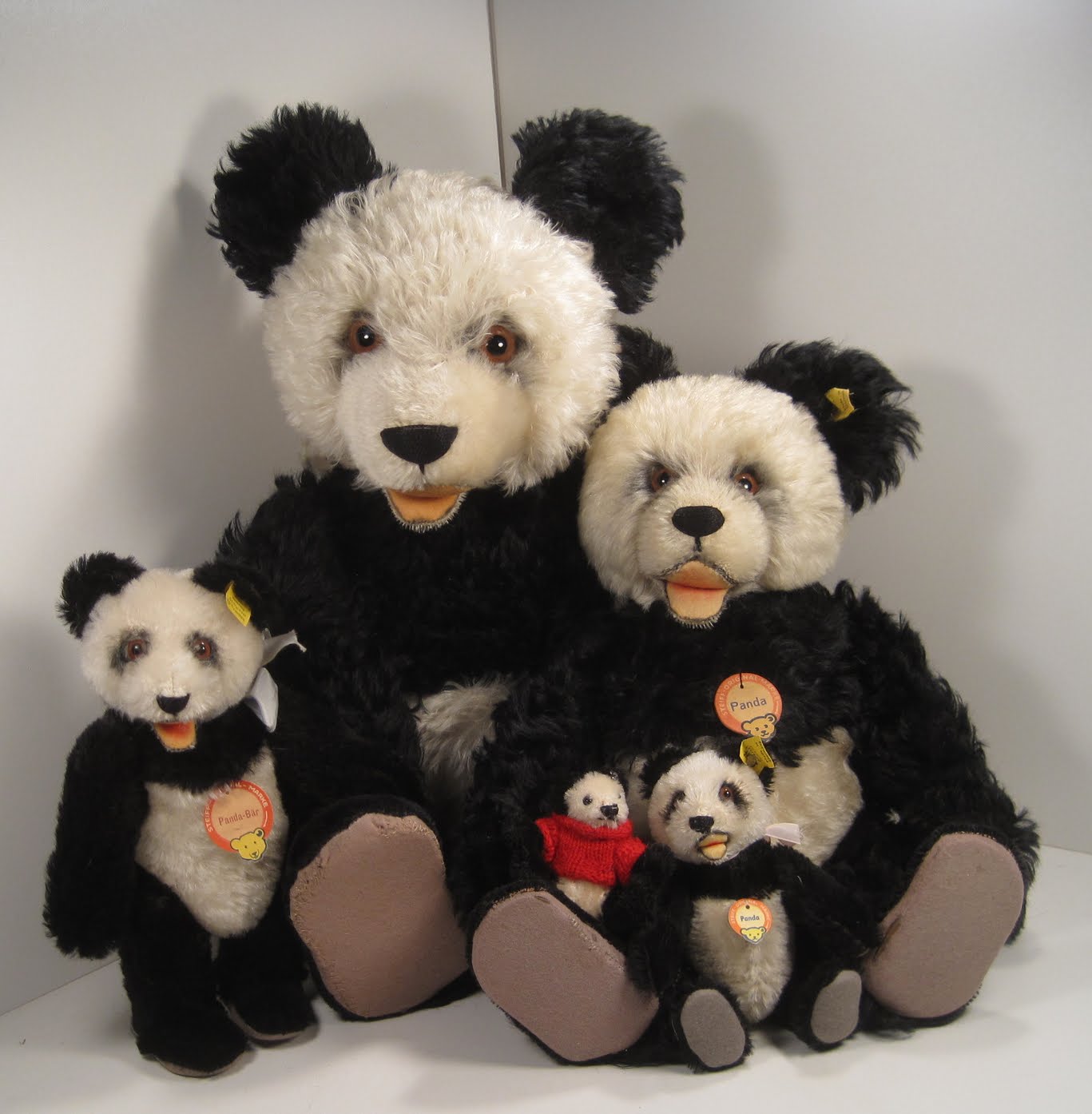
Here we have three Steiff pandas. All are 12 inches tall or 30 cm, 5 ways jointed, and made from black and white mohair. They have small, somewhat triangular shaped open, peach colored felt lined mouths, brown and black pupil eyes, and black, horizontally stitched noses. The black around their eyes, as well as across their back, is airbrushed. Like Steiff's beloved Teddy baby pattern, these also have flat, cardboard lined feet made for standing and downcurved wrists.

This adorable, child-like Panda design was launched in 1938, the same time Pandas made their grand debut at several zoos across the world. Prewar, this perky Panda was made in 15 and 30 cm through 1942. Postwar, this identical Panda design appeared in the line in 30 cm from 1949-1950. In 1951, Steiff updated its Panda design, producing their happy black and white cub in 15, 22, 28, 35, 43, and 50 cm from 1951 through 1961. The new model was produced in larger sizes than previously offered and had a different facial configuration, including a rounder mouth and a fuller, more sculpted muzzle. He had grey felt paw pads from 1951 through 1956 and suede-like grey rubber material paw pads from 1956 onward. The "updated" design from 1951 onward is pictured here on the left for your comparison. 

So now let's jump to some material matters when it comes to this jolly trio of early Steiff Pandas pictured at the top of this post. It's true they could be triplets, sort of. All are the companies pre-1951 pattern. But check out their paw pads and IDs - they are really quite diverse. The one on the far left has thick grey felt pads that have black fibers woven within the fabric. His ID is a raised script button. The one in the middle has linen pads and a short trailing "f" button. And the one on the right has regular grey felt pads and his raised script button and yellow ear tag as his IDs. A close up shot of the unusual grey and black felt pads, and the linen pads, are featured here; you can click on the image to enlarge it.  

So what is their birth order here? 

Hum, well, this will take some sorting out... and not all the dates and time lines align perfectly here. That's pretty standard when it comes to Steiff "mid-century mysteries." 

So, that being said... it is Steiffgal's best guess that the one with the linen pads and long trailing "f" button is the oldest, given his detailing. He might just be prewar, or immediately post war, as you see this linen treatment in items from the 1940s. Next in age - or the "middle child" - is probably the one with the thick grey felt pads and raised script button. His felt is unusual, and a little odd for Steiff production, so Steiffgal suspects Steiff used what felt was available, or on hand, to produce this pattern. And Steiffgal is pretty certain the one with the standard grey felt pads is the "youngest," relatively speaking. His pads closely match the ones used in the 1951 updated Steiff Panda pattern. The photo on the left is from a late 1930s Steiff catalog and shows Steiff's 1938-1950 Panda palling around with dolls and rabbits from the same era.

Steiffgal hopes this discussion on the company's mid-century Panda design has not left you bamboozled. 

Have a question about one of your Steiff treasures? Let's talk! Click here to learn more!

Sunday, July 21, 2019

Hat's Off To This Tiny And Absolutely Adorable Steiff Dwarf Doll!

Do clothes make the man? No, not always, but they can suggest some very interesting things about him! Check out this happy handful - a well attired Steiff dwarf doll - that recently joined Steiffgal's hug. His outfit, materials, and impish good looks make him quite the cover boy!

This petite treat stands 22 cm tall and is fully jointed. His entire body, including his face, is made from flesh colored linen. His oversized hands and feet are remarkably detailed with realistic fingers and toes. His ever-happy face comes to life with a long, light brown mohair beard and eyebrows, bright green and black glass slit pupil eyes, a charming upturned nose, and a open, red smiling mouth. His cheeks are very rosy and he even has a little razor stubble to him! He wears brown velvet shorts, a white cotton shirt, a bright yellow mohair cap, and a bright blue felt vest. His accessories include a leather belt and a Steiff-branded satchel; this is pictured below. When he left the factory in Giengen, Germany over a century ago, he wore oversized wooden and leather clogs. Dwarf retains his tiny, long trailing "f" button in ear as his Steiff ID.

So just who is this dapper dwarf? Steiffgal has two theories.  First, perhaps he is a hybrid of the company's early 20th century Snak and Snik dwarf designs. Snak was made in 22, 30, 43, and 50 cm from 1911-1915. He is known for his mohair cap and pointy nose. Snik was made in 22, 30, 43, and 50 cm from 1911-1920. He is known for his floppy felt hat and upturned nose. This little guy has a mohair cap and upturned nose - suggesting that he shares key traits from both patterns.

It is also entirely possible, given how every Snak Steiffgal has ever seen has a bright yellow mohair cap, that he is 100% Snak. Sometimes, the smallest versions of a Steiff item have little design tweaks from the larger versions. This usually involves simplification of seaming, body shape, or jointing relative to scale. In this case, this diminutive dwarf does not have eye pockets like the larger versions do, and his nose is definitely not crooked! Perhaps Snak's distinctive, long crooked nose just didn't translate well to the 22 cm version. Only this dwarf knows for certain, and he's not talking!

What is certain is his "birth date" and what that means in terms of his presentation. Given his materials, this dwarf was most certainly made in the World War I era (c. 1914-1918.) During this period, traditional, high quality woolen materials used for toy making like mohair and felt were in very short supply. Most of these fabrics were rationed for war purposes like uniforms and blankets; what was available commercially was very expensive and challenging to obtain.  

During peacetime, this dwarf's entire body and head would have been made from felt; here they are made from inexpensive linen. And his pants, which typically appear in felt, are made from velvet. These substitutions saved a significant amount of costly fabrics, and didn't really change his appearance or personality. It is interesting to note that his "signature" and highly visible elements - his hat, beard, and vest - are still made from woolen fabrics. However, the amount of materials needed for these "key" elements was quite small, and these details could have been pieced together from scraps for efficiency. 

Steiffgal hopes this discussion on this tiny linen dwarf has added to the fabric of your day!

Have a question about one of your Steiff treasures? Let's talk! Click here to learn more!

Sunday, August 26, 2018

Shake A Leg And Check Out This Precious Steiff Rattle Lamb!


How novel! That's how Steiffgal felt when she came across this tiny Steiff treasure at a friend's house recently. It goes without saying that he is adorable, officially qualify as "antique," and has a distinctly playful personality. But more on that later! He lives on a shelf in a beautifully curated collection in New England, along with many fine dolls, bears, and Steiff friends. Take a look at this happy handful and see what would have him a premier plaything more than a century ago.

There's no need to count sheep over this bitty barnyard buddy. Here we have a too cute for words Steiff lamb! It is simply amazing that this item is in such nice shape given its age and that it was designed as a play toy for babies! Steiffgal suspects that it was purchased as a gift for some lucky child and used primarily as a nursery decoration, not a toy. Or, sadly, the child passed away in infancy and never got to enjoy the toy - or life. The lamb measures about 3 inches tall, head to toe. He is standing on all fours, unjointed, and made from lamb's wool plush. His face, ears, and legs are made from felt. His legs are lined in metal wire. His face comes to life with teeny black button eyes and a very simple hand embroidered pink nose and mouth. His bell and ribbon are original to him. He retains all of his original Steiff IDs, including his tiny long trailing "F" button and linen backed white paper ear tag.  

Numbers don't lie! According to the Sortiment books and his prominent ear tag numbering, this lamb was produced from 1902 through 1917 overall, and as a "pram toy." This particular model was made in the 1910 through 1917 time frame. Pram toys were hanging toys designed to dangle from a baby's carriage or crib. Most of Steiff's earliest pram toys were constructed from elastic cord and woolen pom-poms, suspended from a white ivory carved ring. The "1" on the ear tag means "standing" and the "5" means lamb's wool plush. The "75" identifies it as a "hanging toy" while the "46" identifies it as a lamb.  

Now shake a leg and check out his little secret. This lamb actually is also a rattle, elevating him to novelty status! As a rattle, he makes a little "click click" sound when jiggled about. Steiffgal has handled rattle bears, dogs, cats, squirrels, and now this lamb. They all share the similar construction of having a small sealed glass tube filled with beads inserted into their torsos. Usually, but not always, rattles were made from the smallest versions of Steiff's most popular designs. The "youngest" product Steiffgal has seen with a rattle is a c. 1929 velvet sitting "Pip" dog. You can see this "chatty" Pip pictured here on the left. It is her best guess that the company stopped making rattle items in this fashion from the 1930's onward. 

Steiffgal has not been able to figure out any ear tag numerical code that distinctly and specifically identifies an item as having a rattle feature. So finding one, which usually comes about by accident, is always such a delightful surprise!

Steiffgal hopes this discussion on this wonderful Steiff novelty as shaken you up a bit!

Have a question about one of your Steiff treasures? Let's talk! Click here to learn more!

Tuesday, November 22, 2016

This Distinctive Steiff Teddy Baby Is One International Sensation!

Teddy hugs from London! Literally! Steiffgal has just returned from a very quick hop "across the pond," where she attended the delightful and inaugural London International Antique Doll, Teddy Bear and Toy Fair. Many thanks to friends Hilary Pauley and Daniel Agnew for their great job in bringing this brilliant event to life. Held on November 19th and 20th, 2016, this weekend happening featured a full day of seminars, speakers, and learning on Saturday, followed by a collector's fair in Olympia Hall on Sunday - showcasing a dizzying array of the finest antique dolls, plush, trains, and toys.  And, of course, Steiff!  

Steiffgal was walking the fair when - oh baby! - did this distinctive Teddy catch her eye! So much so, that this cheeky cub is now happily residing in the United States as part of her collection. And, as a nod to her adoption location, she's been named "Olympia!" 

Olympia is an example of the iconic Teddy Baby pattern, which was produced as a standard line design in the Steiff catalog from 1929 through 1957. This particular Ted is 28 cm standing and fully jointed. Her body is made from brown cotton plush, her muzzle and the tops of her feet are made from very short tan mohair, and her paw pads are made from tan linen. Her always happy and smiling mouth is lined in peach colored felt. She has four black hand embroidered claws on each paw. Her precious face comes to life with black and brown glass pupil eyes and a black hand embroidered nose. Her squeaker works loudly and clearly! Olympia was produced around 1950, give or take a year or two, and just a handful of years after the Giengen factory reopened for toymaking business after the conclusion of WWII.

Olympia has several design and physical features that truly are worthy of a gold medal, as well as reflective of the period in which she was made. 

First, its easy to have a plush crush on her very unusual material. Her body, head, and limbs are made out of brown cotton plush. This fabric has both a cotton backing and a cotton pile. The best way to describe it is that it feels like a cotton bathroom towel that has been through a number of wash and dry cycles; a little bumpy in texture but with an overall and somewhat smooth feel. It is not like mohair, which can be distinctive and prickly; or silk plush, which is shiny and smooth feeling; or wool plush, which is continuous in texture and more "dense." It is Steiffgal's guess that this material was used instead of the company's more traditional fabrics on her body as these were in very short supply or extremely expensive at the time.  

For the most part, cotton plush does not appear all that durable, at least on this Teddy Baby example. Although Olympia has a little playwear to her, her plush has a few losses, and seems more matted and worn than it should be, especially given how sound and hearty her body is otherwise. Usually paw pads and feet seams show wear and tear, but Olympia's are all original, and in excellent, even like new, condition.  

Second, her pad pads are hands-down interesting. They are made from tan linen. This material was used as a substitute for wool felt when it was in short supply. Steiffgal has a number of c. 1950 Steiff bears with the same linen material on their pads, including one made from artificial silk plush. It is interesting to note that a similar linen fabric was used in the place of felt on the bodies of Steiff's 19-teen doll line around the time of WWI for probably the same logistical and supply reasons.  

And finally, her ID really buttons her up as a rarity. Olympia proudly bears an "all capital" Steiff button, which was used for just a handful of years in the very late 1940's and early 1950's. Steiffgal has just a few other Steiff treasures in her collection with this style button; some sport a US Zone tag, other do not. Clearly, the early postwar years were a period of great transition and evolution for Steiff in terms of design and IDs. 

Steiffgal hopes this discussion on Olympia, the cotton plush Teddy Baby bear from London, will be met with international appeal!

Have a question about one of your Steiff treasures? Let's talk! Click here to learn more!

Sunday, December 21, 2014

Here's A Steiff-y Holiday Pug Hug, Just For You!

Are you in the mood for a Steiff-y holiday hug? Or even better, a Steiff-y holiday pug hug? Of course you are! Then check out this most unusual Steiff dog doll that will certainly warm your heart. He's certainly got Steiffgal's all a-flutter!
 

This darling dressed doggy is none other than Steiff's Pupphund or pug dog doll. He is 22 cm, standing, and head jointed. His arms hang softly at his sides, and he has flat feet for standing. Pug's head, ears, and the tops of his hands and feet are (or in this case were) made from mohair. His body is made from a tan linen fabric. He is filled both with soft stuffing and crunchy excelsior. His head and face come to life with floppy ears, oversized black and brown glass pupil eyes, a black hand embroidered nose, a pink mouth, and a distinct brown inset muzzle area. He retains his large, long trailing f button and traces of his red ear tag as his Steiff IDs.  

According to Coco Chanel, “Fashion changes, but style endures.” Such is the case with our sweet pup pal. He is dressed to the nines in brown cotton pants, a tan checked shirt, and a light grey-blue felt tam-o-shanter style hat which is "topped off" with a pom-pom. His shirt and pants are original to him, but it is not clear if his hat is. It is of Steiff quality and design and fits him quite well; Steiffgal simply has not ever seen another one like it. Pupphund was made in 14, 22, and 28 cm from 1932 through 1935 only. Each size came in six different clothing styles, which included pyjamas, swimsuits, dresses, and play suits.  You can see another one of Puggy's outfits here on the left, the photo is from Pfeiffer's 1892-1943 Sortiment book.  

Take a good look at Pupphund's pug-mug. It is quite unusual and as far as Steiffgal can tell, this doll pattern is the only item produced by Steiff with this basic design. Steiff often made their charming characters in a number of "theme and variation" ways. For example, many popular and now legacy 1920's and 1930's era designs were often produced as puppets, in sitting and standing versions, as music boxes, in different colors, as handbags, night dress bags, or other novelties. Unfortunately, this does not seem to be the case with this pug design - which is too bad for collectors today! 

 So how did this pug doll pattern come about? There are few clues here to work with. Steiff produced two different pre-war pugs; a grey standing mohair version on wheels from 1916 through 1927, and a caricatured blond and white mohair pug from 1925 through 1927. However, Pupphund really does not share any characteristics with either of these items. The only design element this pug dog doll does seem to share with any other Steiff dogs of its period is its distinctive pink mouth stitching. This can also be seen on Steiff's Ball Chin Chin, a 15 cm novelty which was produced from 1932 through 1935 as well. Ball Chin Chin is pictured on the left for your review; the photo is from Pfeiffer's 1892-1943 Sortiment book.  

As you can see from the photo to the left, the resemblance between Steiff's pug dog doll and real pugs is absolutely striking! 

Steiffgal hopes this conversation on this rare and darling Steiff dog doll has made you feel as snug as a pug in a zebra striped rug!  And happy holidays to all the Steiff fans out there.  Your readership and friendship are most appreciated! 

Have a question about one of your Steiff treasures? Let's talk! Click here to learn more.
The teddy bear search engine