Showing posts with label advertisement. Show all posts

Saturday, May 11, 2024

Wool You Be My Baby?

It may sound corny, but this small scaled maize wool plush Teddy baby bear has captured Steiffgal's heart in a really big way! This happy handful has seen a lot in his nearly century of life, based on his loved condition. But the world hasn't seen a lot of him - or his pattern - based on his absolute rarity and short stint in Steiff's product catalog. Take a look at this beautiful baby and see what makes him so special from the design and promotional perspectives.

Teddy baby is 15 cm tall, fully jointed, and made from fuzzy maize colored wool plush.
His feet are made from slightly shorter wool plush. He has felt pads and four black claws on each paw. He has a side squeaker in his torso. Typical to his legacy namesake pattern, he has flat feet designed for standing, downturned arms, and a distinctly toddler-esque appearance and proportions. Although most Teddy baby bears are open mouthed, this particular model was produced with a closed mouth in all sizes. As such, his pensive face comes to life with proportional glass pupil eyes, a shorter wool plush inset muzzle, and a probably restitched black floss nose and mouth. He retains his long "trailing f" button as his Steiff ID.

Wool plush, closed mouth Teddy baby was produced in 12, 15, 20, 22, 28, and 35 cm (measured sitting) from 1929-1932 overall.
This pattern is one of the rarer prewar Teddy baby varieties. This is the first of his kind Steiffgal has ever seen or handled. The vast majority of prewar Teddy baby bears were produced in brown, blonde, or white mohair with smiling, velvet or felt lined open mouths.

Despite his relative rarity, this wool plush Teddy baby was featured in its own Steiff print advertisement.
This was produced and distributed in 1929, the year this Teddy baby was introduced. The main copy on the advertisement translates basically as: "The cute, fluffy bear child with the new expressive face, the loyal look and the cuddly paws, a great performance, fully mobile, and well-positioned." According to the print advertisement, Teddy baby is offered in maize mohair plush or wool plush. Both versions are available in 12, 15, 20, 22, 28, and 35; those at 22 cm and larger came with a growler. You can see this print advertisement here on the left. If you click on it, you can view it in a larger format.

It is also very interesting to note that the two different versions had significantly different prices as noted in Reichsmarks, the German currency of the era. You can see this in the third column of information describing each of the two Teddy baby variations. The wool plush versions generally are around 20% more expensive than the mohair plush versions. Steiffgal suspects that this likely reflected the actual costs of the fabric to make these items as the time and effort to make these two variations had to be almost identical.

Steiffgal hopes this discussion on this unusual prewar Teddy baby model has helped to rejuvenate your day!

Have a question about one of your Steiff treasures? Let's talk! Click here to learn more.

Saturday, October 10, 2020

The Best of All Worlds: Steiff REAL and Replica!

Are you seeing double? Usually, this is cause for alarm. But not in this case, in terms of these two very fine Steiff fellows. Produced nearly a century apart, these "hairy canaries" prove that good looks, genes, and and remarkable beards are not only timeless and appealing, but great assets, too! Let's take a look at this original turn of last century Steiff doll and his 1990s era replica and see how they compare.


Things are twice as nice when it comes to Steiff's "Hungarian" doll. The original is shown here on the left, and the replica from 1996 is on the right. The early and original Hungarian doll was manufactured by Steiff from 1912 - 1917. According to the Pfeiffer's early Sortiment reference book, he was produced in 50 cm, although this particular example measures 43 cm and the number on his tag reads "Ung 43." It is very possible that he was produced in a number of different sizes during his manufacturing run; not all early records are perfect.

So let's look at the older guy first. Vintage Hungarian - on the left in this photo - is made from felt, stuffed with excelsior, and fully jointed. His uniform is integral to his body. He wears a red felt jacket that is trimmed with curly, jet black mohair and detailed with metal buttons, black and gold embroidery, and cord and orange felt trimmed cuffs. His tan pants are decorated with red embroidered felt stripes. His knee-high leather boots are trimmed with tan string tassels and orange felt. His "proper topper" is a red felt cap embellished with a metal button, orange felt, and a leather brim. Hungarian has a gold rope whip wound around his left shoulder. His face comes to life with Steiff's signature center seam construction, black eyes, a prominent nose, oversized ears, and a full mustache, beard, and head of hair made from the same curly jet black mohair that decorates the bottom circumference of his jacket.

Now let's check out his doppelgänger. This marvelous Steiff replica doll was produced in the late 1990s as part of limited edition doll and horse set. You can see that dynamic duo in the photo here on the left. Although the replica is cataloged at 43 cm, Steiffgal's example actually measures 47 cm tall. In the late 1980s through the late 1990s, Steiff created a series of replicas based on their 19-teen era Schlopsnies Circus program. These replica dolls included clowns, animal trainers, musicians, and performers, among others. The original Schlopsnies Circus was large scale, dynamic, and extremely popular exhibit designed and created by Steiff creative freelancer Albert Schlopsnies. It consisted of over 30 circus themed dolls and acrobats, based on real life performers at the world famous Circus Sarrasani of Dresden, Germany.


So how do the original and the replica align? Keep in mind that it is nearly impossible to recreate something exactly as it was a century onward - given how materials and technology change over time, and how fabrics and fillings oxidize and age. With that as a backdrop, let's compare three factors here: these two doll's detailing and materials, construction, and general aesthetics.

Detailing and materials:
For the most part, the two have a lot in common in these categories. There are a few very minor differences, like the exact embroidery on the back and arms of their jackets and the spacing of the stripes on their cuffs. The original has his button and white paper tag located in his ear, while the replica has his button in ear, and another Steiff button and his white tag located on the edge of his jacket. Clearly, the doll's rope whip and boot tassels cannot be exactly replicated as the materials used for these accessories have evolved over time. The key physical material difference between the early Hungarian and the replica Hungarian is that the replica uses long black plush in the place of long black mohair on the doll's hair, beard, and jacket trim - perhaps as a cost savings measure. 

Construction:
The original Hungarian doll is entirely stuffed with excelsior from head to toe. The replica's head is softly stuffed, while the rest of his body and limbs are stuffed with excelsior. It is really interesting to note that the dolls are nearly identical in weight, with the replica just 4 grams heavier than the antique one. Both dolls have analogous jointing. Here on the left, you can see an original Steiff advertisement from around 1912 featuring the Hungarian astride a camel; the photo is from Ayers and Harrison's Advertising Art of Steiff, Teddy Bears and Playthings.

General aesthetics:
It is obvious that the turn-of-last century doll is slimmer, curvier, and more elegantly scaled than the replica. This is especially noticeable in the face; the original has old fashioned facial contouring and a smaller, to scale nose while the newer version has a fuller, flatter, rounder face with a really bulbous nose. This probably has to do with the fact that excelsior stuffing allows greater contouring than simply polyfill. The replica, although still quite handsome and a wonderful addition to any Steiff collection, is simply a bigger, somewhat streamlined, and boxier interpretation.

Steiffgal hopes this discussion on Steiff's original and replica circus dolls has been one hot ticket for you.

Have a question about one of your Steiff treasures? Let's talk! Click here to learn more.

Sunday, May 12, 2019

Hans-Down, This Is One Amazing Antique Steiff Doll

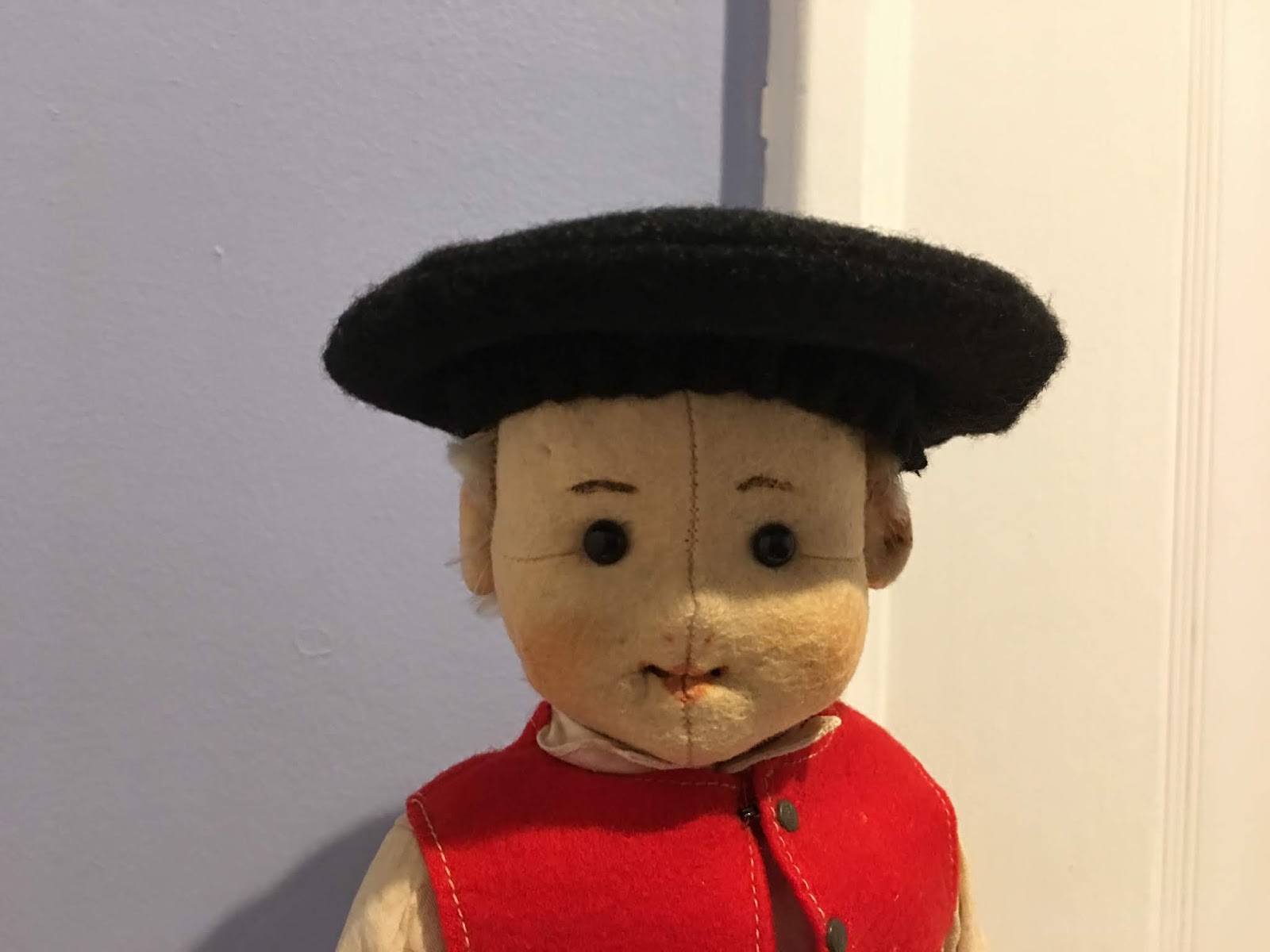
Well hello, handsome! Country life certainly agrees with you. Today's special guest is a delightful example of Steiff's extraordinary, first quarter of the 20th century cloth doll production. Please say hello to Hans, the Swabian farmer.

Hans-down, this is one delightful doll. Hans has human proportions and stands 35 cm tall.  He is made from felt and is fully jointed. His hands have stitched fingers. His face comes to life with a brown mohair wig which has faded to silver over time, black button eyes, a prominent vertical facial seam, light blushing to his cheeks, and two horizontal seams by his eyes. His lips and nostrils are delicately defined by pink paint. Hans wears a traditional southern German (Swabian) farmers outfit, including a red buttoned felt vest detailed with five tiny Steiff buttons, black felt pants, a white cotton collared shirt, black tie shoes and white socks, and a black felt hat. He retains his tiny long trailing "f" button-in-ear as his Steiff ID. Hans was made in 28, 35, 43, 50, 60, and 75 cm from 1908-1927. 

Hans appeared in Steiff's line for nearly two decades - and for good reasons! His charming presentation, regional outfit typical to southern Germany (where the Steiff factory is located), and ties to a popular Brothers Grimm fairy tale probably explain why - but more about that in just a bit! So given his long production period, how can you tell roughly when he might have been made?  Here are a few general guidelines to help approximately date Steiff's center-seamed faced cloth dolls from the early 1900s-late 1920s.

1.  Body: The earliest ones had cartoon-like or exaggerated features; starting around 1908 the company started producing children, adults, and soldiers with human proportions.

2.  Clothing: The earliest ones had clothing mostly or entirely integral to their bodies; starting around 1908 children and adult dolls with removable clothing were introduced on a large scale. Soldiers usually had most or all of their uniforms integral to their bodies.

3.  Eyes: The earliest ones had black shoe button eyes; starting around 1910 or so glass pupil eyes became the norm.

4.  Hands: The earliest ones had "fist" style hands; starting around 1910 or so fingered hands became the norm.

5.  Materials: The earliest dolls were produced in felt and/or velvet. Dolls with felt heads and linen bodies and/or limbs were produced during the WWI era (around 1914-1919). All felt dolls appeared in the line from around 1905-1914 and then again from around 1920 through the late 1920s.

If you overlay these guidelines on the Hans under review today, this model was most likely produced in the c. 1909-1911 time frame, give or take a bit.

Colleagues who study both Steiff and the history of literature suggest that Hans just might be the Hans of the Brothers Grimm "Clever Hans" story. The title of the story is meant to be ironic, as Hans is pretty much the opposite of clever. In a nutshell, Hans is "a day late and a dollar short" on a number of common sense tasks. These mis-steps ultimately result in the loss of his fiance. You can read, or listen to that short tale here. In 1913, Steiff created a print ad titled "Clever Hans" featuring this farmer doll doing something both foolish and endearing at the same time. This marketing piece is featured above; you can click on it to make it larger. The picture is from D. Ayers & D. Harrison's Advertising Art of Steiff, Teddy Bears & Playthings.

Steiffgal hopes you've found this Hans the Farmer quite the charmer!

Have a question about one of your Steiff treasures? Let's talk! Click here to learn more.
The teddy bear search engine