Showing posts with label panda. Show all posts

Monday, December 19, 2022

Tag - You're It - With These Amazing Steiff Rarities From Ladenburger Spielzeugauktion's January, 2023 Sale

Here's something incredibly fantastic to look forward to! Mark your calendars for Ladenburger Spielzeugauktion GmbH's Steiff Special Auction on January 21st, 2023. The catalog has just been published online in German and English. It features nearly 200 breathtaking Steiff, Schuco, and Bing rarities from the collection of the late Susan Kilgore Wiley. Mrs. Wiley had an amazing eye for gorgeous prewar toys. Half of her antique plush collection will be sold as part of this January, 2023 event, and the second half will be offered through Ladenburger Spielzeugauktion at their July 1, 2023 Steiff Special Auction in Giengen, Germany. 

This January sale offers so many WAH-HOO GOOD options, it's almost impossible to pick highlights.
That being the case, let's look at the "cream of the crop" per category over the next few weeks. We'll kick off this auction review here today with a peek at extremely rare items with great ID. 

Size defies with this first January auction highlight. It is lot #6074, a supersized, midcentury Lulac rabbit. His starting bid is 180 €. He is cataloged in part as: 

"Lulac, exceptional size, 80 cm, with button, breast sign and yellow cloth tag label, number is partially illegible, breast sign with stronger kinks, cross-eyed with big glass eyes, jointed arms and legs, small faults in the mouth felt insert, exceptional."

It's not going out on a limb to say how exceptional this rabbit truly is.
 His pattern is in Steiff's beloved "lulac" scale. These legacy items have mile-long limbs and torsos. Lulac animals made their debut in 1952. The first to appear was a 43 cm rabbit. Like the example under discussion here, he was made from caramel mohair and his hands and feet were detailed with especially shaggy mohair. This original lulac rabbit pattern was also produced in 60 cm; the 43 cm version was in the line from 1952-1974, while the larger size made a more limited appearance from 1964-1966. Mrs. Wiley's supersized example has awesome adjustable black and blue glass google eyes retains his button, ear tag, and named chest tag as his Steiff IDs. He is the first of his type Steiffgal has ever seen.

As far as Steiffgal can tell, there is no mention in any of the standard reference books of an 80 cm version of this lulac rabbit. It is possible that he was made in very small quantities as a window display animal. Other early 1950s lulac items included a 35 cm donkey, a 40 cm elephant, a 90 cm tiger, an 80 cm poodle, and an 80 cm lion. All of these models were mohair, fully jointed, and were produced exclusively for the United States market and only for a year or so. Given the proportions of some of those early post war lulac exclusives, it is also possible that this extra large lulac rabbit was made as part of that series, but never went into full production for some reason.

This second auction highlight also doesn't have a hare out of place.
Here we have lot #6004, a prewar bunny named Ossi. His starting bid is 60 €. He is cataloged in part as:
 

"Ossi, wool plush, sitting, with button, block letters, long trailing f, swivel head, white/brown spotted, 16 cm seat height, big glass eyes, with breast sign, red inscription, small mohair loss below the right eye."

It's time to play the name game with this hoppy handful. Ossi was produced in five sizes ranging from 4 to 15 cm from 1938-1943 overall. His design elements, including his wartime era fabric, proportional eyes, and his simple hand embroidered nose and mouth, are typical to the late 1930s production era at Steiff. But what's most interesting about Ossi is that he was the first "named" rabbit produced by Steiff. All others before him were simply called "hase" or "rabbit." What are the odds that this example of Steiff's first named rabbit would retain his his "Ossi" chest tag? Steiffgal had never seen an Ossi before this one  - with or without IDs!

Steiff started to give adorable or endearing names to its standard line items starting in the 1920s.
It was at that time that Molly the Puppy, Fluffy the Cat, Charly the King Charles Spaniel, Jocko the Chimp, and many other legacy named patterns were introduced. But it was not until 1938 - about a decade and a half later - that Steiff gave a playful name to a rabbit in its line. It is possible that "Ossi" is a play on the German word "Ostern" which translates to "Easter." It's also just a very sweet name for a bunny in any language.

And three's a charm when it comes to our third auction highlight in this can't bear to miss sale.
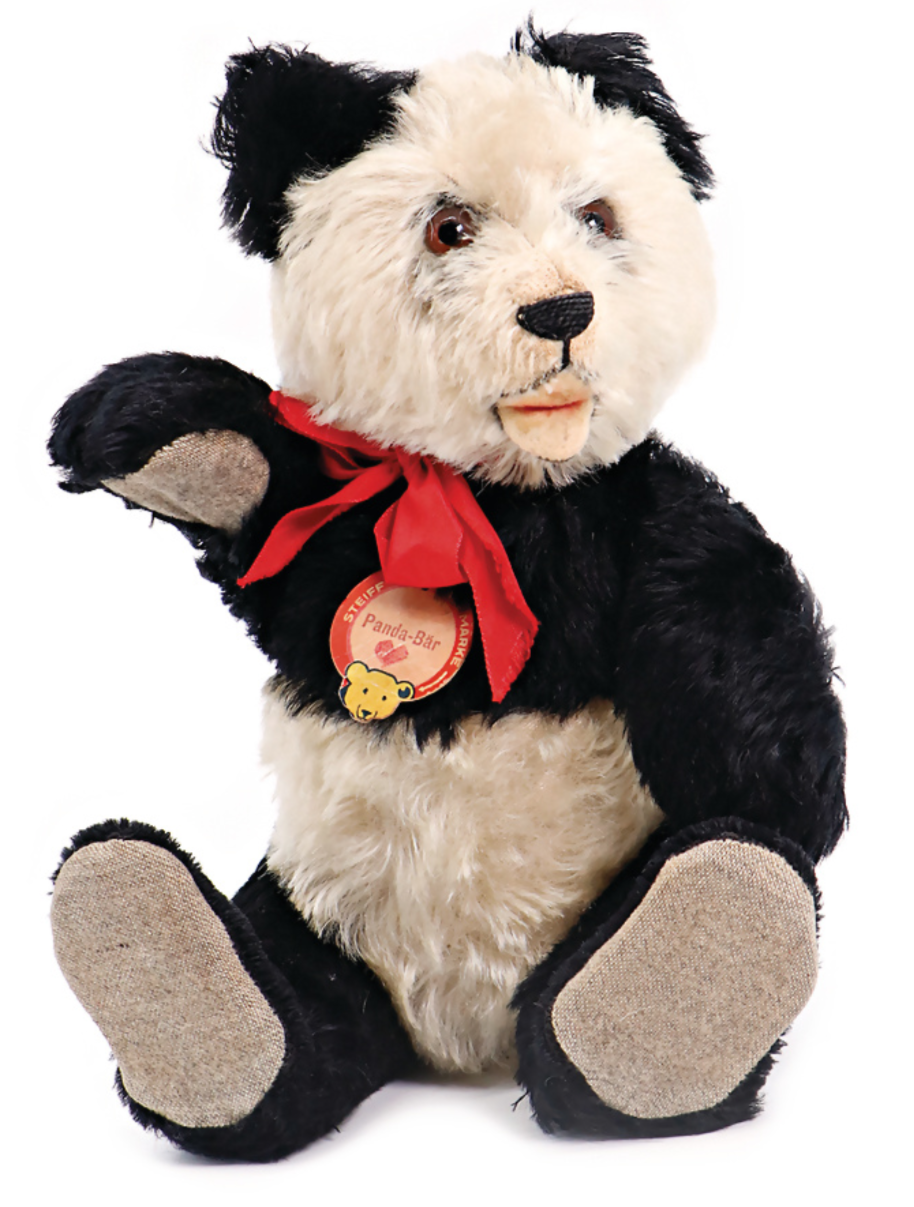
Here we have lot #6045, a precious prewar panda bear. He has an opening bid of 280 €. He is cataloged in part as:

"Panda, with button, long trailing f, writing "Panda-Bär", red with afterwards up-painted heart, mohair-plush, 2-colored, tricot paws, 26 cm, minimally mohair loss around the snout, otherwise very good condition, rare."

Pandas are a great example of Steiff using news headlines and cultural trends for product development ideas. These black and white beauties began appearing "in the flesh" in several major zoos across the globe in the late 1930s. They immediately rocketed to international superstar status. Piggybacking on the success of their real-life cousins, pandas made their debut in the Steiff line in 1938; by 1939, they were being produced in 15 and 30 cm on a commercial scale through 1942 overall. This fantastic example, with his long trailing "f" button and breathtaking named, red imprinted chest tag, is most likely from the earliest part of that time time. 

Steiff's debut pandas were five ways jointed and made from black and white mohair.
Their faces were detailed with brown and black pupil eyes, a black hand embroidered nose, and an small scaled, open, peach colored felt lined mouth. The black circles around their eyes and the black stripe across their backs were created by hand airbrushing. Because of wartime material shortages, some models - like the one under discussion here today - were produced with linen or other alternative fabrics in the place of felt on their hand and foot paw pads.

Steiffgal hopes this discussion on these rare, named Steiff auction lots has bid up your interest in this upcoming sales event!

Sunday, May 16, 2021

This Charming Steiff Panda Bear Is Simply Mid-Century Marvelous!

It was pure panda-monium this week at Steiffgal's home when this latest addition joined her hug! Pandas top many Steiff collector's "love lists" and this sweet girl deserves a crown and throne for many reasons. Check out this black and white beauty and see why she really is mid-century marvelous!

This smiling sweetheart - newly named Princess - is 28 cm, five ways jointed, and made from black and white mohair. Her face is detailed with brown and black pupil eyes, a black hand embroidered nose, and an open, triangular shaped peach felt lined open mouth. The black circles around her eyes are created by hand airbrushing; she also has black airbrushing on her back. Princess' pads are made from grey felt. She proudly dons her original pink silken ribbon. Princess retains her yellow eartag, US Zone tag, and raised script button as her Steiff IDs. 

Now let's take a closer look at Princess' place in the product development timeline.
According to the Sortiment, this pattern was produced in 15, 22, 28, 35, 43, and 50 cm from 1951-1961. Her eartag reads 5328,2. This translates to... 5 = jointed, 3 = mohair, 28 = 28 cm tall, and ,2 = with a voice. This pattern, introduced in 1951, was a modification of Steiff's first panda design which debuted in 1938. Steiff's prewar pandas were produced commercially in 15 and 30 cm, and would go on to appear postwar from 1949-1950 in 30 cm only. Given how Princess has elements of both the debut and updated panda patterns in her presentation, as well as her US Zone tag, it is clear that she was produced as the company was transitioning from one pattern to the other - probably in 1951. 

Despite her 1950s birthdate, Princess has many elements of Steiff's earliest panda cubs - especially from the midsection up.
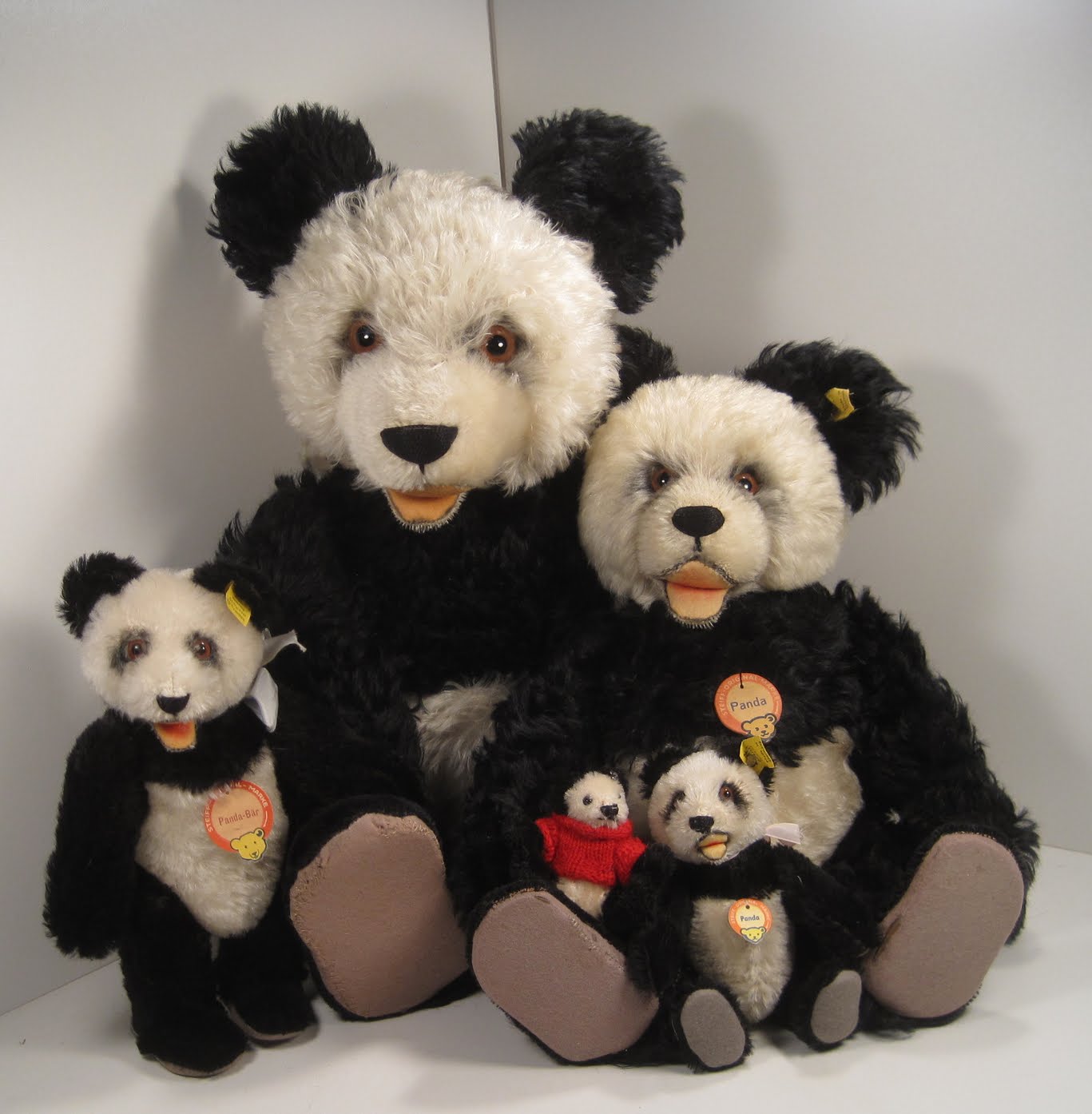
Princess has a broad and triangular mouth; the updated mid-century version has a much smaller, half-oval shaped mouth. Princess has a very round face and muzzle; the updated mid-century one has a more finely contoured head and muzzle. And Princess has her black midsection almost to her mid-torso; the updated mid-century version generally has a much shorter black midsection. Also intriguing is the fact that Princess is technically cataloged at 28 cm, but actually measures 30 cm. And her pre- and very early postwar cousins - who are technically cataloged at 30 cm, actually measure about 26 cm. You can see Princess and her 22 cm updated 1951 postwar panda cousin pictured here on the left for comparison.

Steiff introduced pandas to the world just as they started appearing at zoos across the world in the late 1930s.
These jolly bears immediately rocketed to superstar status. Piggybacking on the success of their real-life cousins, pandas made their debut in the Steiff line in 1938. Because of wartime material shortages, some pandas were produced with linen or other alternative fabrics in the place of felt on their hand and foot paw pads. The success of its first early panda inspired Steiff to produce more pandas in the line as soon as the factory reopened for business in the late 1940s. These early postwar production pandas often had inferior quality felt on their pads as high quality felt materials were still only available in very limited quantities at that time. 

To bring history to life here, check out the two Steiff wartime era pictures above on the left. The one on the left has linen pads and the one on the right has with lesser quality greyish-black felt pads. The one with linen pads has a short trailing "f" button as her ID; the one with greyish-black pads has a raised script button and traces of her US Zone tag as her IDs. 

Steiffgal hopes this discussion on Princess panda has added a touch of royalty to your day.

Have a question about one of your Steiff treasures? Let's talk! Click here to learn more!

Sunday, April 11, 2021

Chilling Out With This Life-sized Steiff Polar Bear

It's white-out conditions - in a very big way - when it comes to this next SteiffLife blog inquiry. Who knew Polar bears roamed Salt Lake? But apparently they do, at least in this lucky collector's home. Greg from Utah writes:

"Dear Steiffgal, 
Greetings from Salt Lake. Please find attached photos of a Polar bear we acquired recently. It is almost 6 feet long and 3 feet tall. We found it in Utah. Do you have any ideas on when it was made, where it came from or if he has a name? Thank you in advance for your help here."


Size certainly defies when it comes to this big boy. Given Greg's note, and the bear’s IDs, materials, and presentation, Steiffgal can confirm that this is a Steiff Studio Polar bear, and that it probably dates from the mid 1970s through the early 1980s. The size certainly confirms its Studio status - meaning that the item is life-sized, or created in pre-historic proportions. As far as Steiffgal can tell, he does not have a "name" other than something descriptive like Studio Standing Polar Bear, so Greg has the opportunity to name him anything he'd like! And, for his origins... it is possible that he made his way from Giengen to an area museum, toy store, or zoo awhile back as a display or window feature. But only the Polar bear knows for sure!


The devil is in the details - and their interpretation - when it comes to dating this polar pal, as Steiffgal was not able to find any specific reference to this design in her reference materials at hand. This bear's materials and detailing are consistent with display sized items of the mid 1970s through the early 1980s, with three factors rising to the tip of the iceberg. 


1. Material. The "heyday" of premier Steiff Studio animal production was in the 1960s, when the company produced many extraordinary, lifesized species in mohair. As this fabric became more expensive in the 1970s onward, the company started transitioning production towards synthetic materials, including long woven fur like this.


2. Facial detailing. Mid-century Studio items also usually had finely executed facial detailing, including elegant and lifeline hand embroidered noses and mouths. This example has a solid black nose which has been inserted into his facial muzzle. This sort of nose treatment - using cloth, faux leather material, or a 3D plastic or rubber version - is seen frequently on items from the third quarter of the 20th century onward. 


3. IDs. The appearance of the item's yellow cloth ear tag and Steiff button is consistent with the time frame under discussion. Throughout the 20th century, it was not unusual for Steiff animals that were not standard line, or that were produced in very small numbers, to have hand-written numbers on their oversized eartags. Steiffgal has several "larger than life" 1950s through 1980s era items with yellow ear tags and hand-written numbers. And for the larger metal script style button - this exact detailing appears on her standing Studio Panda, which was produced most likely in the 1972 through 1980 timeframe.


Steiffgal hopes you found this discussion on this Studio Polar bear a great opportunity to chill out - in the best possible way. 


Have a question about one of your Steiff treasures? Let's talk! Click here to learn more.

Thursday, August 15, 2019

It's Three Of A Kind With These Midcentury Steiff Panda Triplets

The devil - or the discovery - is in the details! And this is especially true when it comes to Steiff's World War II era (c. late 1930's-early 1950's) editions. Patterns that were made throughout these turbulent years often had slight design and/or material changes over time due to supply or manufacturing constraints. These differences are subtle, but extremely interesting as well. Here's one example that is pretty black and white in these regards.

Here we have three Steiff pandas. All are 12 inches tall or 30 cm, 5 ways jointed, and made from black and white mohair. They have small, somewhat triangular shaped open, peach colored felt lined mouths, brown and black pupil eyes, and black, horizontally stitched noses. The black around their eyes, as well as across their back, is airbrushed. Like Steiff's beloved Teddy baby pattern, these also have flat, cardboard lined feet made for standing and downcurved wrists.

This adorable, child-like Panda design was launched in 1938, the same time Pandas made their grand debut at several zoos across the world. Prewar, this perky Panda was made in 15 and 30 cm through 1942. Postwar, this identical Panda design appeared in the line in 30 cm from 1949-1950. In 1951, Steiff updated its Panda design, producing their happy black and white cub in 15, 22, 28, 35, 43, and 50 cm from 1951 through 1961. The new model was produced in larger sizes than previously offered and had a different facial configuration, including a rounder mouth and a fuller, more sculpted muzzle. He had grey felt paw pads from 1951 through 1956 and suede-like grey rubber material paw pads from 1956 onward. The "updated" design from 1951 onward is pictured here on the left for your comparison. 

So now let's jump to some material matters when it comes to this jolly trio of early Steiff Pandas pictured at the top of this post. It's true they could be triplets, sort of. All are the companies pre-1951 pattern. But check out their paw pads and IDs - they are really quite diverse. The one on the far left has thick grey felt pads that have black fibers woven within the fabric. His ID is a raised script button. The one in the middle has linen pads and a short trailing "f" button. And the one on the right has regular grey felt pads and his raised script button and yellow ear tag as his IDs. A close up shot of the unusual grey and black felt pads, and the linen pads, are featured here; you can click on the image to enlarge it.  

So what is their birth order here? 

Hum, well, this will take some sorting out... and not all the dates and time lines align perfectly here. That's pretty standard when it comes to Steiff "mid-century mysteries." 

So, that being said... it is Steiffgal's best guess that the one with the linen pads and long trailing "f" button is the oldest, given his detailing. He might just be prewar, or immediately post war, as you see this linen treatment in items from the 1940s. Next in age - or the "middle child" - is probably the one with the thick grey felt pads and raised script button. His felt is unusual, and a little odd for Steiff production, so Steiffgal suspects Steiff used what felt was available, or on hand, to produce this pattern. And Steiffgal is pretty certain the one with the standard grey felt pads is the "youngest," relatively speaking. His pads closely match the ones used in the 1951 updated Steiff Panda pattern. The photo on the left is from a late 1930s Steiff catalog and shows Steiff's 1938-1950 Panda palling around with dolls and rabbits from the same era.

Steiffgal hopes this discussion on the company's mid-century Panda design has not left you bamboozled. 

Have a question about one of your Steiff treasures? Let's talk! Click here to learn more!

Friday, March 31, 2017

Tag, You're It With These Frozen-In-Time Steiff Treasures


For many collectors, Steiff remains timeless in a fast changing world. Some of us have family heirloom treasures that have been passed down from generation to generation. Others collect vintage pieces that may represent a little piece of childhood, happy memories, or a favorite decade. Given the company's extensive ID system and records, it is pretty easy to date a piece of vintage Steiff. But sometimes, a great vintage item in "tissue new" condition also comes along with a big bonus - its retail price tag from the store that originally sold it. These tags help shed more information on the origins of the piece - and often generate a little nostalgia, too. Here are a few items from Steiffgal's collection with these great original sales tags.

All panda-monium broke out when this sweet cub joined Steiffgal's hug. This of course is Steiff's smallest fully jointed, post war panda. He is 15 cm, made from black and white mohair, and has an open, peach colored velvet lined mouth lined in black. His absolutely irresistible face is detailed with brown and black pupil eyes and a black hand embroidered nose; the black circles around his eyes are airbrushed. He retains his original pink silk ribbon. This particular model was made in 15, 22, 28, 35, 43, and 50 cm from 1951 through 1961. This panda was produced with grey felt paw pads from 1951 through 1956 and suede-like grey rubber material paw pads from 1956 onward. This panda has felt pads, dating it from the early 1950's. 


Panda retains his original white string tag from the high end, national department store Lord and Taylor. This store is still in business, and still sells Steiff items in their larger stores with toy and baby departments. The tag itself has four rows of numbers and codes. The only ones that Steiffgal can decipher is a code the second row - "5315" which matches his ear tag number, "6" on the third row which probably corresponds to 6 inches tall (his height), and 1.95 on the last row, which is most likely his price in dollars. Assuming that he sold in 1951, $1.95 in 1951 had the same buying power as $18.83 in 2017.

Now let's add this fantastic Tabby cat into this meow mix. Here we have Steiff's largest "Tabby" cat. She is 17 cm from head to toe, standing, unjointed, and made from off white mohair. Her back, arms, legs, tail, and the sides of her head are beautifully airbrushed with grey shading and black stripes, making her truly the cats meow! She has black and green plastic slit pupil eyes, a pink hand embroidered nose and mouth, and clear whiskers. She retains her original red ribbon and bell and purple hang tag indicating that her exterior is washable. Tabby was produced from 1949 through 1977 in 7, 10, 14 and 17 cm. This particular example, with her lentil style button and article number 2700/17, was made in the 1969-1977 time frame.

Tabby has her pricetag from Marshall Field and Company, a department store that began in the Chicago, IL area but expanded rapidly to other states in the mid to late 20th century. Steiffgal grew up in the Chicago area, and spent many happy hours in these stores, often nibbling on their legendary "Frango Mint" candies. Sadly, Marshall Field does not exist anymore, having been bought by the Macy's chain in the early 2000's. This tag has three rows of numbers. The only one that Steiffgal can decipher is the last row, being "18.00," most likely her price at the time. Assuming that she sold in 1969, $18.00 in 1969 had the same buying power as $122.42 in 2017.

Given Easter is on the horizon, let's take a look at a fine bunny as our last example of "tag, you're it!" Here we have the smallest example of Steiff's sitting rabbit. She is 8 cm, not jointed, and made from tan mohair that is airbrushed with tan, brown, pink, and black details all over her back, sides, and ears. She has beautiful black and brown pupil eyes, a red hand embroidered nose and mouth, and clear, playful whiskers. She retains her original blue silk ribbon and bell. This particular pattern was produced 8, 9, 15, and 18 cm from 1950 through 1974; she was called Rabbit from 1950 to 1966 and Sonny from 1967 onward. This particular example is numbered 3308,03, dating her in the 1965 to 1967 time frame.

This petite treat has her pricetag from Hahne and Company. Hahne's was a chain of department stores that was based in Newark, NJ and had branches throughout the central and northern parts of the state. The company was purchased by Lord and Taylor in the late 1980's. Rabbit's tag has three lines of numbers and codes. The last one, "3.00," is most likely her price at the time. Assuming she sold in 1965, $3.00 in 1965 had the same buying power as $23.21 in 2017.

Steiffgal hopes this discussion on retail tags on vintage Steiff treasures didn't leave you hanging!

Have a question about one of your Steiff treasures? Let's talk! Click here to learn more.

Sunday, August 7, 2016

Are You A Fan of Dandy Dan?

Ok, Steiffgal is certain this big reveal will result in wide scale panda-monium! Check out this note from a new friend from Ohio who wanted to introduce the Steiff world to a beloved "mohair" member of her family. Over a series of communications, Kristy shares...

"I know there is a special love for Panda Bears so I would like to introduce to you Dandy Dan! We purchased Dandy Dan around 1983 from an antique dealer in Michigan.

It is our understanding through research and documentation that Dandy Dan was a special order for the department store Stix, Baer and Fuller in St. Louis Missouri in the late 1930's. This is around the time the St. Louis Zoo had a few panda bears as well. So the excitement of Pandas was a big thing then as well.

Dandy Dan was signed by Hans Otto Steiff in the later 1980's. He measures 63 inches tall and weighs about 45 lbs."

Bear with Steiffgal a moment as she catches her breath over this remarkable treasure! Yes, indeed, this is an early Steiff display panda.  His pattern and proportions for the most part match the company's original panda designs, which were based on the beloved "Teddy Baby" pattern. These details include an open, smiling mouth; flat feet designed for standing; downturned paws; and a distinctly youthful appearance.  Although it is impossible to tell with 100% certainty without examining him firsthand, it is Steiffgal's best guess that he is head and arm jointed for flexibility in displaying him, but not jointed in the legs for stability.  He is mounted on a support structure that Kristy's family made for him.

Steiff has been designing and producing lifesized special order editions since the turn of last century, so it is not surprising, but totally thrilling, that Dan would make an appearance after all these years.  Exactly dating him is tricky.  Written provenance suggests that he was produced and delivered to Stix, Baer and Fuller (a department store chain in St. Louis, Missouri that operated from 1892 to 1984) in the 1930's.  Two pandas arrived at the St. Louis zoo in 1939, and this news worthy of international headlines at the time. According to the zoo's website...

“When Happy and Pao Pei pandas arrived at the Zoo in 1939, more than 35,000 people greeted them. They were a rare sight indeed. At the time, only three other pandas were on exhibit in the United States. Director George Vierheller called the pandas the greatest attractions the Zoo had had up to that time.”  (Happy and Pao Pei are pictured here on the left.)

It is completely understandable that a major department store in the area would want to share in the excitement (and marketing potential) of the pandas in their city.  And, apparently the department stores in downtown St. Louis had a tradition of outstanding holiday window displays in the mid-20th century.  As such, it is entirely possible that the panda was produced in the late 1930's or early 1940's and delivered to St. Louis at the time for a holiday or general window display.  

It is very interesting to note that 1939 marked the start of WWII.  At that time, Steiff's production was significantly limited, and high end fabrics such as mohair and felt were severely rationed for toy manufacturing purposes.  So it is a bit unusual that the company would make a large, labor intensive specialty that required a great deal of rationed fabrics at the time - and then have the infrastructure to export it to the United States across battle lines.  Given all that, it is also possible that this panda was made and delivered to St. Louis in the mid to late 1940's, once the war was over and Steiff's toy making business was slowly returning to normal.  However, only Dandy Dan knows for sure!

Steiffgal hopes this interesting panda discussion has also made YOU a fan of Dandy Dan!

Have a question about one of your Steiff treasures? Let's talk! Click here to learn more.

Sunday, May 24, 2015

Creating Panda-Monium Over This Most Unusual Steiff Bear

Oh baby! Steiffgal does not mean to pander to you, but how can you resist this utterly charming Steiff cub! Have you ever seen anything quite like him? Check out this black and white beauty and learn what we can piece together about his mysterious origins.

There's nothing not to love about this rare bear. Baby Panda is 80 cm, standing, and unjointed. He is made from long black and white mohair, while his muzzle area is made from shorter white mohair. He has flat, cardboard lined feet and is self-standing. His paw pads are made from trivera velvet material, which has been airbrushed with paw prints. He has four rubber claws on each pad. His face is detailed with black and brown pupil eyes, a black hand embroidered nose and mouth, and black airbrushing around his eyes and on the tip of his mouth. He is simply adorable and has a most toddler-esque look to him.
 

This sweetie absolutely deserves a standing ovation. But who is he, and when was he made? He does not appear in any of the standard Steiff reference books, at least as far as Steiffgal could find.
 

It is Steiffgal's best thinking that this "petite" Panda is a version of the company's early 1970's "Jungbaer" or Bear Cub. This terrific brown plush Ted is pictured to the left for reference. Like Baby Panda, Jungbaer is 80 cm, standing, and unjointed. He also has an insert muzzle area. Jungbaer has the same trivera velvet material paw and rubber claw construction as his Panda cousin; they both share a very similar "look and feel" in terms of their body shape and proportions. Don't the two of them look like they could be friends from kindergarten? Jungbaer was made from 1972 through 1975 in this size only; in 1972 he was sold as a US exclusive. 

Baby Panda also has other family ties. It is entirely possible he is related to another Steiff standout - a full sized adult Studio Panda. A photo of him is shown here on the left. Big boy is 190 cm, standing, unjointed, and made entirely from long shaggy mohair - except for his ears, which are made from black dralon. His face, which is made from slightly shorter white mohair, is detailed with large brown and black pupil eyes and a hand embroidered black nose and mouth. His mouth has a little additional grey airbrushed highlights around his jaw. Panda's foot pads are made from heavy plastic material, while his paw pads are made from trivera velvet material. They are carefully airbrushed with authentic looking hand prints. He has four rubber claws on each of his hands and feet. Panda keeps his standing balance via a metal support stand attached to his backside.  

Like Baby Panda, the origins of Big Panda are not clear. But studying him closely, Steiffgal thinks, given big Panda's size, appearance, and body shape, that he is a modification of Steiff's Studio standing Braunbaer or Brown Bear that was in the line from 1972 through 1980. You can learn more about this big brown buddy by clicking here. 

So what does all this mean in terms of identifying Baby Panda's approximate birthday and evolution?  Well, given his appearance, size, and probable relationship to other documented bears in similar patterns, it is Steiffgal's best estimate that he was made around 1970 or so as an early example or trial of this general cub pattern.  Most likely, his construction (more complicated given two distinct colors) and materials (expensive mohair) deemed him too costly and labor intensive to put into the standard line.  As such, his pattern was converted to a simpler, more economical design by making him one color in less expensive synthetic plush. 

Steiffgal hopes this discussion on this great standing baby bear has added a little Panda-monium to your day.


Have a question about one of your Steiff treasures? Let's talk! Click here to learn more.

Saturday, March 22, 2014

These Unusual Steiff Pandys Are Really Quite Dandy!

Ok, Steiffgal confesses - she is indeed pandering to her reader's love of exotic Steiff collectibles in this week's blog post. Here we have two wonderful critters that sort of look like a mashup between a raccoon, fox, and panda bear! And maybe a little cat in the mix, too...?  But indeed, they do represent a real species - and they were in the Steiff line for a real-ly short time! Can you guess the identity behind these beautiful beasts?  

These standing sweeties are none other than Steiff's Pandy Indischer Pandas or Pandy Indian Pandas. Both are standing on all fours, head jointed, and made from mohair. Their limbs, backs of their ears, and their undercarriages are black. Their backs, faces, and tails are coppery mohair. And their muzzles, inside ears, and "sideburn" areas are tan mohair. Their tails are airbrushed with brown stripes, sort of like a raccoon. Pandy's face is brought to life with brown and black pupil eyes; a black hand embroidered nose and mouth; clear monofilament whiskers; and gentle brown airbrushing for definition. Pandy was produced overall in 10, 17, and 25 cm from 1963 through 1964.  

Pandy was also produced in a 50 cm riding version on wheels in 1963 only. This model is extremely rare; Steiffgal has never seen this "Pandy on the go" in real life.
 

As a footnote, it interesting to note that the 14 and 25 cm Pandys had small felt claws on each of their four limbs. This is a relatively unusual design treatment for Steiff bears. Steiffgal can only think of two other vintage Steiff bear designs with this similar detail, and both are from the same general time frame as Pandy. They include Zooby, the Zoo Bear, who appeared in 28 cm from 1964 through 1966, and a white dralon bear named Cosy Teddy who appeared in 28 cm in 1964 only.  Of course, felt claws can be seen on Steiff's beloved turtles and crocodiles from the late 1950's through 1970's time frame.

So, is an Indian Panda truly a rare bear?  Well, maybe.  This species - which average the size of a large house cat - is extremely hard to classify, and has been thought to be a relative of giant pandas, as well as raccoons.  Today, they are considered members of their own unique family—the Ailuridae.  They are generally nocturnal, spend much of their time in trees, and live in the mountains of Nepal and northern Myanmar (Burma), as well as in central China.  Unfortunately, today Indian pandas are endangered, mostly because of deforestation, as logging and agriculture take over their natural habitat.

Steiffgal hopes this discussion on Steiff's unusual and rare Indian Pandas has been an exotic treat for you.

Have a question about one of your Steiff treasures? Let's talk! Click here to learn more.

Friday, November 16, 2012

Stand and Deliver With This Huge And Unusual Steiff Surprise

Panda-monium has absolutely broken out in Steiffgal's house over the most recent addition to her ever growing hug.  Here's the story of the arrival of a larger than life new Steiff companion worthy of the red carpet treatment!


Good things come in all size packages... and the courier arrives around 10:00am with one extra-large sized delivery!  He personally drove the item from Indiana to Massachusetts, so the two of them got to be good friends crossing the country together. 


The anticipation builds as the surprise makes its way towards the house...


Just bear-ly fitting up the narrow, curved staircase....

At last landing at its final destination, the bedroom (which is in the process of being painted in honor of his arrival.) 


Now for the great unveiling... just what do we have here?  Click on the arrow on the photo above to view the video and find out!


This bit of advice doesn't suck... always thoroughly clean your new Steiff arrivals carefully, including a light vacuuming...


...and a gentle scrub with a white cotton washcloth and a dilute solution of Woolite in warm water. 


So just who is this prehistorically sized panda?  In reality, Steiffgal isn't 100% certain, as she can find no reference to him in any Steiff reference book.  And his previous owners don't know a thing about him either; they found him in a storage bin in Indiana and put him up for auction shortly after.  Here's what we DO know about him:  he's 190 cm, standing, unjointed, and made entirely from long shaggy mohair - except for his ears, which are made from black dralon.  His face, which is made from slightly shorter white mohair, is detailed with large brown and black pupil eyes and a hand embroidered black nose and mouth.  His mouth has a little additional grey airbrushed highlights around his jaw.  Panda's foot pads are made from heavy plastic material, while his paw pads are made from trivera velvet material.  They are carefully airbrushed with authentic looking hand prints.  He has four rubber claws on each of his hands and feet.  Panda keeps his standing balance via a metal support stand attached to his backside. 


It's not so black and white when it comes to identifying a rarity like this.  However, it is Steiffgal's best guess, given panda's size, appearance, and body shape, that he is a modification of Steiff's Studio standing Braunbaer or Brown Bear that was in the line from 1972 through 1980.  Brown bear is pictured above; his full story can be found here. Brown bear is also standing and 190 cm tall.  His body is made from a brown knitted fur material.  His face is made from short tan colored mohair and is detailed with brown and black pupil eyes, a black leather-like nose, and a few airbrushed highlights.  And, like Studio panda, his paw pads are made from a trivera velvet like material, have airbrushed "paw prints" on them, and are complemented by lifelike claws.  Studio Brown bear was made from 1972 through 1980; in 1972 only he was sold exclusively in the United States.


And, just in case you were wondering, ALMOST everyone here was excited to welcome new Studio panda to the hug.  

Steiffgal hopes this unveiling of her Steiff studio panda has been a larger than life experience for you!

Have a question about one of your Steiff treasures? Let's talk! Click here to learn more.  

Sunday, November 11, 2012

A Steiff Love Story In Three Chapters

Is it possible to fall in love over and over again?  Well, when it comes to Steiff, the answer is a resounding YES!  Over the past few months, Steiffgal has been amazingly fortunate to add a few Steiff treasures to her collection that continue to make her heart a-flutter.  Take a look at these Steiff sweethearts and see if you fall victim to love at first sight as well!

Sweetheart #1:
All panda-monium broke out when this huge black and white buddy arrived at Steiffgal's home.  Here we have Steiff's largest sized post war panda, affectionately called "King Panda." Panda is 50 cm, five ways jointed, and made from really thick and long black and white mohair.  The tops of his flat feet are made from shorter black mohair.  Panda's face is detailed with large black and brown pupil eyes, a black hand embroidered nose, and an open, peach colored felt lined mouth.  He truly appears to be smiling! His foot and hand paw pads are made from taupe colored felt.  This pattern was produced in 15, 22, 28, 35, 43, and 50 cm from 1951 thorough 1961; the company used a suede-like grey rubber material instead of felt on this panda’s paws and soles from 1956 onward. This particular example, with a US Zone tag and felt feet, dates from the very early 1950's.  His crown is a gift from a friend from England, who purchased it at the gift shop at Buckingham Palace in London.

King Panda was discovered on eBay with a very reasonable "buy it now" price.  And Steiffgal did... with no regrets whatsoever!

Sweetheart #2:
No clowning around...  nothing wins a woman over more than a sense of humor!  Here we have Steiff's most unusual Larifari Kasperl (clown-like) doll.  Larifari is standing and five ways jointed.  His head and arms are made from rubber while his body and legs are made from felt.  He is handsomely dressed in brown felt boots, tan cotton pants, a white frilly collared shirt, red felt jacket, and green felt hat.  He wears brown leather suspenders and a belt.  Larifari's hair is made from very short grey mohair. His face is simply adorable, and highlighted by big blue eyes and a sheepish smile.  Swoon!  Larifari is based on a German book and movie character created by Ferdinand Diehl, the same creative genius who designed the beloved Micki and Mecki hedgehog characters. Larifari only appeared in the line from 1955 through 1957 and is seldom seen on the secondary market - especially in North America.  

Steiffgal found Larifari at a Boston area doll event.  He was on display with a number of other non-Steiff dolls in the very last booth Steiffgal visited on her way out of the show.  The dealer, who had owned Larifari for close to 50 years, was delighted to learn that he was going to a Steiff loving home. 

Sweethearts #3 and 4:
Oh baby... check out these very early 1950's era Steiff Teddy babies.  Little brother is 22 cm and blonde.  Big brother is 28 cm and brown.  Both are five ways jointed and have distinctive, well defined muzzles; flat, broad, clawed feet made for standing; and sweet, toddler-like features including open, smiling, peach colored felt lined mouths.  Post war, Steiff produced their beloved Teddy baby pattern in blonde or brown mohair in 9, 22, 28, 30, and 40 cm in the identical pattern made before the war. All sizes over 9 cm came with a leather collar with a bell.  Teddy Baby remained in the Steiff line until 1957, although due to his popularity with collectors, has been replicated many times in numerous limited edition series.

Steiffgal purchased these brothers from a collector who was moving and downsizing her collection.   Steiffgal was delighted to make it a family affair and adopt the duo.

Steiffgal hopes this love story helps to fan your flames of passion for this delightful brand!  

Have a question about one of your Steiff treasures? Let's talk! Click here to learn more. 

Friday, July 20, 2012

An International Steiff Unboxing Celebration!

Everyone loves a surprise package - especially when the contents are most certainly made by Steiff!  Steiffgal recently had the pleasure of receiving a big brown shipping box full of goodies from overseas.  Take a look here to witness firsthand the "unboxing" of several "button-in-ear" treasures... which is YOUR favorite?


It's easy to see why the first item could cause "panda" - monium with some collectors.  Here we have Steiff's beloved 35 cm five ways jointed early postwar panda.  This particular model was made in 15, 22, 28, 35, 43, and 50 cm from 1951 through 1961. He is made from black and white mohair and has an open, peach colored felt lined mouth.  His face is detailed with brown and black pupil eyes and a black hand embroidered nose; the black circles around his eyes are airbrushed.  It is interesting to note that with this particular model, the 15 cm sizes have a black mohair upper back area; sizes larger than 15 cm have upper back areas that are made from white mohair that are airbrushed black.  Additionally, this panda was produced with grey felt paw pads from 1951 through 1956 and suede-like grey rubber material paw pads from 1956 onward.  This particular panda, with his felt feet, was produced in the earlier part of the production time frame. 

Hopefully you listened closely to the description of the second "unboxing" treasure.  This is a 25 cm version of Nipper, the Elektrola Fox, one of the early logos behind the media company now known as RCA. Nipper was produced by Steiff in 12, 17, 25 centimeters from 1968 through 1974. He was also made in a rare 45-cm display size studio piece in 1968 only.  This precious pooch is sitting and unjointed. His body is made from white dralon which is punctuated with a few brown and black spots. His ears are brown mohair; one is supposed to be down while the other is playfully and purposefully pointing upward.  His face is detailed with large black and brown pupil eyes and a sweet black hand embroidered nose and mouth.  His head is tilted off slightly to the side, as if he is listening to something... yes, that would be "his master's voice!" 

Although Nipper as a logo debuted more than 100 years ago, and is only used today as part of the marketing behind HMV stores in Europe and the UK, this cute canine is almost universally recognized and is considered to be one of the top 10 famous brands of the 20th century. 

The third treasure in this unboxing adventure is certainly a charmer.  Of course, here we have a precious and toddler-esque proportioned 50 cm Steiff Zotty.  Zotty was one of the first new bear designs introduced after the Second World War, in 1951. He has appeared in the line, in one form or another, almost continuously since then. The early 1950's were an amazingly busy time at Steiff, as the company looked to rebuild its pre-war reputation for quality, while at the same time introduce new, innovative, contemporary designs to an expanding global marketplace. Zotty’s debut was one of the most significant efforts towards those goals. The original, mid-century Zotty was primarily made from brown tipped mohair and was five-ways jointed. He was produced in nine sizes, ranging from 17 through 100 centimeters. To “qualify” as a Zotty, a Steiff Teddy bears needed these three things: an open felt lined mouth; a front insert bib made of a complementary colored mohair to his body; and of course, be made from very shaggy material.

Zotty was an overnight success, and became an extremely popular Teddy bear amongst European youngsters from the mid 1950s onward. His design and endearing facial expression proved irresistible and comforting; many European toy manufacturers introduced copycat Zotty-looking Teddy bears as a result of his sales success. As Zotty’s popularity grew, so did his range in the Steiff line. Steiff seized on his appeal and created him in many forms over the next 20 years, including a sleeping animal, a playful floor friend, a pajama bag, and a long legged lulac animal, called Zolac, among other items. In 1960, a white mohair version in 28 and 35 cm was introduced, but only stayed in the line for one year. 

Steiffgal hopes you have been able to contain yourself in regards to this international "unboxing" celebration. 

Have a question about one of your Steiff treasures? Let's talk! Click here to learn more 
The teddy bear search engine