Showing posts with label lulac. Show all posts

Sunday, February 12, 2023

Going Out On A Limb Over This Extraordinary Midcentury Steiff Lion

If this isn't the mane event, Steiffgal is not sure what is! To make a long story short, look who popped over for a visit... a supersized Steiff lion with mile long legs. Just who is this tall drink of water? Check out his story right here!

Steiffgal's not lyin' when she says this guy is wah-hoo good.
This supersized lion is 80 cm tall, fully jointed, and made from blonde mohair. He has oversized brown and black glass pupil eyes, a prominent pink hand embroidered nose, a black embroidered mouth and painted freckles, and clear mono-filament whiskers. He has a white mohair chin. His mane is made from very long, brown tipped mohair; the same mohair details the tip of his tail. Steiffgal thinks this particular lion has a delightful, innocent "toddler" look to him. He was made in 1958 only as an exclusive for the United States. Other extra-large (80+ cm) long and leggy exclusives of this period also included a 90 cm tiger and a 80 cm grey poodle.

This lovely lion is a rare example of Steiff's beloved and legacy lulac style design.
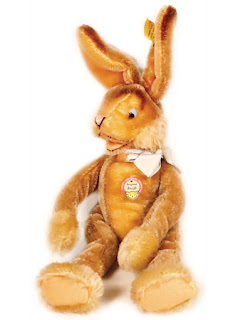
Steiff's lulacs all have comically long arms, legs, and torsos. They are long and lanky, usually fully jointed, and have a very playful air about them. It is interesting to note that the German verb “to laugh” is lachen, and the word for smile is lächeln, perhaps suggesting that this style was designed to have a comical appearance and to bring a smile to the face of the owner. The original Steiff lulac animal was a rabbit, which debuted in the line in 1952. He was made in 43 cm through 1974, and in 60 cm from 1964-1966. Due to the success of this beautiful bunny, Steiff quickly followed with several additional lulac animal patterns, including dogs, cats, donkeys, zebras, bears, and others. Steiff's rare and goofy 40 cm black mohair lulac tomcat, made from 1964-1966, is pictured below. 

The lulac lion under discussion here today was designed and produced at a most creative period at Steiff - the mid 1950s through the mid 1960s.
It was during this time that the company made a number of unique, well designed products for their United States customers, as well as distributors at the time - Reeves International and Loucap. Other noteworthy US editions of that era were the company's dinosaur range, basset hounds, animal head trophies, and school and institutional mascots. These items, made in relatively small numbers for a short period of time, seem to always catch the eye - and pocketbooks - of collectors worldwide.

Steiffgal hopes this discussion on this fabulous lulac lion has given you a leg up on your day.

Have a question about one of your Steiff treasures? Let's talk! Click here to learn more.

Monday, December 19, 2022

Tag - You're It - With These Amazing Steiff Rarities From Ladenburger Spielzeugauktion's January, 2023 Sale

Here's something incredibly fantastic to look forward to! Mark your calendars for Ladenburger Spielzeugauktion GmbH's Steiff Special Auction on January 21st, 2023. The catalog has just been published online in German and English. It features nearly 200 breathtaking Steiff, Schuco, and Bing rarities from the collection of the late Susan Kilgore Wiley. Mrs. Wiley had an amazing eye for gorgeous prewar toys. Half of her antique plush collection will be sold as part of this January, 2023 event, and the second half will be offered through Ladenburger Spielzeugauktion at their July 1, 2023 Steiff Special Auction in Giengen, Germany. 

This January sale offers so many WAH-HOO GOOD options, it's almost impossible to pick highlights.
That being the case, let's look at the "cream of the crop" per category over the next few weeks. We'll kick off this auction review here today with a peek at extremely rare items with great ID. 

Size defies with this first January auction highlight. It is lot #6074, a supersized, midcentury Lulac rabbit. His starting bid is 180 €. He is cataloged in part as: 

"Lulac, exceptional size, 80 cm, with button, breast sign and yellow cloth tag label, number is partially illegible, breast sign with stronger kinks, cross-eyed with big glass eyes, jointed arms and legs, small faults in the mouth felt insert, exceptional."

It's not going out on a limb to say how exceptional this rabbit truly is.
 His pattern is in Steiff's beloved "lulac" scale. These legacy items have mile-long limbs and torsos. Lulac animals made their debut in 1952. The first to appear was a 43 cm rabbit. Like the example under discussion here, he was made from caramel mohair and his hands and feet were detailed with especially shaggy mohair. This original lulac rabbit pattern was also produced in 60 cm; the 43 cm version was in the line from 1952-1974, while the larger size made a more limited appearance from 1964-1966. Mrs. Wiley's supersized example has awesome adjustable black and blue glass google eyes retains his button, ear tag, and named chest tag as his Steiff IDs. He is the first of his type Steiffgal has ever seen.

As far as Steiffgal can tell, there is no mention in any of the standard reference books of an 80 cm version of this lulac rabbit. It is possible that he was made in very small quantities as a window display animal. Other early 1950s lulac items included a 35 cm donkey, a 40 cm elephant, a 90 cm tiger, an 80 cm poodle, and an 80 cm lion. All of these models were mohair, fully jointed, and were produced exclusively for the United States market and only for a year or so. Given the proportions of some of those early post war lulac exclusives, it is also possible that this extra large lulac rabbit was made as part of that series, but never went into full production for some reason.

This second auction highlight also doesn't have a hare out of place.
Here we have lot #6004, a prewar bunny named Ossi. His starting bid is 60 €. He is cataloged in part as:
 

"Ossi, wool plush, sitting, with button, block letters, long trailing f, swivel head, white/brown spotted, 16 cm seat height, big glass eyes, with breast sign, red inscription, small mohair loss below the right eye."

It's time to play the name game with this hoppy handful. Ossi was produced in five sizes ranging from 4 to 15 cm from 1938-1943 overall. His design elements, including his wartime era fabric, proportional eyes, and his simple hand embroidered nose and mouth, are typical to the late 1930s production era at Steiff. But what's most interesting about Ossi is that he was the first "named" rabbit produced by Steiff. All others before him were simply called "hase" or "rabbit." What are the odds that this example of Steiff's first named rabbit would retain his his "Ossi" chest tag? Steiffgal had never seen an Ossi before this one  - with or without IDs!

Steiff started to give adorable or endearing names to its standard line items starting in the 1920s.
It was at that time that Molly the Puppy, Fluffy the Cat, Charly the King Charles Spaniel, Jocko the Chimp, and many other legacy named patterns were introduced. But it was not until 1938 - about a decade and a half later - that Steiff gave a playful name to a rabbit in its line. It is possible that "Ossi" is a play on the German word "Ostern" which translates to "Easter." It's also just a very sweet name for a bunny in any language.

And three's a charm when it comes to our third auction highlight in this can't bear to miss sale.
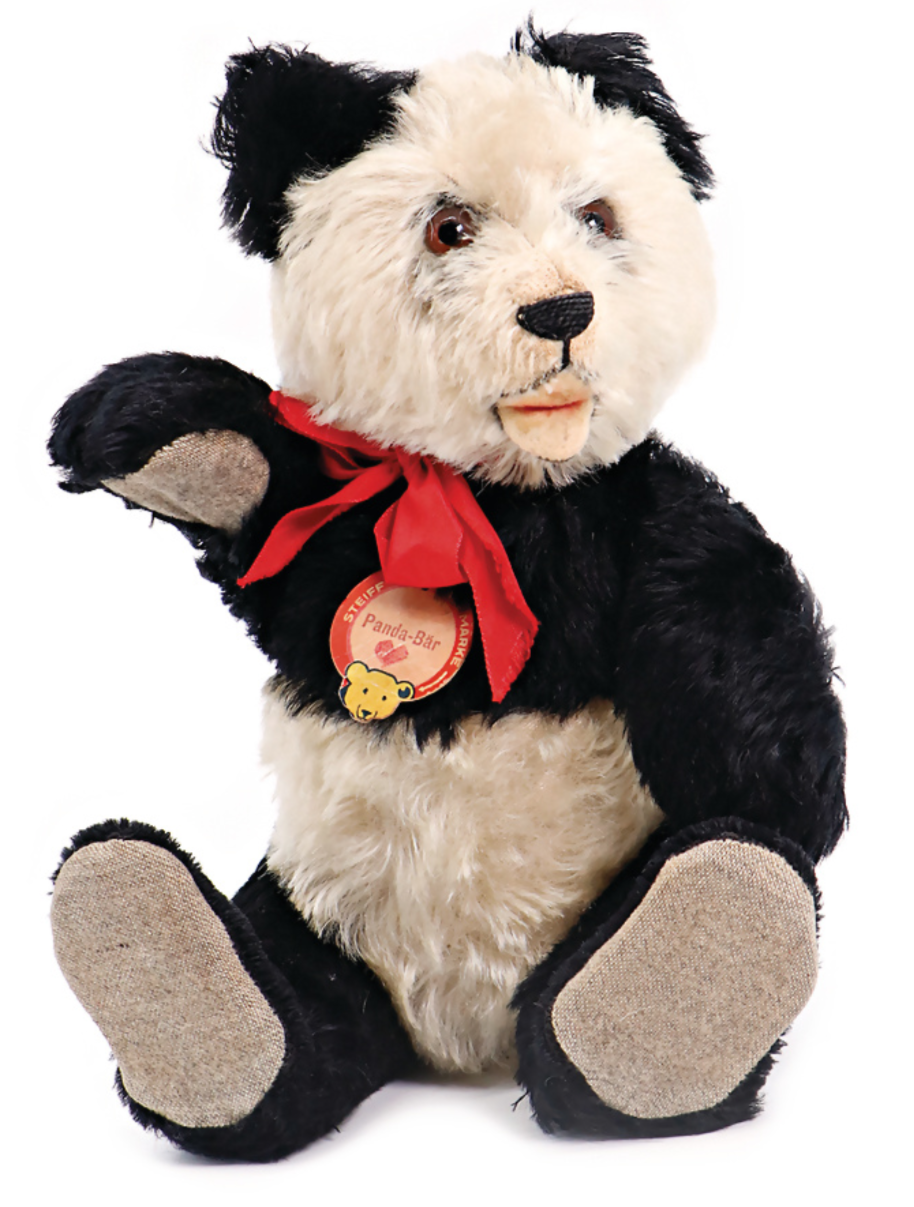
Here we have lot #6045, a precious prewar panda bear. He has an opening bid of 280 €. He is cataloged in part as:

"Panda, with button, long trailing f, writing "Panda-Bär", red with afterwards up-painted heart, mohair-plush, 2-colored, tricot paws, 26 cm, minimally mohair loss around the snout, otherwise very good condition, rare."

Pandas are a great example of Steiff using news headlines and cultural trends for product development ideas. These black and white beauties began appearing "in the flesh" in several major zoos across the globe in the late 1930s. They immediately rocketed to international superstar status. Piggybacking on the success of their real-life cousins, pandas made their debut in the Steiff line in 1938; by 1939, they were being produced in 15 and 30 cm on a commercial scale through 1942 overall. This fantastic example, with his long trailing "f" button and breathtaking named, red imprinted chest tag, is most likely from the earliest part of that time time. 

Steiff's debut pandas were five ways jointed and made from black and white mohair.
Their faces were detailed with brown and black pupil eyes, a black hand embroidered nose, and an small scaled, open, peach colored felt lined mouth. The black circles around their eyes and the black stripe across their backs were created by hand airbrushing. Because of wartime material shortages, some models - like the one under discussion here today - were produced with linen or other alternative fabrics in the place of felt on their hand and foot paw pads.

Steiffgal hopes this discussion on these rare, named Steiff auction lots has bid up your interest in this upcoming sales event!

Sunday, May 1, 2022

There's No Need To Make A Long Story Short Over This Rare Steiff Rabbit!

Talk about a hare-raising find! A Steiff-loving friend from Europe has just added a super-sized rabbit to their hug, but wants to learn more about it. There's no tall tales when it comes to this distinctive and legacy Steiff design! Bojan from Serbia shares, 

"This time I got this long-legged rabbit, which I got by exchanging for one little Steiff pig. Unfortunately, his left foot is damaged, so if you can give me some advice, what should I do, fix it if possible, or leave him like this? He is filled with some solid material, he is fully jointed and the dimensions (standing) from the top of the head to toe are 50 cm (with raised ears 60 cm). I would say that the button is made of nickel and has a diameter of 8mm. His fur is made of mohair. His eye color is a combination of blue and black and he has an open mouth."


This long and lanky fellow is Steiff's fun and hard to find dangling lulac rabbit in the largest standard size made. This model technically is cataloged at 60 cm tall, is five ways jointed, and is made from caramel and light orange mohair. His hands and feet are made from shaggy mohair. His mouth is open and lined in peach colored felt; his pink nose is hand embroidered. He has blue and black google eyes. These can be twisted and turned about to give the rabbit's face comical expressions. This large sized lulac hare was in the line from 1964-66. Although lulac rabbits are of interest to collectors, this big guy is highly sought after due to his short time in the line. Also charming, but more common, is the smaller version of this fun bun who was made in 43 cm from 1952-74.

Most collectors are familiar with Steiff’s cartoonish “lulac” creatures. These are animals like Bojan's rabbit with exaggeratedly long limbs and torsos. The name "lulac" probably came about through the combination of the German words for laughter, smiling, and lanky - suggesting that this unconventional design was designed to have a goofy appearance and to bring a smile to the face of the owner. You can see one of the rarest midcentury lulac style animals in the form of a zebra here on the left. He is 30 cm tall, made from mohair, and is unjointed. Although the history of this particular black and white beauty is not entirely known, it has been suggested that he was produced as an exclusive for the upscale toy retailer F.A.O. Schwarz in the mid-1950s. The photo is from Steiffgal's personal collection. 

Now let's talk about the big bunny's foot issue; he seems to have lost most of his felt pad over time.
Given the rarity of this item, and how much Bojan clearly likes it, it would be Steiffgal's recommendation to have the pad repaired. For the most part, this fix is pretty simple and not terribly expensive in the hands of a skilled restorer. Sometimes it is challenging to find felt that closely matches the original fabric for the patch given how natural and organic materials age and fade over time. It is just really important that all restoration work is documented, and communicated to potential future buyers, as "all original condition" is important to some collectors. 

Steiffgal hopes this discussion on Bojan's big bunny has been a good learning "hop"-portunity for you!

Have a question about one of your Steiff treasures? Let's talk! Click here to learn more. 

Monday, January 3, 2022

Taking A Joyride With This Midcentury Steiff Car Display

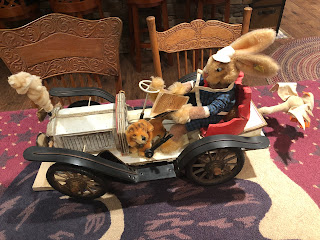
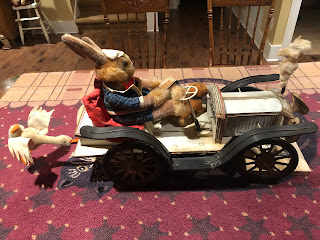
So let's kick off 2022 in fifth gear! It's always so much fun to learn about unusual Steiff display pieces, and this one will make you want to hit the road for sure. What secrets do its design elements hold? Check out this note and photos from Susie in Ohio. She shares, 

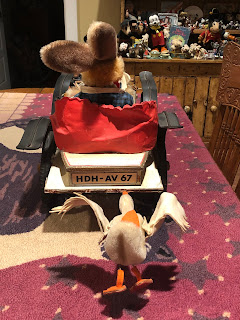
"This is a wonderful Steiff display piece I own that I call "Distracted Driving!" It has a Lulac, a Cockie, and a Tulla Goose. When you push the car, the goose wings flap up and down and the cotton smoke stack in the front rotates. It is in pretty great condition although some of it is made from rubber and has become slightly brittle. This does not distract from its irresistible charm. I honestly think this display should be in a museum somewhere!"

A joy ride indeed!
Steiff's tradition of creating still and animated displays goes back to the dawn of the 20th century. These first, early vignettes reflected things like life in a small town, farming, schoolrooms, or sports, among others. In some cases, these were photographed for advertising purposes, while in others, the scenes were actually sold as a package to stores as displays. It wouldn't be long before Steiff's creative team brought these scenes to the next level with movement; in about 1910 the company launched the large-scale, mechanized window display pieces that it would continue to produce throughout the 20th century. Albert Schlopsnies, a design and creative freelancer for the company, is responsible for many of Steiff's most breathtaking museum, retail, exhibit, and special event displays through the mid-1920s. 

Now let's take a closer look at Susie's display.
 
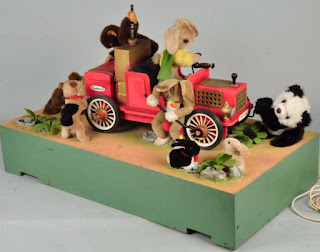
Its passengers include two standard line items and one modified standard line item. Given its form, materials, and detailing, it is Steiffgal's best guess that this display was made sometime in the c. 1955-1965 timeframe. Steiff used the "old jalopy" car concept in its automaton production frequently throughout the third quarter of the 20th century. Here on the left you can see a similarly themed display from the late 1970s or so; the photo is from LiveAuctioneers/Morphy Auctions. 

Taking the wheel of this display is Steiff's legacy Lulac rabbit.
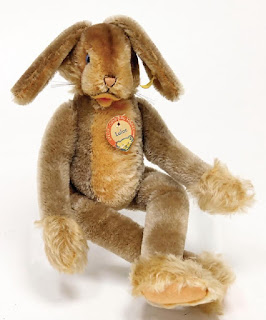
This long legged lovely was produced in 43 cm from 1952-74 and 60 cm from 1964-66. Given the scale of display, it is Steiffgal's best guess that this is the smaller version. He is five ways jointed, features comically long arms, legs, and torso, and is made from made from caramel and light orange mohair. His paws are made from longer, shaggy mohair. His face comes to life with an open, peach felt mouth, a pink embroidered nose edged in black, and blue and black googly style eyes. It is possible that his name derives from a combination of the German words associated with laughter, smiling, and a "long and lanky" presentation. You can see Lulac here on the left, the photo is from Liveauctioneers/Ladenburger Spielzeugauktion GmbH.

Lulac's wingman is a standing Bazi dog.
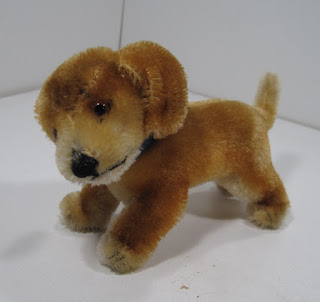
He is made from short tan colored mohair that is accentuated with darker airbrushed highlights on his back, chest, and head. Bazi's face is detailed with black and brown pupil eyes and a hand embroidered nose and mouth. Bazi left the factory in Giengen wearing a blue leather collar with a little brass bell. The standing mohair version of Bazi was produced in 10 and 14 cm from 1950 through 1975. Given the presentation of the display, it is Steiffgal's best guess that this is the 10 cm version. You can see standing Bazi here on the left, the photo is from Steiffgal's collection. 

At the tail end of all of this - and yes, pun intended - looks to be a little Tulla goose, sort of. 
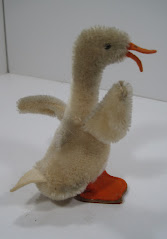
Regular line Tullas are standing, unjointed, and made entirely from white mohair with grey airbrushed highlights, especially on their heads and necks. They feature playful, outstretched mohair wings, oversized orange felt feet, and a thin, happy orange felt beak which really looks like a smile! Their back tail feathers are made from a solid piece of single thick white felt, and their faces are detailed with tiny black button eyes. Tulla goose was made from 1952 through 1974 in 12, 17, and 28 cm. You can see Steiff's 12 cm standard line Tulla goose here on the left, the photo is from Steiffgal's collection.

If you look closely at the goose on this display, you will notice that she has a few small design details that are different than her standard line cousins.
First, her tail is made from orange felt, not white felt. Second, her wings are made from white felt, not white mohair. And finally, her orange beak is much larger and more prominent than the standard line version's beak. It is entirely possible that these simple modifications were made so the goose would have the physical structure, critical mass, and flexibility to hold her position on the display, as well as flap her wings when activated.

Steiffgal hopes this discussion on Susie's animated Steiff automobile display has been the real-wheel-deal for you!

Have a question about one of your Steiff treasures? Let's talk! Click here to learn more.

Friday, October 22, 2021

One-derful Highlights From Ladenburger Spielzeugauktion November 6th Auction!

The countdown continues towards November 6, 2021 for Ladenburger Spielzeugauktion GmbH's Special Steiff Auction! This amazing sale, offers 367 OFF THE CHARTS vintage button-in-ear temptations. It's so hard to pick highlights here as practically every lot qualifies as a headliner. Steiffgal offered her top Teddy Baby selections a few days ago; now here are her WAH-HOO good favorites. To qualify for today's elite list, these items (as far as Steiffgal can tell) were not produced on a commercial scale and/or have not appeared in any standard Steiff reference book, such as the Sortiment tomes. So here we go!

There's no monkeying around when it comes to lot #3967, a Steiff monkey made from paper plush.
The cataloging for this item is: "paper monkey, probably produced from 1919-1920, exceptional monkey, in paper plush substitute, wood pulp plush, jointed, with small button, block letters, long stretched F, glass eyes, seat height 18 cm, used condition, exceptional, extremely rare." The presale estimate for this little guy is €220-€440.

There are many things that make this five ways jointed chimp such a champ. His design, scale, and presentation are really appealing. But of course, you can't help but notice his "unconventional" construction of paper plush and linen. Steiffgal has seen, or has known about, a few paper plush Teddy bears. But nothing like this monkey, ever!

During and immediately following the First World War, Steiff was unable to procure adequate supplies of high end fabrics.
Mohair and felt manufacturing had decreased, and the materials produced were allocated towards military purposes. In order to continue some production, Steiff was forced to come up with some alternative products, as well as materials. Given the abundance of wood in the area, the company started producing things like building sets and furniture for children. Steiff also found a way to produce a tweed-like material from local natural products. This "paper plush" was made from nettles and called "Brennessel." Paper plush items appeared in the line from 1919 through 1921, and included popular models of the company's standard line bears, dogs, cats, and rabbits... and apparently this monkey, too!

Next, size defies with this teeny tiny Lulac rabbit, lot #3993.
This is kind of an oxymoron here, as Lulacs are famous for their size and cartoonishly long limbs. He is cataloged as: "Lulac, '60s, with button, chest label and cloth tag label, number on cloth tag label 1322,00, without damage, this size couldn't be found in the STEIFF-catalog, it is probably a sample item." His presale estimate is €250-€500.

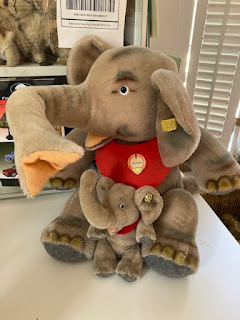
It's difficult to tell just from the photo here, but this guy is like an extra from the movie "Honey I Shrunk The Kids!" This bitty bunny really is only a petite 22 cm tall, measured vertically from the top of his head to his toes. As noted, he probably was a small scaled sample of a popular pattern of the time - created as a possible product line extension. And there is precedent for this; Steifgall has a 15 cm version of Steiff's sitting Jumbo elephant which appeared in the line from 1952-1975. Jumbo was produced commercially at 22 and 35 cm. You can see this little guy along with his 35 cm mama below.

Steiff's wonderful five ways jointed Lulac rabbits debuted in 1952.
It is Steiffgal's best thinking that their name derives from the German verb “to laugh” which is lachen, and the word "smile" which is lächeln. Lulacs are famous for their comically long arms, legs and torsos, goofy eyes, and playful personalities. Standard line Lulac rabbits were produced in produced in 43 cm from 1952-74 and 60 cm from 1964-66. So this 22 cm version is one rare rabbit indeed.

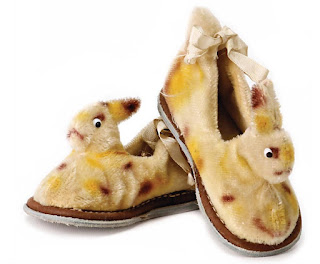
And finally, this last auction rarity is certainly a shoe-in for WAH-HOO good status. Check out lot #4318, a pair of fancy mohair kicks for kids. They are noted as, "exceptional children's hares shoes, probably '50s, very nice, strong colors, sole is 16.5 cm long, unused condition, rare, collection Koskinen." They carry a presale estimate of €120-€240. 

These shoes are worthy of walking the red carpet. And Steiffgal so wishes they were made in her size! They feature a rabbit design which is somewhat like Steiff's lying rabbit pattern. This little cutie is known for her stretched out body position and black and white google eyes. These often have the appearance of giving a side glancing "stink eye." Lying Rabbit was made in 6, 9, and 12 cm from 1953 through 1970.

Steiff's tradition of creating innovative product line extension items goes back to the turn of last century. The company has a long history of creating unusual novelties based on their most popular designs of the time. These things include purses, puppets, tea cosies, roly polys, tail moves head items, music boxes, and other functional and/or fun treasures.

It is entirely possible that someone at Steiff made these shoes as an experiment, for fun, or as simply an end of day or whimsy item - perhaps as a birthday or even Easter gift for a child or grandchild. It is also possible, given that the rabbit pattern's detailing is not exactly identical to Steiff, that they don't seem to have any IDs, and the painting and detailing of them is so unusual to Steiff, that they were made by another very high quality manufacturer also producing really appealing midcentury novelties. For example, the company Felpa Zurich MUTZLI created a series of children's hangers; they were covered in mohair and featured the face of a soft mohair Teddy bear or other animal. Only the shoes know for sure - and it is clear they are keeping their origins deep within their sole!

Steiffgal hopes this discussion on these WAH-HOO good auction picks has totally energized your day!

Have a question about one of your Steiff treasures? Let's talk! Click here to learn more!

Saturday, January 23, 2021

Tuning Into This Rare And Unusual Musical Steiff Santa Claus Doll

Does this great Steiff Santa doll strike a chord with you? Check out this unusual holiday hero with a very special feature - he's musical! Have you ever seen another one like it? A friend from Pennsylvania shares... 

We bought this 15" Steiff with a music box key wind in the sack. The music box is in the sack attached to his back with a large key protruding from it. I would love to know anything you can tell me about it. Thank you!


Well, let's warm things up with what we know about this friend from the North Pole. The doll itself is based on the company's legacy midcentury Santa doll pattern introduced in 1953. This earliest Santa doll was 31 cm and five-ways jointed. He had a rubber head, felt body, bright red felt suit and cap trimmed in white mohair, and a white, fluffy mohair beard. By 1955, this design was also produced in 13 and 18 cm. These Santa dolls appeared in the line through 1963 and were, and remain, year-round favorites with collectors worldwide. The Santa under discussion today measures 15" tall, or 38 cm, so he was probably not part of Steiff's standard line Santa production. His larger size suggests he was a special order, perhaps intended as a seasonal window or mantel display. 

Now let's tune into his musical feature. With full disclosure that Steiffgal has not handled this item in person and inspected for originality, she can suggest two possible origins for his music box.  

First: Given that the music box is located in his sack, and not in his torso, it is possible that it is not Steiff original to him and was placed there by a previous owner.
 The music box is described as having "a large key." Every wind up music box Steiffgal has handled has a very small, simple turning knob. It's size hints that the music box may not be Steiff original to him. Just about every musical Steiff item Steiffgal can think of from any era has its musical feature embedded in its body - probably to secure it in place, as well as to protect it against bangs and bumps. For example, the musical Basi pictured to the left has her music feature in her bottle shaped body; it is activated by pressing her up and down. As Steiff's midcentury Santa dolls were not distributed with a Santa sack, it wouldn't be that challenging to make one, put a wind up music box in it, and sew it to the doll's body. That would be MUCH easier than opening up the doll, removing stuffing, inserting a music box, and sewing everything up seamlessly. 

Second: It is also possible that the musical feature is all original to the doll.
Most Steiff collectors are familiar with the company's standard line musical Cockie Cocker Spaniel, Teddy Bear, and cat patterns. These were all produced in the mid to late 1950s. However, Steiff also produced a number of other uncatalogued musical rarities based on beloved 1950s era designs, including their Lulac rabbit and lying tiger. "Music Tiger" is pictured here on the left. Given the timeline and popularity of the 38 cm doll design under discussion here, it is not out of the question that the company tried to make a musical Santa Claus doll, too; maybe even in a distinctly larger size. Perhaps the musical machinery was too large or strangely shaped to bury it in the doll's torso so the designers made a sack for him, and hid the music box within it. If the Santa sack is elegantly constructed from period fabric, matches the look and feel of the doll, and has aged in tandem with the rest of the overall doll and clothing, this would suggest that is factory original to the doll. But, in the end, only Santa knows for sure... and he's keeping tight lipped over this!

Steiffgal hopes this discussion of this musical Santa Claus has wound up your interest in this unusual doll. 

Have a question about one of your Steiff treasures? Let's talk! Click here to learn more.

Friday, February 8, 2019

Getting A Leg Up On This Midcentury Steiff Mystery!

This inquiry from a new friend is simply ele-phantastic! Kati has something very special in her collection, but one that so far has defied identification.  Let's take a look at her note and use our grey matter to figure out what this mystery item just might be! 

Kati shares,

"I have a very unusual Steiff that I am having a hard time identifying. Not sure if you can point me in the right direction. I am not in anyway wanting an appraisal but just a little bit more information on the piece. I have searched EVERYWHERE and have not been able to come up with anything. 

It is an elephant with a Steiff tag and he has extremely long legs. The number on his tag is 7330. He measures 12.5” inches tall and 12” from trunk to tail. His legs alone are 7.5” tall. He has wood tusks and a red felt bib/collar. 

I am hoping you either know a little about him or can point me in the direction to a site or someone who might. Thanks for your time!"

There's no junk in the trunk when it comes to this absolute rarity. What we have here is Steiff's wonderful and seldom seen Lulac elephant. He is as Kati describes above; his delightful details include a jointed head; a smiling, open, felt lined mouth; and playful black and white google eyes. His upturned trunk is a sign of good luck, too. "Lulac" refers to his goofy, exaggerated form consisting of really long arms and legs. Other Lulac style animals produced at or around the same period include a Zotty bear, rabbit, Cocker Spaniel, donkey, zebra, tiger, lion, and poodle. This particular Lulac elephant was made as an exclusive for the United States market in this size only in 1958.

If you look hard enough, you can find jumbo clues about a Steiff treasure by examining its small details. In this case, check out what Kati says about his ear tag. The code on it reads 7730. According to Steiff reference materials, this corresponds to... 7 = in caricature, 3 = mohair, and 30 = 30 cm tall. But these numbers don't shed any light on how unusual this pattern truly is. To put things in context, the only other example Steiffgal has even come across was one at auction in 2010 at Christies. You can see that auction listing by clicking here.

Now for that "elephant in the room" question that everyone undoubtedly has on their minds about now. How does this great item value in today's marketplace? As always, something is worth what someone will pay for it, and Steiffgal has not seen the item firsthand to inspect for condition. Many critical condition items, like dry rot, odors, insect damage, etc., do not show up on photos, and that's why it is essential to see an item firsthand to give it a fair review. Given the Lulac elephant is as described and as presented, with no essential structural or aesthetic issues, it is Steiffgal's best guess sight unseen that this item may sell on an online channel or auction in the c. $1,000-2,000 range.


Steiffgal hopes that you found this discussion on Kati's elephant absolutely unforgettable.


Have a question about one of your Steiff treasures? Let's talk! Click here to learn more.

Monday, February 22, 2016

Fun Finds And Unusual Rarities At The Upcoming March 2016 Teddy Dorado Auction!

Continuing on with our focus on upcoming Steiff sales events, Steiffgal is thrilled to present the Steiff community with highlights from the upcoming Teddy Dorado auction.  This can't miss event will be held on March 5th, 2016 in Germany.  One thing Steiffgal particularly loves about Teddy Dorado is the company's ability to find and sell the most interesting rarities and one of a kind Steiff finds.  Here are three great highlight items from this sale that really caught her eye.  

Please take a leap of faith with Steiffgal on this first Teddy Dorado auction highlight. Here we have lot 17-1705, a 60 cm "Schlenker frog" or dangling frog. He is cataloged as...

"From about 1981, with all IDs and article number 2380/60. Made from green and orange trevira velvet. Large, yellow and black eyes, open mouth. Posable with wire reinforced limbs. Firmly stuffed with poly fiberfill, no voice. With yellow Steiff flag in the left foot and chest tag. Not seen in any catalog or publication. Clean, non-faded, no odors, top condition. Standing about 83 cm tall and sitting about 42 cm tall."

It's easy being green when it comes to this giant uncataloged frog! His size and presentation are truly impressive. His wonderful long arms and legs are perfect proportions for a "lulac" style animal. And who wouldn't want a "one of a kind" Steiff treasure such as this one? It is Steiffgal's best guess that this happy hopper may have been made as a special feature for a customized window display, or that he was a sample of an idea that never made it into full production. It is also possible that his design was based on an "uber" vision of the company's 32 cm standard line Cappy Dangling Frog. Cappy is also lulac styled with long arms and legs which are lined in wire so he can be posed. Cappy was in the Steiff line from 1979 through 1984. He is pictured here on the left for comparison. 

This second auction highlight will bug some readers, but there is a good reason for his selection.  Please check out lot 17-1608,  a cosy fly.  Yes, a fly.  He is cataloged as...

"A 20 cm Cosy Flappy fly made in 1994 with all IDs and additional hang tags.  The article number is 099588. He is unjointed and in top condition.  He is made from russet fleece, black woven fur, white fur, and blue trevira velvet that has a honeycomb print on it.  Detailed with black cord on the face.  Softly stuffed with poly fiberfill.  About 10 cm tall and 20 cm long."

No need to wing it here... this little guy is one big Steiff deal!  Believe it or not, this funky fly, despite his relative newness, is on the wish list of many collectors due to his rarity and strangeness.  Back in 2009, Steiffgal awarded this pattern the grand prize winner of a Steiff "What Were They Thinking" contest - a countdown of Steiffgal's top choices for the oddest Steiff designs.  Flappy was only produced in 1994 and came in five colors: red, yellow, green, blue, and brown. This model is the brown model. Steiffgal has the green version, he is pictured here on the left.  Steiffgal once gave a red Flappy to a friend as a birthday gift; in disbelief he exclaimed that the fly would forever be his favorite Steiff collectible of all time.

Size defies with today's third auction highlight.  Here we have lot 17-5003, a little hedgehog clip.  He is cataloged as...

"A 6 cm tip clip premium hedgehog made in 1979-1985.  The article number is 1671/06. Made as a brooch or decoration.  The face, ears, ears, and underside are made of brown trevira velvet.  He has black plastic eyes and a black glass bead nose.  The clip is on his back. He has a special yellow and green Steiff linen tag imprinted with his article number and "FFSPN - Fédération Française of the Societes de protection de la nature."  It is very clean and in top condition.  He measures approximately 6 cm long and 4.5 cm wide."

There's no need to hedge any bets here that this baby hedgehog is a "customer special" for The National Society of Nature Protection, a French nonprofit which "aims to implement educational activities and nature protection in France but also in the world." This sweet treat is based on Steiff's standard line 6 cm Joggi Igel or Joggi Hedgehog. Joggi was manufactured in 6, 10, and 17 cm from 1966 through 2002. The original 6 cm Joggi is pictured here on the left. 

A customer special is an item that is embellished with an unusual custom ribbon, a felt accessory, a unique tag, or other small differentiators. In the case of this hedgehog, the standard yellow and black tag was replaced with a green and white tag, and a clip was added. In the past, Steiff did not necessarily separately catalog customer specials. These finds are exciting, as well as frustrating, to collectors, who always want to know the full story behind unusual Steiff items. It is Steiffgal's best guess that this item was produced for NSNP as a gift for the organization's staff, donors, or volunteers; made as a give-away for a trade show or conference; or was available for purchase directly from NSNP to help support the organization.  NSNP's current logo is here on the left.  It is interesting to note it now features a ladybug... which would also make for a great Steiff customer special pin!

Steiffgal hopes this review of some of these hot lots available at the upcoming Teddy Dorado sale has given you auction fever!  You can view the entire auction catalog by clicking here. 

Have a question about one of your Steiff treasures? Let's talk! Click here to learn more!

Saturday, September 27, 2014

Cataloging What Makes Steiff's 1970's-era Playthings So Distinctive

A picture is worth a thousand words! And this is especially true when it comes to Steiff, and their marvelous catalogs over the years. These great time-capsules really capture the essence of the brand from decade to decade - in terms of key styles, proportions, fabrics, and designs. When giving a talk on the history of Steiff and the company's product design evolution, Steiffgal often refers to the 1970's (in the most loving way) as the "ugly decade." By this, she means that for the most part, item designed in this time frame have a goofy, nontraditional look about them. Let's look at the items on this cover of a 1971 Steiff catalog and see if you agree, too!

Before we start, it is important to note that this particular catalog cover from 1971 features both legacy and "new to the 1970's" items. Today, Steiff, or really any other company, only features the newest, latest, and greatest items on the cover of any printed materials. In terms of "vintage" items, collectors will surely recognize Zotty, the gymnastics ball, the Lulac style rabbit, the lying tiger, the Jumbo elephant, and the woolen miniature ladybug as beloved items first introduced in the 1950's - or even earlier! These items are made from high quality mohair and have a very youthful, energetic, and "here for the long run" feeling to them - sort of the opposite of the vibe of 1970's items.   

So are you "red"-dy to dive right into the 1970's now? Then let's check out the 70's pieces in above, from left to right. No monkeying around here - the cheerful chimp is Steiff's "Weich-Schimpanse" or soft chimpanzee. He is standing and unjointed. He is made from brown dralon - a very common synthetic material used by Steiff in the 1970's and '80's - and has red overalls. His face, hands, and ears are made from peach colored synthetic velour, another material typical to Steiff for the period. Chimp has a sweet and playful face, highlighted by oversized white and black cartoon-style eyes. He is stuffed with foam chips and is fully washable. He was produced in 30 and 40 cm from 1971-1982 overall.  In addition to his chest tag, button, and yellow ear tag, this chimp - and other foam stuffed, washable dralon items - would have left the factory with an additional silver hang tag, which read, "form formgeschaumt" with the Steiff logo. You can see this on the chimp if you look closely; a sample of this tag is pictured here on the left. (Is it Steiffgal's imagination or does the bear faced logo look uncharacteristically unhappy here?) 

Let's now check out Steiff's "Buzzel Hen," just to the right of the chimp. Hen is 19 cm, unjointed, and sitting on a flat bottom. Like her chimp neighbor, she is made of dralon, stuffed with foam, and is fully washable. Her feathers, beak, face, and comb are made from yellow, red, and white felt. She has a squeaker in her base. She was made in this size only from 1971-1974.

Bird is also the word with the adjacent pair of featured feathered friends. Here we have Steiff's well attired Cosy Duck Boy and Cosy Duck Maid. Both are 25 cm, standing, unjointed, and made from white dralon. Their beaks and webbed feet are orange synthetic velour. Both have airbrushed highlighting on their faces. The boy dons a dapper blue tam-o-shanter and a matching blue sailor collar. The girl is adorable in her green felt hat. They are stuffed with foam and are fully washable. Boy and Girl Duck were both produced in 25 cm only from 1970-1973. 

It's easy to see things in black and white with this next 1970's feature. Here we have Steiff's 17 cm Pinni penguin. He is standing, unjointed, and made from black and white dralon materials. He has a chubby, orange beak and feet, as well as oversized black and white cartoon style eyes. He was made in this size only from 1971-1974.

Can you feel the "buzz" from the last two 1970's cover stars on the far right of the catalog cover? If you guessed that these, like the hen, are also buzzel items, then give yourself a high five! The bunny is Steiff's Buzzel Rabbit. He is made from tan and white dralon and has a face that sort of reminds Steiffgal of Steiff's Pummy Rabbit. The rooster is Steiff's Buzzel Rooster; he is pictured here on the left. He is made from orange and black dralon. He has a yellow felt beak, and a red felt waddle and comb. His tail feathers are made from green felt. He is a very simplified version of the company's legacy mohair and felt rooster model. Both are 20 cm, sit upon a flat bottom, have a squeaker, are stuffed with soft foam, and are fully washable. The rooster was made from 1971-1976; the rabbit from 1971-1978.

When it comes to Steiff, it goes without saying that "the more, the merrier!" In addition to the Buzzel collectibles noted above, the company also produced a Buzzel Cat and a Buzzel Santa, which did not make it into this cover shot. Both are pictured here on the left. The cat is made from grey and white dralon and has a pink hand embroidered nose, clear monofilament whiskers, and adorable green and black slit pupil eyes. Santa is made from red and white dralon material and felt, with a full long white dralon beard. His face is precious and simple; he has small blue felt eyes, a round peach colored felt nose, and a tiny red circle for his lips. Santa is wearing his traditional Santa suit which is integral to his body. He carries a brown Santa sack, which has a little bell in it. Both are 20 cm with typical "Buzzel" construction and features. Cat was made from 1971-1975; Santa from 1972-1974.

Steiffgal hopes this discussion of vintage Steiff treasures from the early 1970's has been a great blast from the past for you.

Have a question about one of your Steiff treasures? Let's talk! Click here to learn more.

Saturday, September 14, 2013

Seeing Stripes Over This Zany Steiff Zebra

My, oh my, what a wonderful day 
Plenty of sunshine headin' my way 
Zip-a-dee-doo-dah, zip-a-dee-ay"

Steiffgal couldn't help but break into song - that wonderful Academy Award winning Disney tune from "Song of the South" - when she was introduced to this week's blog feature item.  After all, it is possible that this happy fellow just might be the zenith of early post war Steiff items.  No other rarity from this era can match the zip and zeal of this black and white beauty.   Take a look and zee - I mean see -  for yourself!

This tall drink of water is Steiff''s Lulac zebra.  Lulac style animals have comically long arms, legs, and torsos, and are usually very playful and goofy looking.  This zany Lulac zebra is 30 cm tall and unjointed.  He is made from tan mohair which has been stenciled with black stripes all over his body.  His paw pads are made from black felt, and his tail is made from white felt which has also been airbrushed with stripes.  The tip of his tail is finished with a tuft of long black mohair.  Zebra has a tan and black bristle-style mane.  The insides of his ears are airbrushed in pink and grey.  His face is detailed with black and brown pupil eyes, longer fur around his sideburn areas and forehead, and a smiling, peach felt lined open mouth.  He is complete with his raised script Steiff button, yellow ear tag, and large, colorful bear faced chest tag.

This jungle jem is really rare; so rare that little is known about him.  It is not really even clear what his name is, or might be (Zelac, maybe?) or when he was made.  Steiffgal was not able to find out any more information on him in any of the standard Steiff reference books.  However, he comes with two small clues about his identity.  The first is his yellow ear tag, which has the numbers 7330 on it.  This corresponds to... 7 = in caricature, 3 = mohair, and 30 = 30 cm tall.  The second is his complete set of IDs, its configuration dates him in the early 1950's through late 1960's.  What is striking about him, however, are his physical and structural similarities to another rare and beloved Steiff Lulac character, the Lulac Esel or Lulac donkey, which was a USA exclusive in 1954 only.  Lulac donkey and Lulac zebra are pictured here on the left.  This beloved barnyard buddy is documented at 35 cm and looks almost identical to his zebra cousin, except for a few design details:
  • Lulac zebra is black and white striped while Lulac donkey is shades of grey
  • Lulac zebra has black and brown pupil eyes while Lulac donkey has shiny black button eyes
  • Lulac zebra's ears face outward while Lulac donkey's ears face inward  
It is also interesting to note that even though Lulac donkey is cataloged at 35 cm, he is in reality 30 cm tall, identical to Lulac zebra.

So what's the story behind Lulac zebra?  Well, Steiffgal can't find anything definitive in writing about him, so here are her best thoughts, based on the little that can deduced and some circumstantial evidence.  First of all, Steiffgal has seen one or two other Lulac zebras over the decade, so a few were made; this is not a "one of a kind" rarity.  And, given how close he is in design, look, and feel to Lulac donkey, Lulac zebra was most likely produced at the same time (1954, plus or minus a year or two) as Lulac donkey.  Steiffgal does know with certainty that Lulac zebra was purchased in the mid to late 1950's at FAO Schwarz in New York.  So net net, it is Steiffgal's best guesstimate that Lulac zebra is either a poorly documented United States or FAO Schwarz exclusive edition that was produced in exceedingly small numbers in the mid 1950's.  

Steiffgal hopes this introduction to Steiff's Lulac zebra has been quite "zee" exclusive experience for you!

Have a question about one of your Steiff treasures? Let's talk! Click here to learn more.   
The teddy bear search engine